Fibers and Castor Oil-based Polyurethane Resin
*e-mail: [email protected], [email protected]
Production and Characterization of MDF Using Eucalyptus
Fibers and Castor Oil-based Polyurethane Resin
Cristiane Inácio de Camposa*, Francisco Antonio Rocco Lahrb*
aMaterials Science and Engineering, University of São Paulo - USP,
Av. Trabalhador Sãocarlense, 400,13566-590 São Carlos - SP, Brazil bDepartment of Structural Engineering, São Carlos School of Engineering - EESC,
University of São Paulo - USP,
Av. Trabalhador Sãocarlense, 400, 13566-590 São Carlos - SP, Brazil
Received: September 11, 2003; Revised: May 3, 2004
The growing popularity of wooden panels renders this market segment increasingly competi-tive. MDF (Medium Density Fiberboard), in particular, is widely employed for a variety of appli-cations, including civil construction, furniture, and packaging. This paper discusses a study of MDF produced from alternative raw materials, i.e., Eucalyptus fibers and castor-oil-based poly-urethane resin. Physical and mechanical tests were performed to determine the MDF’s modulus of elasticity and modulus of rupture in static bending tests, its swelling, water absorption, moisture and density. The results of the physical and mechanical characterization of this laboratory-pro-duced MDF are discussed and compared with the Euro MDF Board standard. MDF prolaboratory-pro-duced with eucalyptus fiber and castor-oil-based polyurethane resin presents results very satisfactory.
Keywords:MDF, wooden panels, derived products
1. Introduction
Wood-based products offer an interesting alternative to expand the range of materials for use in civil construction, cabinetmaking and other industries. Brazil is a potentially important worldwide producer/supplier of general purpose boards and possesses state-of-the-art technology to produce reconstituted wood products.
The total production of wood-based products shows a steady annual growth, and new types of panels which, until recently, had been produced only in Europe and the U.S. are now beginning to be manufactured in Brazil. This grow-ing production is attributed to the increasgrow-ing use of boards in some industrial sectors, e.g., cabinetmaking, civil con-struction, packaging, etc.
Although Brazil’s share in the production and consump-tion of wooden panels was not significant in the past, this situation has been changing in recent years owing to new investments in board production units, especially particleboards and MDF. Both domestically and internation-ally, the production and use of general purpose boards will continue to grow at higher rates than other wood products. Panel production will continue to belong to the current major
producers for some time to come, but the growth of panel production in developing countries will ensue from several factors, among them the availability of raw material in suit-able quantities and quality, the competitiveness resulting from lower operational costs, and the opening up of new markets.
Brazil’s prospects for becoming a major manufacturer of particleboard are excellent, with reconstituted wood pan-els, today represented by MDF and more recently by OSB, promising to change the profile of internal consumption.
Holokiz1 successfully proved, in the laboratory, that eu-calyptus fibers used in the composition of MDF confer greater modulus of rupture (MOR) on boards, and slightly lower values of water absorption and swelling in thickness properties.
Some authors argue that the use of Eucalyptus in the manufacture of reconstituted wood boards involves diffi-culties in terms of gluing, because the density of eucalyptus is higher than that of conifers, resulting in boards with low perpendicular tensile strength. However, other authors have demonstrated excellent mechanical properties for boards made of certain Eucalyptus species. Those studies indicate that there is still no consensus about the properties of boards produced from different species of Eucalyptus and the per-centage of adhesive employed. Therefore, this study aims to help clarify the use of eucalyptus species in the produc-tion of boards, specifically in the manufacture of MDF, by varying the resin content.
MDF is normally produced using urea formaldehyde-based adhesive. However, in our search for new adhesives and resins for the manufacture of boards, we have employed an alternative, castor-oil-based polyurethane resin to pro-duce MDF in the laboratory.
Using a natural and renewable resource, it is possible to synthesize polyols and prepolymers having different char-acteristics originating from the castor-oil plant which, when mixed, produce a polyurethane. Castor-oil-based poly-urethane is competitive in comparison to other polymers because, in addition to its main mechanical properties, it derives from a low-cost natural and renewable raw mate-rial. Furthermore, it is flexible, rigid, and possesses mo-lecular interchains and intercross strength conferred by the balancing of the chemical characteristics of the polyol in combination with the prepolymer.
Mixing polyol and castor-oil-based prepolymer causes the mixture to become polymerized. This polymerization re-action leads to the formation of polyurethane, in which the percentage of polyol may vary to produce greater or lesser hardness, and the use of a catalyzer can accelerate curing of the reaction. The adhesive used here was donated by KHEL Indústria Química, located in São Carlos, SP, Brazil, which pledged to provide further details about the adhesive and its advantages in working with wood and its by-products.
2. Methodology
The industrial dry process was used to produce the MDF in the laboratory. The eucalyptus fiber for the MDF was supplied by DURATEX Madeira Industrializada S.A. and, in collaboration with this research, KHEL Indústria Química donated the castor-oil-based polyurethane resin. 1500 g lots of fiber with 3% moisture content were used for the labora-tory scale production of MDF. After being weighed, the fiber was placed in the upper part of a motor-driven gluer ma-chine with a rotation rate of up to 120 rpm. The mama-chine was closed, the motor activated and, with the blades rotat-ing, the glue was added under high pressure to pulverize the resin for optimal distribution. After the fiber and glue
were properly mixed, the mixture was transferred to an-other container to smooth out the lumps.
The material was then placed in a molding box. After deposition of the fibers, the material (air mattress) was com-pacted in a pre-press under a load of approximately 800 N, which corresponds to the pre-pressing stage without heat transfer. The purpose of pre-pressing is to reduce the vol-ume of the mattress to be placed in the press.
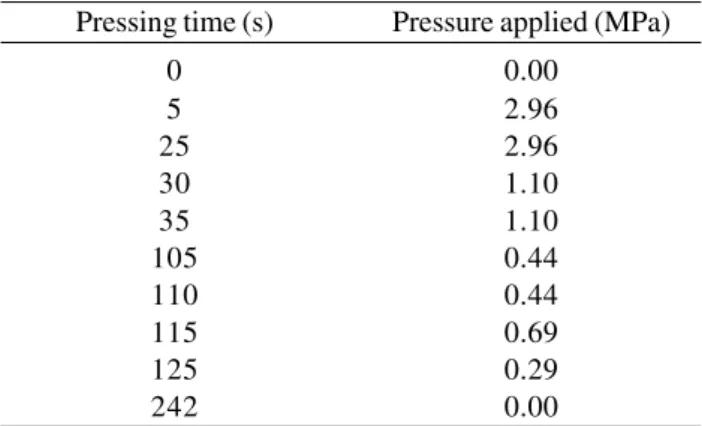
The pre-pressing procedure was following by pressing in a hydraulic press heated electrically to a temperature of about 160 °C. The pressure applied was adapted to the press-ing cycle proposed by Neves3.
Table 1 indicates the cycle, in which the pressure varies from 0 to 3 MPa. In this work, the pressure on the sheet was determined by 1 cm thick limiters.
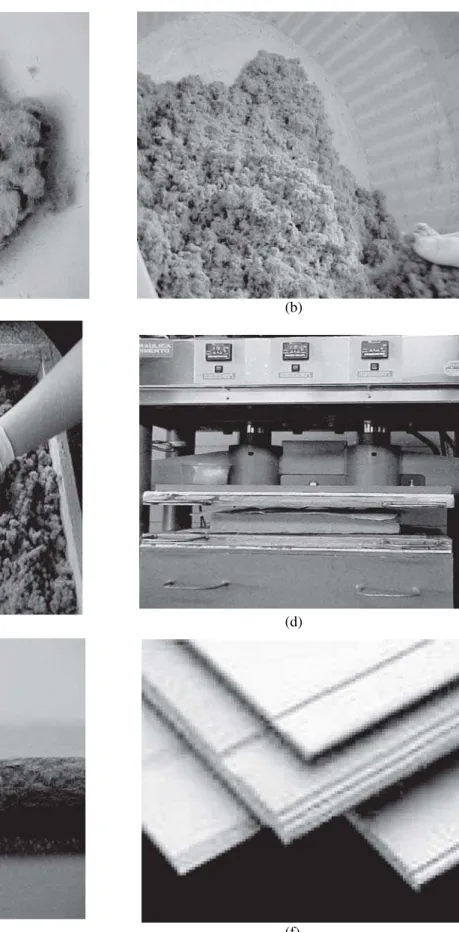
Starting from the fiber, the sheets were produced in the following sequence: drying of the fibers; preparation of the adhesive; mixing of the adhesive with the fibers in the mixer; dissolution of the lumps; preparation and formation of the mattress; cold pre-pressing; hot pressing; cutting and accli-matization of the sheets.
Figure 1 illustrates the MDF manufacturing sequence in the laboratory: a) fibers ready to be placed in the mixer; b) material from the mixer, composed of wood fibers, resin, catalyzer and water; c) dissolution of lumps in the mixture of the panel’s constituents; d) placement of the mattress in the thermo-mechanical press; e) sheet removed from the press immediately following pressing; and f) sheet ready for use.
Following the manufacturing process, the sheets were acclimatized at a temperature of about 25 °C for 48 h, after which test specimens were prepared for physical and me-chanical tests performed according to the EUROCODE (EC), whose results are listed below:
• Density (EC 323)4; • Moisture (EC 322)5;
• Swelling in thickness (EC 317)6; • Absorption (EC 317) 6;
• Flexural strength (EC 310) 7.
Table 1. Pressing cycle in MDF production.
Pressing time (s) Pressure applied (MPa)
Fibers and Castor Oil-based Polyurethane Resin
(a) (b)
(c) (d)
(e) (f)
3. Results
Shown below are the results of the density, moisture, swelling in thickness, absorption and static flexure tests obtained for the panels produced with polyurethane resin and Eucalyptus grandis fibers. The results of the density
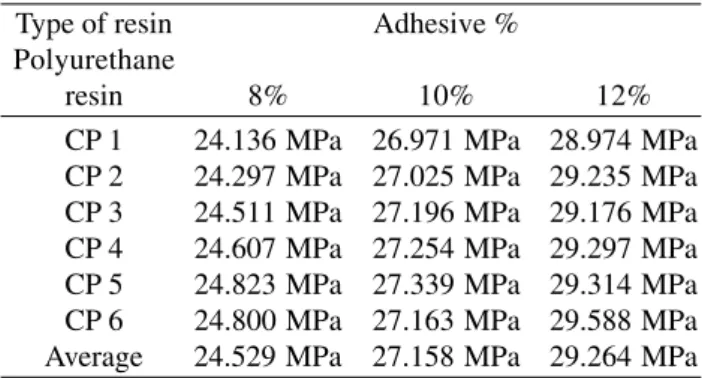
test are shown in Table 2, moisture in Table 3, swelling in thickness in Table 4, absorption in Table 5, static flexure to determine the MOE in Table 6, and static bending to deter-mine the MOR in Table 7.
3.1. Results of the test to determine density
Table 2. Values of density for the eucalyptus sheets produced with polyurethane resin.
Type of resin % Adhesive
Polyurethane resin 8% 10% 12%
CP 1 698 g/cm3 724 g/cm3 761 g/cm3
CP 2 702 g/cm3 726 g/cm3 764 g/cm3
CP 3 700 g/cm3 729 g/cm3 767 g/cm3
CP 4 705 g/cm3 730 g/cm3 769 g/cm3
CP 5 703 g/cm3 731 g/cm3 770 g/cm3
CP 6 698 g/cm3 722 g/cm3 765 g/cm3
Average 701 g/cm3 727 g/cm3 766 g/cm3
3.2. Results of the test to determine moisture
Table 3. Values of moisture for the eucalyptus sheets produced with polyurethane resin.
Type of resin % Adhesive
Polyurethane resin 8% 10% 12%
CP 1 5.0% 5.0% 4.3%
CP 2 5.4% 4.9% 4.2%
CP 3 5.6% 5.1% 5.3%
CP 4 5.9% 5.4% 4.7%
CP 5 6.1% 5.3% 4.9%
CP 6 5.0% 5.5% 4.8%
Average 5.5% 5.2% 4.7%
3.3. Results of the test to determine swelling in thickness
Table 4. Values of swelling in thickness for the eucalyptus sheets produced with polyurethane resin.
Type of resin % Adhesive
Polyurethane resin 8% 10% 12%
CP 1 14% 10% 7%
CP 2 14% 12% 9%
CP 3 18% 10% 10%
CP 4 17% 14% 11%
CP 5 15% 16% 13%
CP 6 18% 16% 10%
Average 16% 13% 10%
3.4. Results of the absorption test
Table 5. Values of absorption for the eucalyptus sheets produced with polyurethane resin.
Type of resin % Adhesive
Polyurethane resin 8% 10% 12%
CP 1 35.4% 32.1% 27.4%
CP 2 35.1% 32.0% 27.7%
CP 3 35.7% 32.4% 28.1%
CP 4 35.9% 32.6% 28.0%
CP 5 35.8% 32.3% 27.7%
CP 6 35.1% 32.4% 28.5%
Average 35.5% 32.3% 27.9%
3.5. Results of the static bending test
Table 6. Values of MOE for the eucalyptus sheets produced with polyurethane resin.
Type of resin Adhesive %
Polyurethane
resin 8% 10% 12%
CP 1 24.136 MPa 26.971 MPa 28.974 MPa
CP 2 24.297 MPa 27.025 MPa 29.235 MPa
CP 3 24.511 MPa 27.196 MPa 29.176 MPa
CP 4 24.607 MPa 27.254 MPa 29.297 MPa
CP 5 24.823 MPa 27.339 MPa 29.314 MPa
CP 6 24.800 MPa 27.163 MPa 29.588 MPa
Average 24.529 MPa 27.158 MPa 29.264 MPa
Table 7. Values of MOR for the eucalyptus sheets produced with polyurethane resin.
Type of resin Adhesive %
Polyurethane resin 8% 10% 12%
CP 1 231 MPa 260 MPa 278 MPa
CP 2 230 MPa 263 MPa 280 MPa
CP 3 234 MPa 262 MPa 284 MPa
CP 4 235 MPa 265 MPa 285 MPa
CP 5 232 MPa 267 MPa 283 MPa
CP 6 230 MPa 261 MPa 276 MPa
Average 232 MPa 263 MPa 281 MPa
4. Conclusion
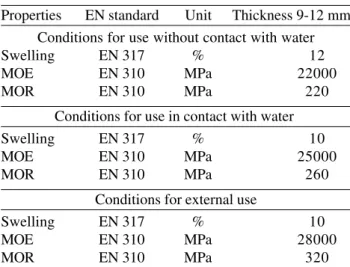
A comparison was made of the results of the tests of the laboratory-produced MDF made of eucalyptus fibers and three different contents of castor-oil-based polyurethane resin and the specifications of the Euro MDF Board – Part II8 of December 1995.
Fibers and Castor Oil-based Polyurethane Resin
Table 9. Values specified by the Euro MDF Board
Properties EN standard Unit Thickness 9-12 mm
Conditions for use without contact with water
Swelling EN 317 % 12
MOE EN 310 MPa 22000
MOR EN 310 MPa 220
Conditions for use in contact with water
Swelling EN 317 % 10
MOE EN 310 MPa 25000
MOR EN 310 MPa 260
Conditions for external use
Swelling EN 317 % 10
MOE EN 310 MPa 28000
MOR EN 310 MPa 320
Source: EuroMDFBoard – Part II: Requirements for general pur-pose boards (1995).
Table 8. Average values of MDF from eucalyptus and polyurethane resin, varying the adhesive content.
MDF with eucalyptus 8% 10% 12 %
and polyurethane resin
Density 701 g/cm3 727 g/cm3 766 g/cm3
Moisture 5.52% 5.21% 4.73%
Swelling in thickness 16% 13% 10%
Absorption 35.54% 32.32% 27.96%
MOE 24.529 MPa 27.158 MPa 29.264 MPa
MOR 232 MPa 263 MPa 281 MPa
values of the Euro MDF Board.
The results obtained by using Eucaliptus saligna and
castor oil-based polyurethane resin in the production of MDF were quite satisfactory, indicating the possibility of varying both the wood species and the resin used in its fabrication. This would allow for new materials to be pro-posed for future use by the wood panel manufacturing sector, and especially of MDF such as that proposed herein,
aiming particularly at making use of wood processing residues and resin from natural renewable sources, and incentive to realized research news relationship to sub-ject.
Acknowledgements
The authors gratefully acknowledge FAPESP (Fundação de Amparo à Pesquisa de São Paulo - Brazil) for financially supporting this work.
References
1. Holokiz, H. The effects of stock washing on the proper-ties of hardboard. Appita v. 25, n. 3, p. 194-199, 1991.
2. Pranda, J. Painéis de fibra de média densidade feitos de
Pinus pinaster e Eucalipto globulus. Área de
composição química específica da madeira desfibrada. Drevarsky Vyskum. v. 2, p. 19-28, 1995.
3. Neves, J.M.(1988); Celulose e papel - Tecnologia de fabricação da pasta celulósica. Cap. VII - Polpação de alto rendimento e semiquímica. SENAI / IPT - São Paulo,
v. 1, 1988.
4. European Committee for Standardization. European Standard EN 323 - Particleboards and Fiberboards - De-termination of density. Brussels: 1993.
5. European Committee for Standardization. European Standard EN 322- Particleboards and Fiberboards - De-termination of moisture. Brussels: 1993.
6. European Committee for Standardization. European Standard EN 317- Particleboards and Fiberboards - De-termination of swelling in thickness after immersion in water. Brussels: 1993.
7. European Committee for Standardization. European Standard EN 310 - Particleboards and Fiberboards - De-termination of modulus of elasticity in bending and bending strength. Brussels: 1993.
8. EMB – Euro MDF Board (1995), Part II: Requirements
for General Purpose Boards. Giessen, Germany.