FROM A DESIGN
MUSEUM TOWARDS
A EUROPEAN
CULTURAL
PLACE
_
THE
DESIGN MILIEU
Doctoral Studies in Design X X I V C y C L E PhD CandidateS U S A N A G O N z A G A
Strategies for European Design Culture
CREDITS
Doctoral StuDieS in DeSign XXiV cycle coordinator
PROF. FRANCESCO TRAbUCCO
PhD candidate
SUSANA GONzAGA
interior Design research unity
DHOC
indaco Department
POLITECNICO DI MILANO
aDViSory coMMittee Supervisor
PROF. LUCIANO CRESPI – POLITECNICO MILANO
reviewe
PROF. PIETRO MARANI - POLITECNICO MILANO
external reviewer
PROF. GUy JULIER – bRIGHTON UNIVERSITy
research project financed
by Fundação para a ciência e tecnologia of the Portuguese government
Strategies for european Design culture
in the globalization era
FROM A DESIGN
MUSEUM TOWARDS A
EUROPEAN CULTURAL
PLACE
_
THE DESIGN
“you are a european and civilized man, except for one thing, which is that you are victim of Portuguese education.
you admire Paris, and all big cities.
if you had been educated abroad, and had lived under the influx of a great european culture, as i had, you would not notice big cities. they would all be inside of you.”
ACkNOWLEDGEMENTS
Living in Milan for more then three years, was an incredible life experience. Moving with my daughter to a different country, city and culture, to be part of the PhD program at the Politecnico di Milano was more than a professional goal. It revealed to be a life fulfilment impossible to reach without the extraordinary persons with whom I had the privilege to learn, work, talk, discuss, laugh, cry and live.
A very special acknowledge to my tutor Prof. Luciano Crespi for his unconditional support during these three years. Thank you for all help given, discussions and enrichment to my research.
I would also like to thank to Agnese Rebaglio for all the conversations, friendship and precious help in so many critical research phases.
To the Interior Research Unity for receiving and helping me along the way.
Thank you my PhD colleagues, especially Valentina, Anna, Patrick, Xia, Fang, Elisa, Shujoy and Michelle for all support, friendship, discussions and great parties.
To the teaching group of the Final sintesis Lab, thank you for helping and introducing me to new methodologies, sharing new approaches and points of view. Barbara, D. Fassi, D. Cripa, Laura and Raffaella, it was a pleasure work with you.
To all the persons who contributed for this research with their expertise, knowledge and insights.
Thank you very much: Andrea Branzi, Paola Antonelli, Zoe Ryan, Ugo la Pietra, Susanna Pettersson, Vivien Hynes, Ida van Zijl, Claudia Cattaneo, Renate Flagmeier, Mienke Simon Thomas, Anne Perry, Vera Gang, Mariana Holá, Pietro Marani, Vasco Branco e Francisco Providência.
To all persons that had collaborate in the surveys.
Thank you to all my Portuguese fellows in Milan for trying to make home feel closer. Thank you to my wonderful family and dear friends that despite the distance have survived without us! It was marvellous knowing that you were always standing with your open arms to receive us whenever the joy, “saudades” and difficulties were hard to stand.
Last but not least, thank you so much to Claudia Candeias for the exceptional help, insights and for turning the final revisions phase into something delightful, with out you was unbearable!
AbSTRACT
The aim of this thesis is to establish the strategic lines for the creation of a place dedicated to European Design. Based on the survey and study of European Design museums, and by analyzing their typologies, missions, relationships with local and audience, we verified that the European museology trend focuses mainly on the conservation and communication of industrial production artifacts mostly of nationalistic nature, with little differentiation from its peers, be it in the available services, be it in museum strategies.
Based on the theoretical-critical background of the design culture and of the Museum Studies, we have associated the evolution of the subject to: the globalization of the creation and production processes; new cultural ways and expressions; and the European Union’s strategies for the creation of transcultural environments.
By crossing these macro-areas with the results obtained in the mapping of the design museums we were able to formulate the following hypothesis: are the places dedicated to design communicating its diversity, plurality and multiplicity of expressions in the contemporary European society?
From this hypothesis comes the research question that guided this investigation. How can we build a systemic and holistic vision of the European design culture, through its exhibition places and relationship with its audience?
To compose this plan, design museums, as well as Design Week/Festival events and Design Districts were specified as the main agents in the conservation, dissemination, exhibition and divulgation of design in Europe. By resorting to a qualitative methodology to analyze each of these agents, and to the Ground Theory instruments, we were able to, on one hand; determine the diachronic portrait of this cultural system, and on the other, to obtain the results of its social and cultural impact.
The contrast of these results has given us empirical evidence that provides a project opportunity. Thus appears the Design Milieu concept. It is a place that spotlights the plurality of the European project practice and compares it to itself and the world.
Xiii
INTRODUCTION
“time as the World has two hemispheres: one high and visible, which is the past.
other one lower and invisible, is the future. in between are time horizons.
those are the instants of the present in which we are living. Where past ends and future begins.”
Priest Antonio Vieira, 1608-1697
Design is changing. In the past 20 years design has branched out in many new di-rections. Being a discipline strongly connected with the future, by its modus operandi or by working towards innovation, design acts within contemporary society activities. It reaches many areas of every day’s private and public life as few practices do. Therefore the issues addressed by design are changing, as well as its tools.
Design is a multifaceted and broad concept with no commonly agreed definition. There is an agreement that design can be both a verb and a noun — an activity (to design) and the results of this activity (a design) — but the understanding of what the activity of design actually entails varies. This lack of definition and common understanding results in lack of common knowledge about what design is.
On the other hand in some countries, design is seen as an important activity therefore they have a design policy in place, such as Finland, the UK, Denmark or New Zealand.
I N T R O D U C T I O N
Therefore Design in this century is assuming new directions. The traditional spec-ifications like graphic design, interior design, product design and so fourth are beginning to blur.
Obviously Graphic design is still central to organizations, particularly in the creation and reinforcement of identities and brands, whether at a level of the organization itself (cf. corporate identity) or in designing products, services or environments. Interface design still creates the visual language, the ‘look and feel’, of computer interfaces, be it for a website, a software or a mobile device. Still design as evolved into strategic and as medium. Actually is a key to build effective communication that helps us in everyday life.
Due to this many design interpretations, notions and practices, it was fundamental for this research to find a theoretical background that sustained the perspective that De-sign no longer concerns only the attribution of forms, functions or aesthetics to artifacts. It became a more complex and systemic discipline.
It’s not our intention to reach, in this research, to a design definition, as we saw, it’s impossible and not the aim. This “non common settle” is something that has to do with nature of the discipline itself. With plurality and diversity. And is precisely here, where lies its charm and enchantment.
ArticulAting the theme And the reseArch questions
My Phd started with the aim of researching about design museums. I’ve chosen the PhD program of the Politecnico di Milano precisely because of the opportunity to work among the experts that though and designed the museological concept of the Trieannale Design Museum.
This theme has always interested me, I’ve always had the sensation, that design museums didn’t follow the evolution of the discipline. That they were more focused on telling about the past, then thinking about the future. Most of the times that I’ve visited a design museum, I left with the sensation that there could be another way of telling history. Maybe in a more holistic, exciting and innovative experience, rather then mirror other museological methodologies. It was this conviction that lead the first research moments of the PhD.
The first hypothesis was to verify which museological strategy do Design Museum’s follow. Does it refer to design ontology?
As this is a research financed by the Portuguese governmental foundation (FCT), and my own previous research practice was on Portuguese Design History, the purpose of this research work was to gain international knowledge to be applied later on, in the construction of a national design museum in Portugal.
I N T R O D U C T I O N
XV
So this thesis is mainly founded in two author’s positions: Margolin’s definition of product milieu:
“the human-made material and immaterial objects, activities, and services; complex systems or environments that constitute the domain of the artificial represent the aggregate of objects, activities, services and environments that fills the lifeworld.”
And on Julier’s research on the transformation of design scenario into “Material Culture”:
that studies the interrelationships between design artefacts, in all their manifestations, the work of designers, design production (including marketing, advertising and distribution), mediation and their consumption.
Having the design culture and the Museum Studies as a theoretical-critical back-ground we have associated the Design discipline evolution with the following topics: the globalization of the creation and production processes; new cultural forms and expres-sions; and the European Union’s strategies for the creation of transcultural environments. By crossing these macro-areas with the results obtained in the mapping of the design museums we were able to formulate the second hypothesis: are the places dedicated to design communicating its diversity, plurality and multiplicity of expressions in the contemporary European society? From this hypothesis comes out the research question that guided this investigation. How can we build a systemic and holistic vision of the European design culture, through its exhibition places and relationship with its audience?
To compose this plan, Design Museums weren’t enough to represent what was go-ing on in Europe around design themes. By tracgo-ing the European museums map and their activities, the results shown by some best practices we could verify they were not working isolated. Rather they cooperate within their communities, in design events hosting or even curating special exhibitions. At this point expanding the research to the study of Design Weeks/Festival and Design Districts seemed fundamental to answer to the rise of the third hypothesis: is design transforming itself in a cultural agent? Can we define a cultural sys-tem, driven by design?
By resorting to a qualitative methodology to analyse each of these agents, and to the Ground Theory instruments, we were able to, on one hand: determine the diachronic portrait of this cultural system, and on the other, to obtain the results of its social and cul-tural impact.
If we look to the development that Design had in the last 20 years, we notice at brand new directions that point out even the immaterial character that this discipline has reached. So for that concern this study, we’ve notice that in Europe is arising a cultural de-sign system. This system is here made from the interaction between three entities:
I N T R O D U C T I O N
- the Design Districts: all organized urban districts that have a trade mark with the mission of connecting different hospitable, cultural and business services with creative industries production.
- the Design Weeks: all temporary design events, with a organizational and management structure, created for cultural, innovation and Design promotion purposes.
This research does not want to unify what is really broad, contradictory and di-verse. It calls for diversity and symbolic meanings, it call to the open nature of the disci-pline.
Aims And purpose of the reseArch
As told before, this thesis started with the aim of study the main agents in the con-servation, dissemination, exhibition and divulgation of design in Europe.
During the second phase of the research, the data obtained have raise an important gap: there’s no single entity who dedicates to the study, collection and research of what means “European design” assumed as an holistic system.
This result pointed out another aim: to establish strategic guidelines for the creation of a dynamic and permanent place that heightens a holistic perception of European Design. A place that dedicated to the material culture, viewed in a systemic and interdisciplinary perspective, that appeals for participation and communication of the plurality aspects that characterize the European design practice.
I N T R O D U C T I O N
XVii
in manufacturing, but for the ability in being creative, innovators and knowledge constructors. So why not propose a place that amplify the “Design made in Europe”?
As the future growth of the European economy depends increasingly on our strengths in creativity, innovation and ideas, areas in which Europe has a pre-eminent record achievement, we have to find ways to maximize the potential of these skills in order to maintain international competitiveness and expand its position as one of the world leaders.
This research meets also the EC request for the study of the economic and cultural impact of Design in the EU, through The European Design Innovation Initiative; and strategic European Union guidelines for developing cultural strategies for transnational heritage exchange and networking, that also encounter ICOM directives for the future development of Museums. Accordingly the present study will contribute to:
- individuate, define and characterize the principal agents for collecting, disseminating, exhibit and diffuse de Design practice in europe.
- establish the guidelines for the creation of a permanent and hybrid place, dedicated to the research, exhibition and development of the european material and
immaterial Design production.
- reveal new research and project opportunities, as well as to help to strengthen the european identity and enhance a more heuristic and diffuse comprehension of the Design discipline. Meeting also the political Portuguese will to implement new european connections through the development of the creative industries.
structure And methodology of the reseArch
This research thesis is divided in four parts. A first part dedicated to the construc-tion of a theoretical background on the subject; the second refers to the research meth-odology, data collection and analyses, the third part to the construction of a meta-project concept for the Design Milieu, and its application in Porto.
The first part is related to the study of the elements that contribute for the cultural design scenario in Europe. We intend to analyse if design as became on itself a cultural agent as a natural evolution of the discipline. In that sense, we no longer consider design as merely project activity that defines objects. But a potential generator of value. The relation-ship between design culture and design as a culture producer are here debated.
I N T R O D U C T I O N
that despite smaller sample still exist in Europe, that are also increasing and helping to redefine cities social and urban landscapes.
The second part refers to all the data collection, interviews and surveys about the social impact that these three entities have in the actual panorama.
For that matter choosing qualitative research as one of the main methodology it due to a lack of theory and literature review about design big events such as the design weeks and districts. For what concerns design museums, there’s more information, but Museum studies haven’t yet dedicate much attention on this specific topic.
On other hand according to Charmaz (2006), Henwood (2007). The choice of the grounded theory method (GTM) help to understand the why and how design evolved to a cultural agent. The tools of the Ground theory compromises a systematic, inductive and comparative approach for conducting inquiry for the purpose of constructing theory (the method is designed to encourage researcher’s persistent interaction with their data, while remaining constantly involved with their emerging analyses. Data collection and analysis proceed simultaneously and each informs and streamlines the other. The GMT builds empirical checks into the analytic process and leads researchers to examine all possible theoretical explanations for their empirical findings. The iterative process of moving back and forth between empirical data and emerging analysis makes the collected data progressively more focused and the analysis successively more theoretical. In this second part, the use of this methodology enabled us to generalise on:
- Best practices in each of these cultural entities; - Form and function typologies;
- relationship typologies (entities and its audience, territory, object and time)
- concluding that in becoming a cultural agent, Design coincides with its own evolution.
The discussions of the results obtained in this second moment with the theorecti-cal construction of the first part, lead to the third part of this work: the research outcomes.
In the third part we applied a mixed methodology, which embraces a sequential, current and transformative strategies of inquiry. (Merriam; 2008)
The results achieved in the previous parts, gave us empirical evidence that provides a project opportunity. Thus appears the Design Milieu concept. It could be intended as a possible evolution of a design museum, or a brand new place.
This part is divided in three chapters. Here we try to do a phenomenological analysis that lead to the establishment of the concept of the place.
This concept is presented in two steps. In the second chapter is introduced as a meta-project concept, featuring its mission, aims and functions. Still in a conceptual phase, it was designed an abstract concept that could be applied into any city that has an amount of characteristics defined during this phase.
I N T R O D U C T I O N
19
In the final part, the conclusions, we make an overview of the overall research proj-ect, discussing the results, methodology and findings. The meta-project that have emerged from the generalizations are here compared and confronted with research hypothesis, and if it responds to the research question.
TAbLE OF
TA b L E O F C O N T E N T S
acknowledgements abstract
i introduction
1.1 aims and purpose of the research
1.2 articulating the theme and research questions 1.3 Structure and Methodology of the thesis
Part i
the europeAn culturAl design system scenArio – A theoreticAl BAcKground
Foreword
chApter 1 design & culture or culture of design
1.1 Design culture: establishing criteria
1.2 Design as cultural agent in the contemporary society 1.3 Design as a eu strategy
chApter 2 design museums, leAding or leAVing
2.1 From museum studies to design museology 2.2 From applied arts to design museums
2.3 Design museums by their typological approaches 2.4 Best practices in europe in interdisciplinary approaches
chApter 3 design WeeKs And festiVAls, A 21st century phenomenA
3.1 Festivals, weeks and biennale, from business to cultural assessments 3.2 the “festival mania”
3.4 Making design accessible and engaging 3.5 Promoting local versus global
chApter 4 design districts, the neW economies driVers
4.1 the foundations of a city network
4.2 offering a hospitable and creative city through design 4.3 Designing the city from within
4.4 urban design districts typologies
Part ii
understAnding the europeAn design culture By collecting And
AnAlysing the three culturAl Agents By their missions, collections, structures And sociAl functions - A quAlitAtiVe reseArch
Foreword
chApter i methodology And dAtA collection
1.1 the qualitative research strategy 1.2 the grounded theory tools of inquiry
chApter ii design museums, the KnoWledge constructors
2.1 european design museums map 2.2 Data findings
2.3 interviews highlight 2.3 generalizing
chApter iii design WeeKs , the design incuBAtors
3.1 european Design weeks map 3.3 Data findings
chApter iV design districts, the design engAgers
4.1 european Design districts map 4.2 Data findings
4.4 generalizing
chApter V museums And Audience
5.1 “Social and cultural impact of museums in contemporary society”, a public survey. expectations and aims 5.2 Public characterization.
5.3 results regarding museum concept
5.4 results regarding architecture and interiors expectations and communication displays 5.5 results regarding experience and learning
5.6 generalizing
chApter Vi discussions
Part iii
shAring design KnoWledge, incuBAting neW ApproAches engAging And confonting the europeAn design With neW territories - estABlishing the conceptuAl frAmeWorK for europeAn design production
– reseArch outcomes
Foreword
chApter i shAring KnoWledge for the construction of A europeAn design identity
1.1 Why a european design place?
1.2 the museum is no longer the Musa´s house 1.3 Design Milieu, a theoretical construction
1.4 Design Milieu as hybrid concept for multidisciplinary design communities
chApter ii design milieu A metA-proJect concept
2.1 the Design Milieu mission and aims: collaboration, networking and coordination 2.2 the elastic, incubator and confrontation place, for multidisciplinary scenarios 2.3 a possible organization structure
2.4 engaging the audience and the city through Design s
chApter iii porto As A territory for eXperience
3.1 the city’s opportunity
3.3 Defining local and european partnerships
3.2 Discussing the meta-project with curators; creative agencies and cultural districts- highlights 3.4 connecting the city infrastructures with Design Milieu activities
3.5 Design Milieu at oporto meta-project layout 3.6 oporto expectations
Part iV
conclusions
Foreword 1.1 general results
1.2 limitations and critic aspects of the research 1.3 implications for further research and practice
tABle of imAges
BiBliogrAphy
Appendices
TA b L E O F C O N T E N T S
THE EUROPEAN
CULTUAL DESIGN
SCENARIO
_
A THEORETICAL
bACkGROUND
FOREWORD
the culture of design is a fascinating theme. For diverse motives and reasons, maybe due to the character mutable and flexible of the discipline, the design definitions, practices and concepts about are infinite as design possibilities are.
according about the ontology of the discipline is an inglorious effort as each designer, company and even design centres or regulator institutions have its own interpretation. But precisely this is the most interesting aspect. it demonstrates its own character: the ability to change, the continuous evolution and adaption. growing and innovating into new fields of the human existence.
this first part of the thesis is divided in four chapters. each one intends to establish the theoretical background and foundations of the research theme from a historical-critical point of view. the themes of the design culture are articulated with the contemporary european strategies for economic and cultural ascendant of europe in confrontation with the growing economies as china, South america or even the eua.
27
cHaPter 1
D E S I G N & C U LT U R E
O R C U LT U R E
O F D E S I G N
1.1
DESIGN CULTURE:
ESTAbLISHING CRITERIA
What is Design Culture?
According to the material culture research group, directed by Guy Julier, Design Culture is the academic study of the interrelationships between design artefacts, in all their manifestations, the work of designers, design production (including marketing, advertising and distribution), mediation and their consumption.
Concurring the opinion of Daniel Koh, Singapore-based art director, the design culture
refers to the communication field: it is a term “to define the way designers think and work through different mediums. Different thought processes/approaches but one common objective: to communicate. Design is a way of life; it’s all around us. We should make things better”. It is something designers do but is also something that is ‘all around’ (Koh, 2004).
The design culture is part of the flows of global culture (Julier, 2008); it is located within network society and is also an instrument for it. Because of the fluid and uncertain context of knowledge, the design culture cannot be fixed, homogeneous or homogenizing.
The design culture expresses itself as an attitude, a value and a wish to improve things. And, at last, its visual, material, spatial and textual manifestations can have high level of complexity. To explain the multi-levelled existence of the design culture and map out some of its qualities, here are some definitions by Julier (2008), extracted from the introduction of his book «The culture of design».
Part 1
T H E E U R O P E A N C U LT U A L D E S I G N S C E N A R I O - A T H E O R E T I C A L b A C k G R O U N D
Still according to Julier’s opinion, Design could be defined as a highly entrepreneurial pro-fession and at the same time a maturing academic discipline. It has become a source of public entertainment, but also a vehicle of political coercion and symbolism. It is also an informal indicator of economic performance , cultural regeneration and social well-being. In the field of intellectual and commercial human activity there exists just few practices that allow to reach into so many areas of everyday private and public life, as well as few professions have increased their presence in the economy and cultural import as much as design has in the past two decades.
Becoming a global phenomenon, with a new global generation of design consumers, it is no longer a ‘value-added’ extra applied to a restricted range of domestic objects; rather it extends, for example, to the planning and shaping of digital interfaces in computer games and websites, to larger-scale leisure and retail spaces and even the creation of a country’s public image (Julier, 2008, p. 1).
On the other hand, Manzini, (2006) stresses that design can be understood as culture, practice and community of operators, has deeply changed its relationship with the other actors of production and consumption systems and with society in general.
The phenomenology of contemporary Design demonstrates a strong contradiction between the multiplying and differentiation of those fields in which designers should operate (and a specialization is required) and the contemporary crisis of consolidated disciplines (and then the demand of interdisciplinary tools and concepts, common for different design practices). The observation on the contemporary design practice and culture shows how disciplines and specializations (not only in the design field) merge together and blur, making it difficult to define boundaries. The world we live in is fluid where everything lose a clear definition: the society seems not to have its own solidity, each project tends to be flexible, each choice reversible. The forms that appear are instable, their existence and duration are the result of a series of phenomena in which the combination asks to all the involved actors a great design ability. Each person must redefine constantly his/her own objectives and invent new manners and behaviors: constantly operating in a design – understood according to the Italian term ‘progettuale’ – and strategic way.
cHaPter 1
D E S I G N & C U LT U R E O R C U LT U R E O F D E S I G N
29
Then, who are the designers today? Which role have they got in this world of pseudo- designers? Designers are “project experts” that act in the contemporary complex network of actors/interlocutors (i.e. companies, institutions, local authorities, final users) as particular process facilitators. They are experts because they use specific skills and expertise to make some events, oriented to a specific result, be realized. They use design tools to facilitate the convergence of several actors toward shared ideas and possible solutions, suggesting solutions and/or scenarios. They formalize efficiently what emerges from the collective discussion of the group of project, developing those ideas on which the meeting/convergence of the necessary partners manifests (different involved actors, different fields, different results).
Designers are also promoters of diffused design skills, that let people and communities be able to better design independently their future. It can be also added that, thanks to the statement of the natural human creativity as a key factor for the economy and society, there exists a “creative class” that depends on the personal attitude to design. The contemporary society is characterized by the designerly way of doing as an central element for the economies and also a value that changes the social dynamics of relationships, cultural elaborations, consumption, geographical localization.
Designers have new and different roles compared with the past; for example, today they are more involved in the corporation’s decision making processes. The design approach seems to offer new contributions to the literature and interpretation of reality; in other words it is possible to define Design as a cognitive tool, so as a “knowledge agent”.
Julier (2008, p. 4) seeks to give clarity to Design’s definitions: «The word ‘design’ denotes the activities of planning and devising as well as the outcome of these processes, such as drawing, plan or manufactured object. It is both a verb and a noun. However, the term ‘design culture’ also gets close to being adjectival. It suggests the qualities by which design is practiced – and Julier uses the the word ‘practiced’ very deliberately to infer the ways that is undertaken, but also the ways that it is lived, perceived, understood and enacted in everyday life. As such, design culture exists at a very local level. It maybe embedded in the working systems, knowledge and relationships of designers and/or in the quotidian actions of design users. But it may also work more widely and publicly, fostered within discursive systems of power, economic structures and dynamics or social relations».
Design is an interdisciplinary discipline, characterized both by complexity and sys- tematicity; as seen till this point, it can be understood in terms of culture, practice, “knowledge agent” and science.
Part 1
T H E E U R O P E A N C U LT U A L D E S I G N S C E N A R I O - A T H E O R E T I C A L b A C k G R O U N D
Design is about products, services, systems, environments and communication.
Many designers work in manufacturing firms, dealing with products and packaging, but design can also be applied to services — private and public — as well as to systems, as in the case of urban planning, and even to experiences. A service designer may for example look at how a patient experiences being taken to emergency or a bank customer visiting their bank.
In the interesting case of “The Future of Design Culture” by Bruce Mau in 2004, in is website (www.massivechange.com), they discuss the sense of design culture towards future global change.
Julier on other side provides a representation of the design culture domains: production, designers and consumption are link together and they constantly inform each other in an endless cycle of change. Production, designers and consumption individually have some influence on the form of objects, spaces and images, but these in turn are not neutral playing an active part in influencing or making sense of the systems of their provision.
It is the interaction and intersection of these three domains and their interactions with designed artefacts that is of prime interest to the study of design culture (Julier, 2008, p.13).
Design and designers have become signs themselves. These signs are largely visual, and based on a cult of the creative artist. It is banal when compared to the complexities of design in the economy and culture, not to mention modern production technology, but
once you start questioning what you see, you understand a little bit more about the evolution of things. Design is not a simple invention “ the lightbulb above your head” but design comes out of long processes and many years of history with some important breaking points. But in order to break with the past, you need to know how things were before,why the past was not good enough and why
you need to go other ways.Konstantin grcic
cHaPter 1
D E S I G N & C U LT U R E O R C U LT U R E O F D E S I G N
31
is alive and well in the press and electronic media. Design became fashionable, a trend in itself. This promotion, either from designers or design promotion organizations like mega events such as design weeks, pops up everywhere.
Ilpo KosKinen points out that this massive and banal design promotion, mainly by the media that sometimes pass a design writing may be based on romantic notions of creativity, this culture its not banal in its consequences. It could pass the idea of a “celebrity culture” (Koskinen) that works against the self-image of the profession, pushing it into a conservative, artistic direction at the expense of technology and social concerns.
1.2
DESIGN AS CULTURAL AGENT
IN THE CONTEMPORARy SOCIETy
Design is changing. the issues it addresses are changing. its tools are changing. Whether aware of it or not, people who design are changing. there is nothing strange or new in this: in a society in transformation, design, by its very nature, cannot but change.
(Ezio Manzini ‘10)
In the past 20 years, design has branched out in many new directions. There are many different ways in which one can be a designer today. (Antonelli ,2011)
Being a discipline strongly connected with the future, by its modus operandi or by working towards innovation, design acts within contemporary society activities. It reaches many areas of everyday’s private and public life as few practices do. Therefore the issues addressed by design are changing, as well as its tools.
Design is a multifaceted and broad concept with no commonly agreed definition. There is agreement that design can be both a verb and a noun — an activity (to design) and the results of this activity (a design) — but the understanding of what the activity of design actually entails varies. This lack of definition and common understanding results in a lack of statistical data on design across countries and on its economic importance as an activity as well as a sector. The exception is the area of design protection, where statistics on designs registered as intellectual property rights exist. Some relevant and illustrative definitions of design come from countries that have a design policy in place, such as Finland, the UK, Denmark and New Zealand.
Part 1
T H E E U R O P E A N C U LT U A L D E S I G N S C E N A R I O - A T H E O R E T I C A L b A C k G R O U N D
The UK Department of Trade and Industry (DTI) said the following about design:
“Design is a structured creative process. Design is readily associated with industrial product design for manufactured products — specifically the ‘look’ of a product. However, the application of design is much broader, for example designing for function; for aesthetic appeal; for ease of manufacture; for sustainability; and designing for reliability or quality and business processes themselves. Service design affects how customers will experience the delivery of a service, such as a bank or a fast food restaurant. elements of design, particularly graphic design, will form part of product, service and company branding and advertising strategy.”
Among international organisations, ICSID (The International Council of Societies of Industrial Design) defines design in the following manner:
“Design is a creative activity whose aim is to establish the multi-faceted qualities of objects, processes, services and their systems in whole life cycles. therefore, design is the central factor of innovative humanisation of technologies and the crucial factor of cultural and economic exchange.”
Many designers work in manufacturing firms, dealing with products and packaging, but design can also be applied to services — private and public — as well as to systems, as in the case of urban planning, and even to experiences. A service designer may for example look at how a patient experiences being taken to emergency or a bank customer visiting their bank. Urban designers look, for example, at how elderly or disabled people experience a visit to the town centre from an accessibility point of view. Business model design is an activity linked to organizational innovation.
Graphic design is central to the visual communication of organizations, particularly in the creation and reinforcement of identities and brands, whether at level of the organization itself (cf. corporate identity) or at the level of its products, services or environments. Interface design creates the visual language, the ‘look and feel’, of computer interfaces, be it a website, a software or a mobile device.
In short, design as an activity can and often does take place in any organization.
cHaPter 1
D E S I G N & C U LT U R E O R C U LT U R E O F D E S I G N
33
This revolution has had a huge urban impact, mainly in Europe. The European cities began to register more quickly than expected or thinkable, large unoccupied areas. Where previously were industrial or manufacturing blocks, administrative and residential facilities, are now abandon skeletons with no predictable destination. These holes consist of a large urban real estate, often strategic located, began to be a difficult problem to manage by the local governments and stakeholders. What destiny for this heritage of industrial archeology and the new urban voids that they generate?
Sociologists, thinkers, urban planners, architects and designers started to question the issue, trying to establish new concepts and destinations for these sites, but the debate is still open. Despite some remarkable top-down initiatives for urban renewal such as St. Etienne’s Citè du design, or the more recent conversation of Lodz’s industrial sites into a contemporary art district, the great innovation of this phenomena is nevertheless the bottom-up initiatives, often directed by the local creative communities.
These groups organized by people from different creative backgrounds, have found a fertile ground to develop new urban ideas and solutions for the urgent society problems that arise from the new status quo, in a more spontaneous, effective and rapid way.
The first examples in the late 90’s beginning of 00’s, were set off as “guerrilla actions”, simple interventions, or spontaneous actions from local communities. Like the Gordon Matta Clark work, or Archigram, Ant Farm, Ufa Frabrike, among others. Although these groups were not always composed of planners, architects or designers their manifestations had showed great creative power and answers to urban and social issues. Even if some times this reflected an ad hoc way of working, more intended as polemics than to question conventional practice. Projects such as N55 Protest Rocket, a project that aimed “bomb” the green city spaces with seeds or the illicit “Operation: Ivy League” created by the self-proclaimed “anarchitects” The Space Hijackers, who installed ivy on sites around central London as a protest against corporate architecture, or the project “Sit in” Liverpool, all of these examples function more in a reactive way then revolutionary.
These manifestations have awakened thinkers, as they gain social and economic power. Florida: 2005; Landry: 2004; and Zukin: 2005, to quote a few, describe them as the third revolution society, as being a more visual, creative and symbolic one. The contemporary cultural power to create an image, to frame a vision of the city has become more important as publics have become more mobile and diverse, than traditional institutions. This happens because (see Zukin; 2005)the notion of a city depends on how people perceive and combine the traditional economic factors of land, labour and capital, but also the symbolic level of order and disorder and the uses of aesthetics power. In the symbolic economy the concepts of a city become unified with the material practices of finance, labour, art, performance and design. These notions have created the perfect environment for flourishing an increasing amount of cultural and urban manifestations, which are reshaping, as showed, European urban landscape.
Part 1
T H E E U R O P E A N C U LT U A L D E S I G N S C E N A R I O - A T H E O R E T I C A L b A C k G R O U N D
property, integrate a group of disciplines such as architecture, music, advertising, visual arts and antiques, video and computer games, craftwork and jewelry, design, performing arts, (UK Creative Industries Taskforce, Department of Culture) have never been so preponderant has they are nowadays. They’ve grown considerably over the past century, as the number of professionals as well as educational courses. Yet the most rapid and punctuated growth occurred over the past two decades or so. In the 50’s, for instance, only 15 % of the workforce was related to the creative areas of the economy. But over the past two decades, creativity has become the driving force of our economy and the creative sector has exploded. In 2004 the Demos report revealed that 25 to more than 30% of the total workforce in the developed nations, was engaged in science and engineering, research and development, technology-based industries, in the arts, music, culture, aesthetics and design industries.
As these assessments are being made, one must not lose sight of what this creative society can offer in terms of innovation and opportunities especially due to its social impact, for what they propose as alternative lifestyles, reinventing our daily lives and reoccupying urban space with new uses (Mirko Zardini, 2008), at the same time they open a brand new territory for designers and architects to think and develop new quality designs to new fruition’s, relational and engaging spaces.
Cities are places full of dynamic, creative tensions arising from population density and spatial proximity (UNESCO, 1996), which makes them the places par excellence for the emergence of possible alternative solutions and the Hotbed for innovative and sustainable development strategies updated to cope with the far-reaching cultural, economic and technological shifts that are reshaping society (Creative Economy Report, 2008). The cross-fertilization that occurs when people of different cultural, social and ethnic backgrounds mix
cHaPter 1
D E S I G N & C U LT U R E O R C U LT U R E O F D E S I G N
35
breeds innovative thinking and gives way to creative solutions to both old and new problems. Among with the diversity, creativity and cultural activity that increase cities’ quality of place, supporting the revitalization of run-down areas, enabling more innovative problem-solving and thinking in all sectors. They also work as powerful channels for community development and engagement, providing opportunities for economic growth (Evans et al., 2006). All this exciting phenomena gave ground and impulse for the so-called Social Innovation. This refers to new ideas regarding the social sphere (Mulgan, 2007), i.e. new ideas that work to meet pressing unmet needs and improve peoples’ lives. Assuming that creativity and culture play a fundamental role in economic growth, it also can be a motor for shifting from the present economic paradigm to a new one, more sustainable from a social, environmental and individual perspective. Nowadays civil society is more engaged than ever before in the search for solutions for social problems emerging from the melting pot that characterizes the XXI century city
Meanwhile, contemporary panorama points out knowledge and creativity to play a key role in social, economic and production scene. They are essential inputs in goods and services that compete in knowledge in that so called experience economy. In this context, culture is increasingly seen as an economic assetinstead of a money consuming, luxury activity affordable in times of economic wealth. (Ray and Anderson, 2000)
This awareness constitutes a major shift in the cultural and economic policy of European cities and regions (Rutten, 2006). The emergent changes are already taking place and we can watch that human cleverness, motivations, imagination and creativity are replacing location, natural resources and market access as urban resources (Landry, 2000). And this is an important issue not to be ignored, as society is changing into different approaches and new demands, changing the landscape with new interventions more culture enriching then material.
1.3
DESIGN AS A
EUROPEAN UNION (EU) STRATEGy
A particular importance of design as a key discipline and activity to bring ideas to the market, has been recognized in the Innovation Union Europe’s 2020 flagship initiative. In line with the commitment taken in the Innovation Union, the European Commission will launch in 2011 the European Design Innovation Initiative to exploit the full potential of design for innovation and to reinforce the link between design, innovation and competitiveness. The goal of the initiative is to:
- raise the awareness of design as a driver of innovation in europe;
Part 1
T H E E U R O P E A N C U LT U A L D E S I G N S C E N A R I O - A T H E O R E T I C A L b A C k G R O U N D
European Design Leadership Board was set up to steer the initiative. To ensure the crucial link between design and innovation, the Board is composed of members with diverse backgrounds (i.e. business sector, higher education, designers, national and regional agencies promoting design and innovation).
The Leadership Board, together with the Secretariat of the European Design Innovation Initiative (chosen following the call for tenders) and the European Commission will develop a joint vision, priorities and actions to better integrate design into innovation policy. (http:// ec.europa.eu/)
The first meeting of the newly established European Design Leadership Board, which took place in Helsinki on Friday, the 27th May 2011. The newly established board of fifteen
members from umbrella organizations, design promotion institutions, leading academics, industrialists and designers will steer the European Design Innovation Initiative (EDII) with the aim to exploit the full potential of design for innovation and to reinforce the link between design, innovation and competitiveness. The European Design Innovation Initiative is to be launched by Commissioner Tajani as a component of the Innovation Union later this summer. The Innovation Union is one of seven flagship initiatives of EU’s growth strategy: Europe 2020, following BEDA’s Design Manifesto requesting that the European Commission include design as a key driver in its innovation policy.
Beyond the recognized drivers of innovation in other policy domains, such as education and entrepreneurship, some countries in the EU and beyond have started looking at drivers of innovation not previously examined in a policy context. Notably, some of Europe’s leading innovation nations have included user-driven or user-centred innovation as cornerstones of their national innovation strategies. It is seen as a way of providing innovative products, services and systems that correspond better to user needs and therefore are more competitive.
The same countries that explore the potential of user-driven or user-centred innovation are leading nations as regards the development of national design policies. User-driven innovation is often closely associated with design, involving tools and methodologies developed and used by designers.
On 7 April 2009, the Commission published a working document on Design as a driver of user-centred innovation. It provides an analysis of the rationale for making design an integral part of European innovation policy. On the basis of this document, the Commission launched a public consultation aiming at finding out if more should be done at EU level in the area of design and - if so - what.
cHaPter 1
D E S I G N & C U LT U R E O R C U LT U R E O F D E S I G N
37
The Industrial Innovation - Design for innovation a EU program are developing with the European Design Leadership Board a all program towards a more consist view of the European design. To this purpose, on September 2012 will be presented during Helsinki Design Capital, their proposal consisting in six strategic areas for design action:
- europe in the World;
- Design in europe’s innovation system; - Design in europe’s enterprises;
- Design in europe’s public sector; - Design in europe’s research system; - Design in europe’s education system;
For decades, design has not been an issue in the EU strategies. All these initiatives, new in a conservator environment such as the EU reveal a great mind-set transformation on and top-down government decision makers. Using Design strategies and tools that put together a group of entrepreneurs, decision makers from the business world, EU policy makers and education and research professionals for a co-design workshop in Brussels, is a real great step forward.
“Each of the Design Leadership Board members got to invite experts in design, industry, business and community outreach to take part in the workshop. The participants were divided into seven groups, each headed by one of our facilitators, who helped and mediated the co-design process.” Say’s Christian Bason, Director of Innovation at MindLab.
The aim of the workshop, that occurred last March 2012 was to brainstorm, discuss and prioritize the following three key challenges:
- How to implement design in innovation processes for the benefit of society, enterprises and public sector?
- How to develop europe’s design competencies and knowledge for the 21st century? - How to valorize design “made in europe”?
cHaPter 2
D E S I G N M U S E U M S ,
L E A D I N G O R L I V I N G
2.1
FROM MUSEUM STUDIES
TO DESIGN MUSEOLOGy
During centuries the museum main function was to collect and preserve evidence and property. To preserve the prominence of the power of great empires over times and generations. Today we are far from the notion of a museum as a merely “deposit of works of art”. This notion that have origin the art museum, that has somehow been responsible for the design of traditional museums of the 19th and 20th century.
If it’s true that the safeguarding of the assets is still an important and the main basic func-tion in nowadays museums, it’s also true that in the dawn of the 21st century, museums all
over the world have faced growing challenges that question their organization methods; their attitude towards society, the way and interpretation toward the collections, the com-munication to the external and different kinds of audiences, and the way they make them-selves known in the world.
“Museums provide a structured platform for interactions between cultures, which makes them ideal ambassadors for intercultural communication”. an laishun, 2009
cHaPter 2
D E S I G N M U S E U M S , L E A D I N G O R L I V I N G
39
The transition of the millennium started to bring new important insights to the debate about Museums and their future, mainly in Europe and North America. The concept of what is a “museum” began to be questionable and some authors defended the interaction between the old museums institutions to meet the challenges of their communities. R. Lumley, (1989) pointed that in the 21st century, the word “Museum” will conquer new signifies, questioning what will be the
meaning of what it means living in the old continent. “It’s no longer a museum in the restrictive meaning of a building or institution, but as a powerful social metaphor and as a way in which societies represent the relationship with their own History and the others”. This debate is no longer finished and it’s transversal to almost all museology typologies. This is no longer a History, Art or Sciences Museums problem. It’s an identity crisis that all museums are facing.
The notion of the democratization of knowledge (Landry, 2007) that have the heart in the 19th century, saw in the museum the natural concept of cultural institution, whose purpose was to uplift and improve the broader public to suit the emerging conditions of the industrial era and the nation state. But in the decors of the last century and the challenges that the new one have brought to the world such big and fast transformations, that a transformation momentum is happening and drives with it an identity crisis. The museums are faced with these challenges within different and structure levels. (Landry, 2007) suggest that the museum identity crisis is almost at the level of understanding the difference lets say between a museum and a shop, a school or a sports centre.
“icoM 2010 will provide opportunities to contribute to museum development addressing all forms of heritage: tangible, intangible, movable, immovable, cultural and natural. the museum will be considered as a ProceSS, as a ForuM, and as a conStruct”. icoM’s 22nd general conferences, 2010
The relevant and the most innovating venue that ICOM presents deals directly with Design Discourse. The museum seen as a process, forum and constructor of knowl-edge and culture is absolutely what design museums should stand for.
Mainly because this is exactly the critic point about DM’s and the design as a discipline. Each case should have something original to say - many grounded deeply in their locality whilst oth-ers may stretch horizons far more widely. But like a lattice work the overall Network represents an under-considered strength showing distinctiveness, diversity and difference.
Part 1
T H E E U R O P E A N C U LT U A L D E S I G N S C E N A R I O - A T H E O R E T I C A L b A C k G R O U N D
“even in the smallest details, museums reveal their real function, which is to reinforce among some people the feeling of belonging and others the feeling of exclusion.”
Pierre Bordieu, Alain Darbel
Fortunatly some of the contemporary museology currents are introducing new and more interesting thoughts to this debate. We have to say that this evolution in mainly appointed by the International Council of Museums (ICOM) that in the decors of his exis-tence has contribute enormously for establishing guidelines to this area. If we analyse the ICOM statues during the last 60 years of his existence, we realize how the role of museums has changed. In 1995 they first include the concept of serving the community. “Nowadays a museum is also a business”. (K. Hudson, 2004) Museums in the 21st century are at the cross
roads of major transformations in the global economy and environment. They are in a po-sition to address the urgent need for safeguarding cultural diversity and bio-diversity as the common heritage of humanity. As An Laishun (2009) understands, the museums nowadays provide a structured platform for interactions between cultures, which makes them ideal ambassadors for intercultural communication.
“today’s cultural environment is a flexible articulation of traits and features, a multinational puzzle where new significance is assigned to concepts such territory, heritage, identity, culture and museum. this prompts the need to examine the ways by which culture and citizenship develop, and to better understand the interfaces between the global and the local, the public and the private, the individual and the common spheres.”
(Scheiner, 2010)
When the author refers to today’s cultural environment, indeed shows us how quick the culture paradigm change. Consequently rises the inevitable question, can we, as human beings, deal with such a faster and hallucinating velocity of changing? Bauman (2008) says that in this era of easy and instantly connection, the communication between the momentum experience and everything that precedes it or that follows it, should be absolutely interrupted. The sociologist, affirm that even though this affirmation is a para-dox, we can’t as humanity, continue to live in such a society that reign the culture of the ephemera.
In fact, the articulation between the institutions and the society is fundamental in order to create venues that people recognize as important. We face ourselves with the incapacity to deal with everything that is produced in real time. This velocity of production brings to the museums a very delicate problem. What and how can we conserve the con-temporary production? If we address to the ICOM Statutes, adopted by the 22nd General Assembly (Vienna, Austria, 24 August 2007) where it was established that:
“a museum is a non-profit, permanent institution in the service of society and its
development, open to the public, which acquires, conserves, researches, communicates and exhibits the tangible and intangible heritage of humanity and its environment for the purposes of education, study and enjoyment. “
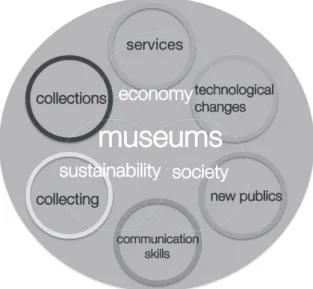
Putting together these two concepts, the question that arises is even more complex to answer. The Museums nowadays have to deal with a high complex system. It’s no longer a cultural and knowledge preoccupation. The institutions deal (see Figure 1) with a very complex system that creates and put together areas that are new to the traditional ways.
cHaPter 2
D E S I G N M U S E U M S , L E A D I N G O R L I V I N G
41
MuDac,
Part 1
T H E E U R O P E A N C U LT U A L D E S I G N S C E N A R I O - A T H E O R E T I C A L b A C k G R O U N D
According to David Flemming issues presented in the ICOM congress in Seoul 2004, and with the ones presented by ICOM - Italy during a country congress in Milan 2009, the institutions have to deal mainly with five macro areas of concern, which are:
- Social change - a role increasingly seen as central to museums, that is the impact museums can have in helping bring about social change through learning. - technological change - is rapid and keeps raising the stakes for museums.
- cultural authority– a key characteristic of museums, which are powerful places for dialogue and discussion. Museums are trusted and revered by many people. Museums can open up access, then the ‘authority’ can be shared.
- People – not objects are at the heart of the museum function. objects are the means, people are the ends. opening museums to the community engaging knowledge, entertainment, services and education. Finding new publics, attracting them to museums, such us emigrants and teenagers, and not informed public.
- collections and collecting - it is becoming more difficult and expensive to care for collections, and more of a challenge to collect.
These big macro areas related to economical, collecting and public produce a table of constrains where we are able to individuate some of the major issues that, for instance, the economical crisis that as been happening in the last two years provoke in museums scenario. As we can see in the diagram above, the lack of founds generate by itself several problems not only in acquisitions that maybe could be in stand by, but it could be seen as an opportunity to generate new creative and more sustainable solutions that helpfully can be a venue to invite the community to participate in possible new partnerships.
It seams that a major part of the European design museums have some difficulties approaching design and museum concepts. The practice of questioning established systems
of power has led artists to examine the role and mechanisms of cultural institutions. Spon-sor, art and commerce.
Museums are not simply collectors, taxonomic repertoire or displays, they are still acting as a medium that gives significance and an aura of authenticity.
Much recent debate on the value of the public arts sector (including museums and galleries) has focused on its measurable contribution to the national economy via the cre-ative industries, tourism and a vibrant art market, and to the quality of life of individuals and communities. It is certainly the case that the UK’s museums play an important role in raising social capital, encouraging inclusion and kick-starting urban regeneration. Less has been said however, on the ways in which the practice of Arts and Humanities research underpins these initiatives, particularly in the context of the museum exhibition and display.
Acting on this conviction, the Vitra design museum initiated the European
Mu-seum Network Conference called MUSCON back in 1996. This annual conference offers a unique platform for museums with a focus on design, architecture and contemporary art. Even if this network major aim is creating a network that promoted the mobility and sheer-ness of temporary exhibitions, although this is an important contribution to the debate of the actual issues that design and contemporary art museums affront. For Landry [2003], the constitution of museums networks suggests there are many stories still to be told and they can be told in many ways.
cHaPter 2
D E S I G N M U S E U M S , L E A D I N G O R L I V I N G
43
Part 1
T H E E U R O P E A N C U LT U A L D E S I G N S C E N A R I O - A T H E O R E T I C A L b A C k G R O U N D
Considering the design discipline as enlarge so much its own field of action, and the Muscon presents a group of strategies to enlarge and give some kind of relevance to the design museums, it seems strange that furniture still prevails as the main design museums collection strategy. It’s true, though, that some began as decorative art museums, like the Victoria & Albert Museum in London and Musée des Arts-Décoratifs in Paris. They tend to see furniture as a more logical development of their historic interest in fine craftsman-ship, than the design of, say, cars or computer software. But even among the newer design museums, as the Vitra design museum near Basel was set up specifically to explore furni-ture, which also dominates the programming of the more dynamic small institutions, like MUDAC in Lausanne and Z33 in Hasselt, Belgium.
But isn’t it odd that something that was designed to do just that should occupy more cultural space than arguably more useful and complex objects? And will it be as important to the design history of this century, as it was to the last? (Rawsthorn, 2007)
So we could say that we have a conflict of interests here. The Design Culture point of view and the museological History based organizations. This brings us back to the pub-lic issue. How do we communicate and show the new design fields and approaches as the intangible tendency that design is getting. For instance Service Design, information design, interface design, Interiors Design, Design for sustainability, Design Thinking, and so forth?
indeed the vast networks of museums suggest there are many stories still to be told and they can be told in many ways. each may have something original to say - many grounded deeply in their locality whilst others may stretch horizons far more widely. But like a lattice work the overall network represents an under-considered strength showing distinctiveness, diversity and difference. (charles landry, 2003)
cHaPter 2
D E S I G N M U S E U M S , L E A D I N G O R L I V I N G
45
Therefore we need to consider that the issues addressed by design are changing, as well as its tools. Design museums in Europe should follow this evolution, helping to create a more holistic vision of the discipline. Design stands today on the fault line between old and young in societies around the world. Designers will increasingly find themselves acting as mediators between the old world and the new – between institutions, ways of thinking, educational models and practical methods that belong to the 20th century and those that are fast emerging in this, the new century.
Design museums, should act as a cultural authorities responding to demands ad-dressed above. Not just merely displaying artefacts, but promoting design culture, cultivate integration between different people (young and new, north and south hemisphere, west and east) not just by using new technologies as a medium, but building different levels of communication and therefore knowledge, that responds to the professionals, public, re-searchers, and global society as well.
2.2
FROM APPLIED ARTS
TO DESIGN MUSEUMS
“to secure the quality of museum work in the long run, and even more importantly in times of economic crisis, we should focus on networking and cooperations.”
Alexander von Vegesack, Director of Vitra Design Museum 2010
cHRONOLOGIc OPENING OF DESIGN MUSEUMS
Part 1
T H E E U R O P E A N C U LT U A L D E S I G N S C E N A R I O - A T H E O R E T I C A L b A C k G R O U N D
In the 1980s we first witnessed a dichotomy between the design museum versus the traditional decorative arts museum. The dichotomy emerged with the creation of two new design museums: Vitra design museum and the design museum in London. These two institutions – both small and both focused exclusively on modern and contemporary design – necessitated a new approach towards the presentation of historical and contem-porary design/decorative art. Decorative Arts museums such as the V&A in London or the decorative arts museum of Helsinki began as museums of contemporary design at their inception, but over the course of a hundred years, we think it is fair to say that their collec-tions and expertise in contemporary, late twentieth century design was thin and the active links to industry – an integral part of their founding principles – had weakened. Faced with a new type of privately funded design museum, and by civic museums which were increasingly presenting contemporary design exhibitions, were the traditional decorative arts museums to focus solely on the masterworks of previous centuries, catering to a small but educated elite of decorative arts lovers, or were they to mask the past, and focus their marketing budgets and temporary exhibition programming on the contemporary?
In the case of the government sponsored V&A, concerns were expressed at the central government Department for Culture, the main financial supporter of the V&A, about the fact that attendance had dipped just below the annual 1 million visitor mark and the consequent need for the Museum to revitalize its programs – Now, of course, is doing very successfully. In order to “contemporize” the brand in the early 1990s, the V&A staged contemporary design exhibitions with the recruitment of contemporary design curators such as Gareth Williams; large, temporary exhibitions on Branding, Vivienne Westwood or Versace, brought new audiences into their hallowed galleries; the highly successful series of Friday night events, the “Now” gallery, installations of Ron Arad juxtaposed with the medieval treasury, new works from Milan Salone del Mobile, etc, all sought to engage new audiences in the institution and build audience levels back up above the 1 million level where the V&A had been in the 1980s.
At museums like the Design Museum or Vitra Design Museum, with small staffs and relatively small collections, the institutions could focus in depth on temporary exhibi-tions: on themes which were clearly appealing to the growing tide of interest in modern-ism, the Bauhaus, American mid-century Modernmodern-ism, and the presentation of popular cul-ture from Coca Cola bottles to Issey Miyake. They could exploit the success of a Museum of Modern Art’s curatorial approach to design, but without the curatorial friction which invariably exists between fine art and design departments housed within an art museum. While the design museum London and the Vitra design museum were mere Davids in com-parison to the Goliaths, they nevertheless exhibited an envious ability to be nimble on their feet, grow audiences and capture headlines.