SUMMARY
Objective: he aim of the study was to identify the frequency of risk factors for hyper-tensive disorders in pregnancy in Southern Brazil. Methods: he study included 161 pa-tients with hypertensive disorders and 169 control subjects matched by age and ethnicity. he frequency of the risk factors was compared by Fisher’s exact test, chi-square and Student’s t test. A multivariate logistic regression analysis assessed the independent role of clinical, social and demographic factors which were associated with occurrence of the hypertensive disease in pregnancy in the univariate analysis. Results: Patients enrolled in the study were predominantly Caucasian (73%) and the mean age was 29. In the multi-variate analysis, the variables associated were: family history of preeclampsia (p = 0.001; OR = 3.88; 95% CI = 1.77-8.46), diabetes (p = 0.021; OR = 3.87; 95% CI = 1.22-12.27) and chronic hypertension (p = 0.002; OR = 7.05; 95% CI = 1.99-24.93). Conclusion: he risk factors associated with hypertensive disorders in pregnancy appear to be similar to those reported in other countries. he knowledge of the risk factors could be helpful in a prenatal care.
Keywords: Hypertension, pregnancy-induced; risk factors; Brazil.
RESUMO
Fatores de risco para distúrbios hipertensivos durante a gravidez no Sul do Brasil
Objetivos: Identiicar a frequência dos fatores de risco para distúrbios hipertensivos du-rante a gravidez na região Sul do Brasil. Métodos: O estudo incluiu 161 pacientes com distúrbios hipertensivos e 169 controles, compatíveis em idade e etnia. A frequência dos fatores de risco foi comparada a partir do teste exato de Fisher, teste qui-quadrado e teste
t de Student. Uma análise logística multivariacional de regressão avaliou a inluência de fatores clínicos, sociais e demográicos, associados com a ocorrência de doenças hiper-tensivas durante a gravidez na análise univariada. Resultados: Os pacientes envolvidos no estudo eram predominantemente caucasianos (73%) e a idade média foi 29 anos. Na análise multivariada as variáveis associadas foram: histórico de pré-eclâmpsia na família (p = 0,001; OR = 3,88; 95% IC = 1,77-8,46), diabetes (p = 0,021; OR = 3,87; 95% IC = 1,22-12,27) e hipertensão crônica (p = 0,002; OR = 7,05; 95% IC = 1,99-24,93).
Conclusão: Os fatores de risco associados a distúrbios hipertensivos durante a gravidez parecem ser similares àqueles relatados em outros países. O conhecimento sobre os fato-res de risco pode ser útil durante o acompanhamento pré-natal.
Unitermos: Hipertensão, induzida pela gravidez; fatores de risco; Brasil. Study conducted at Universidade
Federal do Rio Grande do Sul, Porto Alegre, RS, Brazil
Submitted on: 07/30/2011 Approved on: 09/18/2011
Correspondence to: Caroline Abrão Dalmáz Av. Grécia, 1100 – apto. 1407 CEP: 91350-070 Porto Alegre, RS, Brazil [email protected]
Conflict of interest: None.
©2011 Elsevier Editora Ltda. Todos os direitos reservados.
Risk factors for hypertensive disorders of pregnancy in Southern Brazil
CAROLINE ABRÃO DALMÁZ1, KÁTIA GONÇALVESDOS SANTOS1, MARIANA RODRIGUES BOTTON2, ISRAEL ROISENBERG31 PhD in Genetics and Molecular Biology; Professors, Centro Universitário LA SALLE, Canoas, RS, Brazil
INTRODUCTION
he hypertensive disorders of pregnancy afect up to 8% of all gestations and are the second leading cause, ater embolism, of maternal mortality in United States, accounting for almost 15% of such deaths1,2. Expectant
mothers with hypertension are predisposed toward the development of potentially lethal complications, mainly
abruptio placentae, disseminated intravascular coagula-tion, cerebral hemorrhage, hepatic failure, and acute re-nal failure3.
Hypertension during pregnancy, particularly pre-eclampsia, is one of the major obstetrical problems in less-developed countries and the causes of most cases remain unknown4. Obstetricians are attempting to early
recognize and diagnose this complication. However, bio-physical and biochemical tests have been suggested to identify women who are at increased risk of developing of this complication in the future. Unfortunately, some of these tests are invasive whereas others require expen-sive techniques or special expertise that preclude their utility in routine screening4,5. In addition, the results of
the pooled data for the various tests studied suggest that many of them have poor sensitivity and poor predictive value4,5.
Several risk factors have been described as predispo-nent to hypertensive disorders in pregnancy worldwide, such as: family history of preeclampsia4, preeclampsia in
a previous pregnancy6,7, multifetal gestation6,8,9, obesity10,
nulliparity11, diabetes11,12, chronic hypertension6,12, and
extremes of maternal age4. he knowledge of the most
important risk factors in our population could be use-ful to identify the patients who have higher chances to develop the hypertensive disorders, and, subsequently, adequate prenatal care could contribute to decrease this mortality ratio. However, reports designed to identify risk factors for hypertensive disorders of pregnancy in our country are scarce13,14. herefore, the aim of the
pres-ent study was to idpres-entify the frequency of risk factors for hypertensive disorders in Southern Brazil.
METHODS
A prospective case-control study was developed consid-ering 161 patients with hypertensive disorders and 169 control subjects matched by age and ethnicity. Subjects were recruited in the maternity of a tertiary public hos-pital in Southern Brazil (Hoshos-pital Nossa Senhora Con-ceição) and they were followed until 90 days postpartum (late puerperium), since PE can occur ater childbirth. he hypertensive disorders in pregnancy were classiied ac-cording to the proposal of the ACOG15. he outcome was
the occurrence of mild preeclampsia, severe preeclamp-sia, non-proteinuric gestational hypertension, chronic hypertension with mild preeclampsia superimposed and chronic hypertension with severe preeclampsia
super-imposed. At enrollment, a standardized questionnaire provided informations on age, weight, height, school-ing (divided by levels and if completed or not), ethnicity, smoking habits, and known risk factors for hypertension in pregnancy. Body mass index (BMI) was calculated considering the values of weight and height obtained at the irst appointment, and results were described as mean BMI. All subjects gave their written informed consent to be included in the study, and protocol was approved by the ethics committee of Grupo Hospitalar Conceição and by the National Research Ethics Committee.
he frequencies of risk factors were compared be-tween groups by Fisher’s exact test, chi-square and Stu-dent’s t tests. A multivariate logistic regression analysis was performed by a backward conditional procedure to assess the independent role of clinical, social and de-mographic variables which were signiicantly associated with hypertensive disease in pregnancy in the univariate analysis, using the SPSS package. he variables tested in the univariate analysis included the family and the pre-vious history of preeclampsia, multifetal gestation, BMI, nulliparity, diabetes, chronic hypertension, smoking (current smoker × non-smoker), schooling (women with at least complete fundamental level, according to Brazil-ian educational system, were considered as having high schooling) and prenatal care. he continuous variable (BMI) was entered as a linear factor ater being tested for nonlinearity, using the SPSS package. he p-values < 0.05 were considered statistically signiicant.
RESULTS
Patients enrolled in this study were predominantly Cau-casian (73%) and the mean age was 29 years (13-48 years). he frequency of cases of hypertensive disorders compli-cating pregnancy was the following: 58 mild preeclamp-sia (36.0%), 51 severe preeclamppreeclamp-sia (31.7%), 3 eclamppreeclamp-sia (1.9%), 7 gestational hypertension (4.3%), and 42 chronic hypertension with preeclampsia superimposed (26.1%).
Table 1 shows the demographical, clinical and social risk factors for hypertensive disorders. he family histo-ry of preeclampsia (PE), previous PE histohisto-ry, high BMI, diabetes, chronic hypertension, schooling and prenatal were demonstrated to be more frequent in hypertensive disorders in pregnancy when compared to normotensive women. Regarding nulliparity, multifetal gestation (even so higher in the patients group) and smoking habits, there were no signiicant diferences between patients and controls.
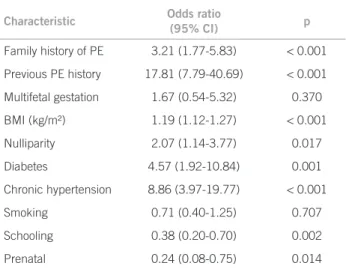
signiicantly associated with hypertensive disease in pregnancy while multifetal gestation, and smoking habits were not associated with this disorder. In the multivari-ate analysis, the association with the following variables remained statistically signiicant: family history of PE, diabetes, and chronic hypertension (Table 3).
DISCUSSION
he causes of hypertensive diseases in pregnancy are still uncertain, thus the efective primary prevention is not available in this stage4. However, several risk factors have
been identiied and modiication of some of these risk fac-tors might result in the decreasing of its frequency.
In our data, family history of PE, previous PE history, high BMI, nulliparity, diabetes, and chronic hypertension were signiicantly more frequent in patients when com-pared to the control group. In addition, schooling was less frequent in cases than in controls. Our results are similar to other studies in diferent populations3,11,12,16-19.Moreover,
the frequency of eclampsia and chronic hypertension with superimposed preeclampsia are according to other reports that investigated women with hypertensive diseases in pregnancy in a Brazilian population13,20,21.
As expected, multivariate analysis showed that family history of PE, diabetes and chronic hypertension are in-dependent risk factors for hypertensive diseases in preg-nancy. he family and the previous history of PE increased the risk for this complication in our patients. hese data have been reported in other studies12,19,21-23. Indeed, the
genetic component in pathophysiological abnormalities of preeclampsia has been suggested24-26. Preeclampsia was
reported to be more common in daughters of preeclamp-tic women27 and in pregnancies fathered by sons of
pre-eclamptic women28; this data suggest the involvement of
both maternal and fetal genes in the syndrome. Pregnant women with this history should be carefully monitored in the prenatal care and postpartum5.
High BMI was prevalent in both groups; however, the mean BMI was higher in hypertensive women, and it is a deinite risk factor for developing pregnancy-induced hypertensive disorders, including preeclampsia10. Risk
increases with BMI4,10, and the possible explanation is the
increased shear stress due to hyperdynamic circulation as-sociated with obesity3. he worldwide increase in obesity
is likely to raise the frequency of preeclampsia4. Our result
is in agreement with other Brazilian reports: Nucci et al.14
who showed that overweight nutritional status (obesity and pre-obesity) was associated with an increased risk for preeclampsia, Gaio et al.13 who identiied obesity as a risk
factor for preeclampsia/eclampsia and chronic hyperten-sion, and Assis et al.29 who demonstrated that obesity is a
risk factor for gestational hypertension and for preeclamp-sia superimposed on chronic hypertension. Actions in public health could prevent and/or treat obesity and, con-sequently, could prevent hypertensive disorders.
With regard to diabetes, Schmidt et al.30 conirmed
that gestational diabetes mellitus is independently as-sociated with preeclampsia in Brazilian women, and preexisting diabetes mellitus is also a risk factor for pre-eclampsia11. Women with preexisting chronic
hyperten-sion also have an increased risk of preeclampsia8,9,12,23,29.
Characteristic
Hypertensive disorders
n = 161
Control
n = 169 p
Family history of PE 44% 20% < 0.001
Previous PE history 57% 7% < 0.001
Multifetal gestation 6% 3% 0.530
BMI (kg/m²)* 32.9 ± 6.1 28.2 ± 4.6 < 0.001
Nulliparity 27% 22% 0.300
Diabetes 26% 6% < 0.001
Chronic hypertension 30% 5% < 0.001
Smoking 18% 23% 0.327
Schooling 34% 57% 0.003
Prenatal 88% 97% 0.007
PE, preeclampsia; BMI, body mass index; *Data are presented as mean ± SD or %.
Table 1 – Risk factors for hypertensive disorders in
pregnancy
Characteristic Odds ratio
(95% CI) p
Family history of PE 3.21 (1.77-5.83) < 0.001
Previous PE history 17.81 (7.79-40.69) < 0.001
Multifetal gestation 1.67 (0.54-5.32) 0.370
BMI (kg/m²) 1.19 (1.12-1.27) < 0.001
Nulliparity 2.07 (1.14-3.77) 0.017
Diabetes 4.57 (1.92-10.84) 0.001
Chronic hypertension 8.86 (3.97-19.77) < 0.001
Smoking 0.71 (0.40-1.25) 0.707
Schooling 0.38 (0.20-0.70) 0.002
Prenatal 0.24 (0.08-0.75) 0.014
PE, preeclampsia; BMI, body mass index.
Table 2 – Characteristics of women with hypertensive
disorders in pregnancy compared to normotensive women (univariate analysis)
Characteristic Odds ratio (95% CI) p
Family history of PE 3.88 (1.77-8.46) 0.001
Diabetes 3.87 (1.22 -12.27) 0.021
Chronic hypertension 7.05 (1.99-24.93) 0.002
PE, preeclampsia.
Table 3 – Characteristics of women with hypertensive
In the present study, diabetes, and particularly, preexisting chronic hypertension were risk factors for preeclampsia in Southern Brazilian women. hus, actions in the public health focused to prevent these diseases are important to also prevent preeclampsia.
Generally, PE is regarded as a disease of irst preg-nancy and its frequency ranges between 2% and 7% in healthy nulliparous women31. Nulliparity is well
estab-lished as a risk factor for hypertensive disorders in preg-nancy3,11. In this study, nulliparity was conirmed as a risk
factor in the conditional logistic regression analysis. Nul-liparous women have a two-fold increase in the risk of developing hypertensive disorders in pregnancy.
On the other hand, there were no signiicant difer-ences in multifetal gestation and smoking habits, char-acteristics that were described in some reports as risk factors3,11,32,33.Multiple pregnancy doubles the risk of
pre-eclampsia11,17; however, in our indings this association
was not established, likely due to low number of cases in both groups of subjects associated with a reduced sample size as a whole. Extremes of maternal age cannot be dem-onstrated as a risk factor in our study since our sample is matched by age; nevertheless, it is an established risk factor for PE3. A curious but consistent inding is that
women who smoke cigarettes have a lower risk of PE
than women who do not smoke27. However, this beneit is
cancelled out by the substantial negative efect of smok-ing on fetal growth, risk of placental abruption, and gen-eral health. In our population, this “protective” efect was not observed.
Regardless of the indicator of social deprivation, we found that low educational level was signiicantly more frequent in the group of cases. Haelterman et al.33 showed
that the burden of PE is concentrated in socially disad-vantaged women, thus health services should be more responsive to the speciic needs of these women. In our study, we found the protective efect of the prenatal care and its importance cannot be refuted. In the prenatal care the following factors are analyzed, among others: schooling, familiar and previous history of hyperten-sion and diabetes, number of pregnancies, and smoking. Some of these factors were demonstrated to inluence the development of hypertensive disorders in pregnancy. Women who are adequately assisted can detect earlier these possible risk factors; therefore, they can assume preventive actions, decreasing the chance of developing the disease. Our results show that women who do not received prenatal care have a four-fold increase in the risk of developing hypertensive disorders in pregnancy. To our knowledge, this is the irst study which reported this association in Brazil. A previous study realized in a Brazilian population revealed that low degree of school-ing and socioeconomic status are factors that hinder access to prenatal care31,34. Investments in public health
intended to improve the prenatal access, mainly in the group of women with low schooling and socioeconomic status, can decrease the levels of hypertensive disorders of pregnancy in our population.
CONCLUSION
In conclusion, the present study conirmed that family and previous history of PE, high BMI, diabetes and chronic hypertension are more frequent in patients with hyperten-sive disorders in pregnancy. heir frequencies appear to be similar to those reported in North American3 and
Eu-ropean11 women, and our results relect behavioral factors
whereby women may be predisposed to increased risk of PE. Hypertensive disorders and their complications are the most common cause of maternal death in Latin America and Caribbean37-39. he knowledge of important risk
fac-tors in our population could be useful to help the clinician to detect pregnant women who will develop preeclampsia. Prevention of hypertensive diseases in pregnancy would mean a huge step forward in prenatal care and, assuming that efective prenatal is available, it may have greater po-tential in the treatment of these diseases.
REFERENCES
1. Roberts JM, Pearson G, Cutler J, Lindheimer M. Summary of the NHLBI working group on research on hypertension during preg-nancy. Hypertension. 2003;41:437-45.
2. American College of Obstetricians and Gynecologists. Hypertension in pregnancy. ACOG Technical Bulletin N. 219. Washington (DC): he College; 1996. p. 1-8.
3. Sibai BM, Dekker G, Kupferminc M. Pre-eclampsia. Lancet. 2005;365:785-99.
4. Dekker G, Sibai B. Primary, secondary, and tertiary prevention of preeclampsia. Lancet. 2001;357:209-15.
5. Dekker GA, Sibai BM. Early detection of preeclampsia. Am J Obstet. 1991;165:160-72.
6. Caritis S, Sibai BM, Hauth J, Lindheimer MD, Klebanof M, hom E, et al. Low-dose aspirin to prevent pre-eclampsia in women with high risk. N Engl J Med. 1998;338:701-5.
7. Hnat MD, Sibai BM, Caritis S, Hauth J, Lindheimer MD, MacPher-son C, et al. National Institute of Child Health and Human Devel-opment Network of Maternal-Fetal Medicine-Units. Perinatal out-come in women with recurrent preeclampsia compared with women who developed preeclampsia as nulliparous. Am J Obstet Gynecol. 2002;186:422-36. Erratum in: Am J Obstet Gynecol. 2003;189:244. 8. Sibai BM, Hauth J, Caritis S, Lindheimer MD, MacPherson C,
Kle-banof M, et al. Hypertensive disorders in twin versus singleton ges-tations. Am J Obstet Gynecol. 2000;182:938-42.
9. Wen SW, Demissie K, Yang Q, Walker MC. Maternal morbid-ity and obstetric complications in triplet pregnancies and quadru-plet and higher-order multiple pregnancies. Am J Obstet Gynecol. 2004;191:254-58.
10. O’Brien TE, Ray JG, Chan WS. Maternal body mass index and the risk of: a systematic overwiew. Epidemiology. 2003;14:368-74. 11. Pipkin FB. Risk factors for preeclampsia. N Engl J Med. 2001;12:925-6. 12. Lykke JA, Langhof-Roos J, Sibai BM, Funai EF, Triche EW, Paidas
MJ. Hypertensive pregnancy disorders and subsequent cardiovascu-lar morbidity and type 2 diabetes mellitus in the mother. Hyperten-sion. 2009;53:944-51.
14. Nucci LB, Schmidt MI, Duncan BB, Fuchs SC, Fleck ET, Britto MMS. Nutrional status of pregnant women: prevalence and associated pregnancy outcomes. Rev Saúde Pública. 2001;35:502-7.
15. American College of Obstetricians and Gynecologists. ACOG prac-tice bulletin. Diagnosis and management of preeclampsia and ec-lampsia. Number 33, January 2002. Obstet Gynecol. 2002;99:159-67. 16. McCowan LM, Buist RG, North RA, Gamble G. Perinatal morbidity
in chronic hypertension. Br J Obstet Gynaecol. 1996;103:123-9. 17. Ros HS, Cnattingius S, Lipworth L. Comparison of risk factors for
pre-eclampsia and gestational hypertension in a population-based cohort study. Am J Epidemiol. 1998;147:1062-70.
18. Gonzáles AL, Ulloa GG, Alpuche G, Romero ARF. Risk fac-tors for preeclampsia. Multivariate analysis. Ginecol Obstet Mex. 2000;68:357-62.
19. Hutcheon JA, Lisonkova S, Joseph KS. Epidemiology of pre-eclamp-sia and the other hypertensive disorders of pregnancy. Best Pract Res Clin Obstet Gynaecol. 2011;25:391-403.
20. Kahhale IS, Zugaib M. Síndromes hipertensivas na gravidez. Rio de Janeiro: Atheneu; 1995. p. 115-26.
21. Araujo FM, Duarte G, Nomelini J, Lôbo RB, Ramos ES. Familial oc-currence of gestational hypertensive disorders in a Brazilian popula-tion. Hypertens Pregnancy. 2007;26:357-62.
22. Sibai BM. Risk factors, pregnancy complications, and prevention of hypertensive disorders in women with pregravid diabetes mellitus. J Matern Fetal Med. 2000;9:62-5.
23. Bezerra PC, Leão MD, Queiroz JW, Melo EM, Pereira FV, Nóbrega MH, et al. Family history of hypertension as an important risk fac-tor for the development of severe preeclampsia. Acta Obstet Gynecol Scand. 2010;89:612-7.
24. Arngrimsson R, Bjornsson S, Geirsson RT, Bjornsson H, Walker JJ, Snaedal G. Genetic and familial predisposition to eclampsia and pre-eclampsia in a deined population. Br J Obstet Gynaecol. 1990;97:762-69.
25. Chesley LC, Cooper DW. Genetics of hypertension in pregnancy: pos-sible single gene control of pre-eclampsia and eclampsia in the descen-dents of eclamptic women. Br J Obstet Gynaecol. 1986;93:898-908. 26. Mütze S, Rudnik-Schöneborn S, Zerres K, Rath W. Genes and the
preeclampsia syndrome. J Perinat Med. 2008;36:38-58.
27. Cooper DW, Hill JA, Chesley LC, Bryans CI. Genetic control of susceptibility to eclampsia and miscarriage. Br J Obstet Gynaecol. 1988;95:644-53.
28. Esplin MS, Fausett MB, Fraser A, Kerber R, Mineau G, Carrillo J, et al. Paternal and maternal components of the predisposition to preeclampsia. N Engl J Med. 2001;344:867-72.
29. Assis TR, Viana FP, Rassi S. Study on the major maternal risk fac-tors in hypertensive syndromes. Arq Bras Cardiol. 2008;91:11-7. 30. Schmidt MI, Duncan BB, Reichelt AJ, Branchtein L, Matos MC,
Costa e Forti A, et al. Gestational diabetes mellitus diagnosed with a 2-5h 75-g oral glucose tolerance test and adverse pregnancy out-comes. Diabetes Care. 2001;24:1151-5.
31. Audibert F, Boucoiran I, An N, Aleksandrov N, Delvin E, Bujold E, et al. Screening for preeclampsia using irst-trimester serum mark-ers and uterine artery Doppler in nulliparous women. Am J Obstet Gynecol. 2010;203:383.
32. Einarsson JI, Sangi-Haghpeykar H, Gardner NO. Sperm exposure and development of preeclampsia. Am J Obstet. 2003;188:1241-43. 33. Haelterman E, Qvist R, Barlow P, Alexander S. Social deprivation
and poor access to care as risk factors for severe pre-eclampsia. Eur J Obstet Gynecol Reprod Biol. 2003;111:25-32.
34. Conde-Agudelo A, Belizan JM. Risk factors for pre-eclampsia in a large cohort of Latin American and Caribbean women. Br J Obstet Gynaecol. 2000;107:75-83.
35. Halpern R, Barros FC, Victora CG, Tomasi E. Prenatal care in Pelotas. Rio Grande do Sul, Brazil, 1993. Cad Saúde Pública. 1998;14:487-92.
36. Fernandes RAQ. Estudo da morbimortalidade materna e perinatal e a qualidade da assistência pré-natal. Rev Paul Enferm. 2001;20:57-67. 37. Khan KS, Wojdyla D, Say L, Gülmezoglu AM, Van Look PF. WHO
analysis of causes of maternal death: a systematic review. Lancet. 2006;367:1066-74.
38. Vega CE, Kahhale S, Zugaib M. Maternal mortality due to arterial hypertension in São Paulo city (1995-1999). Clinics. 2007;62:679-84. 39. Kale PL, Costa AJ. Maternal deaths in the city of Rio de Janeiro,