267
ABSTRACT
BACKGROUND AND OBJECTIVES: Verbal investigation is a critical step of nursing neurological evaluation of neuropathic pain patients, due to its multidimensionality. here are few stud-ies in the literature speciically dealing with this subject. In light of the above, this study aimed at evaluating medical records on clinical topographic characteristics of neuropathic pain reported by patients from a multidisciplinary management center. METHODS: his is a documental, crossover and quantitative study evaluating 50 medical records of patients with established neuropathic pain diagnosis who came for routine consultations between January and June 2014. Data collection form was based on McGill Pain Questionnaire and data regarding age, gender, pain topography and presence of verbal descriptors were ana-lyzed. Data were submitted to statistical analysis and Chi-square test was applied to compare association among variables. RESULTS: here has been prevalence of females (64%), with mean age of 57 years. Most common pain descriptors were from the sensory dimension and were associated to cases where neu-ropathy afected lower limbs (p=0.006).
CONCLUSION:here has been association between topogra-phy and pain dimension. Due to the subjectivity and complexity involving neuropathic pain evaluation, it is necessary to under-stand its clinical manifestations and to prepare the whole multi-disciplinary team, especially Nursing, which plays a critical role in verbal investigation of painful patients.
Keywords: Nervous system diseases, Neurological evaluation, Neuropathic pain, Nursing, Pain clinics, Pain measurement.
Clinical topographic analysis of neuropathic pain in patients admitted in
a center of multidisciplinary treatment*
Análise clínico-topográfica da dor neuropática de pacientes admitidos em um centro de
tratamento multidisciplinar
David Ribeiro dos Santos1, Adriana do Carmo Gentil Fornel1, Ana Flávia Bezerra1, Janaína Duarte1, Stela Márcia Draib Gervásio1
*Received from the Institute of Health Sciences, Paulista University, São José dos Campos, SP, Brazil.
1. Paulista University, Nursing Course, São José dos Campos, SP, Brazil.
Submitted in September 19, 2014.
Accepted for publication in November 05, 2014. Conlict of interests: None – Sponsoring sources: none.
Correspondence to: David Ribeiro dos Santos
Rodovia Presidente Dutra, km 157,5 - Bairro Jardim Limoeiro 12240-420 São José dos Campos, SP, Brasil.
E-mail: [email protected]
© Sociedade Brasileira para o Estudo da Dor
RESUMO
JUSTIFICATIVA E OBJETIVOS: A investigação verbal é uma etapa fundamental do exame neurológico do enfermeiro na aval-iação do paciente com dor neuropática, dada à sua multidimen-sionalidade. Na literatura, poucos são os trabalhos que lidam especiicamente com esse tema. Diante disso, o objetivo deste es-tudo foi analisar registros em prontuários sobre as características clínico-topográicas da dor neuropática relatadas por pacientes de um centro de tratamento multidisciplinar.
MÉTODOS: Estudo documental, transversal, de natureza quantitativa. Analisaram-se 50 prontuários de pacientes com diagnóstico estabelecido de dor neuropática que compareceram para consultas de rotina entre janeiro e junho de 2014. Utilizou-se formulário para coleta de dados baUtilizou-seado no Questionário de Dor McGill e foram analisados dados referentes a idade, gênero, topograia da dor e presença de descritores verbais. Os dados foram submetidos a análise estatística e aplicou-se teste de Qui-quadrado para comparar a associação entre as variáveis.
RESULTADOS: Prevaleceram pacientes do gênero feminino (64%), com média de 57 anos. Os descritores de dor mais cita-dos foram da dimensão sensorial e se associaram aos casos em que a neuropatia atingia os membros inferiores (p=0,006). CONCLUSÃO: Foi observada uma associação entre topograia e dimensão da dor. Em virtude da subjetividade e complexidade que envolvem a avaliação da dor neuropática, faz-se necessário o conhecimento das suas manifestações clínicas e o preparo de toda a equipe multidisciplinar, sobretudo da Enfermagem, que des-empenha papel fundamental na condução da investigação verbal do paciente com dor.
Descritores: Clínicas de dor, Dor neuropática, Doenças do sistema nervoso, Enfermagem, Exame neurológico, Mensura-ção da dor.
INTRODUCTION
According to the International Association for the Study of Pain (IASP), pain is deined as unpleasant sensory and emo-tional experience associated to real or potential injury1. Pain is reported since the early days of mankind; however its deini-tion has gone through signiicant chances until current days. Currently, pain may be seen as a multidimensional phenom-enon involving physiologic, sensory, afective and cognitive
Rev Dor. São Paulo, 2014 oct-dec;15(4):267-70 ORIGINAL ARTICLE
268
Santos DR, Fornel AC, Bezerra AF, Duarte J and Gervásio SM
Rev Dor. São Paulo, 2014 oct-dec;15(4):267-70
aspects and its evaluation shall involve detection, qualiica-tion and measurement of all these dimensions2.
As a function of its nature, pain may be classiied as nocicep-tive or neuropathic. he former is caused by the activation of peripheral nociceptors, with natural physiologic transduction and recognized modulation3. Neuropathic pain is a conse-quence of injuries or diseases afecting somatosensory nervous system with consequent central impairment of information processing and, for such, its symptoms go beyond the physi-cal healing period of such injuries and may be associated to motor, psychic, neuroendocrine and neurovegetative deicits4. To identify individuals with neuropathic pain requires ap-proaches involving verbal investigation by means of pain de-scriptors5. he analysis of such descriptors is a stage of nurs-ing neurological evaluation and, in the literature, there are few studies speciically dealing with this subject under neuro-pathic pain patients’ perspective, considering that such proce-dure is not exclusively object of neurologists, but it is also part of the multiprofessional physical evaluation6.
So, this study aimed at analyzing clinical topographic neu-ropathic pain characteristics, reported by patients of a mul-tidisciplinary treatment center during neurological evalua-tion, and at discussing available scientiic literature results. he analysis of the deined proile provides subsidies for the planning of health actions based on prevalence of cases, as well as contributes for the technical-scientiic knowledge of health professionals, especially those involved with pain man-agement.
METHODS
This is a documental, crossover, descriptive and quantita-tive research carried out in a small-sized multidisciplinary pain management clinic located in the city of São José dos Campos, SP, were the vast majority of patients are private or referred by health insurance and who are followed by profes-sionals of the following specialties: Neurology, Orthopedics, Nursing, Chiroacupuncture, Physiotherapy, Psychology and Nutrition.
Data were collected during three weeks of the month of July 2014, by analyzing medical records of 50 adult patients, of both genders, belonging to the clinic database, randomly and sequentially selected. All patients had established diagnosis of neuropathic pain and had their anonymity preserved, being medical records data used only for statistical purposes. A form was developed, based on McGill Pain Questionnaire, which is a validated inventory with 78 descriptors organized in 4 dimensions: sensory, afective, evaluative and mixed7. his form had patients’ identiication data and data regard-ing age, gender, pain topography and presence of neuropathic pain verbal descriptors.
Descriptive and inferential statistical analyses were used. he software GrapPad Instat for Windows, version 3.0 was used for descriptive analysis, where the numerical variable age was evaluated by means of descriptive measures of central-ity (mean and median) and of dispersion (minimum,
maxi-mum and standard deviation). Categorical variables (gender, pain topography and verbal descriptors) were expressed in percentages, absolute and relative frequencies. he software RStudio, version 0.98.1028 was used for inferential analysis where Chi-square test of linear trend was used to compare the association between pain topography and dimension, with statistical signiicance of p<0.05.
his study was approved by the Research Ethics Committee, Paulista University, under process 31382214.0.0000.5512.
RESULTS
From 50 patients meeting inclusion criteria, 64% (n=32) were females. Age has varied from 22 to 91 years with mean of 57.3±14.2 years.
With regard to verbal investigation, figure 1 shows the sce-nario of pain descriptors, allocated according to their di-mensions. In cases where patients have reported two or more descriptors, all of them were considered since different pain modalities may be present according to the type of affected fiber.
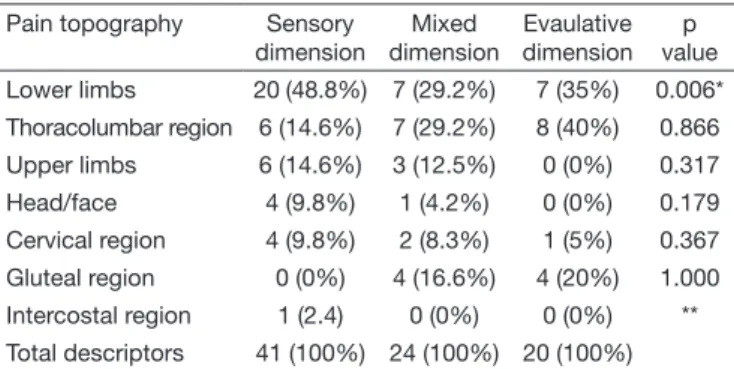
When investigating the association between pain topography and dimension, results have shown that sensory dimension descriptors are associated to patients with LLLL neuropathic pain, as shown in table 1. To conirm such hypothesis,
Chi-Sensory dimension Mixed dimension
14.1% (n = 12)
14.1% (n = 12)
3.5% (n = 3)
12.9% (n = 11) 8.2%
(n = 7)
1.2% (n = 1)
1.2% (n = 1) 7.0%
(n = 6)
23.5% (n = 20) Evaluative dimension
Tingling pain
25.00%
20.00%
15.00%
10.00%
5.00%
0.00%
Bur
ning pain Itchy pain Numb pain Tugging pain
Thr
obbing pain Pressing pain Flashing pain Radiating pain
Intense/unbearable pain
14.1% (n = 12)
Figure 1. Neuropathic pain descriptors identiied in the sample (n=85)
Table 1. Clinical topographic association of pain and p values obtai-ned by Chi-square test (p<0.05)
Pain topography Sensory dimension
Mixed dimension
Evaulative dimension
p value Lower limbs 20 (48.8%) 7 (29.2%) 7 (35%) 0.006* Thoracolumbar region 6 (14.6%) 7 (29.2%) 8 (40%) 0.866 Upper limbs 6 (14.6%) 3 (12.5%) 0 (0%) 0.317 Head/face 4 (9.8%) 1 (4.2%) 0 (0%) 0.179 Cervical region 4 (9.8%) 2 (8.3%) 1 (5%) 0.367 Gluteal region 0 (0%) 4 (16.6%) 4 (20%) 1.000 Intercostal region 1 (2.4) 0 (0%) 0 (0%) ** Total descriptors 41 (100%) 24 (100%) 20 (100%)
269
Clinical topographic analysis of neuropathic pain in patients admitted in a center of multidisciplinary treatment
Rev Dor. São Paulo, 2014 oct-dec;15(4):267-70
square test of linear trend was applied with comparison free-dom level of 2. Chi-square value (x2) corresponded to 9.9412, being higher than critical Chi-square (x2c=0.103).
DISCUSSION
In recent years, the choice of multidisciplinary pain manage-ment clinics as alternative for traditional chronic pain man-agement is becoming popular. However, information about users of such health service is still scarce in scientiic studies8. he interaction between diferent knowledge and patients’ multidisciplinary approach in pain clinics positions them as active subjects in the therapeutic process and provides a holis-tic vision to professionals, which makes clinical information more detailed and the diagnosis faster9.
In our study, the sample has shown predominance of females, which reinforces the hypothesis of previous studies which have evidenced higher neuropathic pain prevalence among females6,10-12. Hormonal diferences, easiness to verbalize pain and lower tolerance to pain may explain such results6. It is consensus in the literature that longevity progressively and proportionally increases the risk for chronic pain10,13, which is in line with our results, which have shown sample age distribution with mean of 57 years. This prevalence may be associated to labor activities or to the aging process, which increases the risk of developing chronic-degenerative diseases14.
With regard to verbal investigation to screen pain descriptors, the form based on the McGill Pain Questionnaire was used because it is a multidimensional and validated tool which allows characterizing and separating pain afective, sensory, evaluative and mixed dimensions7. In our study, 10 descrip-tors were reported by the sample and this broad spectrum of qualiications reinforces the complexity of pain, as well as its individuality. Six from 10 reported descriptors belong to the sensory dimension. From these, there has been prevalence of tingling (14.1%) and burning (14.1%) symptoms which are attributed to the aggression to thin type C and A-delta ibers, respectively. hese results conirm previous studies on the subject6,15.
According to verbal investigation data, a heterogeneous pain verbal qualiication group was identiied; however, the topo-graphic pattern was more homogeneous. As to body location of pain, there has been predominance of LLLL (48.78%). Similarly to this study, pain pattern in the distal portion of lower extremities has been referred by several authors as clini-cal presentation typiclini-cal of neuropathy16,17.
Up to now, there were no scientific studies in the literature trying to associate topographic patterns seen in the neu-rological exam and neuropathic pain descriptors reported during patients’ verbal investigation in multidisciplinary management centers. Our study has identified that sensory dimension is frequently associated to cases where neuro-pathic pain affects LLLL. For being poorly explored data, such hypothesis was submitted to statistical analysis and was significantly proven, showing that deviations were not due
to chance.
Considering this association, it is possible to infer that spi-nothalamic tract, pathway responsible for the transmission of sensory dimension painful information to thalamus and cortex18, had prevailing action on LLLL neuropathies afect-ing the sample, conigurafect-ing symptoms of tafect-inglafect-ing, burnafect-ing, tugging, lashing, itchy and throbbing pain.
Neurological evaluation knowledge and understanding, as part of physical evaluation, are key for the diagnosis of neu-ropathic pain. Traditionally, every health professional should recognize patients experiencing pain; however, some profes-sionals, such as nurses, should develop integral assistance to painful patients, to make feasible a multiprofessional care19. In light of such responsibility, subsidies to understand neuro-pathic pain in its diferent dimensions should be incorporated to clinical practice to guide diagnostic evaluation and assure the correct assistance direction20.
CONCLUSION
Notwithstanding the limitations of a small sample size, this study has identiied an association between pain topography and dimension. Another relevant data is the similarity ob-served between patients looking for multidisciplinary treat-ment in specialized clinics and those users of traditional pain ambulatories.
Due to subjectivity and complexity involving neuropathic pain evaluation, it is necessary to know its clinical manifesta-tions and to prepare the whole multidisciplinary team, espe-cially Nursing, who plays a critical role in verbal investigation of painful patients.
REFERENCES
1. Sociedade Brasileira para Estudo da Dor (SBED). Projeto Hospital sem dor: diretrizes para implantação da dor como 5º sinal vital. J Dor. 2005;2(16):1-7.
2. Silva JA, Ribeiro-Filho NP. A dor como um problema psicofísico. Rev Dor. 2011;12(2);138-51.
3. Rocha AP, Kraychete DC, Lemonica L, Carvalho LR, Barros GA, Garcia JB, et al. Dor: aspectos atuais da sensibilização periférica e central. Rev Bras Anestesiol. 2007;57(1):94-105.
4. Kraychete DC, Gozzani, JL, Kraychete AC. Dor neuropática: aspectos neuroquími-cos. Rev Bras Anestesiol. 2008;58(5):492-505.
5. Loeser JD. Avaliação médica do paciente com dor. In: Alves Neto O, Costa CMC, Siqueira JTT, Teixeira MJ (colaboradores). Dor: princípios e prática. Porto Alegre: Artmed; 2009. 355-69p.
6. Resende MA, Nascimento OJ, Rios AA, Quintanilha G, Sacristan Ceballos LE, Araú-jo FP. Peril da dor neuropática: a propósito do exame neurológico mínimo de 33 pacientes. Rev Bras Anestesiol. 2010;60(2):144-53.
7. Varoli FR, Pedrazzi V. Adapted version of the McGill pain questionnaire to Brazilian Portuguese. Braz Dent J. 2006;17(4):328-35.
8. Forni JE, Martins MR, Rocha CE, Foss MH, Dias LC, Santos Junior R, et al. Peril sócio-demográico e clínico de uma coorte de pacientes encaminhados a uma Clinica de Dor. Rev Dor. 2012;13(2):147-51.
9. Lima MA, Trad LAB. “Circuloterapia”: uma metáfora para o enfrentamento da dor crônica em duas clínicas de dor. Physis. 2011;21(1):217-36.
10. Bouhassira D, Lantéri-Minet M, Attal N, Laurent B, Touboul C. Prevalence of chronic pain with neuropathic characteristics in the general population. Pain. 2008;136(3):380-7.
11. Palmer KT, Harris EC, Coggon D. Carpal tunnel syndrome and its relation to occu-pation: a systematic literature review. Occup Med (Lond). 2007;57(1):57-66. 12. Jenkis PJ, Watts AC, Duckworth AD, McEachan JE. Socioeconomic deprivation and
the epidemiology of carpal tunnel syndrome. J Hand Surg Eur Vol. 2012;37(2):123-9. 13. Lu B, Yang Z, Wang M, Yang Z, Gong W, Yang Y, et al. High prevalence of diabetic
270
Santos DR, Fornel AC, Bezerra AF, Duarte J and Gervásio SM
Rev Dor. São Paulo, 2014 oct-dec;15(4):267-70
downtown. Diabetes Res Clin Pract. 2010;88(3):289-94.
14. Sá K, Baptista AF, Matos MA, Lessa I. Prevalência de dor crônica e fatores associados na população de Salvador, Bahia. Rev Saúde Pública 2009;43(4):622-30.
15. Bouhassira D, Attal N, Fermanian J, Alchaar H, Gautron M, Masquelier E, et al. Development and validation of the Neuropathic Pain Symptom Inventory. Pain. 2004;108(3):248-57.
16. Schestatsky P. Deinição, diagnóstico e tratamento da dor neuropática. Rev HCPA. 2008;28(3):177-87.
17. daCosta DiBonaventura M, Cappelleri JC, Joshi AV. A longitudinal assessment of
painful diabetic peripheral neuropathy on health status, productivity, and health care utilization and cost. Pain Med. 2011;12(1):118-26.
18. Pereira LV, Sousa FA. Categorização de descritores da dor pós-operatória nas dimen-sões sensitiva, afetiva e avaliativa da experiência dolorosa. Rev Lat Am Enfermagem. 2007;15(4):563-7.
19. Nascimento LA, Kreling MC. Avaliação da dor como quinto sinal vital: opinião de proissionais de enfermagem. Acta Paul Enferm. 2011;24(1):50-4.