OF THE EXECUTIVE COMMITTEE
32nd Session, 25-26 March 1999
Provisional Agenda Item 8 SPP32/8 (Eng.)
26 February 1999 ORIGINAL: ENGLISH
HEALTH AND ITS CONTRIBUTION TO POVERTY ALLEVIATION
This document examines the relationship between poverty and health in Latin America and the Caribbean with the purpose of promoting a more relevant role for the health sector in the formulation and implementation of multisectoral anti-poverty strategies at regional and national levels. It introduces the conceptual basis of the mutual relation between poverty and ill health, focuses on the relation between poverty and health situation, and examines the impact of poverty on health care access and financing. It summarizes recent initiatives aimed at protecting the health of the poor in the Americas and provides an account of the work PAHO/WHO has carried out in this field, indicating some anti-poverty health policy priorities that PAHO should support its Member States to formulate and implement.
CONTENTS
Page
Executive Summary ...3
1. Introduction...5
2. Health Situation and Poverty ...8
3. Health Care Access and Financing Implications for the Poor... 10
4. Initiatives Focusing on the Health of the Poor in the Americas ... 12
4.1 United Nations Development Program (UNDP) ... 14
4.2 World Bank... 14
4.3 Inter-American Development Bank (IDB) ... 15
4.4 Agency for International Development (USAID)... 15
4.5 Swedish International Development Agency (SIDA) ... 15
4.6 Rockefeller Foundation ... 15
5. PAHO/WHO Support to Pro-Poor Health Policies... 15
5.1 Situation Analysis ... 16
5.2 Policy Analysis, Advocacy and Development... 16
5.3 Research Promotion ... 16
5.4 Dissemination of Information ... 16
EXECUTIVE SUMMARY
Most countries in Latin America and the Caribbean are continuously grappling with the challenges of reforming their health care systems in response to changing economic factors, increasing health care demands, escalating health care costs, resource limitations, and the inability of a substantial section of the population to afford good quality care. Many of the current reform efforts are driven by the perceived urgency of improving the effectiveness and the efficiency of the health sector. In this environment, it is even more necessary to redress existing inequalities in health status and health care utilization and financing, and to ensure that the reform does not increase the inequities affecting especially those who are most vulnerable in society.
Poverty has been defined as the inability to attain a minimal standard of living, due to lack of sufficient income, assets, and other capabilities. The relation between poverty and health was established a long time ago. Although improvement of the health conditions of a population should in principle help to reduce poverty, this connection is not always recognized. Poverty is commonly measured by the so-called poverty line, which represents the income level required to meet the basic needs of household members.
The Americas has the highest income inequality among the various regions of the world. The pattern of income concentration has experienced quite different trends over the last three decades. ECLAC data show that the Gini coefficient increased in two thirds of Latin American countries over the last two decades, indicating that income distribution worsened in that period. Other conditions affecting the poor also deteriorated during the 1990s. Several studies have shown that, worldwide, the poor generally have a higher burden of disease and higher death rates than the non-poor, in spite of rising average income or public health and other policy interventions designed to reduce such inequalities in the respective societies.
Because of their greater morbidity and risk of mortality, poor people have greater need of health care services. However deprivation makes it difficult for poor people to gain access to services. Even when they gain access, it is more difficulty for them to recover from illness due to their poorer nutritional and immunological status and living conditions. Moreover, health services are of poor quality in areas serving the poor. All these have implications for the ability of the poor to afford the cost of adequate health care.
the relations between poverty and health or advocating pro-poor health policies. Country-based initiatives usually involve health sector or multisectoral activities targeting the poor.
PAHO/WHO has worked on poverty and health issues over recent years, as part of its effort to promote equity in health and health care. For some of these activities poverty and health issues are the central objective while for others, the topic is of implicit concern. Activities have included situation analysis, policy advocacy and development, training, research promotion, and information dissemination.
Both PAHO and WHO are placing equity in health and poverty issues among their priorities for the near future. The need to establish pro-poor health priorities is predictably greatest in those societies with more inequity and fewer resources, as in Latin America and the Caribbean. As a means to realize its objective, PAHO should support its Member States in the formulation, implementation, and evaluation of anti-poverty health policies focused on:
Ÿ improving measurement of health inequalities among socioeconomic groups;
Ÿ identifying specific health problems of the poor for concerted attack;
Ÿ targeting public subsidies in health care to the benefit of the poor;
Ÿ assessing the poverty reduction impact of specific health interventions;
Ÿ mobilizing NGO support for more and better health care for the poor;
Ÿ empowering the poor through the promotion of their health;
1. Introduction
Most Latin American and Caribbean countries are now reforming their health sector in response to increasing demands, escalating costs, resource limitations and the lack of access to good quality care of many of their citizens. In addition to improving the health sector effectiveness and efficiency, it is even more important to reduce inequalities in health status and health care utilization and financing, making sure that the reform does not penalize the most vulnerable social groups. The underlying assumptions are that health is an indicator of a population’s welfare1 and its improvement is key both to rectifying social inequalities and promoting economic development.2 Because of that, governments placing a high value on health intervene to correct market failures causing inequitable access to health care.3
Poverty has been defined as the inability to attain a minimal standard of living, due to lack of sufficient income, assets and other capabilities.4 It is commonly measured by the poverty line, representing the income level required to meet the basic needs of household members. A household is poor when its members do not have sufficient income to buy a basket of staple food and other goods and services necessary to meet their basic needs. When their income is insufficient to cover even their minimum nutritional needs, the household members are considered to be extremely poor or indigent. The urban poverty line is usually 100% higher than the indigence line, but in rural areas this difference is just 75%.5 When estimated for individual countries, as ECLAC does for Latin America, these lines measure relative poverty. The World Bank estimates absolute poverty as an income lower than $370 per year—or $1 a day—for all countries of the world.
The Americas has the highest income inequality among the various regions of the world. Table 1 shows that the highest income quintile in Latin America has a larger share of national income than any comparable group in the world, while the reverse occurs with the other income quintiles. The ratio of the shares going to the highest and lowest income quintiles in the Region is between 1.8 and 2.7 times greater than that in
1 Townsend, P., N. Davidson, M. Whitehead. Inequalities in Health: the Black Report and the Health Divide.
Harmondsworth. Penguin, 1990; WHO, Health for All, 1990.
2 Sen, A., Mortality as an indicator of economic success and failure, Innocenti Inaugural Lecture, Florence, 1995;
Strauss, J. and Thomas, D., Human resource s and empirical modeling of household and family decisions, J. Behrman and T.N Srinavasan (ed.)Handbook of Development Economics, Amsterdam, Holland, 1996. World Bank, World Development Report, World Bank, 1993.
3 Gertler, P.J. and Rose, E. Collecting health information in multi-purpose household surveys, World Bank Workshop
on Increasing the Policy Relevance of LSMS surveys, World Bank, May 1997.
4 World Bank, World Development Report – 1990: Poverty, Washington, DC, 1990. Sen, A. K., Equality of What?, in
McMurrin, S. (ed.) The Tanner Lectures in Human Values. Volume 1, Cambridge University Press and University of Utah Press, 1980. Mesa-Lago, Carmelo, Health Care for the Poor in Latin America and the Caribbean, PAHO/Inter-American Foundation, PAHO Scientific Publication No. 539, 1992.
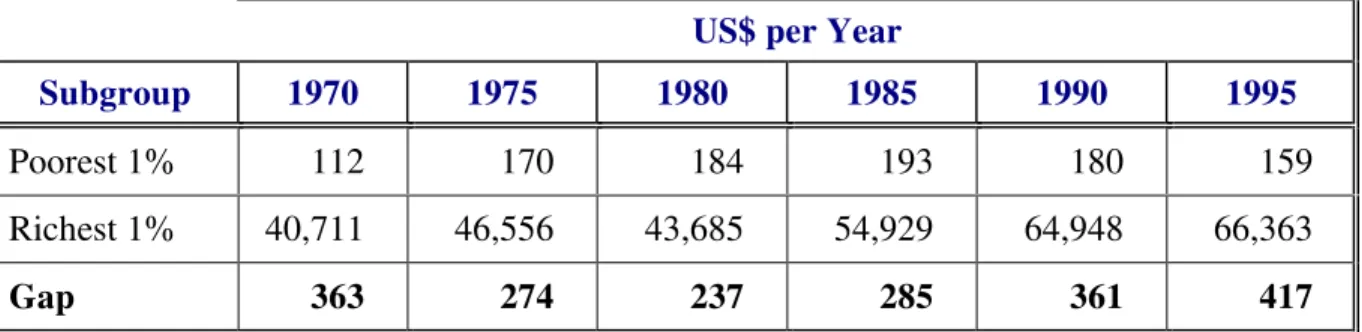
other regions. This pattern of income concentration has experienced quite different trends over the last three decades. As shown in Table 2, after decreasing by 35% from 1970 to 1980, the gap in purchasing power between the poorest and richest 1% of Latin America increased by 76% from 1980 to 1995.
Table 1: Income Distribution by Quintiles and Regions, 1990
Percentage by Region
Income Quintiles
North Africa Middle
East
Latin America
South Asia
South East Asia
Eastern Europe
OECD Countries
1 6.90 4.52 8.76 6.84 8.83 6.26
2 10.91 8.70 12.91 11.30 13.36 12.15
3-4 36.84 33.84 38.42 37.53 40.01 41.80
5 45.35 52.94 39.91 44.33 37.80 39.79
Gap 6.57 11.71 4.56 6.84 4.28 6.36
Source: Adapted from Deininger and Squire, Measuring income inequality - A new database, World Bank Economic Review, 1996
Table 2: Income Polarization in Latin America, 1970-1995
US$ per Year
Subgroup 1970 1975 1980 1985 1990 1995
Poorest 1% 112 170 184 193 180 159
Richest 1% 40,711 46,556 43,685 54,929 64,948 66,363
Gap 363 274 237 285 361 417
Source: Londoño, J. L. and Szekely, M., Persistent poverty and excess inequality: Latin America, 1970 -1995, IDB Working Paper Series # 357, 1997.
indicator between the highest and lowest income quartiles varies from 0.1 to 2.9. Despite a steady growth in a population's access to drinking water and basic sanitation, the cross-country polarization of this indicator continues to be very high, both for drinking water (0.1 to 1.9) and basic sanitation (1.2 to 7.1). At the same time, the percentage of women aged 20-24 years who had been pregnant during adolescence varied between 1% and 13% in the highest income quartile and between 31% and 83% in the poorest income quartile.6
The relation between poverty and health was established a long time ago. Poverty is a key determinant of the health status of individuals and communities. Poor people have fewer resources to spend on food, clothing or housing and other basic ingredients of well being. In addition, they also tend to have less access to education, sanitation and health care. Such deprivation makes them more vulnerable to illness and, once ill, less capable of recovering their health. Accordingly, to the extent that it is both avoidable and unjust, poverty-related ill health clearly constitutes an inequity.7
Ill health also contributes to poverty. A sick individual has a reduced capacity to work and tends to earn less than one who is healthy. Illness also causes young people to be less productive and to develop less work skills at school than healthy students. Under-educated workers cannot obtain well-paid jobs. Also illness in the household imposes additional burdens due to the cost of health care and medicines, particularly in the absence of appropriate coverage of health insurance or good quality publicly provided health care.
Despite the belief that improvement of the health conditions of a population should in principle help to reduce poverty, such an effect either receives a less than favorable recognition or is not recognized at all for at least two reasons. In the first place, because it is usually more concerned with combating ill health than with the broader socioeconomic consequences of better health, the health sector does not routinely assess and publicize its contributions to the reduction of social problems, such as poverty. Second, authorities and experts responsible for anti-poverty strategies do not always appreciate the impact of health on poverty alleviation in the favorable way they do those of education or employment, for example. Not surprisingly, the role ascribed to the health sector in multisectoral and anti-poverty strategies is often marginal and much more restricted than is to be expected.8
6 ECLAC, 1996, tables V.3, V.7 and V.9; ECLAC, 1997, tables V.3.4 and 23.
7 Whitehead, Margaret, The Concepts and Principles of Equity and Health, EURO/WHO, 1991.
8 Inter-American Development Bank, Economic and Social Progress in Latin America 1998-1999: Facing Up
2. Health Situation and Poverty
Several studies have shown that, worldwide, the poor generally have a higher burden of disease and higher death rates than the non-poor. One of the most celebrated studies on the history of health and poverty is the Black Report on health status in England.9 It showed that between 1930 and 1970 the gap in the death rates of the rich and the poor widened; and that unskilled and lower skilled persons were considerably more likely to die prematurely than their counterparts in the professional groups. Since then studies in other countries have confirmed that these inequalities have persisted or even increased, in spite of rising average income or public health and other policy interventions designed to reduce such inequalities in the respective societies.
What then is the critical “source” of the disparities in the health status of the poor and non-poor? Some studies focus on education.10 Other studies examine physical working conditions, actual labor market status, or factors related to occupational situation such as, the degree of stress or tedium.11 Yet other analysts single out income levels and income distribution.12 Others point to the peculiar influences of gender, race and culture. A health survey in the United States showed that health status in some communities mostly inhabited by black Americans is as low as that in some African countries with relatively high health outcomes.13 Yet it is not clear what is the “marker” and what is the “cause.” Do these factors independently explain variations in health status and more specifically health inequality? Is race linked to economic status?
Nevertheless, there is little disagreement about the more specific effects of poverty and deprivation on health outcomes. For example, it has been shown that countries with the smallest spread in income distribution and the lowest levels of poverty, such as Sweden, generally have longer life expectancy rates than countries that have higher GDP per capita but with larger income inequalities, such as the United States. This finding is supported by similar comparisons for Latin America.14 It is also known that the degree of affluence or poverty in household living conditions substantially affects
9 Black, Sir Douglas, J.N. Morris, C. Smith, P. Townsend. Black Report: Inequalities in Health. Penguin Books. 1982. 10Roisin, P., T.J. Peters, M. R. Robling. Factors associated with health behavior among mothers of lower
socioeconomic status: A British example. Social Science and Medicine. 1993; 36(9): 1137-1144.
11Ross, C., & Bird. Sex stratification and health life-style: Consequences for men and women’s perceived health.
Journal of Health and Social Behaviour. 1994; 35: 161; Blaxter, Mildred & Tavistock Routledge. Health and Lifestyles. London and New York. 1990; Arber, Sara. Comparing inequalities in women and men’s health: Britain in the 1990s. Social Science and Medicine , 1997; 44(6): 773-878; Bartley, M., L Carpenter, K. Dunnell, R. Fitzpatrick. Measuring inequalities in Health: An Analysis of Mortality Patterns using Social Classifications. Sociology of Health and Illness. 1996; Vol. 18(4).
12Quick, A. & R. Wilkinson. Income and Health. London, Socialist Medical Association. 1991; Duncan Greg. Income
Dynamics and Health. International Journal of Health Services. 1996; 26(3).
13Hahn, R., E. Baker, N. Barker, S. M. Teutsch, W.A. Sosniak, N. Krieger. Poverty and death in the US. International
Journal of Health. 1996; 26(4).
self-assessed health status.15 In the same way, the early impact of inadequate fetal development on later health status is linked to the material deprivations of the mother. In this way, early "life-programming" in conditions of deprivation and “continued socioeconomic disadvantage” are interactive and additive.16
In recent years there has been a great deal of attention on the possible role of life-style on ill health. This approach tends to encourage attention away from conditions of poverty, homelessness and other “negative” social arrangements.17 In fact, a number of studies clearly show that lower socioeconomic groups are more likely to engage in risky health behaviors.18 Accordingly, the adverse environment in which financially disadvantaged people live, especially during childhood, contributes to damaging risk factors.19 On the other hand, life-style factors such as smoking, obesity, physical inactivity, blood pressure and blood level cholesterol explain only 25% to 35% of employment differences in mortality.20 Finally, adjustment of risk factors such as smoking, cholesterol levels and physical inactivity reduced the effect of poverty on women by 46% but had no impact on men.21
Unfortunately, few studies in the Region present comparable data about health differences among social groups in each country. The most relevant among these studies are: (a) the Demographic and Health Surveys (DHS) sponsored by USAID covering 13 countries;22 (b) the Living Standards Measurement Surveys (LSMS) initiated by the World Bank, which are now available for 10 countries; 23 (c) the Survey of Poverty and Income Distribution initiated by the Inter-American Development Bank in Colombia and Barbados, and (d) the Poverty Assessments and the Social Sectors Survey in the Caribbean sponsored by the Caribbean Development Bank in Belize and the Eastern Caribbean countries.
The general trends emerging from these surveys may be crudely summarized as follows: (a) the poor are less healthy than the rich (based on DHS); (b) the poor are often less healthy and sometimes more healthy than the rich; (c) the poor are less likely than the rich to seek health care when they are sick; (d) while there are variations from country
15Arber, 1997.
16McIntyre, S. The Black Report and Beyond. Social Science and Medicine 1997, 44(6). 17Mechanic, D.
Social research in health and the American socio-political context. Social Science and Medicine. 36: 95-102.
18Hertzman, C.,
Where are the differences which make a difference, CIAR Population Health Working paper #8, 1996.
19Barley, M., Carpenter, L., Dunnell, K. and Fitzpatrick, R., Measuring inequalities in health: an analysis of mortality
patterns using social classifications, Sociology of Health and Illness 18 (4), 1996.
20Krieger, N. and Moss, N., Accounting for the public’s health: an introduction to selected papers from the U.S.A
Conference on Measuring Social Inequalities, International Journal of Health Services 20:3, 1996.
21Hahn, R., Baker, E., Baker, N., Sosniah, W.A. and Krieger, N., Poverty and death in the USA, International Journal
of Health Services, 20: 3, 1996.
22Bolivia, Brazil, Colombia, Dominican Republic, Ecuador, El Salvador, Guatemala, Haiti, Mexico, Nicaragua,
Paraguay, Peru and Trinidad and Tobago.
to country, the poor tend to seek care mostly at public facilities, the rich at private ones; and (e) government subsidies based on the use of public hospitals are often more pro-rich than pro-poor.
Insofar as they show differences or similarities in the health situation across the various socioeconomic groups in the population, the results from these surveys may be used to: (a) identify which social groups are suffering from health problems, engaging in risk behaviors and accessing health care; (b) decide whether and to what extent an intervention is urgent or otherwise; (c) direct interventions to prevent illness or promote health status of the entire population or its subgroups; (d) target health programs to protect more effectively those most vulnerable groups; and (e) assess the likely impact of programs on changing health outcomes and risky behaviors.
Provisional results from the PAHO/UNDP/World Bank/EquiLAC-IHEP Project show that the analysis of the links between poverty and health using household surveys poses some challenges related to sample size and specific measurement of health status.24 There is a case for increasing the sample size of these surveys and for using panel data. In addition, the fact that health is multidimensional makes the self-reported incidence of illness or injuries in household surveys their most questionable feature. Counter-intuitive results whereby the poor report less illness than the non-poor may be due to under reporting or presentation of illness at a relatively late stage, outside the survey period.
These mixed results of self-reported illnesses have already been flagged for attention through the reassessment of the surveys’ methodologies, since similar surveys in OECD countries have shown that self-reported and externally observed health status tend to correspond more closely. In order to overcome this problem, it may be necessary to use objective measures such as mortality, anthropometric status, directly observed physical functioning, clinical diagnosis, and observed activities of daily living (ADLs). A proposed study of health inequities in the Americas will use anthropometric measures stratified by socioeconomic, gender and geographic subgroups.25
3. Health Care Access and Financing Implications for the Poor
Because of their greater morbidity and risk of mortality, poor people have greater need of health care services. However deprivation makes it difficult for poor people to
24PAHO/UNDP/World Bank,
Equity, Poverty and Health in Latin America and the Caribbean – Final Report of the EQuiLAC-IHEP Project, Washington, DC, forthcoming, 1999; Campino, A.C.C., Diaz, M. D., Paulani, L.M., Oliveira, R.G., Piola, S. & Nunes, A., EquiLAC/IHEP Country Report: Brazil; Lasprilla, E., Granda, J.,Obando, C., Encalada, E. & Lasprilla, C., EquiLAC/IHEP Country Report: Ecuador; Theodore, K., Stoddard, D., Yearwood, A. & Thomas, W., EquiLAC/IHEP Country Report: Jamaica;Petrera, M., EquiLAC/IHEP Country Report: Peru; Barillas, E. & Valladares, R., EquiLAC/IHEP Country Report: Guatemala, PAHO/UNDP/World Bank, 1999.
25PAHO, Multi-Center Project Proposal on Inequities in Health and Health Care, Inter-Program Group on Equity and
gain access to services. Even when they gain access, it is more difficulty for them to recover from illness due to their poorer nutritional and immunological status and living conditions. Moreover, health services are of poor quality in areas serving the poor. All these have implications for the ability of the poor to afford the cost of adequate health care. In many respects constraints due to lack of financial access are as important as the lack of geographic or physical access to the services.
There are two inter-related problems of measurement in this area, i.e., the adequate estimation of utilization patterns and the distribution of public health expenditure to protect the poor. As to the first problem, household surveys do not obtain complete data on utilization and expenditure. Individuals, particularly those with serious illnesses, may have obtained treatment through multiple contacts with multiple providers. This leads to an underestimation of utilization patterns among the poor and explains why most LSMS data are studies of provider choice. In addition benefit incidence estimated on the basis of LSMS will possible show greater progressiveness in government expenditure because the unit of analysis is the household. However, since poor households tend to be larger than rich households, there may be need to correct for the pro-poor bias in the data.
There are marked differences in access and use of formal health care services— hospital, clinics, and doctors—among different social, economic and ethnic groups. The non-poor use as much public services as the poor, but much more private services than the poor. What is not clear is the extent to which utilization of health systems is based on perception rather than need. Bridging the gap between health need or perception and use of health services is dependent on the latter quality and coverage.
However, need by itself does not lead to demand for health care, since studies for Africa have shown that children from families in the higher socioeconomic groups are more likely to be taken to a medical facility and therefore be treated than are children from families in the lowest classes. According to LSMS reports, over half of the richest 20% received care for reported illnesses or injury compared with just one third of the poorest group. In the same way, DHS data in the 1980s show that 48% of educated women took their children for treatment compared with 34% of uneducated women.26
LSMS data for Latin America and the Caribbean indicate that 10%-18% of the poorest quintile use private health care providers. More poor than non-poor use public health facilities, and the distribution of expenditure shows that the net benefits of public health expenditure go more to the poor than to the non-poor. This experience is different from that of Africa where public hospitals and primary health care benefit more the rich and in Asia where only public hospitals have a pro-rich bias. However, for Latin
26Boerma, J.T., Sommerfelt, E. and Rustein, S.O., Childhood mortality and treatment patterns in Demographic and
American countries in particular, health services take a much smaller percentage of government expenditure than in Africa and Asia, possibly because health benefits from social security systems are much higher in the former..27 It may also be argued that since social security is concentrated on formal sector workers, this contributes to make the overall impact of government expenditure more regressive.
Household health care expenditures vary according to urban/rural location, affiliation to public and private insurance, report of illness, income level and sex and age composition. Although in general terms expenditure increases as the income level increases, the poorest quintile currently spends 7%-10% of its income to cover private health expenses. Due to their acute vulnerability to unanticipated ill-health shocks leading to unemployment, income loss and increased indebtedness, poor and even non-poor households may slip into hard core poverty.28 At the same time, the coping mechanisms adopted by poor households to the unanticipated health crisis tend to be mainly negative, including non-saving and assets sale.29
A more accurate targeting of the poor and a greater provision of public health care is necessary in order to relieve this burden on the poor. This in turn requires more systematic, country specific surveys assessing poor-rich differences in health care access and utilization, rationalizing health care delivery, measuring incidence benefits of government health care expenditure, and targeting publicly financed health services to those that are most in need.
4. Initiatives Focusing on the Health of the Poor in the Americas
There are many ongoing initiatives in the Region dealing with issues related to the health of the poor. A few of these initiatives are country-based, while international organizations, bilateral cooperation agencies or NGOs sponsor the others. The majority of the initiatives are devoted to analyzing the relations between poverty and health or advocating pro-poor health policies. Country-based initiatives usually involve health sector or multisectoral activities targeting the poor. Some of them have started as research projects, while others have been interventions specifically formulated to minimize the health impacts of poverty.
Among these initiatives, the social emergency funds were implemented in many countries from the mid-1980s to mitigate the undesirable social effects of structural adjustment programs. Once the emergency had been overcome, social investment funds
27PAHO/WHO,
Health in the Americas, Washington, 1998.
28Singh, B., Health and poverty in the context of development strategy: a case study of Bangladesh, in
Macroeconomics, Health and Development Series, no. 26, Geneva, World Health Organization, 1997.
29Whitehead, M., The Contribution of Health Policies and Improved Health to Poverty Alleviation and to the
would originate longer-term social safety nets. An initial assessment PAHO made of these experiences showed that their economic effectiveness was sometimes greater than their social and health impacts. In addition, the long-term sustainability of the funds was problematic, since their implementation was usually based on informal mechanisms and structures outside the existing government agencies.30
Bolivia and Jamaica were the first countries to undergo this experience and both taught many useful lessons to the rest of the Region. Bolivia once merged several ministries into a Ministry of Social Development and has targeted social programs to the elderly, mothers, and children. Jamaica has accumulated the longest and most consistent series of living standards household surveys that provide a rich flow of reliable data essential for formulating, implementing and evaluating innovative social policies. Other countries have introduced innovative approaches to poverty alleviation, such as the Solidarity Program in Mexico and the Solidarist Community in Brazil. Both have had interesting experiences in the mobilization and monitoring of the support from different ministries for poverty alleviation projects with an active participation of the targeted communities.
More recently, second-generation reforms followed structural adjustment, giving origin to health sector reform initiatives. By the late 1990s, the Americas was the WHO region with the highest proportion of countries implementing some kind of reform in their health sector. The World Bank, IDB, PAHO/WHO and other multilateral and bilateral agencies have been active players in the development of these initiatives.31
An impact assessment of these reform initiatives is just beginning to be made, as a result of a regional commitment adopted within the context of the 1995 Special Meeting on Health Sector Reform. For now it is sufficient to say that Health Sector Reform initiatives have contributed to putting the equity issue on the agenda of the health sector. It has also contributed to a better appreciation and understanding of the equity gaps in health situation and access to health care generated by poverty and other factors. Sometimes they have even suggested innovative policies that may help to reduce those gaps. This does not mean that the equity problem in health and health care has been completely solved in the Region.
At the same time, the developed countries of the Region have adopted quite different approaches for dealing with the poverty-related inequities in health and health care affecting their own populations. In Canada both the poor and non-poor enjoy universal access to health care jointly financed by the federal and provincial governments. In the United States, the poor get health care from MEDICAID, a targeted
30PAHO/WHO, Fondos y Programas de Compensación Social: Experiencias en América Latina y el Caribe,
Programa de Desarrollo de Políticas de Salud, Washington, D.C., 1992.
program financed by federal and state funds. Both experiences are very relevant for Latin America and the Caribbean, even though health care alone can do little for redressing poverty without the cooperation of other development sectors.
Universal models like that of Canada have a lot in common with the experiences of Costa Rica, Cuba, and the English-speaking Caribbean. At least in principle, a universal approach is a quite convenient solution for protecting the health of the poor and granting them access to health care. Unfortunately, the experience of the Region indicates that even universal health systems are not immune to inequity. A targeted approach on the other hand could be a convenient remedy for protecting the poor in mixed or segmented health systems. Despite this, the Region has many examples of inadequate targeting of the poor with low-quality, under-financed health care that is unable to compensate for the health inequities affecting the poor.
International organizations, bilateral agencies and NGOs have provided valuable support to pro-poor health initiatives in Latin America and the Caribbean.
4.1 United Nations Development Program (UNDP)
The Regional Project on Poverty Alleviation implemented by CORDES, Ecuador, has completed a multisectoral analysis of poverty including the health perspective.32 It is co-sponsoring a study on poverty and health with PAHO and the World Bank and the evaluation of the 20/20 resolution of the Copenhagen Summit on Social Development with UNICEF.33
4.2 World Bank
A study on inequities, poverty and health is under way based on the Wagstaff-Van Dorslaer approach that Organization for Economic Cooperation and Development adopted for assessing health inequalities among their member countries in the early 1990s.34 A thematic group has recently been created for channeling the interests and inputs from various divisions regarding health, nutrition, population and poverty issues. A comprehensive review of multi-country studies on equity, poverty and health has just been completed.35 The 2000/2001 issue of the World Development Report will focus on poverty, with emphasis on the health dimensions of poverty and poverty alleviation.
32PNUD,
Programa Regional de Reducción de la Pobreza, CORDES, Quito, Ecuador, 1998.
33UNDP/UNICEF, Regional Evaluation of the 20/20 Initiative, New York, 1998.
34World Bank, EQUILAC: Inequalities in Health in Latin America and the Caribbean – A Comparative Analysis of
Equity of National Health Systems, HD/LAC, Washington, DC, September, 1998.
35Gwatkin, D. R. and Fragueiro, D., Multi-Country Study Programs on Equity, Poverty and Health Under Way as of
4.3 The Inter-American Development Bank (IDB)
The Inter-American Development Bank has recently created a Unit of Equity and Poverty Analysis dealing with different dimensions of poverty, including the collection and analysis of living standards household survey data. Its 1998/1999 Report on Economic and Social Progress in Latin America was devoted to the issue of inequalities, most of which are poverty-related and have a clear impact on health and health care.36 In addition, a joint project with the World Bank and PAHO is analyzing inequalities in women’s health and health care that are closely related to poverty related inequalities.
4.4 Agency for International Development (USAID)
USAID has carried out preliminary studies of poverty and health in Latin America (Chile and Paraguay, for instance), as part of a worldwide exploratory application of the Wagstaff-Van Dorslaer approach.
4.5 Swedish International Development Agency (SIDA)
SIDA has launched a special initiative on Equity in Health and Health Care in cooperation with WHO,37 focusing on income, ethnic, gender, geographic and age gaps between social groups. This initiative includes promotion and support to policy analysis, advocacy and development at country, regional and global levels, with the purpose of addressing those inequities in health and health care.
4.6 Rockefeller Foundation
The Rockefeller Foundation has launched the Global Health Equity Initiative that includes theoretical and country case studies on different dimensions of equity in health, as well as advocacy of policies devoted to reducing inequities in health. At least two case studies cover Latin American countries (Chile and Mexico).38
5. PAHO/WHO Support to Pro-Poor Health Policies
PAHO/WHO has worked on poverty and health issues, both explicitly and implicitly, as part of its promotion of equity in health and health care. The Division of Health and Human Development is responsible for most of these activities according to the respective biennial program budget.39 Following is a summary review of these activities.
36Inter American Development Bank, Latin America Facing Up Inequality, 1998/1999. Report on Economic and
Social Progress in Latin America, Washington, DC, 1998.
37WHO/SIDA, Equity in health and health care: a WHO/SIDA Initiative, WHO, Geneva, 1996. 38The Rockefeller Foundation, Global Health Equity Initiative, New York, 1998.
5.1 Situation Analysis
PAHO’s core data include national per capita income and private health care expenditure according to household income level. Health statistics are being mapped with other social indicators in subnational jurisdictions. Household survey data are being stored in a special database resulting from different activities on inequities in health and health care.
5.2 Policy Analysis, Advocacy and Development
The project “Monitoring Health Sector Reform for Poverty Alleviation” has been implemented in cooperation with UNDP, CARICOM and Caribbean Development Bank.40 It is making policy recommendations to the interested Caribbean countries to reduce the negative impacts on the poor of health sector decentralization and financing reforms. It is also promoting a rich exchange of experiences on health sector reform between the Caribbean and Canada. A joint document with UNECLAC proposes equitable health policies benefiting the poor.41
5.3 Research Promotion
The IHEP/EquiLAC Project jointly sponsored by PAHO, UNDP and the World Bank has analyzed the situation of the poor regarding health status and health care utilization and financing in five countries.42 A co-sponsored study with IDB and UNECLAC on investments in health, economic growth and income distribution is about to be completed. A study in collaboration with USAID, Harvard University and Abt Associates estimated National Health Accounts, including health care expenditures by the poor, in eight countries.43 Another study is being carried out by PAHO, IDB and the World Bank on inequities in women’s health status and access to health care, topics that are closely related to poverty. Finally, research proposals for multi-center studies on inequities in health and ethnic inequities in health and health care have been submitted to PAHO’s Research Grants Program and the Kellogg Foundation, respectively.
5.4 Dissemination of Information
Several books and documents about the health-related dimensions of poverty were published and disseminated in the Region. The most relevant covered topics such as
40PAHO/UNDP/CDB/CARCOM,
Managing Health Sector Reform for Poverty Alleviation, PAHO, Washington, DC, 1998.
41PAHO/UNECLAC, Health, Social Equity and Changing Production Patterns in Latin America and the Caribbean,
PAHO Technical Paper #46, 1998.
42Brazil, Ecuador, Guatemala, Jamaica and Peru.
“The Search for Equity”;44 social and health compensatory policies following structural adjustment in the 1980s;45 health care delivery to protect the poor;46 promotion of equity from the health sector perspective;47 and targeting health and nutrition programs to protect the poor.48 Finally, WHO documents on health, equity and poverty published both in Geneva49 and Copenhagen50 have been widely disseminated in the Americas.
6. Future Anti-Poverty Health Policy Priorities
According to PASB’s Strategic and Programmatic Orientations, 1999-2002, the search for equity in health is one of the central objectives for the Organization’s work in the near future.51 PAHO’s program budget proposal for the 2000-2001 biennium includes a project dealing specifically with poverty and health issues.52 In a recent speech at a King’s Fund Seminar in London, the WHO Director General, Dr. Gro Harlem Brundtland, deplored the health implications of poverty and stressed the Organization’s commitment to make the health sector a major partner in multisectoral efforts for poverty reduction.53 Accordingly, the WHO Program Budget proposal for the 2000-2001 biennium includes the promotion of anti-poverty and equity focus on health components of development, with the objective of addressing health in sustainable development and poverty reduction.54
The need to establish pro-poor health priorities is greatest in those societies with more inequities and fewer resources, such as Latin America and the Caribbean. Given the goal of achieving health for all, those with the greatest vulnerabilities and disadvantages must receive the greatest attention; tackling those aspects of health inequalities that are unfair and/or inequitable should then be given early priority. As a means to realize this objective, PAHO should support its Member States in the formulation, implementation and evaluation of anti-poverty health policies focused on:
44PAHO/WHO, The Search for Equity, Annual Report of the Director, Washington, DC, 1995.
45OPS/OMS, Fondos y Programas de Compensación Social: Experiencias en América Latina y el Caribe, Programa
de Desarrollo de Políticas de Salud, Serie Salud y Desarrollo, Washington, DC, 1992.
46Mesa-Lago, Carmelo Health Care for the Poor in Latin America and the Caribbean, PAHO/Inter-American
Foundation PAHO Scientific Publication No. 539, Washington, 1992.
47De Kadt, E. & Tasca, R.,
Promoting Equity: A New Approach from the Health Sector, Health Policies Program, Washington, D.C., 1993.
48OPS/OMS y EDI/World Bank
, La Focalización de Programas de Salud y Nutrición para Poblaciones Pobres en América Latina, Programa de Políticas Públicas y Salud, Washington, D.C., 1997.
49WHO/ICO
, Macroeconomics, Health and Development Series, Geneva, 1998; Braverman, P. Monitoring Equity in Health: An Approach for Low-and-Middle Income Countries. WHO, Geneva. 1998.
50Margaret Whitehead,
Los Concertos y Principios de la Equidad en la Salud, Programa de Desarrollo de Políticas de Salud, Serie Documentos Reproducidos #9, 1991.
51PAHO, Strategic and Programmatic Orientations for the 1999/2002 Quadrennium, 1998.
Ÿ improving measurement of health inequalities among socioeconomic groups;
Ÿ identifying specific health problems of the poor for concerted attack;
Ÿ targeting public subsidies in health care to the benefit of the poor;
Ÿ assessing the poverty reduction impact of specific health interventions;
Ÿ mobilizing NGO in support of more and better health care for the poor;
Ÿ empowering the poor through the promotion of their health ;