Corresponding Author: Adriana Cristina de Oliveira
Universidade Federal de Minas Gerais. Escola de Enfermagem Av. Alfredo Balena s/n
Bairro Santa Eigênia
CEP: 30130-100 Belo Horizonte, MG, Brasil Mar-Apr 2010; 18(2):233-9
www.eerp.usp.br/rlae
Nosocomial Infection in an Intensive Care Unit in a
Brazilian University Hospital
Adriana Cristina de Oliveira
1Christine Tassone Kovner
2Rafael Souza da Silva
3This prospective study aimed to determine the nosocomial infection (NI) incidence in an
Intensive Care Unit (ICU), its association with clinical characteristics and occurrence sites.
It was carried out among 1.886 patients admitted in an ICU of a University Hospital, from
August 2005 to January 2008. Data analysis was done using Fisher’s test and Relative
Risk (RR). There were 383 NIs (20.3%). The infections were in the urinary tract (n=144;
37.6%), pneumonia (n=98; 25.6%), sepsis (n=58; 15.1%), surgical site (n=54; 14.1%)
and others (n=29; 7.7%). Hospitalization average was 19.3 days for patients with NI and
20.2 days for those with colonization by resistant microorganisms. The mortality was 39.5%
among patients with NI (RR: 4.4; 3.4-5.6). The NI was associated with patients originated
from other units of the institution/emergency unit, more than 4 days of hospitalization,
community infection, colonized by resistant microorganisms, using invasive procedures and
deaths resulting from NI.
Descriptors: Epidemiologic Surveillance; Cross Infection; Intensive Care Units.
1 RN, Faculty, Escola de Enfermagem, Universidade Federal de Minas Gerais, MG, Brazil. E-mail: [email protected]. 2 RN, Faculty, New York University, College of Nursing, NY, USA. E-mail: [email protected].
Infecção hospitalar em unidade de tratamento intensivo de um hospital universitário brasileiro
Este estudo prospectivo objetivou determinar a incidência da infecção hospitalar (IH) em uma unidade de terapia intensiva (UTI), sua associação com características clínicas do paciente e sítios de ocorrência. Inclui-se 1.886 pacientes de UTI de um hospital universitário, entre agosto de 2005 e janeiro de 2008. Utilizou-se, neste estudo, o teste exato de Fisher e Risco Relativo. Foram identiicadas 383 (20,3%) IH: 144 (37,6%) do trato urinário, 98 (25,6%) pneumonia, 58 (15,1%) sepses, 54 (14,1%) do sítio cirúrgico e 29 (7,7%) outras. A permanência média foi de 19,3 dias para pacientes com IH e 20,2 dias para colonizados com microrganismos resistentes. Registrou-se 39,5% óbitos entre
pacientes com IH (RR: 4,4; 3,4-5,6). A IH esteve associada a pacientes provenientes de outras unidades da instituição/unidade de emergência, permanência superior a 4 dias de internação, infecção comunitária à internação, colonizados por microrganismos resistentes, em uso de procedimentos invasivos e óbitos resultantes de IH.
Descritores: Vigilância Epidemiológica; Infecção Hospitalar; Unidades de Terapia Intensiva.
Infección hospitalaria en unidad de tratamiento intensivo de un hospital universitario brasileño
Este estudio prospectivo tuvo como objetivo determinar la incidencia de infección hospitalaria (IH) en una Unidad de Terapia Intensiva (UTI), su asociación con características clínicas del paciente y sitios de ocurrencia. Fueron incluidos 1886 pacientes de la UTI de un hospital universitario, entre agosto de 2005 y enero de 2008. Se utilizó el test exacto de Fisher y Riesgo Relativo. Fueron identiicadas 383 (20,3%) IH: 144 (37,6%) del tracto urinario, 98 (25,6%) neumonía, 58 (15,1%) sepsis, 54 (14.1%) sitio quirúrgico y 29 (7,7%) otras infecciones. La permanencia promedio fue 19,3 días para pacientes con IH y 20,2 días para colonizados con microorganismos resistentes. Se registró 39.5% óbitos entre pacientes con IH (RR: 4,4; 3,4-5,6). La IH estuvo asociada a pacientes
provenientes de otra unidad de la institución/unidad de emergencia, internación mayor que 4 días, con infección comunitaria, colonizados por microorganismos resistentes, uso de procedimientos invasivos y óbitos resultantes de IH.
Descriptores: Vigilancia Epidemiológica; Infección Hospitalaria; Unidades de Terapia
Intensiva.
Introduction
The 21st century reveals a new healthcare scenario
as result of scientiic and technological progress. New infectious agents are documented and infections resurged
with new strength(1), especially in Intensive Care Units
(ICU). Nosocomial infections (NI) are more severe in
these high technology hospital units which hold acutely
ill patients needing intensive life support(1-3).
ICU nosocomial infections are primarily related to
the patient’s health status, invasive device utilization such
as venous central line, long term urinary catheterization
and mechanical ventilation, use of imunosupressors,
prolonged hospitalization, colonization by resistant
microorganisms, antibiotics prescription and the setting
ICU nosocomial infection rate varies from 18 to 54%, ive to ten times higher than other hospital units’ rates. It is responsible for 5 to 35% of all NI and for
approximately 90% of all outbreaks of diseases in an
ICU(2-3,6-7). The ICU high mortality rates, commonly
ranging from 9 to 38%, can reach 60% due to nosocomial infection occurrence(5,8).
This study aimed to determine the nosocomial
infection incidence in an ICU, its association with
clinical characteristics (gender, age, provenance, medical proile, ICU length-of-stay (days), community infection, colonization by resistant microorganisms,
invasive devices use, and deaths)and occurrence sites. As secondary objective, the study aimed to identify the
more common microorganisms responsible for NI and
their resistance status.
Results of the present study contribute to support
results of other studies on NI and may serve as
comparison with other health establishments’ NI rates.
The study adds knowledge on ICU infection rate and emphasizes the importance of performing the control of
its related outcomes.
Material and methods
The study design was prospective, descriptive and
epidemiological. Data was collected in an adult ICU of
a University Hospital. The Unit has 18 beds, among which two are specially equipped for patient isolation. Staff team is composed by 10 medical doctors and
four residents, four physical therapists, 12 registered
nurses and 71 licensed nurses, a total of 101 healthcare
professionals. Almost all (90%) of all admissions are paid by the Uniied National Health System and the remainder are paid by private health insurances or by the own patient.
The sample included all the patients who were
admitted in the ICU from August 2005 to January
2008 (N=1.889). Exclusion criteria was uncompleted medical records (n=03). Deinitions from the National Nosocomial Infection Surveillance System (NISS) were
used(9-11) as follows:
- Community infections: all notiied infections at the patient’s ICU admittance, whether the infection have
appeared in another hospital, another hospital ward or
outside any hospital establishment;
- Surgical patients: patients who underwent any
surgical procedure, with incision and suture, including
videolaparoscopy, in an Operation Room;
- Colonization by resistant microorganisms: isolation
colonization/infection by resistant microorganisms is a
routine at the study hospital according to this criteria:
patients from the emergency unit, patients transferred from other hospitals with hospitalization greater or equal than 72 hours or patients from the own hospital transferred to the ICU with prior stay greater or equal than seven days(12);
- Nosocomial infection: any notiied infection in an ICU, after 48 hours of admission in the Unit, or 48 hours after
patient’s discharge. Urinary tract infections which appear up to seven days after discharge and are associated with
long term catheterization are considered NI as well.
Before data collection, the research was approved by the institutional review board, protocol 267/2003,
in compliance with Resolution 196/96 of the National
Health Council, which regulates research involving
human subjects. Data were collected by a trained nursing undergraduate student, from medical charts and
patients’ microbial count.
The collected data included gender, age, origin, medical proile, ICU length-of-stay, community infection, colonization during the stay in the ICU by resistant
microorganisms, invasive device utilization, nosocomial infection, deaths and NI´ occurrence sites.
Data were entered in the Statistical Program for
Social Sciences (SPSS, version 13.0) and analyzed using
Fisher’s Exact Test to verify association of the NI with clinical characteristics and demographic variables, and Relative Risk (RR). Conidence Interval (CI) of 95% and statistical signiicance of 0.05 was established.
Results
Demographic characteristics of the sample
A total of 1.889 patients were admitted in the ICU
during data collection, and 1.886 (99.3%) were eligible
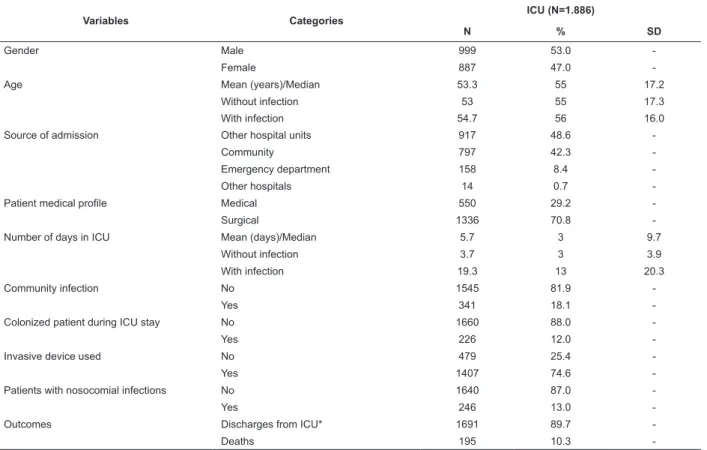
for the study. Table 1 presents demographic and clinical data of the sample.
The overall average for the ICU stay was 5.7 days
(median= 3 days). The average for patients who did not acquire NI was 3.7 days (median= 3 days) and 19.3 days (median= 13 days) for those who had NI. For the
non-colonized patients, the average ICU stay was 3.8
days (median= 3 days) and 20.2 days (median= 14 days) for those colonized by resistant microorganisms.
The majority (n=1.407; 74.6%) used invasive
device, among which urinary catheter (68.5%), venous central line (49.6%) or mechanical ventilation (49.9%).
Rev. Latino-Am. Enfermagem 2010 Mar-Apr; 18(2):233-9.
Table 1 – Distribution of the sample according to the study variables, (Aug. 2005 – Jan. 2008). Brazil, 2008
Variables Categories
ICU (N=1.886)
N % SD
Gender Male 999 53.0
-Female 887 47.0
-Age Mean (years)/Median 53.3 55 17.2
Without infection 53 55 17.3
With infection 54.7 56 16.0
Source of admission Other hospital units 917 48.6
-Community 797 42.3
-Emergency department 158 8.4
-Other hospitals 14 0.7
-Patient medical profile Medical 550 29.2
-Surgical 1336 70.8
-Number of days in ICU Mean (days)/Median 5.7 3 9.7
Without infection 3.7 3 3.9
With infection 19.3 13 20.3
Community infection No 1545 81.9
-Yes 341 18.1
-Colonized patient during ICU stay No 1660 88.0
-Yes 226 12.0
-Invasive device used No 479 25.4
-Yes 1407 74.6
-Patients with nosocomial infections No 1640 87.0
-Yes 246 13.0
-Outcomes Discharges from ICU* 1691 89.7
-Deaths 195 10.3
-* Home discharge, discharge to other wards or hospital transference. SD: Standard deviation
Nosocomial infections incidence and patients
outcomes
The ICU nosocomial infection rate was twenty percent
(383 NIs); there were 246 (13.0%) patients infected and
approximately 10% (n=195) of the patients died.
Subtitle: UTI: Urinary Tract Infections; PNM: Pneumonia; SSI: Surgical Site Infections; CVS: Cardiovascular; EENT: Eye, Ear, Nose and Throat, REPR: Reproductive; GI: Gastrointestinal.
Figure 1 – Distribution of the Intensive Care Unit Nosocomial Infections, according to the type of infection, (Aug.
2005 – Jan. 2008). Brazil, 2008
Urinary infection was the commonest type of
NI with 144 (37.6%) cases, followed by pneumonia
(n=98; 25.6%), sepsis (n= 58; 15.1%), surgical site
(n=54; 14.1%) and others (n=29; 7.7%) (vascular,
eye, ear, mouth, nose and throat, skin, reproductive and
gastrointestinal systems), as depicted in Figure 1.
N
% 140
120
100
80
60
40
20
0
UTI PNM Sepsis SSI CVS EENT Skin REPR GI
Nosocomial infection sites
In
fe
ct
io
n
s
fre
q
u
e
n
ci
e
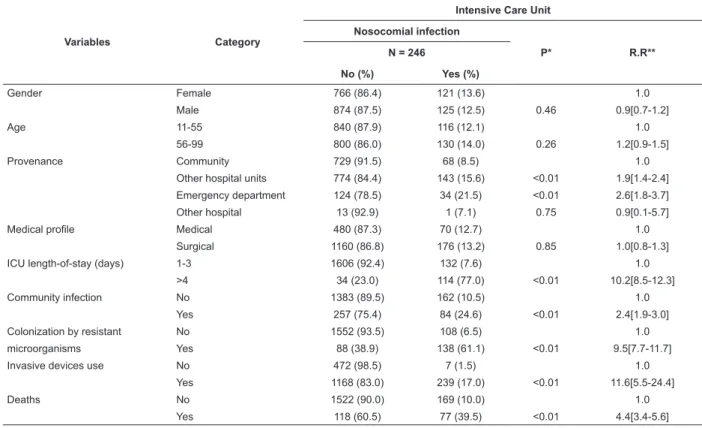
The distribution of the patients with and without
infection is shown in Table 2. Most patients (n=1.075)
were hospitalized at the studied hospital prior to
admission in the ICU, and among them 177 (16.5%)
developed NI. Those transferred from the hospital emergency unit were more likely to acquire infection (RR: 2.6; CI: 1.8-3.7, p<0.05), than those who came
from the community. Also, a relative risk of 1.9 (CI: 1.4-2.4, p<0.05) was veriied for those who came from another units within the hospital, when compared with
those who came from the community.
As reported by other studies in the ield, the length-of-stay for more than four days, the episode
of community infection, the colonization by resistant
microorganisms, and the use of invasive devices were signiicantly associated with the occurrence of NI, with high relative risks indexes (more than 2.4). Furthermore,
among the 195 deaths in the ICU during the study, 77
patients (39.5%) had developed NI.
Table 2 – Comparison of the patients with and without nosocomial infection, (Aug. 2005 – Jan. 2008). Brazil, 2008
Variables Category
Intensive Care Unit
Nosocomial infection
P* R.R**
N = 246
No (%) Yes (%)
Gender Female 766 (86.4) 121 (13.6) 1.0
Male 874 (87.5) 125 (12.5) 0.46 0.9[0.7-1.2]
Age 11-55 840 (87.9) 116 (12.1) 1.0
56-99 800 (86.0) 130 (14.0) 0.26 1.2[0.9-1.5]
Provenance Community 729 (91.5) 68 (8.5) 1.0
Other hospital units 774 (84.4) 143 (15.6) <0.01 1.9[1.4-2.4]
Emergency department 124 (78.5) 34 (21.5) <0.01 2.6[1.8-3.7]
Other hospital 13 (92.9) 1 (7.1) 0.75 0.9[0.1-5.7]
Medical profile Medical 480 (87.3) 70 (12.7) 1.0
Surgical 1160 (86.8) 176 (13.2) 0.85 1.0[0.8-1.3]
ICU length-of-stay (days) 1-3 1606 (92.4) 132 (7.6) 1.0
>4 34 (23.0) 114 (77.0) <0.01 10.2[8.5-12.3]
Community infection No 1383 (89.5) 162 (10.5) 1.0
Yes 257 (75.4) 84 (24.6) <0.01 2.4[1.9-3.0]
Colonization by resistant No 1552 (93.5) 108 (6.5) 1.0
microorganisms Yes 88 (38.9) 138 (61.1) <0.01 9.5[7.7-11.7]
Invasive devices use No 472 (98.5) 7 (1.5) 1.0
Yes 1168 (83.0) 239 (17.0) <0.01 11.6[5.5-24.4]
Deaths No 1522 (90.0) 169 (10.0) 1.0
Yes 118 (60.5) 77 (39.5) <0.01 4.4[3.4-5.6]
*p-value **Relative Risk
Discussion
a risk factor for infection development (p<0.01; RR:
10.2; CI: 8.5-12.3). For a period from four to 11 days
after the 17th ICU hospitalization day, the risk for NI
development increased. Nosocomial infection rate
for patients hospitalized from 17 to 21 days was 1.1,
while for those hospitalized from 43 to 134 days the
infection rate was 3.1, result similar to Latin-American
and European studies, which demonstrated relationship
between longer hospitalization and infection(7,9,15).
Out of the 341 patients who came from the community,
84 (24.6%) developed NI (p<0.01 RR: 2.4 CI: 1.9-3.0). Patients who were derived within and hospitalized
prior to ICU admission had a risk of 1.93 (CI: 1.48-2.49) higher for acquiring NI in the ICU when compared to those admitted from the community. Consistent with our indings, results of studies developed in North America, using similar sample, showed double risk for developing
ICU nosocomial infection for patients transferred from an
emergency room or other hospital unit than those who
came from the community, or from another hospital(13-14).
Among the 151 patients who had hospital length
Rev. Latino-Am. Enfermagem 2010 Mar-Apr; 18(2):233-9.
the ICU admission had higher risk of developing NI in the
Unit compared with those who did not have prior infection
(RR: 0.25; CI: 0.07-0.86; p <0.05)(16).
Patients colonized by resistant microorganisms
evidenced a high NI rate (61.6%) and had a relative
risk of 9.5 (CI: 7.7-11.7; p <0.05) when compared with those who did not have colonization by the resistant
microorganisms. In the sample were isolated 343 cases
of colonization (an average of 1.5 per patient), by 13 different resistant microorganisms; the ive most common represented more than 90% of cases (Acinetobacter
baumannii, 36.3%; Pseudomonas aeruginosa, 21.9%;
MRSA, 14.7%; Klebsiella pneumonia, 11.0%; and
Escherichia coli, 7.8%). However, this does not mean
that the NI was caused by the isolated resistant
microorganisms, only that the colonization in many
situations was associated with the presence of the same
or other microorganisms in the NI.
Indeed, in some cases the resistant microorganisms identiied as causing the NI were different. In 146 of 383 cases the NI was caused by 25 different non resistant
microorganisms, in 74 cases the diagnosed NI was
caused by at least 9 different resistant microorganisms,
and in 163 cases of NI it was not clear from the records what was the speciic microorganism neither the resistance status.
The more frequent non resistant microorganisms responsible for the NI were Candida albicans (18.5%),
Escherichia coli (15.1%), Pseudomonas aeruginosa
(8.9%), Enterobacter cloacae (8.2%), and Enterococcus
faecalis (8.2%). Among the more frequent multi-drug
resistant microorganisms causing NI were identiied
Acinetobacter baumannii (35.1%), Pseudomonas
aeruginosa (21.6%), and MRSA, Klebsiella pneumonia
and Escherichia coli (10.8%).
Most of the patients used at least one invasive device.
Approximately 70% (n=1.292) of the patients used long
term urinary catheter, 49.9% (n=942) used mechanical
ventilation and 49.6% (n=935) venous central line,
demonstrating high device utilization in the Unit.
Researchers report that urinary tract infection
(UTI) associated with long term urinary catheterization
accounts for 8 to 35% of all ICU infections. The most
prevalent urinary infection found in the studies were
asymptomatic bacteriuria(4,8,14). In the present study,
UTI were responsible for 37.6% (n=144) of all reported ICU infections, among which 76.4% (n=110) were
asymptomatic and 33.6% (n=34) were symptomatic.
NNIS (National Nosocomial Infections Surveillance
System) data indicates that pneumonias account for
31% of all ICU infections. Some authors believe that
nosocomial pneumonia is the second commonest NI and
the most common NI cause of death. This is consistent with results of the present study, where pneumonia was
present in 25.6% (n=98) of NI, however less common
than UTI(8,17-18).
Among the 195 deaths (10.3%), 39.5% (n=77)
were patients who developed NI, a datum consistent with indings of others researches that found a positive relation between higher mortality rates and NI diagnosis(5,7-8).
Based on our indings, we suggest periodical discussions among the healthcare team about NI rates, resistant microorganism proile at the institution, and mortality rate associated with them, in seminars, clinical meetings, or training sessions. Moreover, to encourage team
participation and raise awareness about the importance of NI prevention campaigns. Those activities can contribute to
healthcare management, allow an overview of tendencies and luctuations of infections, and provide information for the creation and review of protocols.
Conclusion
Nosocomial infection rate was 20.3% in 246 patients.
The ICU NI rate in the present study was consistent with the literature. The commonest infection was in the
Urinary tract, followed by pneumonia, sepsis, surgical site infection and others (vascular, eye, ear, mouth, nose and
throat, skin, reproductive and gastrointestinal systems). The average hospitalization was 19.3 days for
patients with NI and 20.2 days for those with colonization by resistant microorganism. The mortality rate was
39.5% among patients with NI (RR: 4.4; 3.4-5.6). The NI was associated with patients originated from other
units of the institution/emergency unit, more than 4
days of hospitalization, community infection, colonized by resistant microorganisms, using invasive devices and
deaths resulting from NI.
The most common non resistant microorganisms
responsible for the NI were Candida albicans,Escherichia
coli and Pseudomonas aeruginosa. And those identiied
as most frequent multi-drug resistant microorganisms causing NI were Acinetobacter baumannii and
Pseudomonas aeruginosa.
The results of this study contribute to support other studies on NI, and reafirm the importance of an effective program for infection control with the involvement of healthcare workers. The study adds knowledge on
ICU infection rate and emphasizes the importance of performing the control of its related outcomes such
References
1. Lima ME, Andrade D, Haas VJ. Avaliação prospectiva da ocorrência de infecção em pacientes críticos de Unidade de Terapia Intensiva. Rev Bras Ter Intensiva 2007; 19(3):342-7. 2. Allen S. Prevention and control of infection in the ICU. Curr Anaesth Crit Care. 2005; 16(4):191-9.
3. Gusmão MEN, Dourado I, Fiaccone Rl, Salvador C. Nosocomial pneumonia in the intensive care unit of a brazilian university hospital: na analysis of the time span from admission to disease onset. Am J Infect Control 2004; 32(4):209-14.
4. Wagenlehner FME, Loibl E, Vogel H, Naber KG. Incidence of nosocomial urinary tract infections on a surgical intensive care unit implications for management. Int J Antimicrob Agents 2006; 28(1):86-90.
5. Colpan A, Akinci E, Erbay A, Balaban N, Bodur H. Evaluation of risk factors for mortality in intensive care units: a prospective study from a referral hospital in Turkey. Am J Infect Control 2005; 33(1):42-7.
6. Espósito S, Leone S. Antimicrobial treatment for Intensive Care Unit (ICU) infections including the role of the infectious disease specialist. Int J Antimicrob Agents 2007; 29(5):494-500. 7. Rosenthal VD, Guzman S, Orellano PW. Nosocomial infections in medical-surgical intensive care units in Argentina: attributable motality and lenght of stay. Am J Infect Control 2003; 31(5):291-5.
8. Vincent JL. Nosocomial infections in adult intensive care units. Lancet 2003; 361(9374): 2068-77.
9. Martins MA. Conceitos gerais e terminologia básica em epidemiologia hospitalar e controle de infecção. In: Martins MA. Manual de infecção hospitalar: epidemiologia, prevenção e controle. Belo Horizonte: Medsi; 2001. p. 16-26.
10. Rezende EM, Santos AAM, França E. Vigilância epidemiológica das infecções hospitalares. In: Oliveira AC. Infecções hospitalares:
epidemiologia, prevenção e controle. Rio de Janeiro: Guanabara Koogan; 2005. p. 15-33.
11. Azevedo FM, Paiva LFR. O laboratório no controle de infecção hospitalar. In: Martins MA. Manual de infecção hospitalar: epidemiologia, prevenção e controle. Belo Horizonte: Medsi; 2001. p .435-48.
12. Oliveira AC, Horta B, Martinho GH, Dantas LV, Ribeiro MM. Nosocomial infections and bacterial resistance in patients from a Teaching Hospital Intensive Care Unit. Online Braz J Nurs, 2007; 6:1-132.
13. Urli T, Perone G, Acquarolo A, Zappa S, Antonini B, Candiani A. Surveillance of infections acquired in intensive care: usefulness in clinical practice. J Hosp Infect 2002; 52(2):130-5.
14. McCusker ME, Périssé ARS, Roghmann MC. Severity-of-illness markers as predictors of nosocomial infection in adult intensive care unit. Am J Infect Control 2002; 30(3):139-44. 15. Orsi GB, Scorzolini L, Franchi C, Mondillo V, Rosa F. Denditti M. Hospital-acquired infection surveillance in a neurosurgical intensive care unit. J Hosp Infect 2006; 64(1):23-9.
16. Beyersmann J, Gastmeier P, Grundmann H, Bärwolff S, Geffer C, Behnke M, et al. Transmission-associated nosocomial infections: prolongation of intensive care unit stay and risk factor for analysis using multistate models. Am J Infect Control 2008; 36(2):98-103.
17. Zeitoun SS, Barros ALBL, Diccinia S. Incidência de pneumonia associada à ventilação mecânica em pacientes submetidos à aspiração endotraqueal pelos sistemas aberto e fechado: estudo prospectivo – dados preliminares. Rev Latino-am Enfermagem 2001; 9(1):46-52.
18. Mesiano ERAB, Merchán-Hamann. Bloodstream infections among patients using central venous catheters in intensive care units. Rev Latino-am Enfermagem 2007; 15(3):453-9.