2010 Nov-Dec;18(6):1152-60 www.eerp.usp.br/rlae
Corresponding Author: Adriana Cristina de Oliveira
Universidade Federal de Minas Gerais. Escola de Enfermagem. Av. Alfredo Balena, 190 - Campus Saúde
CEP: 30130-100 Belo Horizonte, MG, Brasil E-mail: [email protected]
Bacterial Resistance and Mortality in an Intensive Care Unit
Adriana Cristina de Oliveira
1Rafael Souza Silva
2Mario E. Piscoya Díaz
3Robert Aldo Iquiapaza
4The goal was to identify risk factors for healthcare–associated infections by resistant
microorganisms and patient mortality in an Intensive Care Unit. A prospective and
descriptive epidemiological research was conducted from 2005 till 2008, involving 2300
patients. Descriptive statistics, bivariate and multivariate logistic regression analysis were
used. In bivariate analysis, infection caused by resistant microorganism was significantly
associated to patients with community-acquired infection (p=0.03; OR=1.79) and
colonization by resistant microorganism (p<0.01; OR=14.22). In multivariate analysis,
clinical severity (p=0.03; OR=0.25) and colonization by resistant microorganism (p<0.01;
OR=21.73) were significant. Mortality was associated to the following risk factors: type
of patient, average severity index, besides mechanical ventilation. The relation between
resistant microorganisms and death shows the need to monitor adherence to infection
control measures so as to improve care quality and mainly survival of critical patients.
Descriptors: Epidemiologic Surveillance; Cross Infection; Intensive Care Units; Mortality;
Drug Resistance, Microbial.
1 RN, Post-doctoral, Adjunct Professor, Escola de Enfermagem, Universidade Federal de Minas Gerais, MG, Brazil. E-mail:
[email protected]. 2 RN. E-mail: [email protected].
3 Statistician, Doctoral Student in Demography, Centro de Desenvolvimento e Planejamento Regional, Universidade Federal de Minas
Gerais, MG, Brazil.
Resistência bacteriana e mortalidade em um centro de terapia intensiva
Objetivou-se identiicar fatores de risco para o desenvolvimento de infecções, relacionadas
ao cuidar em saúde, por microrganismos resistentes e a mortalidade dos pacientes em
um centro de terapia intensiva. Trata-se de estudo epidemiológico prospectivo, realizado
entre 2005 e 2008, envolvendo 2.300 pacientes. Utilizou-se estatística descritiva,
análise de regressão logística bivariada e multivariada. Na análise bivariada, a infecção por microrganismo resistente esteve signiicativamente associada a pacientes com infecção comunitária (p=0,03; OR=1,79) e colonização por microrganismo resistente
(p<0,01; OR=14,22). Na análise multivariada, severidade clínica C (p=0,03; OR=0,25)
e colonização por microrganismo resistente (p<0,01; OR=21,73) foram signiicativas.
Para óbitos, observou-se, como fator de risco: tipo de paciente, severidade clínica e
uso de ventilação mecânica. A constatação da relação entre microrganismo resistente e óbitos evidencia a necessidade de monitorização da adesão às medidas de controle de infecção, no sentido de melhorar a qualidade da assistência e, sobretudo, a sobrevida
de pacientes críticos.
Descritores: Vigilância Epidemiológica; Infecção Hospitalar; Unidades de Terapia Intensiva; Mortalidade; Resistência Microbiana a Medicamentos.
Resistencia bacteriana y mortalidad en un Centro de Terapia Intensiva
Se objetivó identiicar factores de riesgo para el desarrollo de infecciones relacionadas
al cuidar en salud, por microorganismos resistentes, y también investigar su relación
con la mortalidad de los pacientes en un centro de terapia intensiva. Se trata de un
estudio epidemiológico prospectivo realizado entre 2005 y 2008, envolviendo 2.300
pacientes. Se utilizó la estadística descriptiva y el análisis de regresión logístico bivariado
y multivariado. En el análisis bivariado, la infección por microorganismos resistentes
estuvo signiicativamente asociada a pacientes con infección comunitaria (p=0,03;
OR=1,79) y a la colonización por microorganismo resistente (p<0,01; OR=14,22). En
el análisis multivariado la severidad clínica C (p=0,03; OR=0,25) y la colonización por
microorganismo resistente (p<0,01; OR=21,73) fueron signiicativas. En relación a las
muertes, se observó como factor de riesgo: el tipo de paciente, la severidad clínica, y el
uso de ventilación mecánica. La constatación de la relación entre los microorganismos
resistentes y la muerte, coloca en evidencia la necesidad de monitorizar la adhesión a las
medidas de control de la infección con el objetivo de mejorar la calidad de la asistencia
y, sobre todo, la sobrevivencia de los pacientes críticos.
Descriptores: Vigilancia Epidemiológica; Infección Hospitalaria; Unidades de Terapia
Intensiva; Mortalidad; Farmacorresistencia Microbiana.
Introduction
Intensive Care Units (ICUs) deliver care to patients
in clinically severe conditions, generally involving
extended hospitalization and invasive procedures
(central venous catheters, indwelling urinary catheters
and mechanical ventilation). Hence, patients admitted
to ICUs are more susceptible to the development of
healthcare-associated infections (HAI), representing
about 25% of all hospital infections, and especially by
In the global context, the growing emergence
of microorganisms resistant to antimicrobials has been a great source of concern, due to the prolonged
hospitalization time, higher treatment cost, the reduced
therapeutic arsenal and/or the risk of patient death(2).
In addition, it is important to highlight that patients
undergoing critical care are more predisposed to a range of hospital infections, especially caused by multi-resistant
microorganisms, due to the complex nature of care in intensive care units, multiple interventions and factors
related to patients themselves.
Data from North American studies indicate that up
to 50% of ICU infections are associated with the use of
invasive procedures, caused by resistant microorganisms,
frequently Acinetobacter sp, methicillin-resistant
Pseudomonas sp. Klebsiella sp. Staphylococcus aureus (MRSA) and Escherichia coli(1-5). In Brazil, research at
intensive care units report on an association between, on the one hand, use of indwelling urinary catheters, central
catheters and mechanical ventilation and, on the other, increased infections developed at these units, a situation
in which more than 75% of patients with infections use these procedures. Also, the predominance of resistant
agents like Staphylococcus aureus, Pseudomonas
aeruginosa and Klebisiella Pneumoniae is observed(6-9).
In addition, mortality rates at ICUs is high, ranging
from nine to 38%. When patients developed infections caused by resistant microorganisms, this rate can rise
up to 70%(3,10-11). Brazilian studies reports similar rates,
reaching 50% when associated with infections by resistant
microorganisms(8-9).
Given the relevance of the theme and the complexity
of intensive care patients, this study aimed to identify the
factors associated with the risk of developing healthcare-associated infections caused by resistant microorganisms
and patient mortality at an ICU of a university hospital.
Methods
A prospective and descriptive epidemiological study was carried out at the adult Intensive Care Unit of a
university hospital.
All patients admitted to the ICU, and hospitalized for
more than 24 hours between August 2005 and July 2008
were eligible for the study, excluding those patients with incomplete or missing data in the patient chart records
related to the research variables.
Unit characteristics
The Intensive Care Unit consists of four general
rooms with four beds each, and two other beds with
adequate structure for patient isolation (with private
washbasins and bathroom), subject to indication by physicians or the Hospital Infection Control Commission
(HICC), thus totaling eighteen active beds.
This unit comprises a highly trained multiprofessional team that delivers patient care, approximately 90%
originating in the uniied health system (SUS) and the
remainder in health insurances and private patients.
Deinitions
The following deinitions were adopted, according to
the National Nosocomial Infections Surveillance (NNIS)
System:
- Community-acquired infections: infections notiied
upon the patient’s admission to the unit, originating in
the community, another hospital or other hospitalization units in the study hospital.
- Surgical patients: patients submitted to surgical
procedures involving incision and suture, including videolaparoscopic procedures, carried out at the Surgical
Center.
- Colonization by resistant microorganisms: isolation
of resistant microorganisms identiied in laboratory
culture, without clinical or immunological signs. The determination of colonization cases was oriented by the
research institution’s own protocol, in which hospitalized
patients coming from other hospitals with hospitalization
periods of more than 72 hours or patients from the research institution hospitalized for seven days or more
were monitored through surveillance culture.
- Hospital infections or healthcare-associated infections
(HAI): all infections notiied at the ICU 48h after the
patient’s admission to this unit. After the patient’s
discharge, during 48 hours, urinary tract infection cases associated with indwelling urinary catheter were also
considered until seven days after discharge from the unit.
Clinical severity: the clinical severity index measured
upon the patient’s admission was considered, according to the Average Severity Index Score (ASIS):
- A: Post-operative patients who do not demand intensive
medical or nursing care; discharge from the unit in up
to 48 hours.
- B: Physiologically stable patients, demanding nocturnal
preventive observation, without the need for intensive
medical or nursing care.
- C: Physiologically stable patients demanding intensive
nursing care and monitoring.
- D: Physiologically unstable patients demanding intensive medical and nursing care with frequent needs
Oliveira AC, Silva RS, Piscoya Díaz ME, Iquiapaza RA.
- E: Physiologically unstable patients, in coma or
shock, or demanding cardiopulmonary resuscitation or intensive medical and nursing care, with frequent needs
for reassessment.
Resistance markers
Nowadays, various methods exist to assess the
susceptibility test to available antimicrobials, which are
standardized in terms of use, execution and interpretation.
The Clinical and Laboratory Standards Institute (CLSI) is
the referral document used by Brazilian laboratories and
adopted by the Brazilian Microbial Resistance Monitoring
Network, coordinated by the Health Surveillance Agency
(ANVISA), in cooperation with the Pan American Health
Organization (PAHO) and in partnership with the General
Public Health Laboratory Coordination (CGLAB)(12-13). To deine the bacterial resistance markers adopted
in this research, the protocol established by the research
institution’s Hospital Infection Control Committee (HICC)
was followed, in accordance with the CLSI. In other
words, markers resistant to Staphylococcus aureus, to
Oxacillin (analogue to methicillin in Brazil), Vancomycin
(VRE) and Teicoplanin resistant Enterococcus sp. (VRE),
Vancomycin resistant Streptococcus pneumoniae,
Imipenem and/or Meropenem resistant Pseudomonas sp.,
aminoglycoside resistant enterobacteriaceae (Klebsiella,
Serratia, Enterobacter, Escherichia coli, Proteus),
third-generation cephalosporins and luoroquinolones.
Research ethics
A longitudinal study was carried out after approval
had been obtained from the Institutional Review Board
under protocol 267/2003, in compliance with Resolution
196/96 by the National Health Council regarding research
involving human beings.
Data collection
For data collection, nursing records and patient
charts were used, besides microbiological test results.
The collected data were related to gender, age, origin,
clinical severity index upon admission to the ICU, patient
type, time of stay at the unit, community-acquired
infection diagnosis, patient colonized with resistant
microorganisms during hospitalization, use of invasive
procedures, hospital infection and patient outcome.
Data analysis
After completing the data collection instrument, the
records were typed and processed in Statistical Package
for the Social Sciences (SPSS) software, version 14.
Descriptive statistical analysis was carried out to
characterize the study population and logistic regression
analysis was used to identify possible risk factors for
the development of infections caused by resistant
microorganisms, besides risk factors associated with
deaths at the Intensive Care Unit. At irst, bivariate
models were developed to check for associations between
the study variables and the observed events (infection
by resistant microorganisms/death). Then, different
multivariate logistic regression models were constructed
to assess whether associations existed between each
event and the selected characteristics, when controlled
by other variables. Statistical signiicance was set at p<0.05, with 95% conidence intervals.
Results
Demographic proile of the population
During the study period, 2,316 patients were assessed, 2,300 of whom (99.3%) were eligible in
function of the inclusion criteria. 52.6% were men, with
a global mean age of 53 years (median 55 years), mean
time of stay at the unit 5.8 days (median three days)
and mainly admitted (48.5%) from other sectors at the
study hospital, followed by the community (43.2%),
while the remainder, coming from the Emergency Care and other hospitals, represented 8.3% of cases.
Regarding clinical severity, 899 (39.1%) patients
were classiied as A, 260 (11.3%) B, 697 (30.3%) C, 337
(14.7%) D and 107 (4.7%) E. Patients were basically admitted in the postoperative period, adding up to 1,642
(71.4%) cases. Besides, 437 (19.0%) were admitted to
the ICU diagnosed with community-acquired infection. As for colonization by resistant microorganisms,
this condition was identiied in 284 (12.3%) patients
during ICU hospitalization, 61.2% of whom developed some kind of infection.
About the use of invasive procedures (central
venous catheter, mechanical ventilation and indwelling
urinary catheter), 1,749 (76.0%) patients presented this characteristic. And, with regard to the diagnosis of
healthcare-associated infection (HAI), this was identiied
in 311 (13.5%) patients during their ICU stay. In 84 (27%), resistant microorganisms caused these infections.
Outcomes included 244 (10.6%) deaths, 97 (31.2%)
among patients who developed HAI, 64 (28.2%) among patients with HAI caused by sensitive microorganisms
and 33 (39.3%) among patients who developed
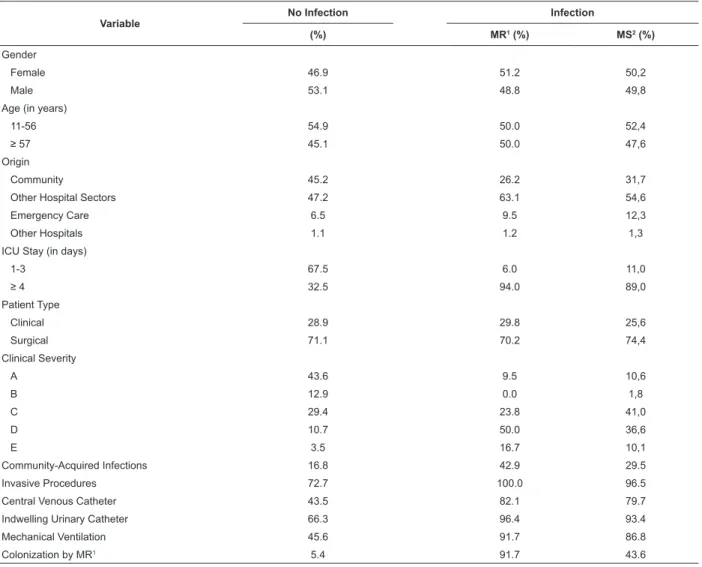
Patient distribution according to the occurrence of HAI
Table 1 – Patient distribution according to study characteristics and HAI development status. Belo Horizonte, 2009
Variable No Infection Infection
(%) MR1 (%) MS2 (%)
Gender
Female 46.9 51.2 50,2
Male 53.1 48.8 49,8
Age (in years)
11-56 54.9 50.0 52,4
≥ 57 45.1 50.0 47,6
Origin
Community 45.2 26.2 31,7
Other Hospital Sectors 47.2 63.1 54,6
Emergency Care 6.5 9.5 12,3
Other Hospitals 1.1 1.2 1,3
ICU Stay (in days)
1-3 67.5 6.0 11,0
≥ 4 32.5 94.0 89,0
Patient Type
Clinical 28.9 29.8 25,6
Surgical 71.1 70.2 74,4
Clinical Severity
A 43.6 9.5 10,6
B 12.9 0.0 1,8
C 29.4 23.8 41,0
D 10.7 50.0 36,6
E 3.5 16.7 10,1
Community-Acquired Infections 16.8 42.9 29.5
Invasive Procedures 72.7 100.0 96.5
Central Venous Catheter 43.5 82.1 79.7
Indwelling Urinary Catheter 66.3 96.4 93.4
Mechanical Ventilation 45.6 91.7 86.8
Colonization by MR1 5.4 91.7 43.6
MR1= multi-resistant; MS2= multi-sensitive.
Resistant microorganisms as causal agents of infection
In Table 2, infections caused by resistant
microorganisms are described in relation to the variables
selected after they had demonstrated statistical
signiicance in bivariate analysis.
Table 2 – Estimated Odds Ratios (OR) based on logistic regression analysis, assessing the association between
infection by resistant microorganism and different patient characteristics at the Intensive Care Unit. Belo Horizonte,
2009
Characteristic
Bivariate Analysis Multivariate Analysis
OR* OR* Confidence Interval 95%
Lower Limit Upper Limit
Origin
Community 1.00 1.00
Other Hospital Sectors 2.309† 1.211 0.551 2.224
Emergency Care 2.537‡ 1.990 0.455 5.281
Other Hospitals 1.948 0.743 0.035 5.861
Oliveira AC, Silva RS, Piscoya Díaz ME, Iquiapaza RA.
Table 2 – (continuation)
Characteristic
Bivariate Analysis Multivariate Analysis
OR* OR* Confidence Interval 95%
Lower Limit Upper Limit
Stay (in days)
1-3 1.00 1.00
≥ 4 32.772† 6.359† 1.829 20.006
Clinical severity
A 1.00 1.00
B 0.000 0.000 0.000 0.130
C 3.711† 0.582 0.159 1.552
D 21.471† 1.545 0.382 3.706
E 21.675† 3.193 0.640 8.292
Community-Acquired Infection
No 1.00 1.00
Yes 3.716† 0.420 0.239 1.320
Central Venous Catheter
No 1.00 1.00
Yes 5.543† 0.658 0.289 1.582
Indwelling Urinary Catheter
No 1.00 1.00
Yes 13.746† 7.015† 1.653 26.218
Mechanical Ventilation
No 1.00 1.00
Yes 13.149† 1.095 0.385 3.129
Colonization by MR§
No 1.00 1.00
Yes 191.583† 107.406† 33.795 196.852
* OR= Odds Ratio; †= p<0.05; ‡= p<0.01; § MR = multi-resistant.
In this study, four variables were considered to describe patients’ use of invasive procedures: one is “invasive procedures”, with the dichotomous response “yes”
and “no”, to describe the use of mechanical ventilation, indwelling urinary catheter and/or central venous catheter; the others are “mechanical ventilation”, “indwelling urinary catheter” and “central venous catheter”. Each of these is
also dichotomous.
Due to the fact that almost 100% of patients with infections used invasive procedures, the statistical analysis models assessed this variable as a constant. Hence,
these procedures were automatically removed from the
analysis, as they exerted no signiicant effect on the
response variable. Hence, for statistical analysis purposes, “mechanical ventilation”, “indwelling urinary catheter” and
“central venous catheter” were considered individually. When comparing the effects of infections developed by resistant and sensitive microorganisms, in bivariate
analysis, statistical signiicance was veriied for patients
diagnosed with community-acquired infections (p=0.03; OR=1.79) and colonization by resistant microorganisms (p<0.01; OR=14.22) upon admission. After multivariate logistic regression, clinical severity C (p=0.03; OR=0.25)
and colonization by resistant microorganisms (p<0.01;
OR=21.73) showed to be statistically signiicant.
In view of this analysis, it is evidenced that, when analyzed independently from other variables, having community-acquired infections was a risk factor for the development of HAI, independently of the resistance/
sensitivity proile of its causal agent. Regarding clinical severity, this variable was statistically signiicant in
multivariate analysis only when patients with infections caused by resistant microorganisms were compared with HAI patients caused by Sensitive Microorganisms (SM).
Assuming that colonization was signiicant in
the presented comparisons between HAI by resistant microorganisms and SM, the fact that determined the development of infections by resistant microorganisms was
colonization by these microorganisms. The identiied odds
ratio, considerably higher than that of other variables in bi and multivariate analysis, reinforces this idea, evidencing its greater role in infection development caused by these microorganisms.
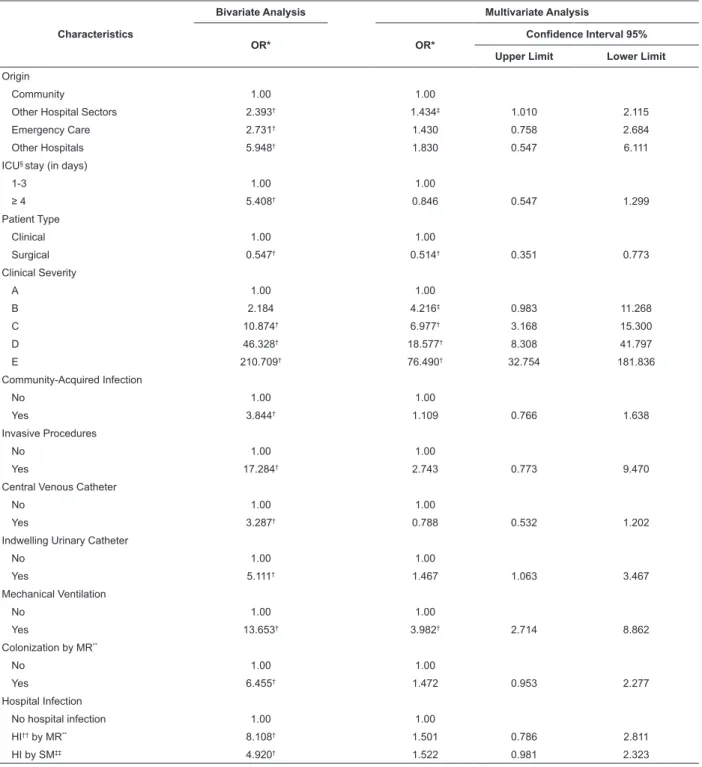
Mortality-associated factors
Table 3 – Estimated Odds Ratios (OR) based on logistic regression analysis, assessing the association between
mortality and different patient characteristics at the Intensive Care Unit. Belo Horizonte, 2009
Characteristics
Bivariate Analysis Multivariate Analysis
OR* OR* Confidence Interval 95%
Upper Limit Lower Limit
Origin
Community 1.00 1.00
Other Hospital Sectors 2.393† 1.434‡ 1.010 2.115
Emergency Care 2.731† 1.430 0.758 2.684
Other Hospitals 5.948† 1.830 0.547 6.111
ICU§ stay (in days)
1-3 1.00 1.00
≥ 4 5.408† 0.846 0.547 1.299
Patient Type
Clinical 1.00 1.00
Surgical 0.547† 0.514† 0.351 0.773
Clinical Severity
A 1.00 1.00
B 2.184 4.216‡ 0.983 11.268
C 10.874† 6.977† 3.168 15.300
D 46.328† 18.577† 8.308 41.797
E 210.709† 76.490† 32.754 181.836
Community-Acquired Infection
No 1.00 1.00
Yes 3.844† 1.109 0.766 1.638
Invasive Procedures
No 1.00 1.00
Yes 17.284† 2.743 0.773 9.470
Central Venous Catheter
No 1.00 1.00
Yes 3.287† 0.788 0.532 1.202
Indwelling Urinary Catheter
No 1.00 1.00
Yes 5.111† 1.467 1.063 3.467
Mechanical Ventilation
No 1.00 1.00
Yes 13.653† 3.982† 2.714 8.862
Colonization by MR**
No 1.00 1.00
Yes 6.455† 1.472 0.953 2.277
Hospital Infection
No hospital infection 1.00 1.00
HI†† by MR** 8.108† 1.501 0.786 2.811
HI by SM‡‡ 4.920† 1.522 0.981 2.323
Obs.: * OR= Odds Ratio; † p < 0.01; ‡ p < 0.05; § ICU = Intensive Care Unit; ** MR = multi-resistant; †† HI = Hospital Infection; ‡‡ SM= Sensitive Microorganisms
Discussion
In this study, it was veriied that patients
who developed healthcare-associated infections
due to resistant microorganisms displayed speciic
characteristics in terms of time of stay at the
unit, presence of community-acquired infections,
accomplishment of invasive procedures and colonization
by resistant microorganisms.
Studies demonstrate that ICU patients are at greater
risk of developing some kind of infection. HAI caused
by resistant microorganisms affect a group of patients
generally submitted to greater hospital exposure, with
Oliveira AC, Silva RS, Piscoya Díaz ME, Iquiapaza RA.
study, where a large part of patients were admitted
from other hospital sectors (other units and emergency
care) and were hospitalized at the ICU for more than
four days(14-15).
Besides, the severity of ICU patients makes them
more vulnerable to HAI when compared with other units,
with ive to ten times higher probabilities of catching this
kind of infection(16).
Many factors are related with the risk of catching HAI,
such as disease severity, underlying disease, duration of
ICU hospitalization and invasive procedures, the latter of
which is frequently associated with infection by resistant
microorganisms, together with high patient density and
this population’s susceptibility(10,16).
In line with this inding, this research also related the
occurrence of HAI with the use of invasive procedures.
Among these, the use of indwelling urinary catheters
stood out, which is also considered a risk factor for HAI
development(17-18).
Studies appoint that community-acquired infections
affect between 13.5 and 61.3% of hospitalized patients.
When caused by Methicillin-resistant Staphylococcus
aureus, infection rates increase, including surgical
site infection, pneumonias associated with mechanical
ventilation and bacteremia(15,19-20). These studies,
however, do not directly relate the presence of previous
community-acquired infections with the occurrence of
infections caused by resistant microorganisms.
Hence, available literature on ICU patients and
infections caused by resistant microorganisms does not
offer a deined proile yet that permits comparisons with
the data found in this study.
Besides, patients with community-acquired
bloodstream infections display mortality rates of
approximately 40%, against 18% for patients without
reports of community-acquired infections(21).
Patients initially colonized by resistant
microorganisms developed infections in 11.1% and 4%
of cases, when the causal microorganism was MRSA and
VRE, respectively(22-23). In the present study, 61.2% of
colonized patients developed some kind of infection, but
the type of microorganism was not speciied.
A consensus exists in literature that bacterial
resistance has been an important factor for increased
mortality rates, mainly in critically ill patients(24-25).
In the assessment of risk factors for ICU mortality, this
study identiied statistical signiicance in bivariate analysis
for all study variables, except patients’ gender and age. In
line with this inding, other studies described(4,10,22) lack of signiicance between gender/age and the development of
infections by resistant microorganisms, even mentioning
analysis of patients over 75 years of age.
Besides, some studies conirm these indings regarding the signiicant association between patients
who developed infections and/or were submitted to
mechanical ventilation, including the occurrence of
deaths(4,10,26-29). One of these studies mentions that the
chance of death is between two and ten times higher
for patients using this device, with death rates that can
range between 24 e 76%(27). According to some of these
studies, in patients who received mechanical ventilation,
respiratory tract infection with resistant microorganisms
is common and associated with higher mortality(28-29).
In literature, however, divergence exists on the
association between mortality and infection development,
even when using multivariate logistic regression(4,10,22).
On the other hand, infections constitute independent
risk factor for mortality and, to the extent that bacterial
resistance to antibiotics increases, the possibility of
adequate infection treatment decreases, favoring
outcomes like death(26).
Conclusion
The emergence of resistant microorganisms is a
source of concern for researchers and professionals
responsible for healthcare-associated infection, and a
priority all over the world. To establish control of these
pathogens, getting to know the risk factors for infection
development becomes essential, mainly when considering
a clientele of critically ill patients.
ICU hospitalizations for more than four days,
diagnoses of community-acquired infections upon
admission to the unit, use of indwelling urinary catheter
and colonization by resistant microorganisms appeared as
risk factors for the development of infections by resistant
microorganisms. The patients’ surgical proile and clinical
severity upon admission to the ICU, besides the use of
mechanical ventilation, appeared as risk factors for death.
The detection of risk factors and the possibility
of acting on them can enhance the control of bacterial
resistance dissemination, entailing greater control of
colonization and, consequently, of high infection rates
at the ICU. Thus, monitoring patients with
community-acquired infections and/or patients colonized by
resistant microorganisms is extremely valuable for the
early establishment of measures to reduce the possible
dissemination of resistant microorganisms. Besides,
patients with risk factors deserve special attention during
References
1. Allen S. Prevention and control of infection in the ICU. Curr Anaesth Crit Care. 2005;16 (4):191-9.
2. Graf BM, Martin E. The intensive care physician and control of antimicrobial resistante. Int J Antimicrobiol Agents. 2000;16(4):511-4.
3. Hernández G, Rico P, Díaz E, Rello J. Nosocomial lung infections in intensive care units. Microbes Infect. 2004;6(11):1004-14. 4. Peres-Bota D, Rodriguez H, Dimopoulos G, DaRos A, Mélot C, Struelens MJ, et al. Are infections due to resistant pathogens associated with worse outcome in critically ill patients? J Infect. 2003;47(4):307-16.
5. Dhillon R, Clark J. Infection in the intensive care unit (ICU). Curr Anaesth Crit Care. 2009;20(4):175-82.
6. Lisboa T, Faria M, Hoher JA, Borges LAA, Gómez J, Schifelbain
L et. al. Prevalência de infecção nosocomial em unidades de
terapia intensiva no Rio Grande do Sul. Rev Bras Ter Intens. 2007; 19(4):414-20.
7. Moura MEB, Campelo SMA, Brito FCP, Batista OMA, Araújo
TME, Oliveira ADS. Infecção hospitalar: estudo de prevalência
em um hospital público de ensino. Rev Bras Enferm. 2007; 60(4):416-21.
8. Lima ME, Andrade D, Haas VJ. Avaliação prospectiva da ocorrência de infecção em pacientes críticos de Unidade de
Terapia Intensiva. Rev Bras Ter Intens. 2007; 19(3):342-7.
9. Andrade D, Leopoldo VC, Haas VJ. Ocorrência de bactérias
multirresistentes em um Centro de Terapia Intensiva de
Hospital Brasileiro de Emergências. Rev Bras Ter Intens. 2006;
18(1):27-33.
10. Colpan A, Akinsi E, Erbay A, Balaban N, Bodur H. Evaluation of risk factors for mortality in intensive care units: A prospective study from a referral hospital in Turkey. Am J Infect Control. 2005;33(1):42-7.
11. Weber IC, Noal CB, Neto CHDPW, Santos RCV. Prevalência e perfil de resistência de microorganismos isolados de uma Unidade
de Tratamento Intensivo de um hospital da região central do Rio Grande do Sul. Prática Hospitalar. 2009;66(6):57-62.
12. Ministério da Saúde (BR). Agência Nacional de Vigilância
Sanitária. I Seminário Nacional da Rede de Monitoramento
e Controle da Resistência Microbiana em Serviços de Saúde
[Internet]. Brasil, ANVISA; 2009. [acesso: 08 set 2009]. Disponível em: http://www.anvisa.gov.br/servicosaude/ controle/rede_rm/1_seminario.pdf.
13. Ministério da Saúde (BR). Agência Nacional de Vigilância Sanitária. Interpretação de dados microbiológicos [Internet].
Brasil, ANVISA; 2009. [acesso: 08 set 2009]. Disponível em: http://www.anvisa.gov.br/servicosaude/controle/rede_rm/ cursos/atm_racional/modulo2/laboratorio2.htm
14. Beyersmann J, Gastmeier P, Grundmann H, Bärwolff S, Geffers C, Behnke M, et al. Transmission-associated nosocomial infections: prolongations of intensive care unit stay and risk factor analysis using multistate models. Am J Infect Control. 2008;36(2):98-103.
15. Balkhy HH, Cunningham G, Chew FK, et al. Hospital- and community-acquired infections: a point prevalence and risk factors survey in a tertiary care center in Saudi Arabia. Int J Infect Dis. 2006;10(4):326-33.
16. Markogiannakis H, Pachylaki N, Samara E, Kalderi M, Minettou M, Toutouza M, et al. Infections in a surgical intensive care unit of a university hospital in Greece. Int J Infect Agents. 2009;13(2):145-53.
17. Tenke P, Jackel M, Nagy E. Prevention and Treatment of Catheter-Associated Infections: Myth or Reality? EAU Update Series. 2004; 2(3):106-15.
18. Tambyah PA. Catheter-associate urinary tract infections: diagnosis and prophylaxis. Int Jf Antimicrobial Agents. 2004;24:44-8.
19. Skov RL, Jensen KS. Community-associated meticillin-resistant Staphylococcus aureus as a cause of hospital-acquired infections. J Hosp Infect. 2009; 73:364-70.
20. Ylipalosaari P, Ala-Kokko TI, Laurila J, Ohtonen P, Syrjälä H. Community- and hospital-acquired infections necessitating ICU admission: Spectrum, co-morbidities and outcome. Journal of Infection. 2006; 53(2): 85-92.
21. Vallés J, Ferrer R. Bloodstream Infection in the ICU. Infect Dis Clin North Am. 2009; 23(3):557-69.
22. Coello R, Glynn-f- JR, Gaspar C, et al. Risk factors for developing clinical infection with methicillin-resistant Staphylococcus aureus (MRSA) amongst hospital patients initially only colonized with MRSA. J Hosp Infect. 1997;37:39-46. 23. Olivier CA, Blake RK, Steed LL. Risk of vancomycin resistant Enterococcus bloodstream infection among colonized individuals. Infect Control Hosp Epidemiol. 2008;29:404-9.
24. Trouillet JL, Chastre J, Vuagnat A, Joly-Guillou ML, Combaux D, Dombret MC, et al. Ventilatorassociated pneumonia caused by potentially drugresistant bacteria. Am J Respir Crit Care Med. 1998;157:531-9.
25. Chastre J, Fagon JY. Ventilator-associated pneumonia. State of The Art. Am J Respir Crit Care Med. 2002;165:867–903. 26. Cevik MA, Yilmaz GR, Erdinc FS, Ucler S, Tulek NE. Relationship between nosocomial infection and mortality in a neurology intensive care unit in Turkey. J Hosp Infect. 2005;59(4):324-30. 27. Cavalcanti M, Valencia M, Torres A. Respiratory nosocomial infections in the medical intensive care unit. Microbes Infect. 2005;7(2):292-301.
28. Chien JY, Hsueh PR, Yu CJ, Yang PC. The evolution of drug-resistant microorganisms in patients with prolonged mechanical ventilation. Am J Infect Control. 2009; 37(3):231-6.
29. Pappalardo F, Franco A, Landoni G, Cardano P, Zangrillo A, Alfieri O. Long-term outcome and quality of life of patients requiring prolonged mechanical ventilation after cardiac surgery. Eur J Cardio-Thoracic Surg. 2004;25(4):548-52.