Ecomorphology of crabs and swimming crabs (Crustacea Decapoda
Brachyura) from coastal ecosystems
Brachyuran crabs are one of the most diverse taxa of
crustaceans, occurring in almost all coastal habitats.
Due to their high morphological diversiication,
the authors sought to ascertain the existence of
morphological patterns related to the habitat of
coastal brachyuran crabs. We analyzed 17 species
from mangrove forests, rocky shores, sandy
beaches and exclusively aquatic marine/estuarine
ecosystems. A total of 16 linear measurements
of males and 17 of females were obtained for
each habitat. We were able to discriminate three
functional groups of crab species, based on their
habitat: 1. Complex Substrates, 2. Semiterrestrial,
3. Exclusively Aquatic. The species belonging to
the Complex Substrates group had long ambulatory
legs, as well as being heteroquely related to uneven
terrain. Semiterrestrial species showed ambulatory
legs of different sizes, allowing them to walk easily
on the terrestrial terrain due to the long fourth
ambulatory leg, and long eyestalks which are
important for visual communication. Exclusively
Aquatic species showed the largest carapace widths
and the shortest eyestalks. The presence of different
crab lineages in the environments analyzed allows us
to demonstrate the clear evolutionary convergence,
by which the crabs adapted to their speciic habitat
and environment.
A
bstrAct
Murilo Zanetti Marochi*, Setuko Masunari
Universidade Federal do Paraná
(Av. Coronel Francisco Heráclito dos Santos, 210, Post box 19020 CEP: 81531-980, Curitiba, Paraná, Brazil)
*Corresponding author: [email protected]
Descriptors: Brachyura community, Ecomorphological attributes, Morphometry, Morphological adaptation.
Caranguejos braquiúros são um dos grupos mais
diversiicados de crustáceos, ocorrendo na maioria
dos habitats costeiros. Devido à alta diversiicação
morfológica, procurou-se veriicar a existência de
padrões morfológicos relacionados ao habitat desses
animais. Foram analisadas 17 espécies provenientes de
manguezal, costão rochoso, praia de areia e ecossistema
exclusivamente aquático marinho/estuarino. Em cada
ambiente um total de 16 medidas lineares foi obtido para
machos e 17 de fêmeas. Foram discriminados três grupos
funcionais de espécies de caranguejos, baseado em seu
habitat: 1. Substratos complexos, 2. Semiterrestre, 3.
Exclusivamente aquático. As espécies pertencentes
ao grupo Substratos complexos apresentaram
pernas ambulatórias longas, bem como heteroquelia
relacionada à vida em substratos irregulares. Espécies do
grupo Semiterrestre apresentaram pernas ambulatórias
de tamanhos distintos, o que lhes permite caminhar de
maneira ágil sobre o ambiente terrestre graças à quarta
perna ambulatória maior e aos pedúnculos oculares
longos, importantes para a comunicação visual. Espécies
do grupo Exclusivamente aquático apresentaram as
maiores larguras de carapaça e pedúnculos oculares
curtos. A presença de distintas linhagens de caranguejos
nos ambientes analisados permitiu demonstrar uma
clara convergência evolutiva, adaptando os caranguejos
ao seu habitat e ambiente especíico.
r
esumo
Descritores: Comunidade de Brachyura, Atributos eco-morfológicos, Morfometria, Adaptação morfológica.
INTRODUCTION
The relationship between morphology and the environ-ment has been an area of study since the dawn of modern biology, and before (DARWIN, 1859). Darwin began the modern study of ecomorphology using the explanatory power of adaptation via natural selection, providing an evolutionary approach to ecomorphological analysis. VAN DER KLAAUW (1948) used the term morphological
ecol-ogy to deine the relationship between an organism’s struc -tures and its environment. However, the term ecomorphol-ogy was only introduced by KARR and JAMES (1975).
Ecomorphology is based on the idea that the body shape of an organism and its lifestyle are correlated, and the environment acts on the phenotype, selecting for ap-propriate traits within the constraints of development and phylogeny (GATZ, 1979; KEAST, 1985; NORTON et al., 1995; LABROPOULOU; ELEFTHERIOU, 1997; PIORSKI et al., 2005). These correlations can be evalu-ated through the use of multivariate techniques that allow the analysis of large numbers of morphometric characters (WINEMILLER, 1991). There are several publications concerning the ecomorphology of different taxonom-ic groups (KESLER; BAILEY, 1993; BETZ, 1998; HARISSON; CRESPI, 1999; CARVALHO; ARAUJO, 2007; TRONTELJ et al., 2012).
The brachyuran crabs and swimming crabs currently comprise more than 7,000 species, and show a high
mor-phological complexity due to the “carciniication” process,
in which the head and thoracic somites are fused, and the
irst chelate pereipods and walking legs are situated on the
side of the body (DE GRAVE et al., 2009). They are con-sidered the most diverse group of crustaceans, present in al-most all coastal habitats including mangrove forests, rocky shores, sandy beaches and other benthic habitats from all zoogeographical regions (except Antarctica) down to 6,000 meters below sea level in abyssal ocean depths, and up to 2,000 meters above sea level in terrestrial environments (NG et al., 2008; DE GRAVE et al., 2009).
Each ecosystem has unique physicochemical charac-teristics that require that the fauna acquires a number of morphological, physiological and behavioral adaptations by different evolutionary processes. In ecomorphologi-cal studies conducted in coastal environments, segrega-tion of species or groups of species by habitat use is well documented in vertebrates (STREELMAN et al., 2002; GOMES et al., 2003; RIBAS et al., 2004; CARVALHO; ARAUJO, 2007; PIORSKI et al., 2007).
Based on the premise that the morphology of an ani-mal living in a certain area must approach an optimum form in order to ensure the best performance in this habitat (IRSCHICK et al., 1997), and in the light of the high mor-phological complexity of this group, the objective of this study was to evaluate the ecomorphology of Brachyuran crabs based on the linear measurements of their bodily dimensions.
MATERIAL AND METHODS
Brachyuran decapods were sampled manually or
with the aid of “double-rig” trawls in the coastal eco
-systems of southern Brazil (from 25°01’S - 48°12’W to 26°46’S - 48°38’W) located in the municipalities of
Guaratuba, Matinhos and Pontal do Paraná in Paraná State (PR) and in the municipalities of Itapoá and Penha in Santa Catarina State (SC). These collection sites are located on a coastal plain composed of sand, muddy areas, mangrove forests and saltmarshes, all with a similar humid subtropi-cal climate (Cfa) (VANHONI; MENDONÇA, 2008).
The specimens were collected in the following bio-topes and ecosystems: infralittoral benthopelagial (Pontal do Paraná), sandy beaches (Itapoá), rocky shores (Farol Island, Matinhos), mangrove forests (Guaratuba and Itapoá), lantern nets of marine oyster farms (Guaratuba) and lantern nets of marine scallop farms (Penha), from December 2009 to January 2011. Decapods living on rocky shores, in mangrove forests, and on sandy beaches and bivalve marine farms were captured manually, while the exclusively aquatic fauna was obtained with trawls
of the “double-rig” type. In the laboratory, the individu
-als were preserved in 75% ethanol and identiied based
on MELO (1996). Only adult crabs of both sexes were analyzed and individuals with appendages undergoing re-generation were excluded from the study.
The following seven species deposited in the Museum of Natural History of Capão da Imbuia (MHNCI) in Curitiba, PR, were also included in the present study: Armases an-gustipes from a mangrove area (n = 13), Eriphia gonagra
from rocky shores (n = 8), Menippe nodifrons from rocky shores (n = 2), Pilumnus dasypodus from a rocky shore (n = 1), Sesarma rectum from a mangrove area (n = 6), Uca (Minuca) thayeri from a mangrove area (n = 1) and Uca (Uca) maracoani from mangrove areas (n = 29).
and those from museum collections, were analyzed. We took 16 linear measurements for males, and 17 for females (Table 1) using a digital calliper (accuracy 0.05 mm) (Figure 1): carapace width (CW), carapace length (CL), carapace height (CH), width of the 4th abdominal somite
of the female abdomen (LAF), width of the orbital region (OW), total length of ambulatory leg 1 (TLA1), length of the merus of ambulatory leg 1 (LM1), width of the merus of ambulatory leg 1 (WM1), length of the dactyl of ambula-tory leg 1 (LD1), total length of ambulaambula-tory leg 4 (TLA4), length of the merus of ambulatory leg 4 (LM4), width of the merus of ambulatory leg 4 (WM4), length of the dactyl of ambulatory leg 4 (LD4), length and height of the major cheliped propodus (LMC and HMC) and length and height of the minor cheliped propodus (LmC and HmC).
In order to take the inluence of the size of the species
on the data into account, all the bodily dimensions were treated as proportional to CW in the Principal Component Analysis (PCA), Cluster Analysis and permutation-based multivariate analysis of variance (PERMANOVA). CW was chosen as the reference dimension as it is consid-ered by several authors to be less sensitive to distortion between size classes (ORENSANZ; GALLUCI, 1988; HINES, 1991; HARRISON; CRESPI, 1999). Thus, a total of 15 measures proportional to CW for males and 16 for females were acquired.
Measurements were ordinated using Principal Components Analysis (PCA, using the covariance matrix)
(PIELOU, 1984). To test the inluence of environment,
taxonomic level (family) and sex on the morphological data a permutation-based multivariate analysis of vari-ance (PERMANOVA) was performed. To visualize the relationship between the populations, a UPGMA cluster analysis was carried out, using the Euclidean distances of the mean of the measurements. The cophenetic
correla-tion coeficient was used to verify the adjustment between
the dissimilarity matrix and the dendogram (SOKAL; ROHLF, 1962).
All data were tested for normality and homoscedas-ticity, and statistical analyses were performed using a/the vegan package (OKSANEN et al., 2012) in the R envi-ronment (R Development Core Team 2011, available at: www.R-project.org).
RESULTS
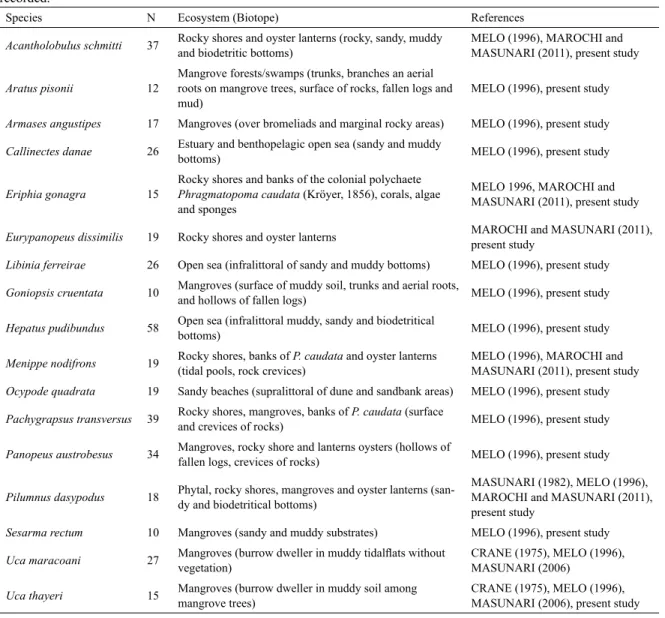
Measurements of 193 females and 199 males of the following 17 brachyuran species were taken (Table 1):
Acantholobulus schmitti (RATHBUN, 1930), Aratus pisonii (H. MILNE EDWARDS, 1873), Armases an-gustipes (DANA, 1852), Callinectes danae Smith, 1869,
Eriphia gonagra (FABRICIUS, 1781), Eurypanopeus dissimilis (BENEDICT; RATHBUN, 1891), Goniopsis cruentata (LATREILLE, 1803), Hepatus pudibundus
(HERBST, 1785), Libinia ferreirae Brito CAPELLO, 1871, Menippe nodifrons STIMPSON, 1859, Ocypode quadrata (FABRICIUS, 1787), Pachygrapsus trans-versus (GIBBES, 1850), Panopeus austrobesus
WILLIAMS, 1983, Pilumnus dasypodus KINGSLEY, 1879, Sesarma rectum RANDALL, 1840, Uca (Uca) ma-racoani (LATREILLE, 1802) and Uca (Minuca) thayeri
RATHBUN, 1900.
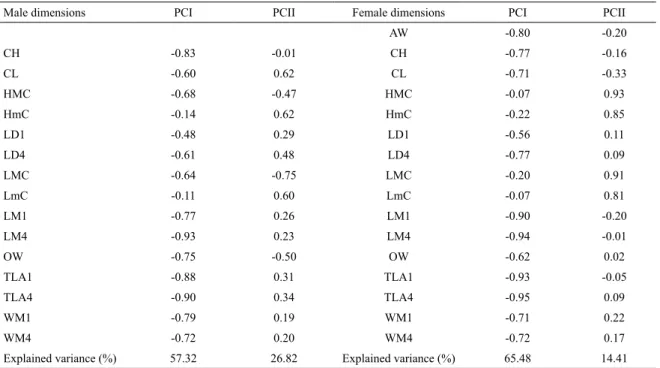
For males, the irst two axes produced by principal
component analysis (PCA) accounted for 84.14% of the
variation. The dimensions that most inluenced the distri -bution of species on axis 1 were length of the merus of ambulatory leg 4 and total length of ambulatory leg 4 that accounted for 57.32% of the variation, while on axis 2, that accounted for 26.82% of the variation, were LMC and HmC/CL (Table 2).
For females, the irst two axes of the PCA accounted
for 79.89% of the variation. Axis 1 accounted for 65.48%
of the variation, and the dimensions that most inluenced
it were TLA4 and LM1, whereas on axis 2, accounting for
14.41% of the variation, it was mostly inluenced by HMC
and LMC (Table 2).
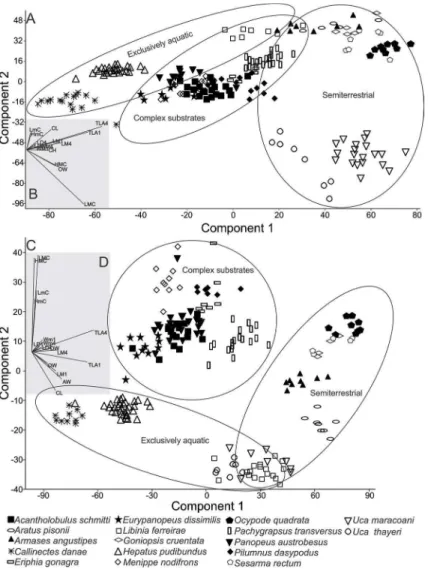
By means of the PCA, it was possible to distinguish three groups of crab species in terms of their lifestyle or the type of habitat in which they occur (Figure 2): 1. Complex Substrates, 2. Semiterrestrial and 3. Exclusively Aquatic.
The Complex Substrates group was composed of the following crab species of the families Eriphidae, Grapsidae, Menippidae, Panopeidae and Pilumnidae: A. schmitti, E. gonagra, E. dissimilis, M. nodifrons, P. trans-versus, P. austrobesus and P. dasypodus. These species live on rocky surfaces and in their crevices, on fallen logs, or on oyster beds, and were characterized by the presence of similar TLA1 and TLA4 (difference not exceeding 17% between these two dimensions), robust major cheliped
propodus (HMC ≥ 35% of LMC) and marked heterochely.
The Semiterrestrial group was composed of species of the families Grapsidae, Sesarmidae and Ocypodidae:
Table 1. List of brachyuran crab species, number of individuals analyzed and ecosystems or biotopes in which they were recorded.
Species N Ecosystem (Biotope) References
Acantholobulus schmitti 37 Rocky shores and oyster lanterns (rocky, sandy, muddy and biodetritic bottoms)
MELO (1996), MAROCHI and MASUNARI (2011), present study
Aratus pisonii 12
Mangrove forests/swamps (trunks, branches an aerial roots on mangrove trees, surface of rocks, fallen logs and mud)
MELO (1996), present study
Armases angustipes 17 Mangroves (over bromeliads and marginal rocky areas) MELO (1996), present study
Callinectes danae 26 Estuary and benthopelagic open sea (sandy and muddy
bottoms) MELO (1996), present study
Eriphia gonagra 15
Rocky shores and banks of the colonial polychaete Phragmatopomacaudata (Kröyer, 1856), corals, algae and sponges
MELO 1996, MAROCHI and MASUNARI (2011), present study
Eurypanopeus dissimilis 19 Rocky shores and oyster lanterns MAROCHI and MASUNARI (2011), present study
Libinia ferreirae 26 Open sea (infralittoral of sandy and muddy bottoms) MELO (1996), present study
Goniopsis cruentata 10 Mangroves (surface of muddy soil, trunks and aerial roots,
and hollows of fallen logs) MELO (1996), present study
Hepatus pudibundus 58 Open sea (infralittoral muddy, sandy and biodetritical
bottoms) MELO (1996), present study
Menippe nodifrons 19 Rocky shores, banks of P. caudata and oyster lanterns (tidal pools, rock crevices)
MELO (1996), MAROCHI and MASUNARI (2011), present study Ocypode quadrata 19 Sandy beaches (supralittoral of dune and sandbank areas) MELO (1996), present study
Pachygrapsus transversus 39 Rocky shores, mangroves, banks of P. caudata (surface
and crevices of rocks) MELO (1996), present study
Panopeus austrobesus 34 Mangroves, rocky shore and lanterns oysters (hollows of
fallen logs, crevices of rocks) MELO (1996), present study
Pilumnus dasypodus 18 Phytal, rocky shores, mangroves and oyster lanterns (san-dy and biodetritical bottoms)
MASUNARI (1982), MELO (1996), MAROCHI and MASUNARI (2011), present study
Sesarma rectum 10 Mangroves (sandy and muddy substrates) MELO (1996), present study
Uca maracoani 27 Mangroves (burrow dweller in muddy tidallats without vegetation)
CRANE (1975), MELO (1996), MASUNARI (2006)
Uca thayeri 15 Mangroves (burrow dweller in muddy soil among mangrove trees)
CRANE (1975), MELO (1996), MASUNARI (2006), present study
and TLA4, the irst being larger than the latter in most
species- A. pisonii, O. quadrata, U. maracoani and U. thayeri - robust major cheliped propodus (HMC > 35% of LMC) which strongly contrasts with the minor propo-dus in four species: O. quadrata, S. rectum, U. maracoani
and U. thayeri. Furthermore, O. quadrata, S. rectum, U. maracoani and U. thayeri dig burrows in unconsolidated substrata of mangrove areas and sandy beaches, and walk mostly on the soil surface. On the other hand, A. pisonii, A. angustipes and G. cruentata live mostly on the surface of trunks and shelter temporarily in their hollows.
The Exclusively Aquatic group was composed of C. danae, H. pudibundus and L. ferreirae. They were characterized by contrasting TLA1 and TLA4,
the former being larger than the latter, with weak heterochely and no robust cheliped propodus (HMC less than 35% of LMC), with the exception of H. pudibundus.
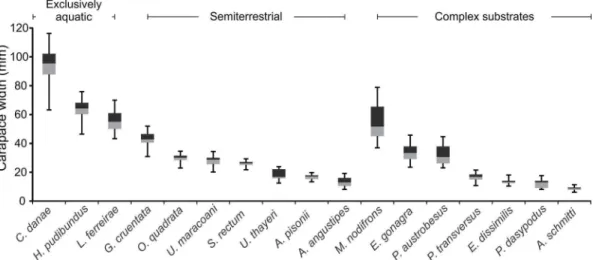
The range of CW of the brachyuran crabs varied wide-ly, but there was a predominance of larger crabs in the Exclusively Aquatic group (Figure 3).
The cluster analysis (Figure 4) showed similar results to those observed in the PCA. The males of genus Uca
were isolated from other semiterrestrial species, due to the
inluence of the major chelipeds (about four times bigger
Figure 1. Schematic igures with indication of morphometric measurements. AW: width of the 4th abdominal somite of females abdomen, CH:
carapace height, CL: carapace length, CW: carapace width, HMC: height of the major cheliped propodus, HmC: height of the minor cheliped propodus, LD1: length of the dactyl of ambulatory leg 1, LD4: length of the dactyl of ambulatory leg 4, LMC: length of the major cheliped propodus; LmC: length of the minor cheliped propodus, LM1: length of the merus of ambulatory leg 1, LM4: length of the merus of ambulatory leg 4, OW: width of the orbital region, TLA1: total length of ambulatory leg 1, TLA4: total length of ambulatory leg 4, WM1: width of the merus of ambulatory leg 1, WM4: width of the merus of ambulatory leg 4.
G. cruentata, S. rectum, A. angustipes, and O. quadrata, belong to the same group visualized in PCA, as did the Complex Substrates group with the exception of E. dis-similis. The species of the Exclusively Aquatic group C. danae, L. ferreirae and H. pudibundus did not formed a single branch.
For females, the similarity between the two analyses was observed for the species group A. pisonii, G. cruen-tata, S. rectum, A. angustipes, O. quadrata, U. maracoani
and U. thayeri, and for the group A. schmitti, E. dissimilis, E. gonagra, M. nodifrons, P. transversus, P. austrobesus
and P. dasypodus. In the Exclusively Aquatic group C. danae and H. pudibundus formed a single branch and L. ferreirae a sister group of Complex Substrates.
For the grouping analysis of linear measurements, high respective cophenetic correlation values of males (R = 0.81) and females (R = 0.75) were obtained,
indicat-ing that the groupindicat-ings satisfactorily relect the structure of
the morphometric data.
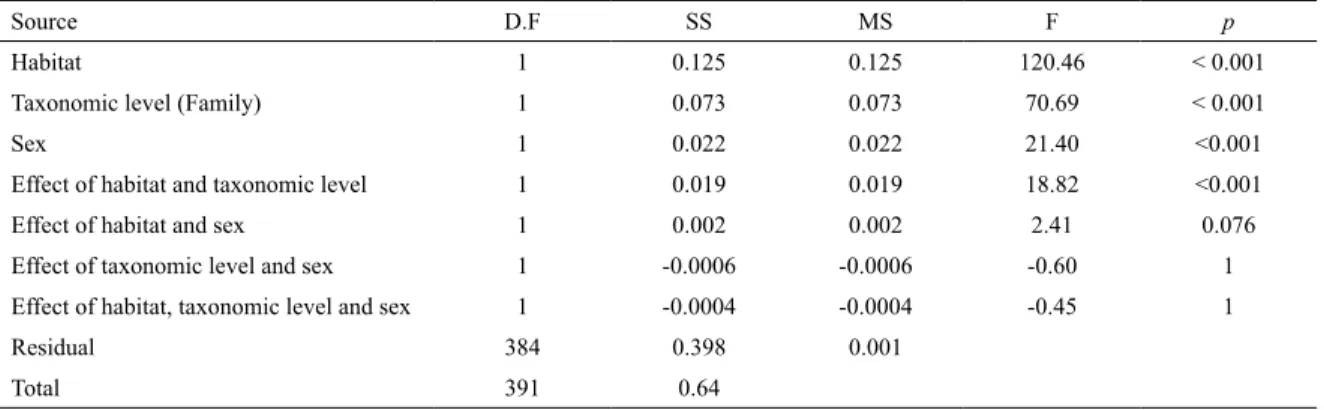
PERMANOVA revealed a signiicant inluence of
habitat type (3 proposed groups), sex and taxonomic level (family) (p < 0.001) in the morphometric data (Table 3).
DISCUSSION
Table 2. Factor loadings obtained in PCA for the irst two axes and the explanation of the variance of the body dimensions of males and females of the brachyuran crab species analyzed.
Male dimensions PCI PCII Female dimensions PCI PCII
AW -0.80 -0.20
CH -0.83 -0.01 CH -0.77 -0.16
CL -0.60 0.62 CL -0.71 -0.33
HMC -0.68 -0.47 HMC -0.07 0.93
HmC -0.14 0.62 HmC -0.22 0.85
LD1 -0.48 0.29 LD1 -0.56 0.11
LD4 -0.61 0.48 LD4 -0.77 0.09
LMC -0.64 -0.75 LMC -0.20 0.91
LmC -0.11 0.60 LmC -0.07 0.81
LM1 -0.77 0.26 LM1 -0.90 -0.20
LM4 -0.93 0.23 LM4 -0.94 -0.01
OW -0.75 -0.50 OW -0.62 0.02
TLA1 -0.88 0.31 TLA1 -0.93 -0.05
TLA4 -0.90 0.34 TLA4 -0.95 0.09
WM1 -0.79 0.19 WM1 -0.71 0.22
WM4 -0.72 0.20 WM4 -0.72 0.17
Explained variance (%) 57.32 26.82 Explained variance (%) 65.48 14.41
animals of different taxonomic groups (FELLEY, 1984; WIKRAMANAYAKE, 1990; AGUIRREL et al., 2002; TEIXEIRA; BENNEMANN, 2007; KIRCHHEIM; GOULART, 2010). However, other authors have observed low correlations between morphological traits and habi-tats, suggesting that this type of analysis would be more effective in comparisons of species belonging to the same family and not among those belonging to different groups (DOUGLAS; MATTHEWS, 1992). In the present study we have demonstrated the existence of consistent relation-ships between the morphology and habitats occupied.
The short legs (LTA1≈LTA4) among species compos -ing the Complex Substrates group are probably associated with an adaptation to traversing uneven surfaces, and en-tering hollows and crevices. Studies on the natural history of P. transversus by ABELE et al. (1986) support this idea: This typical crab of hard substrate uses cracks and crevices as refuges from both predators and waves.
The robust major cheliped of the group of Complex Substrates indicates a well-developed musculature, that could be a useful tool in breaking and opening shells of bivalves or the hard exoskeletons of crustaceans. The ex-periments of SMITH and PALMER (1994) support this as-sumption: groups of crabs Cancer productus (RANDALL, 1839) fed in the laboratory on hard prey items (shells) developed larger and more robust cheliped propodus than
those fed on “soft prey”. Additionally, robust chelipeds may
also assist in protecting crabs against the mechanical action of waves by improving the contact area and adherence of the body to the uneven substrate. This inference is based on the study of Eriphia verrucosa (FORSKAL, 1775) by SILVA et al. (2010), who recorded individuals with stron-ger chelipeds in exposed biotopes of rocky shores than those found in protected areas of the same environments. These observations may explain the robust major cheli-ped of the crabs in the Complex Substrates of this study, which are composed of Eriphidae, Grapsidae, Menippidae, Panopeidae and Pilumnidae, found on rocky shores and in oyster lantern nets. However, the Semiterrestrial crabs that also have robust major chelipeds require a different expla-nation for their large cheliped, likely related to agonistic and social behavior (CRANE, 1975).
The long eyestalks of the Semiterrestrial species are related to visual activities, more important in terrestrial environments. In this habitat visual and acoustic percep-tion are of critical importance for reproductive purpose and for avoiding predators, as well being used to recognise feeding areas near burrows by means of visual landmarks (BLISS, 1968; THIEL; BREITHAUPT, 2011).
Figure 2. A: Principal Component Analysis (PCA) of brachyuran crab males. B: Biplot regarding the PCA of males. C: PCA of brachyuran crab females. D: Biplot regarding the PCA of females.
speed and endurance of the crabs, especially during in-termittent locomotion (WEINSTEIN; FULL, 1998). In a study conducted on the ghost crab O. quadrata, WEINSTEIN and FULL (1998) observed that at an air temperature of 15°C and a continuous mean speed of 0.04 ms-1 for 60 seconds, crabs could travel for 60
me-ters before becoming fatigued. On the other hand, when moving intermittently, with alternating 30 second peri-ods of walking and resting, and an average speed of 0.08 ms-1, the crabs could travel 271 meters before becoming
fatigued - about four times greater than the distance of continuous locomotion.
The short dactyls of Semiterrestrial A. pisonii, a tree climbing species, are thought to aid in rapidly traversing the rough surfaces of mangrove trunks (WARNER, 1967; FRANTINI et al., 2005).
Besides the tendency to be large, the narrow merus of P1 in the Exclusively Aquatic group indicates undevel-oped muscles for body movements. Additionally, the short eyestalk of this crab group can be taken to suggest that visual perception may not be of primary importance in the water column (THIEL; BREITHAUPT, 2011).
The swimming crab C. danae has modiied dactyls
of its ambulatory legs 4 into “paddles” for swimming -
which allow rapid swimming (over 1 m.s.-1) and high manoeuvrability (BOOTH; MCMAHON, 1992). The short, wide merus of ambulatory legs 4 indicates developed mus-culature for body movements that enable the crab to swim
rapidly. The dorso-ventrally lattened carapace creates less
Figure 3. Mean (horizontal line), maximum/minimum values (vertical lines in each box) and CW range of 50% of data (box) of the brachyuran crabs recorded in the three habitat types.
Figure 4. Grouping analysis (UPGMA) using the Euclidean distance matrix of the linear measurements of analyzed crab species.
(WRIGHT et al., 1996; MANTELATTO; FRANSOZO, 1999; MANTELATTO; CHRISTOFOLETTI, 2001; SEITZ et al., 2003).
The long, narrow merus of the ambulatory legs 1 and 4 found in L. ferreirae indicates muscles which though
under-developed are suficient for locomotion in aquatic environ -ments where the species is aided by buoyancy. Due to the
low visibility in this habitat, foraging is accomplished pri-marily using chemosensory organs, thus explaining the short eyestalks found in this crab (THIEL; BREITHAUPT, 2011).
Table 3. Statistical test of differences between three habitat groups and taxonomic level (total n = 392) by two-way multi-variate analysis of variance (PERMANOVA), based on 15 (male) and 16 (female) proportional linear measurements.
Source D.F SS MS F p
Habitat 1 0.125 0.125 120.46 < 0.001
Taxonomic level (Family) 1 0.073 0.073 70.69 < 0.001
Sex 1 0.022 0.022 21.40 <0.001
Effect of habitat and taxonomic level 1 0.019 0.019 18.82 <0.001
Effect of habitat and sex 1 0.002 0.002 2.41 0.076
Effect of taxonomic level and sex 1 -0.0006 -0.0006 -0.60 1
Effect of habitat, taxonomic level and sex 1 -0.0004 -0.0004 -0.45 1
Residual 384 0.398 0.001
Total 391 0.64
crabs developed many strategies to avoid predation. Taking into account the CW of the crabs studied, the Complex Substrates group (rocky shores, oyster banks and fallen logs) was composed of small and medium-sized species, whereas those of the more homogeneous habitats (marine bottoms) were composed of species with an average CW of over 20.00 mm. The predominance of small-sized crab spe-cies in habitats with complex substrates can be explained by the large number of small refuges in these habitats pro-vided by the crevices, hollows and micro depressions which serve as very effective protection against their predators (HARRISON; CRESPI, 1999).
On the other hand, the size of the body of the large-sized crab species can in itself lower the risk of predation. This explanation may be applied to the predominance of larger crab species in the exclusively aquatic environments of the present study, where small refuges are scarce.
The signiicant differences between the morphology of
the males and females of different taxa and habitats reinforce the widely known sexual dimorphism of the Decapoda by means of morphometric approaches (HARTNOLL, 1974).
The presence of different crab lineages in the en-vironments analyzed (Complex Substrates: Eriphidae, Grapsidae, Menippidae, Panopeidae and Pilumnidae; Semiterrestrial: Grapsidae, Ocypodidae and Sesarmidae; Exclusively Aquatic: Epialtidae, Aethidae and Portunidae) suggests the convergent evolution of morphological traits
aimed at optimising performance in the speciic habitat to
which the crabs are adapted.
The environment in which an animal lives, combined with selection caused by predation, could affect its mor-phology, and consequently communication and reproduc-tive pattern. The distinct morphological patterns of brachy-uran crabs found for each biotope in the present study
indicate that it is possible to establish typical crab morphol-ogies for each habitat. The morphological characters that
most inluenced the distribution of brachyuran crab species
(length and width of ambulatory legs and length and height of cheliped propodus) were, in general, related with facility of displacement within each microhabitat, as well as
intra-speciic communication and avoidance of predators.
ACKNOWLEDGEMENTS
We are thankful to Prof. Dr. Tânia Marcia Costa from Paulista State University, Prof. Dr. Janete Dubiaski-Silva
from Pontiical Catholic University of Paraná and Prof. Dr. Marco Fábio Corrêa from Federal University of Paraná for
useful comments and suggestions to this work. Dr. Tomer Czaczkes from University of Regensburg provided useful comments, suggestions and English revision and Dr. Odete Lopez Lopes from Museum of Natural History of Capão da Imbuia provided the deposited crab specimens. Thanks are
also due to Brazilian Council for Scientiic and Technological Development-CNPq for the master scholarship to the irst
author. All biological samples collecting of the present study complies with the current laws of Paraná State and Brazilian Federal Government, and it was conducted with the permission of the “Brazilian Institute of Environment and Renewable Natural Resources (IBAMA) of Paraná
State” (Authorization #23482-1-DIFAP/IBAMA, 30/03/2010). This is Contribution #1895 of Zoology
Department, Federal University of Paraná.
REFERENCES
AGUIRREL, L. F.; HERREL, A.; DAMME, R.; MATTHYSEN, E. Ecomorphological analysis of trophic niche partitioning in a tropical savannah bat community. Proc. Biol. Sci., v. 269, n. 1497, p. 1271-1278, 2002.
BETZ, O. Life forms and hunting behaviour of some Central European Stenus species (Coleoptera, Staphylinidae). Appl. Soil. Ecol., v. 9, n. 1, p. 69-74, 1998.
BLISS, D. E. Transition from water to land in decapod crusta-ceans. Am. Zool., v. 8, p. 355-398, 1968.
BOOTH, C. E.; MCMAHON, B. R. Aerobic capacity of the blue crab, Callinectes sapidus. Physiol. Zool., v. 65, n. 6, p. 1074-1091, 1992.
CARVALHO, A. L. G.; ARAÚJO, A. F. B. Ecomorphometric structure of Restinga da Marambaia lizard community, Rio de Janeiro, southeastern Brazil. Rev. Bras. Zool., v. 24, n. 3, p. 786-792, 2007.
CRANE, J. Fiddler crabs of the world: Ocypodidae: genus Uca. New Jersey: Princeton University Press, 1975. 736 p. DARWIN, C. The Origin of Species by Means of Natural
Selec-tion or the PreservaSelec-tion of Favoured Races in the Struggle for Life. London: John Murray, 1859.
DE GRAVE, S.; PENTCHEFF, N. D.; AHYONG, S. T.; CHAN, T. Y.; CRANDALL, K. A.; DWORSCHAK, P. C.; FELDER, D. L.; FELDMANN, R. M.; FRANSEN, C. H. J. M.; GOULDING, L. Y. D.; LEMAITRE, R.; LOW, M. E. Y.; MARTIN, J. W.; NG, P. K. L.; SCHWEITZER, C. E.; TAN, S. H.; TSHUDY, D.; WETZER, R. A classiication of living and fossil genera of decapod crustaceans. Rafles Bull. Zool., v. 21, p. 1-109, 2009.
DOUGLAS, M. E.; MATTHEWS, W. J. Does morphology pre-dict ecology? Hypothesis testing within a freshwater stream ish assemblage. Oikos, v. 65, p. 213-224, 1992.
FELLEY, J. D. Multivariate identiication of morphological - en -vironmental relationships within the Cyprinidae (Pisces). Co-peia, v. 2, p. 442-455, 1984.
FRANTINI, S.; VANINI, M.; CANNICCI, S.; SCHUBART, C. D. Tree-climbing mangrove crabs: a case of convergent evo-lution. Evol. Ecol. Res., v. 7, n. 2, p. 219-233, 2005. GATZ, A. J. Community organization in ishes as indicated by
morphological features. Ecology, v. 60, p. 711-718, 1979. GOMES, L. N.; PINHEIRO JÚNIOR, J. R.; PIORSKI, N. M.
As-pectos ecomorfológicos da comunidade de peixes do estuário do Rio Anil, Ilha de São Luíz – MA. Bol. Lab. Hidrobiol., v. 16, n. 1, p. 29-36, 2003.
HARRISON, M. F.; CRESPI, B. J. A Phylogenetic Test of Eco-morphological Adaptation in Cancer Crabs. Evolution, v. 53, n. 3, p. 961-965, 1999.
HARTNOLL, R. G. Variation in growth pattern between some secondary sexual characters in crabs (Decapoda Brachyura). Crustaceanas, v. 27, n. 2, p. 131-136, 1974.
HINES, A. H. Fecundity and reproductive output in nine species of Cancer crabs (Crustacea, Brachyura, Cancridae). Can. J. Fish. Aquat. Sci., v. 48, p. 267-275, 1991.
IRSCHICK, D. J.; VITT, L. J.; ZANI, P. A.; LOSOS, J. B. A com-parison of evolutionary radiations in mainland and Caribbean Anolis lizards. Ecology, v. 78, n. 7, p. 2191-2203, 1997. KARR, J. R.; JAMES, F. C. Eco-morphological conigurations
and convergent evolution in species and communities. In: CODY, M. L.; DIAMOND, J. M. (Eds.). Ecology and evolu-tion of communities. Boston: Harvard University Press, 1975.
KEAST, A. The piscivore feeding guild of ishes in small freshwater ecosystems. Environ. Biol. Fish, v. 12, n. 2, p. 119-129, 1985. KESLER, D. H.; BAILEY, R. C. Density and ecomorphology of
a fresh water mussel (Elliptio complanata, Bivalvia: Unioni-dae) in a Rhode Island lake. J. N. Am. Benthol. Soc., v. 12, n. 3, p. 259-264, 1993.
KIRCHHEIM, P. D.; GOULART, E. Ecomorfologia de predação e antipredação em Siluriformes (Osteichthyes). Oecol. Aust., v. 14, n. 2, p. 550-568, 2010.
LABROPOULOU, M.; ELEFTHERIOU, A. The foraging ecol-ogy of two pairs of congeneric demersal ish species: impor -tance of morphological characteristics in prey selection. J. Fish. Biol., v. 50, p. 324-340, 1997.
LINDSEY, C. C. Form, function, and locomotory habits in ish. In: HOAR, W. S.; RANDALL, D. J. (Eds.). Fish physiology Vol. VII Locomotion. New York: Academic Press, 1978. p. 1-100.
MANTELATTO, F. L. M.; FRANSOZO, A. Reproductive biol-ogy and moulting cycle of the crab Callinectes ornatus (De-capoda, Portunidae) from the Ubatuba region, São Paulo, Brazil. Crustaceana, v. 72, n. 1, p. 63-73, 1999.
MANTELATTO, F. L. M.; CHRISTOFOLETTI, R. A. Natural feeding activity of the crab Callinectes ornatus (Portunidae) in Ubatuba Bay (São Paulo, Brazil): Inluence of season, sex, size and the molt stage. Mar. Biol., v. 138, n. 3, p. 585-594, 2001.
MAROCHI, M. Z.; MASUNARI, S. Os caranguejos Eriphiidae, Menippidae, Panopeidae e Pilumnidae (Crustacea Brachyura) de águas rasas do litoral do Paraná, com chave pictórica de identiicação para as espécies. Biota Neotrop., v. 11, n. 3, p. 1-13, 2011.
MASUNARI, S. Organismos do ital Amphiroa beauvoisii La-mouroux, 1816 (Rhodophyta: Corallinaceae) I. Autoecologia. Bol. Zool. Univ. São Paulo, v. 7, n. 1, p. 57-148, 1982. MASUNARI, S. Distribuição e abundância dos caranguejos Uca
Leach (Crustacea, Decapoda, Ocypodidae) na Baía de Guara-tuba, Paraná Brasil. Rev. Bras. Zool.,v. 23, n. 4, p. 901-914, 2006.MASUNARI, S.; DUBIASKI-SILVA, J. Crustacea De-capoda da praia rochosa da Ilha do Farol, Matinhos, Paraná. I. Distribuição espacial de densidade das populações. Rev. Bras. Zool., v. 15, n. 3, p. 643-664, 1998.
MELO, G. A. S. Manual de identiicação dos Brachyura (ca -ranguejos e siris) do litoral brasileiro. São Paulo: Plêiade/ FAPESP, 1996. 604 p.
NG, P. K. L.; GUINOT, D.; DAVIE, P. J. F. Systema Brachyuro-rum: Part I. An annotated checklist of extant brachyuran crabs of the world. Rafles Bull. Zool., v. 17, p. 1-286, 2008. NORTON, S. F.; LUCZKOVICH, J. J.; MOTTA, P. J. The role
of ecomorphological studies in the comparative biology of ishes. Environ. Biol. Fishes, v. 44, n. 1, p. 287-304, 1995. OKSANEN, J.; BLANCHET, F. G.; KINDT, R.; LEGENDRE, P.;
MINCHIN, P. R.; O’HARA, R. B.; SIMPSON, G. L.; SOLY -MOS, P.; STEVENS, M. H. H.; WAGNER, H, 2012. Com-munity Ecology Package, version 2.0-4. Available: <URL: http://CRAN.R-project.org/package=vegan> Accessed: Janu-ary 2015.
ORENSANZ, J. M.; GALLUCCI, V. E. Comparative study of postlarval life-history schedules in four sympatric species of Cancer (Decapoda: Brachyura: Cancridae). J. Crust. Biol., v. 8, n. 2, p. 187-220, 1988.
PIORSKI, N. M.; ALVES, J. R. L.; MACHADO, M. R. B; CORREIA, M. M. F. Alimentação e ecomorfometria de duas espécies de piranhas (Characiformes: Characidae) do Lago de Viana, Estado do Maranhão, Brasil. Acta Amaz., v. 35, n. 1, p. 63-70, 2005.
PIORSKI, N. M.; DOURADO, E. C. S.; NUNES, J. L. S. Análi-se ecomorfológica de três espécies de peixes do parque esta -dual marinho do Parcel de Manuel Luiz, nordeste do Brasil. Bol. Lab. Hidrobiol, v. 20, p. 69-76, 2007.
R Development Core Team. R: A language and environment for statistical computing. R Foundation for Statistical Comput-ing, Vienna, Austria. 2011. ISBN 3-900051-07-0. Available: < URL: http://www> Rproject.org/> Accessed: January 2015.
RIBAS, S. C.; VELLOSO, A. L. R.; TEIXEIRA-FILHO, P.; ROCHA-BARBOSA, O.; EVANGELISTA, H.; SANTOS, E. A. Structure of claws and toes of two tropidurid lizard species of Restinga from Southeastern Brazil: adaptations to the vertical use of the habitat. Rev. Chil. Hist. Nat., v. 77, n. 4, p. 599-606, 2004.
SEITZ, R. D.; LIPCIUS, R. N.; STOCKHAUSEN, W. T.; DELANO, K. A.; SEEBO, M. S.; GERDES, P. D. Potential bottom-up control of blue crab distribution at various spatial scales. Bull. Mar. Sci., v.72, n. 2, p. 471-490, 2003. SILVA, A. C.; SILVA, I. C.; HAWKINS, S. J.; BOAVENTURA,
D. M.; THOMPSON, R. C. Cheliped morphological varia-tion of the intertidal crab Eriphia verrucosa acrossshores of differing exposure to wave action. J. Exp. Mar. Biol. Ecol., v. 391, n. 1/2, p. 84-91, 2010.
SOKAL, R. R.; ROHLF, F. J. The comparison of dendrograms by objective methods. Taxon, v. 11, p. 33-40, 1962. SMITH, L. D.; PALMER, A. R. Effects of manipulated diet on
size and performance of brachyuran crab claws. Science, v. 264, n. 5159, p. 710-712, 1994.
STREELMAN, J. T.; ALFARO, M.; WESTNEAT, M. W.; BELLWOOD, D. R.; KARL, S. A. Evolutionary history of the parrotishes: biogeography, ecomorphology, and com -parative diversity. Evolution, v. 56, n. 5, p. 961-971, 2002.
TEIXEIRA, I.; BENNEMANN, S. T. Ecomorfologia reletindo a dieta dos peixes em um reservatório no sul do Brasil. Biota Neotrop., v. 7, n. 2, p. 67-76, 2007.
THIEL, M; BREITHAUPT, T. Chemical communication in crus-taceans: research challenges for the twenty-irst century. In: BREITHAUPT, T.; THIEL, M. (Eds.). Chemical communica-tion in crustaceans. London: Springer, 2011. 565 p. TRONTELJ, P.; BLEJEC, A.; FIŠER, C. Ecomorphological
con-vergence of cave communities. Evolution, v. 66, n. 12, p. 3852-3865, 2012.
VAN DER KLAAUW, C. J. Ecological Studies and reviews. IV. Ecological morphology. Leiden: E. J. Brill, 1948. p. 27-111. VANHONI, F.; MENDONÇA, F. O clima do litoral do estado do
Paraná. Rev. Bras. Climat., v. 3, p. 49-63, 2008.
WARNER, G. F. The life history of mangrove tree crab, Aratus pisoni. J. Zool., v. 153, n. 3, p. 321-335, 1967.
WAHLE, R. A.; STENECK, R. S. Habitat restrictions in early benthic life: experiments on habitat selection and in situ pre-dation with the American lobster. J. Exp. Mar. Biol. Ecol., v. 157, n. 1, p. 91-114, 1992.
WEINSTEIN, R. B.; FULL, R. J. Performance limits of low-tem-perature, continuous locomotion are exceeded when locomo-tion is intermittent in the ghost crab. Physiol. Zool., v. 71, n. 3, p. 274-284, 1998.
WIKRAMANAYAKE, E. D. Ecomorphology and biogeography of a tropical stream ish assemblage: evolution of assemblage structure. Ecology, v. 71, n. 5, p. 1756-1764, 1990. WINEMILLER, K. O. Ecomorphological diversiication in low
-land freshwater ish assemblages from ive biotic regions. Ecol. Monogr., v.61, n. 4, p. 343-365, 1991.
WRIGHT, R. A.; CROWDER, L. B.; MARTIN, T. H. Selective predation by blue crabs on the gastropod, Bittium varium: conirmation from opercula found in the sediments. Estuar -ies, v. 19, n. 1, p. 75-81, 1996.