A
r
t
ic
le
0103 - 5053 $6.00+0.00
*e-mail: [email protected]
Thermal Decomposition Kinetics of Humic Substances Extracted from Mid-Rio Negro
(Amazon Basin) Soil Samples
Luciana Camargo de Oliveira,*,a Clovis Augusto Ribeiro,a André Henrique Rosa,b Wander Gustavo
Botero,a,c Julio Cesar Rocha,a Luciane Pimenta Cruz Romãod and Ademir dos Santosa
aInstituto de Química de Araraquara, Universidade Estadual Paulista, CP 355, 14800-900 Araraquara-SP, Brazil
bDepartmento de Engenharia Ambiental, Universidade Estadual Paulista, 18087-180 Sorocaba-SP, Brazil
cUniversidade Federal de Alagoas, Arapiraca, CP 61, 57309-005 Arapiraca-AL, Brazil
dDepartamento de Química, Universidade Federal de Sergipe, 49100-000 São Cristovão-SE, Brazil
Neste trabalho substâncias húmicas (SH) extraídas de solos não alagáveis (Araçá) e alagáveis (Iara) foram caracterizadas com cálculos de estabilidade e energias de ativação associadas com a desidratação e decomposição térmica de SH utilizando TGA and DTA, ressonância paramagnética eletrônica (EPR) e razões atômicas C/H, C/N e C/O. Para SH extraídas de solos alagáveis, existe evidências da influência da umidade sobre o processo de humificação da matéria orgânica. Observações do comportamento térmico, com análise elementar, indicaram a presença de fósseis de carbono orgânico nas partículas de argila, o que só decompõe acima de 800 ºC. Essa característica pode explicar as diferentes estabilidades térmicas e energias de ativação requeridas na pirólise para amostra Iara comparada a amostra Araçá.
In this work humic substances (HS) extracted from non-flooded (Araçá) and flooded (Iara) soils were characterized through the calculation of stability and activation energies associated with the dehydration and thermal decomposition of HS using TGA and DTA, electronic paramagnetic resonance and C/H, C/N and C/O atomic ratios. For HS extracted from flooded soils, there was evidence for the influence of humidity on the organic matter humification process. Observations of thermal behaviour, with elemental analysis, indicated the presence of fossilized organic carbon within clay particles, which only decomposed above 800 ºC. This characteristic could explain the different thermal stability and pyrolysis activation energies for Iara HS compared to Araçá HS.
Keywords: soils, humic substances, kinetics, thermal analysis, Amazon
Introduction
The Amazon area occupies approximately 6,000,000 km2
of South America, corresponding to almost 50% of Brazil’s national territory. This region is characterized by a great variety of soil types, flooded and non-flooded zones, and white (particle-laden) and black (humic substances-rich) waters, with unique features of biodiversity, temperature and humidity. An important factor in this area is the high concentration of organic matter present within aquatic and terrestrial systems.
The greatest mass of refractory organic carbon present in soils and aquatic systems is in the form of humic substances (HS). These are a polydisperse mixture of
macromolecules produced by microbial degradation of vegetation and animal residues. HS exert important functions in aquatic and terrestrial systems due to the diversity of the functional groups present in their structures. In soils they occur mainly as insoluble macromoleculal aggregates, linked via di- and tri-valent cations and/or in associations with mineral clay through cationic bridges, hydrogen bonds and ligand exchange reactions.
Humic substances extracted from different types of soils differ in their physical characteristics and chemistries due to their genesis via diverse humification mechanisms. Hence different techniques have been used for their structural characterization, such as measurement of the E4 / E6 ratio, defined as the ratio of optical absorbance at 465 and 665 nm in aqueous solutions,1 carbon-13
spectroscopy,3,4 atomic ratios of the elements carbon,
hydrogen, nitrogen and oxygen (C/H, C/N and C/O)5 and
electronic paramagnetic resonance.3,6,7 The spectroscopic
techniques have been most widely used for structural characterization of HS.
Thermal analyses, mainly thermogravimetric analysis (TGA) and differential thermal analysis (DTA), have shown promise for studies associated with the behaviour of soils in the environment.8 However few studies have been reported
in the literature concerning use of thermal analysis for characterization of HS, with calculation of the activation energy via non-isothermal procedures.
Humic substances extracted from flooded and non-flooded soils of the Amazon basin have similarly been little studied, especially in relation to their structural characteristics. Hence in this work HS extracted from a complex non-flooded soil (Araçá) and a flooded soil (Iara), possessing different mineralogical compositions, were characterized through the calculation of stability and activation energies associated with their dehydration and thermal decomposition, using TGA and DTA, electronic paramagnetic resonance (EPR) and C/H, C/N and C/O atomic ratios.
Experimental
Chemicals and reagents
All reagents used were of high-purity grade unless otherwise stated. The acid and alkaline solutions necessary for HS isolation were prepared by dilution of 30% hydrochloric acid (Merck AG) or dissolution of sodium hydroxide-monohydrate (Merck AG) in high-purity water (Milli-Q system, Millipore).
Soil sampling
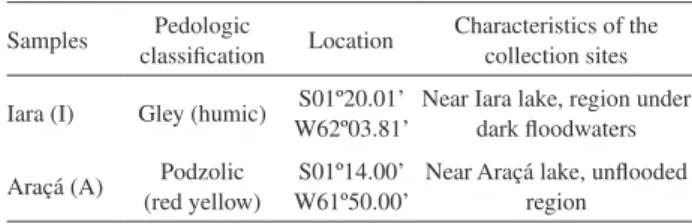
The Amazonian soils under study (Table 1) were collected from the Negro river basin (state of Amazonas, Brazil), between the towns of Barcelos and Santa Izabel. Soils were transferred to wooden trays and dried in a recirculating air oven at 25 oC. Dried soils were then passed through a 2 mm
plastic sieve and stored in polyethylene bags.
Humic substance extractions
The HS were extracted according to the procedure recommended by the International Humic Substances Society.9,10 For this purpose, 50 g of the soil samples were
extracted using a volume of 0.1 mol L-1 HCl equal to ten
times the weight of the sample. The pH of the solution was adjusted to between 1.0 and 2.0 with 1.0 mol L-1 HCl. The
soil /HCl mixture was shaken for 1 h and the suspension allowed to settle. The mixture was then centrifuged at 1478 g for 10 min, and the supernatant was separated from the sediment. The sediment was neutralized with 1.0 mol L-1
NaOH to pH 7.0, and a volume of 0.1 mol L-1 NaOH equal
to ten times the weight of the sample was added under a nitrogen atmosphere. The mixture was shaken for 4 h and then allowed to settle overnight. The supernatant was separated from the sediment by centrifugation at 1478 g
for 10 min, and the sediment discarded. The supernatant (containing the HS) was evaporated under vacuum and dried in a recirculating air oven at 55 °C in order to estimate the percentage of HS in the soils.
Characterization of humic substances
Thermal behavior
TGA and DTA curves were obtained using a TA Instruments Model SDT 2960 analyzer with an alumina pan, a sample mass of around 8 mg, an atmosphere of synthetic air (80% N2 and 20% O2) or nitrogen at a flow rate of 100 mL min-1, and a heating rate of 10 °C min-1.
Using non-isothermal TGA procedures, the thermal decomposition of a material can be mathematically described by the kinetic triplet (E, logA and f(α)). A solid-state Arrhenius type reaction can be expressed by the general equation:11-14
dα A –E
–– = –– exp
(
–––)
f(α) (1) dT β RTwhere the fractional degradation (α) is temperature (T) dependent during an increasing constant heating rate (β). According to the isoconversional Flynn-Wall-Ozawa (F-W-O) method, the angular and line ar coefficients and constant α of a plot of log βversus 1/T at different temperatures gives E.11-14
Elemental analysis
Elemental analyses of the extracted HS were undertaken using a Thermo-Finnegan elemental analyzer.
Electron Paramagnetic Resonance (EPR) Spectroscopy
The EPR measurements were performed in a Bruker
Table 1. Pedologic classification, location and characteristics of soil
sampling sites in the Rio Negro basin, Amazonas State, Brazil
Samples Pedologic
classification Location
Characteristics of the collection sites
Iara (I) Gley (humic) S01º20.01’ W62º03.81’
Near Iara lake, region under dark floodwaters
Araçá (A) Podzolic (red yellow)
S01º14.00’ W61º50.00’
EMX spectrometer operating at X-Band (9 GHz), with a rectangular cavity, at room temperature. The experimental parameters were: 0.2 mW (30 dB) microwave power (obtained from the microwave power saturation curve),15
100 kHz modulation frequency, 0.1 mT modulation amplitude, with minimum 4 scans accumulated. For quantitative analysis, quartz EPR tubes (2.5 mm I.D.) were filled with the sample, taking into account the mass concentration. The relative areas of EPR signals were obtained by the approximation I × ∆H2,16 where I is the
EPR derivative signal amplitude and ∆H2 the peak-to-peak
line width. The relative concentration of semiquinone-type free radicals (spin concentration) was obtained using as a secondary standard a ruby crystal calibrated with a strong pitch reference of known free radical content, according to Singer’s method.17,18 The HS samples were dried in
desiccators over silica gel and the results obtained were corrected for the sample’s carbon content (spins (g C)-1).
Results and Discussion
According to Wershaw,19 in soils and sediments the
humus comprises aggregates consisting of organic matter in the form of double layer membranes coating the mineral grains. These aggregates are formed during humification, the process during which residues of plants and animals are converted into humus, a basic stage of the carbon cycle. The organic components of animal and plant tissues are thermodynamically unstable in an oxidizing atmosphere and, during decomposition, are converted to CO2 and water in degradation reactions catalysed by enzymes secreted by microorganisms. However not all of these animal and plant residues achieve full mineralization, and a fraction can accumulate in the form of humus. Humus produced in soils is comprised of amphiphilic molecules, products of the degradation of plants and lignin carbohydrate complexes, which interact with mineral grains present in the soils. This interaction results in the formation of membranes of amphiphilic molecules on the mineral grains.
The optimum method for measuring the extent of humification remains a debatable question, since there is no well-defined model of HS structure.20 However, it is usually
evaluated through indirect measurements which reflect the structural changes occurring during the humification process. Several techniques have been used to characterize the progress of humification, including measurement of the E4 / E6 ratio, defined as the ratio of optical absorbance at 465 and 665 nm in aqueous solution, which indicates structural condensation, 21,1 aromatic C, determined by CPMAS 13C
Nuclear Magnetic Resonance (NMR)22 and C/H, C/O,
and C/N ratios, defined as the atomic ratio between these
elements (carbon, hydrogen, oxygen, and nitrogen).1,9
A more specific molecular spectroscopic technique to estimate the degree of humification in soil organic matter is the concentration of stable free radicals (semiquinone-type obtainable by electron paramagnetic resonance (EPR)).3,6,7
Complex aromatic structures are believed to stabilize free radicals in HS.1,23 In this paper C/H, C/N and C/O atomic
ratios, and concentrations of free radicals, were used to measure the degree of humification of humic substances.
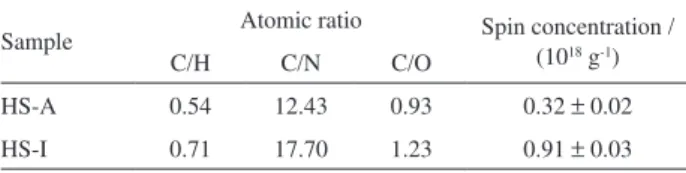
HS spin concentrations were in the range 3.2-9.1 × 10¹⁷
spins (g C)-1 (Table 2), indicating substantial differences in
the humification levels of HS extracted from Amazonian soils. These values are relatively high in comparison with the results reported by Swift,24 but are comparable to values
obtained for more humified samples.7,18 In addition, it was
observed that HS extracted from soils in flooded regions (Iara sample) possessed higher spin concentrations than HS extracted from soils in non-flooded regions (Araçá). The higher spin concentration in flooded soil could be a consequence of the anoxic environment as semiquinones and other organic free radical contents increase under reductive condition. These findings indicate that humidity affects the humification process, as observed earlier by Martin-Neto et al.,7 who found a good correlation between
the spin concentration in HS and annual mean precipitation. Decomposition of organic material in soil tends to lead to the formation of phenolic structures deriving from lignin, whose rates of decomposition differ from those of other organics (such as sugars and proteins).25
Hence C/H, C/N, and C/O atomic ratios have been used as important indicators of the aromaticity and extent of organic material decomposition. According to the literature,1 higher values of C/H, C/O, and C/N atomic
ratios are associated with higher degrees of humification due to decreased carbohydrate and amino acid / protein contents. Hence the fact that the sample collected in the flooded area showed higher atomic ratios indicated a greater extent of humification, in agreement with the EPR data. This is probably related to the nature of the sampling point, in a more anoxic area where organic matter cycling is reduced. Hence anoxia in the flooded areas directly influences the degree of humification of HS.
Table 2. Atomic ratios (C/H, C/N and C/O) and spin concentrations for
humic substances extracted from mid-Rio Negro basin soils
Sample Atomic ratio Spin concentration /
(1018 g-1)
C/H C/N C/O
HS-A 0.54 12.43 0.93 0.32 ± 0.02
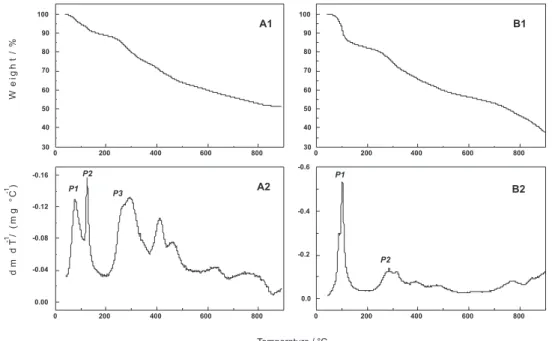
TGA and DTA curves obtained under a synthetic air atmosphere (Figure 1) illustrate the differences in thermal behaviour between the humic substances extracted from Iara and Araçá soils.
From the TGA and DTA curves for Araça HS (Figure 1, A1 and A2), mass loss features between 40 and 650 ºC can be attributed to the dehydration and thermal decomposition of HS resulting in a mineralised residue consisting mainly of clay minerals plus oxides and / or carbonates formed during the decomposition of the organic matter. The DTA curve (Figure 1-A2) shows small endothermic and exothermic peaks up to 400 ºC and a sharp peak around 580 ºC, corresponding to the TGA curve (Table 3).
From the TGA and DTA curves for Iara HS (Figure 1, B1 and B2), the mass loss up to 627 ºC is attributed to dehydration and thermal decomposition, with corresponding exothermic peaks in the DTA curve, however the thermal behaviour differs from that observed for Araçá HS. Between 627 and 954 ºC, a 32 % mass loss was accompanied by a corresponding sharp exothermic peak in the DTA curve, indicative of the decomposition of organic carbon which had been incorporated within the matrix during clay formation.
Hence for Iara soil, but not for Araçá soil, there is evidence for the presence of organic carbon fossilized within the clay, which was later covered with humic substances, suggesting that this may be a characteristic of material originating from flooded areas. The reaction
between 627 and 954 ºC occurs during the phase transition of clay from crystalline to amorphous (800-1000 ºC), which exposes the fossilized organic carbon to the oxidizing atmosphere.8 CHN analysis of Iara HS (Table 4) indicated
the presence of 35.5% of carbon in calcined residue, further supporting this hypothesis.
TGA and DTA curves for Araçá and Iara HS obtained under nitrogen atmospheres (Figure 2) illustrate differences in thermal behaviour, both between soils and relative to their behaviours under air atmospheres, however with similar mass losses up to approximately 600 ºC (Table 3).
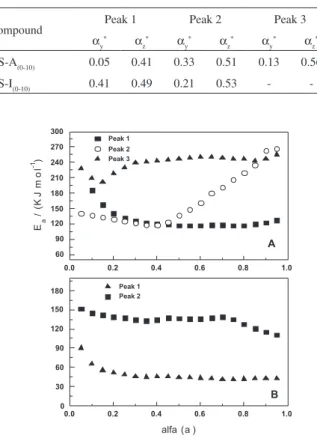
From the TGA and DTA curves obtained under nitrogen atmospheres (Figure 2), behaviour between 40 and 400 ºC was indicative of three stages of mass loss for Araçá HS, and two stages for Iara HS. The events correspond to peaks P1, P2 (and P3) in the DTA curves. From the DTA peak intervals the activation energies, E (α), relative to the reaction fraction, α, for non-isothermal processes were calculated according to the method of Flynn-Wall-Ozawa. Graphs of E (α) versusα (Figure 3) indicate the different pyrolysis/dehydration behaviours of Araçá and Iara HS. Table 5 shows maximum values of the functions y(α) and z(α) against α, for DTA dehydration and thermal decomposition peaks 1-3 (HS-A) and 1-2 (HS-I).
The two pyrolysis / dehydration reactions evaluated for Iara HS (Figure 3B) indicate more homogeneous events, with smaller activation energies, compared to Araçá HS, with activation energies of around 60 kJ mol-1 for P1
Figure 1. TGA and DTA curves for humic substances extracted from (A1, A2) Araça and (B1, B2) Iara soils. Conditions: Air atmosphere (100 mL min-1),
and 150 kJ mol-1 for P2. For Araçá HS (Figure 3A) the
relationship E versus α is suggestive of the occurrence of
a greater number of reactions than indicated by P1, P2 and P3. For the interval which includes these peaks, the initial activation energy (at P1) is around 120 kJ mol-1, increasing
to 140 kJ mol-1 at the beginning of P2 and then increasing
continuously to 240 kJ mol-1, and remaining around this
value for the reaction corresponding to P3.
This behaviour is indicative that (α) there are larger heterogeneities in the decomposition of Araçá HS than of Iara HS, and (β) the clay-carbon support in Iara HS acts as a catalyst during the thermal decomposition of HS.
Figure 2. TGA and DTA curves for humic substances extracted from (A1, A2) Araça and (B1, B2) Iara soils. Conditions: N2 atmosphere (100 mL min-1),
10 ºC min-1 heating rate, alumina pan.
Table 3. Data from TGA and DTA curves (Figures 2-3) for humic substances extracted from Araça (HS-A) and Iara (HS-I) soils
TGA curves DTA curves / (°C)
Air atmosphere N2 atmosphere Air atmosphere / peak N2 atmosphere / peak
∆m / (%) ∆T / (°C) ∆m / (%) ∆T / (°C) Endo Exo Endo Exo
HS-I
12.46
39.45
31.88 16.21 (residue)
40-173
173-627
627-954 954
17.06 14.13 4.50 6.44 11.61 16.86 27.28 (residue)
40-190 190-368 368-435 435-576 576-820 820-991 991
73
292
463 771, 819
107 322
HS-A
6.41
20.19 7.56 23.75
6.86 35.27 (residue)
40-158
158-393 393-489 489-661
738-1000 1000
5.61 4.62 14.32
5.37 5.59 5.11 4.78 48.08 (residue)
40-112 112-192 192-371 371-440 440-544 544-685 685-890 890
85
236, 275
580
83 130
422
637
254
Table 4. Elemental analysis of humic substances extracted from mid-Rio
Negro basin soils
Compounds Initial Calcined residue
C H N C H N
HS-A HS-I
24.70 26.20
3.28 3.84
2.14 1.77
nd 35.54
0.28 1.24
Evaluating the intra-relationship of the results of E x α
in relation to the kinetic compensation effect (KCE), lnA = a + bE, the behaviour illustrated in Figure 4 is obtained for the peak intervals of Araçá and Iara HS samples.
Conclusions
Spin concentration data indicate large differences between the degrees of humification of HS extracted from different Amazon soils. HS extracted from flooded soil showed higher
spin concentrations than HS extracted from non-flooded soil, indicating the influence of humidity on the organic matter humification process. C/H, C/N and C/O atomic ratios corroborated the EPR data, also suggesting a greater extent of humification for extracts of samples collected from flooded areas. It can therefore be inferred that anaerobic conditions exert a strong influence on the humification process within flooded soils of the Rio Negro river basin.
Thermal studies, with elemental analysis, indicate the presence of fossilized organic carbon within clay particles of the flooded soil, which only decomposed above 800 ºC. This finding could explain the different thermal stability and activation energy required for pyrolysis of Iara (flooded) HS compared to Araçá (non-flooded) HS.
Acknowledgments
The authors are indebted to CAPES, FAPESP and CNPq (Brazilian agencies) for their financial support.
References
1. Sheng, G. P.; Zhang, M. L.; Yu, H. Q.; J. Colloid Interface Sci.
2009, 331, 15.
2. Romão, L. P. C.; Lead, J. R.; Rocha, J. C.; Oliveira, L. C.; Rosa, A. H.; Mendonça, A. G. R.; Ribeiro, A. S.; J. Braz. Chem. Soc.
2007, 18, 714.
3. Bayer, C.; Martin-Neto, L.; Mielniczuk, J.; Saab, S. C.; Milori, D. M. B. P.; Bagnato, V. S.; Geoderma 2002, 105, 81. 4. He, Z.; Ohno, T.; Wu, F.; Olk, D. C.; Honeycutt, W.; Olanya,
M.; Soil Sci. Soc. Am. J. 2008, 72, 1248.
5. Margherita, E.; Brunetti, G.; Garcia Isquierdo, C.; Cavalcanti, F.; Fiore, S.; Senesi, N.; Soil Sci. 2006, 171, 322.
6. Oliveira, L. C.; Sargentini,Jr., E.; Rosa, A. H.; Rocha, J. C.; Simões, M. L.; Martin-Neto, L.; Silva, W. T. L.; Serudo, R. L.; J. Braz. Chem. Soc. 2007, 18, 860.
7. Martin-Neto, L.; Rosell, R.; Sposito, G.; Geoderma 1998, 81, 305.
8. Leinweber, P.; Schulten, H. R.; Thermochim. Acta. 1992, 200, 151.
9. Rosa, A. H.; Rocha, J. C.; Furlan, M.; Quim. Nova 2000, 23, 472.
10. Rosa, A. H.; Oliveira, L. C.; Bellin, I. C.; Rocha, J. C.; Dias Filho, N. L.; Thermochim. Acta. 2005, 433, 77.
11. Flynn, J. H.; Wall, J.; Polym. Lett. 1996, 4, 323. 12. Ozawa, T.; Bull Chem. Soc. Jpn. 1965, 38, 1881. 13. Ozawa, T.; J. Therm. Anal. 1970, 2, 301. 14. Ozawa, T.; Polymer 1971, 12, 150.
15. Weil, J. A.; Bolton, J. R.; Electron Paramagnetic Resonance: Elementary Theory and Practical Applications, Wiley: New York, 1994.
Table 5. Maximum values of the y(α) and z(α) functions against α for
the DTA dehydration and thermal decomposition peaks 1-3 (HS-A) and 1-2 (HS-I)
Compound Peak 1 Peak 2 Peak 3
αy* α z
* α
y
* α
z
* α
y
* α
z *
HS-A(0-10) 0.05 0.41 0.33 0.51 0.13 0.56
HS-I(0-10) 0.41 0.49 0.21 0.53 -
-Figure 3. Activation energy (Ea) against alpha for (A) HS-A and (B) HS-I.
16. Poole, C. P.; Farach, H. A.; Theory of Magnetic Resonance, Wiley: New York, 1972.
17. Singer, L. S.; J. Appl. Physiol. 1959, 30, 1463.
18. Martin-Neto, L.; Andriulo, A. E.; Traghetta, D. G.; Soil Sci.
1994, 157, 365.
19. Wershaw, R. L.; Environ. Sci. Technol. 1993, 27, 814. 20. Piccolo, A.; Soil Sci. 2001, 166, 810.
21. Chen, Y.; Senesi, N.; Schnitze, M. R; Soil Sci. Soc. Am. J. 1977, 41, 352.
22. Ikeya, K.; Yamamoto, S.; Watanabe, A.; Org. Geochem. 2004, 35, 583.
23. Serudo, R. L.; Oliveira, L. C.; Rocha, J. C.; Paterlini, W. C.; Rosa, A. H.; Silva, H. C.; Botero, W. G.; Geoderma 2007, 138, 229.
24. Swift, R. S.; Methods of Soil Analysis, Madison: New York, 1996
25. Rosa, A. H.; Simões, M. L.; Oliveira, L. C.; Rocha, J. C.; Martin Neto, L.; Milori, D. M. B. P.; Geoderma 2005, 127, 1.
Received: March 16, 2009 Web Release Date: June 26, 2009