Bolm Inst. oceanogr., S Paulo, 32(2):193-198, 1983
NOTE ON THE SHELF BREAK UPWELLING OFF THE SOUTHEAST COAST OF
BRAZIL (LAT.
26°30 I S)Afr~nfo Rubens de MESQUITA; Jo~o Batfsta de Assis LEITE* & Reyner RIZZO*
Instituto Oceanografico da Universidade de são Paulo
Synopsis
A weste~n margin ,frontal zone is descri be d~ fro m measur ements
of
temperature~saUnity and currents~ in a section taken with R/V "pro f. W. Besnard" in December
1980~ crossing the shelf break border at latitude 26°30'S. The analyse s of the sections showed consistently the occurrence of an ascension of the T and S isolines
over the s helf break. simultaneous current measurements showed a surface eddy
structure with cloc kwis e circulation and anti - clockwise circu lation havinp a common s tem over the break characterizing a shelf break upweUing .
Descriptors: Water temperature, Salinlty, Current measurement, Coastal upwel lin9, Oceanic eddies, Frontal zones, Oceanic
fronts, Advectlon, Sou thea s t coast-Brazil, R/V 11Prof. W. Besnard ll , Paranaguá-PR, Continental shelf break.
Descritores: Temperatura da água, Sallnldade, Medição de corrent~s, Ressurgêncla costeira, Vórtices oceânicos, Zon as frontais,
Frentes oceânicas, Advecção, Costa sudeste-Bras I 1 J N/Oc. IIProf. W. Besnardll , Paranaguã-PR, Borda da plataforma .
..
This work is based on temperature, sa1inity and current measurements con-ducted during the November-December 1980 cruise of the R/V "Prof. W. Besnard" of the Universidade de são Paulo. Measu-rements were taken on stations along a vertical section across the shelf break
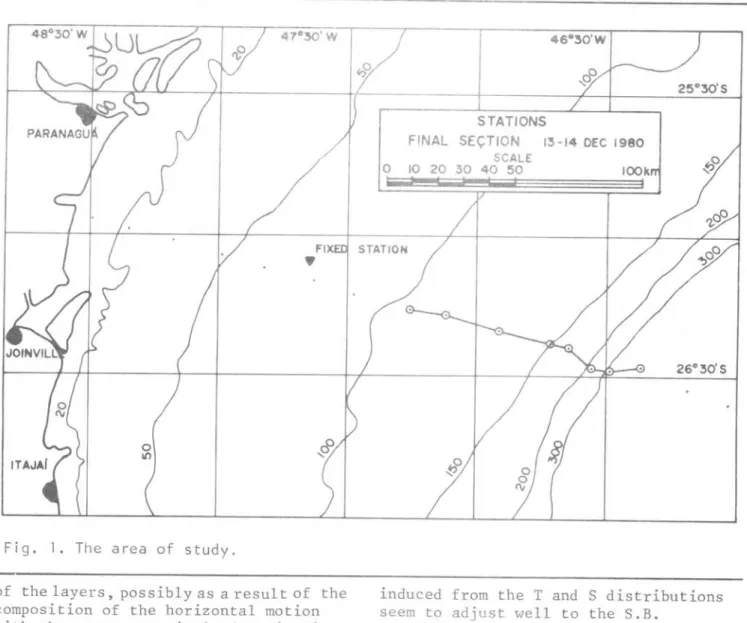
(S.B.) off the coast of paranaguá (26 °30'S), Paraná, Brazil. Continuous temperature and salinity profiles were obtained with a P1essey STD 9040 unit. The current measurements at severa1 depths were taken over-the-side with a Hydrocean time-averaging (20 sec), Savonius type currentmeter. Conven-tional Nansen casts were also made in all stations and in additional stations prolonging the section oceanward from the S.B. and shoreward unti1 the coastline (Fig. 1).
Figures 2-3 show, respectively, the temperature and salinity distributions. It can be seen, in an a rea of limited horizontal extension above the S.B., an upwelling of the cooler (T < 20°C) and
less haline (S < 36 xlO-3 ) Sub-Tropical Water (Emílsson, 1961). This water mass was found at depths of less than 30 m on the S.B. area, whereas, in stations outside the area, it was only found at depths greater than 70 m, over the sh e lf, or greater than 100 m on the ocean side of the S.B.
(*) Contratados do Convênio IOUSP/FINEP -Subprojeto: Hidrodinâmica coste ira.
Publ. n. 605 do In~~. o~~anog~. da U~p.
A separation of the more haline Tropical Water mass (S > 36 x 10-3 ), Emílsson
(op.
~.), in two distinct bodies is shown in Figure 3. In par-ticular, the profi1es obtained in stations 4049 and 4050 exhibited an almost constant (lower) value ofsalinity between the surface and a depth around 70 m. This feature is in sharp contrast with the well defined halocline found ~nthe profiles obtained in stations located outside the S.B. area.
Two weeks earlier, it was also ob-served (Mesquita ~~
al.,
in prep.) in a similar section, using only Nansen casts, that the main body of the southwardflowing Brazil Current (with salinities over 37 x 10-3 ) was located in aposition corresponding to St. 4052 and thus, from the present measurements, it seems t o have moved to a new position more than
50 km oceanward of its first place leaving behind, at mid-depth, an apparent intrusion of Tropical Water which penetrated over the shelf fo r a distance of more than 100 km. A similar intrusion was also observed by Mesquita
e:t
al.
(1979) in two vert ic al sections, with a l3-day interval between th em, in thenorthernmost area of Rio de Janeiro (Lat. 23°30'S).
194 Bolm Inst. oceanogr ., S Paulo. 32(2), 1983
STATIONS
FINAL SEÇTION 13 -14 DEC 1980
SCAlE
O 10 20 30 40 50 IOOk
; i ; 1
STATlON
Fig. 1. The area of study.
of the layers, possibly as a resul t of the composition of the horizontal motion with the strong vertical advection in the area.
It was also observed that, in the area above the S.B., the T and S
horizontal gradients are smaller at the surface than at mid-depth, which may indicate that the upwelling is more intense below the surface layer. On the other way, low salinity water
(S < 35.5 x 10⁻³ ) was found at the surface on the ocean side the S.B. area
(Sts 4053 and 4054) suggesting, ad-ditionally, an offshore transport of the Shelf Water through the upwelling area as indicated by the surface
currents measured at the fixed station (see below). From the measurements one can not expect that the low salinity waters are a result of an offshore
advection of upwelled water, but there is no full evidence to refuse this possibility, since upwelling areas are known to be zones of divergence.
Summing up the above features, the vertical and horizontal circulation as
induced from the T and S distributions seem to adjust well to the S.B.
upwelling models so far proposed in the litterature and a clearer picture may be obtained by examining the currentmeter data.
In each station the deepest current measurements were taken as near as
~ossible to the bottom, so that it
could be assumed that the measured currents at these depths were repre-sentative of the ship's drift. It was also implicitly assumed that the near-bottom currents were much smaller
(- 5 cm/s) than the real currents in the layers above (found to be as large as 30 cm/s in the surface layers).
MESQUITA
et
aL.:
Brazi 1: southeast coast: shelf break upwell ing50
ÊIOO
:r:
I-o... W
o 150
200
250
300
ST N~
/--"
25 ~ ___ -... ___
/..
....---
--
~••••• 23 /- ;; ~ - - - ... 23
•••• • 21 ~( \~»23 ---- ...
/ '-~ - - 21
>21:) , / ~ ______ ... '/'"
'- 19
/""""'-
---I So· / " " / ' 17
.. , / " " ' - - - _ /
,. 17·
.
.
--15.
./
/ \
/
15
FINAL SECTION 13-14 DEC 1980
13
"
"
\ \TEMPERATURE STD DATA
• F I X ST - 26° 08' 5
O 10 20 30 40 50
1- I
47° 39'W
100km I
Fig. 2. Temperature distribution across the shelf break off the southern coast of Brazil, latitude 26°30 '5 - December 1980.
Th€ resulting currents obtained in the section do not show an offshore transport in the surface layer as required by the known S.B. upwelling mode ls , but such an out-going flow was indeed observed in (anchored) current measurements carried out at a fixed station half-way between the S.B. and the coastline. In the preceeding 4 days before the section was taken, the upper 20-25 m (of the 66 m column of water at the fixed station) showed a very definite eastward flow (Mesquita
~ ~
ai.,
in prep.) which, however, didnot seem to be related to the local
195
As it can be seen in the Figure 4, the layer between 25 and 60 m outside the S.B. are a (both offshore and inshore) underwent and inward flow as required for a S.B. upwelling according to Johnson & Killworth's model (1975). These inward current vectors correspond to the mid-depth intrusion of Tropical Water seen in Figure 3. It seems then that an out-ward meandering of the main body of the Brazil Current forces a return flow pushing shoreward, at mid-depth, in a type of response resembling the mid-depth flow observed by Boicourt
& Hacker off the coast of Del aware and
196
5T N!:?
.
'.
. . '
50
>3675Bolm Inst. oceanogr.,
5
Paulo,32(2),1983
'.
'.
" . ...
36 /~\
./'
/
\ - - _ . . / / 355I
\ __ /'
/
E'IOO
I
I-CL W
o
150
200
250
300
..
/
".
"
:
/
35
/
/
I
/
r-I
\
I
I
I
I
I
I
I
/
FINAL SECTION SALlNITY
... FIX ST - 26°08'S
o 10 20 30 40 50
" ' !
13-14 DEC 1980
47° 39'W 100km
I
Fig.
3.
Sal inity distribution across the shelf break off the southern coast of BraziI,
latitude26°30
15 -
December1980.
Although the direction of the flow of the Sub-Tropical Water (below the
Brazil Current) is, in general, northward along the shelf-slope, the current measurements indicate a stronger
northwar~ flow (- 10 cm/s) in the layer
between 130-200 m for the stations on the ocean side of the S.B. (Sts 4051 and 4052). This intensification of the bottom current in the vicinity of the S.B. seems to correspond to the bottom countercurrent known to occur in the S.B. upwelling models.
At the surface, in the area above the S.B., the current vectors suggest an irregular eddy structure as depicted 1n Figure 4. Similar irregular eddies
(cyclonicandanti-cyclonic) over a S.B. have been reported by Pingree (1978)
from infra-red satellite imagery information of the S.B. area between France, Ireland and England.
MESQUITA
et
al.:
Brazil: southeast coast: shelf break upwell ingPOSSIBLE EDDY STRUCTURE AT 5m DEPTH
N CORRECTED CURRENT VECTORS
S
LENGTH SCALE
o 10 20 30 40 50km
...
VELOCITY SCA L E O 10 c m/s
Fig.
4.
Current vectors distribution for the depths of5,
25, 40 and 60 m across the shelf break off the
southern coast of Brazil, latitude 26°30 15
De-cember 1980. The upper part of the Figure indi-cates a probaDle configuration of vortices at the
5 m depth layer.
197
identified as an area of (shelf break) upwelling, which presumably extends from 23°S to 400S. The picture of this
(western) S.B. upwelling seems to be different from the wind-induced S.B. upwelling observed along east margins of the oceans. It also differs from
the already known strongly seasonal, locally wind-driven coas tal upwelling described in Mesquita (1974),which apparently reaches the maximum strength during the summer, due to the onset of
tempo-198 Bolm Inst. oceanogr., S Paulo, 32(2),1983
ral and space extension of the phenome-non are obviously interesting points for further works.
Acknowledgements
This work was financia11y supported by FINEP - Financiadora de Estudos e Pro-jetos.
References
EMILSSON, I. 1961. The shelf and coas tal waters off southern Brazil. Bolm Inst. oceanogr., S Paulo 11(2): 101-112.
JOHNSON, J. A. & KILLWORTH, P. D. 1975.
A bottom current along the shelf break. J. phys. Oceanogr., 5:185-188. MESQUITA, A. R. de 1974. Seasonal
variation of coastal waters: Brazil lato 24°S, I. Relat. int. Inst. oceanogr., Univ. S Paulo, (1):1-36.
; LEITE, J. B. de A.
& RIZZO, R. 1979. Contribuição ao
estudo das correntes marinhas na pla-taforma entre Cabo Frio e Cananêia. Bolm Inst. oceanogr., S Paulo, 28(2): 95-100.
MESQUITA , A. R.; LEITE, J. B. de A. &
RIZZO, R. Circulation and evidences of shelf break upwelling (Brazil, Lat.26°07'S; Long. 47°39'W). Relat. Cruzeiros Inst. oceanogr., Univ. S Paulo, ser. N/Oc. "ProL W. Besnard"
(In preparation).
HOOERS, C. N. K.; FLAGG, C. N. &
BOICOURT, W. C. 1978. prograde and retrograde fronts. In: Bowrnan, M. J.
& Esaias, W. E., ed. - Oceanic fronts
in coas tal processes: proceedings of a workshop held at Marine Sciences Research Center, May 25-27, 1977. Berlin, Springer-Verlag, p. 43-58.
PINGREE, R. D. 1978. Cyclonic eddies and cross frontal mixing. J. mar. biol. Ass. U.K., 58:955-963.