Abstract
This work deals with the fundamental aspects of apatite and quartz biolotation using R. opacus bacteria as a bioreagent. It was observed that the lotability of both
minerals depends on the pH value and the mineral particle size. The maximum lo-tability of both minerals was presented at a pH value of 5, achieving values of 90% and 14% for apatite and quartz, respectively, after seven minutes of lotation. The kinetics analysis showed that the smaller the apatite particle size, the lower its biolotation rate value. On the other hand, the smaller the quartz particle size, the higher its biolota-tion rate value. The irst-order kinetic model better itted the experimental data of both minerals, and a logarithmic relationship between particle size and kinetic rate constant was observed.
keywords: biolotation; bioreagents; particle size; rate constant; apatite; quartz.
Antonio G. Merma
Research Assistant,
Pontifical Catholic University of Rio de Janeiro - Chemical and Materials Engineering
Rio de Janeiro - Rio de Janeiro - Brazil [email protected]
Maurício Leonardo Torem
Professor,
Pontifical Catholic University of Rio de Janeiro - Chemical and Materials Engineering
Rio de Janeiro - Rio de Janeiro - Brazil [email protected]
Bioflotation of apatite and
quartz: Particle size effect
on the rate constant
Mining
Mineração
http://dx.doi.org/10.1590/0370-44672014680239
1. Introduction
Currently, it is believed that mineral biobeneiciation is an emerging technol-ogy due principally its environmental and technological applications (Merma et al.,
2013). The most signiicant application is related to the depletion of the environ-mental impact, generated by the use of conventional lotation reagents (Sharma and Forssberg, 2001). Since its early years of research, the core of the study and development of mineral bioprocess-ing (biolotation and biocoagulation) has been set on the proper understanding of its fundamental aspects. A standard fun-damental biolotation study is normally conducted with pure mineral samples and deals with microorganism growth, equilibrium adsorption fundamentals, flotation and/or flocculation studies; some of them are more speciic and may embrace bacterial adsorption thermody-namics (Sharma and Forssberg, 2001; Botero et al., 2008; Farahat et al., 2008,
2009, 2010), kinetics of bioadsorption of the bioreagent onto the mineral surface
(Tan and Chen, 2012). Moreover, some works (Sharma and Forssberg, 2001; Sarvamangala et al., 2011, 2012, 21013;
Pakudone and Natarajan, 2011) deal with the use of microorganism by-products, extracellular polymeric substances (EPS), or the so-called biosurfactants produced by the microorganisms (Natarajan, 2006). Additionally, literature depicts some rel-evant works on the biolotation of ores (Mehrabani et al., 2010; Khoshdast et al., 2012; Elmahdy et al., 2013) and of
coal (Abdel-khalek and El-midany, 2013; El-midany and Abdel-Khalek, 2014). The aim of these works was to evaluate the performance of these eco-friendly reagents as biocollectors, biodepressors or biofrothers.
Although Biolotation and lotation processes are governed by the same fun-damental physicochemical principles, very little is known about the inluence of the physical properties of minerals on biolota-tion. As example, it is known that there is an optimum particle size range for a given
lotation system (Santana et al., 2008), but
will this range also optimize biolotation? Moreover, before the bioprocessing of a determined ore could be considered suitable, it is necessary to know the re-sponse of each mineral species, present in the ore, to biolotation. Brazilian igneous phosphate ores are associated with several gangue minerals, such as quartz, magne-tite, carbonates and silicates (Oliveira, 2005), Thus, in order to establish the application of a microorganism in the biolotation of phosphate ores, a detailed biolotation study of each component is necessary, principally for apatite, quartz, silicate, calcite, and probably dolomite.
Considering the before mentioned situation, the aim of this study was to investigate the effect of particle size on mineral biolotation. Apatite and quartz samples are the minerals under study and Rhodococcus opacus the strain to act as biocol-lector and biofrother. Moreover, a kinetic analysis of the lotability is used to help the understanding of the process.
2. Materials and methods
2.1 Sample preparation
T h e f l u o r a p a t i t e s a m p l e , Ca5[PO4]3 (Cl, F, OH) (42.33% P2O5
and 54.39% CaO), and the pure quartz sample were provided by a local
REM: R. Esc. Minas, Ouro Preto, 67(3), 343-350, jul. sep. | 2014 344
were crushed and then dry-screened to -3 mm, followed by dry-grinding in a porcelain mortar and then wet-screened to the desired size fractions. Then, the quartz sample was rested
in a KOH (0.1 M) solution during 24 hours to remove the impurities present onto the quartz surface. Afterwards, the samples were washed several times with double-distilled water until the
pH suspension achieved the initial pH. Finally, the samples were dried at room temperature and stored in a desiccator, until their use in the vari-ous tests.
2.2 Microorganisms, Culture and growth
According to Mesquita et al. (2003)
the non-pathogenic Rhodococcus opacus strain presents a hydrophobic behavior (Contact angle around 70°), and it was the main reason for its use in this study. The strain, supplied by the Brazilian Col-lection of Environmental and Industrial Microorganisms (CBMAI-UNICAMP), was developed in a YMG solid media, containing: glucose 10.0 g L-1, peptone
5.0 g L-1, malt extract 3.0 g L-1, yeast
extract 3.0 g L-1, and agar-agar 12 g L-1.
Stocks of the bacteria were prepared and renewed frequently using this medium in Petri plates and storing them in a freezer at 15 °C. Next, the cells were sub-cultured in a YMG liquid medium, containing: glucose 10.0 g L-1, peptone 5.0 g L-1, malt
extract 3.0 g L-1 and yeast extract 3.0 g L-1)
at pH 7.2, on a rotary shaker at 175 rpm and 28 °C, during 72 h. Time needed for the bacterial cells to reach the beginning of the stationary phase of their growth. After that, the cellular suspension was
centrifuged at 3500 rpm during 10 min, followed by twice re-suspensions with deionized water, in order to remove any culture remainder; and then the cells were re-suspended in a 10-3 M NaCl solution.
Finally, the cellular concentrate was in-activated in an autoclave to avoid further bacterial development. The concentration of the biomass was measured by using a spectrophotometer (UV-1800, Shimatzu UV-spectrophotometer) at a wavelength of 620 nm.
2.3 Flotation experiments
The microlotation study was
con-ducted in a modiied Hallimond tube.
The mineral sample (1.0 g) was placed in the tube (volume: 0.16 L) containing a cellular suspension of known concen-tration. The suspension was mixed by constant stirring for about 5 minutes
(conditioning time), and then the pH was adjusted to the desired value with diluted HCl and NaOH solutions. Fi-nally, the mineral lotation tests were carried out using an air low of 15 ml min-1 during a known time of minutes.
The loated and non-loated fractions
were carefully separated, washed, dried and weighed in order to calculate the lotability. For the kinetics analyzes, the lotation was conducted during 7 min. and samples were collected after 0.50, 0.75, 1.00, 2.00, 3.00, 5.00 and 7 minutes of lotation.
2.4 Kinetics of bioflotation
The lotation rate can be deined as a measure of the lotation recovery ex-pressed per unit of time (Bulatovic, 2007), it means, the amount of loated particles with regard to lotation time (Hernáinz and Calero, 2001). Different models have been proposed to evaluate the lotation kinetic behavior (Hernáinz and Calero, 2001; Hernáinz et al., 2005, Yalcin and
Kelebek, 2011; Polat and Chander, 2000; Su et al., 1998; Zhang et al., 2013).
Although there are many approaches to describe mineral lotation kinetics, the most widely used models are based on analogy with a chemical reactor, which means that a lotation cell can be ap-proximated by perfectly mixed CSTR (Hernáinz et al., 2005, Yalcin and
Kele-bek, 2011; Polat and Chander, 2000; Su
et al., 1998; Zhang et al., 2013).
Consid-ering, that biolotation and lotation are governed for the same physicochemical
principles, it is correct to assume that previous kinetic models can be used to describe the kinetics of biolotation. This was also assumed in some biolotation works (Amini et al., 2009; Pecina et al.,
2009; Mehrabani et al., 2010; Khoshdast et al., 2012). Therefore, this paper also
presents a kinetic analysis of the mineral biolotation using kinetic models based on chemical reactor analogy. This equation may be expressed by:
n
C
k
dt
dC
=
(1) (2)100
1
(%)
0=
C
C
R
where “C” is the concentration
of solids, “C0” is the initial
concentra-tion, “t” lotation time, “n” order of
the process, and “k” is the lotation rate
constant. Considering that the mineral recovery (R) is a function of C (equation
2), we can obtain the models in function of such recovery.
It is commonly accepted that the order “n” and the rate constant “k” are
dependent on the lotation conditions, some related to ore characteristics such as mineralogy, particle size and surface chemistry, and others, related to opera-tions condiopera-tions such as air low rate, reagents, etc. (Pecina et al., 2009; Deo et al., 2001; Yalcin and Kelebek, 2011).
Ac-cording to Brozek and Mlynarczykows-ka (2007), the lotation kinetics order changes during the process summarized
as follows: at the beginning, the particles with the uppermost lotation properties may present a zero order value, but with time, the particles present a decreasing ability to loat and, simultaneously, the order of the lotation kinetics increases. In this work, however, three approaches to determine the rate constant were considered, explicitly: irst-order (n=1),
non-integral-order models. The integrated equations for the three models mentioned are shown in Table 1.
Model Formula Description
Classical first order model
(n=1) ln (1- R) = Kl - t
R = recovery percentage of the mineral.
Second order (n=2)
k
m
t
R
R
⋅
⋅
=
−
2 0)
1
(
m0= Initial mass of the mineral in the flotation cell.
Non-integral order k t
R R
ni⋅ = ⎟⎟ ⎠ ⎞ ⎜⎜
⎝ ⎛
⎟ ⎠ ⎞ ⎜ ⎝ ⎛ −1 ∞ 1
ln R∞ = recovery percentage of
the mineral at infinite time.
Table 1 Description of the three flotation kinetic models used in this paper
3. Results and discussion
3.1 Flotation studies
The microflotation studies were carried out in order to evaluate the effect of the mineral particle size and pH on the biolotation of apatite and quartz, using
the R. opacus bacteria as biocollector. It was shown that the R. opacus strain has a strong capability of acting either as a biocollector or a biofrother (Merma et
al., 2013). This previous work pointed out
that the highest lotability value of both minerals was achieved using 0.15 g L-1 of
the bacteria.
3.1.1 Effect of the pH and particle size on the bioflotation of quartz and apatite
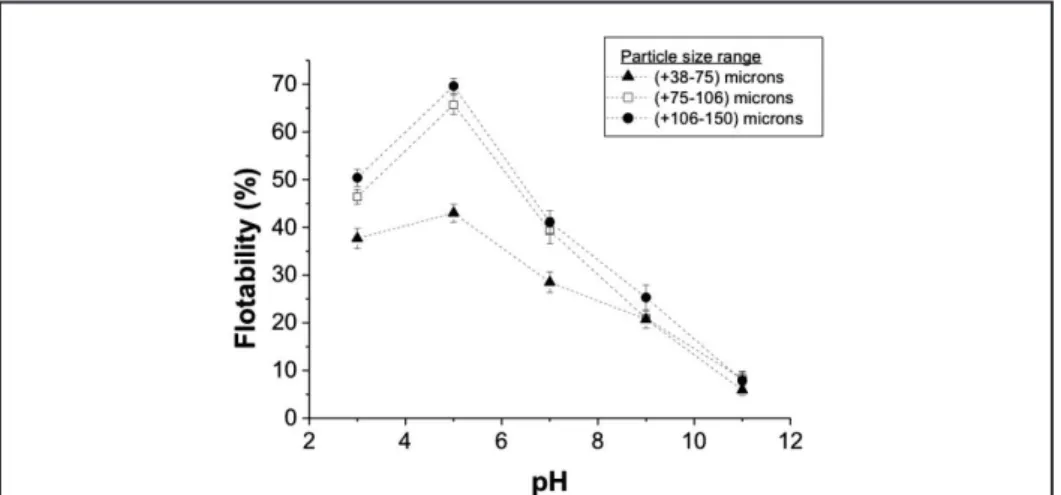
The pH of the solution is one of the most important factors affecting the biolotation. This affects the specia-tion onto the mineral surface as well as the activation of the functional groups present on the wall cell. Thus, the pH value affects the surface properties of the mineral, as the hydrophobicity and, therefore, the biolotation response of the minerals. The lotability of apatite and quartz as a function of pH value is presented in Figs. 1 and 2, respectively. It can be observed that for both minerals, the highest lotability was presented in an acidic medium, around pH 5, after two minutes of lotation. Moreover, in a very acidic medium, the lotability presented lower values, whereas declines were observed in an alkaline medium. This is in accordance with several bioprocessing studies (Farahat at al., 2008, 2010, 2012;
Mesquita et al., 2003; El-midany and
Abdel-Khalek, 2014), where the highest lotability of the minerals was achieved at
around the isoelectric point value of the bacteria, which generally has an acidic pH value. At this point, it is believed that the electrostatic repulsion between mineral particles and bacterial cells is suppressed, and speciic interactions would let the adsorption of the bacterial cells onto the mineral surface, which would increase the hydrophobicity of the mineral and hence a higher lotability would be observed. It was also observed that particle size af-fected in a different form the lotability of quartz and apatite. The smaller the par-ticle size, the higher the quartz lotability value, achieving lotability values around 18% and 10% for the inest and the coars-est particle size, respectively (Fig.2); while for apatite the smaller the particle size the lower the lotability value, achieving lotability values around 69% and 43% for the coarsest and the inest particle size, respectively (Fig. 1). The behavior of the quartz sample can be explained due to the fact that microorganism cells
essen-tially did not adsorb onto the surface of the quartz particles, which consequently maintain hydrophilic. Hence the recovery of the quartz particles depends on the air low (entrainment). Therefore, small quartz particles, with lower mass, could be more easily carried into the concentrate by mechanical entrainment (Konopacka and Drzymala, 2010). On the other hand, the hydrophobized apatite particles pre-sented an opposite behavior. It is possible to mention two factors which would ex-plain the lower lotability value of apatite attained when the smallest particle size was used: (1) there was higher collector consumption due to the larger surface area of the smaller particles (Smith, 1997) and (2) the small particles present a lower eficiency in the bubble-particle collision (Chen jin et al., 1998). According to the
previous, a lower lotability of the apatite would be expected when the inest size range was used, only if the initial bacterial concentration was maintained.
REM: R. Esc. Minas, Ouro Preto, 67(3), 343-350, jul. sep. | 2014 346
3.1.2 Effect of the flotation time on the bioflotation of quartz and apatite
The flotability of apatite and quartz as a function of time for different particle sizes can be seen in Fig. 3 and Fig. 4, respectively. It shows that the lo-tability of apatite increased regularly as a function of time, but decreased as the
particle size was increased. Achieving lotability values around 92% and 80% for the coarsest and the inest particle sizes, after seven minutes of lotation. On the other hand, quartz presented low values of lotabilibity (around 14%)
for the coarsest size range, increasing monotonically as a function of time. Furthermore, for iner particles: the higher the lotation time, the higher its lotability values, achieving around 52% after seven minutes of lotation.
Figure 2
Bioflotation of quartz as a function of pH at different particle sizes; bacterial concen-tration 0.15 g L-1. Flotation of Time: 2 min.
3.2 Kinetics studies
The kinetic study was developed in order to have a better understanding of the effect of particle size on the bio-lotation rate of apatite and quartz. As mentioned before, the existing literature
shows few works dealing with biolota-tion kinetics, hence, this subject is not very well known. However, as in lota-tion, biolotation should be controlled by surface characteristics and knowing that
the lotation recovery depends on the par-ticle size fraction, (Santana et al., 2008;
King, 1982) as well as the rate constant (Jameson, 2012), it should be right to af-irm the same about biolotation.
Figure 3
Bioflotation of apatite as a function of time at different particle sizes; pH: 5; bacterial concentration 0.15 g L-1.
3.2.1 Apatite
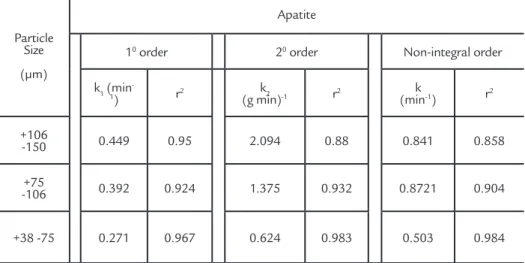
The lotability of apatite (plotted in Fig. 3) has been examined from a kinetics point of view, using the three approaches mentioned before, in order to determine the rate constant. The
kinetics parameters obtained from this analysis are given in Table 2, with their corresponding correlation coeficients (r2) obtained from a linear regression.
From these coeficients, it was able to
assume that the irst-order model best itted the experimental data. This sup-posingly is correct, since, the mineral suspension inside the Hallimond tube
was perfectly mixed by magnetic
stir-Figure 4
347
where, the exponent “m” could be cal-culated from the logarithmic representa-tion of “kq” against the average particle
size “d”.
Thus, the logarithmic representa-tion of “kq” against the average particle size can be seen in Fig. 5. The linear regression showed that the irst-order and second-order models attained high
correlation coeficient values, and there-fore, veriies the previously mentioned relationship. On the other hand, the low correlation value attributed to the non-integral model did not support a relationship between particle size and rate constant.
Therefore, considering the previ-ous analysis, it was confirmed that
the apatite biolotation experimental data were properly itted by using the irst-order kinetic model. And the rate constant for apatite biolotation de-creased as the particle size dede-creased. These results are in good accordance to those observed by Su et al. (1998) and
by Abkhoshk et al. (2010) for apatite
and coal lotation, respectively.
3.2.2 Quartz
Figure 5 Logarithmic representation of “k” in function of particle size, applied to three different kinetics models in the bioflotation of apatite.
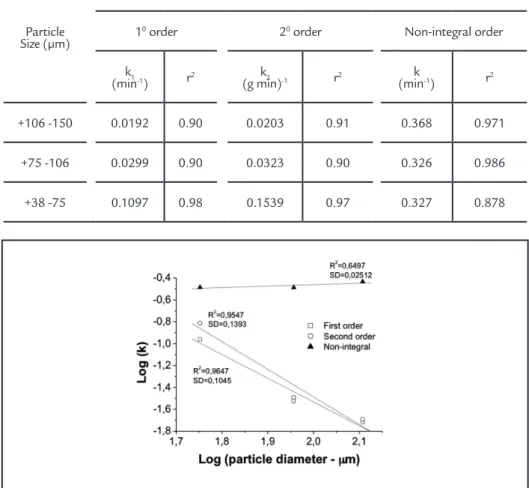
Similarly, the kinetics parameters obtained for the biolotation of quartz are given in Table 3, with their corresponding correlation coeficients (r2) obtained from
the linear regression. From the results, it is possible to observe a similar behavior than that observed in the kinetics
biolota-tion of apatite. It means that the irst-order model best itted the experimental data, in spite of the good adjusted presented for the non-integral model. Model discarded because according to the Fig. 6 it was not observed a clear relation between the rate constant and the particle size and due to
its lesser correlation coeficient.
Therefore, considering the previous analysis, it was conirmed that the quartz biolotation experimental data were prop-erly itted by using the irst-order kinetic model. The results clearly showed that the rate constant for quartz biolotation,
k
qα
d
m (3)Particle Size (µm)
Apatite
10 order 20 order Non-integral order
k1 (min
-1) r2 (g min)k2 -1 r2 (mink -1) r2
+106
-150 0.449 0.95 2.094 0.88 0.841 0.858
+75
-106 0.392 0.924 1.375 0.932 0.8721 0.904
+38 -75 0.271 0.967 0.624 0.983 0.503 0.984
Table 2 Kinetics parameters obtained from three different kinetics models in the bioflotation of apatite
According to the authors, the re- lationship between rate constant and particle size is of the kind:
ring. Moreover, the second-order model also itted the results; however, this ef-fect was attributed to the small amount of particles inside the Hallimond tube (1
g), as pointed out by several authors (Bu-latovic, 2007; Yalcin and Kelebek, 2011; Nguyen and Schulze, 2004; Hernáinz
and Calero, 1996). Additionally, it was observed that the non-integral model also adjusted the experimental data. According to several authors (Hernáinz and Calero, 2001; Hernáinz et al, 2005;
Zhang et al., 2013), there exists a direct
relationship between the lotation rate
REM: R. Esc. Minas, Ouro Preto, 67(3), 343-350, jul. sep. | 2014 348
4. Conclusions
The bioflotation of apatite and quartz particles using R. opacus as bio-reagent was found to be dependent on the pH and the mineral particle size. The highest lotability value of both minerals was achieved at pH 5. For the coarsest fractions, the apatite presented its higher lotability value (around 70%) after 2 min. of lotation, while the quartz pre-sented its higher lotability value (around
18%) for the finest particle size. The results showed that the biolotation rate of apatite is higher, achieving lotabil-ity values of around 92% and 52% for apatite and quartz, respectively, after 7 minutes of lotation. Also, it was observed that the biolotation rate of the apatite de-creased as the particles sizes dede-creased, in contrast to the biolotation rate of quartz, which increased. Finally, the irst-order
kinetic model showed a better it to the experimental data of both minerals and a direct relationship between the rate constant and the mineral particle size was observed. Nevertheless, the non-integral models also itted the experimental data. However, it was not possible to observe a clear relationship between the rate con-stant and particle size when this model was used.
5. References
ABKHOSHK, E., KOR, M., REZAI, B. A study on the effect of particle size
on coal lotation kinetics using fuzzy logic. Expert Systems with
applica-tions. v. 37, p. 5201-5207, 2010.
ABDEL-KHALEK, M.A., EL-MIDANY, A.A. Adsoprtion of Paenibacillus
polymyxa and its impact on coal cleaning. Fuel Processing Technology. v.
113, p. 52-56, 2013.
AMINI, E., OLIAZADEH, M., KOLAHDOOZAN, M. Kinetic comparison
of biological and conventional lotation of coal. Minerals Engineering. v.
22, p. 344-347, 2009.
BOTERO, A.E.C., Torem, M.L., Mesquita, L.M.S. Surface chemistry
fun-Figure 6 Logarithmic representation of “k” in function of particle size, applied to three different kinetics models in the bioflotation of quartz.
Table 3 Kinetics parameters obtained from three different kinetics models in the bioflotation of quartz
Particle Size (µm)
Quartz
10 order 20 order Non-integral order
k1
(min-1) r2 (g min)k2 -1 r2 (mink -1) r2
+106 -150 0.0192 0.90 0.0203 0.91 0.368 0.971
+75 -106 0.0299 0.90 0.0323 0.90 0.326 0.986
+38 -75 0.1097 0.98 0.1539 0.97 0.327 0.878
k, increased as the particle size decreased. This behavior is in good accordance with those observed by Yalcin and Kebelec (2011) and by Yekeler and Sonmez (1997) in the lotation of a pyritic gold ore and
talc, respectively.
From this study, it is clear that the Rhodococcus opacus bacteria can be used as a biocollector and as biofrother during the lotation of apatite, even in
damentals of biosorption of Rhodococcus opacus and its effect in calcite
and magnesite lotation. Minerals Engineering. v. 21, n. 1, p. 83-92, 2008.
BROZEK, M., Mlynarczykowska, A. Analysis of Kinetics models of batch
lotation. Physicochemical Problems of Mineral Processing, v. 41, p.
51-65, 2007.
BULATOVIC, S.M. Theorical Aspects of Flotation. In: Handbook of
lota-tion Reagents.Chemistry, theory and practice: Flotation of sulides ores.
Elsevier, 2007. (Chapter 6: Summary).
CHEN, JIN, CHEN, DAGAO, CHEN, TINZHONG. Technological innova-tion and theoretical approach to shear washing for a refractory manganese ore. Production and Processing of ine particles. Plumpton (ed.). Canadian Institute of Mining and Metallurgy, p. 427-438, 1998.
DEO, N., NATARAJAN, K.A., Somasundaran, P. Mechanisms of adhesion
of Paenibacillus polymyxa onto hematite, corundum and quartz.
Interna-tional Journal of Mineral Processing. v. 62, p. 27-39, 2001.
ELMAHDY, A.M., EL-MOFTY, S.E., KHALEK, M.A., ABDEL--KHALEK, N.A., El-Midany, A.A. Bacterially induced
phosphate-dolo-mite separation using amphoteric collector. Separation and Puriication
Technology. v. 102, p. 94-102, 2013.
EL-MIDANY, A.A. ABDEL-KHALEK, M.A. Reducing sulfur and ash from
coal using Bacillus subtilis and Paenibacillus polymyxa. Fuel, v. 115, p.
589-595, 2014.
FARAHAT, M., HIRAJIMA, T., SASAKI, K. DOI, K., Adhesion of Esche-richia coli onto quartz, hematite and corundum: Extended DLVO theory
and lotation behavior. Colloids and surfaces B: Biointerfaces, v. 74, p.
140-149, 2009.
FARAHAT, M., HIRAJIMA, T., SASAKI, K. Adhesion of Ferroplasma acidi-philhum onto pyrite calculated from the extended DLVO theory using the
van Oss-Good-Chaudhury approach. Journal of colloids and interface
science, v. 29, p. 594-601, 2010.
FARAHAT, M., HIRAJIMA, T., SASAKI, K., AIBA, Y., DOI, K. Adsorption
of SIP E. coli onto quartz and its applications in froth lotation. Minerals
Engineering. v. 21, 389-395, 2008.
HERNÁINZ, F., CALERO, M. Flotation rate of celestite and calcite.
Chemi-cal Engineering Science. v. 51, n. 1, p. 119-125, 1996.
HERNÁINZ, F., CALERO, M. Froth lotation: kinetic models based on
che-mical analogy. Chemical Engineering and Processing, v. 40, p. 269-275,
2001.
HERNÁINZ, F., CALERO, M., BLÁZQUEZ, G. Kinetic considerations in
the lotation of phosphate ore. Advanced Powder Technology, v. 16, n. 4,
p. 347-361, 2005.
JAMESON, GRAEME, J. The effect of surface liberation and particle size on
lotation rate constants. Minerals Engineering, v. 36-38, p. 132-137, 2012.
KHOSHDAST, H., SAM, A., MANAFI, Z. The use of rhamnolipid
biosur-factants as a frothing agent and a sample copper ore response. Minerals
Engineering, v. 26, p. 41-49, 2012.
KING, R.P. Principles of lotation, chapter 11. South African institute of Mi-ning and Metallurgy Monograph series. Johannesburg, 1982.
KONOPACKA, Z., DRZYMALA, J. Types of particles recovery—water re-covery entrainment plots useful in lotation research. Adsorption, v. 16, p.
313-320, 2010.
MEHRABANI, J.V., NOAPARAST, M., MOUSAVI, S.M., DEHGHAN, R., RASSOLI, E., HAJIZADEH, H. Depresion of pyrite in the lotation of high pyrite low-grade lead-zinc ore using Acidithiobacillus ferrooxidans.
Minerals Engineering, v. 23, n. 1, p. 10-16, 2010.
MERMA, A.G., TOREM, M.L., MORAN, J.V., MONTE, M.B.M. On the fundamental aspects of apatite and quartz lotation using a gran positive
strain as a bioreagent. Minerals Engineering, v. 48, p. 61-67, 2013.
MESQUITA, L.M.S., LINS, F.A.F., TOREM, M.L. Interaction of a
hydro-phobic bacterium strain in a hematite-quartz lotation system.
REM: R. Esc. Minas, Ouro Preto, 67(3), 343-350, jul. sep. | 2014 350
NATARAJAN, K.A., Microbially-induced mineral lotation and locculation: prospects and challenges. In: INTERNATIONAL MINERAL PROCES-SING CONGRESS, 23. Procedings... p. 487-498, 2006.
NGUYEN, A.V., SCHULZE, H.J., Colloid science of lotation. In:
Surfac-tant Series. New York: Marcel Dekker, Inc., 2004. v. 118. (Chapter 30).
OLIVEIRA, J.A. Saponiication degree of vegetable oils at selective
lota-tion of apatite from carbonates ore. Ouro Preto: Department of Mining
Engineering - UFOP, 2005. (MSc. Dissertation in Portuguese).
PAKUDONE, S.U., NATARAJAN, K.A. Microbially induced separation of
quartz from calcite using Saccharomyces cerevisiae. Colloids and surfaces
B: Biointerfaces, v. 88, p. 45-50, 2011.
PECINA, E.T., RODRIGUEZ, M., CASTILLO, P., DIAZ, V. ORRANTIA, E. Effect of Leptospirillum ferrooxidans on the lotation kinetics of
sulphi-de ores. Minerals Engineering, v. 22, p. 462-468, 2009.
POLAT, M., CHANDER, S. First-order lotation kinetics models and metho-ds for estimation of the true distribution of lotation rate constants. Inter-national Journal of Mineral Processing, v. 58, p. 145-166, 2000.
SANTANA, R.C., FARNESE, A.C.C., Fortes, M.C.B., Ataíde, C.H, Barro-zo, M.A.S. Inluence of particle size and reagent dosage on the
performan-ce of apatite lotation. Separation and Puriication Technology, v. 64, p.
8-15, 2008.
SARVAMANGALA, H., NATARAJAN, K.A. Microbially induced lotation
of alumina, silica/calcite from haematite. International Journal of Mineral
Processing, v. 99, p. 70-77, 2011.
SARVAMANGALA, H., NATARAJAN, K.A., GIRISHA, S.T.
Microbially--induced pyrite removal from galena using Bacillus subtilis. International
journal of Mineral Processing, v. 120, p. 15-21, 2013.
SARVAMANGALA, H., NATARAJAN, K.A., GIRISHA, S.T.
Biobeneicia-tion of Iron ores. International Journal of Mining Engineering and
Mine-ral Processing. v. 1, n. 2, p. 21-30, 2012.
SHARMA, P.K., RAO, K.H., FORSSBERG, K.S.E., NATARAJAN, K.A., Surface chemical characterization of Paenibacillus polymyxa before and
after adaptation to sulide minerals. International Journal of Mineral
Pro-cessing. v. 63, p. 3-25, 2001.
SMITH, R.W. Bacteria as lotation reagents for the lotation of a dolomitic phosphate rock. Florida Institute of Phosphate Research (FITR) – Univer-sity of Nevada Reno. n. 02, p. 106-131, January 1997.
SU, FENWEI, RAO, K.H., FORSSBERG, K.S.E., Samskog, P.O. The inluen-ce of temperature on the kinetics of apatite lotation from magnetite ines.
International Journal of Mineral Processing. v. 54, p. 131-145, 1998.
TAN, S.N., CHEN, M. Early stage adsorption behavior of Acidithiobacillus
ferrooxidans on minerals I: an experimental approach. Hydrometallurgy,
v. 119-120, p. 87-94, 2012.
YALCIN E., KELEBEK, S. Flotation Kinetics of a pyritic gold ore.
Interna-tional Journal of Mineral Processing, v. 98, p. 48-54, 2011.
YEKELER, M., SONMEZ, I. Effect of the hydrophobic fraction and particle size in the collectorless column lotation kinetics. Colloids and surfaces A: Physicochemical and Engineering Aspects, v. 121, p. 9-13, 1997.
ZHANG, H., LIU, J., CAO, Y., WANG, Y. Effects of particle size on lignite
reverse lotation kinetics in the presence of sodium chloride. Powder
Tech-nology, v. 246, p. 658-663, 2013.