Orality, literacy and reading: differences and complexities facing the public school*
Claudemir Belintane**
University of São Paulo
Resumo
The article presents findings of a research in teaching reading and writing undertaken in two classes during the early years of primary education in a public school in São Paulo. Departing from diagnostics based on oral culture of pupils experiencing learning difficulties in reading even after three or four years of schooling, we tried to design, implement, and monitor a program of instruction based on the transition between oral and written culture. This is a qualitative research, whose aim is to deal with the heterogeneity of the classroom in its process and complexity. The theoretical perspective adopted is a multidisciplinary one, including research areas influenced by linguistics, psychoanalysis, education and but by studies conducted by researchers in a field that came to be known "orality-literacy equation" (Havelock, 1995). The results provide data, reports of interventions, and reflections that may support education programs for the age groups studied; moreover, they also question the excessive focus constructivist methodologies place on the act of writing or on writing itself. The paper proposes a new perspective for relating the oral culture of the pupils and school literacy, presupposing an environment of orality, literacy and reading which includes electronic support (e. g., digital media) and a more collective organization of school work in the early grades, especially in the transition ("hinge") between early childhood education and primary level.
Keywords: Orality - Literacy - Reading - New media - Child.
Contact
Claudemir Belintane
Faculdade de Educação-USP Av. da Universidade, 308 Bloco A 05508-040 – São Paulo – SP E-mail: [email protected]
* Translated from Portuguese by Marcelo Parreira do Amaral
This paper reports and discusses data, events and strategies of a research conducted in a public school in western São Paulo, from April 2007 to December 2009. The research project was funded by FAPESP1 and its main objective was to examine the possibilities of implementing a language teaching program in early grades. The program was designed taking account of more accurate diagnoses of the conditions of orality and literacy of the pupils and the general conditions and limitations of teaching they were actually exposed to (including the praxis of the school, teachers and the influences of existing government programs).2
The research was conducted in two phases: first, we tried to diagnose 43 pupils selected by their teachers and the coordinator of the school as being “pre-syllabic" or "syllabic", i. e., pupils with three or four years of schooling not yet fulfilling the basic conditions for proficiently in reading and writing. Pupils in this reading/writing level make for approximately 20% of those fourth-grade pupils, who score below the minimum rating scales, i. e., those whose scores range between 120 and 150 points in the SAEB evaluation (Brazil, 2007).3
In the second phase, the research accompanied two first grade classes in elementary school (6-7 year-olds); the author implemented, along with their two teachers, a program of orality, reading, and writing based on the results obtained in the first phase. In this article we discuss broader insights of the research and report the more general findings and conclusions reached in the two phases. More punctual reflections that open up prospects for further research will be discussed elsewhere and in partnership with other project participants.4
Before describing the research process of each phase, it is worth addressing some aspects and characteristics of the research. The researcher and his team (graduate students, internship students, and faculty fellows) had intense involvement with the subjects of the research and shared with them common expectations of its results –
that means: the literacy of the pupils involved. The research is thus characterized by a complex nature which could be approached, on the one hand, by a qualitative
1 Translator‟s note: FAPESP - Fundação de Amparo à Pesquisa do Estado de São Paulo (São Paulo Research Foundation].
2 For instance the program “Ler e Escrever” [Read and Write] (São Paulo, 2008).
3 The Saeb - National System for Evaluation of Basic Education - uses a scale of 0 to 500 points, and the average score recommended for fourth grade is 200 points (Brasil, 2008/2009, p. 11).
methodology – for example, a "case study" (Ludke; André, 1986) – and on the other, by – especially when considering the subjective position of the team and their training
– a kind of "engagement" and "listening" with origins in psychoanalysis, but also crossed by linguistics and other fields (Ginzburg, 1989; Lemos, 1998).
The explicit recognition of this involvement and its effects and possible misunderstandings allowed the researcher and his team to maintain some precision when considering the involvement of participants, especially the filtering and the relativization of their written or oral reports, and still preserve certain readiness to document events with no apparent importance (nonsense, repetitions, unusual utterances), which could contain revealing signifiers and clues (Ginzburg, 1989) that originated in both individual assistance as more collective interactions.
It is recognized here that locating the research and the analysis of data among the perspectives of different disciplines (psychoanalysis, linguistics, discourse analysis) is a risky and complex methodology. On the other hand, working from a very narrow perspective, or even from too close an affiliation to any particular theoretical perspective is not an attractive solution in the face of the complexity of contemporary education. We looked, then, for a paradigm more open, more prone to adjusting or even recognizing the limits of its concepts in face of the data that emerged. In search of singularities, the researchers were faced with the need to borrow and reconceptualize procedures and techniques from several fields, including certain adjustments between the design of a qualitative research – perhaps closer to the "case study" – and a "psychoanalytic listening." To better understand this need we have to consider that the research unfolded along two axes: (1) more objective5
diagnoses, made with the help of a semi-structured interview guide; and (2) listening to each individual pupil who signaled differences and to each teacher involved as well as documenting impressions of the researchers reported in their field research diary. In the following section the two axes are presented.
The research: starting from Interviews, Interventions and Findings
In the first phase of the project, the aim of the research group was to diagnose 43 children identified by school as pupils who, after three or four years of schooling (aged 9 to 13 years), not yet fully mastered the alphabetic principle (in the terminology used by the school and the network to which the school belongs, they
were „pre-syllabic‟ or „syllabic-alphabetic‟ pupils).
Since we wanted a diagnosis that took into account the singularities of each child interviewed, and at the same time, recognized the risk that the data would be lost in a plurality of information, we chose to conduct semi-structured interviews during which the researcher could paraphrase or explain and illustrate the questions to the pupils according to their needs. The function of the interview guide was to standardize the interviews to some degree and to avoid drifting and extrapolations.
The data were re-examined one by one in a supervision session held by the coordinator of the project – in short, the technique was to juxtapose two kinds of listening: the interviewer listening to the pupil during the interview, the coordinator listening to the interviewer, and then comparing the two records (the oral communication during the meeting and the written report) while still referring to other documents, video and audio recordings. The most obvious data contained in a written report received quantitative treatment and helped choosing the group of pupils who would undergo individual counseling, since the team could not follow in detail all 43 pupils.
Table 1 presents a quantitative picture of the data obtained and the following paragraphs provide then the justifications for the choice of items diagnosed and present some more qualitative comments from the listening sessions.
Table 1 - Diagnoses of the 43 pupils
Activities/concepts 26 Boys 17 Girls
Very
Good Regular Insatisfactory Very Good Regular Insatisfactory 0
1 Full Name 16 3 07 12 04 01
0
2 Name of siblings 10 07 09 09 05 03
0
3 Birth Date 06 12 08 04 09 04
0
4 Calender 07 05 14 07 05 05
0
0
6 telling, narrating 08 09 09 06 06 05
0
7 Oral ludism 08 11 07 08 08 01
0
8 naming images 24 02 00 17 01 00
0
9 completing words 09 13 05 10 05 02
1
0 counting syllables 09 12 05 10 5 02
1
1 underlining 1
st
syllable 05 13 08 10 04 03
1
2 Inversion of syllables 00 14 12 03 11 03 1
3 Reading rebus
6 01 13 12 02 10 04
Total 26 17
Items 1 to 4 diagnosed key elements of the child's own identification. According to the data in Table 1, we noted that these basic elements of citizenship are still a considerable problem for these children. The date of birth, for example, is still a problem for more than 70% – typically, the interviewer used other expressions more typical of childhood and of spoken language to translate the term date of birth: "When is your birthday?", "When do you have a birthday?", and yet the answers were incomplete and provided, in general, only a day or a month. The full name of the family also came to be a discovery for some pupils, as they were surprised to learn that their own name coincided with that of their father or grandfather. Departing from these data, we can already conclude that the request for this information has two origins: one originated from everyday family speech ("When is your birthday?", "What day were you born?", "Who are your parents?", "Where do you live?," etc..), another based on bureaucratic formality of writing (date of birth, affiliation, address, etc., as it could appear, for example, in a application form for employment or even in the school record) – already at this point are evident signs of a confrontation between writing and speaking skills that might hinder the access of pupils to the minimum requirements of citizenship. This evidence was confirmed by another piece of research by the team conducted with older pupils from a slum in the western zone of São Paulo,7 which found that youth of 14, 15 and 16 years could not understand a simple form for job application; they did not understand items such as date of birth,
parentage, ID, etc. – the surnames of the parents almost always constituted a major problem, some pupils even cited nicknames in the family: Zombie, Bigfoot, Baiano. This topic constituted a thematic focus entitled "naming", as discussed below.
Items 5, 6 and 7 had as objective to study the oral memory of the pupils and their narrative and intertextual skills. In these activities, we found strong evidence confirming the initial hypothesis of the project: about 70% of pupils who not yet mastered the alphabet presented difficulties in these activities.
Item 8 consisted of only naming objects from images; with this item we sought to check whether there were cases of severe aphasia. It was observed whether the pupil named the objects directly or if the image was first put in the context of use, for example, using "for cutting" and meaning "scissors" or "knife," information that might point to a possible "similarity disorder" (Jakobson, 1995). With the data from this item we found that nearly all pupils did well in naming, only two pupils showed partial problems in this skill, but not enough to clearly characterize a type of aphasia.
Items 9 to 13 were to assess the abilities in the handling of significant units of speech, especially syllabic severability and reversibility. Here, pupils showed more difficulties than in previous sections. The oral syllabic reversibility, item 11 (syllabic inversion of dissyllables), for example, for boys, was an almost insurmountable difficulty and reached 100% of respondents; although later during the individual sessions we noted that many of them learned the strategy of inversion with relative ease. Also in item 13, reading rebus, almost all pupils showed many difficulties, however, as in relation to item 11, with a little instruction, the majority quickly mastered the process.
Comparing these data, we can already show a correlation among items 5, 6, and 7 (intertextuality and handling of full texts) and items 9 to 13 (syllabic units), i. e., this comparison reinforces the hypothesis of the research: children who know little about full texts of oral tradition and their handling do not master very well syllabic units, and, as discussed in the second phase of the research, the more complicated the case becomes the more consistent this correlation.
documents of education systems – to the lower levels (phoneme, syllable, word) – a position advocated by traditional methods and by advocates of the phonic method of alphabetization (Brasil, 2003). However, the theoretical basis of our diagnosis is not merely a compromise with these theoretical-methodological poles, the emphasis, for example, on the elements on the lower levels finds its theoretical justification in the history of writing, as is the case, for example, in the adoption of the rebus as an element of diagnosis, since it figured as a kind of hinge between the ideographic and alphabetic writing (Gelb, 1952) and in studies that juxtapose diachronically orality and writing, which Havelock (1995) termed "orality-literacy equation"(p. 17). The hypothesis that it is necessary to resort to lower levels is also based on previous studies (Belintane, 2008), which found that pupils subjected almost exclusively to everyday speech (the use of the imperative, the hasty dialogues composed of short sentences and fragments in which the contextual factors had an excessive weight) and little exposure to narrative and linguistic playfulness tend to take words and sentences as indivisible blocks ([tir'sudaí] – for "tire isso daí” (“take it from there”), or [pegalá] for "pegue lá” (“take it there") and be surprised with segmentations, cuts and losses required by alphabetic writing.
When discussing the topic of the oral language of poor children, there is almost immediate allusion to the controversy about the „inadequate mother‟ and theories of
What did we find out after the Interventions?
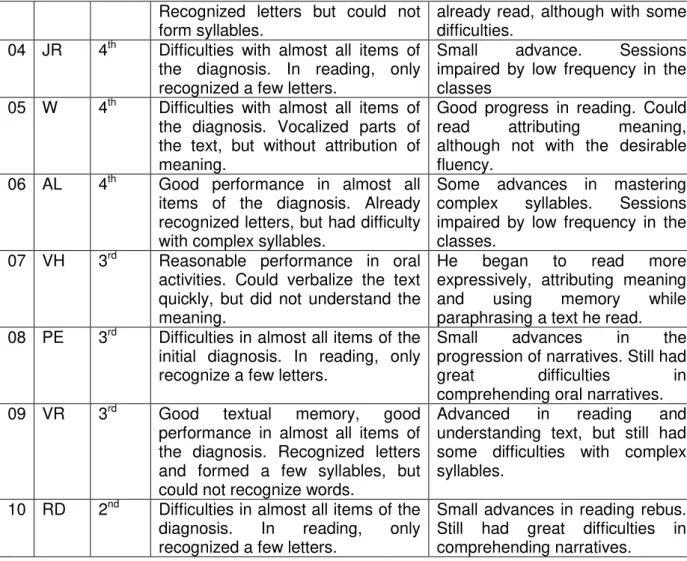
After these diagnoses, the group sought to teach two weekly classes of reinforcement for part of the pupils (six girls and 10 boys). The sessions were individual or in small groups, always with reference to the initial diagnosis. Consider the relationship between initial diagnosis and final performance after one semester of intervention (August-November 2007) in Table 2:
Table 2 - Initial diagnosis and final performance after one semester of intervention.
Pupil Class INITIAL DIAGNOSIS FINAL PERFORMANCE
GIRLS
1 EV 4th Difficulties with all items of orality.
In reading, she recognized only a few letters.
Insignificant improvement. Learned some rhymes, but could barely keep them in memory. 2 LN 3rd Diagnosis hampered by shyness.
An immense difficulty in resuming texts of childhood became evident. Despite the advanced age (13 years), her reading was slow, sub-vocalized.
Small progress in both oral and writing: she could read, although still without the necessary fluency.
3 NAT 2nd Dominated part of the diagnostic
items (rhymes and knew some songs from memory). Reading sub-vocalized, with problems in complex syllables.
She started reading, without sub-vocalization, words with simple syllables, although still having difficulties in complex syllables.
4 BR 3rd Had a good repertoire of texts.
Could read with difficulty, sub-vocalizing and very slowly.
Advanced rapidly in reading, but with variations due to her low frequency in the classes.
5 IN 2nd Good performance in oral activities,
despite the initial shyness. Could read with difficulty, sub-vocalizing and very slowly.
Very significant advance. Upon leaving, she was reading with fluency and meaning.
6 LAR 2nd Good performance in oral activities
(in almost all items). Could read with difficulty, sub-vocalizing and very slowly.
Very significant advance. She learned to read and assign meaning to the text.
BOYS
01 GU 4th Difficulty with narratives and with
memorization of songs and rhymes. Recognized letters, formed a few syllables, but could not read words.
Made little progress in mastering complex syllables. Good performance with rebus and other oral activities.
02 GA 4th Difficulties with almost all items of
the diagnosis. In reading, only recognized a few letters.
Not very significant advance; in the end, still had difficulty reading without vocalizing.
03 VI 4th Difficulties in almost all items of the
diagnosis, especially with those requiring memorization.
Recognized letters but could not
form syllables. already read, although with some difficulties. 04 JR 4th Difficulties with almost all items of
the diagnosis. In reading, only recognized a few letters.
Small advance. Sessions impaired by low frequency in the classes
05 W 4th Difficulties with almost all items of
the diagnosis. Vocalized parts of the text, but without attribution of meaning.
Good progress in reading. Could read attributing meaning, although not with the desirable fluency.
06 AL 4th Good performance in almost all
items of the diagnosis. Already recognized letters, but had difficulty with complex syllables.
Some advances in mastering complex syllables. Sessions impaired by low frequency in the classes.
07 VH 3rd Reasonable performance in oral
activities. Could verbalize the text quickly, but did not understand the meaning.
He began to read more expressively, attributing meaning and using memory while paraphrasing a text he read. 08 PE 3rd Difficulties in almost all items of the
initial diagnosis. In reading, only recognize a few letters.
Small advances in the progression of narratives. Still had great difficulties in comprehending oral narratives. 09 VR 3rd Good textual memory, good
performance in almost all items of the diagnosis. Recognized letters and formed a few syllables, but could not recognize words.
Advanced in reading and understanding text, but still had some difficulties with complex syllables.
10 RD 2nd Difficulties in almost all items of the
diagnosis. In reading, only recognized a few letters.
Small advances in reading rebus. Still had great difficulties in comprehending narratives.
As can be seen in Table 3 below, there is no case of a pupil who – having showed an interesting oral repertoire (+ sign) in the initial diagnosis – has not experienced some improvement in reading in the final situation. The two more complex cases which remained stagnant even after the sessions, showed an initial situation jeopardized (- sign) in terms of mastering the items of the diagnosis and were exactly those two pupils who were confused when simply naming images. These two pupils were a girl (IV, line 1), whose attendance could not be continued because of her resistance, and a boy (RD, line 10) who is being treated for the past two years, and whose progress was achieved only after a year attendance. RD was one of the most complex cases of this public school, but his stay in the program has allowed considerable advances: when we concluded the second phase of the research, this pupil read with some fluency.
Initial Final Girls Boys
- - 1 1
- +- 1 4
- + 0 2
+- + 1 3
+ + 3 0
We would reemphasize, then, the following hypothesis: pupils lacking capacity for intertextual handling and language and narrative skills tend to experience serious
problems while learning how to read and write.
The project started another phase, during which we sought support two grades of elementary school, maintaining a teaching program based on diagnoses, i. e., for each item in Table 2 a curricular topic was set up. In the course of the year, we also sought to observe the "dynamics of renitency" of pupils who tended to complete the year without complete mastery of the alphabet and reading. "Dynamics of renitency" is defined here as the way how a pupil resisted to school strategies, both those that aimed at teaching reading and writing and those that aimed to involve them in performative activities in the field of orality.
Search for a Singular Model of Treatment
The listening of the pupils in the school situation as it was exercised in this study differs substantially from a psychoanalytic listening. While listening in psychoanalysis, as Freud pointed out (1988),8 focuses on the "free-floating attention," on the silent waiting for a lapse, a Freudian slip, or even on significant games in accounts of dreams, in this research we also valued as significant evidence that emerged in the relationship, but from a semi-structured teaching situation, mediated by literary activities such as storytelling, recitation, ludic games and talks about the heroes of the narratives, about the ways of how to play with words.
While in the clinic the patient's interaction is entirely open, motivated by situations experienced, imagined or even dreamed of and still scored by the scansion of the analyst, in the sessions in our research we confronted the pupil with a textual set full of ambiguities and possibilities for subjective understandings. Most times, the trigger
of a significant chain was a ludic-literary text or an element of a narrative, as can be seen in these two cases below, one from the first phase and another from the second:
VG (11 year-old child with four years of schooling, came to the sessions with many difficulties, without yet mastering the alphabetic principle and with an oversensitive renitency). S/he got involved in the sessions after the valorization of a significant clues obtained when – while s/he was paraphrasing the rhyme “Hoje é domingo,” ["Today is Sunday,"] – s/he took on a tone of jest reading the words “a gente é fraco/cai no buraco/o buraco é fundo/acabou-se o mundo” ["we are weak / fall into the pit / the hole is deep / the world ends" and added: "I once fell into a hole when I was little." As s/he noticed that the researcher appreciated her/his speech, s/he continued: "My mom says I don‟t learn to read because I fell into the hole and a stove fell on my head." The researcher seized on the association between "not read" and "fall into the hole" and together they remade the rhymes citing comically the situation of VG falling into the hole. This delicate listening to his situation led him to enjoy more of the texts used in class and playing with words. Shortly thereafter, VG committed her/himself very much in the sessions, and little by little, escaping the awkward position in which the speech of his mother put him; in the end, s/he stated that s/he would show her/his mother that s/he could read, and that the story of "falling in the hole" was not true.
MT (7 year-old former street child). Experienced improvement with the help of two figures: “Little Thumb" of Perrault's tales, and "Saci Perêre", a character of Brazilian folklore,9 incorporated orally and through reading the
book “O Saci” by Monteiro Lobato. According to one of the researchers, the boy questioned the very nature of fiction, seemed to demonstrate certain surprise with the stories, he almost always tried to question the storytelling introducing other possibilities of action rather than passively accepting the progression of the story as do children who accept the fiction – an example: when Little Thumb and his brothers are abandoned in the woods, MT, distressed, interrupted and pointed to another solution: "they can go after the parents back, and return, follow their track back home." Gradually, he assimilated the narrative, accepting its progression and identifying with this tiny character who, with his cunning, triumphed over the huge ogre and brought his brothers back home. As for the Saci, a little being, deprived of one leg, but full of artfulness and powers, it offered the boy good possibilities of commiting himself during the sessions. These movements of his subjectivity functioned as turning points in his reluctance: MT had difficulties to behave as a pupil, he lived on the streets, did not even have an idea of how to behave in a classroom or even actually how to handle school supplies. By identifying himself with
9 Translator‟s note: Saci Pererê is a legend of Brazilian folklore that originated among the indigenous tribes of southern Brazil. Saci Pererê is always getting in trouble because of the tricks he plays on others. See the songtext by Ernani Aguiar at:
Little Thumb and Saci, his relation with storytelling, with reading aloud and with the letters themselves have changed enough so that major breakthroughs happened. In just three months, MT mastered the alphabet, just having some difficulties with complex syllables (usually digraphs) and sustaining a subjective position as a reading learner, showing great interest in the history books, the work of Monteiro Lobato, in the library, in playing and in games based on the narratives created especially for the project in the classrooms.
From these and other cases experienced in the project, it began to be possible to devise a model of instruction which, although based on psychoanalytic listening, was also structured in the linguistic-literary handling of texts of children's oral culture – for example, in case I, a rhyme and acceptance of a nonsense allowed the pupil to come closer to teaching proposals; in case II, it was a narrative with its mythical fictional universe that allows for this openning. From this fictional ambience full of ambiguities, it becomes easier the emergence of a subjectivity predisposed to a confrontation between an excessive corporeality (run around and play without too many rules) and a posture of self-restraint that writing brings into play (be seated, concentrate). It is at this point that the situation comes closer to a transferential dynamics from which values can be rebalanced. Just as in psychoanalysis, in which the patient invariably introduces a theory about their symptoms and eventually includes the analyst as part of this theory and the very symptom (Nasio, 1993), in this study the researcher was faced with explanations similar to those reported above.
The same happens with the concept that the pupils present about their way to read or deal with letters and texts. For example, there were many utterances as these:
"one must read slowly not to make mistakes," “I can only write, not read," “this is no
It is interesting to emphasize that the concept of subject that guides this research is not the same as that sustained by constructivists or sociointeractionists, i. e., the active subject that changes phases, who builds the writing from their trials and errors, but rather an eccentric subject, who is positioned in relation to the discourse of the Other (Lacan, 1998) and who emerges in the language in such an evanescent manner, between words, between sentences, between texts. For example, MT, when he started the sessions, had a position of reluctance, but became enchanted with the stories of Little Thumb and Saci and with his instructor (who was the source of these stories); he gained some fluency and agreed to reposition himself in the face of the letters and reading and writing activities. However, the staff knew his position would oscilate, i. e., it departed from the idea that this predisposition that looks like an active subject would eclipse and might require new strategies of the person who instructed him. Another interesting fact that seems to support the hypothesis of this subjective evanescence is the fact that MT and other pupils studied did not transfer directly to the classroom the knowledge they gained in the consultations; to make that happen, even partially, specific strategies were needed as for example, transfer to the classroom content that the pupil mastered in the sessions, or also that the researcher participated in some classes with the teacher and explicitly recognize the changed position of the pupil.
The model of listening sought here is based on language and has as its tools orality and literature. Unlike other forms of listening, its goal is quite explicit: to change the pupil's subjective positioning in relation to writing and orality skills. Listening, thus, is an activity whose ethics and technique need to be redefined specifically for this field, because it became very clear in the research, from the initial series, that we need to enhance subtle verbalizations and attitudes of pupils, in order to reposition them face a more oral language, more prone to the poetic function, that is, rich enough to give consistency to the scansions of the alphabet and to the textual logic of reading and writing.
Phase II of the Project: some possible conclusions
and their conditions of orality and literacy (what they bring from their environment and early childhood education). The team studied the records of pupils coming from elementary schools, but as there is still no practice of systematically organizing this transition, children's materials were delivered by the parents not before one month after the school start – the ideal would have been to start the year with an assessment of this material.
After the analysis of portfolios received, it was possible to detect that a good part of activities to which the children were exposed aimed directly at mastering numbers and letters. In only one of the preschools we detected a more systematic concern with texts of oral origin, but even then, from which we could analyze, the texts were exploited for purposes related to the field of writing. The involvement of the team with the pupils in the course of the year confirmed this initial suspicion: the children had a small and undiversified repertoire of oral genres of childhood, that is, during their early childhood education they have not had enough opportunities to deal sufficiently with texts of oral origin for these to actually constitute a foundation for textual memory.
Based on these findings, the research team along with the school teachers tried to provide a program that would link a network of oral texts; that is, the concern was to ensure that a number of texts were stabilized in the memory, as narratives matrices or sources of linguistic skills with which and among which a subjectivity more adequate with the requirements of reading and writing could emerge. As already stated, if in the memory of a pupil there is a net of texts, which are associated either by common themes, or by their formal elements, the effect of such a network should also extend to the field of writing. If the pupils know how to listen, tell and relate stories (thematic intertextuality), if they haves ludic-poetic texts in their memory and learned to identify the aesthetic elements of each genre oral (parallelism, alliteration, assonance, rhymes and other iterations), most likely their reading and their handling of writing will become more dynamic and meaningful.
The team sought to mobilize the teachers of both classes to understand well the principles that guided the work perspective and to build into their programs items proposed by the project. However, these insertions could not be made without regard
to the curriculum for the project “Ler e Escrever.” From the hypotheses of the project,
1. Collective Oral Diagnosis – we began the process with a collective diagnosis, or through conversations in the classroom, trying to map the thematic and formal universe of the oral texts that children brought in their memory.
2. Performative Activities – in collective performative activities, a researcher observed the reaction of pupils signaling evidence of little repertoire or even a little practice in collective oral activities. In each classroom, it was noticed from the outset, that eight or nine pupils did not favor such activities: there was for instance complete avoidance, or exaggerated and indisciplined participation. These pupils were interviewed and treated separately, and, where possible, we sought to catch up on the activity or talk about it. In subsequent classes, special attention was given to engaging these pupils.
3. Route to Oral Activities – the activities pursued the following route: (1) performance, (2) talk about the activity, (3) ask for games or similar story in the memory of pupils, (4) search at home and/or in books with the aim of finding similarities, (5) organization of collections. Some examples may illustrate the process:
Riddles: according to the classroom teachers it was a moment of euphoria when the pupils received school supplies from the government; hence the team decided to present some riddles whose answers were exactly the materials they had in hand (e. g., "it is born large and dies small"? – answer: the pencil). The work was successful and ended with a collection of riddles. When school was resumed at the second half of the year, the project coordinator noted that pupils easily recalled the name of all materials, their riddles and others have already addressed during the first semester.
European and Brazilian Tales: as children brought in their memories only a few European tales, the most widely covered by the media, the team aimed at rapidly expanding this repertoire and, preferably, entangling intertextuality as well as introducing several Brazilian tales. The following tales were narrated and intertwined from the outset: "Jack and the Beanstalk," "Hansel and Gretel" and "Little Thumb", also offering a repertoire of Brazilian tales: “A árvore de
Simon"], “O macaco e o pé de milho” ["The monkey and the corn stalk,"], “A história da coca” "The story of coca"], “A árvore da montanha” ["The tree of the mountain"], “A velha a fiar” ["The old woman spinning"] and others. After the performances and conversations, the pupils knew the stories in books or, where appropriate, in movies. Only after mastery of these matrices they started working with passages, words, phrases and images as dynamic motivators for the use of writing.
Memory between Texts, Images, and Media
In the diagnosis of phase I, the rebus appeared as a difficult element for pupils who did not master writing even after three or four years of schooling. In the program, it was used as a special strategy, because, besides being taken as a hinge between images and writing, it also functioned as a strong element of diagnosis. Using rebus is a qualitative step that allows diagnostics to go beyond the stages or levels described by Ferreiro y Teberosky (1989), since the passage from the image to the syllable requires "cuts" and "losses" whose meanings go beyond the domain of conscious writing. The following is an example of the implications that rebus reading proposes:
= GATO [cat]
GAlo [rooster] TOmate [tomato]
First, the subject has to "detach" herself/himself from the image of the rooster (leave the "imaginary pregnance") and read the figure only as GA, cutting the LO. After this, s/he has to do the same with the second image. The subject will have to accept the adjustments between the two fragments to find there the word GATO [CAT]. In building the word, there is also a breach of the "pregnance of sound,” because the
text), the cat rediscovered as well as other words, allowed to find a hidden rhyme (the words cat, forest, fire, water, beef, wheat, chicken, egg, priest and mass formed the rhyme “Cadê o toucinho daqui?” ["Where's the bacon from here?"]). The game was called "Discover the rhymes."
The rebus was also the basis of several games developed by the staff as electronic support, in which the pupil rediscovered, in addition to rhymes, other oral games and narratives they already had in memory. In addition to this reading of the rebus, we also practiced reading illustrations of books; for example, they read episodes of "Little Thumb" in the illustrations of Gustave Doré, which served as a mnemonic aid, especially for those children who did not yet have practice in the reconstruction of narratives. The use of the rebus is opposed by constructivists and sociointeractionists as it is understood as a pedagogy of the smaller parts of speech, syllabication, letter, etc. However, in our research, it proved effective and necessary, especially for pupils who had difficulty understanding the syllable as an algorithm. Films were also used: the two animations of Michel Ocelot, “Kiriku and the Witch” and
“Kiriku and the wild animals” were showed more than once. Many scenes were isolated so that the narratives were reconstructed in a fairly complete manner. Film narratives were also reused in computer games produced specifically for the project.
Naming
Another equally important point was to expand the theme of "naming", whose goal was not only expand the vocabulary, but also confront the child with two phenomena: (1) the relationship between more general terms (hypernymy: trees, animals, birds) and more specific popular names (ipê tree, fox, tié-sangue [Ramphocelus bresilius]), calling attention to the mode of naming ("Why is this bird called "Quero-quero”
between signifier and signified (bilabial consonants [m], [t] and the alveolar tap/flap of [r], associated with the repetition of [u], which is also a closed vowel; this introduces new meanings to this coruja [owl], whose singing and mystery seem to resonate in its own name, so does the "jaratataca" that opens itself in its cracking [noises] and jumps). We found that the onomatopoeic and semiotic re-motivation may have a crucial role in literacy.
As can be seen, the research project emphasized the building of a textual basis in memory, always taking as its starting point the performative orality, the body as support, but always exploring other parallel linguistic forms and media (writing, pictures, posters, books, computer and cinema). It became clear to the team that very positive effects on the classroom dynamics can be obtained from this entanglement: the constant rediscovery of the texts, words, images, resulted in a rich, diverse and interactive educational environment.
Alternating: tell, read; read and tell
Another important strategy used by the group was switching between narrative modes. The storytelling always came to the fore; it was the main responsible for the foundation of a narrative memory. The reading came next and, finally, commenting and exchanging opinions, for example: the Saci as a folklore character, was presented through conversation and storytelling, then through the book “The Saci” by Monteiro Lobato, whose narrative was paraphrased and at the same time, read aloud. The apex of this activity was reached when the teacher, during a more cathartic moment, interrupted the reading and left the final passage for the pupils who made an effort and rushed to read in pairs or small groups.
waste time with games” and others. These skills should be understood as essential to the profession and be required in official examination for public posts and in the work itself.
Paralell Monitorings
The research makes it clear in its results, that the classrooms are already heterogeneous from the beginning, i. e., there will be mismatches in the levels of learning already from the initial two months. If one desires, thus, to assume a true policy of literacy and reading, it will be necessary to have team work that exceeds the current model (one teacher for every room with thirty or more pupils). Since, among Brazilian constructivists, the idea that the child has two years to become literate is widely disseminated, all remnants of 1st grade go to second grade without the slightest embarrassment.
What is not realized is that from the initial two months, the pupil who does not assimilate the rhythm of the activities of mastery of the code already positions herself/himself as a renitent subjectivity; as the one who cannot learn to read and who, for this reason, also isolates herself/himself from oral games and other group activities.
The project experimented with diagnosing and monitoring these pupils in their singularities, trying to detect their movements of approaching and distancing the world of reading and writing. The team followed those pupils who, from the beginning, deviated from the class. The synthesis of these results is presented in Table 4.
Table 4– Comparison between Baseline and Final Situations
Pupil G P Situation on 04/ 2009 Situation on 12/2009
Dan M M
Played excessively without much attention to collective activities. Low concentration in both oral and in writing. He showed some skills in oral and writing (memorized easily and quickly assimilated the mechanism of the syllable), however, his difficulty to engage in collective activities kept him out of the activities and, therefore, he did not retain or
expanded what he learned.
Tha M M
Even though with good textual memory and skillful in linguistic activities, showed a certain apathy and little involvement with writing – a subjective position supported by his mother, who claimed his son to be "lazy to read." His low attendance, too, hindered his involvement in writing activities; it may even be the case that these caused his frequent absences.
Despite not attending the sessions continually, he made some progress in mastering the alphabet and the rebus, but not enough to read a simple text independently. His understanding was still hampered by delays in the composition of the syllables.
Joa M M
He showed great reluctance in relation to the letters and verbalized the desire to return to EMEF [primary school], where he "only played." His low attendance also was impedimental. In oral diagnoses, he showed skill and ease, but was reluctant to implement such easiness in activities with written texts.
The problem of low attendance was resolved during the second half of the year, after contacts with the family. Soon, the pupil improved his listening to narratives, demonstrating mastery in reading rebus and in the mechanism of syllables, but still ended the year with difficulties in comprehension of words while reading.
Ray M M
Presented difficulties even to recognize initial letters. Had the sequence of the alphabet in memory, but rather as a rhytm than as functional units. He confused the letters when they were isolated, both in their visual forms and their functions. In the pronunciation of rebus, could not single out the first syllable, pronouncing the whole word always. In oral tasks, when stimulated individually, showed certain predisposition to involvement.
Starting with lyrics, memory game with letters, activities with rebus and texts from his repertoire, the pupil partly changed his position, came to accept the monitoring and the challenges of the alphabet, although in his final diagnoses still could not recognize words after recognizing letters and assembling, with difficulties, some syllables. This pupil started attending sessions only in the second half, which made it more difficult to make advances.
Jen F M
This was the most complex case of the two series. Her subjective position was always of escape and isolation. Her entry into the school coincided with her admission to a nursing home following a court order. As a former homeless girl, Jen did not even have an idea of the obligations or of the way a pupil behaves to others in the classroom. She not even recognized the initials of her name, refused to participate in oral activities and not even expressed interest in computer games. She was always walking, running and getting out of the reach of any interventions.
The sessions focused more on interaction, on listening to her sigularity. Jen learned to play, listen to stories and comment on them, and even memorized two rhymes.
In the field of reading, she began to accept the activities with letters and books in general. In the end, had mastered the alphabet and, with help, managed to read some rebus.
Bre F M
of activity. Her teacher considered her "apathetic"; hovewer, her crying showed concern about her difficulties in the classroom. Had difficulty paying attention to the stories and did not engage in playful activities, or when she did, then with many reservations. In writing, her difficulties were global, not even recognized the letters.
with her attendant, advanced in all fields, from the interest in oral storytelling and games to the mastery of the alphabet. Ended the year still experiencing difficulties, but now dominating letters and syllabic families. Her constant absence severely affected her progress.
Mat M M
Ex-homeless, had virtually to be escorted from the shelter to school. Went through a difficult adjustment, but surprised everyone and even excelled in performative activities, although his participation was often exaggerated, breaking into conflict. He did not master even the letters of his name and did not know how to listen to a story, he always tried to demonstrate that they were all false, "all lies", i. e., the pupil did not seem to tolerate the fiction or show involvement with the narrator.
His progress was notable in all evaluable items: speaking, reading and writing, performative activities. In the end of the year still had some difficulty with some complex syllables, but already showed clear capacity for resilience.
The narratives ("Little Thumb", "The Saci") played a key role in his gradual success.
Cau M M
Showed difficulties in all genres of oral texts, he could not memorize even small passages. He recognized a few letters of the alphabet and showed little familiarity with the handling of books, even when reading illustraded stories.
Hampered by a very low frequency, number of absences above 50%, yet the pupil showed significant progress, he became involved with stories, made effort to narrate episodes and suceeded in oral games. His mastery of reading progressed and regressed according to his absence.
Dar F V
Pupil with poor health, including eye problems. Presented difficulties both in oral (memorization) as recognition of letters and rebus.
Her monitoring was poor because of the constant absences, but still advanced in the field of syllables, in reading images and in the writing of her full name.
Cla F V Already mastered the names of letters, but did not know their functions. She engaged well with oral activities.
Experienced a rapid advance, in a short time had already caugt up on the level equivalent to the grade, read fluently and with typical difficulties of age.
Mel F V
Her participation in the activities seemed to be affected by her shyness. Had a rather negative subjective position, saying repeatedly that she could not read. Indeed, her mastery of the alphabet was still precarious, so far as not being able to identify the letters of her surname.
She changed her subjective position in relation to reading, ended the year reading and understanding simple texts, albeit slowly.
These sessions took part weekly with supervision of the project coordinator. The intention was to seek a model of team work that could cope with all kinds of difficulties the pupils had from the first day of class. The monitoring of the sessions allows for some conclusions:
1) Attendance is critical: Much of the lag in performance/achievement is caused by
the pupils‟ low frequency, despite the offer of parallel monitoring. During the sessions, it was common to experience a pupil advance in the expansion of both their oral memory and in the field of the alphabet, but undergo the same setbacks after a prolonged absence. One of the researchers directed their research to the families, trying to understand this apparent neglect in relation to school. Although the work is not yet completed, the researcher found a complex set of reasons, ranging from family difficulties (e. g., parental conflict) to other work-related issues (leaving home early, the child is alone and decides for itself) or even housing and transportation.
2) Teamwork ("the hinge"): Responsibility for the early grades should be assigned to a team of educators from kindergarten and the first two grades – one could use the image of a hinge as a metaphor for the articulation of kindergarten and early phase of elementary school (ensino fundamental I) – the curriculum must be articulated, the continuity of the program has to be guaranteed, grade 1 should not be understood as the absolute starting point. Each class of 1st grade could be under the responsibility of
model, also adopted by the state network of São Paulo (Rede Estadual de São Paulo), assigns "an assistant – research student, student of Pedagogy and Literature (Pedagogia e Letras) to each first grade teacher” (São Paulo, 2006,. p. 5) and provides for a training program that strives to define itself as constructivist, and whose focus is placed on writing to the detriment of orality (Belintane, 2008), of reading (Bajard, 1992) and other dimensions of language (Borges, 2006; Bosco, 2002). As noted in the research, the excessive submission to constructivism in the school routine results in two serious problems: (1) a single approach to diagnosis focusing on writing, through which pupils are classified, (2) a strong ideological refusal against the use of syllabic families and other techniques that use the smaller elements of language and writing.10 What our research shows is that the isolation of the teacher with her/his class, associated with this diagnostic classification system centered on writing, leaves aside the most concrete burning issues of a class, which generally requires a more detailed listening to its heterogeneity and more contextualized and diversified strategies.
3) Shifting the focus from writing to orality: The project started from a form of orality that dynamizes memory, body language abilities and linguistic skills, which favors an approach to writing that, at the same time, aims at the full mastery of difficulties of the code and the expansion of matrices that will support a significant fluency in reading. The pilot scheme implemented in the research project was successful in the collective activities, in the individual sessions and even in the more complex cases.
General Conclusion
The implementation of the program in the two classrooms followed an interesting dynamic, though it could not enjoy exclusivity, since the teachers also had to meet
the requirements of the program “Ler e Escrever” ["Read and Write”], which required
the researchers to establish some convergence between the two programs. As what concerns the support, we also sought to maintain convergent paths, from the support
of the body (memory, performance), to electronic media, through to the graphical, but always opening up possibilities for other languages. It created an environment of immersion and submersion of subjectivities, that is, we have provided the basic linguistic conditions for subjective movements among the different genres, means, suports, and languages. The introduction of electronic support, as it was done, with richly contextualized activities using orality and books allowed us a glimpse into the possibilities of introducing the computer to pupils in early grades, but without imaginary ruptures in the world of orality and of the book. All pupils in the two classrooms, during their early years, they understood the computer merely as an opportunity to "play games", but when faced with the figures and situations in stories, in books and movies, they realized they were learning to read and, at the same time, that they were rediscovering themes and characters already in their memory.
Using a program11 that allows for simple commands ("drag and drop", "connect points", "image-sound"), the team created games of orality and literacy12 that allowed fun playing with the oral texts seen in class and, at the same time, propitiated the use of multimedia (sound, image, moving image, text, hypertext, and recursivity).
Although the planned program was not implemented with exclusivity in the two classrooms, the results were interesting and promising. The graph below represents an assessment of the six classes of first grade school, held on July 13, 2009, by the school itself at the request of the Secretariat of Education. Note that the two series followed by our research (B and E) showed the best performance, even when taking into account only the constructivist classification:
Graph 1
11 The project worked with an easy to use program, "Visual Class", written by Celso Tatizana.
PS – Pre-syllabic; SSV – Syllabic no Value; SCV – Syllabic with Value; SA – Syllabic-Alphabetic; A – Alphabetic
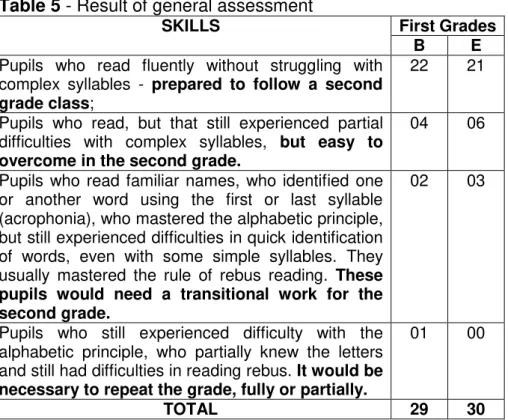
In the evaluative dialogues with pupils, conducted during the last week of the classes, which recapitulated stories, games, plays, readings and characters, one could clearly see two dynamic rooms, animated, and predisposed to continue the work – in the language of the research , "two ambiances conducive to the formation of readers." However, despite all the difficulties to assess reading skills, the team decided to administer, in the first week of December, a final evaluation which aimed to detect more precisely the reading level of the two rooms. The instrument featured the following activities:
Correlation between word and image (the image of a banana tree [bananeira], for example, should be associated with the correct written form, placed randomly among four other segments with almost homographs: barateira, banheira, pananeira, baladeira, bananeira);
Naming of characters known from the rebus, the computer or from graphical support;
Reading and understanding familiar texts – choose the correct alternative, reading it with autonomy;
Identification of excerpts from stories (paraphrased) from its illustrations – for
example, the image of Little Thumb taking off the Ogre‟s boots or of Macaco
Simão [Monkey Simon] eating his bananas should be pasted so as if they were baseball cards into the spaces containing their respective captions. The overall result of the evaluation was as follows:
FIRST GRADE CLASSES
0 5 10 15 20
A B C D E F
PS SSV SCV
Table 5 - Result of general assessment
SKILLS First Grades
B E
Pupils who read fluently without struggling with complex syllables - prepared to follow a second grade class;
22 21
Pupils who read, but that still experienced partial difficulties with complex syllables, but easy to overcome in the second grade.
04 06
Pupils who read familiar names, who identified one or another word using the first or last syllable (acrophonia), who mastered the alphabetic principle, but still experienced difficulties in quick identification of words, even with some simple syllables. They usually mastered the rule of rebus reading. These pupils would need a transitional work for the second grade.
02 03
Pupils who still experienced difficulty with the alphabetic principle, who partially knew the letters and still had difficulties in reading rebus. It would be necessary to repeat the grade, fully or partially.
01 00
TOTAL 29 30
Would the monitoring of the groups have been more complete, with a good transition between kindergarten and elementary school and an exclusive implementation of the program recommended, the results would have possibly been even better. What becomes clear is that the focus of research and teaching activities should be placed more on the personal and cultural singularity of the Brazilian child. The transition from orality to writing entails more accurate and contextualized didactic arrangements, with constant monitoring of level gaps since the beginning of the first years of elementary school.
The articulation of academic research and public education can improve significantly if there is a detachment of researchers and educators in relation to the methodologies or theories that make rigid their ways of dealing with the complex Brazilian reality.
References
BELINTANE, C. Vozes da escrita: entre crianças e menestréis. Estilos da clínica,
São Paulo, v. 1, n. 1, p. 36-51, 2008.
BAJARD, E. Afinal, onde está a leitura? Cadernos de Pesquisa, São Paulo, n. 83,
p. 29-41, 1992.
BERNSTEIN, B. Estrutura social, linguagem e aprendizagem. In: PATTO, M. H. S,
Introdução à psicologia escolar. São Paulo: Casa do Psicólogo, 1997. p. 145-169.
BORGES, S. O quebra-cabeça da escrita: a alfabetização depois de Lacan.
Goiânia: UCG, 2006.
BOSCO, Z. R. No jogo dos significantes: a infância da letra. Campinas: Pontes,
2002.
BRASIL. Ministério da Educação. Plano de Desenvolvimento da Educação. Prova
Brasil: Ensino Fundamental: matrizes de referência, tópicos e descritores. Brasília: MEC, SEB, INEP, 2008/2009.
BRASIL. Sistema Nacional de Avaliação da Educação Básica. INSTITUTO NACIONAL DE ESTUDOS E PESQUISAS EDUCACIONAIS ANÍSIO TEIXEIRA (INEP/MEC), 2007 IN
http://www.inep.gov.br/imprensa/noticias/saeb/arquivo07.htm (última consulta em agosto de 2010)
BRASIL. Relatório Final do Grupo de Trabalho Alfabetização Infantil: os novos caminhos. Seminário “O Poder Legislativo e a Alfabetização Infantil: novos caminhos”. Comissão de Cultura e Educação da Câmara dos Deputados, 2003. Disponível em: <http://www.mec.gov.br>. Acesso em: 15 set. 2003.
FERREIRA, E. y TEBEROSKY, A. Los sistemas de escritura en el desarrollo del niño. 11. ed. México: Siglo Ventiuno, 1989.
FREUD, S. Obras Completas de Sigmund Freud. Rio de Janeiro: Imago, 1988.
GELB, J. I. Historia de la escritura. Versión española de Alberto Adell.
Madrid-Espanha: Alianza, 1952.
GINZBURG, C. Sinais: raízes de um paradigma indiciário. In: GINSBURG, C. Mitos, emblemas e sinais: morfologia e história. Tradução Federico Carotti. São Paulo:
Companhia das Letras, 1989. p.143-179.
HAVELOCK, E. A equação oralidade-cultura escrita: uma fórmula para a mente moderna. In: OLSON, D. R.; TORRANCY, N. Cultura escrita e oralidade. Tradução Valter Lellis Siqueira. São Paulo: Ática, 1995. p. 17-34.
JAKOBSON, R. Dois aspectos da linguagem e dois tipos de afasia. In: _______.
Lingüística e comunicação. Tradução Izidora Blikstein e José Paulo Paes. São
Paulo: Cultrix, 1995. p. 34-62.
LACAN, J. A instância da letra no inconsciente. In: ______. Escritos. Tradução Vera Ribeiro. Rio de Janeiro: Jorge Zahar, 1998. p. 496-533
LEMOS, C. Sobre a aquisição da escrita: algumas questões. In: ROJO, R. (Org.).
Alfabetização e letramento. São Paulo: Mercado de Letras, 1998. p. 13-53.
LUDKE, M.; ANDRÉ, M. E. D. Pesquisa em educação: abordagens qualitativas.
São Paulo: EPU, 1986.
NASIO, J. Cinco lições sobre a teoria de Jacques Lacan. Tradução Vera Ribeiro.
PATTO, M. H. S. (Org.). Introdução à psicologia escolar. São Paulo: Casa do
Psicólogo, 1997.
SÃO PAULO. Secretaria Municipal da Educação. Projeto “Toda força ao 1º ano”: guia para planejamento ao professor alfabetizador – orientações para o planejamento e avaliação do trabalho com o 1º ano do Ensino Fundamental. São Paulo: SME/DOT, 2006.
SÃO PAULO. Secretaria Municipal da Educação. Ler e escrever: guia de
planejamento e orientações didáticas; professor alfabetizador 1. série. São Paulo: FDE, 2008.
SOARES, M. Linguagem e escola: uma perspectiva social. São Paulo: Ática, 1989.
Received in 06.03.2010 Approved on 22.06.2010
Claudemir Belintane is professor of Methodology of Portuguese Teaching at the