www.jped.com.br
REVIEW
ARTICLE
Factors
related
to
the
association
of
social
anxiety
disorder
and
alcohol
use
among
adolescents:
a
systematic
review
夽
Elisabeth
Lima
Dias
da
Cruz
a,∗,
Priscila
Diniz
de
Carvalho
Martins
b,
Paula
Rejane
Beserra
Diniz
aaUniversidadeFederaldePernambuco(UFPE),Pós-graduac¸ãoemNeuropsiquiatriaeCiênciadoComportamento,Recife,PE,
Brazil
bUniversidadeFederaldePernambuco(UFPE),Pós-graduac¸ãoemSaúdedaCrianc¸aedoAdolescente,Recife,PE,Brazil
Received20October2016;accepted9January2017 Availableonline1June2017
KEYWORDS
Phobicdisorders; Adolescent; Behavior; Ethanol; Riskfactors
Abstract
Objective: Toidentifytheriskfactorsrelatedtotheassociationbetweensocialanxietydisorder
andalcoholuseinadolescents.
Sourceofdata: ThePICOresearchstrategywasusedtoperformasystematicreviewinMedline,
LILACS,Pubmed,IBECSandCochraneLibrarydatabases.DeCS/MeSH:PhobicDisorders,
Adoles-cent,Behavior,Ethanol,RiskFactors,andtheBooleanoperator‘‘AND’’wereused.Inclusion
criteriawere:cross-sectional,prospective/retrospectivecohort,andcase-controlstudies,
car-riedoutinadolescents(10---19years),originalarticlesonsocialanxietydisorderandalcohol
usepublishedbetween2010and2015.Studiesthatdidnotreporttheterms‘‘anxietydisorder’’
and‘‘alcoholuse’’inthetitleandabstractwereexcluded.
Synthesisofdata: 409articleswereretrieved;aftertheexclusionof277repeatedarticles,the
followingwereeligible:94inMEDLINE,68inPubmed,12inIBCS,andthreeinLILACS.Titles
andabstractswereindependentlyreadbytwoexaminers,whichresultedintheselectionof
eightarticlesfortheanalysis.Riskfactorsassociatedtothetwodisorderswerefemalegender,
age,peer approvaland affectiveproblems for alcohol use,confrontationsituations and/or
compliancereasons,frequencyofalcoholuse,andsecondarycomorbidities,suchasdepression
andgeneralizedanxiety.
Conclusions: Itisnecessarytoassesstheperiodofsocialanxietydisordersfirstsymptomonset,
aswell astherisks for alcoholuse inordertoestablish corrective interventionguidelines,
especiallyforsociallyanxiousstudents.
©2017PublishedbyElsevierEditoraLtda.onbehalfofSociedadeBrasileiradePediatria.Thisis
anopenaccessarticleundertheCCBY-NC-NDlicense(http://creativecommons.org/licenses/
by-nc-nd/4.0/).
夽 Pleasecitethisarticleas:CruzEL,MartinsPD,DinizPR.Factorsrelatedtotheassociationofsocialanxietydisorderandalcoholuse
amongadolescents:asystematicreview.JPediatr(RioJ).2017;93:442---51.
∗Correspondingauthor.
E-mail:[email protected](E.L.Cruz).
http://dx.doi.org/10.1016/j.jped.2017.05.001
PALAVRAS-CHAVE
Transtornosfóbicos; Adolescente; Comportamento; Etanol;
Fatoresderisco
Fatoresrelacionadosàassociac¸ãodetranstornodeansiedadesocialeusodeálcool entreadolescentes:umarevisãosistemática
Resumo
Objetivo: Identificar os fatores de risco relacionados a associac¸ão entre o transtorno de
ansiedadesocialeusodeálcoolentreadolescentes.
Fontesdosdados: Utilizou-se a estratégia de pesquisa PICO para realizar a revisão
sis-temática nasbasesMedline,LILACS, Pubmed, IBECSeBiblioteca Cochrane.Foiutilizadoos
DeCS/MeSH:TranstornosFóbicos,Adolescente,Comportamento,Etanol,FatoresdeRiscoeo
operadorboleano‘‘AND’’.Oscritériosdeinclusãoforam:estudotransversal,coorte
prospec-tiva/retrospectivaecaso-controle,realizadosemadolescentes(10a19anos),artigosoriginais
sobretranstornodeansiedadesocialeusodeálcoolpublicadoentre2010a2015.Excluíram-se
osestudosquenãoreferiamtranstornodeansiedadeeusodeálcoolnotítuloenoresumo.
Síntesedosdados: 409artigosforamidentificadoseapósexclusãorepetidos277estudosforam
elegíveis:94noMEDLINE,68emPubmed,12IBCSe3LILACS.Foirealizadaaleituradostítulos
eresumosdeformaindependentepordoisexaminadores,queresultounaselec¸ãode8artigos
paraanálise.Fatoresderiscosassociadosaosdoistranstornos:predominânciadogênero
fem-inino,idade,aprovac¸õespelospareseproblemasafetivosparaousodeálcool,situac¸õesde
enfrentamentose/oumotivosdeconformidades,frequênciadeusodoálcoolecomorbidades
secundáriascomodepressãoeansiedadegeneralizada.
Conclusões: Énecessárioavaliaroperíododesurgimentodosprimeirossintomasdetranstorno
de ansiedade social e dos riscos para o uso de álcool e instituir normas corretivas de
intervenc¸ões,principalmenteparaosalunossocialmenteansiosos.
©2017PublicadoporElsevierEditoraLtda.emnomedeSociedadeBrasileiradePediatria.Este
´
eumartigoOpenAccesssobumalicenc¸aCCBY-NC-ND(http://creativecommons.org/licenses/
by-nc-nd/4.0/).
Introduction
Social anxiety disorder (SAD) is a condition that starts in childhood/adolescence and is characterized by exces-sive fear or intense anxiety when the individual is faced with social exposure situations in public or meeting new people. It is estimated that between 5% and 13% of the population have this problem. It is considered as a chronic pathology, capable of incapacitating the indi-vidual and promoting the development of high rates of psychiatriccomorbidities, suchasdepression, generalized anxietydisorder,andagoraphobia,beingthemostcommon anxiety disorder and the third most frequent psychiatric disorder.1---4
Theseindividualshavedifficultiesininterpersonal rela-tionships(familyandsocialinteractions),lowself-esteem, low school performance, school dropout, and impairment inmemory, perception,andthinkingprocesses.Itis note-worthy that SAD usually precedes abuse and dependence of alcohol and other illicit substances, which aggravates symptoms.5
Consideredapublichealthproblem,alcohol experimen-tationtypicallybeginsinadolescence,betweentheagesof 12 and 15 years, regardless of social context; individuals withearlyonsetof SADareatrisk for developing depres-sionoralcoholism.2,6,7Thisdiagnosis occursshortlybefore orconcurrentlywiththeonsetofsubstanceuse,which sug-gestsanassociationbetweenthesetwohealthproblemsand that,eveninthefaceofthisevidence,thistypeofdisorder inadolescencehasshownaconflictingassociationwiththe useofalcohol.
Thepresentsystematicreviewaimedtoidentifytherisk factorsrelatedtotheassociationbetweenSADandalcohol useamongadolescents.
Method
Asystematicreviewoftheliteraturewascarriedoutbased onasearchintheMedicalLiteratureAnalysesandRetrieval Online(Medline),LatinAmericanandCaribbeanLiterature in Health Sciences (LILACS), PubMed, Indice Bibliográfico Espa˜noldeCienciasdelaSalud(IBECS),andtheCochrane Librarydatabases.
Foreachresearchportal,aspecificstrategywas devel-opedfor crossing Descriptors in HealthSciences (DeCS, a Braziliandatabaseofmedicalkeywords)orMedicalSubject Headings(MeSH).Thekeywordsusedforthestudyselection were:PhobicDisorders,Adolescents,Behavior,Ethanol,Risk Factors, and the corresponding terms in Portuguese. The Booleanoperator‘‘AND’’wasusedtocombinekeywordsand termsforsearches.Theselectionwaslimitedtostudies pub-lishedinPortuguese,English,orSpanishbetween2010and 2015.
andcase---controlstudies,carriedoutinhumansaged10---19 years10;originalstudies;withalcoholismasariskfactorfor phobicdisorders.Studies that didnotmentionalcoholism andphobicdisordersinthearticletitlewereexcluded,as wellasthosewithapopulationofyoungadultsaged20---24 years.
Articleselectionwascarriedoutinthreesteps, follow-ing the Transparent Reporting of Systematic Reviews and Meta-Analyses(PRISMA)method.11Inthefirststep,two inde-pendentresearchersreadthe titles withoutknowledge of the authors and the journal where they were published. After the exclusion of the repeated articles, the second stepbegan,inwhich theabstractsoftheselectedstudies werereadand,likewise,thosethatdidnotmeetthe inclu-sioncriteriawereexcluded.Disagreementswereresolvedby consensus.Inthethirdstep,allstudiesnotexcludedinthe previousstepswerereadinfulltoselectthosethatwould beincludedinthisreview(Fig.1).
Results
Afterexclusionofthe repeatedarticles,277 studieswere eligible:94inMEDLINE,68inPubmed,12inIBCS,andthree inLILACS.Thetitlesandabstractswereindependentlyread bytwoexaminers,totalingeightarticlesforanalysisinthis review.
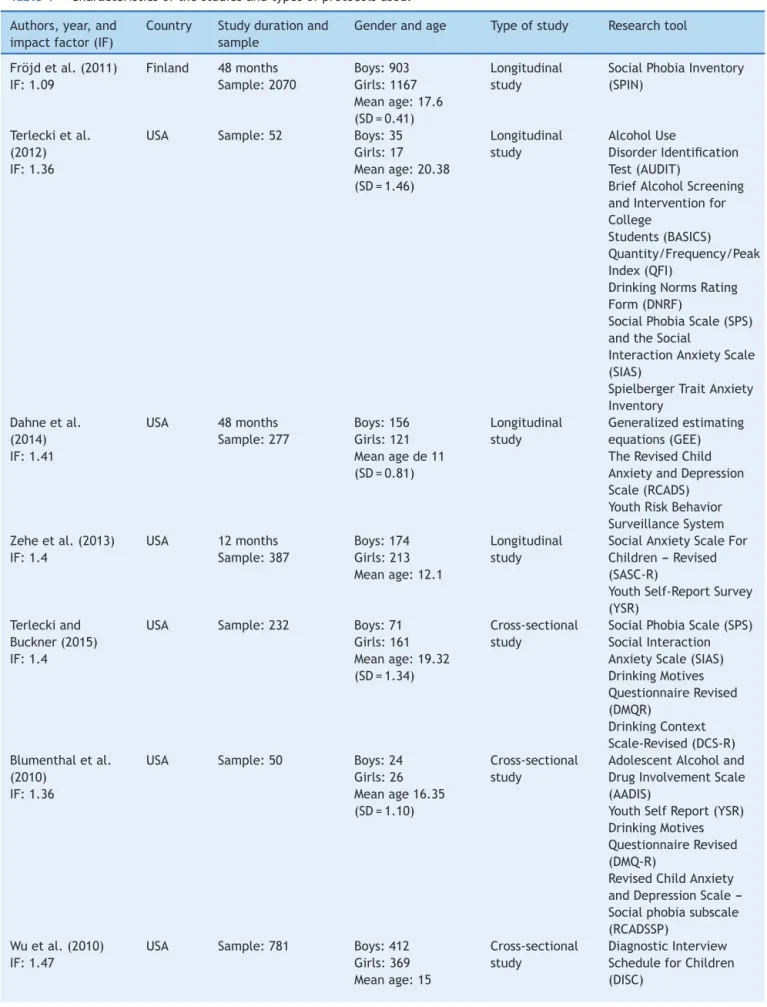
Table1showsthecharacteristicsoftheeightstudiesand the type of protocols used; one study was carried out in FinlandandsevenintheUnitedStates.Atotalof4579 ado-lescents,aged10---19years,whohadsymptomsofSADand whoconsumed alcohol wereinvestigated. In62.5% of the studies, the female gender predominated, accountingfor 54%ofthetotalsample.
The association between social anxiety symptoms and alcohol use was confirmed in six studies, two of which werecarriedoutinagroupof adolescentswithmeanage between10and11years,whereastheothersevaluated ado-lescentsolderthan15years.Theriskfactorsattributedby the studies for this association werefemale gender, peer acceptance,andaffectiveproblemsforalcoholuse,aswell asthepresenceofsecondarycomorbidities,suchas depres-sion,generalizedanxiety,agoraphobia,separationanxiety, and obsessive---compulsive disorder. Other factors such as cultural aspects,frequency ofalcohol use, andfrequency ofintoxicationinvestigatedbythestudiesdidnotappearto berelatedtothisassociation(Table2).
Discussion
The findings show that the evaluated association is still unclear,duetothesmallnumberofstudiesretrieved; how-ever,75%ofthestudiesshowedpositiveevidencebetween theassociationofSADandalcoholuse.
409 articles identified through database search
Screenin
g
Include
d
Eligibilit
y
Identification
132 duplicate articles subsequently removed
277 selected articles 258 excluded articles
19 full-text articles evaluated for readability
Full text articles excluded
Six did not have alcohol in title or abstract
Two included adults in the sample
Three included late adolescents in the sample Studies included for
quantitative synthesis (n = 8)
Figure1 Flowchartrepresentingtheselectionstepsofarticlesaboutsocialanxietydisorderandalcoholabuseinadolescents.
Table1 Characteristicsofthestudiesandtypesofprotocolsused.
Authors,year,and
impactfactor(IF)
Country Studydurationand
sample
Genderandage Typeofstudy Researchtool
Fröjdetal.(2011)
IF:1.09
Finland 48months
Sample:2070
Boys:903
Girls:1167
Meanage:17.6
(SD=0.41)
Longitudinal study
SocialPhobiaInventory
(SPIN)
Terleckietal.
(2012)
IF:1.36
USA Sample:52 Boys:35
Girls:17
Meanage:20.38
(SD=1.46)
Longitudinal study
AlcoholUse
DisorderIdentification
Test(AUDIT)
BriefAlcoholScreening
andInterventionfor
College
Students(BASICS)
Quantity/Frequency/Peak
Index(QFI)
DrinkingNormsRating
Form(DNRF)
SocialPhobiaScale(SPS)
andtheSocial
InteractionAnxietyScale
(SIAS)
SpielbergerTraitAnxiety
Inventory
Dahneetal.
(2014)
IF:1.41
USA 48months
Sample:277
Boys:156
Girls:121
Meanagede11
(SD=0.81)
Longitudinal study
Generalizedestimating
equations(GEE)
TheRevisedChild
AnxietyandDepression
Scale(RCADS)
YouthRiskBehavior
SurveillanceSystem
Zeheetal.(2013)
IF:1.4
USA 12months
Sample:387
Boys:174
Girls:213
Meanage:12.1
Longitudinal study
SocialAnxietyScaleFor
Children---Revised
(SASC-R)
YouthSelf-ReportSurvey
(YSR)
Terleckiand
Buckner(2015)
IF:1.4
USA Sample:232 Boys:71
Girls:161
Meanage:19.32
(SD=1.34)
Cross-sectional study
SocialPhobiaScale(SPS)
SocialInteraction
AnxietyScale(SIAS)
DrinkingMotives
QuestionnaireRevised
(DMQR)
DrinkingContext
Scale-Revised(DCS-R)
Blumenthaletal.
(2010)
IF:1.36
USA Sample:50 Boys:24
Girls:26
Meanage16.35
(SD=1.10)
Cross-sectional study
AdolescentAlcoholand
DrugInvolvementScale
(AADIS)
YouthSelfReport(YSR)
DrinkingMotives
QuestionnaireRevised
(DMQ-R)
RevisedChildAnxiety
andDepressionScale
---Socialphobiasubscale
(RCADSSP)
Wuetal.(2010)
IF:1.47
USA Sample:781 Boys:412
Girls:369
Meanage:15
Cross-sectional study
DiagnosticInterview
ScheduleforChildren
Table1(Continued)
Authors,year,and
impactfactor(IF)
Country Studydurationand
sample
Genderandage Typeofstudy Researchtool
Clerkin.Barnett
(2012)
IF:1.4
USA 12months
Sample:730
Boys:295
Girls:435
Meanage18.35
(SD=0.47)
Cross-sectional study
SocialAvoidanceand
DistressScale(SADS)
DrinkingMotives
Questionnaire---Revised
TheGraduated
FrequencyforAlcohol
Questionnaire
YoungAdultAlcohol
ProblemsScreeningTest
Contextualization
of
study
location
Thisreviewidentifiedapredominanceofstudiescarriedout indevelopedcountries,primarilyintheUnitedStates,which maybe relatedtogreater epidemiological surveillance in mentalhealthforchildrenandadolescents.
Itis importanttoremember thatapproximatelyonein fiveadolescentsinthatcountrysufferfromamental disor-dersevere enoughtohaveanimpactontheiractivitiesof dailyliving,andthesearerelevantdatafortheincreasein theinvestigations.12
InBrazil,population-basedstudieshaveshownthatthe onsetofanxietydisordersoccursatthemeanageof13years andtheuseofalcoholbetween12and15years,while sub-stanceabusebeginslater,attheageof24years.Thismay beanindicationthattheresourcesavailableforthe treat-mentofmentaldisordersinchildrenandadolescentsmight bedeficient,consequentlyincreasingtheratesof comorbid-ityinearly adultlife.13,14 Thisreviewdidnotretrieveany Brazilianpublicationthatcouldclarifythenationalreality abouttheassociationbetweenSADandalcoholuse.
These data are important to emphasize the need to diagnose and follow-up adolescents who are predisposed to developing mental disorders and to initially establish preventiveactionsinschoolsandhealthcareservices,thus reducingthelong-termassociatedburdenontheindividual, family,andcommunity.
SAD
and
alcohol
use
GiventhatSADisoneofthemostprevalentpsychiatric con-ditionsintheworld’spopulation,secondonlytodepression,6 andthatitsdevelopmentprecedestheonsetofalcoholuse disorders,itis importanttocarryoutalcoholintervention activities,15 as young individuals with SAD are five times morelikelytodevelopalcoholdependencethanthose with-outthedisorder.14,16---20
Studies that failed to show a significant association betweenSADandalcoholuseinadolescents,15,21still indi-cated the possibility of reaching different results when culturaldifferenceswereobserved,suchasfreeaccessto alcoholbyadolescents.Anotherobservedriskwasthe devel-opmentofthisassociationwithdepression,whichmayoccur inlateadolescenceortakemorethantwoyearstodevelop.
Itisworthemphasizingtheimportanceofrecognizingand treating anxiety disorders in childhood,especially among girls,aimingtohelpthempreventthedevelopmentof sub-stanceusedisordersandsecondarycomorbidities.22
According to the Differential Diagnostic Guidelines for SocialAnxietyDisorder,theageofSADonsettendstooccur earlier and the distribution between the genders is more homogeneous.3When analyzing genderin associationwith alcohol consumption among Brazilian adolescents in the NationalSchoolHealthSurvey(PeNSE2012),ahigher preva-lenceofthefemalegender(51.7%;95%CI:50.8---52.6)was observed.23 Whenassessingtheinfluenceofgenderonthe association between illicit substance use and social anxi-ety,itwasobservedthatwomenwithhigherlevelsofsocial anxietyhadahighernumberoffriendswhousedrugsand alcohol.24
However, there are differences between the patterns observed in adolescents and the results of studies with adults,i.e.,theassociationbetweenanxietydisordersand substanceusecanchangefromadolescencetoadulthood.22 What isinitially usedasananxiety coping tool, attenuat-inginhibition and makingthem feelsafewhile alleviating the fear in social situations throughout life, can lead to embarrassingsituationsanddependence,aswellasthe per-sistenceofphobicsymptoms.25
In the study carried out at schools, libraries, and adolescent clubs in the Washington, DC, United States metropolitanarea,theratesofalcoholusewererelatively low; however,theresults indicated thatyoung individuals weremorelikelytohaveproblemswithalcoholconsumption overtime.26
In the study that investigated social anxiety, general-izedanxiety,andsubstanceuse(cigarettesandalcohol)in theearly adolescencephase,itwasobservedthatfor the female gender, social anxiety is a risk factor when alco-holuse approval use bypeers is high (highlevels ofpeer approvalandhigh levelsofsocialanxiety wereassociated withahighlikelihoodofsubstanceuse),whereasfor gener-alizedanxiety,itisconsideredariskfactorwhentheuseby peersislow.27
anxiety
and
alcohol
use
among
adolescents
447
Table2 Summaryofstudiesandriskfactorsassociatedwithsocialanxietydisorderandalcoholuseinadolescents.
Authors,yearand
impactfactor(IF)
Objective Analyzedriskfactors Results Conclusions
Fröjdetal.(2011)
IF:1.09
Toinvestigatewhetherthe
associationbetweenanxietyand
alcoholandothersubstancesare
alreadyevidentinthemiddle
adolescence,andwhetherthe
generalanxietyorsocialphobia
symptomsaffectsthecontinuityof
frequentuseofalcohol,frequent
drunkenness,andmarijuanause.
Generalizedanxiety
Socialphobia
Substanceuse
Frequencyofuse
Drunkennessfrequency
Useofmarijuana
Anxietyprecededtheuseofthe
substance,whilenoreciprocal
associationswereobserved.
Depression-mediatedassociations
betweenanxietyandsubstanceuse.
Symptomsofsocialphobiadidnot
increasetheincidenceofsubstance
use,butoverallanxiety.
Generalanxietyincreasedthe
persistenceoffrequentalcoholuse,
whileco-morbidsocialphobia
decreaseditspersistence.
Generalanxietyinadolescenceputs
adolescentsatriskforsubstanceuse.The
riskmay,however,beassociatedwith
depression.Socialphobiainmiddle
adolescencemayprotectagainstsubstance
use.
Adolescentswithsymptomsof
internalizationmayneedguidancein
copingwithsymptoms,eventhoughthe
symptomsdidnotmeetthecriteriaof
moodoranxietydisorder.
Terleckietal.
(2012)
IF:1.36
Toevaluatewhethersociallyanxious
studentsshowedlesschangein
alcoholusebehavioramongcollege
students.
Socialanxiety
Typicaldrinks
Rulesfordrinking
Amongstudentswithminorchanges
inrules,beingamemberofagroup
withsocialanxietywasassociated
withheavierdrinkingoftypical
drinks.
Amongstudentswithmajorchanges
inrules,beingamemberofasocial
anxietygroupwasnotsignificant.
Generalizedanxietyinmiddleadolescence
putsadolescentsatriskforconcomitant
substanceuseandsubsequentlyinlate
adolescence.
Theriskmay,however,beassociatedwith
depression.
Socialanxietyanduseofalcoholor
substancewasnotobservedinmiddleand
lateadolescence.
Dahneetal.
(2014)
IF:1.41
Toassesswhethersocialphobia
symptomspredictedincreased
likelihoodofalcoholuseovertime.
Demographicdata
Psychopathology
Alcoholuse
Therewerecorrelationsbetweenthe
baselinepredictors(child’sage,
child’sgender,baselinealcoholuse,
socialphobiasymptoms)andwaves
1---5alcoholuse
Ingeneral,theconcurrent
associationswerelowtomoderate.
Ithighlightstheimportanceofsocialphobia
symptomsinpredictingalcoholuseover
timeamongyoungadolescents.
Severalfuturedirectionswithinthislineof
researchwouldbevaluable,including
expandingtheassessedagerangeto
youngerchildrenandadolescents/older
youngadults.
Zeheetal.(2013)
IF:1.4
Toassesstheassociationbetween
socialandgeneralizedanxiety
symptomsandalcoholandcigarette
useinearlyadolescenceandasa
precautionarymeasure(perceived
peeruseapproval)and(perceived
usepoint)descriptiverulesmay
moderatetheassociation.
Peernorms
Genderdifferences
Peernormsweremoderatedforthe
associationbetweensocialanxiety
symptoms,generalizedanxiety,and
thelikelihoodofalcoholand
cigaretteusebygirls,butnotfor
boys.
Girlswithhighlevelsofsocialanxiety
symptomswereatriskforusewhen
perceivedpeerapprovalofusewashigh,
andprotectedfromusewhenperceived
peerapprovalofusewaslow.
Profilesofanxietysymptomsandperceived
peerapprovalofusemayhelpidentifygirls
whoarepotentialtargetsforintervention,
butthenatureoftheseinterventionsisstill
unclear,sincethisstudydidnotassessthe
Cruz
EL
et
al.
Table2(Continued)
Authors,yearand
impactfactor(IF)
Objective Analyzedriskfactors Results Conclusions
Terleckiand
Buckner(2015)
IF:1.4
Identifycognitive/motivational
factorsrelatedtodrinkingin
high-risksituations.
Demographicdata
SocialanxietyandReasonstodrink
Highsocialanxietywasassociated
withgreatercopingandcompliance
reasons.
Bothcopingandcompliancemotives
weremediated,theassociation
betweensocialanxietytoheavy
alcoholconsumptiontonegative
emotionalandpersonal/intimate
contexts.
Multiplemediationanalysishas
indicatedthattomediateanxiety
situationsuniversitystudentsdrink
socially,suchthatheavydrinking
amongcollegestudentswith
clinicallyelevatedsocialanxietycan
beattributedjointlytothedesireto
dealwithnegativeaffectandto
avoidsocialscrutiny.
Blumenthaletal.
(2010)
IF:1.36
Toassessthereasonsforalcoholuse
amongyoungindividualsasafunction
ofsocialanxiety,associatedvariables
(age,gender,frequencyofalcohol
use,affectiveproblems)
Age
Frequencyofalcoholuse
Affectiveproblems
Highsocialanxietywassignificantly
associatedwithahighlevelof
affectiveproblems,aswellaswith
copingreasons.
Socialanxietywassignificantly
associatedwithcopingmotives,so
thatyoungindividualswhohadhigh
socialanxietyreportedgreater
motivationtodrinkfor
coping-relatedpurposes.
Sociallyanxiousyoungindividuals
endorsehigherconsumptionmotives,
relatedtocopingissues,a
characteristicthatmayputthemat
riskfordevelopingalcoholism
problems.
Prospectivestudiesfocusedon
clarifyingassociationsbetween
adolescentsocialanxiety,dealing
withreasonsfordrinkingand
problematicuseofalcohol,withthe
ultimategoalofdesigningprevention
programstargetingyoungindividuals
anxiety
and
alcohol
use
among
adolescents
449
Table2(Continued)
Authors,yearand
impactfactor(IF)
Objective Analyzedriskfactors Results Conclusions
Wuetal.(2010)
IF:1.47
Toassesstheuseofthreesubstance
categoriesbyadolescents(frequent
smoking,frequentdrinking/heavy
use,anduseofillicitdrugs)in
relationtoeachofthesixanxiety
disorders(socialphobia,
agoraphobia,highanxiety
disorder/generalizedanxiety
disorder,separationanxiety,and
obsessive-compulsivedisorder).
Substanceuse
Anxietydisorder
Demographicsandfamilyfactors
Depression
Socialphobiawasassociatedwith
smokingonlyamongboys.Forgirls,
socialphobiaappearedtobe
negativelyassociatedwithdruguse.
Fortheotheranxietydisorders,
associationswithsubstanceusetend
tobestrongeramonggirls.
Therewasanassociationbetween
socialanxietysymptomsandalcohol
useonlyingirls.Frequentorheavy
drinkingwasmorecommonamong
boysthangirls,butthisdifference
wasonlymarginallysignificant.
Thedifferencesbetweenthe
patternsobservedinthestudy
sampleofadolescentsandtheresults
ofstudieswithadultsregardingsocial
phobiatosomeextentindicatethat
theassociationbetweenanxiety
disordersandsubstanceusemay
changefromadolescenceto
adulthood.
Clerkinand
Barnett(2012)
IF:1.4
Totesttheseparateandinteractive
effectsofdrinkingmotivesandsocial
anxietysymptomsinpredicting
drinkinganddrinking-related
problems.
Socialanxietysymptoms
Reasonstodrink
Alcoholconsumption
Problemswithalcohol
Increasedsocialanxietysymptoms
weresignificantlyassociatedwith
lessalcoholconsumption,andthere
wassomeevidencethatgreater
socialanxietysymptomswerealso
associatedwithgreaterproblems
withalcohol.
Themaineffectsofsocialanxiety
symptomsandconsumptionmotives
weremoreinfluentialinpredicting
consumptionoutcomes.
Greatersocialanxietywasassociated
withgreaterendorsementofcoping
andcompliancemotives,andless
endorsementofreasonsfor
enhancement.
Symptomsofsocialanxietywere
associatedtoloweralcohol
consumption,andalsowithmore
increasedmotivationto drinkassociatedwithcoping pur-poses.Thiswasalsodemonstratedinthethreemodelsused toassessthegroupsofpeoplewithsocialanxietywhoused alcohol in situations of confrontation and/or compliance reasons.29
Adolescentswithelevatedsocialanxietysymptoms con-sumelessalcohol,butshowahigherassociationwhenitis relatedwithcopingendorsementandcompliancemotives.30
Future
perspectives
Thelimitationsoftheanalyzedstudiesarebasedonsample size;onthe shortperiodof follow-upof the adolescents; on the fact that, as it was not possible to observe the students’behaviorduringthetransitionperiodfrom elemen-tarytohighschool,15,26,28theresultscannotbegeneralized for allphases of adolescenceor for allregions (ruraland urban areas), since each phase has different characteris-tics and behaviors regarding the decision-making for use of alcohol according to the place of residence27; and on theuseofacombinationofvariablesregardingtheuseof alcohol,cigarettes,marijuana,andothersubstances,which hasimplicationsfortheirassociationwithanxiety,aseach substancehas uniquepropertiesanddistinct physiological effects.21,22,27
Regardingfutureinvestigations,itisnecessarytoassess theindividualsattheinitial,middle,andlateadolescence phases, as well as to expand racial and ethnic groups; to use both the descriptive analysis (perceptions of the drinkingbehavior)andtheanalysisofprecautionarynorms (approval/disapprovalof thedrinkingbehavior); to evalu-atethetreatmentanditseffectsontheadolescent;andto assessthecopingreasonsfordrinkingandproblematicuse ofalcohol,withtheultimategoalofdevelopingprevention programsaimedatyoungindividualsatrisk.
Limitations
The present systematic review study had as limitations: (a)non-use ofthe Webof ScienceandPschynfo scientific databases,withthelatterbeingthedatabasespecializedin behavioralandsocialscienceresearch;(b)scarcityof stud-iespublishedinPortuguese,English,orSpanish;and(c)the smallnumberofarticlesincludedintheanalysis.
Despitethelimitations,thisreviewbecomesrelevant,as itallowedtheidentificationandunderstandingofthemain riskfactorsassociatedwithSADandalcoholusein adoles-cents,inadditiontobroadening theknowledgeabout the subject.
Conclusions
TheassociationbetweenSADandalcoholuseinadolescents appears tobe unclear, due to the few identified studies, the methodological heterogeneity, and their regionaliza-tion.Nevertheless,thisreview raisedinterestingevidence ontheexistenceofthisassociationandidentifiedthemain riskfactorsrelatedtotheassociationbetweenSADand alco-hol use among adolescents, such as female gender, peer acceptance,andaffectiveproblemsregardingalcoholuse,
aswellasthepresenceofsecondarycomorbidities,suchas depression and anxiety disorders. Therefore,studies with representativesamples,withanincreaseintheracialand ethnicgroupsandthatcontemplatetheinitial,middle,and latephasesofadolescencearestillnecessary.
Some authors also suggest that prospective studies be carriedouttoobservestudents’ behaviorduringthe tran-sition period from elementary to high school, as well as evaluatetheonsetperiodofthefirstsymptomsofSADand therisksforalcoholuse;assessthereasonsforalcoholuse; evaluatetreatment anditseffectsonadolescents;andto implementcorrectiveinterventionguidelinesforalcoholuse amongsociallyanxiousstudents.
Conflicts
of
interest
Theauthorsdeclarenoconflictsofinterest.
References
1.GarciaJM.Saúdementalnaescola:oqueoseducadoresdevem saber.Psico-USF.2016;21:423---5.
2.PereiraSM,TavaresFS, SouzaLC,de BadaróAC,GomesDA, PeresFS,etal.Análisebibliométricadosestudossobrefobia socialeousodeálcool.PsicolPesqui.2011;5:168---78.
3.CrippaJA,ChagasMH,NardiAE,ManfroG,HetemLA,Levitan
MN,et al.Transtornodaansiedadesocial:diagnóstico.
Dire-trizesclínicasdasaúdesuplementarassociac¸ãobrasileira de
psiquiatriasociedadebrasileirademedicinadefamíliae
comu-nidade.[cited2015Aug15].Availablefrom:http://diretrizes.
amb.org.br/ans/transtornodaansiedadesociedade social-diagnostico.pdf.
4.Chagas MH, Nardi AE, Manfro GG, Hetem LA, Andrada NC, LevitanMN, et al.DiretrizesdaAssociac¸ãoMédicaBrasileira parao diagnósticoediagnósticodiferencialdotranstornode ansiedadesocial.RevBrasPsiquiatr.2010;32:444---52. 5.EstanislauGM,BressanRA. Saúdementalnaescola:oqueos
educadoresdevemsaber.Artmed:PortoAlegre;2014. 6.Fernandes LF, Alckmin-Carvalho F, Izbicki S, Melo MH da S.
Prevenc¸ãouniversaldeansiedadenainfânciaeadolescência: umarevisãosistemática.PsicolTeorPrat.2014;16:83---99. 7.NardiAE, QuevedoJ, da Silva AG.Transtorno de ansiedade
social:teoriaeclínica.PortoAlegre:Artmed;2014.
8.SantosCMdaC,PimentaCAdeM,NobreMRC.AestratégiaPICO paraaconstruc¸ãodaperguntadepesquisaebuscade evidên-cias.RevLatino-amEnferm.[cited2016Apr29].Availablefrom: http://www.scielo.br/pdf/rlae/v15n3/ptv15n3a23.pdf. 9.CamposJ,ÁlvaroF.Manualpráticodepesquisacientífica---da
graduac¸ãoàpós-graduac¸ão.1st ed.RiodeJaneiro:Revinter; 2016.
10.DonovanJE,MolinaBS.Childhoodriskfactorsforearly-onset drinking.JStudAlcoholDrugs.2011;72:741---51.
11.Prisma:Transparentreportingofsystematicreviewsand meta-analyses. [cited 2016 Apr 29]. Available from: http://www. prisma-statement.org/PRISMAStatement/Default.aspx. 12.LiveScienceStaff.InUS,1in5teenshaveseriousmental
disor-der.LiveSci.[cited2016Apr29].Availablefrom:http://www. livescience.com/8787-1-5-teens-mental-disorder.html. 13.VianaMC,Andrade LH.Lifetime prevalence,ageand gender
14.LopesCS,AbreuGdeA,dosSantosDF,MenezesPR,Carvalho KM,CunhaCdeF,etal.Transtornosmentaiscomunsem ado-lescentes.RevSaudePubl.2016;50:14s.
15.Terlecki MA, Buckner JD, Larimer ME, Copeland AL. Brief motivationalinterventionforcollegedrinking:thesynergistic impactofsocialanxietyandperceiveddrinkingnorms.Psychol AddictBehav.2012;26:917---23.
16.Buckner JD, Schmidt NB, Lang AR, Small JW, Schlauch RC, LewinsohnPM.Specificityofsocial anxietydisorderasa risk factorforalcoholand cannabisdependence.JPsychiatrRes. 2008;42:230---9.
17.Buckner JD, Timpano KR, Zvolensky MJ, Sachs-Ericsson N, Schmidt NB. Implications of comorbir alcohol dependence amongindividualswithsocialanxietydisorder.DepressAnxiety. 2008;25:1028---37.
18.BucknerJD,TurnerRJ.Socialanxietydisorderasariskfactor foralcoholusedisorders:aprospectiveexaminationofparental andpeerinfluences.DrugAlcoholDepend.2009;100:128---37. 19.SchneierFR,FooseTE,HasinDS,HeimbergRG,LiuS-M,Grant
BF,etal.Socialanxietydisorderandalcoholusedisorder comor-bidity in the national epidemiologic survey on alcohol and relatedconditions.PsycholMedPsycholMed.2010;40:977---88. 20.GomesAG,Lourenc¸oDM, BaptistaLN. Construc¸ão daescala cognitiva e comportamental de ansiedade social (ECCAS). Universidade Federal de Juiz de Fora; 2014. [cited 2016 Jul 15]. Available from: https://repositorio.ufjf.br/jspui/ bitstream/ufjf/558/3/danielalexandregouveagomes.pdf. 21.FröjdS,RantaK,Kaltiala-HeinoR,MarttunenM.Associations
of social phobia and general anxiety withalcohol and drug usein acommunity sample ofadolescents. Alcohol Alcohol. 2011;46:192---9.
22.WuP,GoodwinRD,FullerC,LiuX,ComerJS,CohenP,etal. Therelationshipbetweenanxietydisordersandsubstanceuse among adolescentsinthecommunity:specificityand gender differences.JYouthAdolesc.2010;39:177---88.
23.MaltaDC,MachadoIE,PortoDL,SilvaMMda,FreitasPCde,da CostaAW,etal.AlcoholconsumptionamongBrazilian adoles-centsaccordingtotheNationalAdolescentSchool-basedHealth Survey(PeNSE2012).RevBrasEpidemiol.2014;17:203---14. 24.BucknerJD,MallottMA,SchmidtNB,TaylorJ.Peerinfluence
andgenderdifferencesinproblematiccannabisuseamong indi-vidualswithsocialanxiety.JAnxietyDisord.2006;20:1087---102. 25.PaivaDP,deAraújoLF,PereiraSM,RonzaniTM,Lourenc¸oLM. O estudoda comorbidadeentrefobia social eálcool. Psicol Pesqui.2008;2:40---5.
26.DahneJ,BanducciAN,KurdzielG,MacPhersonL.Early adoles-centsymptomsofsocialphobiaprospectivelypredictalcohol use.JStudAlcoholDrugs.2014;75:929---36.
27.ZeheJM,ColderCR,ReadJP,WieczorekWF,LenguaLJ.Social and generalizedanxiety symptomsand alcoholandcigarette useinearlyadolescence:themoderatingroleofperceivedpeer norms.AddictBehav.2013;38:1931---9.
28.BlumenthalH,Leen-FeldnerEW,FralaJL,BadourCL,HamLS. Socialanxietyandmotivesforalcoholuseamongadolescents. PsycholAddictBehav.2010;24:529---34.
29.TerleckiMA,BucknerJD.Socialanxietyandheavysituational drinking:copingandconformitymotivesasmultiplemediators. AddictBehav.2015;40:77---83.