J Pediatr (Rio J). 2013;89(5):510---513
www.jped.com.br
ORIGINAL ARTICLE
Milk from Brazilian women presents secretory IgA antibodies and
neutralizes rotavirus G9P[5]
夽
Simone M.R. Santos
a, Thalita L. Ferreira
a, Virgínia S. Quintal
b,
Solange B. Carbonare
c, Milene Tino-De-Franco
c,∗aMD. Laboratório de Imunogenética, Instituto Butantan, São Paulo, SP, Brazil
bPhD. Banco de Leite Humano, Hospital Universitário da Universidade de São Paulo, São Paulo, SP, Brazil
cPhD. Laboratório de Imunogenética, Instituto Butantan, São Paulo, SP, Brazil
Received 14 September 2012; accepted 18 February 2013 Available online 10 July 2013
KEYWORDS Human milk; Rotavirus; Secretory IgA; Rotavirus neutralization
Abstract
Objective: To verify the presence of anti-rotavirus serotype G9P[5] SIgA and the virus neutral-ization capacity of milk samples from Brazilian women.
Methods: SIgA antibody levels reactive to rotavirus G9 were determined in 30 maternal milk samples by enzyme-linked immunosorbent assay (ELISA) using purified virus suspensions. The samples’ capacity to neutralize rotavirus G9P[5] was analyzed using the MA-104 cells neutral-ization assay.
Results: Great individual variations were observed regarding the SIgA levels and neutralization titers, but all samples showed some G9P[5] neutralizing ability. A highly significant positive correlation was observed between antibody levels and neutralization titers.
Conclusions: The high correlation between anti-rotavirus antibody levels and neutralizing capacity of the milk samples suggests a possible protective role of these antibodies against infection. These results also support the encouragement of the breast-feeding practice. © 2013 Sociedade Brasileira de Pediatria. Published by Elsevier Editora Ltda. All rights reserved.
PALAVRAS-CHAVE Leite humano; Rotavírus; IgA secretora; Neutralizac¸ão do rotavírus
Leite de mulheres brasileiras apresenta anticorpos IgA secretores (SIgA) que neutralizam o rotavírus G9P[5]
Resumo
Objetivo: Verificar a presenc¸a de SIgA anti-rotavírus sorotipo G9P[5] e a capacidade de neutralizac¸ão do vírus de amostras de leite de mulheres brasileiras.
Métodos: Foram determinados os níveis de anticorpos IgAS reativos contra rotavírus G9 em 30 amostras de leite materno por ELISA usando suspensões purificadas do vírus. A capacidade das amostras de neutralizarem o rotavírus G9P[5] foi analisada em ensaio de neutralizac¸ão utilizando células MA-104.
夽 Please cite this article as: Santos SM, Ferreira TL, Quintal VS, Carbonare SB, Tino-De-Franco M. Milk from Brazilian women presents
secretory IgA antibodies and neutralizes rotavirus G9P[5]. J Pediatr (Rio J). 2013;89:510---3. ∗Corresponding author.
E-mail:[email protected] (M. Tino-De-Franco).
Anti-rotavirus G9P[5] SIgA in milk samples 511
Resultados: Foram observadas grandes variac¸ões individuais referentes aos níveis de IgAS e títulos de neutralizac¸ão, mas todas as amostras mostraram certa capacidade de neutralizar o G9P[5]. Verificamos uma correlac¸ão positiva altamente significativa entre os níveis de anticorpos e os títulos de neutralizac¸ão.
Conclusões: A alta correlac¸ão entre níveis de anticorpos anti-rotavírus e a capacidade neu-tralizante das amostras de leite sugere um possível papel protetor desses anticorpos contra a infecc¸ão. Esses resultados também apoiam o incentivo à prática do aleitamento materno. © 2013 Sociedade Brasileira de Pediatria. Publicado por Elsevier Editora Ltda. Todos os direitos reservados.
Introduction
Rotaviruses are among the major causes of
gastroenteri-tis affecting young children worldwide.1 The causative
rotavirus agent has a capsid structure with two protein layers. The outer capsid is composed of two structural pro-teins that determine the rotavirus serotype classification: VP7 (glycoprotein, G types) and VP4 (protease-sensitive, P types); both induce neutralizing and protective antibodies. The inner capsid contains the structural protein VP6, which
determines the rotavirus serogroup.2 The G9 serotype is
frequently detected in humans, and was the second most frequent G type among rotavirus diseases and strains cir-culating in Latin America and the Caribbean from 1990 to
2009.3High occurrences of the G9 strain have been detected
in Brazil since 1998.4,5
Children have an immature immune system, and they depend on the antibodies that they receive from their mothers through the placenta during pregnancy or from the colostrum and breast milk after birth to protect them
against infections.6However, there is no current consensus
regarding the role of maternal antibodies against rotavirus infections. Some studies have reported lower infection rates among infants that have been exclusively breast-fed, when
compared to non-breast-fed infants,7,8while other studies
have failed to detect any protective effect of
breast-feeding.9,10
Other reports investigating anti-rotavirus antibodies in human milk have suggested that they may interfere with anti-rotavirus vaccine efficiency by neutralizing the virus particles present in the vaccine before they can multiply within the intestinal cells, thus diminishing the
immunolog-ical potential of the vaccine.11,12
A pentavalent human-bovine rotavirus vaccine contain-ing the serotypes G1, G2, G3, G4, and G9 is currently under development at the Butantan Institute (Brazil) for human use. The aim of this study was to investigate the presence of SIgA antibodies reactive to the rotavirus serotype G9P[5] in milk samples from Brazilian mothers and their capacity to neutralize virus particles, since it may affect the immuniza-tion efficiency of vaccines containing the G9 serotype.
Methods
The presence of SIgA anti-rotavirus serotype G9P[5] (human vaccine strain) was analyzed by enzyme-linked immunosor-bent assay (ELISA) in 30 milk samples collected from healthy
nursing mothers, aged between 19 and 38 years, who had given birth at the Hospital Universitário da Universidade de São Paulo, which mostly attends to patients from lower socio-economic levels, a group that is highly representative of the Brazilian female population. All samples were man-ually collected in the morning, between breast-feedings. Informed consent from the patients and approval from the Ethics Committee of the Universidade de São Paulo were obtained prior to the collections. The milk samples were collected from nursing mothers with good nutritional and health condition, who were not receiving any medications that might have interfered with the lactation, and had negative serology for HIV, hepatitis B, and syphilis. ELISA tests were performed by coating half of the microtiter
plates with 5g/mL of viral antigen (supernatant of
MA-104-infected culture cells that had been ultracentrifuged onto a 30% sucrose cushion) and the other half with the same concentration of control antigen solution (the supernatant of ultracentrifuged non-infected cells). A milk pool was pre-pared from equal volumes of 50 different milk samples from
the Milk Bank of theHospital Universitário da Universidade
de São Pauloand used as a positive control. The antibody levels were calculated by the difference between the optical density readings obtained with viral and control antigens. The final titers were reported as relative titers, in percent-ages, considering the milk pool as 100%.
The milk samples were also tested for their G9P[5]-neutralizing ability using MA-104 cell cultures. Equal volumes of milk sample serial dilutions and a suspension
containing 100 TCID50/mL of G9P[5] rotavirus were mixed.
After 30 minutes of incubation, the mixtures were added to a confluent monolayer of MA-104 cells grown in 96-well microplates. Neutralizing antibody titers were considered as the highest dilution of the samples that showed more than 60% cytopathic effect inhibition after 48 hours of incubation. The correlations between the milk samples SIgA lev-els and the neutralization titers were calculated using the Spearman correlation coefficient. The confidence interval was set at 95% (95% CI) and p-values < 0.05 were considered to be statistically significant.
Results
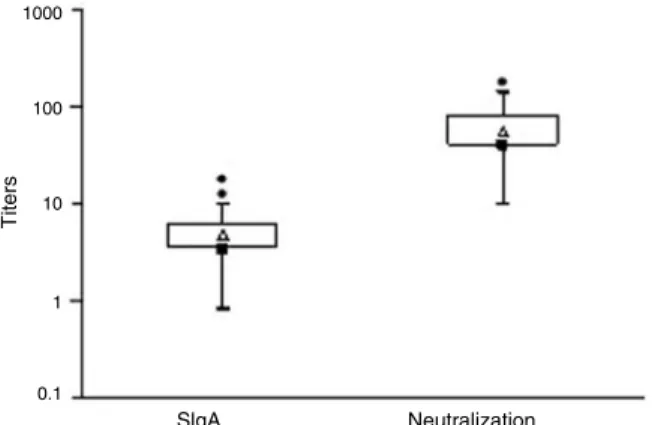
SIgA anti-rotavirus and neutralization titers, with maximum
and minimum values, 75th and 25th percentiles, mean, and
512 Santos SM et al.
1000
100
10
1
0.1
SlgA
Titers
Neutralization
Figure 1 Anti-rotavirus SIgA antibodies and neutralizing titers in milk samples.
Box plots: [] - medians; [△] - means; [䊉] - discrepant values; bottom edge of the box: 25thpercentile; top edge of the box
-75thpercentile; bottom short line - lowest value; top short line
- highest value.
120
80
40
0
0 5 10 15 20 25
160 200
Neutr
a
lization titer
SlgA titer
Figure 2 Correlations between neutralizing and anti-rotavirus SIgA titers in milk samples (r = 0.740; p < 0.0001).
neutralization titers determined by the neutralization assay also varied widely. The highest titer obtained (160) was 16 times greater than the lowest titer (10), and one sample showed a discrepant value.
Fig. 2 shows the correlation between SIgA and neu-tralization titers. One sample showed very high IgA and neutralization titers discrepant from the others. A high significant and positive Spearman correlation coefficient (r = 0.740, p < 0.0001) was observed in the statistical analysis comparing the two parameters.
Discussion
The levels of protection induced by currently available anti-rotavirus vaccines appear to vary depending on the locality where they have been administered. The protection conferred by vaccination diminished significantly in many countries in Africa and Asia compared to more developed
nations, such as Finland.13However, the factors that
influ-ence the low immunogenicity of these vaccines are not yet clear. One possible explanation could be the presence of anti-rotavirus antibodies in the milk of nursing mothers in developing countries where breast-feeding is a more com-mon practice. Due the presence of these antibodies, if the infants are nursed within short periods of time either before
or after oral vaccination, the immunological benefits could
be compromised.11,12 Thus, it becomes important to study
the anti-rotavirus antibody repertoire present in the breast milk that may potentially interfere with the immunogenicity and efficacy of the vaccine that is currently under develop-ment in Brazil.
Even though the circulation of the G9 serotype is vari-able in developing countries (depending on the time of year and the locality), this serotype has been found to be quite
prevalent in Brazil since 1998.4,5As such, the Brazilian
popu-lation has been widely exposed to this serotype, which could influence the repertoire of antibodies present in the milk of nursing mothers. This repertoire is a result of the humoral immune response to antigens to which they were exposed. The large variations in the levels of rotavirus SIgA anti-bodies that have been observed in these women may reflect the different degrees of their exposition to the G9 serotype. The capacity of maternal milk to neutralize the G9P[5] serotype was also evaluated. All samples showed some ability to neutralize the virus, with a broad variation in neu-tralization titers. The positive correlation observed between the SIgA anti-rotavirus and neutralization titers suggest that anti-rotavirus G9 antibodies play a role in virus neutraliza-tion.
However, the fact that some samples showed high SIgA
titers (≥80) and low neutralization titers (< 5), while other
presented high neutralization titers but low SIgA titers, cannot be ignored. As such, the possibility that other com-ponents of the mothers’ milk are also important in viral neutralization must be considered. For instance, lactadherin
has been observed to inhibit rotavirus infectionin vitro.14
The presence of SIgA anti-rotavirus G9 in mothers’ milk should not be, by any means, considered an argument against nursing. To the contrary, the antibodies present in maternal milk can potentially protect nursing infants against rotavirus infections in early age, and for this reason the practice should be encouraged, particularly in developing countries. Additionally, aiming to improve the effectiveness of immunizations, an interval between breastfeeding and vaccination should be advised.
Funding
São Paulo Research Foundation (Fundac¸ão de Amparo à Pesquisa do Estado de São Paulo - FAPESP), grant 2004/07694-9.
Conflicts of interest
The authors declare no conflicts of interest.
Acknowledgments
We thank Dr Neuza Frazatti Gallina (Butantan Institute) for providing rotavirus G9 strain.
References
Anti-rotavirus G9P[5] SIgA in milk samples 513
2008 estimate of worldwide rotavirus-associated mortality in children younger than 5 years before the introduction of uni-versal rotavirus vaccination programmes: a systematic review and meta-analysis. Lancet Infect Dis. 2012;12:136---41. 2. Estes MK, Kapikian AZ. Rotaviruses. In: Knipe DM, Howley PM,
et al, editors. Fields virology. Philadelphia: Wolters Kluwer Health/Lippincott Williams&Wilkins; 2007. p. 1917---74. 3. Linhares AC, Stupka JA, Ciapponi A, Bardach AE, Glujovsky
D, Aruj PK, et al. Burden and typing of rotavirus group A in Latin America and the Caribbean: systematic review and meta-analysis. Rev Med Virol. 2011;21:89---109.
4. Leite JP, Carvalho-Costa FA, Linhares AC. Group A rotavirus genotypes and the ongoing Brazilian experience: a review. Mem Inst Oswaldo Cruz. 2008;103:745---53.
5. Cilli A, Luchs A, Morillo SG, Costa FF, Carmona Rde C, Timenet-sky Mdo C. Characterization of rotavirus and norovirus strains: a 6-year study (2004-2009). J Pediatr (Rio J). 2011;87:445---9. 6. Hanson LA. Session 1: feeding and infant development
breast-feeding and immune function. Proc Nutr Soc. 2007;66:384---96.
7. Mastretta E, Longo P, Laccisaglia A, Balbo L, Russo R, Mazza-ccara A, et al. Effect ofLactobacillusGG and breast-feeding in the prevention of rotavirus nosocomial infection. J Pediatr Gastroenterol Nutr. 2002;35:527---31.
8. Plenge-Bönig A, Soto-Ramírez N, Karmaus W, Petersen G, Davis S, Forster J. Breastfeeding protects against acute gastroenteri-tis due to rotavirus in infants. Eur J Pediatr. 2010;169:1471---6. 9. Wobudeya E, Bachou H, Karamagi CK, Kalyango JN, Mutebi E, Wamani H. Breastfeeding and the risk of rotavirus diarrhea in hospitalized infants in Uganda: a matched case control study. BMC Pediatr. 2011;11:17.
10. Rennels MB, Wasserman SS, Glass RI, Keane VA. Comparison of immunogenicity and efficacy of rhesus rotavirus reassortant vaccines in breastfed and nonbreastfed children. US Rotavirus Vaccine Efficacy Group. Pediatrics. 1995;96:1132---6.
11. Desselberger H, Huppertz HI. Immune response of rotavirus infection and vaccination and associated correlates of protec-tions. J Infect Dis. 2011;203:188---95.
12. Patel M, Shane AL, Parashar UD, Jiang B, Gentsch JR, Glass RI. Oral rotavirus vaccines: how well will they work where they are needed most? J Infect Dis. 2009;200:S39---48.
13. Moon SS, Wang Y, Shane AL, Nguyen T, Ray P, Dennehy P, et al. Inhibitory effect of breast milk on infectivity of live oral rotavirus vaccines. Pediatr Infect Dis J. 2010;29:919---23. 14. Kvistgaard AL, Pallesen LT, Arias CF, López S, Petersen