ORIGIN
AL RESEAR
CH
Correlation between sleep and quality of life in
patients with heart failure
Correlação entre sono e qualidade de vida em pacientes com insuiciência cardíaca
Correlación entre sueño y calidad de vida en los pacientes con insuiciencia cardíaca
Ingrid Guerra Azevedo1, Elamara Marama de Araújo Vieira1, Nestor Rodrigues de Oliveira Neto2, Ivan Daniel Bezerra Nogueira3, Flávio Emanoel Souza de Melo4, Patrícia Angélica de Miranda Silva Nogueira3
Mailing address: Patrícia Nogueira – Av. Senador Salgado Filho, 3000 – Lagoa Nova – CEP: 59072-970 – Caixa Postal 1524 – Natal (RN), Brazil. E-mail: [email protected]. This study was presented at the XVII International Symposium on Respiratory Physical Therapy and ICU Physical Therapy.
Presentation: Jul. 2014 – Accepted for publication: Mar. 2015 – This study was approved by the Ethics Committee, protocol no. 0147.0.061.000-11.
A study developed at Onofre Lopes University Hospital, of Universidade Federal do Rio Grande do Norte (UFRN) – Natal (RN), Brazil.
1Resident in the Multi-Professional Residency Program in Adult Intensive Therapy at the Federal University of Rio Grande do Norte –
Natal (RN), Brazil.
2Cardiologist at Onofre Lopes University Hospital – Natal (RN), Brazil.
3Physical therapist, professor at Universidade Federal do Rio Grande do Norte (UFRN) – Natal (RN), Brazil.
4Physical therapist, master’s degree student in Physical Therapy at the Federal University of Rio Grande do Norte – Natal (RN), Brazil.
ABSTRACT | Heart failure (HF) is a serious and growing public health problem on the world. Among its many features there are low quality of life (QOL) and excessive daytime sleepiness (EDS) due to sleep disorders which impairs its quality. It was identiied the EDS and sleep quality in patients with HF and their SDE was correlated to their QOL. Among the 52 subjects of the study, 23 patients completed the study (13 M), with average age of 60.5 years, functional class (FC) II and III, ejection fraction ≤ 45%. Subjects were evaluated for their quality of sleep, EDS and QOL. Questionnaires were applied in the form of interview by using the SF-36 for QOL, Pittsburgh Sleep Quality Index Questionnaire for quality of sleep and Epworth Sleepiness Scale for SDE. A total of 60.86% of the sample showed poor sleep quality. Correlating QOL to EDS, signiicant results were obtained in the pain (p=0.04 and r=-43), vitality (p=0.05 and r=-0.40) and social functioning (p=0.003 and r=-0.59). The sample has a poor sleep quality, with presence of SDE negatively correlated with QOL in aspects of vitality, pain and social functioning.
Keywords | Heart Failure; Quality of Life; Sleep Disorders by Excessive Somnolence
RESUMO | A insuiciência cardíaca (IC) é um problema grave e crescente de saúde pública no cenário mundial. Dentre suas várias características, estão a baixa qualidade de vida (QV) e sonolência diurna excessiva (SDE) em virtude dos distúrbios do sono, que prejudicam sua qualidade. Identiicou-se a SDE e a qualidade do sono (QS) em pacientes com IC e, correlacionou-se a SDE à QV desses pacientes. Dos 52
148
indivíduos incluídos no estudo, 23 pacientes o concluíram (13 H), com idade média de 60,5 anos, classe funcional (CF) II e III, com fração de ejeção ≤ 45%. Aplicou-se o 36-item Short-Form Health Survey (SF-36) para QV, Questionário de Pittsburgh para QS, e Escala de Sonolência de Epworth para SDE. Ao inal, 60,86% da amostra apresentaram QS ruim. Ao correlacionar-se QV com o grau de SDE, obtiveram-se resultados signiicativos para dor (p=0,04 e r=-0,43), vitalidade - VT (p=0,05 e r=-0,40) e aspectos sociais -AS (p=0,003 e r=-0,59). A amostra estudada apresenta QS ruim, com SDE estando presente e se correlacionando de forma negativa com QV em seus aspectos de dor, VT e AS.
Descritores | Insuiciência Cardíaca; Qualidade de Vida; Distúrbios do Sono por Sonolência Excessiva.
RESUMEN | La insuiciencia cardíaca (IC) es un problema mundialmente grave y creciente en la salud pública. La mala calidad de vida (QV) y la somnolencia excesiva (SDE), debida a los trastornos del sueño, son las principales características que perjudican su calidad. Se identiicó la SDE y la calidad del sueño (QS) en pacientes con IC y se los correlacionó con estos pacientes. De los 52 sujetos participantes, concluyeron el estudio 23 pacientes (13 H), con un promedio de edad de 60,5 años, la clase funcional (CF) II y III y fracción de eyección del
con el grado SDE los resultados fueron signiicativos al dolor (p=0,04 y r=-0,43), a la vitalidad - VT (p=0,05 y r=-0,40) y a los aspectos sociales - AS (p=0,003 y r=-0,59). En la muestra estudiada se mostró una mala QS, además estaba presente
la SDE correlacionándola negativamente con la QV en los aspectos dolor, VT y AS.
Palabras clave | Insuiciencia Cardíaca; Calidad de Vida; Trastornos del Sueño por Somnolencia Excesiva.
INTRODUCTION
Heart failure (HF) is a serious health care problem worldwide, with large impacts in morbidity and mortality and signiicant inancial expenditure. It is characterized for having a bad prognosis1. In Brazil, 6.4 million individuals are estimated to have HF2, with 450 thousand other new cases a year3. It is a complex syvndrome whose patients’ functional abilities (FA) progressively decline, with consequent exercise intolerance4.
he symptoms regarding exercise intolerance are frequent in HF5 and they are related to changes in the respiratory function6. Not only do those alterations result in functional limitations and higher breathing efort due to hyperpnea that exists during the performance of exercises7, but also in hindered quality of life (QoL)8.
Besides the decline in QoL, recent studies have shown the high prevalence of sleep disorders in HF, which are taken as indicators for heart failure severity in certain European patients. Apneas and repeated awakening fragment sleep, worsening the fatigue and causing excessive daytime sleepiness (EDS)10.
EDS is deined as trouble keeping a desired wakefulness level, with a feeling of sleepiness at improper times11. EDS in adults is not yet perfectly understood. In the general population, EDS is found 8%10 and 20% of studied subjects12, and it interferes in professional and family activities and in social relationships13,14.
Subjects with impaired sleep were shown to be incapable of quickly responding to external stimuli and to have more trouble concentrating, due to limitations in sleep quality or quantity, which damages their ability to perform certain activities14. hus, screening work on sleep alterations must be a constant practice among professionals dealing with HF15. EDS prevalence in adults with HF is still under investigation, and the factors EDS correlates with are still unknown16.
herefore, evaluating quality of sleep (QoS) and EDS is observed to be required, in order to better guide therapeutic procedures and identify patients at risk. Due to the absence of a cure to HF, there is increasing
interest in measuring the factors which afect the QoL in those patients, in an attempt to obtain data which result in better clinical interventions.
We have hypothesized the presence of EDS and bad QoS in evaluated patients, and a possible correlation between EDS and QoL. his study aimed to identify QoS and EDS in patients with HF, and to correlate their EDS to their QoL.
METHODOLOGY
Subjects
Based on the study by Casida et al.17, which showed the linear correlation coeicient between EDS and QoL is r=0.6, the established sample size was 20 subjects, considering an alpha level of 0.05 and a test power of 0.80. he calculation was conducted by Bio Estat 5.3 software.
52 patients with HF were recruited, who were being supervised by a multidisciplinary team in the cardiology ward of a high-complexity hospital in Natal (RN). However, only 23 inished the study (Figure 1). 29 patients could not make it to the end as they had trouble commuting to the evaluation site, had diiculty understanding the questionnaires, or could not arrange their family commitments in a way that enabled them to come to the ward where the research would take place.
Patients were considered to be eligible if they had been diagnosed with HF, were between 18 and 90 years old, fell into NYHA classes II and III (New York Heart Association - NYHA), either had pacemakers or not, had the consent from the cardiologists supervising them, were found to be stable in regards to procedures and medications, had no cognitive deicits or any other comorbidities which could interfere n the evaluations. Patients who could give up the study during the execution of tests and the ones who did not understand the orders were excluded from the test.
Resolution 196/96 of Brazil’s National Health Council
(Conselho Nacional de Saúde - CNS), and it was approved
by the Research Ethics Committee of the institution, under protocol no. 481/2011.
STUDY DYNAMICS
In this cross-sectional, exploratory and descriptive study, selected patients, after being medically consented to, were submitted to clinical evaluation, and were asked about their life habits (general health perceptions, practice of physical exercises, and use of medications). he ejection fraction values in the echocardiograms they brought on the evaluation day, which had been performed by their responsible cardiologists, were written down. An anthropometric assessment was conducted in order to characterize the sample. Subjects’ body weights and heights were measured in a WELMY® scale, model R-100 (WELMY, Santa Bárbara d’Oeste, Brazil), and their body mass indices (BMI) were calculated.
Once they met the inclusion criteria, subjects were analyzed for QoS, EDS, and QoL. Questionnaires were applied as interviews by the same researcher, in order that illiterate patients be included.
Quality of sleep
Pittsburgh Sleep Quality Index (a version that had been translated and validated to Portuguese by Bertolazi
et al.,18) was applied in order to assess QoS. It contained ten open and semi-open questions, which make up seven components: 1) subjective sleep quality; 2) sleep latency; 3) sleep duration; 4) habitual sleep eiciency; 5) sleep disturbances; 6) use of sleeping medication; 7) daytime sleepiness and dysfunctions. Each parameter has speciic scores, and the total score is 21 points. Scores over ive indicated bad QoS18.
Excessive daytime sleepiness
Epworth Sleepiness Scale (ESS) was used to evaluate EDS, in a version that had been translated and validated into the Portuguese language by Bertolazzi et al.19. It comprised key questions regarding eight everyday activities, which are used to analyze how sleep afects everyday life. Questions relate to everyday life habits. Even if patients have not performed any of the items recently, they are stimulated to try and ind how they would afect them, and each situation is assigned the most proper scores, which are the following: 0=no chance of dozing; 1=slight chance of dozing; 2=moderate chance of dozing; 3=high chance of dozing. he global score ranges from 0 to 24, and scores above 10 suggest EDS diagnoses19.
Quality of life
36-item Short-Form Health Survey (SF-36) quality of life questionnaire was used to evaluate Quality of life - in a version that had been translated and validated
Figure 1. Flowchart of the study
Subjects selected to the study n=52
Excluded subjects n=29
E
valua
tion
Alloca
tion
– Personal reasons;
– Impossibility to commute to the evaluation site; – Impossibility to understand questionaires; – Family commitments preventing participation.
Subjects included in the evaluation n=23
into the Portuguese language by Ciconelli20. It comprises 36 items which are subdivided in 8 dimensions: physical role functioning (PRF); physical functioning (PP); bodily pain; general health perceptions (GHP); vitality (VT); social role functioning (SRF); emotional role functioning (ERF); and mental health (MH). Each dimension generates a score which can range from 0 to 100, zero corresponding to maximum disability and 100 to no disability20.
STATISTICAL ANALYSIS
he data were analyzed with SPSS 17.0 software (SPSS Inc., Chicago, IL, USA). he descriptive analysis was presented as average and standard deviation (SD). Pearson product-moment correlation coeicient was used to check for the association between EDS and QoL, between age and QoS, and between age and QoL, once Kolmogorov-Smirnov test showed data were normally distributed. Correlation was classiied as perfect (r=1), strong (1>r>0.75), moderate (0.75>r>0.5), weak (0.5>r>0), and inexistent (r=0). he signiicance level was 5%.
RESULTS
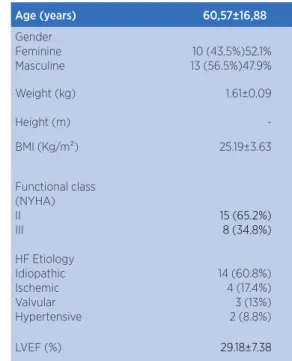
he clinical and anthropometric characteristics of the sample can be found in Table 1. A large part of the sample in this study was found to make use of diuretic drugs (100% - 23 subjects). 84.5% (20) of subjects made use of beta blockers; 38.5% (9) made use of antiaggregant drugs; 30.8% (7) made use of lipid-lowering drugs, and 15.4% (4) made use of antiarrhythmic agents. Around 69.6% (16) subjects used pacemakers. In regards to the practice of physical activity, 82.6% of patients (19) went walking for an average duration of 40, from 3 to 4 days in the week.
When evaluated for QoS, 60.9% (14) of the sample was found to have bad QoS, with Pittsburgh Sleep Quality Index scores >5, the average being 7 (±4.7). When evaluated for EDS, 39.1% (9) of the sample was found to have scores indicating EDS (scores>10), and 52% (12) of the sample was found to have ESS>8. he average ESS values in the studied sample was 8 (±5.1).
In regards to QoL, SF-36 showed averages of 60 (±25.6) for PRF; 5 (±38.5) for CA; 62 (±29.8) for bodily pain; 60 (±27.9) for GHP; 65 (±22.7) for VT;
62.5 (±20.6) for SRF; 50 (±39.2) for limitations due to ERF, and 72 (±23.7) for MH.
Table 1. General characteristics of the studied population
Age (years) 60,57±16,88
Gender Feminine Masculine
10 (43.5%)52.1% 13 (56.5%)47.9%
Weight (kg) 1.61±0.09
Height (m)
-BMI (Kg/m²) 25.19±3.63
Functional class (NYHA) II III
15 (65.2%) 8 (34.8%)
HF Etiology Idiopathic Ischemic Valvular Hypertensive
14 (60.8%) 4 (17.4%) 3 (13%) 2 (8.8%)
LVEF (%) 29.18±7.38
BMI - Body Mass Index; NYHA - New York Heart Association; LVEF - left ventricular ejection fraction (echocardiogram). The values were shown as average and standard deviation (for gender, weight, height, BMI, and LVEF), with absolute and percentage values (for NYHA classes and HF etiology)
When QoL was correlated to EDS degrees through SF-36, signiicant results were obtained in domains regarding bodily pain (p=0.04 and r=-0.43), VT (p=0.05 and r=-0.40) , and SRF (p=0.003 and r=-0.59)(Table 2).
Table 2. Correlation (r) obtained each domain of SF-36 quality of life questionnaire and excessive daytime sleepiness (Epworth), in 23 diagnosed with heart failure
SF-36 r
PRF -0.37
BODILY PAIN
-0.43*
GHP 0.41
VT -0.40*
SRF -0.59
ERF -0.38
MH -0.31
PRF – physical role functioning; PP – physical functioning; GHP –general health perceptions; VT - vitality; SRF –social role functioning; ERF – emotional role functioning; MH –mental health. *p≤0.05 for statistic signiicance
SF-36 questionnaire domains regarding QoL was also tested, but no signiicant correlations were obtained for all studied domains: Bodily pain: r=0,012 and p=0,957; LF: r=0.192 and p=0.380; PRF: r=0.178 and p=0.417; GHP: r=0.165 and p=0.452; VT: r=0.330 and p=0.124; SRF: r=0.379 and p=0.075; ERF: r=0.105 and p=0.634, and MH: r=0.200 and p=0361.
DISCUSSION
Recent studies have shown that screening work on sleep alterations must be a constant practice among professionals dealing with HF9. In this sample, 60.9% (14) of patients were found to have bad QoS. In the study by Santos et al.21, who evaluated 400 subjects with HF (NYHA Classes I-IV), 68.5% (263) of the patients were also found to be “bad sleepers” (score ≥5 in the Pittsburgh Sleep Quality Index). In our sample, subjects were only classiied as “bad sleepers” when they had scores above 518, which can justify the small classiication diference as compared to the study by Santos21. he average slept hours were the same in both studies (6 hours).
Another study included 101 patients (average age= 74 years; NYHA class II=63.4% of patients), of whom 81.2% (82) were classiied as “bad sleepers”22. his evaluated sample comprised patients with average age above the one in this study (60.5 years), which might explain the observed diference, as general population studies show that sleep disorders get more frequent as the age increases23.
In this study, 52% (12) of the sample was found to have ESS>8. In the study by Ferrier et al.24, 47% (25) of patients were found to have ESS>8, and their sample comprised 75% (40) of patients of NYHA classes I and II. he fact that our sample found a higher number of patients with ESS over 8 may be linked to the inclusion of NYHA class III patients, which possibly suggests that, the worse the NYHA class, the higher is EDS, as seen in Riegel et al.16 when they correlated NYHA classiication and EDS16.
Riegel et al.16, who investigated EDS prevalence and its correlation with fatigue in patients with HF, observed that 23.6% (66) of their sample were found to have EDS, and its main determining factors were QoS, NYHA classiication, the non-ingestion of diuretic drugs, and the lack of physical activity; however, the last two factors were not signiicant. In that sample the correlation between EDS and fatigue was r=0.38 (p < 0.001).
he results found through SF-36 in this sample yielded higher scores in 6 domains (PRF, Bodily pain, GHP, VT, SRF, and MH), as compared to the ones from Bröstrom25, who studied 223 patients with HF, of NYHA classes II-IV, whose average age was 76.5 years (higher than the average age in this sample). he QoL in the studied sample is found to be better than the one from Bröstrom25 study, and it can be explained through the diference in ages between both studies (76.5 years versus 60.5 years), once QoL decreases as age increases26. However, in this study, the correlation between age and QoL domains was not found to be signiicant, which shows sample homogeneity despite the age variation.
EDS interferes in professional activities and social relationships, reduces cognitive performance, and increases the risk of accidents13,14. When QoL was correlated with EDS degrees through SF-36, signiicant results were found in regards to bodily pain, VT, and SRF domains, showing that the worse EDS is, the worse its aspects will be.
In the study by Casida et al.17, QoL was evaluated through a speciic questionnaire, the Minnesota Living with Heart Failure Questionnaire (MLHFQ). Variables regarding “day dysfunction due to sleepiness” (present in Pittsburgh Sleep Quality Index) were related to physical (r=0.71, p=0.02) and emotional domains (r=0.74, p=0.02) of QoL through the MLHFQ, as well as the global QoL measure (r=0.66, p=0.04). here were also signiicant correlations between global daytime sleepiness and physical (r=0.66, p=0.05), emotional (r=0.84, p=0.01) and global domains (r=0.82, p<0.01) of MLHFQ. heir indings were similar to ours, once we have found, when QoL was correlated to EDS degrees through SF-36, p=0.04 and r=-0.43 for bodily pain domain, p=0.05 and r=-0.40 for VT, and p=0.003 and r=-0.59 for SRF domain. Such domains are directly related to PP and ERF. A subject whose EDS interferes in their emotional role functioning will have their social role functioning inluenced.
Sleep physiology alterations, as seen in patients with HF, promote intense fatigue, difuse pain, attention disorders, irritability, and marked diminishing of patients’ discriminative ability and pain thresholds29. Non-invigorating sleep is accompanied by hindered performance of daytime activities, which is indicated by fatigue or low energy, attention, concentration, and memory deicits, irritability, hyperactivity and aggression, diminished professional and social relationship performances30. Pedrosa et al.31 found that worse QoS is an independent predictor for low QoL.
he study by Gooneratne et al.32 suggests that EDS must be continuously analyzed in elderly people, particularly in those with several medical conditions. hat must be extended to patients with HF, as they are subjects who undergo associated comorbidities and altered vitality, and sufer from difuse pains and from altered social functioning due to EDS. We believe that studies which produce and synthesize evidence on non-pharmacological interventions for sleep disorders, EDS, and QoS in patients with HF are required in order to guide therapeutic decisions and improve those patients’ QoL.
his study is innovating in regards to the correlation between QoL and EDS. However, some limitations were faced, such as the number of patients who needed to be excluded, which interfered in the sample size. We suggest future studies with larger samples exploring QoL, EDS, and QoS. Besides that, no speciic instrument was used to assess HF.
CONCLUSION
he data suggests that the studied sample has bad QoS and EDS, the latter, in turn, negative correlating with QoL in its aspects regarding vitality, bodily pain, and social role functioning.
REFERENCES
1. Permanyer MG, Soriano N, Brotons C, Moral I, Pinar J, Cascant P, et al. Características basales y determinantes de la evolución en pacientes ingresados por insuiciencia cardiaca en un hospital general. Rev Esp Cardiol 2002;55(6):571-8. 2. Forgiarini Junior LA, Rubleski A, Douglas G, Tieppo J,
Vercelino R, Dal BA, et al. Evaluation of respiratory muscle strength and pulmonary function in heart failure patients. Arq Bras Cardiol. 2007;89(1):36-41.
3. Dickstein K, Cohen-Solal A, Filippatos G, McMurray JJV, Ponikowski P, Poole-Wilson PA, et al. ESC Guidelines for the diagnosis and treatment of acute and chronic heart failure. Eur J Heart Fail. 2008;10(10):933-89.
4. Ribeiro JP, Chiappa GR, Callegaro CC. Contribuição da musculatura inspiratória na limitação ao exercício na insuiciência cardíaca: mecanismos isiopatológicos. Rev Bras Fisioter. 2012;16(4):261-7.
5. Witte KK, Clark AL. Why does chronic heart failure case breathlessness and fatigue? Prog Cardiovasc Dis. 2007;49(5):366-84.
6. Plentz RDM, Sbruzzi G, Ribeiro RA, Ferreira JB, Dal Lago P. Inspiratory muscle training in patients with heart failure: meta-analysis of randomized trials. Arq Bras Cardiol. 2012;99(2):762-71.
7. Di Naso FC, Pereira JS, Dias AS, Forgiarini La JR, Monteiro MB. Correlations between respiratory and functional variables in heart failure. Rev Port Pneumol. 2009;15(5):875-90.
8. Jolly K, Tayor RS, Lip GYH, Greenield SM, Davies MK, Davis RC, et al. Home-based exercise rehabilitation in addition to specialist heart failure nurse care: design, rationale and recruitment to the Birmingham rehabilitation Uptake Maximisation study for patients with congestive heart failure (BRUM-CHF): a randomized controlled trial. BMC Cardiovasc Disord. 2007;7:9. doi: 10.1186/1471-2261-7-9
9. Oldenburg O, Lamp B, Faber L, Teschler H, Horstkotte D, Töpfer V. Sleep disordered breathing in patients with symptomatic heart failure. Eur J Heart Fail. 2007;9(3):251-7 10. Johansson P, Arestedt K, Alehagen U, Svanborg E, Dahlström
U, Broström A. Sleep disordered breathing, insomnia, and health related quality of life - a comparison between age and gender matched elderly with heart failure or without cardiovascular disease. Eur J Cardiovasc Nurs. 2010;9(2):108-17.
11. Ohayon MM. From wakefulness to excessive sleepiness: What we know and still need to know. Sleep Med Rev. 2008;12(2):129-41.
12. Whitney CW, Enright PL, Newman AB, Bonekat W, Foley D, Quan SF. Correlates of daytime sleepiness in 4578 elderly persons: cardiovascular health study. Sleep. 1998;21(1):27-36. 13. Mulgrew AT, Ryan CF, Fleetham JA, Cheema R, Fox N,
Koehoorn M, et al. The impact of obstructive sleep apnea and daytime sleepiness on work limitation. Sleep Med. 2007;9(1):42-53.
14. Antonelli IR, Marra C, Salvigni BL, Petrone A, Gemma A, Selvaggio D, et al. Does cognitive dysfunction conform to a distinctive pattern in obstructive sleep apnea syndrome? J Sleep Res. 2004;13(1):79-86.
15. Oldenburg O, Lamp B, Freudenberg G, Horstkotte D. Screening for sleep-disordered breathing is recommended in patients with chronic heart failure. Eur Respir J. 2007;30(5):1023. 16. Riegel B, Ratclife SJ, Sayers SL, Potashnik S, Buck HG,
Jurkovitz C, et al. Determinants of excessive daytime sleepiness and fatigue in adults with heart failure. Clin Nurs Res. 2012;21(3):271-93. doi: 10.1177/1474515115575834
17. Casida JM, Brewer RJ, Smith C, Davis JE. An exploratory study of sleep quality, daytime function, and quality of life in patients with mechanical circulatory support Int J Artif Organs. 2012;3(7):531-7.
19. Bertolazi AN, Faggondes SC, Hof LS, Pedro VD, Barreto SSM, Johns MW. Portuguese-language version of the Epworth sleepiness scale: validation for use in Brazil. J Bras Pneumol. 2009;35(9):877-83.
20. Ciconelli RM, Ferraz MB, Santos W, Meinão I, Quaresma MR. Brazilian portuguese version of the SF-36, a reliable and valid quality of life outcome measure. Rev Bras Reumatol. 1999;39(3):143-50.
21. Santos MA, Guedes Ede S, Barbosa RL, Cruz Dde A. Sleeping diiculties reported by patients with heart failure. Rev Lat Am Enfermagem. 2012;20(4):644-50.
22. Wang TJ, Lee SC, Tsay SL, Tung HH. Factors inluencing heart failure patients’ sleep quality. J Adv Nurs. 2010;66(8):1730-40. 23. Ohayon MM, Sagales T. Prevalence of insomnia and sleep
characteristics in the general population of Spain. Sleep Med. 2010;11(10):1010-8.
24. Ferrier K, Campbell A, Yee B, Richards M, O’Meeghan T, Weatherall M, et al. Sleep-disordered breathing occurs frequently in stable outpatients with congestive heart failure. Chest. 2005;128(4):2116-22.
25. Broström A, Strömberg A, Dahlström U, Fridlund B. Sleep diiculties, daytime sleepiness, and health-related quality of life in patients with chronic heart failure. J Cardiovasc Nurs. 2004 Jul-Aug;19(4):234-42.
26. Azevedo A, Bettencourt P, Alvelos M, Martins E, Abreu-Lima C, Hense H.-W, et al. Health-related quality of life and stages of heart failure. Int J Cardiol. 2008;129(2):238-44.
27. Addington-Hall J, Rogers A, McCoy A, Gibbs J. Heart disease. In: Morrison R, Meier D, Capello C, editors. Geriatric palliative care. Nova York: Oxford University Press; 2003. p.110-22. 28. Murray SA, Boyd K, Kendall M, Worth A, Benton TF, Clausen
H. Dying of lung cancer or cardiac failure: prospective qualitative interview study of patients and their careers in the community. Br Med J. 2002;325:929-34.
29. Teixeira MJ, Yeng LT, Kaziyama HHS. Fibromialgia e sono. In: Reimão R, Organizador. Avanços em medicina do sono. São Paulo: Associação Paulista de Medicina; 2001. p.169-74. 30. Edinger JD, Bonnet MH, Bootzin RR, Doghramji K, Dorsey
CM, Espie CA, Jamieson AO, et al. Derivation of research diagnostic criteria for insomnia: report of an American Academy of Sleep Medicine
31. Pedrosa RP, Lima SG, Drager LF, Genta PR, Amaro ACS, Antunes MO, et al. Sleep quality and quality of life in patients with hypertrophic cardiomyopathy. Cardiology. 2010;117(3):200-6.