Fisioter. Mov., Curitiba, v. , n. , p. - , Apr./June Licenciado sob uma Licença Creative Commons DO): http://dx.doi.org. . / - . . .AO
[T]
Physical exercise modifies the functional capacity
of elderly patients on hemodialysis
[)]
Exercício físico modii ca a aptidão funcional de idosos
em hemodiálise
[A]
Moane Marchesan[a], Rodrigo de Rosso Krug[a], José Raphael Leandro da Costa e Silva[a],
Aline Rodrigues Barbosa[a], Airton José Rombaldi[b]*
[a] Universidade Federal de Santa Catarina UFSC , Florianópolis, Santa Catarina, Brazil [b] Universidade Federal de Pelotas UFpel , Rio Grande do Sul, Brazil
[R]
Abstract
Introduction: Patients on hemodialysis (D improve functional capacity after physical training. (owever, little is discussed about these effects in elderly patients, since these are usually excluded of studies, due to their physical disabilities and other de icits. Objective: To analyze the effects of aerobic and resistance training in the functional capacity of elderly patients submitted to (D. Methods: Studied participants were patients, of both genders, and aged over years. Aerobic and resistance training was carried out during the hemodialysis session, three times per week, during four months. Patients were distributed into control CG and experimental EG groups. Functional capacity was assessed by six-minute walk MW , sit-to-stand STS and respiratory muscle strength tests. Results: After the phy-sical training, EG presented a signi icant increase in the distance covered in MW Z = . , p < . , respiratory muscle strength inspiratory pressure: Z = . , p < . ; expiratory pressure: Z = . ,
*MM: Doctoral student, e-mail: moed [email protected] RRK: Doctoral student, e-mail: [email protected] JRLCS: MSc student, e-mail: [email protected] ARB: PhD, e-mail: alinerb @hotmail.com
352
p < . ; and in number of STS repetitions . ; p <. . Conclusion: The training modi ied the func-tional capacity of the (D patients, contributing to their rehabilitation.
Keywords: Chronic renal insuf iciency. Exercise. Renal dialysis. Physical itness.
Resumo
Introdução: Pacientes em hemodiálise (HD) melhoram sua aptidão funcional após o treinamento ϔísico. Porém, pouco se discute sobre esses efeitos em pacientes idosos, sendo que esses geralmente são excluídos dos estudos, por apresentarem debilidades ϔísicas e demais déϔicits. Objetivo: Analisar os efeitos do treinamento aeróbio e contra resistência sobre a aptidão funcional de pacientes idosos submetidos à HD. Materiais e Métodos:
Participaram deste estudo 15 pacientes, de ambos os sexos, com idade superior a 60 anos. Foi realizado trein-amento aeróbio e contra resistência, durante a sessão de HD, três vezes/semana, por 24 semanas. Os pacientes foram divididos em grupo controle (GC) e experimental (GE). A avaliação da aptidão funcional foi feita através dos testes de seis minutos de caminhada (T6), de sentar e levantar (TSL) e de força muscular respiratória.
Resultados: Após o treinamento ϔísico o GE apresentou aumento signiϔicativo na distância percorrida no T6 (Z = 2.521; p < .012), na força muscular respiratória (pressão inspiratória: Z = 2.533; p < .011; pressão expiratória: Z = 2.536; p < .011); e no número de repetições no TSL (2.54; p < .001). Conclusão: O treinamento utilizado modiϔicou a aptidão funcional dos pacientes, contribuindo na reabilitação destes.
Palavras-chave: Insuϔiciência renal crônica. Exercício ϔísico. Diálise renal. Aptidão ϔísica.
Introduction
The number of older people is increasingly grow-ing worldwide. Added to this growth is the increased number of chronic diseases , such as chronic kid-ney disease CKD .CKD is characterized by pro-gressive, irreversible loss of kidney function and, in its most advanced stage stage V , renal replacement therapy is indispensable, so that the body maintains its balance levels .
)n Brazil, the treatment method commonly used by patients in stage V is hemodialysis (D and a higher prevalence, about % of dialysis patients, is in the age range of years or older . Patients on (D usually exhibit decreased functional capacity due to metabolic and physiological changes , .
Anemia, imbalance in the body homeostasis , reduction of approximately % of maximal oxygen consumption and % to % of muscle strength, compared to the values found in healthy subjects, lead to decreased muscle functionality and cardio-respiratory capacity. These are cited as some of the complications in physical itness in this population
, leading to decreased exercise capacity.
One way to maintain satisfactory response to effort and daily activities is to insert physical exercise into the routine of (D patients. Studies point out that an
exercise program can maintain and, even increase the variables of functional capacity in dialysis patients .
Therefore, stimulating and encouraging elderly (D patients to perform physical exercise seems to contribute for their rehabilitation since, in addition to increasing exercise capacity, it also improves their perception of quality of life , , , .
Despite the arguments cited above, intervention programs and research with this population in Brazil are still rare and, those that exist, often are not con-ducted exclusively with elderly subjects , , , as they are more unstable and impaired. Thus, the aim of this study was to analyze the effects of an ex-ercise program on the functional capacity of elderly (D patients.
Materials and Method
Study design
353 Population and sample
The study sample consisted of patients submitted to (D in the Renal Clinic at Santa Lucia (ospital, in Cruz Alta city, in the state of Rio Grande do Sul. Among patients who were in dialysis treat-ment in this unit n = , were excluded for being in (D for less than three months, having a central catheter, being under years old, having severe heart disease, respiratory problems, and not having been released by the physician to partici-pate in the program, due to unstable clinical condi-tions. Unstable medical conditions encompassed biochemical aspects, weight gain on the opposite dialysis day, uncontrolled anemia and the number of complications and hospitalizations in the last six months.
Out of selected patients, five refused to par-ticipate, remaining who were randomly divided into a control group CG and an experimental group EG . Three patients were lost, due to hos-pitalization CG-n = ; EG-n = and death GC-n = . None of these losses was associated with exercise. The EG performed the exercise program, which will be described later, and the CG did not. At the end of the intervention, patients in the CG were invited to participate in the exercise pro-gram proposed by the researchers.
Ethical aspects
The research proposal was approved by the Ethics Committee of the School of Physical Education at the Federal University of Pelotas n. / . All patients were informed about the procedures of the research and signed a free and informed consent form.
Instruments
Clinical and sociodemographic characteris-tics evaluation
These variables were collected by means of an anamnesis of the patients. Sociodemographic char-acteristics sex, age, skin color, marital status were evaluated using a structured questionnaire. Clinical aspects time of hemodialysis and etiology of the dis-ease were collected from medical records. Systemic arterial pressure and heart rate were also measured.
Functional capacity evaluation
The evaluation of functional capacity of the pa-tients was carried out before and after training. The variables and their respective instruments were:
a Functional capacity: evaluated by a six-minute walk MW test, using methodology proposed by Brazilian standardization, in which patients are oriented to cover the longest possible dis-tance in a period of six minutes .
b Resistance of lower limb muscles: evaluated by a sit-to-stand test STS . The patient was in-structed to rise from a chair and go back to sitting position, as fast as possible, in an interval of seconds. The maximum number of repetitions within the established time was recorded .
c Respiratory muscle strength: measured by inspiratory maximum pressures M)P and expiratory maximum pressures MEP , using a scaled manometer in - to + cm ( O Famabras, Brazil . The Black and (yatt pro-tocol was used, in which patients remain seated, with nostrils occluded by a nose clip. Three maximal inhalation and exhalations were collected, and the mean among them was considered.
The evaluation of the functional capacity of pa-tients was carried out in a room in the Renal Clinic at Santa Lucia (ospital, in city of Cruz Alta, Rio Grande do Sul, by means of a MW test in a -m corridor properly marked from to meters. These evalu-ations occurred on opposite days to the ones of (D.
Physical exercises program
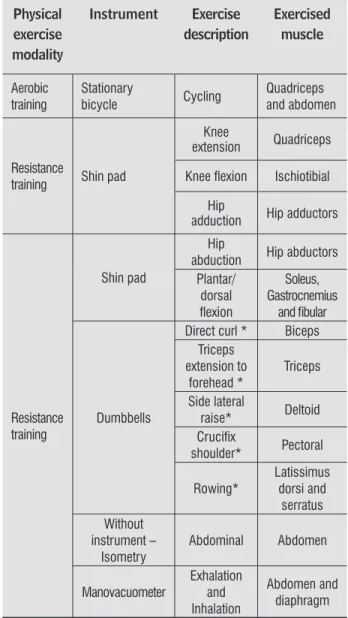
The physical exercise program consisted of aerobic training in a stationary bicycle, followed by resistance exercises for upper and lower limbs, thorax, abdomen and the posterior region of the trunk Table - .
354
The thoracic region was exercised by isometric abs, exercise for the chest cruci ix , and rowing, in which the patient was asked to lean forward to take the elbow further from the body midline. The ankle exercises were carried out with the aid of a step, where the patient's tiptoe was supported to perform lexion and extension exercises.
This program had a frequency of three times a week and lasted for weeks. The duration of each exercise session was minutes initially, gradually increasing over time. The prescription of exercises is described in Figure , and it has been previously published . To evaluate the intensity of the exercises, heart rate and Borg's perceived exertion scale were used.
Legend: BS= Borg Scale; %= percentage; HR= Heart rate; kg= Kilogram. Figure 1 - Physical exercises prescription.Source: Marchesan and Rombaldi (17)
Statistics Analysis
Data normality was tested by the Shapiro-Wilk test. As the sample did not present a normal distribution, U-Mann Whitney test was used to compare the dif-ferences between groups CG versus EG before the exercise program and paired samples were compared between, before and after the exercise program in both groups by the Wilcoxon test. Descriptive statistics were utilized for the sample characterization. The software SPSS® version . was used in data analysis.
Results
Of patients selected for the intervention, only did not complete the minimum period of participation adher-ence of % . Table - shows the characteristics of the (D patients participating in the study with respect to so-ciodemographic variables. )t can be observed that, in both
Table 1- Description of the physical exercises
per-formed during the intervention program
Physical exercise modality Instrument Exercise description Exercised muscle Aerobic training Stationary bicycle Cycling Quadriceps and abdomen Resistance
training Shin pad
Knee
extension Quadriceps
Knee fl exion Ischiotibial
Hip
adduction Hip adductors
Resistance training
Shin pad
Hip
abduction Hip abductors
Plantar/ dorsal
fl exion
Soleus, Gastrocnemius
and fi bular
Dumbbells
Direct curl * Biceps
Triceps extension to forehead * Triceps Side lateral raise* Deltoid
Crucifi x
shoulder* Pectoral Rowing* Latissimus dorsi and serratus Without instrument – Isometry Abdominal Abdomen Manovacuometer Exhalation and Inhalation Abdomen and diaphragm
Note:* Exercises performed only in the opposite side of arteriove-nous fi stula
355 groups, most patients were male, of white skin color, and
lived accompanied. )n clinical aspects, both in the CG and in the EG, the (D period was superior to months and prevalent causes of CKD were hypertension and diabetes.
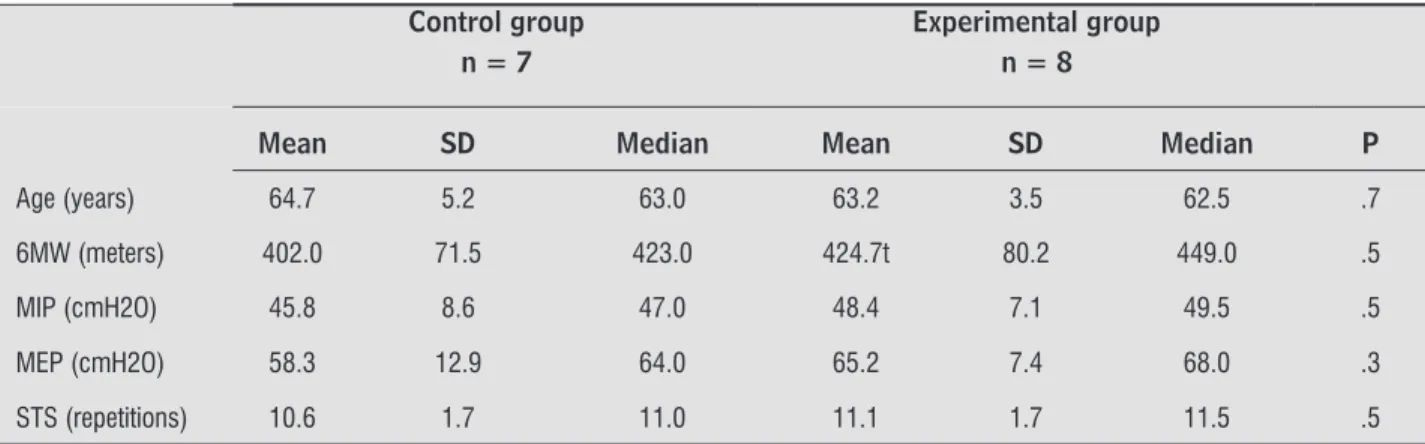
Patients data regarding functional capacity are ex-posed in Table , for both groups in the beginning of the training. Comparing variables of the CG with those of the EG, no signi icant differences were observed be-fore training, indicating homogeneity between groups. The functional capacity of the EG participants presented a signi icant difference after training. No patient presented any type of complication during or after the exercise program. There was a signi icant increase in the covered distance at MW Z = . ; p < . , number of STS repetitions Z = . ; p < . and respiratory muscle strength M)P: Z = . ; p < . ; MEP: Z = . ; p < . , as shown in Figure .
Table 2 - Sociodemographic characteristics of the sample
in the beginning of the physical exercise pro-gram. Cruz Alta, Rio Grande do Sul, 2010
Variables Control
Group % (n)
Experimental
Group % (n)
Sociodemographic
Sex
Male 71.43 (5) 75.00 (6)
Female 28.57 (2) 25.00 (2)
Skin Color
White 85.71 (6) 75.00 (6)
Other 14.29 (1) 25.00 (2)
Marital Status
Lives alone 14.29 (1) 37.50 (3)
Lives accompanied 85.71 (6) 62.50 (5)
Clinical Aspects
HD period
Six to 12 months - 25.00 (2)
More than 12 months 100.00 (7) 75.00 (6)
Etiology
Hypertension 57.15 (4) 50.00 (4)
Diabetes 42.85 (3) 37.50 (3)
Others - 12.50 (1)
Lifestyle
Smoking in the last 12 months
Yes 0 (0) 0 (0)
No 100 (7) 100 (8)
Regular physical exercise in the last six months
Yes 0 (0) 0 (0)
No 100 (7) 100 (8)
Note: legend: %= percentage; n= sample size; HD= Hemodialysis
Note: Legend: cmH2O= centimeters of water; p= signifi cance level in Wilcoxon test.
Figure 2 - Results of functional capacity of elderly HD
356
with physical exercise practice, which was observed in the present study with the increase of LME Local Muscular Endurance of lower limbs, evaluated by the number of STS repetitions after weeks of physi-cal exercise in EG. The elderly had improvement in approximately . repetitions in STS.
The results of the present study are also in agree-ment with the indings of Painter et al. mean age of . years , in which patients carried out a similar physical exercise program, made up of aero-bic, resistance and lexibility exercises. The authors observed signi icant reduction in the execution time on sit-to-stand movement ive times from the chair. This reduction in the execution time in STS predicts death risk by all causes and improves the capacity of developing the basic activities of daily living .
Studies by (eadley et al., mean age of . years , Chen et al. mean age of years and Segura-Ortí, Kouidi & Lison, mean age of . years , which compared isolated effects of resistance training and Koufaki, Mercer & Naish's study
mean age of . years , which compared the isolat-ed effects of aerobic training, also found an increase in the repetition number or, a reduction in execution time in STS. Such improvement may be attributed to the fact that physical exercise improves the muscular structure, the number of capillaries and mitochon-dria, which are responsible for getting oxygen , and the capacity of performing physical exercise . One of the countless consequences of CKD, as well as the dialysis therapy, is pulmonary dysfunction. A study conducted in a renal clinic in the city of )juí, Rio Grande do Sul, with the objective of comparing the functional Discussion
The results of the present study showed that el-derly (D patients, when inserted into a physical exer-cise program, presented improvement in the covered distance at MW, in STS repetitions and in maximal respiratory pressures.
After six months of participation in the physical exercise program, the EG patients increased, in av-erage, . meters in the covered distance at MW, which is considered very important for this popula-tion, since (D patients have a great decrease in func-tional capacity caused both by the disease and by the treatment . This increase in the covered distance is especially relevant, mainly in a population with high morbidity, since short distances shorter than meters are strongly associated with morbidity and mortality .
The results of a study conducted with New Yorkers, aged between and years, agree with the results of the present research, in which three months of aerobic and resistance training during (D sessions obtained an increase in covered distance at MW . This improvement was highlighted in sev-eral review studies , , , indicating that physi-cal exercise brings positive effects to the functional capacity of (D patients.
The muscular system of CKD patients suffers several morphologic and physiologic alterations. Muscular atrophy and malnutrition are cited as fac-tors that lead to muscular weakness , usually more observed in lower limbs. According to Reboredo et al. , such muscular force loss may be reverted
Table 3- Sample characterization with data from the beginning of the physical exercise program. Cruz Alta, Rio Grande
do Sul, 2010.
Control group n = 7
Experimental group n = 8
Mean SD Median Mean SD Median P
Age (years) 64.7 5.2 63.0 63.2 3.5 62.5 .7
6MW (meters) 402.0 71.5 423.0 424.7t 80.2 449.0 .5
MIP (cmH2O) 45.8 8.6 47.0 48.4 7.1 49.5 .5
MEP (cmH2O) 58.3 12.9 64.0 65.2 7.4 68.0 .3
STS (repetitions) 10.6 1.7 11.0 11.1 1.7 11.5 .5
357 Such data are extremely relevant for the health and physical activity area because, in addition to increasing functional capacity in elderly individuals on (D, they em-phasized the importance of the physical education pro-fessional, together with all staff of the renal unit, for the rehabilitation and physical improvement of these patients. Thus, it is recommended that physical exercise pro-grams for patients on (D be encouraged and, mainly, inserted in sites of CKD care, as a way to help in their treatment and rehabilitation. Yet, further studies with this population are suggested, publishing bene its and consequences of this kind of intervention.
Other aspects that may interfere in the improve-ment / maintenance of physical capacity of these patients, such as health quality and clinical aspects, should be considered in further studies. Moreover, studies with a greater number of participants and with more than two evaluations are proposed.
References
. (irvensalo M, Lintunen T. Life-course perspective for physical activity and sports participation. Eur Rev Aging Phys Act. ; : - .
. Sesso RC, Lopes AA, Thomé FS, Lugon JR., Santos DR. Relatório do censo brasileiro de diálise de . J Bras Nefrol. ; : - .
. Bastos MG, Bregman R, Kirsztajn GM. Doença renal crônica: frequente e grave, mas também prevenível e tratável. Rev Assoc Med Bras. ; : - . . Medeiros R(, Pinent CEC, Meyer F. Aptidão ísica de
indivíduo com doença renal crônica. J Bras Nefrol.
; : - .
. Odden MC. Physical functioning in elderly persons with kidney disease. Adv Chronic Kidney Dis. ;
: - .
. Casaburi R. Treinamento de Exercício Reabilita-tivo em Pacientes Submetidos à Diálise. )n: Kopple JD, Massry SG, editor. Cuidados Nutricionais das Doenças Renais. Rio de Janeiro: Guanabara Koogan;
. p. - .
. Greenwood SA, Lindup (, Taylor K, Koufaki P, Rush R, Macdougall )C, et al. Evaluation of a pragmatic exercise rehabilitation programme in chronic kidney disease. Nephrol Dial Transplant. ; Suppl
: - . capacity and quality of life of CKD patients on (D n=
and pre-dialysis therapy patients n= , identi ied that there was a decrease in the muscle respiratory strength M)P and MEP in both groups, but with greater impact on the group who already was on (D treatment . This dysfunction usually occurs due to circulant toxins or other factors such as volume overload, anemia, mal-nutrition and muscular weakness , causing count-less physical and functional problems .
)n the present study, respiratory muscle strength presented changes after the training period of approxi-mately . cm( O in M)P and . cm( O in MEP. These data agree with those found by Coelho et al. mean age of . years , in which seven patients on (D, after an eight-week training, had an increase in M)P and MEP. Such improvement was also observed in a study with patients mean age of . years , of both genders, who underwent (D treatment for more than six months and took part in a physical exercise program aerobic and resistance training for weeks .
The gain observed for this variable can be attrib-uted to bene its promoted by physical exercise in the respiratory dysfunction, present in these patients, ei-ther due to the disease or (D ei-therapy. The improve-ment in respiratory muscle strength may contribute to functional capacity by increasing the capacity to per-form physical exercise, consequently, assisting in treat-ment and rehabilitation of these patients and improv-ing their health and quality of life . Rehabilitation and treatment programs with speci ic exercises for respiratory muscle strength may contribute with the increase of covered distance at the MW test, bringing several bene its for patients on (D .
Besides the contribution of this study for the phys-ical activity and health area, its data cannot be gen-eralized for other patients, because it was conducted in only one clinic. This limitation did not affect the potential of the study, since it seems to be the irst to analyze the effects of the regular practice of physical exercise on the functional capacity of elderly patients submitted to (D in a city of Rio Grande do Sul, Brazil.
Conclusion
358
. Fassbinder TRC, Winkelmann ER, Schneider J, Wend-land J, Oliveira OB. Capacidade funcional e qualidade de vida de pacientes com doença renal crônica pré-dialítica e em hemodiálise - Um estudo transver-sal. J Bras Nefrol ; : - .
. Gorkin L, Norvel NK, Rosen RC, Charles E, Shumaker AS, Mclntyre KM et al. Assessment of quality of life of observed from the baseline data of the studies of left ventricular dysfunction SOLVD . Am J Cardiol. ;
: - .
. Oh-Park M, Fast A, Gopal S, Lynn R, Frei G, Drenth R, et al. Exercise for the dialyzed: Aerobic and strength training during hemodialysis. Am J Phys Med Rehabil.
; : - .
. Böhm J, Monteiro MB, Thomé FS. Efeitos do exercí-cio aeróbio durante a hemodiálise em pacientes com doença renal crônica: uma revisão da literatura. J Bras Nefrol. ; : - .
. Adams GR, Nosratola DV. Skeletal muscle dysfunction in chronic renal failure: effects of exercise. Am J Phys Renal Physiol. ; : F - .
. Reboredo MM, (enrique DMN, Bastos MG, de Paula RB. Exercício ísico em pacientes dialisados. Rev Bras Med Esp. ; : - .
. Painter P, Carlson L, Carey S, Paul SM, Myll J. Physical functioning and health-related quality-of-life changes with exercise training in hemodialysis patients. Am J Kidney Dis. ; : - .
. (eadley S, Germain M, Mailloux P, Mulhern J, Ash-worth B, Burris J, et al. Resistance training improves strength and functional measures in patients with endstage renal disease. Am J Kidney Dis. ; :
- .
. Chen JLT, Godfrey S, Ng TT, Moorthi R, Liangos O, Ruthazer R, et al. Effect of intra-dialytic, low-intensity strength training on functional capacity in adult he-modialysis patients: a randomized pilot trial. Nephrol Dial Transplant. ; : - .
. Segura-Ortí E, Kouidi E, Lisón JF. Effect of resistance exercise during hemodialysis on physical function and quality of life: randomized controlled trial. Clin Nephrol. ; : - .
. Johansen KL. Exercise and dialysis.(emodial )nt. ; : - .
. Johansen KL, Painter P. Exercise in individuals with CKD. Am J Kidney Dis. ; : - .
. Mustata S, Groeneveld S, Davidson W, Ford G, Kiland K, Manns B. Effects of exercise training on physical impairment, arterial stiffness and health-related quality of life in patients with chronic kid-ney disease: a pilot study. )nt Urol Nephrol. ;
: - .
. Coelho DM, Ribeiro JM, Soares DD. Exercícios ísicos durante a hemodiálise: uma revisão sistemática. J Bras Nefrol. ; : - .
. Soares KTA, Viesser MV, Rzniski TAB, Brum EP. E icácia de um protocolo de exercícios ísicos em pacientes com insu iciência renal crônica, durante o tratamento de hemodiálise, avaliada pelo SF- . Fisioter Mov.
; : - .
. Lima FF, Miranda RCV, Rossi e Silva RC, Monteiro (L, Yen LS, Fahur BS, et al. Avaliação funcional pré e pós-programa de exercício ísico de pacientes em hemodiálise. Rev Med USP. ; : - . . Britto RR, Souza LAP. Teste de caminhada de seis
minutos - uma normatização brasileira. Fisioter Mov. ; : - .
. Jones CJ, Rikli RE, Beam WC. A -s chair-stand test as a measure of lower body strength in community-residing older adults. Res Q Exerc Sport. ; :
- .
. Black LF, (yatt RE. Maximal respiratory pressures: normal values and relationship to age and sex. Am Rev Resp Dis. ; : - .
. Marchesan M, Rombaldi AJ. Programa de exercícios ísicos para o doente renal crônico em hemodiálise. Rev Bras Ativ Fis e Saúde. ; : - . . Coelho DM, Castro AM, Tavares (A, Abreu PCB, Glória
RR, Duarte M(, et al. Efeitos de um Programa de Ex-ercícios Físicos no Condicionamento de Pacientes em (emodiálise. J Bras Nefrol. : : – . . Borg G. Escalas de Borg para dor e esforço percebido.
359 . Koufaki P, Mercer T(, Naish PF. Effects of exercise
training on aerobic and functional capacity of end-stage renal disease patients. Clin Physiol Funct )mag-ing. ; : – .
. Kouidi E, Albani M, Natsis K, Megalopoulos A, Gigis P, Guiba-Tziampiri O, et al The effects of exercise training on muscle atrophy in hemodialysis patients. Nephrol Dial Transplant. ; : - .
. Prezant DJ. Effect of uremia and its treatment on pul-monary function. Lung. ; : - .
. Marchesan M, Nunes VGS, Rombaldi AJ. Treinamento ísico melhora a aptidão ísica e a qualidade de vida de pacientes em hemodiálise. Rev Bras Cineantropom Desempenho (um. ; : - .
. Silva VG, Amaral C, Monteiro MB, Nascimento DM, Boschetti JR. Efeitos do treinamento muscular respi-ratório nos pacientes em hemodiálise. J Bras Nefro.
; : - .
Received: / / Recebido: 09/07/2014