READING ENGAGEMENT: A COMPARISON BETWEEN
E-BOOKS AND TRADITIONAL PRINT E-BOOKS IN AN
ELEMENTARY CLASSROOM
Troy Jones
Asst. Prof., East Carolina University, USA [email protected]
Carol Brown
Assoc. Prof., East Carolina University, USA
Electronic books (e-books) are gaining popularity for personal reading. Options for access to a large selection of book titles and “anytime/anywhere” reading choices have added to the increased use of e-books. For this study, 22 third-grade students completed satisfaction surveys and reading comprehension tests on three separate reading sessions: one traditional print-based and two e-book titles. Indicators of reading engagement included motivation for independent reading and comprehension as measured by standardized tests on the print book and both e-books. Results showed that format was not as important as students’ identification with setting, characters, and theme of the book. Students did, however, indicate a preference for e-books when given the option of a wide selection of titles and the freedom to choose their own e-book. Students further indicated a preference for the amenities associated with e-book reading such as pop-up definitions and pronunciations of words, automatic page turning, and the option of read-aloud narration. The authors concluded that children quickly become comfortable with e-books and welcomed the technology. However, they are not completely ready to disregard print books.
Key Words: e-books, reading engagement, children,print books, elementary classroom
INTRODUCTION
environment (Arzubiaga, Rueda, & Monzo, 2002), independent reading, and gains in reading achievement. It is multidimensional and influenced by the cognitive and emotional engagement of the reader (Wigfield, et al., 2008). Wigfield, et al. (2008) found a strong correlation between reading engagement and reading achievement when they studied the effects of Concept-Oriented Reading Instruction on the reading outcomes of fourth grade children. The authors concluded that children’s reading engagement is enhanced when they are provided with instruction in cognitive strategies associated with reading. Children who use sophisticated strategies and enjoy literacy activities are considered to be engaged readers. Consistently engaged readers actively seek appropriate books and become excited about learning new material (Lutz, Guthrie, & Davis, 2006). Marinak and Gambrell (2008) reported that children are motivated to read and remain engaged in reading when rewarded with the opportunity to choose their own books. Arzubiaga, et al., (2002) claimed that context within literacy activities was an important factor crucial to reading engagement and literacy development. Other factors reported include culture of the school, various intervention programs, and the child’s home and classroom environment all influence reading achievement.
All of these findings (Arzubiaga, et al., 2002; Clark, et al., 2003; Flowerday, et al., 2004; Marinak & Gambrell, 2008; McGlinn & Parrish, 2002; Wigfield, et al., 2008) indicate that the availability of materials will play a determining factor in how engaged children are in reading. The classroom material available is evolving as computers are becoming more prominent in classrooms (McGlinn & Parrish, 2002). Children are being introduced to computers in schools at very early ages (Johnson & Christie, 2009). SuccessMaker™ (Pearson Education, Inc.), JumpStart Phonics (Knowledge Adventure, Inc.) and similar multimedia integrated learning systems are designed to teach emergent readers basic skills and provide developmental readers with remedial instruction. In addition, a plethora of interactive websites such as blogs, wikis, and other Web 2.0 resources have created a digital environment in which students are creators of information as well as readers of information. Children are now being acclimatized to technology in their classrooms beginning in preschool and continuing through adulthood. In addition to remedial learning, computer-based technologies in the classroom have the potential to facilitate deep learning and critical thinking skills in children (Hyun, 2004; Lowther, Inan, Daniel, & Ross, 2008). The influx of computer-based technology employed in classroom instruction will ultimately play a role in children’s literacy development. Therefore, computer–based technologies are likely to shape the way that children will ultimately view literacy (Mioduser, Tur-Kaspa, & Leitner, 2000).
electronic resources could easily affect selection of reading materials in K-12 schools.
Electronic books are available through two main sources: online websites and personal electronic devices. The importance of such devices cannot be underestimated. There are several factors influencing the transition from print to electronic format. First, online resources provide instant access to reading materials at the point of need. For example, teachers can search for primary source documents and digitized books that support a variety of curriculum areas (Brown & Dotson, 2004). Whether in a computer lab or through use of a personal hand-held device, students are able to read a wide variety of materials specifically suited to an instructional unit. Secondly, 21st century learners are motivated to use personal devices to gain immediate access to answers and to communicate with peers. Reading from a digital screen is comfortable and familiar for most K-12 students. The “read-write” web has produced a generation of readers who are motivated to communicate with their peer writers and established authors. Some experts predict that there will soon be publishing sites comparable to social networking sites such as YouTube.com where writers can share their books with a community of writers (Sangani, 2009). A downside of this trend would be the potential for mass publication of reading materials lacking credibility in both content and sources; however, this also opens the door to new skills in literacy and evaluation of digital resources (Metzger, 2007). The increasing number of e-reading devices and the authors’ embracing of e-books would indicate that the technology is more than a passing fad.
The combination of new-found popularity for electronic reading and computers in classrooms would indicate that these factors will shape children’s literacy development in the next decade. Children are still being introduced to literacy through print books, but signs point to electronic reading being a greater part of their literary life as they develop and mature. If the goal of schools is to keep children actively engaged in reading, then educators need to examine the effects of electronic books on the reading engagement of children. As has been stated, engagement also impacts motivation and reading achievement (Marinak & Gambrell, 2008). If the publishing trend of promoting electronic books continues, then it is reasonable to predict these books will eventually make their way into the schools. The purpose of the present study was to examine the reading engagement and comprehension of children as they read electronic books.
Research Questions
The primary research question was “What are the effects of electronic books on third-grade children’s reading engagement?” Because engagement impacts comprehension and the degree of satisfaction that children gain from reading, two sub questions were examined. First, “What are the effects of electronic books on third-grade children’s reading comprehension?” and second, “What are the effects of electronic books on third-grade children’s reading enjoyment?”
Significance
METHOD
Participants
The participants were 22 third-grade children in a single self-contained classroom at an urban school in the southeast region of the United States. The students consisted of 11 boys and 11 girls. Four of the students were Caucasian, one student was Asian-American, and all of the remaining students were African-American. Most of the students read on grade three level, although a few read below grade level. The students were divided into four groups with a mixture of boys and girls in each group. The students were also grouped homogeneously by reading level. The grouping decisions were made by the classroom teacher. The children were grouped homogeneously so that the researchers monitored advanced or average groups of readers while the classroom teacher circulated around the classroom and provided extra support to the most struggling group of readers. This decision allowed the researchers to focus on the study, while the classroom teacher helped students in need. The children were ultimately rewarded with a free pencil and cupcakes for their participation in the project.
The Procedure
Permission was obtained from the parents of each participant. All supplies were provided by the two researchers with the exception of the laptops which belonged to the school. The participants were introduced to the project, and verbal assent was obtained from the students.
Phase I
Upon the completion of each of the first two chapters of The Yellow House Mystery, the student groups were given a reading activity by the classroom teacher to measure their comprehension and prediction skills. The students worked in their respective groups to complete a mapping activity and presented their maps to the class. The mapping activity consisted of the students developing a chart divided into three sections. The first section contained questions posed by the classroom teacher. In the second section, students were to list the clues that they thought might help to answer the questions. In the final section students were to list any inferences or predictions that could be made from what the clues in section two were. All students then read chapter three silently. After reading chapter three, students were administered a comprehension test on chapters one through three and an enjoyment survey of the first three chapters. Students were asked to enter their name on the survey so information could be cross tabulated with their comprehension score and observation data. Since students may have concerns about impact on reading grades, the researcher assured students that the scores on the comprehension test or survey would not affect their school grade in any way. The remainder of The Yellow House Mystery was read aloud to the students during subsequent days by either the classroom teacher or one of the researchers.
Phase II
During Phase II of the study, each student was provided with a school-owned laptop. Participants were then introduced to the subscription website Raz-Kids.com and provided instructions for the login process. Each participant was given login identification and a password. Students were also informed that they would be able to log into the site and read books at home on their own time. A researcher provided instruction in interactive features of the books on the website. Students were then given opportunities to investigate and experiment with the online features. These included electronic page turning, vivid color graphics, and access to a library of approximately 100 titles grouped by reading level. Each title had two options for viewing. The students could listen to a computerized read-aloud version or view text and pages as e-books with links to the glossary and selected words that include audio pronunciations. The design of the study required students to access only the assigned books while data were collected, however, it was later discovered that access to a wide variety of titles was a strong motivator for engagement.
mysterious wind that brings good fortune to her village. This story was selected because of its relation to a mystery. One student read at a time, while others followed along. The student who read aloud at any given time was the only one with permission to use the interactive features accessible from the website. Others in the group were instructed to continue reading along silently until it was their turn to read. Again, the observers videotaped the sessions and took field notes. After completing The Mystery Wind students were again assigned a comprehension activity by the classroom teacher. Students completed a mapping activity similar to the first one in their respective groups and shared their ideas with the class. Students then completed a comprehension test in the same fashion as the test in Phase I. They also completed a survey to measure their enjoyment of The Mystery Wind.
Phase III
During Phase III of the study, students “bump read” another book from Raz-Kids.com entitled The Sweet Potato Challenge by Vera Ogden Bakker and Joel Snyder. This e-book was about a cooking contest and contained recipes for various desserts. This book centered on children living in America and challenging each other to make the best sweet potato pie. Although not a mystery, this story was selected because of its appeal to children in the age group. Again, only the student reading aloud at any particular time was the only one with permission to use the interactive features. Students were again assigned a mapping activity comparable to the first two. Upon completion, students were then given a comprehension test and administered an enjoyment survey of the book. Students were also administered a fourth survey to gauge their overall enjoyment of reading electronic books. Students were finally given an opportunity to read or listen to any book from the website and play with all of the features as they read. All materials were then collected by the researchers and undergraduate students recruited as research assistants. Students were informed that they would be able to read books from Raz-Kids.com from home using the same login I.D. and password.
Data Analysis
reading comprehension hinged upon students being able to a) preview the text, b) activate prior knowledge, c) identify main ideas, d) sequence, e) make predictions, f) make inferences, and g) draw conclusions. At least one question was included in the comprehension tests to assess each one of the aforementioned cognitive skills. The researchers also scored each assessment and entered the data into a statistical processing program. The initial three surveys were designed to measure a) the students’ level of enjoyment with each selection, b) the ease with which they read, c) their self assessment of comprehension, d) their motivation to read more of each selection, e) their desire to read other comparable books, f) the likelihood of reading the book outside of school, g) the recommendation they would give to a friend about the selection, and h) their satisfaction with the selection. The final survey was designed to measure their preference for traditional print books or e-books. The data from the surveys and the comprehension tests were entered into PASW Statistics 17™ for final analysis. The survey items were assigned a value and entered into the same software program. A repeated measure ANOVA was performed on the comprehension tests data to measure the variation in test scores depending upon the format of the book. The survey data were cross tabulated with the comprehension data to measure the interaction between their enjoyment of the books and their comprehension scores. Ch-Square was used to identify any relationships between preferences for selected titles and format of books.
RESULTS
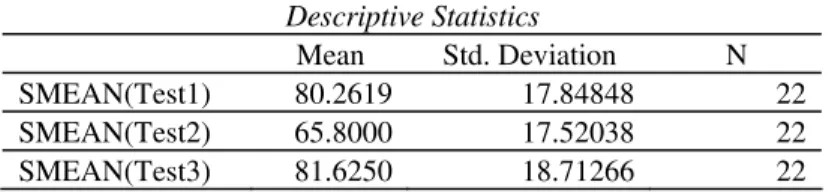
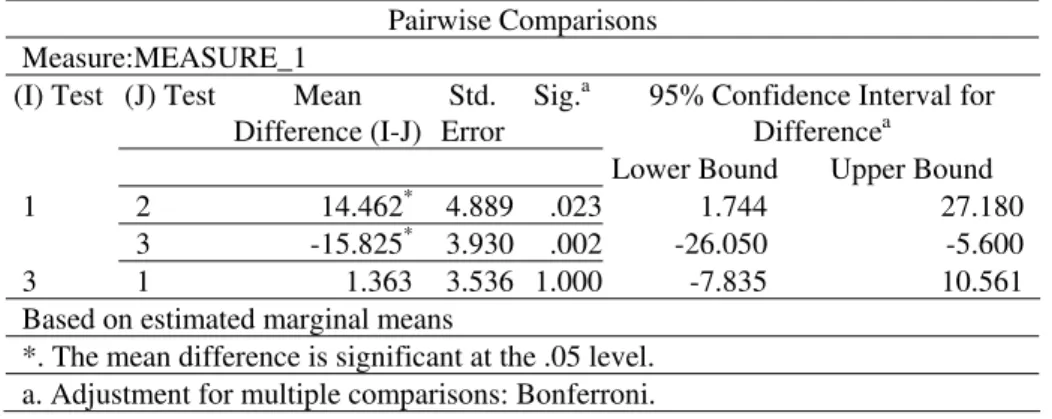
The repeated measure ANOVA revealed no significant difference in the mean scores between comprehension tests one and three. However the mean score on comprehension test two differed significantly from the other two tests. Table 1 provides mean scores for the three tests.
Table 1. Comparison of mean scores for the three reading comprehension tests. Descriptive Statistics
Mean Std. Deviation N
SMEAN(Test1) 80.2619 17.84848 22
SMEAN(Test2) 65.8000 17.52038 22
SMEAN(Test3) 81.6250 18.71266 22
one and three were not significantly different. The level of significance was 1.00, p < .05.
Table 2. Pairwise tests providing level of significance in mean score differences.
Pairwise Comparisons Measure:MEASURE_1
(I) Test (J) Test Mean
Difference (I-J) Std. Error
Sig.a 95% Confidence Interval for
Differencea
Lower Bound Upper Bound
1 2 14.462* 4.889 .023 1.744 27.180
3 -15.825* 3.930 .002 -26.050 -5.600
3 1 1.363 3.536 1.000 -7.835 10.561
Based on estimated marginal means
*. The mean difference is significant at the .05 level. a. Adjustment for multiple comparisons: Bonferroni.
The participants scored significantly lower on test two even though it assessed comprehension of a book delivered in the exact same format as the book for test 3. Test one assessed comprehension of a print book, and test three assessed the comprehension of an e-book. However, the scores for test 1 (print book) compared with test 3 (e-book) were nearly identical. Test items were written using standardized tests typically used in the subjects’ classroom.
Unlike the test items, the survey items were intended to measure the level of enjoyment that the participants experienced while reading the books in the various formats. Additionally, Chi-square cross tabulations were conducted to reveal any interaction among the four surveys. The first three surveys measured enjoyment of each book, and the fourth survey measured their preference for reading books in either print or electronic format. The only significant interaction among the first three surveys was the question regarding enjoyment of the books. The participants indicated an equal level of enjoyment regardless of the book format.
also indicated that they would like to log into the Raz-Kids website from home and read more books from home. The students did not have difficulty with navigating the books on the computer, and they did not find it confusing.
Nonparametric analysis
Survey 1 measured the enjoyment for Yellow House, and Survey 3 measured enjoyment for Sweet Potato. In terms of the enjoyment question on Survey 1 compared to Survey 3 Sweet Potato, the response to Enjoy is 62.5% for Yellow House compared to 71.4% for Sweet Potato. See also the response to somewhat true at 25% for Yellow House compared to 33.3% for Sweet Potato in Table 3. This shows more students responded at a higher level of enjoyment for Sweet Potato e-book than for Yellow House print book.
Table 3. Comparison of enjoyment of Yellow House (print) with enjoyment of Sweet Potato (electronic)
Compare Survey 1 with Survey 3 Not True Somewhat True True Total
Count 1 2 5 8
Expected Count 1.5 3.0 3.5 8.0
% within Survey 1 Enjoy 12.5% 25.0% 62.5% 100.0%
% within Survey 3 Enjoy 33.3% 33.3% 71.4% 50.0%
True
6.3% 12.5% 31.3% 50.0%
Compare this to Table 4 as shown below. Students’ response to the enjoyment question for Mystery Wind compared to enjoyment question for Yellow House is the same. The format print book compared to e-book does not appear to be a factor. This leads to the conclusion that content, theme, setting, and plot may have a stronger effect on children's reading motivation than format.
Table 4. Comparison of enjoyment of Yellow House (print) with enjoyment of Mystery Wind (electronic)
Survey 1 to Survey 2 Enjoy Not
True
Somewha t True
True Total
Count 1 0 6 7
% within Survey 1 Yellow Enjoy
14.3% .0% 85.7% 100.0%
% within Survey 2 Mystery Enjoy
25.0% .0% 85.7% 46.7%
Survey 1 to Survey 2 Enjoy
True
Total 6.7% .0% 40.0% 46.7%
book titles. There is a strong correspondence in survey response between those students who enjoyed the e-book Sweet Potato with students who liked being able to choose from a wide selection of book titles. This suggests that students who enjoyed the e-book Sweet Potato are motivated when given the opportunity to choose their own reading materials.
Table 5. Significant relationship between “enjoyment” and “freedom to books to read”
Chi-square Tests for Pearson correlation between “Enjoy” Sweet Potato with “choice of titles”
Value df Asymp. Sig. (2-sided)
Pearson Chi-square 12.974a 4 .011*
Likelihood Ratio 9.709 4 .046
Linear-by-Linear Association 4.532 1 .033
N of Valid Cases 18
DISCUSSION
The results of the ANOVA yielded interesting results since the students scored significantly lower on the second test based on a book that was read in the same electronic format as the third book. The survey results also indicated that the participants enjoyed the first and third books more than the second book. The mean enjoyment score for book one was 2.32 which was identical for the mean enjoyment score for book three. The mean enjoyment score for book two was 2.11 which was significantly lower. This coincided with the significantly lower score on the comprehension test for book two, while the comprehension scores for books one and three were nearly identical. These findings would indicate that the format of the book did not matter as much as the level of enjoyment that the children received from the storyline. All three books were read in the same fashion with the children “bump reading” in the same reading groups for each session. The groups also had the same facilitator for each session. The groups also all engaged in the same extension activities after reading each selection. The homogeneous groupings also ensured that their reading levels were comparable. The only difference in the study design was the format of the books. Readings of the print book and the second e-book resulted in comparable amounts of enjoyment and comparable comprehension scores.
The first reading selection was the first three chapters of The Yellow House Mystery. The first three chapters of the book were read in groups, and participants were subsequently tested on those three chapters. The remainder of the book was read aloud to the students with the teacher or a researcher reading a chapter a day after recess.
The third book that the participants read in electronic format was entitled The Sweet Potato Challenge. This e-book was about a cooking contest and contained recipes for various desserts. This book centered on children living in America and challenging each other to make the best sweet potato pie. The children “bump read” this entire book and were also able to click on highlighted vocabulary words to either have the word pronounced or have the definition displayed. The facilitators ensured that the only child who was allowed to use the interactive features was the child who was reading aloud. The book also contained a feature that would allow children to change pictures without changing the page. Therefore, some children clicked the “enter” button expecting the page to change while only seeing a different picture. The text remained the same. In responding to the survey, children did not find this feature difficult or annoying.
read” and used the interactive features. One difference was that this was the first book that the children read using the electronic format. They were allowed to explore the other books in the Raz-Kids site before reading The Mystery Wind, but this was the first e-book that the children had ever read. Another notable difference between this book and the other two was that The Mystery Wind was about a little girl in Africa who discovers a mysterious wind that brings good fortune to her village. The program offered sound effects of the wind blowing and had other similar features to the third book that the participants read in electronic format.
The most notable difference between this book and the other two was that this book was not set in America and did not contain a setting that was automatically familiar to the participants. The huts in which the characters lived and the oxen that roamed around the village may not have been as easy to understand as the settings of the other two books. The students also did not enjoy the story as indicated on the survey. Their lack of enjoyment was also reflected in their comprehension scores. It is possible that their reading engagement was lower because of their lack of interest in the story.
A central finding in these data was the strong correlation between enjoyment of the final e-book that the children read and their preference for a choice of books. As Flowerday, et al., (2004) found, children are highly motivated to read and remain engaged in literacy activities when afforded a choice of what to read. The participants in this study all rummaged through the Raz-kids site to find other books which might interest them when given the opportunity to do so. This correlation between enjoyment of Sweet Potato, an e-book, and a preference for self-selected reading material suggests that the electronic format combined with the opportunity for choosing books was a highly motivating factor for children to read.
they still indicated that they would like to continue reading books from both formats.
The results from both the comprehension tests and the surveys indicated that the format in which children read the material is not an important indicator for this study. The e-book format did not significantly increase comprehension, enjoyment, or engagement. The data clearly indicated that children prefer to have a choice of reading material and that the format was not as central to reading engagement as a connection with the story’s characters and setting. As publishers and teachers begin to introduce electronic reading to younger children, strong consideration must be given to the quality and quantity of the books provided for children to read. The results of this study indicated that the format in which the book was delivered did not matter as much as the suitability of character, theme, and setting of the books and how these align with personal preferences of the reader. A second outcome is further evidence which suggested a wide variety of reading choices and the opportunity to select books does impact reading engagement and ultimately reading comprehension.
LIMITATIONS
REFERENCES
Arzubiaga, A., Rueda, R., & Monzo’, L. YUN (2002). Family matters related to the reading engagement of Latino children. Journal of Latinos and Education, 1(4), 1-17.
Bairstow, J. (2009). Tales from the e-book battle lines. Laser Focus World, 45(10), 76.
Bakker, V. O. & Snyder, J. (n.d.). The sweet potato challenge. Retrieved from http://www.razkids.com/main/Play/id/105/resource/read_along_book/cat/18/sor t/latest
Binder, J. (2008). Curling up with a good e-book. Aerospace America, 46(8), 20-22.
Brown, C. A., & Dotson, K. (2007). Writing your own history: A case study using digital primary source documents. TechTrends, 51(3), 30-37.
Brown, C. & Hill, J. (2009). Connecting media specialists, students, and standards through Web 2.0. In M. Orey, V. J. McClendon, & R. B. Branch (Eds.), Educational Media and Technology Yearbook (pp. 211-229). Boston, MA: Springer Publishers.
Clark, A. T., Power, T. J., Blom-Hoffman, J., Dwyer, J. F., Kelleher, C. R., & Novak, M. (2003). Kindergarten reading engagement: An investigation of teacher ratings. Journal of Applied School Psychology, 20(1), 131-144.
Flowerday, T., Schraw, G., & Stevens, J. (2004). The role of choice and interest in reader engagement. The Journal of Experimental Education, 72(2), 93-114.
Grudzien, P. & Casey, A. M. (2008). Do off-campus students use e-books? Journal of Library Administration 48(3/4), 455-466.
Hyun, E. (2004). A study of 5- to 6-year-old children’s peer dynamics and dialectical learning in a computer-based technology-rich classroom environment. Computers & Education, 44(1), 69-91.
Jewell, J., Phelps, A., Phelps, A., & Kuhnen, D. (1998). Improving reading engagement in the primary classroom. Unpublished action research project, Saint Xavier University & IRI/skylight.
Johnson, J. E. & Christie, J. F. (2009). Play and digital media. Computers in the Schools, 26(4), 284-289.
Kasten, W. C. & Wilfong, L. G. (2007). Encouraging independent reading: Towards lifelong readers and learners. International Journal of Learning, 13(10), 1-8.
Kaufman, W. (2010, January 20). At Amazon, e-book sales outpace hardbacks. National Public Radio. Retrieved from http://www.npr.org/templates/story/ story.php?storyId=128635547
Lardinois, F. (2009). Google opens up its EPUB archive: Download 1 million books for free. Read Write Web. Retrieved from http://www.readwriteweb.com/
Larson, L. C. (2010). Digital readers: The next chapter in e-book reading and response. The Reading Teacher, 64(1), 15-22.
Law, N. (2007). Curriculum and staff development in education. In T. Plomp, R. E. Anderson, N. Law, A. Quale, (Eds.), Cross-national information and communication technology: Policies and practices in education (2nd Ed.) (pp. 19-39). Charlotte, NC: Information Age Publishing.
Love, M. S. (2005). Multimodality of learning through anchored instruction. Journal of Adolescent & Adult Literacy, 48(4), 300-310.
Lowether, D., Inan, F., Daniel, S., & Ross, S. (2008). Does technology integration work when key barriers are removed? Educational Media International, 45(3), 195-213.
Lutz, S. L., Guthrie, J. T., & Davis, M. H. (2006). Scaffolding for engagement in elementary school reading instruction. Journal of Educational Research, 100(1), 3-20.
Marinak, B. A. & Gambrell, L. B. (2008). Intrinsic motivation and rewards: What sustains young children’s engagement with text? Literacy Research and Instruction, 47(1), 9-26.
McGlinn, & Parrish. (2002). Accelerating ESL students’ reading progress with Accelerated Reader. Reading Horizons, 42(3), 175-189.
Mioduser, D., Tur-Kaspa, H., & Leitner, I. (2000). The learning value of computer-based instruction of early reading skills. Journal of Computer Assisted Learning, 16(1), 54-63.
Ryan, C. & Armstrong, H. (n. d.). The mystery wind. Retrieved from http://www.razkids.com/main/Play/id/406/resource/read_along_book/cat/15/sor t/latest
Sangani, K. (2009). Give us an ‘e’. Engineering and Technology, 4(7), 32-33.
Warner, G. C. & Gehr, M. (1989). The yellow house mystery (The boxcar children mysteries #3). Park Ridge, IL. Albert Whitman & Company.