Exacta
ISSN: 1678-5428 [email protected]
Universidade Nove de Julho Brasil
Silva, André Carlos; Medeiros da Luz, José Aurélio Continuous grinding mill simulation using Austin's model
Exacta, vol. 10, núm. 3, 2012, pp. 333-339 Universidade Nove de Julho
São Paulo, Brasil
Available in: http://www.redalyc.org/articulo.oa?id=81024949003
How to cite Complete issue
André Carlos Silva
Doutor em Engenharia de Materiais, Universidade Federal de Goiás – UFG. Departamento de Engenharia de Minas – DEMIN. Catalão, GO – Brasil. [email protected]
José Aurélio Medeiros da Luz
Doutor em Engenharia Metalúrgica e de Minas, Universidade Federal de Ouro Preto – UFOP, Departamento de Engenharia de Minas – DEMIN. Ouro Preto, MG – Brasil]. [email protected]
Continuous grinding mill simulation using
Austin’s model
Simulação da moagem contínua usando o modelo de Austin
Abstract
Comminution is a frequently-required step in mineral processing and is re-sponsible for almost 90% of all energy consumption in a mineral processing plant. Tumbling mill design has been studied since the middle of the XIX century. There are many comminution models in the literature, with prepon-derance, however, of Austin’s model (2002) for mineral impact breakage. In this paper, Austin’s model was applied to tubular tumbling mills. Once Austin’s model was proposed for batch processing of narrowly-distributed fraction sizes, an artifice has allowed it to be used in continuous grinding mill processes with widely-distributed fraction sizes. Interesting results were obtained with errors less than 0.005 for mills with sharp residence time distributions.
Key words: Comminution. Grinding. Simulation.
Resumo
A etapa de cominuição é frequentemente requerida no processamento mi-neral, sendo responsável por cerca de 90% do consumo energético de uma planta de processamento mineral. O dimensionamento de moinhos tubu-lares revolventes é objeto de estudo desde meados do século XIX. Existem vários modelos para a cominuição disponíveis na literatura, com ênfase no modelo de Austin (2002) para a quebra mineral por impacto. No presente trabalho o modelo de Austin foi aplicado a moinhos tubulares revolventes. Uma vez que o modelo de Austin foi originalmente proposto para processos em batelada de estreita distribuição de tamanhos um artifício foi criado para permitir o seu uso em processos de moagem contínuos com amplas frações de tamanhos. Resultados interessantes foram obtidos com erros inferiores a 0,005 para moagens realizadas com uma distribuição de tempos de residên-cia aguda.
Continuous grinding mill simulation using Austin’s model
1 Introduction
According to Koka and Trass (1987), model-ling of material breakage in mills is very useful for accurate design, operation and control of milling circuits. There has been tremendous progress in the development of models of the unit operation of size reduction, dealing with every type of grinding operation.
Essentially, these models are based on the fact that material breakage in mills is a rate pro-cess and on the application of size/mass balances or population balances on particulate matter un-dergoing size reduction. The models are formulat-ed in terms of the breakage parameters, selection functions and cumulative breakage functions.
The high energy consumption by commi-nution machinery associated with indispensable machines in many mineral processing routes have made grinding mills an intense object of study and research by both academic institutions and private initiative.
Fuerstenau et al. (2011) compared the break-age kinetics and energetics of grinding coarse-sized feed in the presence of deliberately-added fines for different material systems at different coarse/fine ratios. According to the authors, the initial breakage rate function of the coarse par-ticles increases with increasing proportion of fines in the mixture. The fines produced and the coarse material retained on the top sieve were normaliz-able with respect to the specific energy consumed by the coarse fractions.
In this paper, Austin’s model (2002), which was originally proposed only for batch process-ing of narrowly-distributed fraction sizes, was adapted and tested for tubular tumbling mills us-ing an artifice to allow it to be used in continuous processes. The results found were obtained with errors less than 0.005 for mills which a sharp resi-dence time distribution.
2 Material and methods
2.1 Austin’s impact breakage
model
Austin (2002) presented a set of thirteen equations (equations 1 to 13) which model re-petitive breakage and can be used in an algorithm for calculating the apparent cumulative primary breakage (B). Consider feed particles of size xi im-pacted with a specific impact energy E. The en-ergy increment for each enen-ergy class is:
(1)
where N is the number of energy classes considered. The specific impact energy for energy class k is:
(2)
For any given size, the minimum specific im-pact energy required to cause breakage is:
(3)
and the maximum specific impact energy required to give complete breakage is:
(4)
where A is a dimensionless material constant not dependent on particle size, and Ki (units of Ki are specific impact energy) was found to be dependent on particle size with the form:
(5)
unit size x0. According to Yildirim et al. (1999), for dry grinding of high-purity quartz sand using ceramic balls as grinding medium, C should be 0.103. Using instead ceramic cylinders, C should be 0.148; and, using pebbles, 0.0965.
According to Austin (2002), the mass frac-tion of particles of size xi that breaks by fracture at a specific impact energy class k is:
(6)
since there can be no breakage of any size for the zero-energy class and no breakage out of the final “sink” size interval. Assuming that fragments of size i formed by breakage (progeny) have the same strength distribution as the size i tested (irrespec-tive of whether their source is from strong or weak parent particles), the fraction of particles of size i
that fracture over the energy range indexed by k is:
(7)
The size/mass/energy balance is:
(8)
where p’i,k is the mass fraction of material that ar-rives in size i and energy class k that can be re-broken (the sum of p’i,k is not equal to 1 because
the same mass can be broken over and over again). The mass fraction of larger size t that appears in size interval i after primary fracture (bi,t) is:
(9)
where Bi,j is the mass fraction of material of larger size j that appears smaller than size xi after primary fracture. According to Austin and Luckie (1972) the values of Bi,j can be estimated from a size anal-ysis of the product from short-time grinding of a starting mill load predominantly of size j (the one-size fraction BII method) using the equation:
(10)
This is approximately correct for small de-grees of repeated breakage products. Pi(t) is the weight fraction less than the upper size of size in-terval i after grinding time t. The equation applies only if less than about 30% of size 1 is broken.
The sum of remaining fractions of unbroken material left in size i at each step is the final prod-uct leaving the impact zone:
(11)
Cumulating from the smallest size to give the mass fraction less than size xi, one has the follow-ing equation:
Continuous grinding mill simulation using Austin’s model
Since some material in the single feed size 1 may be unbroken (p1), the apparent cumulative primary breakage B values are:
(13)
2.2 Specific impact energy
calculation
In the absence of an appropriate experimen-tal apparatus for the determination of the specific impact energy (E), a methodology proposed by Morrell (1992) for tumbling mills was adopted (equations 14 to 21). The total density of the tum-bling mill load (t/m3) is:
(14)
where ρO is the ore density (t/m3), ρ
B is the ball density (t/m3), F
B is the volume fraction of the tum-bling mill occupied by the grinding media (balls including voids) and Ft is the volume fraction of the tumbling mill occupied by the ore, and by the grinding media balls (including voids). The angu-lar displacement of the top position (in radians) is:
€
θ
S=
(
0.499
f −
0.746
)
+
(
5.490
f −
0.969
)
F
t (15)where f is the fraction of the tumbling mill criti-cal speed. The angular momentum of the bottom fraction (θT) is:
(16)
where the A1 parameter is:
(17)
The radial position of the surface of the load (ri) is:
(18)
where rm is the internal effective radius of the bling mill (in m). The power delivered to the tum-bling mill load (in kW) is:
(19)
where g is the acceleration of gravity (m/s2) and L
the effective length of the tumbling mill (m). The power delivered to the empty tumbling mill, des-ignated by the term no-load (kW) is:
(20)
The gross power delivered to the tumbling mill (kW) is:
(21)
where FK is a correction factor equal to 1.22 for grating mills. In order to calculated the gross pow-er delivpow-ered to the tumbling mill ppow-er ton of mate-rial, the result of equation 21 was divided by the mass of material inside the tumbling mill.
2.3 Adapting Austin’s model to
widely-sized feed
iterations is equal to the number of screens used, and each iteration product is the feed of the next iteration. The new approach comes from the fact that feeds need not be narrowly-sized.
3 Results
The model was initially validated with a single-size distribution feed (batch grinding) with two different data sets: a literature data set (Austin, 2002) and experimental data obtained from the grinding of quartz sand and glass balls. Figure 1 shows the results for Bi,j from quartz sand and glass ball grinding (experimental) ver-sus the model for batch grinding and a good agreement of the proposed model with two dif-ferent cases of batch grinding, which indicates that Austin’s model (2002) is a good fit for this type of grinding process.
To test the applicability of the proposed model to tumbling mills with a wide-ranging size distribution of feed (continuous grinding), samples of 3.5 kg of quartz sand were separated to be used in a series of four grinding tests. The sample size distribution was determined by dry sieving. Figure 2 shows the size distribution of the quartz sand sample used before grinding (feed) and the products of the grindings (1, 4, 8 and 16 minutes). The product of each grinding test was used as feed for the next one, and at the end of the four grinding tests the sample was ground during 29 minutes.
The operational characteristics of the grind-ing tests were: 14.0 kg of steel balls 25 mm in diameter; tumbling mill with a diameter 20 cm, length of 20 cm, and rotational speed of 80 ± 3 rpm. The experimental breakage matrix was de-termined for each grinding test using the equation 10, and the theoretical breakage function was cal-culated using equations 1 to 13 (Austin, 2002). An
(a)
(b)
Figure 1: Results of Bi,1 determination for quartz
sand (a) and glass ball (b) batch grinding versus the model
Continuous grinding mill simulation using Austin’s model
error search and minimization algorithm was used to evaluate the model parameters using MathCad software version 6.0, and a sensitivity analysis of the evaluated parameters was performed to check the adherence of the parameters to the experimen-tal breakage function (error less than 5 %). The constants obtained were: C = 3.000; m = 0.580; and A = 0.150. The specific impact energy was de-termined using equations 14 to 21 (Morrell, 1992).
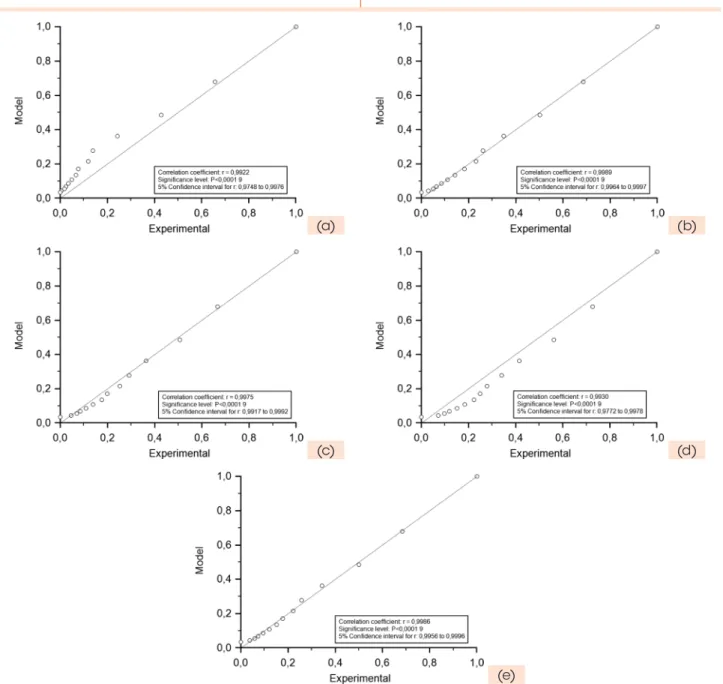
Figure 3 shows the results for Bi,j from quartz sand grinding (experimental) versus the model for continuous grinding. Figure 3a shows the results for 1 minute of grinding; 3b for 4 min-utes; 3c for 8 minmin-utes; and 3d for 16 minutes. Figure 3e shows the results for the average ex-perimental value of Bi,j.
Figures 3a through 3d show fitness between the model and the experimental results. Although
(a) (b)
(c) (d)
(e)
Figure 3: Results of Bi,1 determination for quartz sands grinding versus the model: (a) 1 minute, (b) 4
the worst result has a correlation coefficient equal to 0.9922 (Figure 3a), which can be considered a good result, it is lower than the correlation coef-ficient found for the batch grinding. When the re-sults for continuous grinding simulation are con-sidered as averages of results from the other four tests (Figure 3e) the fit is considerably better. This can be understood as a global breakage function, which applies for both the mill and the material. It should be noted that no adjustment was made of the theoretical breakage function in relation to the experimental breakage functions for the individu-al times. A better fit will probably be achieved be-tween the two breakage functions, but this would deviate from the proposed methodology.
4 Conclusions
Although Austin’s model has been developed for impact comminution, it applies well to batch grinding in tumbling mills where impact and abrasion breakage mechanisms exist. The pro-posed variation in the use of Austin’s model can be used in the simulation of continuous grind-ing in tumblgrind-ing mills since the range of residence time distribution in the tumbling mill is small. As the grinding tests were batch tests while the
grinding operations are mostly conducted in con-tinuous flow, the grinding time of this study rep-resents the average residence time of particles in a tumbling mill.
In future work, we intend to validate the proposed model for other mineral species and for different grinding operational parameters, such as rotation, media and dimensions of the mill.
References
AUSTIN, L. G. A treatment of impact breakage of particles. Powder Technology, v. 126, n. 1, p. 85-90, 2002.
AUSTIN, L. G.; LUCKIE, P. T. Methods for determination of breakage distribution parameters Original Research Article. Powder Technology, v. 5, n. 4, p. 215-222, 1972.
FUERSTENAU, D. W. et al. Simulation of the grinding of coarse/fine (heterogeneous) systems in a ball mill. International Journal of Mineral Processing, v. 99, n. 1-4, 8, p. 32-38, 2011.
KOKA, V. R.; TRASS, O. Determination of breakage parameters and modelling of coal breakage in the Szego mill. Powder Technology, v. 51, n. 2, p. 201-214, 1987.
MORRELL, S. Prediction of grinding-mill power. Transaction Inst. Min. Metall. (Sect.C: Mineral Process. Extr. Metall.), v. 101, p. 25-32, 1992.
YILDIRIM, K.; CHO, H.; AUSTIN, L. G. The modeling of dry grinding of quartz in tumbling media mills. Powder Technology, v. 105, m. 1-3, p. 210-221, 1999.
Recebido em 10 set. 2012 / aprovado em 21 nov. 2012
Para referenciar este texto