Arbuscular mycorrhizal fungi in saline soils:
Vertical distribution at different soil depth
Alejandra Becerra
1, Norberto Bartoloni
2, Noelia Cofré
1,
Florencia Soteras
1, Marta Cabello
31Instituto Multidisciplinario de Biología Vegetal, Consejo Nacional de Investigaciones Científicas y
Técnicas, Facultad de Ciencias Exactas, Físicas y Naturales, Universidad Nacional de Córdoba, Córdoba, República Argentina.
2Facultad de Agronomía, Universidad de Buenos Aires, Buenos Aires, República Argentina.
3Instituto Spegazzini, Facultad de Ciencias Naturales y Museo, Universidad Nacional de La Plata,
La Plata, República Argentina.
Submitted: March 7, 2013; Approved: March 14, 2014.
Abstract
Arbuscular mycorrhizal fungi (AMF) colonize land plants in every ecosystem, even extreme condi-tions such as saline soils. In the present work we report for the first time the mycorrhizal status and the vertical fungal distribution of AMF spores present in the rhizospheric soil samples of four species of
Chenopodiaceae (Allenrolfea patagonica,Atriplex argentina,Heterostachys ritterianaandSuaeda
divaricata) at five different depths in two saline of central Argentina. Roots showed medium, low or no colonization (0-50%). Nineteen morphologically distinctive AMF species were recovered. The number of AMF spores ranged between 3 and 1162 per 100 g dry soil, and AMF spore number de-creased as depth inde-creased at both sites. The highest spore number was recorded in the upper soil
depth (0-10 cm) and inS. divaricata. Depending of the host plant, some AMF species sporulated
mainly in the deep soil layers (Glomus magnicaule in Allenrolfea patagonica, Septoglomusaff.
constrictuminAtriplex argentina), others mainly in the top layers (G. brohulttiinAtriplex argentina
andSeptoglomusaff. constrictuminAllenrolfea patagonica). Although the low percentages of
colo-nization or lack of it, our results show a moderate diversity of AMF associated to the species of Chenopodiaceae investigated in this study. The taxonomical diversity reveals that AMF are adapted to extreme environmental conditions from saline soils of central Argentina.
Key words:arbuscular mycorrhiza, saline environments, soil profile, vertical distribution, mycor-rhizal status.
Introduction
In central Argentina 9% of the area is occupied by halophytic vegetation (Cabido and Zak, 1999). This type of vegetation grows in habitats that are rare worldwide, since only approximately 7% of the global land surface is cov-ered with saline habitats (Ruíz-Lozano and Azcón, 2000). Central Argentina presents some conspicuous salt flats: the Salinas Grandes and the Salinas de Ambargasta, which to-gether occupies an area of approximately 600,000 hectares. The environmental isolation, the harsh climatic conditions,
the characteristics of marginal lands for agriculture and livestock and no stable human population within it, have fa-cilitated the preservation of this pristine ecosystem. Within these saline habitats, the distribution patterns of plant com-munities are defined by the salt gradient, with plant cover inversely proportional to the presence of salt. At sites where plant life is still possible, the most characteristic plant com-munity is the halophytic shrub or jumeal, composed of spe-cies of the Chenopodiaceae family (Cabido and Zak, 1999).
Send correspondence to A. Becerra. Instituto Multidisciplinario de Biología Vegetal, Consejo Nacional de Investigaciones Científicas y Técnicas, Facultad de Ciencias Exactas, Físicas y Naturales, Universidad Nacional de Córdoba, C.C. 495. 5000 Córdoba, República Argentina. E-mail: [email protected].
According to Juniper and Abbott (1993), high salinity in soils has adverse effects on plant colonization by arbus-cular mycorrhizal fungi (AMF). However, there are reports in the literature from all over the world that plants of salt
marshes can be colonized by AMF (Hildebrandt et al.,
2001; Juniper and Abbott, 1993; Landwehr et al., 2002;
Smith and Read, 2008; Wanget al., 2004). Even in families
that are generally considered non-mycorrhizal, such as
Chenopodiaceae (Gerdemann, 1968; Hirrel et al., 1978;
Mohankumar and Mahadevan, 1987; Petersonet al., 1985),
the most salt-tolerantSalicorniasp. andSuaeda maritima
can be colonized (Kim and Weber, 1985; Rozemaet al.,
1986; Sengupta and Chaudhuri, 1990).
Ecological studies on the community structure of AMF are generally restricted to the top 20 cm of soil, where most of the root biomass is concentrated (Brundrett, 1991). Only a few studies included the subsoil. Mycorrhizal colo-nization (Jakobsen and Nielsen, 1983; Rillig and Field,
2003), infective propagules (Annet al., 1990), extra-radical
mycelium (Kabiret al., 1998) and AMF spores (Oehlet al.,
2005) decrease with increasing soil depth. Few studies have documented what happens with AMF diversity along soil
profile. Cookeet al.(1993), Oehlet al.(2005), Cuenca and
Lovera (2010) and Wanget al.(2004) have published the
species diversity and distribution across the soil profile in salt marsh grasses in the United States, in cultivated soils of Central Europe, tropical soils of Venezuela and in the Yel-low River Delta of China, respectively. Until now, nothing has been reported about vertical distribution of AMF com-munities in natural saline soils of Central Argentina.
In the present work we report for the first time the mycorrhizal status and the vertical fungal spores in four
species of Chenopodiaceae (Allenrolfea patagonica(Moq.)
Kuntze,Atriplex argentinaSpeg.,Heterostachys ritteriana
(Moq.) Moq. andSuaeda divaricata Moq.) in two saline
soil of central Argentina. Species of Chenopodiaceae are the only plants able to growth in such extremophilus condi-tions and in Argentina ecosystems have not been previ-ously examined for AMF presence.
Materials and Methods
Study area and sample collection
The study was conducted in two saline “Salinas de Ambargasta” -SA- (64º18’ W, 29º27’ S) and “Salinas Grandes” -SG- (64º31’ W, 29º44’ S), in the north of Cór-doba Province, central Argentina. The climate in both sites is dry and warm, with a mean annual precipitation below 500 mm and mean temperature of 19.9 °C. The highest ar-eas (170 masl, with low salt concentration) are occupied by
a xerophytic forest of Aspidosperma quebracho-blanco
Schltdl., Prosopis flexuosa DC., Cercidium australe
Johnst., Mimozyganthus carinatus (Grisseb.) Bukart,
Ziziphus mistolGriseb.,Prosopis torquata(Cav. ex Lag.)
DC., and Stetsonia coryne(Salm-Dyck) Britton & Rose;
the understory vegetation is represented by Larrea
divaricataCav. and some halophytes.
Our studied area, the edge of the salt flat, shows heavy constraints to the developing of any type of plant cover, being extremely open and scarce with the only pres-ence of four species adapted to harsh environment:
Allenrolfea patagonica(Moq.) Kuntze,Atriplex argentina
Speg.,Heterostachys ritteriana(Moq.) Moq. andSuaeda
divaricata Moq. (Cabido and Zak, 1999; Cabido et al.,
2006). Sampling was made in an area of approximately 50 x 50 m in the two sites in end of the growing season (March, Summer) because during this period the plants present their full splendor (with flowers). Soil samples were randomly and carefully taken with a metal corer (3 cm of diameter) from under the canopy of five plants of each species to con-firm connection between roots and shoots. The five soil samples per species were considered replicates.
Samples were collected from 0 to more than 40 cm in depth, at 10-cm intervals (at 0-10, 10-20, 20-30, 30-40, and 40-50 cm depths) in each site. Samples from each layer
(620 cm3soil volume) of each replicate were placed in
indi-vidual plastic bags and stored at 4 °C.
To characterize the soil from each site, four soil sam-ples per depth level were taken and the following parame-ters were measured: electrical conductivity (mmhos/cm), extractable P determined with the method of Bray and Kurtz I (Jackson, 1964), pH in water (1:2.5), organic matter content (Nelson and Sommers, 1982), carbon: nitrogen ra-tio and soil texture. Total nitrogen was determined using the micro-Kjeldhal method (Bremner and Mulvaney, 1982).
AMF colonization and spores
Fresh roots were rinsed with water, cleared with 10%
KOH (15 min at 90 °C) and bleached with 30% H2O2
(10 min, room temperature), acidified with 1% HCl (1 min, room temperature) and stained for 5 min in 0.05% trypan blue (Phillips and Hayman, 1970). To confirm mycorrhizal structure, in a second stage we then mounted the roots on glass slides for examination under a Kyowa 4-100x micro-scopic. The presence of arbuscules, vesicles, hyphal coils and intra- and intercellular hyphae without septa were used to designate AM associations. Quantification of AM root colonization was estimated visually as the proportion of the root which was colonized and characterized using five classes: very high (> 80%), high (60-79%), medium (40-59%), low (20-39%), and very low (1-19%), following
Zangaroet al.(2002).
AMF spores were extracted from 100 g (dry weight) of each soil sample by wet sieving and decanting (Ger-demann and Nicolson, 1963), and the supernatant was
cen-trifuged in a sucrose gradient (Walkeret al., 1982). The
procedure included passage through 500-, 125-, and 38-mm
sieves. The 500-mm sieve was checked for large spores,
spore clusters, and sporocarps. The contents of the 125- and
38-mm sieves were layered onto a water-sucrose solution
(70% [wt/vol]) gradient and centrifuged at 900 x g for
2 min. Only apparently healthy spores (those that contained cytoplasm, with no collapsed surface and no evidence of parasitism) were counted under stereomicroscope directly. For taxonomic identification, fungal spores and sporocarps were mounted onto slides using PVA
(polyvi-nyl alcohol) with and without Melzer reagent (Omaret al.,
1979) and examined with a compound microscope. AMF species were identified following original species descrip-tions and those presented by INVAM (International Cul-ture Collection of Arbuscular and Vesicular-Arbuscular
Mycorrhizal Fungi), Szcezecin University and Redeckeret
al.(2013). Vouchers were deposited in the Herbarium at
the Spegazzini Institute (LPS), La Plata, Argentina. Spore number and AMF species richness in different soil layers were expressed as follows: total number of spores and number of AMF species in 100 g dry soil. Soil moisture content was calculated for each soil sample as per-cent oven-dry weight of soil by drying at 80 °C for 48 h.
Species diversity was measured by the Shannon di-versity index, which combines two components of diver-sity, species richness and evenness. It is calculated with the equation
H pi pi
i s
=
=
å
(log2 ) 1wherepiis the probability of finding each speciesiin one
sample.
Statistical analysis
To evaluate the effect of depth level (within-subjects variables), sites and hosts species (between-subjects fac-tors) on spore number, richness and diversity of AMF a re-peated measures analysis of variance (ANOVA) followed by a Bonferroni multiple comparisons with a significance level of 0.05 was performed. All residuals were tested for normality and homocedasticity with Shapiro-Wilks and Levenes tests, respectively. AMF spore number was log transformed. All statistics were performed using
STATISTICA program of statsoft
(http://www.statsoft.com/) Version 8.
Results
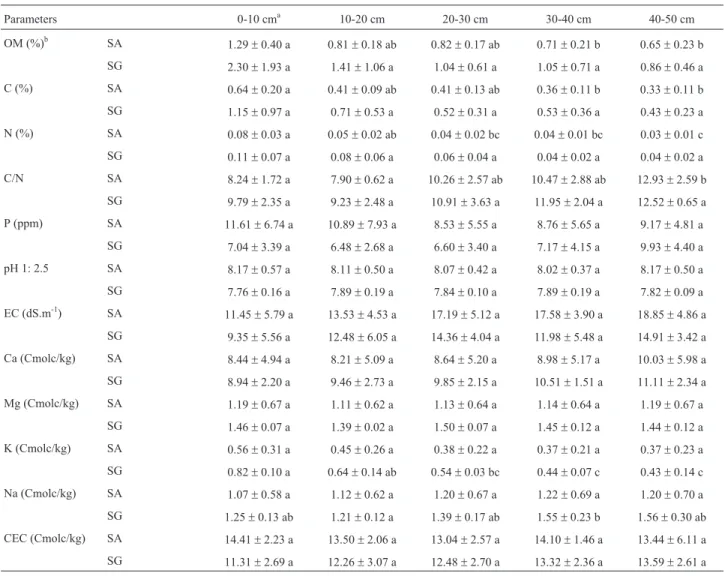
Soils of Salinas de Ambargasta (SA) and Salinas Grandes (SG) were Aridisol-Orthid typic Salorthids (INTA, 2003). Both sites presented a sandy clay loam tex-ture, high pH and electrical conductivity, and slightly CEC and organic matter content. Depth level influenced signifi-cantly some soil parameters (Table 1). A decrease in or-ganic matter content, C, N, K and an increase in Na with increasing soil depth were observed (Table 1).
Roots fromA. patagonica,A. argentina,H. ritteriana
andS. divaricatawere colonized and showed entry points,
intraradical aseptate hyphae, intracellular hyphal coils and intracellular vesicles in both sites at all soil depths. Arbuscules were not detected. AM colonization in plant
species was very low to low (5-31% and 2-37%) in A.
patagonicaandS. divaricata, respectively; inH. ritteriana
andA. argentinaAM colonization was very low to medium
(0-45% and 4-50%), respectively.
A total of 19 morphologically distinctive AMF spe-cies were recovered, and 14 could be attributed to known species belonging to eigth genera (Acaulospora,
Ambispora, Claroideoglomus, Diversispora, Glomus,
Funneliformis,RhizophagusandSeptoglomus) (Table 2).
The community of spores was dominated by Glomus
brohultti,Septoglomusaff. constrictumand Funneliformis
geosporum. In total four morphotypes belonging toGlomus
were found (two glomoid morphotypes remain
unidenti-fied, Figure 1). Five morphotypes belongs toAcaulospora
(two acaulosporoid morphotypes remain unidentified,
Fig-ure 1), three toClaroideoglomus, two toFunneliformisand
Rhizophagus, one to Ambispora, Diversispora and
Septoglomus.
Brief morphological characteristics of two glomoid and acaulosporoid unknown morphotypes are described be-low.
Glomoid morphotype sp. 1: Spores reddish brown;
globlose to subglobose, 72-130 mm x 82-130 mm.
Sub-tending hyphae: straight to curved; wall continuous with spore wall and slightly lighter in color than spore wall. Pore closure: septum under spore base. Other characteristics:
ir-regular globular projections (3-5) x (5-6) mm slightly
lighter in color than spore wall (Figure 1 a-b).
Glomoid morphotype sp. 2: Spores orange; globose
to subglobose, 60-112 mm x 60-112 mm. Subtending
hyphae: straight; wall continuous with spore wall and slightly lighter in color than spore wall. Pore closure: con-stricted at spore base. Other characteristics: irregular glob-ular projections slightly lighter in color than spore wall. Usually, very long subtending hyphae (Figure 1 c-d).
Acaulosporoid morphotype sp. 1: Spores hyaline to
orange, globose to subglobose, 75-150mm x 60-180mm.
Spore wall with three layers. The outer hyaline, thin and flexible. Middle layer pale yellow, very fine, with numer-ous folds on the spore surface and appears “rugose”. The
third layer is a thin layer, less than 1mm thick. It often is
ad-herent to the spore wall in which case it cannot be detected (Figure 1 e).
Acaulosporoid morphotype sp. 2: Spores orange to
red orange, globose to subglobose, 50-90mm x 45-80mm.
Table 2 lists the relative abundance of all AMF spe-cies collected ordered according to soil profile, sites and plant species. Clearly the majorities of AMF spore types were rare and apparently did not change along soil profile. The majority of AMF occurred in low densities (relative abundance < 1%). Depending on the plant species, some species were increasingly found with increasing soil
depth, at least in relative terms. These were Glomus
magnicaule in Allenrolfea patagonicaand Septoglomus
aff. constrictum in Atriplex argentina. Some species
sporulated in the top layers; these were G. brohulttiin
Atriplex argentina and Septoglomus aff. constrictum in
Allenrolfea patagonica.
The AMF spores number ranged between 3 and 1162
per 100 g dry soil (mean number:166±75). Spore number
varied from 7 to 591 per 100 g dry soil in Salinas de
Ambargasta (mean number: 122±37) and from 3 to 1162
per 100 g dry soil in Salinas Grandes (mean number: 210±
117). Spores number was high in the upper soil horizon (0-10 cm), decreasing with increasing soil depth. AMF spores differed among plant species throughout soil depths (Table 3). Significant differences were observed among rhizospheres of the different plant species and soil depths, and among sites and soil depths. A significant triple interac-tion among soil depth x plant species x site was observed, indicating that AMF spore number decreases as depth in-creases at both sites (Figure 2).
AMF species diversity and richness differed signifi-cantly among rhizospheres of the host species and sites (Tables 3, 4). Similarly to observed for spore number, a sig-nificant triple interaction among soil depth x host plant spe-cies x site were evidenced in AMF spespe-cies diversity and richness, indicating that all ecological parameters decrease in plant species as depth increases at both sites. The highest
value of species diversity and richness was recorded inS.
divaricata(H = 2.3, richness 8 species).
588 Becerraet al.
Table 1- Soil properties of the two study sites, Salinas de Ambargasta (SA) and Salinas Grandes (SG), at five depth levels (0-10, 10-20, 20-30, 30-40, and 40-50 cm).a: Mean value of 4 samples. Values within a row followed by the same letter were not significantly different for each saline site among soil
depth (p < 0.05).b: OM: organic matter content, C: carbon, N: total nitrogen; C/N: carbon/nitrogen ratio, P: available phosphorus, EC: electrical
conduc-tivity, Ca: calcium, Mg: magnesium, K: potassium, Na: sodium, CEC: cation exchange capacity.
Parameters 0-10 cma 10-20 cm 20-30 cm 30-40 cm 40-50 cm
OM (%)b SA 1.29
±0.40 a 0.81±0.18 ab 0.82±0.17 ab 0.71±0.21 b 0.65±0.23 b
SG 2.30±1.93 a 1.41±1.06 a 1.04±0.61 a 1.05±0.71 a 0.86±0.46 a
C (%) SA 0.64±0.20 a 0.41±0.09 ab 0.41±0.13 ab 0.36±0.11 b 0.33±0.11 b
SG 1.15±0.97 a 0.71±0.53 a 0.52±0.31 a 0.53±0.36 a 0.43±0.23 a
N (%) SA 0.08±0.03 a 0.05±0.02 ab 0.04±0.02 bc 0.04±0.01 bc 0.03±0.01 c
SG 0.11±0.07 a 0.08±0.06 a 0.06±0.04 a 0.04±0.02 a 0.04±0.02 a
C/N SA 8.24±1.72 a 7.90±0.62 a 10.26±2.57 ab 10.47±2.88 ab 12.93±2.59 b
SG 9.79±2.35 a 9.23±2.48 a 10.91±3.63 a 11.95±2.04 a 12.52±0.65 a
P (ppm) SA 11.61±6.74 a 10.89±7.93 a 8.53±5.55 a 8.76±5.65 a 9.17±4.81 a
SG 7.04±3.39 a 6.48±2.68 a 6.60±3.40 a 7.17±4.15 a 9.93±4.40 a
pH 1: 2.5 SA 8.17±0.57 a 8.11±0.50 a 8.07±0.42 a 8.02±0.37 a 8.17±0.50 a
SG 7.76±0.16 a 7.89±0.19 a 7.84±0.10 a 7.89±0.19 a 7.82±0.09 a
EC (dS.m-1) SA 11.45
±5.79 a 13.53±4.53 a 17.19±5.12 a 17.58±3.90 a 18.85±4.86 a
SG 9.35±5.56 a 12.48±6.05 a 14.36±4.04 a 11.98±5.48 a 14.91±3.42 a
Ca (Cmolc/kg) SA 8.44±4.94 a 8.21±5.09 a 8.64±5.20 a 8.98±5.17 a 10.03±5.98 a
SG 8.94±2.20 a 9.46±2.73 a 9.85±2.15 a 10.51±1.51 a 11.11±2.34 a
Mg (Cmolc/kg) SA 1.19±0.67 a 1.11±0.62 a 1.13±0.64 a 1.14±0.64 a 1.19±0.67 a
SG 1.46±0.07 a 1.39±0.02 a 1.50±0.07 a 1.45±0.12 a 1.44±0.12 a
K (Cmolc/kg) SA 0.56±0.31 a 0.45±0.26 a 0.38±0.22 a 0.37±0.21 a 0.37±0.23 a
SG 0.82±0.10 a 0.64±0.14 ab 0.54±0.03 bc 0.44±0.07 c 0.43±0.14 c
Na (Cmolc/kg) SA 1.07±0.58 a 1.12±0.62 a 1.20±0.67 a 1.22±0.69 a 1.20±0.70 a
SG 1.25±0.13 ab 1.21±0.12 a 1.39±0.17 ab 1.55±0.23 b 1.56±0.30 ab
CEC (Cmolc/kg) SA 14.41±2.23 a 13.50±2.06 a 13.04±2.57 a 14.10±1.46 a 13.44±6.11 a
mycorrhizal
fungi
in
saline
soils
589
Allenrolfea pagatonica Atriplex argentina Heterostachys ritteriana Suaeda divaricata
SA SG SA SG SA SG SA SG
1 2 3 4 5 1 2 3 4 5 1 2 3 4 5 1 2 3 4 5 1 2 3 4 5 1 2 3 4 5 1 2 3 4 5 1 2 3 4 5
Acaulospora bireticulata I I I I
A. scrobiculata II I I I I I IV II I I I I I I I I
A. aff. undulata I I I I I I I I II
Acaulosporasp. 1 I I I I I I I I
Acaulosporasp. 2 I
Ambispora leptoticha I
Claroideoglomus claroideum I
Clar.etunicatum I I I I I I I I I I I I I I I I I I I I I I I I I I I I I I
Clar. luteum I I I I I I I I I I I I I I I I I I I I I I I I I I I I I I I
Diversispora spurca I I I I I I I I I I I I I I I I I I I II II I I I I I
Funneliformis geosporum I I I I II I I I I I I I I I II II I II II I I I I I I I I I I II I II II II II II II II
Fun. mosseae I I I I I I I I I I I I I I I I I I I I I I I I I II I I I II I I I I I I I I
Glomus brohultii I I I I I II I I I I I I I I II II I I I I I II I I I I I II I II II II II II II II II III II
G. magnicaule I I I I I I II II II I I I I I I II I I I
Glomussp. 1 I I I I I I I I I I I I I I I I I I I
Glomussp. 2 I I I I I I I I I I I I
Rhizophagus clarus I I I I I I I I I I I I I I I I I I I I I I I I I I I I I I I I I I
Rhiz. intraradices I I I I I I I I I I I I I I I I
Septoglomusaff. constrictum V V IV IV IV II II II II III II III III III II I II III IV III IV III III II I I II II I I I I I I I I I I
Relative spores abundance are symbolized as follows: I 0-£20%; II > 20-£40%; III > 40-£60%; IV > 60-£80%; V > 80-100%. bSalinas de Ambargasta (SA) and Salinas Grandes (SG).
590 Becerraet al.
Discussion
Mycorrhizal symbiosis is a key component in helping plants cope with adverse environmental conditions (Ruíz-Lozano and Azcón, 2000). In this study, AMF was found to
occur naturally in Chenopodiaceae plants across the soil profile in saline environments of Central Argentina.
The present study shows that the four species of Chenopodiaceae presented AM fungal structures in their roots. This finding is partly in agreement with the literature
(Allen, 1983; Fontenlaet al., 2001; Plenchette and
Dupon-nois, 2005), especially under drought and salt-stress condi-tions (Sengupta and Chaudhuri, 1990). AM colonization of the plants sampled in this study was significantly higher
than values reported by Wanget al.(2004), but similar to
Figure 2- Spore density of AMF (100 g dry soil) in four host plant species at different soil depths in both sites (a: Salinas de Ambargasta (SA), b: Salinas
Grandes (SG)). Host plant species:Suaeda divaricata,Heterostachys ritteriana,Allenrolfea patagonicaandAtriplex argentina. Soil depths 1 (0-10 cm), 2 (10-20 cm), 3 (20-30 cm), 4 (30-40 cm), 5 (> 40 cm); errors bars represent standard errors.
Table 3-F-values from repeated measured ANOVA for Arbuscular
Mycorrhizal Spores (AMS), Arbuscular Mycorrhizal Diversity (AMD) and Arbuscular Mycorrhizal Richness (AMR) in Host Plant Species (HPS), sites (S) (Salinas de Ambargasta and Salinas Grandes) and soil depth (SD).
AMS AMD AMR
Within-subject effects
Soil depth (SD) 17.407*** 1.7680 1.8760
SD x HPS 2.456** 2.3100* 3.0614**
SD x S 2.460* 12.6139*** 7.7972***
SD x HPS x S 2.265* 5.3024*** 5.7144***
Between-subject effects
Host plant species (HPS) 5.150** 16.5204*** 16.5962***
Sites (S) 1.434 5.7848* 4.2074*
HPS x S 0.136 1.5919 0.3309
* Significant at the level 0.05. ** Significant at the 0.01 level. *** Signifi-cant at the 0.001 level.
Table 4- Biodiversity index and species richness values for AMF
mor-photypes found in Salinas de Ambargasta and Salinas Grandes and hosts species. Data are means of one hundred replicates for each site and fifty replicates for each host. Values within a column followed by the same let-ter were not significantly different for sites (p < 0.05) for host species (p < 0.0001).
Biodiversity index (H) Richness (S)
Salinas de Ambargasta 1.72 b 5.47 b
Salinas Grandes 1.93 a 6.21 a
Allenrolfea pagatonica 1.5 c 5.04 a Atriplex argentina 1.87 b 5.24 a
Heterostachys ritteriana 1.62 bc 5.04 a
those of other plants species evaluated in saline soils
(Hil-debrandtet al., 2001; Landwehret al., 2002).
The AMF diversity found in this study was higher than at two saline habitats in Netherlands and Northern
Germany, where Wildeet al.(2009) found 14, 11 and 10
AMF species under Aster tripolium, Puccinellia distans
and Salicornia europaea, respectively. In particular
Funneliformis geosporumandF. mosseaehas been widely
reported for natural saline soils (Aliasgharzadeh et al.,
2001; Carvalhoet al., 2001; Hildebrandtet al., 2001; Wilde
et al., 2009). Moreover,Claroideoglomus etunicatuswas
also found in saline soils of the Tabriz Plain of Iran
(Aliasgharzadehet al., 2001) andAmbispora leptotichain
saline-alkaline soils of the Yellow River Delta of China
(Wanget al., 2004). As far as we know the other AMF
spe-cies revealed here were not yet reported for saline soils. AMF spore number in the rhizosphere of Cheno-podiaceae plants, in deep soils, were similar to numbers in other saline soils (Aliasgharzadeh et al., 2001; García and
Mendoza, 2008; Hildebrandtet al., 2001; Landwehret al.,
2002). This suggests that AMF distribution is related to the physiological characteristics of the host and morphology
and distribution of roots (Inglebyet al., 1997; Wanget al.,
2004). Most spores were found in the surface soil layer (0-10 cm), decreasing in number with increasing soil depth. Spore production is concentrated near the soil surface (Abbott and Robson, 1991; Cuenca and Lovera, 2010;
Inglebyet al., 1997; Lovera and Cuenca, 2007; Oehlet al.,
2005) and could be associated with the greater presence of fine roots than in the deeper soil layers. Although Pearson’s correlations between these variables have not been signifi-cant, we observed that root density was highest in the top soil and decreased with increasing depth (data not shown). AMF are fully dependent on host carbon; hence, the distri-bution of AMF spores associated with the fine root distribu-tion across the soil profile was not surprising.
In the complex saline environments where soil physi-cal and chemiphysi-cal properties, plant ecophysiologiphysi-cal adapta-tion, and temperature-moisture characteristics are closely related, soil nutrient sources will certainly facilitate soil
biota coexistence and activity (Barnesset al., 2009). The
soils from central Argentina here analyzed were similarly to semi-arid and arid environments, where Chenopodiaceae
are common (Aguileraet al., 1998; Aliasgharzadehet al.,
2001; Landwehret al., 2002; Wildeet al., 2009). As
in-creasing soil depth, differences in soil parameters (a reduc-tion of OM, C and N in SA; a reducreduc-tion of K and an increase of Na in SG) were found. These soil differences probably affect AMF spore number, as was observed in other
Chenopodiaceae species (Aguileraet al., 1998) and in other
plant species (Vermaet al., 2010).
High levels of AMF diversity were observed in the saline environments of central Argentina. Diversity values recorded in the present study are similar to those found in
saline-alkaline soils of the Yellow River Delta (Wanget al.,
2004). The AMF species richness differed among the host species investigated across the soil profile. The same effect
was reported by Oehlet al.(2005) across soil profile in
in-tensively cultivated soils in Central Europe. The highest number of species and the highest diversity was found in Suaeda divaricatain the first two soil depths (0-10, 10-20). As Bellgard (1993) and Lovera and Cuenca (2007) stated, AMF spores are concentrated in the first centimeters of soil and decrease significantly in the deepest layers of the soil profile.
The AMF community composition changed along soil depth. The community seemed to be dominated by
Glomus brohultti, Septoglomus aff. constrictum and
Funneliformis geosporum. Depending of the host plant, some species sporulated mainly, or exclusively, in the
deeper soil layers (Glomus magnicaule in Allenrolfea
patagonica,Septoglomus aff. constrictum inAtriplex
ar-gentina), others mainly in the top layers (G. brohulttiin
Atriplex argentina and Septoglomus aff. constrictum in
Allenrolfea patagonica). As stated by Abe and Katsuya
(1995), Ho (1987) and Wanget al.(2004). Glomeraceae
species are the most commonly observed in stressful habi-tats.
AMF were described to protect plants against salinity (Ruíz-Lozano and Azcón, 2000) and AMF may have devel-oped adaptive strategies to tolerate this stressful environ-ment. In these saline environments, the interaction between host plant species and abiotic factors is so complex that AMF patterns are difficult to explain. The present study contributes to the knowledge of the vertical AMF distribu-tion in extremely saline soils of two salines of Central Ar-gentina and shows the high diversity of AMF in natural saline ecosystems. In addition, the results of our study dem-onstrate that these AMF species, belonging to different genera and families of Glomeromycota, are adapted to extreme environmental conditions and indicate the impor-tance of conducting more exhaustive samplings (at differ-ent depths across the soil profile) to obtain a complete picture of AMF in the field.
Acknowledgments
This work was financially supported by Secretaría de Ciencia y Técnica - Universidad Nacional de Córdoba, Agencia de Promoción Científica y Tecnológica (PICT 438-2006) and Project, CICPBA for soil analysis. A.G.B. is researcher of the Consejo Nacional de Investigaciones Científicas y Tecnológicas (CONICET). M.C. is researcher from Comisión de Investigaciones Científicas de la provin-cia de Buenos Aires (CICPBA).
References
Abbott LK, Robson AD (1991) Factors influencing the occur-rence of vesicular arbuscular mycorrhizas. Agric Ecosys En-viron 35:121-150.
Abe JP, Katsuya K (1995) Vesicular-arbuscular mycorrhizal fun-gi in coastal dune plant communities II. Spore formation of
Glomusspp. Predominates under geographically separated
patches ofElymus mollis. Mycoscience 36:113-116. Aguilera LE, Gutierrez JR, Moreno RJ (1998) Vesicular
arbus-cular mycorrhizae associated with saltbushesAtriplexspp. (Chenopodiaceae) in the Chilean Arid Zone. Rev Chil Hist Nat 71:291-302.
Aliasgharzadeh N, Saleh Rastin N, Towfighi H, Alizadeh A (2001) Occurrence of vesicular arbuscular mycorrhizal fun-gi in saline soils of the Tabriz Plain of Iran in relation to some physical and chemical properties of soil. Mycorrhiza 11:119-122.
Allen MF (1983) Formation of vesicular-arbuscular mycorrhizae
inAtriplex gardneri(Chenopodiaceae): seasonal response in
a cold desert. Mycologia 75:773-776.
An ZQ, Grove JH, Hendrix JW, Hershman DE, Henson GT (1990) Vertical distribution of endogonaceous mycorrhizal fungi associated with soybean, as affected by soil fumiga-tion. Soil Biol Biochem 22:715-719.
Barness G, Rodriguez Zaragoza S, Shmueli I, Steinberger Y (2009) Vertical distribution of a soil microbial community as affected by plant ecophysiological adaptation in a desert system. Microb Ecol 57:36-49.
Bellgard SE (1993) The topsoil as the major store of propagules of vesicular-arbuscular mycorrhizal fungi in southeast Austra-lian sandstone soils. Mycorrhiza 3:19-24.
Bremner JM, Mulvaney CS (1982) Chemical and microbiological properties.In: Page, A.L. (ed). Methods of soil analysis. Part II. American Society of Agronomy: Soil Science Society of America, Madison, Wisconsin, pp 595-624.
Brundrett M (1991) Mycorrhizas in natural ecosystems. Adv Ecol Res 21:171-262.
Cabido M, Zak M (1999). Vegetación del Norte de Córdoba, Córdoba, Argentina.
Cabido M, Rosacher C, Roqué Garzón JM, Cabido D, Gorgas J, Piana J (2006) Reserva de Usos Múltiples Salinas Grandes. In: Cabido, M., Rosacher, C., Roqué Garzón, J.M., Cabido, D. (eds). Áreas Naturales Protegidas de la Provincia de Córdoba, Córdoba, Argentina, pp 81-96.
Carvalho LM, Caçador I, Martins-Loução MA (2001) Temporal and spatial variation of arbuscular mycorrhizas in salt marsh plants of the Tagus estuary (Portugal). Mycorrhiza 11:303-309.
Cooke JC, Butler RH, Madole G (1993) Some observations on the vertical distribution of vesicular-arbuscular mycorrhizae in roots of salt marsh grasses growing in saturated soils. Myco-logia 85:547-550.
Cuenca G, Lovera M (2010) Seasonal variation and distribution at different soil depths of arbuscular mycorrhizal fungi spores in a tropical sclerophyllous shrubland. Botany 88:54-64. Fontela S, Chaia E, Bustos C, Pelliza A (2001) Microorganismos
simbióticos en Atriplex. XXVIII Jornadas Argentinas de Botánica, La Pampa, Argentina. Bol Soc Arg Bot 36:114. García I, Mendoza R (2008) Relationships among soil properties,
plant nutrition and arbuscular mycorrhizal fungi plant sym-bioses in a temperate grassland along hydrologic, saline and sodic gradients. FEMS Microbiol Ecol 63:359-371. Gerdemann JW (1968) Vesicular arbuscular mycorrhiza and plant
growth. Ann Rev Phytopatol 6:397-418.
Gerdemann JW, Nicolson TH (1963) Spores of a mycorrhizal Endogone species extracted from the soil by wet sieving and decanting. Trans Brit Mycol Soc 46:235-244.
Hildebrandt U, Janetta K, Fouad O, Renne B, Nawrath K, Bothe H (2001) Arbuscular mycorrhizal colonization of halophytes in Central European salt marshes. Mycorrhiza 10:175-183. Hirrel MC, Mehravaran H, Gerdemann JW (1978)
Vesicular-arbuscular mycorrhizae in the Chenopodiaceae and Cruciferae: do they occur? Can J Bot 56:2813-2817. Ho I (1987) Vesicular-arbuscular mycorrhizae of halophytic
gras-ses in the Alvard desert of Oregon. Northwest Sci 61:148-151.
Ingleby K, Diagne O, Deans JD, Lindley DK, Neyra M, Ducousso M (1997) Distribution of roots, arbuscular mycorrhizal colo-nisation and spores around fast-growing tree species in Sen-egal. For Ecol Manag 90:19-27.
INTA (Instituto Nacional de Tecnología Agropecuaria) (2003) Recursos Naturales de La Provincia de Córdoba: Los Sue-los, Nivel de Reconocimiento 1:500.000, Argentina. INVAM (International Culture Collection of Arbuscular and
Ve-sicular-Arbuscular Mycorrhizal Fungi)
http://invam.caf.wvu.edu/Myc_Info/Taxonomy/spe-cies.htm.
Jackobsen I, Nielsen NE (1983) Vesicular-arbuscular mycorrhiza in field-grown crops I. Mycorrhizal infection in cereals and peas at various times and soil depths. New Phytol 93:401-413.
Jackson ML (1964) Análisis Químico de Suelos. Omega, Barce-lona.
Juniper S, Abbott L (1993) Vesicular-arbuscular mycorrhizas and soil salinity. Mycorrhiza 4:45-57.
Kabir Z, O`Halloran IP, Widden P, Hamel E (1998) Vertical dis-tribution of arbuscular mycorrhizal fungi under corn (Zea maysL.) in no-till and conventional tillage systems. Mycor-rhiza 8:53-55.
Kim C-K, Weber DJ (1985) Distribution of VA mycorrhiza on halophytes on inland salt playas. Plant Soil 83:207-214. Landwehr M, Hildebrandt U, Wilde P, Nawrath K, Toth T, Biro B,
Bothe H (2002) The arbuscular mycorrhizal fungusGlomus
geosporumin European saline, sodic and gypsum soils.
My-corrhiza 12:199-211.
Lovera M, Cuenca G (2007) Diversidad de hongos micorrícicos arbusculares HMA y potencial micorrízico del suelo de una sabana natural y una sabana perturbada de la Gran Sabana Venezuela. Interciencia 322:1-8.
Mohankumar V, Mahadevan A (1987) Vesicular-arbuscular mycorrhizal association in plants of Kalakad reserve forest, India. Angew Bot 61:255-274.
Nelson DW, Sommers LE (1982) Total carbon, organic carbon, and organic matter.In: Page, A.L. (ed). Methods of soil anal-ysis. Part II. American Society of Agronomy: Soil Science Society of America, Madison, Wisconsin, pp 539-579. Oehl F, Sieverding E, Ineichen K, Ris EA, Boller T, Wiemken A
(2005) Community structure of arbuscular mycorrhizal fun-gi at different soil depths in extensively and intensively managed agroecosystems. New Phytol 165:273-283. Omar MB, Bolland L, Heather WA (1979) P.V.A. (polivinil
Peterson RL, Ashford AE, Allaway WG (1985) Vesicular-arbus-cular mycorrhizal association of vasVesicular-arbus-cular plants on Heron Island, a great barrier reef coral ray. Aust J Bot 33:669-676. Phillips JM, Hayman DS (1970) Improved procedures for clearing
roots and staining parasitic and vesicular-arbuscular mycor-rhizal fungi for rapid assessment of infection. Trans Brit Mycol Soc 55:158-161.
Plenchette C, Duponnois R (2005) Growth response of the saltbush Atriplex nummularia L. to inoculation with the arbuscular mycorrhizal fungusGlomus intraradices. J Arid Environ 61:535-540.
Redecker D, Schüßler A, Stockinger H, Stürmer SL, Morton JB, Walker C (2013) An evidence-based consensus for the clas-sification of arbuscular mycorrhizal fungi (Glome-romycota). Mycorrhiza 23:515-531.
Rillig MC, Field CB (2003) Arbuscular mycorrhizae respond to plants exposed to elevated atmospheric CO2as a function of
soil depth. Plant Soil 254:383-391.
Rozema J, Arp W, van Diggelen J, van Esbroek M, Broekmann R, Punte H (1986) Occurrence and ecological significance of vesicular arbuscular mycorrhiza in the salt marsh environ-ment. Acta Bot Neerlandica 35:457-467.
Ruíz-Lozano JM, Azcón R (2000) Symbiotic efficiency and infec-tivity of an autochthonous arbuscular mycorrhizalGlomus
sp. from saline soils andG. deserticolaunder salinity. My-corrhiza 10:137-143.
Sengupta A, Chaudhuri S (1990) Vesicular arbuscular mycorrhiza (VAM) in pioneer salt marsh plants of the Ganges River delta in West Bengal (India). Plant Soil 122:111-113. Smith SE, Read DJ (2008) Mycorrhizal Symbiosis. 3er ed.
Aca-demic Press, Amsterdam, Boston.
Szczecin University Szcezecin University:
http://agro.ar.szczecin.pl/ ~ jblaszkowski/index.html Walker C, Mize W, McNabb HS (1982) Populations of
endo-gonaceous fungi at two populations in central Iowa. Can J Bot 60:2518-2529.
Wang FY, Liu RJ, Lin XG, Zhou JM (2004) Arbuscular mycor-rhizal status of wild plants in saline-alkaline soils of the Yel-low River Delta. Mycorrhiza 14:133-137.
Wilde P, Manal A, Stodden M, Sieverding E, Hildebrandt U, Bothe H (2009) Biodiversity of arbuscular mycorrhizal fun-gi in roots and soils of two salt marshes. Environ Microbiol 11:1548-1561.
Zangaro W, Nisizaki SMA, Domingos JCB, Nakano EM (2002) Arbuscular mycorrhizal in native woody species of Tibagi River Basin, Paraná. Cerne 8:77-87.
All the content of the journal, except where otherwise noted, is licensed under a Creative Commons License CC BY-NC.