online | memorias.ioc.fiocruz.br The number of cases of American cutaneous
leish-maniasis (ACL) per year in the department of Meta (ME) of Colombia has increased during the last decade (139 in 2005 to 1,062 in 2012) (SIVIGILA 2012). Since 2005, several outbreaks have been recorded in different mu-nicipalities and are mainly related to new human settle-ments in rural areas that have been affected by different social factors (Velez et al. 2001); peridomiciliary trans-mission has been reported (INS 2012). This epidemio-logical profile has been associated with legal or illegal urbanisations in deforested areas of Villavicencio.
Lutzomyia antunesi (Coutinho, 1939)is likely the pri-mary ACL vector in ME. This fly is naturally infected with Leishmania (Leishmania) chagasi in Brazil (Ryan et al. 1984) and it has been determined that this species plays an important role in the transmission of Leishma-nia (VianLeishma-nia) lindenbergi (Silveira et al. 2002). The first report of leishmaniasis infection in Colombia involved the observation of undetermined flagellates in an ACL focus in a case of intradomiciliary and peridomiciliary
transmission (Ferro et al. 1997). Natural infection with Leishmania spp was recently confirmed (Vásquez-Tru-jillo et al. 2008).
Preliminary studies have been conducted in Colom-bia to assess the existing sandfly fauna associated with ACL transmission areas (Montoya-Lerma & Ferro 1999, Barreto et al. 2000, Bejarano 2006). Recent studies inves-tigating Lu. antunesi have determined its relative abun-dance, vector-human contact, the presence of Leishma-nia parasites and sandflies in the same geographical area and the detection of these parasites in insects and do-mestic animals (Vásquez-Trujillo2006, Vásquez-Trujil-loet al. 2008), thereby fulfilling some criteria for vector incrimination (Young & Lawyer 1987, Killick-Kendrick 1990). However, environmental determinants and their relationship with seasonal abundance and infection have not yet been studied. This study aimed to increase the knowledge of Lutzomyia species and to determine the effects of seasonal variations in Lu. antunesi abundance and infection with Leishmania spp in an ACL-endemic area of Villavicencio.
MATERIALS AND METHODS
Study area - The study was conducted in a rural area near Villavicencio, northern ME, a subregion of the Eastern Plains (Llanos Orientales) region on the bor-der of the western Andean foothills of Colombia, which together form part of the Colombian Orinoquia ecore-gion. Samples were collected in three rural areas: La Re-doi: 10.1590/0074-0276108042013011
+Corresponding author: [email protected] Received 15 August 2012
Accepted 10 April 2013
Seasonal variation and natural infection of
Lutzomyia antunesi
(Diptera: Psychodidae: Phlebotominae), an endemic species
in the Orinoquia region of Colombia
Adolfo Vásquez Trujillo1/+, Angélica E González Reina1, Agustín Góngora Orjuela2,
Edgar Prieto Suárez3, Jairo Enrique Palomares4, Luz Stella Buitrago Alvarez5
1Corporación para la Investigación en Salud Tropical, Villavicencio, Meta, Colombia 2Escuela de Ciencias Animales, Universidad de los Llanos, Villavicencio, Meta, Colombia 3Departamento de Salud Pública, Facultad de Medicina, Universidad Nacional de Colombia,
Bogotá DC, Colombia 4Clinical Sciences Department, Colorado State University, Fort Collins, CO, USA 5Laboratorio de Entomología, Secretaria de Salud del Meta, Villavicencio, Meta, Colombia
Lutzomyia antunesi has been commonly reported in outbreaks of cutaneous leishmaniasis (CL) in the Orinoquia region of Colombia. The bionomics of this species were studied in the municipality of Villavicencio (Meta, Colom-bia). Sandflies were captured over the course of one week per month for one year in intradomiciliary, peridomiciliary and extradomiciliary housing areas. The captures were performed from 06:00 pm-06:00 am using CDC light traps and the females were processed for polymerase chain reaction (PCR) to detect Leishmania spp. A total of 22,097 specimens and 19 species were captured of which Lu. antunesi (89%) and Lutzomyia walkeri(5%) were the most abundant. Other species recognised as anthropophilic (Lutzomyia panamensis, Lutzomyia gomezi, Lutzomyia fla-viscutellata and Lutzomyia fairtigi) were present in very low abundance (< 2%). Natural infection with Leishmania spp was detected using PCR in Lu. antunesi, Lu. panamensis and Lu. flavicutellata, showing infection rates of 1%, 4.8% and 7.5%, respectively. The present paper provides information on various ecological aspects of Lu. antunesi. An analysis of seasonality shows that this species increases in abundance in the hottest months (December, January and February), directly correlating with the maximum temperature and inversely correlating with precipitation. The natural infection rate is associated with the peaks of highest abundance.
Bionomics of Lu. antunesi in Colombia • Adolfo Vásquez Trujillo et al. 464
forma (4º45’81”N 73º28’34”W), Barcelona (4º39’05”N 73º35’68”W) and Cocuy (4º24’94”N 73°36’36”W), lo-cated 12 km, 4 km and 7 km away from Villavicencio, respectively (Fig. 1). These sites have similar environ-mental conditions, including an elevation 380 m above sea-level, an average temperature of 25ºC, 85% relative humidity (RH) and 3,600 mm annual rainfall according to the Colombian Institute of Hydrology, Meteorology and Environmental Studies (IDEAM). Sampling was conducted from June 2008-May 2009, encompassing both the wet and dry periods. The area is characterised as premontane humid tropical forest and has some ele-ments of humid tropical forest (Holdrige 1967).
Lutzomyia capture sites, collection and identifica-tion - A preliminary study was conducted on all proper-ties in La Reforma (21), Barcelona (82) and Cocuy (44) to establish a rough composition of the populations of Lut-zomyia species present in these areas and to determine which properties had the highest abundance of sandflies. Those properties with the highest abundance were then selected as monthly follow-up units (MFUs) for fur-ther longitudinal sampling. The preliminary study used CDC-type light traps placed 1.5 m above the ground in peridomiciliary areas, 15 m away from the houses; col-lections were performed between 06:00 pm-06:00 am.
Seasonal sampling was then conducted at three dwellings selected as MFUs according to the following selection criteria: (i) the houses were a minimum dis-tance of 200 m away from the forest, (ii) there was a recent registry of confirmed cases of ACL in humans or canines and (iii) the inhabitants provided informed con-sent. Intradomiciliary, peridomiciliary and extradomi-ciliary sites (forests adjacent to the dwellings located a minimum of 200 m away) were sampled as capture habitats. The sampling lasted for one week per month over a 12-month period, simultaneously in the three ru-ral areas, from June 2008-May 2009.
The sandflies collected were transferred to the Labo-ratory of Entomology of Department of Health of Meta, sacrificed at 0ºC and stored in Eppendorf tubes with 70% ethanol at 4ºC until taxonomic identification was conducted. A clarifying process was performed to iden-tify male sandflies according to the methodology re-ported by Maroli et al. (1997). Female taxonomic classi-fication was based on the following characteristics: fifth
palp length, scutum pigmentation, flagellomere length and alpha and beta veins in the wings and spermathecae. For males, all taxonomic characteristics were evaluated after the clarifying process. The classification used was based on Young and Duncan (1994).
Determination of natural infection - Natural in-fection was determined by polymerase chain reaction (PCR). DNA was extracted using the phenol-chloroform protocol described by Golczer and Arrivillaga (2008) and amplified by the protocol standardised by Cabrera et al. (2002) using the Leishmania genus-specific OL1 and OL2 universal primers, which target kinetoplast minicircle DNA (Romero et al. 2001). This test was only performed for Lutzomyia species that had a vector-re-lated background. The Lutzomyia species were tested in pools with a maximum of 30 insects classified by cap-ture habitat (intradomiciliary, peridomiciliary and extra-domiciliary) and by capture month. The head and thorax of the insects were used in an attempt to obtain infective forms only from the upper digestive tract.
Statistical analysis - Seasonal variation was evalu-ated first by transforming the variable “abundance” into its natural logarithm plus one [logn (y+1)] and a one-way ANOVA was performed, followed by Tukey’s multiple comparison test (95% confidence level). Spear-man’s rank correlation non-parametric test (ρ) was used to evaluate the correlations between the abundance and environmental determinants. Data regarding the daily maximum, minimum and average temperatures, maxi-mum, minimum and average daily rainfall and daily RH were obtained from the weather station closest to the sampling sites in the IDEAM weather station net-work (Unillanos station: 3503507, main climate type). Data were also obtained for one, two and 15 days prior to sampling to determine the relationship between the abundance and preceding daily climatic variables.
RESULTS
A total of 14,553 Lutzomyia specimens were collect-ed during the preliminary sampling. The most abundant species was Lu. antunesi (63%, 86% and 93.3% of the total specimens captured in Barcelona, Cocuy and La Reforma, respectively), followed by Lutzomyia walkeri (35%, 17% and 6%), Lutzomyia gomezi (0.4%, 0% and 2.5%) and Lutzomyia panamensis (1%, 0.4% and 1%). For the selected MFUs, 4,356 Lutzomyia per trap/night were obtained from a dwelling in the Barcelona rural area, 3,413 Lutzomyia per trap/night from the Cocuy rural area and 1,034 Lutzomyia per trap/night in the La Reforma rural area.
A total of 22,094 Lutzomyia specimens were cap-tured during the seasonal sampling. The evaluation of the richness observed at each habitat revealed seven spe-cies captured in the intradomiciliary areas, 18 in the peri-domiciliary areas and 19 in the extraperi-domiciliary areas. The most abundant species was Lu. antunesi (89%), fol-lowed by various species with vector backgrounds: Lu. panamensis (2.3%), Lutzomyia flaviscutellata (1.05%), Lu. gomezi (0.8%) and Lutzomyia fairtigi (0.6%) (Table I). The seasonal variation analysis obtained by ANOVA Fig. 1: geographic location of the study area in Colombia and in
4
65
Mem Inst Oswaldo Cruz
, Rio de Janeiro, V
ol.
108
(4), June 2013
The number of Lutzomyia specimens collected in an endemic area of the municipality of Villavicencio, department of Meta, Colombia, from June 2008-May 2009
I P E
Species Jun Jul Aug Sep Oct Nov Dec Jan Feb Mar Apr May ♀ ♂ ♀ ♂ ♀ ♂ Total (%)
Lu. antunesi 764 261 950 552 923 386 3,073 2,840 3,272 513 5,560 604 420 304 3,208 2,481 5,952 7,333 19,698 89.087
Lu. aragaoi - - - 1 2 2 1 2 11 - - 2 - 2 15 19 0.086
Lu. barrettoi barrettoi - - - 2 - 6 1 1 - - - 1 - 5 4 10 0.045
Lu. barrettoi majuscula - 1 - - 8 2 9 - 5 13 7 5 - - - 1 5 44 50 0.226
Lu. begonaea 3 2 1 - 4 - - - 1 2 - - - - 2 6 1 4 13 0.059
Lu. chagasi - - - - 1 - 1 - 1 - 1 - - - - 1 - 3 4 0.018
Lu. fairtigi 1 5 8 2 41 1 61 - 1 4 11 4 - 1 11 13 19 95 139 0.629
Lu. flaviscutellata 21 11 1 24 12 12 31 28 33 23 30 8 - - 18 12 128 76 234 1.058
Lu. gomezi 2 8 5 9 9 12 10 41 56 10 22 6 10 1 29 14 55 83 190 0.859
Lu. micropyga 0 - - - 1 - - - 1 - - 1 0.005
Lu. nematoductaa 2 1 4 1 2 1 - 2 - - 4 - - - 4 1 12 - 17 0.077
Lu. panamensis 21 16 50 42 32 18 70 82 55 15 35 73 3 33 61 137 54 221 509 2.302
Lu. preclara 1 1 2 - - - 2 - 1 - 17 - - - 18 6 24 0.109
Lu. punctigeniculataa 2 1 3 6 6 - - - 1 - 3 - - - 2 3 5 12 22 0.099
Lu. saulensis - - 2 1 - - 1 1 1 1 1 - - - 1 - 2 5 8 0.036
Lu. sordellii 5 1 - - - 1 3 3 9 3 1 0 1 1 14 2 7 1 26 0.118
Lu. vattierae 1 - 1 57 - 1 4 2 1 1 10 - 1 - 4 - 14 59 78 0.353
Lu. walkeri 295 43 14 20 26 15 42 155 207 99 95 38 34 35 163 462 221 134 1,049 4.744
Lu. yuilli - - 1 - - - 1 - - - 2 - 2 0.009
Lu. (Sciopemyia) spp - - - 9 - 9 - - 3 - 15 - 18 0.081
Environmental determinants (average)
Rainfall (mm) 14.4 13.7 9.19 16.4 12.3 12.3 3.4 4.24 1.78 8.3 15.5 11.7 - - - -Maximum temperature (ºC) 30.6 30.8 32.4 31.8 31.4 33.2 31.6 32.8 33.2 34.2 33.2 32.6 - - -
Bionomics of Lu. antunesi in Colombia • Adolfo Vásquez Trujillo et al. 466
showed that only total Lu. antunesi (F = 4.99; p < 0.001) and Lu. antunesi at extradomiciliary sites (F = 5.99; p < 0.001) exhibited significant seasonal variation. These groups had different rates of abundance during the sampling months of December (t = 2.212; p = 0.0367), January (t = 2.237; p = 0.0257), February (t = 2.343; p = 0.0277) and April (t = 3.162; p = 0.004) and these months exhibited the highest abundance according to Tukey’s multiple comparison test.
An analysis of Spearman’s correlation revealed that rainfall was the variable that best explained the total abundance of Lutzomyia species (ρ = -0.704; p < 0.0001). Lu. antunesi (the most abundant species) had a similar pattern and was similarly affected by rainfall (ρ = -0.688; p < 0.0001) (Fig. 2). Other environmental determinants, such as the maximum temperature one day before sam-pling and the minimum temperature two days before sampling, positively correlated with the Lu. antunesi abundance in all capture habitats. The maximum tem-perature (29-31ºC; ρ = 0.627; p < 0.0001) was the vari-able that most significantly correlated with Lu. gomezi, whereas the maximum temperature one day before sam-pling (ρ = 0.419; p = 0.0110) and rainfall were the main environmental variables (ρ = -0.408; p = 0.0136) that correlated with Lu. flaviscutellata and Lu. panamensis, respectively (Table II).
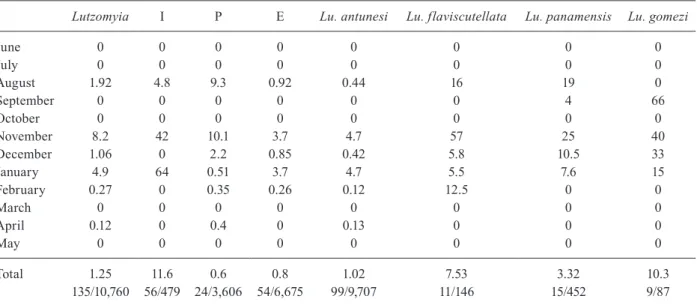
A total of 10,760 female Lutzomyia were assessed by PCR to investigate the rate of natural infection. The evaluated species were Lu. antunesi, Lu. panamensis, Lu. gomezi andLu. flaviscutellata. The monthly infec-tion rates obtained primarily correlated with the months that had the least rainfall (November-February) and those months for which the high abundance was recorded (De-cember, January and April). Lu. antunesi was found to be an important species, as it was the most abundant,
and also had the most consistent monthly infection rates. The importance of Lu. flaviscutellata, Lu. panamensis and Lu. gomezi as vectors was also confirmed, as they were found to be naturally infected despite very low abundance rates compared to Lu. antunesi (Table III).
DISCUSSION
Of the total species identified in this study, Lutzomyia begonae, Lutzomyia nematoducta and Lutzomyia punc-tigeniculata were identified for the first time in ME. Lu. begonae has been identified in other departments that have different ecological characteristics, such as Gua-viare (Cabrera et al. 2009), and the species is always as-sociated with wooded areas. Lu. nematoducta and Lu.
TABLE II
Environmental determinants correlated with the most abundant Lutzomyia species in the municipality of Villavicencio, department of Meta, Colombia
Rainfall (mm)
Maximum temperature (°C)
Maximum temperature < 1 day
(°C)
Minimum temperature < 2 days
(°C)
ρ p ρ p ρ p ρ p
Total -0.704 < 0.0001 0.26 0.1256 0.378 0.0232 0.431 0.0086
Lu. antunesi -0.688 < 0.0001 0.257 0.1296 0.382 0.0216 0.441 0.0071
Lu. antunesi (I) -0.507 0.0016 0.21 0.2201 0.346 0.0385 0.337 0.0446
Lu. antunesi (P) -0.509 0.0015 0.227 0.1829 0.55 0.0005 0.18 0.2939
Lu. antunesi (E) -0.579 0.0002 0.364 0.0291 0.266 0.1171 0.527 0.0010
Lu. flaviscutellata -0.384 0.0209 0.307 0.0688 0.419 0.0110 0.356 0.0333
Lu. panamensis -0.408 0.0136 0.378 0.0230 0.342 0.0410 0.326 0.0525
Lu. gomezi -0.122 0.4779 0.627 < 0.0001 0.383 0.0211 0.335 0.0457
Lu. gomezi (E) -0.143 0.4059 0.566 0.0003 0.307 0.0683 0.334 0.0462
significant Spearman’s coefficient of correlation (ρ) values regarding an alpha threshold = 0.05 are shown in bold. E: extradomi -ciliary; I: intradomi-ciliary; P: peridomiciliary.
Fig. 2: average monthly total of Lutzomyia, Lutzomyia antunesi and
Lutzomyia antunesi extradomiciliary population and monthly rainfall
punctigeniculata were found in both peridomiciliary and extradomiciliary areas, though they exhibited high-er abundance in extradomiciliary habitats. Lu. antunesi, Lu. panamensis and Lu. gomezi were the most abundant species in all the capture habitats, demonstrating their adaptation to anthropophilic settings where blood meal sources and possible breeding sites can be found. There-fore, dwellings and their surrounding areas are high-risk areas for acquiring ACL (Pardo et al. 2006, Santamaría et al. 2006), which is evident from previous studies con-ducted in the area (Vásquez-Trujillo et al. 2008).
The ecological behaviour of an ACL focus encom-passes different characteristics: its niche, its reservoirs, the vector and its seasonal abundance pattern, which is influenced by environmental determinants. Molina et al. (2008) showed that Lutzomyia fairtigi underwent a sea-sonal variation in the department of Casanare that was mainly determined by increased rainfall (ρ = 0.675; p < 0.001), whereas no changes in abundance or any associa-tion with environmental determinants were recorded for Lu. antunesi throughout the year. In contrast, the present study showed that Lu. antunesi exhibited a seasonal vari-ation in abundance (F = 4.990; p < 0.001) that was deter-mined by rainfall (ρ = -0.688; p < 0.001), with abundance increasing during the hottest months and in the absence of rain (maximum temperature 1 day before sampling) (ρ = 0.55; p < 0.001). These differing results demonstrate that a particular species can behave differently depend-ing on the local environmental conditions, its niche adap-tation, food sources, soil and other factors that dominate and thereby affect Leishmania transmission in the area.
The increased Lutzomyia abundance determined by temperature (maximum temperature 1 and 2 days before sampling) could be explained by increased physiological
lifecycle activity (Killick-Kendrick 1978, Ready & Croset 1980), primarily consisting of nocturnal activity patterns and biting behaviour (Morrison et al. 1995, González et al. 1999, Souza et al. 2002). Conversely, reduced rainfall abundance could be related to the reduced physiological activity of fourth-instar larvae (Killick-Kendrick 1978) or mechanical effects on breeding sites (wash out).
Importantly, the opposite effect was observed during the months with the highest precipitation, specifically September and April. This result is expected for Septem-ber based on the correlation model obtained, which dem-onstrates an inverse effect between rain and abundance (Table II). However, in April, the abundance of Lutzo-myia species increased despite the high rainfall (Fig. 2), which can be explained by the transition from summer to winter and its effect on the soil conditions, low water table, low saturation and high temperatures. These fac-tors benefit the development of the larval stage, as op-posed to September when rains were continuous and the temperature was two degrees lower (Table I).
With regard to Lu. gomezi, the increased abundance observed during the dry months (December, January and February) agreed with previous studies conducted in Venezuela (Feliciangeli 1987). In contrast, the behaviour of Lu. panamensis was different from a previous study by González et al. (1999), reporting that Lu. panamensis abundance increased dramatically with rainfall.
In terms of natural infection, Lu. flaviscutellata, Lu. panamensis and Lu. gomezi were confirmed as potential cutaneous leishmaniasis vectors in the rural areas of Vil-lavicencio due to their constant infection rates, mainly during dry months (November-February), despite their very low abundance, particularly in wooded (extradomi-ciliary) areas (Table I). Studies conducted in the wild
ar-TABLE III
Monthly natural infection rate (%) regarding the most abundant Lutzomyia species in the municipality of Villavicencio, department of Meta, Colombia, Colombia
Lutzomyia I P E Lu. antunesi Lu. flaviscutellata Lu. panamensis Lu. gomezi
June 0 0 0 0 0 0 0 0
July 0 0 0 0 0 0 0 0
August 1.92 4.8 9.3 0.92 0.44 16 19 0
September 0 0 0 0 0 0 4 66
October 0 0 0 0 0 0 0 0
November 8.2 42 10.1 3.7 4.7 57 25 40
December 1.06 0 2.2 0.85 0.42 5.8 10.5 33
January 4.9 64 0.51 3.7 4.7 5.5 7.6 15
February 0.27 0 0.35 0.26 0.12 12.5 0 0
March 0 0 0 0 0 0 0 0
April 0.12 0 0.4 0 0.13 0 0 0
May 0 0 0 0 0 0 0 0
Total 1.25 11.6 0.6 0.8 1.02 7.53 3.32 10.3
135/10,760 56/479 24/3,606 54/6,675 99/9,707 11/146 15/452 9/87
Bionomics of Lu. antunesi in Colombia • Adolfo Vásquez Trujillo et al. 468
eas of the department of Guaviare have shown that Lu. flaviscutellata can act as a vector due to its anthropo-philic behaviour (Cabrera et al. 2009). This fly predomi-nates in the woods and savannahs of Brazil, has been im-plicated in the transmission of Leishmania (Leishmania) amazonensis and identified as a possible vector of ACL in the state of Bolívar, in Venezuela (González & Devera 1999, Ribeiro et al. 2007, da Silva et al. 2010).
Lu. gomezi and Lu. panamensis have been proposed as vectors for Leishmania (Viannia) braziliensis and Leishmania (Viannia) panamensis in Venezuela and Panamá (Christensen et al. 1983, Rodríguez et al. 1999). These species are widely distributed throughout Colom-bia and are present in 18 of 32 departments (Bejarano 2006). Furthermore, it has been demonstrated that these species have a great ability to adapt to environmental changes in their habitat (Travi et al. 2002). Lu. gomezi and Lu. panamensis were incriminated as vectors in a suburban focus of visceral leishmaniasis in Chicamocha Canyon (Sandoval et al. 2006) and natural infection with L. (V.) panamensis has been recently found in areas of human activity in the department of Boyacá (0.5-0.6% natural infection rates) (Santamaría et al. 2006).
Conversely, Lu. antunesi exhibited infection rates of 0.1-4.7%, which agree with the rates described in the literature (Travi et al. 1988). Lu. antunesi stands out as the dominant species in the study area, as it is present in both anthropophilic (intradomiciliary and peridomi-ciliary) and extradomiciliary areas in great abundance (85%, 85% and 91% for each habitat). Even though this species has not been considered to be medically impor-tant in Colombia, it has been identified in regions with high ACL incidence and comprises equal or higher population percentages compared to species that have already been incriminated, indicating that it could be present for disease transmission (Sandoval et al. 2006). Ryan et al. (1984) first identified the natural infection of Lu. antunesi in Brazil with the presence of flagel-late forms in a focus of visceral leishmaniasis. The first epidemiological nexus in Colombia was registered in the department of Amazonas where Lu. antunesi is consid-ered an important species because it was present in high abundance in rural and periurban intradomiciliary and peridomiciliary areas of the municipality of Leticia dur-ing an active focus (Ferro et al. 1997). Natural infection with Leishmania spp was recently identified in an ACL focus in the rural area of Villavicencio (1.6% infection rate) (Vásquez-Trujillo et al. 2008).
Increased Lu. antunesi abundance in anthropophilic areas and gallery forest, mainly during dry months, cou-pled with evidence of natural infection with Leishmania spp highlights the epidemiological importance of this endemic species in Colombia’s Orinoquia region and the possible role it plays in parasite transmission in ME.
ACKNOWLEDGEMENTS
To Dr Martha Ayala and Parasitology Group (RNL), for the donation of reference strains of Leishmania, and Entomol-ogy Group from the National Institutes of Health, for their constant support.
REFERENCES
Barreto M, Burbano ME, Barreto P 2000. Lutzomyia sand flies (Dip-tera: Psychodidae) from middle and lower Putumayo department, Colombia, with new records to the country. Mem Inst Oswaldo Cruz95: 633-639.
Bejarano EE 2006. Lista actualizada de psicódidos (Diptera: Psy-chodidae) de Colombia. Folia Entomol Mexic45: 47-56.
Cabrera OL, Mosquera L, Santamaría E, Ferro C 2009. Flebótomos (Diptera: Psychodidae) del departamento de Guaviare, Colombia, con nuevos registros para el país. Biomedica 29: 73-86.
Cabrera OL, Munstermann LE, Cárdenas R, Gutiérrez R, Ferro C 2002. Definición de las condiciones de temperatura y almace-namiento adecuadas en la detección de ADN de Leishmania por PCR en flebotominos. Biomedica22: 296-302.
Christensen HA, Fairchild GB, Herrer A, Johnson CM, Young DG, de Vásquez AM 1983. The ecology of cutaneous leishmaniasis in the Republic of Panama. J Med Entomol20: 463-484.
da Silva PES, Alves de Freitas R, Ferreira da Silva D, Alencar RB 2010. Fauna de flebotomíneos (Diptera: Psychodidae) de uma reserva de campina no estado do Amazonas e sua importância epidemiológica. Rev Soc Bras Med Trop43: 78-81.
Feliciangeli MD 1987. Ecology of sandflies (Diptera: Psychodidae) in a restricted focus of cutaneous leishmaniasis in northern Venezu-ela. IV. Sandfly monthly fluctuation and leishmaniasis incidence relationship. Mem Inst Oswaldo Cruz 82: 177-179.
Ferro C, Pardo R, Díaz A, Pérez L, Munstermann L 1997. Com-posición de la fauna de flebotomíneos, género Lutzomyia, de la periferia de la ciudad de Leticia, Amazonas, Colombia. Congreso Internacional Investigación y Salud, INS 80 años 1917-1997.
Bio-médica 17 (Suppl. 1): 84-85.
Golczer G, Arrivillaga J 2008. Modificación de un protocolo estándar de extracción de ADN para flebotominos pequeños (Phlebotomi-nae: Lutzomyia). Rev Colomb Entomol 34: 199-202.
González R, de Sousa L, Devera R, Jorquera A, Ledezma E 1999. Sea-sonal and nocturnal domiciliary human landing/biting behaviour
of Lutzomyia (Lutzomyia) evansi and Lutzomyia
(Psychodopy-gus) panamensis (Diptera: Psychodidae) in a periurban area of
a city on the Caribbean coast of eastern Venezuela (Barcelona, Anzoátegui state). Trans R Soc Trop Med Hyg93: 361-364.
González R, Devera R 1999. Fauna flebotomínica (Diptera, Psychodi-dae, Phlebotominae) do estado Bolívar, Venezuela. Rev Soc Bras
Med Trop32: 721-723.
Holdrige LR 1967. Life zone ecology, Tropical Science Center, San José, 206 pp.
INS - Instituto Nacional de Salud 2012. Informe del evento leishma-niasis hasta decimo periodo epidemiológico del año 2012. Avail-able from: ins.gov.co/lineas-de-accion/Subdireccion-Vigilancia/ Informe%20de%20Evento%20Epidemiolgico/LEISHMANIA-SIS%20Periodo%20X%202012.pdf.
Killick-Kendrick R 1978. Recent advances and outstanding problems in the biology of phlebotomine sandflies. Acta Trop35: 297-313.
Killick-Kendrick R 1990. Phlebotomus vector of the leishmaniasis: a review. Med Vet Entomol4: 1-24.
Maroli M, Feliciangeli MD, Arias J 1997. Métodos de captura,
con-servación y montaje de los flebotomos (Diptera: Psychodidae),
OPS/OMS/HCP/HCT/95/97, Washington, p. 1-67.
Montoya-Lerma J, Ferro C 1999. Flebótomos (Diptera: Psychodidae) de Colombia. In G Amat, MG Andrade, F Fernández (eds.),
In-sectos de Colombia, Vol. II, Colección Jorge Álvarez Lleras, 13,
Academia Colombiana de Ciencias Exactas, Físicas and Natu-rales, Bogotá, 211-245.
Morrison AC, Ferro C, Pardo R, Torres M, Wilson ML, Tesh RB 1995. Nocturnal activity patterns of Lutzomyia longipalpis (Diptera: Psychodidae) at an endemic focus of visceral leishmaniasis in Colombia. J Med Entomol32: 605-617.
Pardo RH, Cabrera OL, Becerra J, Fuya P, Ferro C 2006. Lutzomyia
longiflocosa as suspected vector of cutaneous leishmaniasis in a
focus of cutaneous leishmaniasis in the sub-Andean region of the Tolima department, Colombia, and knowledge on sandflies by the inhabitants. Biomedica26 (Suppl. 1): 95-108.
Ready PD, Croset H 1980. Diapause and laboratory breeding of
Phle-botomus perniciosus newstead and Phlebotomus ariasi Tonnoir
(Diptera: Psychodidae) from southern France. Bull EntomolRes 70: 511-523.
Ribeiro AL, Missawa NA, Zeilhofer P 2007. Distribution of phleboto-mine sandflies (Diptera: Psychodidae) of medical importance in Mato Grosso state, Brazil. Rev Inst Med Trop S Paulo 49: 317-321.
Rodríguez N, Aguilar CM, Barrios A, Barrer DC 1999. Detection
of Leishmania braziliensis in naturally infected individual sand
flies by the polymerase chain reaction. Trans R Soc Trop Med
Hyg 93: 47-49.
Romero GA, Guerra MV, Paes MG, Cupolillo E, Bentin Toaldo C, Macêdo VO, Fernandes O 2001. Sensitivity of the polymerase chain reaction for the diagnosis of cutaneous leishmaniasis due to
Leishmania (Viannia) guyanensis. Acta Trop 79: 225-229.
Ryan L, Silveira FT, Lainson R, Shaw JJ 1984. Leishmanial infections
in Lutzomyia longipalpis and L. antunesi (Diptera: Psychodidae)
on the island of Marajó, Pará state, Brazil. Trans R Soc Trop Med
Hyg 78: 547-548.
Sandoval CM, Gutiérrez R, Cárdenas R, Ferro C 2006. Species of
Lutzomyia (Psychodidae, Phlebotominae) in endemic cutaneous
and visceral leishmaniasis foci of the department of Santander, in the eastern range of the Colombian Andes. Biomedica 26 (Suppl. 1): 218-227.
Santamaría E, Ponce N, Zipa Y, Ferro C 2006. Presencia en el peri-domicilio de vectores infectados con Leishmania (Viannia)
pana-mensis en dos focos endémicos en el occidente de Boyacá,
piede-monte del valle del Magdalena medio, Colombia. Biomedica 26
(Suppl.1): 82-94.
Silveira FT, Ishikawa EA, de Souza AA, Lainson R 2002. An out-break of cutaneous leishmaniasis among soldiers in Belém, Pará state, Brazil, caused by Leishmania (Viannia) lindenbergi n. sp. A new leishmanial parasite of man in the Amazon Region. Para-site9: 43-50.
SIVIGILA - Sistema de Vigilancia en Salud Publica 2012. Estadís-ticas de vigilancia rutinaria. Available from: ins.gov.co/lineas- de-accion/Subdireccion-Vigilancia/sivigila/Paginas/vigilancia-rutinaria.aspx.
Souza NA, Andrade-Coelho CA, Vilela ML, Peixoto AA, Rangel EF 2002. Seasonality of Lutzomyia intermedia and Lutzomyia whit-mani (Diptera: Psychodidae: Phlebotominae), occurring sympat-rically in area of cutaneous leishmaniasis in the state of Rio de Janeiro, Brazil. Mem Inst Oswaldo Cruz97: 759-765.
Travi BL, Adler GH, Lozano M, Cadena H, Montoya-Lerma J 2002. Impact of habitat degradation on Phlebotominae (Diptera: Psy-chodidae) of tropical dry forests in northern Colombia. J Med
Entomol39: 451-456.
Travi BL, Montoya J, Solarte Y, Lozano L, Jaramillo C 1988. Leish-maniasis in Colombia. I. studies on Phlebotomine fauna associ-ated with endemic foci in the Pacific Coast region. Am J Trop
Med Hyg 39: 261-266.
Vásquez-Trujillo A 2006. Registro de leishmaniasis cutánea en cani-nos presentes en zonas peri-urbana de Villavicencio, Meta, y su importancia en la salud pública. Orinoquia 10: 79-86.
Vásquez-Trujillo A, Santamaría-Herreño E, González-Reina AE, Buitrago-Alvarez LS, Góngora-Orjuela A, Cabrera-Quintero OL 2008. Lutzomyia antunesi as suspected vector of cutaneous leishmaniasis in the Orinoquian region of Colombia. Rev Salud
Publica 10: 625-632.
Velez ID, Hendrickx E, Robledo S, Agudelo S 2001. Leishmaniosis cutánea en Colombia y género. Cad Saude Publica 17: 171-180.
Young DG, Duncan MA 1994. Guide to the identification and geo-graphic distribution of Lutzomyia sand flies in Mexico, the West Indies, Central and South America (Diptera: Psychodidae). Mem
Am Entomol Inst 54: 1-881.