Study performed at Instituto do Coração de Pernambuco. Real Hospital Português in Pernambuco.
Correspondence address: Carlos R. Moraes. Instituto do Coração de Pernambuco. Av. Portugal, 163. Recife, PE. CEP: 52.010-010. Phone: 5581-32210382. Fax 5581-32315968.
E-mail [email protected]
Fernando MORAES, Carlos DUARTE, Edmílson CARDOSO, Euclides TENÓRIO, Virgílio PEREIRA, Diana LAMPREIA, João WANDERLEY, Carlos R. MORAES
Article received in October, 2005 Article accepted in March, 2006
RBCCV 44205-791
Avaliação do EuroSCORE como preditor de mortalidade em cirurgia de revascularização miocárdica
no Instituto do Coração de Pernambuco
Assessment of the EuroSCORE as a predictor for
mortality in myocardial revascularization surgery
at the Heart Institute of Pernambuco
Abstract
Objective: To assess the applicability of the European Risk
Score System in Cardiac Operations (EuroSCORE) in patients undergoing myocardial revascularization at the Heart Institute of Pernambuco.
Method: From 2003 to 2004, 759 patients underwent
myocardial revascularization. For the study, seven were excluded due to the lack of information on one aspect or another involved in obtaining the EuroSCORE. In order to assess the applicability of the EuroSCORE, an adjustment was made using a logistic regression model of operative mortality (response variable) on the EuroSCORE (explanatory variable). The calibration of the model was measured by comparing the morbidity observed with that expected, using the Hosmer-Lemeshow Test of Goodness of Fit. The accuracy of the model was evaluated by means of Statistics-c.
Results: The accuracy of the model, estimated at 69.9%,
and the calibration (Hosmer-Lemeshow test, p=0.663) were
satisfactory. The total predicted mortality was practically identical to the observed – 1.7%. The low-risk group (EuroSCORE: 0-2) comprised 231 patients and had two (0.87%) deaths within this group. The medium-risk group (EuroSCORE: 3-5) comprised 268 patients and one (0.37%) death occurred. The high-risk group (EuroSCORE: =6) comprised 253 patients and ten (3.95%) deaths occurred. The discrepancies between the percentages of deaths observed in these groups and those predicted by the model were not statistically significant on the basis of the result of the chi-square test (p=0.624).
Conclusion: The EuroSCORE, a simple and objective
index, proved to be a satisfactory predictor of operative mortality in patients submitted to myocardial revascularization in the Heart Institute of Pernambuco.
Descriptors: Myocardial revascularization. Epidemiologic
Resumo
Objetivo: Avaliar a aplicabilidade do Sistema Europeu de
Risco em Operações Cardíacas (EuroSCORE) em pacientes submetidos à revascularização miocárdica no Instituto do Coração de Pernambuco.
Método: Durante os anos de 2003 e 2004, 759 pacientes
foram submetidos à revascularização miocárdica. Desse total, sete doentes foram excluídos por ausência de informações relativas a algum dos fatores envolvidos na obtenção do EuroSCORE. Para avaliar a aplicabilidade do EuroSCORE, foi realizado o ajuste de um modelo de regressão logística da mortalidade operatória (variável resposta) sobre o EuroSCORE (variável explanatória). A calibração do modelo foi mensurada comparando−−−−−se a mortalidade observada com a esperada, utilizando o teste de bondade de ajuste de Hosmer−−−−− Lemeshow. A acurácia do modelo foi avaliada através da estatística−−−−−c.
Resultados: Foram satisfatórias a acurácia do modelo,
estimada em 69,9%, e a calibração (valor p do teste de Hosmer−−−−−
Lemeshow igual a 0,663). A mortalidade total prevista foi praticamente idêntica à observada, 1,7%. O grupo de baixo risco (EuroSCORE: 0-2) tinha 231 pacientes e ocorreram dois (0,87%) óbitos. O grupo de médio risco (EuroSCORE: 3-5) tinha 268 pacientes e ocorreu 1 (0,37%) óbito. O grupo de alto risco (EuroSCORE: >6) apresentava 253 pacientes e houve 10 (3,95%) óbitos. As discrepâncias entre as porcentagens de óbitos observadas nesses grupos e aquelas previstas pelo modelo não foram estatisticamente significantes, de acordo com o resultado do teste qui-quadrado (p = 0,624).
Conclusão: O EuroSCORE, um índice simples e objetivo,
mostrou-se como um preditor satisfatório de mortalidade operatória, em pacientes submetidos à revascularização miocárdica no Instituto do Coração de Pernambuco.
Descritores: Revascularização miocárdica. Métodos
epidemiológicos. Índice de gravidade de doença. Medição de risco, métodos. Análise de sobrevivência. Mortalidade.
INTRODUCTION
Several models of risk stratification have been idealized to predict mortality in cardiac surgery [1-7]. The European system for the assessment of risk in cardiac surgery (EuroSCORE) first started to be outlined in 1995, when information on risk factors and mortality were collected from 19030 adult patients consecutively submitted to heart surgery at 128 centers in eight European countries [8]. Sixty-eight preoperative and 29 operative factors risks, which may influence hospital mortality were analyzed. The relationship between different risk factors and the results was statistically studied using univariate analysis and logistic regression. This allowed the identification of 17 real risk factors and, for each of them, a score was attributed, thereby creating a model that allows the division of patients into three risk groups: low-risk (score from 0 to 2), medium-risk (score from 3 to 5) and high-risk (score > 6)[9]. This model of risk stratification has been highly effective, even when applied to non-European populations [10, 11].
The aim of this study was to assess the applicability of the EuroSCORE in patients submitted to myocardial revascularization at the Heart Institute of Pernambuco.
METHOD
The records of 759 patients who underwent myocardial revascularization from 2003 to 2004 in the Heart Institute of Pernambuco were studied.
the model. The Statistics-c is sometimes termed the area under a ROC (Receiver Operating Characteristic) curve, but the values are not always in agreement. Some consider the Statistics-c a generalization of the ROC curve [11].
RESULTS
Of the 752 studied patients, 503 (66.9%) were male and 249 (33.1%) were female. The ages ranged from 27 to 88
Score
1 1 1 2
2 3 2 3 3
2
1 3 2 2
2 2
3 4 Table 1. Risk factors, definitions and score
Patients-related factors Age
Sex
Chronic pulmonary disease Extracardiac arteriopathy
Neurological dysfunction Previous Cardiac Surgery Serum creatinine
Active endocarditis Critical preoperative state
Cardiac-related factors
Unstable angina
Left Ventricle Dysfunction
Recent myocardial infarction Pulmonary hypertension
Operation-related factors
Emergency
Other surgeries than myocardial revascularization
Surgery on thoracic aorta Post infarct septal rupture
Definitions
For 5 years or fraction > 60 years Female
Long term use of bronchodilators or steroids
Any of the following: claudication, carotid occlusion or stenosis >50%, prior or planned intervention on the abdominal aorta, peripheral arteries or carotids
Disease affecting walking or day-to-day activities Requiring opening of the pericardium
> 2.3 mg in preoperative
Patient still on antibiotic treatment for endocarditis at time of surgery
Any of the following: ventricular tachycardia / fibrillation or aborted sudden death, preoperative cardiac massage, preoperative ventilation before arriving in the surgical room, preoperative inotropic support or intra-aortic balloon pump, preoperative Acute Renal Failure (<10mL/hr)
Angina at rest requiring nitrates until arrival in anesthesia room
LVEF 30-50% LVEF < 30% < 90 days
Systolic pulmonary artery pressure >60mmHg
Operation before beginning of next working day Another cardiac surgery or in association to myocardial revascularization
For ascending aorta, aortic arc or descending aorta
Group
Low risk
Medium risk
High risk
Table 2. Mortality risk groups of EuroSCORE
Score
0–2
3–5
>6
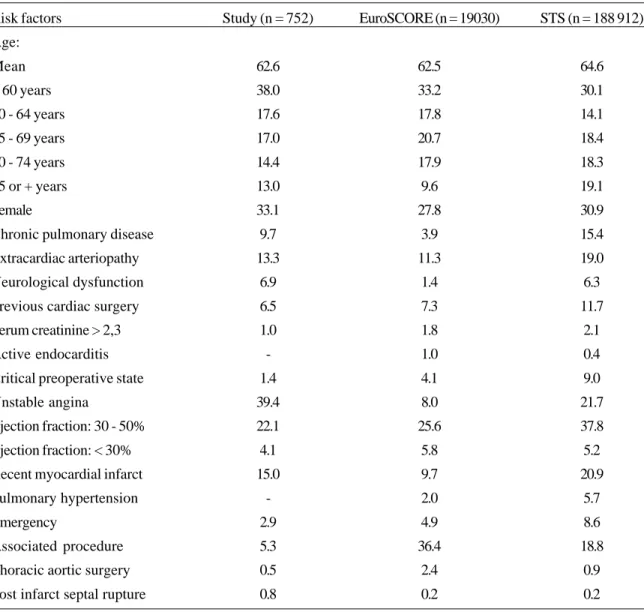
the calculation of the EuroSCORE. The prevalences of these risk factors in patients of the EuroSCORE database [9] and STS database [11] are also presented in this table just for comparison purposes.
Table 4 presents the predicted and the observed mortality, according to the groups defined by the Hosmer-Lemeshow test. The predicted mortality by the EuroSCORE can be considered very close to the observed mortality as the p-value in the Hosmer-Lemeshow test was 0.663, indicating a good adjustment or good calibration of the model.
The accuracy or the predictive ability of the EuroSCORE, estimated by the Statistics-c logistic model, was 69.9% (95%
Confidence interval: 69% - 70.8%).
The hospital mortality in this series of 752 patients submitted to myocardial revascularization was 1.7% (13 cases). There were two deaths (0.87%) among the 231 patients ranked in the low-risk group, one death (0.37%) in the medium-risk group (n=268) and 10 deaths (3.95%) among the 253 patients in the high-risk group. These results are presented in Table 5, alongside the percentage of deaths predicted by the adjusted model for each EuroSCORE risk group. The inconsistencies between the percentages of the predicted and observed deaths were not statistically significant, according to the results of the qui-square test (p=0.624).
STS (n = 188 912)
64.6
30.1
14.1
18.4
18.3
19.1
30.9
15.4
19.0
6.3
11.7
2.1
0.4
9.0
21.7
37.8
5.2
20.9
5.7
8.6
18.8
0.9
0.2 Table 3. Prevalence of risk factors in the patients of this study, of EuroSCORE and of STS
Risk factors
Age:
Mean
< 60 years
60 - 64 years
65 - 69 years
70 - 74 years
75 or + years
Female
Chronic pulmonary disease
Extracardiac arteriopathy
Neurological dysfunction
Previous cardiac surgery
Serum creatinine > 2,3
Active endocarditis
Critical preoperative state
Unstable angina
Ejection fraction: 30 - 50%
Ejection fraction: < 30%
Recent myocardial infarct
Pulmonary hypertension
Emergency
Associated procedure
Thoracic aortic surgery
Post infarct septal rupture
Study (n = 752)
62.6
38.0
17.6
17.0
14.4
13.0
33.1
9.7
13.3
6.9
6.5
1.0
-1.4
39.4
22.1
4.1
15.0
-2.9
5.3
0.5
0.8
EuroSCORE (n = 19030)
62.5
33.2
17.8
20.7
17.9
9.6
27.8
3.9
11.3
1.4
7.3
1.8
1.0
4.1
8.0
25.6
5.8
9.7
2.0
4.9
36.4
2.4
Expected 75.7 72.6 81.4 91.1 100.8
72.9 76.6 87.7 80.0 Table 4. Observed and predicted mortality using EuroSCORE as a predictive variable at the groups defined
by Hosmer-Lemeshow test.
Groups 1 2 3 4 5 6 7 8 9
Number of patients 76
73 82 92 102
74 78 90 85
Discharge condition Death
Observed 1 1 0 0 1 0 2 2 6
Expected 0.3 0.4 0.6 0.8 1.1 1.1 1.4 2.3 5.0
Survival
Observed 75 72 82 92 101 74 76 88 79
*Teste qui-quadrado
Table 5. Comparison of the percentages of observed and predicted deaths at each risk group of the EuroSCORE.
Risk group
Low-risk (0-2)
Medium-risk (3-5) High-risk (>6)
Number of cases
231
268 253
Observed deaths (%)
0.87
0.37 3.95
Predicted deaths (%)
0.57
1.13 3.42
P value*
0.624
DISCUSSION
Stratification of risk provides an estimation of the operative risk in certain individuals and has great importance in retrospective analyses of surgical results, providing a comparison, not only among institutions, but also among individual surgeons and making quality control in the daily clinical practice possible [14,15]. Several score systems have been developed to predict the hospital mortality in heart surgery, especially in coronary artery surgery [1-7]. Since its introduction, the EuroSCORE has been widely accepted all over the world and it has been used as a risk predictor of morbimortality in non-European populations [11-16], but it has not been applied to Brazilians before. The EuroSCORE is a cumulative system in which each of the 17 risk factors receives a number of points that are added together. The final sum provides a score used to place a patient in one of three risk groups: low-risk (score 0-2), medium-risk (score 3-5) and high-risk (score >6).
The EuroSCORE has been applied in North America population and compared to the Society of Thoracic Surgeons registration database, which has already been used as a surgical risk predictor for several years. Despite the demographic differences, the EuroSCORE has proven to be effective to both populations [11].
REFERENCES
1. Parsonnet V, Dean D, Bernstein AD. A method of uniform stratification of risk for evaluating the results of surgery in acquired adult heart disease. Circulation. 1989;79(6 pt 2):I3-I12.
2. Higgins TL, Estafanous FG, Loop FD, Beck GJ, Blum JM, Paranandi L. Stratification of morbidity and mortality outcome by preoperative risk factors in coronary artery bypass patients. JAMA. 1992;267(17):2344-8.
3. Hattler BG, Madia C, Johnson C, Armitage JM, Hardesty RL, Kormos RL et al. Risk stratification using the Society of Thoracic Surgeons program. Ann Thorac Surg. 1994;58(5):1348-52.
4. Roques F, Gabrielle F, Michel P, de Vincentiis C, David M, Baudet E. Quality of care in adult heart surgery: proposal for a self-assessment approach based on a French multicenter study. Eur J Cardiothorac Surg. 1995;9(8):433-40.
5. Tu JV, Jaglal SB, Naylor CD. Multicenter validation of a risk index for mortality, intensive care unit stay, and overall hospital length of stay after cardiac surgery. Steering Committee of the Provincial Adult Cardiac Care Network of Ontario. Circulation. 1995;91(3):677-84.
6. Pons JM, Granados A, Espinas JA, Borras JM, Martin I, Moreno V. Assessing open heart surgery mortality in Catalonia (Spain) through a predictive risk model. Eur J Cardiothorac Surg. 1997;11(3):415-23.
groups of risk. The analysis did not show statistically significant differences when comparing the predicted and observed mortality in each risk group. Despite the accuracy of the model, estimated at 69.9% being lower than those obtained in six European countries [15], the EuroSCORE has shown to be a simple and objective index and an acceptable predictor of operative mortality in patients undergoing myocardial revascularization at the Heart Institute of Pernambuco.
ACKNOWLEDGMENTS
The authors wish to thank Professor José Natal for the statistical analysis performed in this research.
7. Tremblay NA, Hardy JF, Perrault J, Carrier M. A simple classification of the risk in cardiac surgery: the first decade. Can J Anaesth. 1993;40(2):103-11.
8. Roques F, Nashef SA, Michel P, Gauducheau E, de Vincentiis C, Baudet E et al. Risk factors and outcome in European cardiac surgery: analysis of the EuroSCORE multinational database of 19030 patients. Eur J Cardiothorac Surg. 1999;15(6):816-23.
9. Nashef SA, Roques F, Michel P, Gauducheau E, Lemeshow S, Saloamon R. European system for cardiac operative risk evaluation (EuroSCORE). Eur J Cardiothorac Surg. 1999;16(1):9-13.
10. Kawachi Y, Nakashima A, Toshima Y, Arinaga K, Kawano H. Risk stratification analysis of operative mortality in heart and thoracic aorta surgery: comparison between Parsonnet and EuroSCORE additive model. Eur J Cardiothorac Surg. 2001;20(5):961-6.
11. Nashef SA, Roques F, Hammill BG, Peterson ED, Michel P, Grover FL et al. Validation of European System for Cardiac Operative Risk Evaluation (EuroSCORE) in North American cardiac surgery. Eur J Cardiothorac Surg. 2002;22(1):101-5.
12. Hosmer DW, Lemeshow S. Applied logistic regression. New York:John Wiley & Sons;1989. p.140-5.
13. Roques F, Nashef SA, Michel P, Pinna Pintor P, David M, Baudet E. Does EuroSCORE work in individual European countries? Eur J Cardiothorac Surg. 2000;18(1):27-30.
14. Hammermeister KE. Risk, predicting outcomes, and improving care. Circulation. 1995;91(3):899-900.
15. Nashef SA. Monitoring of cardiac surgical results. Lancet. 1998;351(9096):143-4.
16. Fukuda M, Takagi Y. Application of preoperative risk severity evaluation system (EuroSCORE=European system for cardiac operative risk evaluation) for cardiac operative patients. Masui. 2004;53(10):1149-54.
17. Toumpoulis IK, Anagnostopoulos CE. Does EuroSCORE predict length of stay and specific postoperative complications after heart valve surgery? J Heart Valve Dis. 2005;14(2):243-50.