*Correspondence: M. P. H. Amaral. Faculdade de Farmácia e Bioquímica, Universidade Federal de Juiz de Fora, Campus Universitário - Bairro Martelos, 36036-330 - Juiz de Fora - MG, Brasil. E-mail: [email protected] #From title: NBCAL = Norma Brasileira de Comercialização de Alimentos para Lactentes e Crianças de 1ª Infância, Bicos, Chupetas e Mamadeiras
A
rti
Pharmaceutical Sciences vol. 45, n. 3, jul./sep., 2009
Oficial monitoring of the Brazilian Norm for Commercialization
of food for nursling and children of irst infancy, rubber nipples,
paciiers, and nursing bottles – NBCAL
#Fabrício Luiz Silva Bartolini, Maria da Penha Henriques do Amaral
*, Miriam Aparecida Pinto
Vilela, Alessandra Ésther de Mendonça, Fernanda Maria Pinto Vilela, Lílian Henriques do Amaral,
Felipe
Villela Gomes
Faculty of Pharmacy and Biochemistry, Federal University of Juiz de Fora
This work aimed to evaluate advertisement of baby food, rubber nipples, paciiers and nursing bottles through newspapers as well as on TV, radio, and the internet, in order to check whether the ‘Brazilian Norm for Commercialization of Food for Nursling and Children of First Infancy, Rubber Nipples, Paciiers and Nursing Bottles’ (Norma Brasileira de Comercialização de Alimentos para Lactentes e Crianças de Primeira Infância, Bicos, Chupetas e Mamadeiras – NBCAL) has been complied. Samples of all the items above were acquired at discount and department stores to check whether labeling was in compliance with the NBCAL. The development of this research as well as the analyses of commercial promotion were carried out in Juiz de Fora – state of Minas Gerais, from May to July 2006, using convenient, non-representative sampling composed of 680 pieces of advertisement. The results obtained through descriptive statistics showed that 564 of the 680 samples analyzed, or 83.0%, did not meet the NBCAL. Irregularities were detected in 100% of the samples advertised on the media and found in hospitals and drugstores; in 70.1% of the samples purchased at supermarkets, in 37% of those from medical clinics and in 86.6% of those found on the internet. The evidences showed that monitoring must be carried out continuously and educational campaigns on the importance of breast-feeding for the full development of children must be addressed to mothers, the food industry and commercial establishments.
Uniterms: Publicity/baby food/evaluation. Advertisement/baby food/evaluation. Childish ware/evaluation of labeling.
O presente trabalho teve como objetivo avaliar propagandas e publicidades impressas de alimentos infantis, bicos, chupetas e mamadeiras, além das veiculadas em rádio, TV e internet, para veriicar o cumprimento da Norma Brasileira de Comercialização de Alimentos para Lactentes e Crianças de Primeira Infância (NBCAL). Também foi realizada a aquisição de bicos, mamadeiras e chupetas em “lojas de 1,99” e de departamento, para a veriicação de rotulagem de acordo com a NBCAL. O desenvolvimento da pesquisa foi realizado no período de maio a julho de 2006, no município de Juiz de Fora, MG, mediante amostragem não representativa, de conveniência. A amostra constituiu-se de 680 peças publicitárias. Os resultados foram analisados pela estatística descritiva. Das 680 peças publicitárias analisadas, 564 (83,0%) não cumpriram a NBCAL. Foram encontradas irregularidades em 100% das amostras captadas em rádio, TV, jornais, revistas, hospitais e farmácias; em 70,1% das amostras captadas em supermercados; em 37% das amostras captadas em clínicas médicas e em 86,6% das captadas na internet. Concluiu-se que há necessidade de intensiicar o monitoramento em caráter contínuo e que as ações educativas relativas à importância do aleitamento materno devem ser direcionadas para as mães, indústrias produtoras e empresas que comercializam alimentos infantis.
INTRODUCTION
According to ‘The United Nations Children’s Fund’ (UNICEF) and the ‘World Health Organization’ (WHO), mother’s milk contains all the necessary nutrients and in the correct quantity for the infant growth and develop-ment, speciically during the irst six months of life, and it should be used up to the age of two years or older (Araújo
et al., 2006).However, by inluence of external factors or
by characteristics of the woman herself, many mothers have introduced new products for their babies, before the recommended time (Rede Internacional em Defesa do Direito de Amamentar 1 - IBFAN, 2003).
Many foods are presented as potential substitutes of mother’s milk, such as infant formulas, diverse milks substituting the human one, products based on wheat and other industrialized foods. It is convenient to emphasize that these products do not present two fundamental be-neits, which are only supplied by mother’s milk: the im-munological and the emotional ones (Longo et al., 2005). Jellifea and Jellife (1978) have created the expres-sion “bottle fed babies” e “commerciogenic malnutrition”, explaining the inluence of advertising on children nou-rishment, mainly in the developing countries. The early weaning is inluenced mainly by a complex interaction of socio-cultural factors, such as the industrialization process, the appearance and divulgence of industrialized milks, the adhesion of health professionals to prescription of artiicial feeding, and the insertion of woman in the labor market (Araújo et al., 2006).
The Brazilian legislation has as legal instruments for protection of public health concerning the promotion of breast-feeding, the Brazilian Norm for Commercialization of Food for Nursling and Children of First Infancy, Rubber Nipples, Paciiers, and Nursing Bottles (NBCAL), which regulates the commercial promotion of pasteurized and sterilized powdered milks and paciiers (Brasil, 2002), and the Federal Law # 11265, which reinforces the complying of NBCAL (Brasil, 2006; Monteiro, 2006).
The NBCAL is constituted by three documents: the Ordinance 2051 (Brasil, 2002) and two Resolutions from the Collegiate Directory (Resolução da Diretoria
Colegiada - RDC) of the National Agency of Health
Surveillance (Agência Nacional deVIgilância SAnitária
- ANVISA), the RDC # 221 (Brasil, 2002), which is about the commercial promotion of rubber nipples, paciiers, and nursing bottles, and the RDC # 222 (Brasil, 2002), which is about the commercial promotion of Food for Nursling and Children of First Infancy. The ANVISA has the res-ponsibility of supervise and penalize the breaches to this Norm, therefore, it has signed covenants with national
universities, between them the Federal University of Juiz de Fora (Universidade Federal de Juiz de Fora - UFJF). The Federal Law # 11265 reinforces the resolutions RDC # 221 and # 222. In this way, the non-accomplishment of some of these resolutions characterizes also the non-accomplishment of this Law.
This present work has the purpose of evaluate printed advertisement and publicity of baby food, rubber nipples, paciiers and nursing bottles, besides promotional pieces of these same articles that are divulged by means of radio, TV and internet; and this evaluation was done to verify the accomplishment of Federal Law # 11265, dated January 4th, 2006, of protection to breast-feeding. Additionally, it was done the acquisition of rubber nipples, nursing bottles and paciiers in pharmacies, drugstores, “$1.99 stores” and department stores for veriication of packages labeling accordance with NBCAL.
MATERIAL AND METHODS
The collection, acquisition and analyses of com-mercial promotions of foods included by NBCAL, and labeling of rubber nipples, paciiers and nursing bottles were developed in the period of eight weeks between May and July of 2006, in the city of Juiz de Fora, through non-representative sampling, of convenience. The results were analyzed by descriptive statistics.
Developed Activities
1. Selection of a multidisciplinary team, constituted by adviser teachers from the Faculty of Pharmaceutics & Biochemistry of the Federal University of Juiz de Fora
(Faculdade de Farmácia e Bioquímica/Universidade
Fe-deral de Juiz de Fora - FFB/UFJF) and students from the
courses of Law, Social Communication, and Pharmaceu-tics, for the catchment and analysis of promotional pieces face to RDC # 222 and RDC # 221, dated August 5th, 2002 and Federal Law # 11265, dated January 4th, 2006.
and nutritional clinics, hospitals/maternity hospitals, pharmacies/drugstores, supermarkets, “$1.99 stores” and stores of infant products at discretion of FFB/UFJF. The criterion adopted by FFB was to monitor all local AM and FM radio stations, pediatric clinics, hospitals and maternity hospitals, and stores commercializing rubber nipples, paciiers, and nursing bottles in the city of Juiz de Fora (Table I).
3. Catchment of promotional pieces in selected pla-ces and media for analysis regarding the accomplishment or not of legislation.
4. Acquisition by means of purchase of rubber ni-pples, paciiers, and nursing bottles in the commerce at pharmacies, drugstores, “$1.99 stores”, and department stores for analysis of products package labeling according the criteria of evaluation of irregularities in agreement with RDC # 221. All found trademarks were acquired: ive samples of rubber nipples for nursing bottle, being one of each trademark; three samples of nursing bottles, being one of each trademark, and eight samples of paciier, being one of each trademark.
Criteria for evaluation of accordance of
advertisement and labeling of monitored products package
The RDC # 222 dated August 5th, 2002, comprises the following products:
A. Infant formulas for nursling and follow-up infant for-mulas for nursling;
B. Follow-up infant formulas for children of irst infancy; C. Fluid milks, modified powdered milks, milks from diverse animal species and plant origin products of the same purpose;
D. Transition foods and foods based on cereal indicated for nursling and/or children of irst infancy, as well as other foods or beverages based on milk or not, when commercia-lized or otherwise presented as appropriate for the feeding of nursling and children of irst infancy;
E. Nourishing formulas presented and/or indicated for high-risk newborns;
Criteria for coniguration of irregularity
According RDC # 222, for items A and E, it is debar-red the commercial promotion by any communication me-ans. The commercial promotion of infant foods described in B and C should include, under mandatory character and emphasized, the following visual and/or auditory warning, according the divulgence mean: “The Ministry of Health advertises: Breast-feeding avoids infections and allergies,
and is recommended up to two years of age or older”. For the infant products presented at item D, the warning phrase is: “The Ministry of Health advertises:After the age of six months, continue to breast-feed your child and offer new food as well” (Brasil, 2002).
The RDC # 221, on the other hand, regulates the commercial promotion and labeling of rubber nipples, nursing bottles and paciiers. It is debarred any type of commercial promotion of these products, at any means of communication. The labels of these products package comprised by RDC # 221 should contain: name of ma-nufacturer or importer, lot identiication, manufacturing date and the necessary and suficient guidelines for the correct, safe, and indicated use of the product, besides the following warning phrases (Brasil, 2002):
“The Ministry of Health advertises”:
- “The breast-fed child does not require nursing bottle, rubber nipple, or paciier”.
- “The use of nursing bottle, rubber nipple, or paci-ier harms the breast-feeding and its prolonged use causes damage on the child teething and speaking”.
The Federal Law # 11265 reinforces the resolutions RDC # 221 and # 222. So, the non-accomplishment of some of these resolutions characterizes the non-accom-plishment of Law, as well.
Selection of monitored places and media
The selection of monitored places and media is represented at Table I.
RESULTS AND DISCUSSION
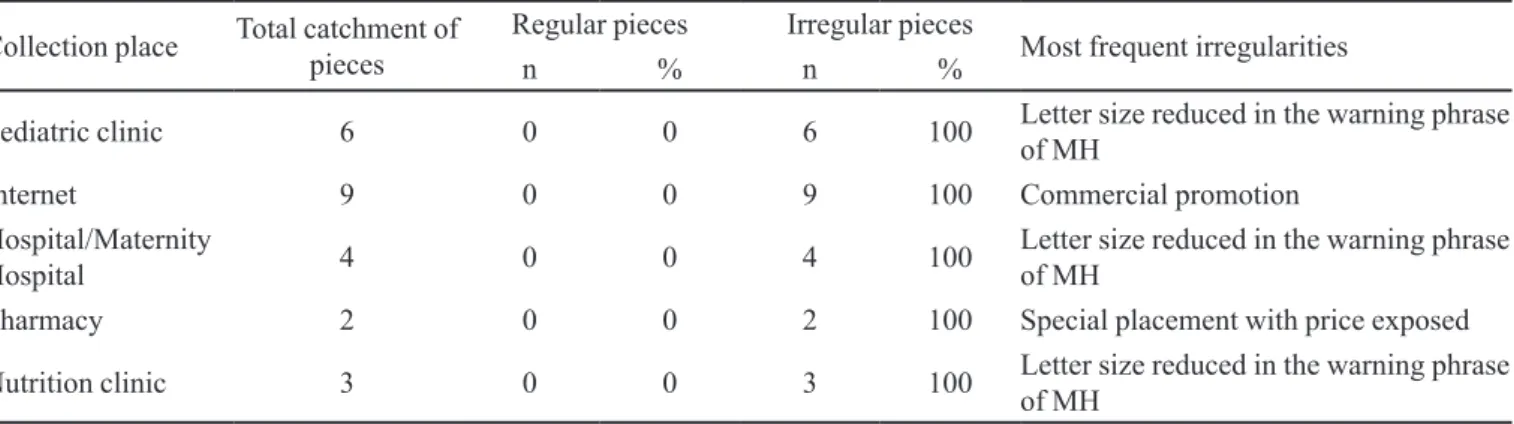
The results of analysis respecting advertisement of infant formulas for nursling and follow-up infant formulas for nursling (A), concerning legislation RDC # 222, accor-ding to collection place are presented at Table II.
All promotional pieces of infant formulas for nursling and follow-up infant formulas for nursling (A) captured in pediatric clinic, internet, hospital/ maternity hospital, pharmacy, and nutrition clinic presented irregu-larities concerning legislation (Table II).
Irregularities were not found in the monitoring of advertisement of B class products (follow-up infant for-mulas for children of irst infancy) and E class products (nutrient formulas presented and/or indicated for high risk newborns).
TABLE I - Presentation of media and places to be monitored, according orientation from GPROP or through a choice by FFB/UFJF,
with indication of monitoring frequency
Media and places Orientation Frequency Total
AM and FM radio station FFB/UFJF 2 radio stations/week (1 AM e 1 FM) 2
hours daily in a given program 16 radio stations (8 AM and 8 FM)
Television GPROP 1 local broadcasting station with monitoring
in the period between 10 am-midday and one additional hour, in diverse period according the availability of students
1 TV broadcasting station
Newspapers FFB/UFJF 2 local newspapers/day 2 local newspapers
Magazine GPROP 1 for speciic public (milk)/month 1 bimonthly magazine
Pediatric clinic FFB/UFJF 1 clinic/week 8 pediatric clinics
Hospitals or Maternity
Hospitals FFB/UFJF 1 private and 1 public/week 16 visits to hospitals or maternity hospitals (8 visits in the private
network and 8 in the public one)
Pharmacies/Drugstores FFB/UFJF 2 (1 from a network and 1 individual) 32 (16 from a network and 16
individual)
Nutritional clinic FFB/UFJF 1/week 8 nutritional clinics
Supermarkets FFB/UFJF 2 (1 from a network and 1 individual)/week 16 (8 from a network and
8 individual)
“$1.99 stores” FFB/UFJF 1/week 8 “$1.99 stores”
Stores of Infant Products FFB/UFJF 1/ week 8 stores of infant products
Internet FFB/UFJF 1 website analyzed/week 1 website
TABLE II - Analysis respecting advertisement of infant formulas for nursling and follow-up infant formulas for nursling (A),
concerning legislation, according to collection place
Collection place Total catchment of pieces Regular pieces Irregular pieces Most frequent irregularities
n % n %
Pediatric clinic 6 0 0 6 100 Letter size reduced in the warning phrase of MH
Internet 9 0 0 9 100 Commercial promotion
Hospital/Maternity
Hospital 4 0 0 4 100 Letter size reduced in the warning phrase of MH
Pharmacy 2 0 0 2 100 Special placement with price exposed
Nutrition clinic 3 0 0 3 100 Letter size reduced in the warning phrase of MH
MH = Ministry of Health
place are presented at Table III.
The most frequent irregularities were the absence or illegibility of warning phrase of MH and absence of auditory warning phrase of MH in case of radio adverti-sements.
The results of advertisement analysis of transition food and cereal based food indicated for nursling and/or
children of irst infancy, as well as other foods or bevera-ges milk based or not, when commercialized or otherwise presented as appropriate for nursling and children of irst infancy feeding (D), regarding legislation RDC # 222, and according the collection place are presented at Table IV.
Commercial Promotion of Infant Foods of Diverse Categories
680 advertisement pieces of infant foods of diverse categories have been analyzed. Out of these advertisement pieces, 17.0% (n=116) were regular and 83.0% (n=564) irregular respecting legislation RDC # 222 (Figure 1).
The most frequent irregularities were the absence or the lack of emphasizing of the warning phrase of Ministry of Health and the occurrence of commercial promotion.
Analysis of irregular advertisement pieces of infant food concerning RDC 222/2002
The distribution of irregular advertisement of infant food of diverse categories (A, C, D) (n=564) by different types of media and collection places is presented at Ta-ble V.
In radio stations, as in AM tuning as in FM tuning, breaches were veriied in the format of product
divulgen-TABLE III - Analysis of luid milks, modiied powdered milk, milks from varied animal species, and products of plant origin with
the same purpose (C), respecting the legislation, according to collection place
Collection place Total of captured pieces Regular Pieces Irregular Pieces Most Frequent Irregularities
n % n %
TV 8 0 0 8 100 Illegibility of warning phrase of MH
Internet 74 33 44.6 41 55.4 Absence of warning phrase of MH
Supermarket 72 51 70.8 21 29.2 Absence of warning phrase of MH
Pharmacy 3 3 100 0 0
-FM Radio Station 2 0 0 2 100 Absence of auditory warning phrase of MH
Newspaper 1 0 0 1 100 Absence of warning phrase of MH
Addressed Magazine 5 0 0 5 100 Absence of warning phrase of MH
MH Ministry of Health
TABLE IV - Advertisement analysis of transition food and cereal based food indicated for nursling and/or children of irst infancy,
as well as other foods or beverages milk based or not, when commercialized or otherwise presented as appropriate for nursling and children of irst infancy feeding (D), regarding legislation RDC # 222, and according the collection place
Collection place Total of captured
pieces Regular Pieces Irregular Pieces Most Frequent Irregularitiesn % n %
Internet 270 0 0 270 100 Lack of emphasizing in the warning phrase of MH
Supermarket 36 18 50 18 50 Absence of warning phrase of MH
FM Radio Station 2 0 0 2 100 Absence of auditory warning phrase of MH
AM Radio Station 1 0 0 1 100 Absence of auditory warning phrase of MH
Pharmacy 6 0 0 6 100 Commercial promotion
MH Ministry of Health
FIGURE 1 - Percentage of regular (accordance) and irregular
(discordance) advertisement pieces of infant food concerning RDC # 222.
who are those presenting the higher indexes of early we-aning and higher health risk respecting the preparation of these industrialized food, due to occurrence of possible microbiologic contaminations.
In the selected TV broadcasting station, eight irre-gular pieces were captured. In the month of June it was announced the product “A +” from a multinational food industry. In this advertisement, appeared the mandatory phrase from Ministry of Health: “The Ministry of Health warns: Breast-feeding avoids infections and allergies and
is recommended up to two years of age or older”, however,
it appeared in reduced size, complicating the reading and coniguring an irregularity.
Two local newspapers were selected to be submitted to monitoring. In the irst one, it was not observed any irregularity; while in the second one, only an irregular advertisement of milky beverage was veriied.
The magazine selected by GPROP, of bimonthly
edition, is characterized by a technical-scientiic proile in the area of dairy. On it, ive irregular advertisements of luid and powdered milks were veriied.
The percentage of captured and analyzed promotio-nal pieces per collection place and most frequent irregu-larities concerning RDC # 222 is presented at Table VI.
Respecting pediatric clinics, 24 promotional pieces were analyzed, being nine (37.5%) of them presented in re-gular format and 15 (62.5%) irrere-gular at all, due to reduced size of the Ministry of Health warning phrase (Table VI). In hospitals, maternity hospitals and nutritional clinics all technical-scientiic materials presented irregularities, as in the informative text the recommendations from the Minis-try of Health were not presented in a legible format, being them presented in the opposite side of last page, in small letters, complicating reading. It is worthy emphasize that, in monitored pediatric and nutritional clinics, hospitals and maternity hospitals, it was not observed the contact of customers with these divulgence materials, conirming so their technical-scientiic character.
Respecting pharmacies and drugstores, it was ob-served a considerable number of food products addressed to nursling and children of irst infancy placed in store windows, and announced as promotion. As a total, 11 promotional pieces were analyzed. Out of these, three units were captured in network pharmacies and eight in individual pharmacies.
In supermarkets, all irregularities were observed in regional network establishments. The pieces, in their majority, were presented as insets showing the advertise-ments grouped into product categories. Out of these, the single one that was regular face to NBCAL was that from an international network, in which the mandatory warning phrases from the Ministry of Health appeared in legible letters. In the remaining supermarkets, the promotional pieces simply did not present the recommended phrases. In TABLE V - Percent of irregular advertisement of infant foods of
diverse categories (A, C, D) concerning NBCAL, in different types of media and collection places
Media and places Percentage of Irregular Advertisement
AM and FM Radio Stations 100.0
Television 100.0
Newspapers 50.0
Magazine 100.0
Pediatric clinic 63.0
Hospitals/maternity hospitals,
nutritional clinic 100.0
Pharmacies/Drugstores 100.0
Supermarkets 71.0
Internet 86.6
TABLE VI - Percentage of captured and analyzed promotional pieces per collection place and most frequent irregularities concerning
RDC # 222
Place Analyzed pieces(n) Regular Pieces Irregular Pieces Most Frequent Irregularities
n % n %
Pediatric clinic 24 9 37.5 15 62.5 Reduced size of warning phrase of MH
Hospitals, maternity hospitals
and nutritional clinics 7 0 0 7 100 Illegibility and inadequate placement of warning phrase of MH
Pharmacies and drugstores 11 0 0 11 100 Commercial promotion
Supermarket 108 39 36.1 69 63.9 Illegibility of warning phrase of MH
Internet 492 66 13.4 426 86.6 Commercial promotion e Lack of emphasizing in the warning phrase of MH
these last supermarkets, the larger part of announced pro-ducts was composed by luid milks, powdered milks, and cereal based food. Advertisement of infant formulas for nursling and children of irst infancy were not observed.
In the establishments known as “$1.99 stores” and infant items, promotions of infant products were not ob-served during the catchment period.
The internet was the media that presented the larger
number of advertisement pieces for commercial promotion of food addressed to nursling and children of irst infancy. In the site of a multinational industry, previously selec-ted by GPROP, the transition foods as well as the luid and powdered milks presented the mandatory warning phrases from Ministry of Health, however, they were not emphasized from the original text, being it considered as infraction face to NBCAL. This site did not present advertisement of infant formulas for nursling and follow-up infant formulas for nursling. Out of the 492 products analyzed in this media, 66 (13.4%) were regular, and 426 (86.58%) were irregular.
Commercial Promotion of Rubber Nipples, Nursing Bottles, and Paciiers
The research of commercial promotion for these pro-ducts, within monitored pharmacies and drugstores, was developed by means of observation about the disposition format or style adopted for these products: in shelves close to infant products or in a special manner, in privileged places within these establishments or in store windows.
The internet has shown to be an important divulgence vehicle for these products. Several analyzed sites presented irregularities concerning RDC # 221. A frequent infraction was the utilization of commercial promotion, in which the older price was compared with a new reduced price.
The results respecting the analysis of abidance to commercialization conditions for rubber nipples, nursing bottles and paciiers concerning RDC 221/2002 is presen-ted at Figure 2.
Acquisition of Rubber Nipples, Nursing Bottles and Paciiers for Veriication of Products Package Labeling
The acquisition of these products has occurred in pharmacies, drugstores, “$1.99 stores” and department stores. The products acquired in these establishments pre-sented simple packages and their labeling was incomplete, breaking so the RDC # 221 and the NBCAL.
The more frequent infractions were: term of validity expired, the non-presentation of mandatory warning phra-ses from the Ministry of Health and/or the presence of false information such as: product with “anti-colic systems”.
It was noted a difference in the quality of products addressed to social classes A and B respecting to products addressed to social classes C and D. The majority of products addressed to social classes A and B, acquired in department stores, pharmacies and drugstores, presented a certiicate from the National Institute of Metrology, Normalization and Industrial Quality (Instituto Nacional
de Metrologia, Normalização e Qualidade Industrial –
INMETRO) with the purpose to prove their quality, and in their labels, the mandatory warning phrases from the Ministry of Health appeared regularly; while in the pro-ducts addressed to social classes C and D, that is, those acquired at “$1.99 stores”, the INMETRO certificate did not appear, being also common to ind unlabelled products.
CONCLUSIONS
The industry and commercial establishments make use of the most varied promotional strategies to increase their sales of products comprised by NBCAL. Many of them allege ignorance about the existing Legal Norm. Other ones know it, but make use of strategies to cheat it, do not emphasizing or simply omitting the mandatory warning phrases.
In supermarkets and drugstores, the main com-mercial establishments offering products comprised by NBCAL, these merchandises were regularly exposed in a special form or by means of commercial promotion, breaking so the NBCAL and the Federal Law # 11265.
The internet was the main media vehicle for
com-mercial promotions of NBCAL comprised products, allowing to consumer the acquisition of any type of these products.
Respecting labeling of rubber nipples, pacifiers and nursing bottles it was observed negligence from the governmental organs, responsible for supervising the commercialization of these products, as they were being FIGURE 2 - Percentage of promotional pieces of rubber nipples,
commercialized without the due labeling and with validity terms expired.
It is suggested a sequence of procedures to assure the accomplishment of NBCAL, such as: to transform the monitoring project of NBCAL as a proposal for continuous research, utilizing the monitoring team as opinion multi-pliers respecting the breast-feeding beneits; to establish a partnership between the academic environment and the Health Surveillances (VIgilâncias SAnitárias – VISAs) to decrease the monitoring costs and the inclusion the inclusion of this subject in the curriculum of health pro-fessionals; a larger interaction between the University and the VISAs, including the people responsible for the development of educative programs addressed to general society; to assure continued educational actions to general society, through medias such as radio and TV, showing the enormous advantages of breast-feeding face to infant formulas, and create more rigid control mechanisms for
the internet, because it was in this type of media that the
most severe infractions face to NBCAL were observed.
ACKNOWLEDGEMENTS
The authors recognize the inancial support received from ANVISA for the development of this work.
REFERENCES
ARAÚJO, M.F.M.; REI, M.F.; PINHEIRO, K.A.; SCHMITZ, B.A.S. Avanços na norma brasileira de comercialização de alimentos para idade infantil. Rev. Saúde Pública, v.40, p.513-520, 2006.
BRASIL. Agência Nacional de Vigilância Sanitária. RDC nº 221 de 05 de agosto de 2002. Regulamento técnico sobre chupetas, bicos, mamadeiras e protetores de mamilo. Brasília: Diário Oficial Rep. Fed. Brasil; 06 ago. 2002. Seção 1, p.557-558.
BRASIL. Agência Nacional de Vigilância Sanitária. RDC nº 222 de 05 de agosto de 2002. Regulamento técnico para a promoção comercial dos alimentos para lactentes e crianças de primeira infância. Brasília: Diário Oficial Rep. Fed. Brasil; 06 ago. 2002. Seção 1, p.558-560.
BRASIL. Lei 11265 de 04 de janeiro de 2006. Regulamenta a comercialização de alimentos para lactentes e crianças de primeira infância e também a produtos de puericultura correlatos. Brasília: Diário Oicial Rep. Fed. Brasil; 04 jan. 2006. Seção 1, p.1-3.
BRASIL. Ministério da Saúde. Portaria 2051 de 08 de novembro de 2001. Estabelece novos critérios da norma brasileira de comercialização de alimentos para lactentes e crianças de primeira infância bicos, chupetas e mamadeiras e protetores de mamilo. Brasília: Diário Oicial Rep. Fed. Brasil; 09 de novembro de 2001. Seção 1, p.44.
REDE INTERNACIONAL EM DEFESA DO DIREITO DE
AMAMENTAR.Atualidades em amamentação. Brasília:
IBFAN, 2003. n.36, 4p.
JELLIFFE, D.B.; JELLIFE, E.F.P. Human milk in the modern
world. Oxford: Oxford University Press; 1978. 500 p.
LONGO, G.Z.; SOUZA, J.M.P.; SOUZA, S.B. Szarfarc SC. Crescimento de crianças até seis meses de idade, segundo categorias de aleitamento. Rev. Bras. Saúde Matern. Infant., v.5, p.109-118, 2005.
MONTEIRO, R. Norma Brasileira de comercialização de alimentos para lactentes e crianças de primeira infância: histórico, limitações e perspectivas. Rev. Panam. Salud Publ., v.9, p.354-362, 2006.
WORLD HEALTH ORGANIZATION. International code of
marketing of breast-milk substitutes. Geneva: The World Health Organization, 1981. 36 p.
Received for publication on 16th May 2008