w ww . e l s e v i e r . c o m / l o c a t e / b j p
Original
Article
Neuropharmacological
effects
of
the
ethanolic
extract
of
Sida
acuta
Dora
M.
Benjumea
a,∗,
Isabel
C.
Gómez-Betancur
a,
Julieta
Vásquez
a,
Fernando
Alzate
b,
Andrea
García-Silva
c,
José
A.
Fontenla
caOphidism/ScorpionismProgram,UniversityResearchCenter,UniversityofAntioquia,Medellin,Colombia bInstituteofBiology,FacultyofNaturalSciences,UniversityofAntioquia,Medellin,Colombia
cLaboratoryofPharmacologyoftheCentralNervousSystem,DepartmentofPharmacology,FacultyofPharmacy,UniversityofSantiagodeCompostela, SantiagodeCompostela,Spain
a
r
t
i
c
l
e
i
n
f
o
Articlehistory:
Received7May2015 Accepted22September2015 Availableonline5January2016
Keywords:
Anxiolyticactivity Anticonvulsantactivity Rotarod
Sodiumpentobarbital-inducedsleeping time
a
b
s
t
r
a
c
t
SidaacutaBurm.f.,Malvaceae,isregardedasastringent,tonicandusefulintreatingurinarydiseases
andblooddisorders,bile,liverandastreatmentfornervousdiseases.Differentmethodsweredeveloped: sodiumpentobarbital-inducedsleepingtime,anxiolyticactivity,testformuscle-effects, pentylenetetra-zole(PTZ)-inducedseizures,effectonnormalbodytemperature.Allexperimentswereperformedinan isolatedroomwith12/12hlight/darkcyclesat22±1◦C.TheeffectsdescribedinthisworkforSidaacuta areaccordingtowhatisknownintraditionalmedicine,whereisusedassedativeagent.Atthehigher dosesusedinthiswork(500and1000mg/kg),theSidaacutaextractreducedthelatencytime(T1)and increasedthesleepingtime(T2)inducedbypentobarbital,indicatingasedativeandhypnoticeffectof theplant’sextract.TheextractofSidaacutashowsanincreaseinopenarmexploration(anxiolytic activ-ity).Resultsobtainedintherota-rodtestshowedthatonlytheelevateddose(750mg/kg)ofSidaacuta extract,acutelyadministered,promotessignificantchanges,at60and120minpost-administration,in thetimeofpermanenceintherod.TheethanolicextractfromtheleavesandstemsofSidaacuta,causes effectsonthecentralnervoussysteminexperimentalanimals.
©2015SociedadeBrasileiradeFarmacognosia.PublishedbyElsevierEditoraLtda.Allrightsreserved.
Introduction
Malvaceaeisafamilyoffloweringplantscontainingover200
generawithcloseto2300species.Themaineconomicuseof
Mal-vaceaeplantsisasasourceofnaturalfibers,thefamilyisalsoused
forfood,beverages,timber,intraditionalmedicineandin
horticul-ture.ThelargestgeneraareHibiscus(300species),Streculia(250
species),Dombeya(225species),Pavonia(200species)and Sida
(200species)(RizkandSoliman,2014).SidaacutaBurm.f.,locally
knownas“escobabosa”and“kuala”inCuna,“samampiisa”in
Bur-kinaFaso(Nadembegaetal.,2011),“arbreàbalai”inFrenchand
“zon-raaga”inMooré,isaperennialshrubwidelydistributedinthe
subtropicalregions,foundinbushes,infarms,aroundhabitations.
Growsabundantlyoncultivatedfields,wasteareas,roadsidesand
highways,indampordry,between0and1800masl(Mejíaetal.,
1994;Karouetal.,2007).
In Colombia, the whole plant of S. acuta is widely used in
traditionalmedicineoftheIndigenousTribesEmbera,Wounaan,
∗ Correspondingauthorat:DepartamentodeFarmacia,FacultaddeQuímica Far-macéutica,UniversidaddeAntioquia,Medellín,Colombia.
E-mail:[email protected](D.M.Benjumea).
CunasandKatíos,andinothersregionsofAntioquia,preparedas
drinks, ointements and external baths against snakebite (Otero
etal.,2000a,b,c;Vásquezetal.,2015).Itisalsousedasstomachic,
diaphoreticandantipyretic.Itisregardedasastringent,tonic,
use-fulinurinarydiseasestreatment(diuretic)andalsoblooddisorders
(stops bleeding),bile and liverand nervous diseases treatment
(sedative) inIndian traditional medicine(Sreedevi et al.,2009;
Govindarajan,2010);inMexico,smokedasmarihuanasubstitute,
and it is also used to treat asthma, renal inflammation, colds,
gonorrhea,fever,bronchitis,malaria,diarrhea,headache,
dysen-tery,abortion,breastcancer,skindiseases,hemorrhoids,insects’
bites,erectiledysfunction,elephantiasis,rheumatismandulcers
(Napralertdatabase,Bhardwajetal.,2011;Kumaretal.,2012).Itis
claimedtohaveaphrodisiacproperties(Govindarajan,2010).The
root’sjuiceisappliedtowoundsandthebarksareusedformeasles
(Adetutuetal.,2011;Allabietal.,2011).InNigeria,S.acutaisoneof
theplantsmostcommonlyusedforthetreatmentofhypertension,
usingitsleaves,seedsandstemsindifferentpreparations(Gbolade,
2012).
ThephytochemicalscreeningofS.acuta speciesrevealedthe
presenceofalkaloidssuchasvasicine,ephedrineandcryptolepine
(themainalkaloidintheplant)(Prakashetal.,1981;Karouetal.,
2005), saponosides (unspecifiedtype or hemolytic), coumarins,
http://dx.doi.org/10.1016/j.bjp.2015.09.011
steroids(ecdysterone,-sistosterol,stigmaterol,ampesterol),
tan-nins,phenolic compounds(evofolin-A,andB,scopoletin,loliolid
and4-ketopinoresinol,polyphenol,sesquiterpeneandflavonoids
(Konatéetal.,2010;Napralertdatabase).
Thetested pharmacological activitiesof theS. acuta involve
stimulating smooth muscle, abortifacient, antiulcer, antiyeast,
diuretic,antiplasmodial,antimicrobial,antiophidian,antioxidant,
hepatoprotective, insecticidal, larvicidal-repellent and cytotoxic
activities(Oteroetal.,2000a;Karouetal.,2003;Banzouzietal.,
2004; Ekpo and Etim,2009; Akilandeswari et al.,2010; Pieme etal.,2010;Upadhyayetal.,2010;Adeniyietal.,2010;Ahmed etal.,2011;Koudouvoetal.,2011).Meanwhile,S.acutaextracts
impactinthecardiovascularsystemfunctioninzebrafishembryos
(KannanandPrakash,2012).Additionally,ithasbeenprovedthat
theaqueous-acetoneandethanolicextractsofS.acutaleaveshave
analgesicactivityandantidepressant-likepropertiestestedin
dif-ferentanimalmodels,provingthattheplantcontainspsychoactive
substances(Konatéetal.,2012;Ibironkeetal.,2014).
Sidacordifolia(L.)extracthasbeenreportedtohavecentral
ner-voussystemactivityinexperimentalanimals(Francoetal.,2005)
andSidatiagiiBhandarihasbeenreportedtohaveanxiolyticand
anticonvulsantactivity(Datusaliaetal.,2008).Inthepresentstudy,
assessestheneuropharmacologicalproperties ofS. acutaleaves
andstems,includingsedative,anticonvulsantandanxiolytic
activ-ities.
Materialsandmethods
Plantmaterial
Sidaacuta Burm.f.,Malvaceae,wascollectedfromMedellín,
inaUniversityofAntioquia(Colombia),at1525maltitudeabove
sea level, in February 2012. It was identified by Dr. Fernando
AlzateGuarín,InstituteofBiology,UniversityofAntioquia
(Medel-lín,Colombia),wherevoucherspecimenshavebeendepositedwith
thenumber5111inthecollection.
PreparationofSidaacutaextracts
Leavesandstems(60:40)ofS.acutawereair-driedinanoven
at40◦Cfor4days,thenthedryplantwascutandgroundto
pow-derbymechanicalmilling.Thedriedpowderedplantmaterialwas
submittedtoacontinuousextractioninaSoxhletextractorfor5
daysusing100%ethanolassolvent.Thesolventwasthen
elimi-natedbyvacuumdistillationinarotaryvacuumevaporator(Büchi
R–124,Flawil,Switzerland),anditwaslyophilized,representing
anextractionyieldof3.1%ofthedrymaterial.
Animals
MaleCD1albinoSwissmice(weighing22±2g)wereobtained
fromtheCentralAnimalHouse(UniversityofSantiagode
Com-postela) and housed in groups of four, eight or twelve in
standardMakrolon®cages(215mm
×465mm×145mm).The
ani-malsreceivedstandard laboratorychow(ScientificAnimalFood
andEngineering(SAFE),Augy,France)andtapwateradlibuntilthe
beginningoftheexperiments.Threedaysafterlaboratoryarrival,
boththehousingandhandlingduringexperimentationwere
car-riedoutaccordingwiththestandardsestablishedinthedirective
2010/63UEoftheEuropeanParliamentand theCouncilandthe
Galician(Decreto296/2008,DOGAnumber11,January16,2009)
andSpanish(RealDecreto53/2013,BOEnumber34,February8,
2013)legislationonanimalexperimentation.
Drugs
AlldrugswereboughtfromSigma–Aldrich(USA)orMerck
(Ger-many).Drugsor thecrude extract ofSida acuta wereprepared
immediatelybeforeuseandorallyadministered(peros)inatotal
volumeof0.1ml/10gbodyweight(b.w.).Diazepam(DZP),sodium
pentobarbital(PTB)andPentylenetetrazole(PTZ)weredissolvedin
salinesolution(NaCl0.9%).ThecrudeextractofS.acutawas
sus-pendedina1%(weight/volume)sodiumcarboxymethylcellulose
(NaCMC)dispersionatdosesof50,100,300,500and1000mg/kg.
Pharmacologicalevaluation
All experiments were performed in an isolated room with
12/12hlight/darkcyclesat22±1◦C,atthesametimeofday,in
ordertoavoidpotentialvariationscausedbycircadianrhythms.
Theevaluationoftimeinopenarms,numberofentries,traveled
distance,velocity,and anotherevaluatedparameterin elevated
plusmaze(EPM)testandtheopenfieldtest(OFT)weremadewith
thevideocomputerizedanimalobservationsystemEthoVisionV.
3.16(NoldusInformationTechnology,Wageningen, The
Nether-lands).
Alltheproceduresfollowtheguidelinesoftheresearchethics
committeeattheUniversityofSantiagodeCompostela,according
withtheguidelinesoftheEuropeanCommunityCouncilDirective
86/609.
Sodiumpentobarbital-inducedsleepingtime
TheeffectofS.acutaextractonpentobarbitalsleepingtimewas
performedinsixgroupsofmice(n=4).Fourgroupsreceivedgraded
dosesoftheextract(100,300,500and1000mg/kgp.o.).Onegroup
receiveddiazepam(5mg/kgi.p.),whileanimalsinthecontrolgroup
wereadministeredNaCMC(0.1ml/10gp.o.).Thirtyminutes
post-treatment,sodiumpentobarbital(40mg/kgi.p.)wasadministered
toeachmouse.Theelapsedtimebetweentheadministrationof
pentobarbitaluntilthelossoftherightingreflexwasrecordedas
thesleeplatency(T1),andthetimeelapsedbetweenthelossand
recoveryoftherightingreflex(T2)wasrecordedasthesleeptime
(CarliniandBurgos,1979;Ramírezetal.,1998;Wambebe,1985).
Anxiolyticactivity
Elevatedplusmaze(EPM):TheEPMtestwasintroducedinthe
researchofnewdrugswithpotentialanxiolyticactivity(Hanledy
andMithani,1984).Experimentalgroupsoffourmiceweretreated
withvehicle(NaCMC1%,0.1ml/10gp.o.),Sidaacuta(50,100,300
and500mg/kgp.o.)ordiazepam(1mg/kgi.p.).
Theelevatedplusmaze(EPM)ismadeofwoodpaintedblack.It
hastwoarms60cm×10cm,arrangedoppositetoeachother,and
enclosedbywalls35cmheight.Italsohastwoopenarmsofthe
samesizeandwithoutflanges.Thefourarmsareinterconnected
byacentralsquareof10cm×10cm,formingacross,andelevated
toadistanceof75cmfromtheground.Thedeviceisilluminatedby
fourindependenttubes,arrangedinacross,locatedintheceiling
oftheroom,andtheanimalbehaviorwasobservedwithavideo
cameradisposedonthecenter.
Sixtyminutesafterthetreatment, animalswereplaced
indi-viduallyatthecenteroftheelevatedplusmazewiththeirnose
facingthedirectionof one oftheenclosed arms,and observed
for5min(Pellowetal.,1985;Lister,1987;YemitanandAdeyemi,
2003).Themazeplatformsandwallswerethoroughlycleanedwith
70%ethanolbetweensessionsandallowedtodry.Totalresidence
timeinopenorclosedarms,timeratiospentinopenarms,and
thenumberofentries(frequency)intheopenorclosedarmswere
recorded.
Openfieldtest(OFT):Thismethodisusedtoevaluatepossible
throughtheevaluationofambulatorybehaviorinmice;alsouseful
todetectbothanxiolyticandanxiogenicagents.30minafterthe
treatment(n=4)withvehicle(1%NaCMC0.1ml/10g,p.o.),S.acuta
atdosesof 50,100, 300and500mg/kg p.o.ordiazepam1 and
5mg/kgi.p.,theanimalswereplacedatthecenterofanopenfield
arena.Theapparatusconsistedoffouridenticalarenasmeasuring
eacharena50cm(width)×50cm(length)30cm(height).Traveled
distance(cm),velocity (cm/s)andnumber of rearingbehaviors
wererecordedandanalyzedwithEthoVisionina30minsession
(Siegel,1946;Archer,1973;Carlinietal.,1986).Aftereachtrial,the
open-fieldapparatuswaswipedcleanwithethanol(10%)solution.
Testformuscle-effects
Rota-rodtest(RRT):Itistheclassicmethodusedforthe
assess-mentofmotorcoordinationinmiceorrats(Dunham andMiya,
1957;Ozturketal.,1996;Pérezetal.,1998).Animalsweretrained
previously (72hbefore experiment)based on theircapacity to
maintaintheirbalance(for3min)ontherotatingbar(16rpm)with
a3cm diameteraxis.Arota-rodtreadmilldevice(Rotamex4/8,
ColumbusInstruments,OH,USA)wasusedforthispurpose.
Attime 0 (0min)the pre-trainedanimalswere placed ona
horizontalrotatingrodsetataspeedof16revolutionspermin.
Micethatwereabletoremainontherodlongerthan180swere
selectedandclassifiedintosixgroupsoffourmicepergroup.Four
groupsoftheselectedanimalsreceivedgradeddosesoftheS.acuta
extract(100,300,500and750mg/kg,p.o.),whiletheremaining
groupsreceivedNaCMC(0.1ml/10gb.wp.o.)ordiazepam(5mg/kg
i.p.).Sixtyminuteslater,eachmousewasplacedontherota-rod,
forevaluationofmotor-coordination(cut-offtimewas180s).Two
complementarymeasurementsweremade60minapart(120and
180min).
Tractiontest(TT):Themouse’sforepawswereplacedonasmall
twistedwire rigidly supportedabove(20cm high) a laboratory
benchtop.Normalmicegraspedthewirewiththeforepaws,and
whenallowedtohangfree,placedatleastonehindfootonthewire
within5s.Inabilitytoplaceatleastonehindfootmarkedfailure
inthetractiontest–lowmuscularstrength(Rudziketal.,1973).
Groupsoffourmalemicewereusedforthetestat0and60,120
and180minaftertheadministrationofSidaacuta(500,750and
1000mg/kg,p.o.),diazepam(5mg/kg,i.p.)orNaCMC(0.1ml/10g,
p.o.)tofivedifferentgroups.
Chimneytest (ChT):The chimneytest measurestheanimals’
motorcoordinationandmuscledysfunctionanditwasperformed
accordingtoamethoddescribedbyBoissieretal.(1960).Amouse
wasintroducedatoneendandallowedtomovetotheotherend
ofa Pyrexglasstube(30cmlong×3.0cm diameter),markedat
20cmfrombase.Whentheanimalreachedtheendofthetube,
thetubewasmovedtotheverticalpositionandimmediately,the
mousetriedtoclimbthetubewithabackwardmovement.The
micethatcrossthemarkin30sorlessare“normal”unlessare
“affected”.Thetestwasrepeatedat0,60,120and180minafter
theadministrationofS.acutaextract(500,750and1000mg/kg,
p.o.),diazepam(5mg/kg,i.p.)orNaCMC(10ml/kg,p.o.)to
differ-entgroups(n=4).Motor/muscleimpairmentwasexpressedasthe
percentageofanimalsunabletoperformthistestwithin30s.The
averagetimenecessarytoclimbbackwardsupthechimneywas
alsocountedforeachexperimentalgroup.
Pentylenetetrazole(PTZ)-inducedseizures
Thecapacityof S.acutatoprovideprotectionwasmeasured
inchemical seizuretestsbydetermining modulationof
charac-teristics of theseizures induced bythe i.p. injectionof PTZ. In
agreementwithSwinyardetal.(1952),thisdose(75mg/kg)was
givenintraperitonealy30minafterS.acutaextractadministration
(50,100, 300and 500mg/kg p.o.)or diazepam(1mg/kgi.p.)to
groupsofeightmice.Anothergroupofeightmiceservesascontrol
(NaCMC1%p.o.).AfterPTZinjectionmicewereplacedseparately
intocircularandtransparentplexiglassdevices,measuring25cm
(diameter)×14cm(height)andobservedfor30minforthe
occur-renceofseizures,andweretakenasthemaximumtimeofonsetof
seizures(Tmax)(VogelandVogel,2002).Thetimetakenbeforethe
onsetofclonicconvulsionsandthepercentageofseizureprotection
wereindividuallyrecorded.
Effectonnormalbodytemperature
Therectaltemperatureofeach mousewasmeasured30min
afteradministrationofeachdoseofSidaactua(SA)(100,300and
500mg/kg,p.o.)usingathermometermodel0331(PanLab
Instru-ments,Barcelona,Spain).
Resultspresentation,plottingandstatisticalanalysis
Results areexpressedas mean±standard errorof themean
(SEM). All data were analyzed using one-tailed test analysis
of variance (ANOVA) followed by Dunnet’s test post hoc. The
graphicalrepresentationandstatisticalanalysiswereperformed
using GraphPad Prism (V 4.3) (San Diego, USA). Statistically
significantdifferencesweredeterminedbyone-wayANOVA
(treat-ment) followed by the Dunnet’s test or by two-way ANOVA
(treatment–time)followedbyBoferronitest.Statistically
signifi-cantdifferencesweredeterminedwithp<0.05.
Results
Sodiumpentobarbital-inducedsleepingtime
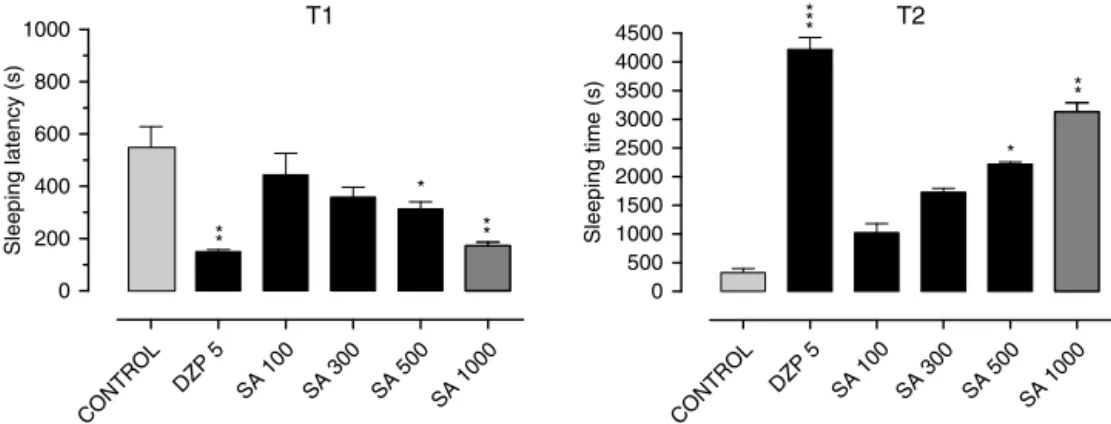
Treatment with SA at high doses (500 and 1000mg/kg)
increasedthesleepingtime(T2)anddecreasedthesleepinglatency
(T1);theeffectwassignificantlydifferentfromthecontrolgroup
(p<0.05).Diazepam5mg/kgincreasedthesleepingtime(T2)and
decreasedthesleepinglatency(T1)(Fig.1).Theeffectsofgraded
dosesofSAshowedadosedependenteffect.
Anxiolyticactivity
Elevatedplusmaze(EPM)
Administration of SA (at dose of 500mg/kg) significantly
increasedtheamountoftimespentandthepercentageofentries
intheopenarmsoftheEPM(p<0.05),comparedtovehicle
admin-istration.Similarly,animalstreatedwithdiazepam(1mg/kg,i.p.)
demonstrated a significantly increased number of entries and
increased time in the open arms, as compared with controls
(p<0.01)(Fig.2).
Thehigherthepercentagesofentriesandtimeinopenarms
means, rodents havelower levelsof anxiety(Park et al.,2005;
Primeauxetal.,2006).
Openfieldtest
IntheOFT,SAatdosesof50,100,300and500mg/kgdecreased
thedistancemoved(cm),velocity(cm/s)andrearings(f)as
com-pared tocontrol(NaCMC 1%)(p<0.01).Diazepam, as expected,
showednoeffectatthedoseused(1mg/kg,i.p.),butatdoseof
5mg/kgshowsdiminutionoftheseparameters(Table1).
Testsformuscleeffects
Therota-rod,chimneyandtractiontestswereusedtoassess
motoractivitycoordination,musclerelaxantandmusclestrength
inexperimentalanimalsunderstimulantsordepressantscentral
nervoussystemdrugs.SAshowsnodecreaseinmotorcoordination
atalluseddoses,except750mg/kgat60and120min(p<0.05vs.
CONTROL DZP 5
CONTROL DZP 5
SA 100 SA 300 SA 500 SA 1000 SA 300 SA 500 SA 1000
0 200 400 600 800
1000 T1
*
**
** **
* *
**
Sleeping latency (s)
T2
SA 100
0 500 1000 1500 2000 2500 3000 3500 4000 4500
Sleeping time (s)
Fig.1. EffectsoftheethanolicextractofSidaacuta(SA)atdosesof100,300,500and1000mg/kg,diazepam5mg/kgandcontrol(vehicle)onpentobarbital(40mg/kgi.p.) inducedsleepingtimeinmice.T1=timeoflatencyandT2=timeofdurationofsleep,n=4.Valuesareexpressedasmean±SEM.*p<0.05,**p<0.01and***p<0.001,as comparedtonormalcontrol.ANOVAandDunnet’sastheposthoctestwereperformed.
Control DZP PTZ SA 50 SA 100 SA 300 SA500 Control DZP PTZ SA 50 SA 100 SA 300 SA 500
0 5 10 15 20 25 30 35
*
* *
*
* *
# entries into open arms
0 50 100 150 200
Time spent on open arms (s)
Fig.2.InfluenceoftheethanolicextractofSidaacuta(SA)atdosesof50,100,300and500mg/kg,diazepam1mg/kgandcontrol(vehicle),expressedbypercentageofentries inopenarm(a)andthetimespentinopenarms(b)intheelevatedplusmaze.Resultsareexpressedasmean±SEM,n=4eachgroup;*p<0.05vs.control;**p<0.01vs. control;ANOVAwithStudent–Dunnet’sposthoctest.
Table1
EffectsofSidaacuta(SA)ontheopenfieldtestinmiceatdosesof50,100,300and 500mg/kg,anddiazepamat1and5mg/kg.Valuesrepresentthemean±SEMof dis-tancemoved(cm),velocity(cm/s)andrearing(f).Valuesrepresentthemean±SEM, medium±E.S.ofdistancemoved(cm),velocity(cm/s)andrearing(f).ANOVAand Dunnet’sastheposthoctestwereperformed.
Group Distancemoved(cm) Velocity(cm/s) Rearing(f)
Control 11,268±466.4 6.26±0.26 350.5±28.9 Diazepam1mg/kg 14,862±2334.0 8.26±1.30 312.3±38.6 Diazepam5mg/kg 980±11.7** 0.77
±0.16** 22.5 ±3.8**
SA50mg/kg 2901±938.7** 1.61±0.52** 26.5±8.7**
SA100mg/kg 2726±385.0** 1.52±0.21** 14.8±5.4**
SA300mg/kg 1513±146.3** 0.84±0.08** 11.8±4.6**
SA500mg/kg 1614±254.4** 0.89
±0.14** 20.0 ±14.4** ** p<0.01comparedwithcontrolgroup(CMC1%).
Inthetractiontest(TT)S.acuta(500,750and1000mg/kg)did
notimpairtheabilitytoplaceatleastonehindfootonthewire
within5s,unlikediazepam(Table2).
Inthechimneytest(ChT)nosignificanteffectwasobservedin
micepretreatedwithS.acutaextract(500,750and1000mg/kg)in
thetimetakentoclimbbackwardinthePyrexglasstube.However,
micepretreatedwithdiazepamcouldnotclimbbackwardsinthe
Pyrexglasstube(Table3).
Pentylenetetrazole(PTZ)-inducedseizures
SAextractat50mg/kgdosesshowsadiminutionofthenumber
ofmicethatpresentseizures(0%),atdosesof100mg/kgshows
de 50% of the number of mice that present seizures. At doses
of300mg/kg justdemonstrated a25%ofprotectiontheseizure
Rota-rod test (RRT)
Measurement time (min)
Time spent in the rod (s)
200
160
120
80 *
*
***
***
*** 40
60 120 180
0
0
Control
DPZ
SA 100 SA 750 SA 500 SA 300
Fig.3. Effectsonrota-rodinmiceat0,60,120and180afteradministrationofSida acuta(SA),atdosesof100,300,500and750mg/kgordiazepam(DZP)at5mg/kg,
n=4.Valuesareexpressedasmean±SEM.*p<0.05,**p<0.01and***p<0.001,as comparedtonormalcontrol(NaCMC1%).TwowaysANOVAandBonferroniasthe posthoctestwereperformed.
inducedPTZ.Meanwhile,dosesof500mg/kgdonotshow
protec-tionagainstthePTZinducedseizure(Table4).
Bodytemperature
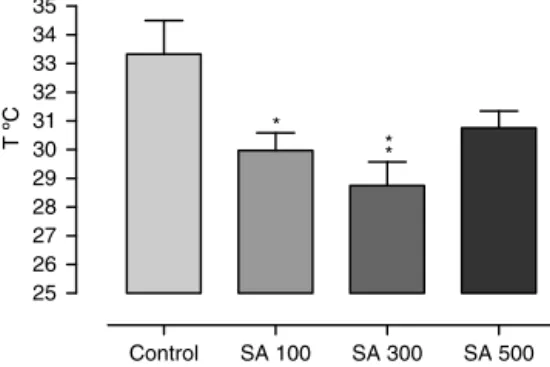
S.acutaatdosesof100mg/kg(p<0.05)and300mg/kg(p<0.01)
causedasignificanthypothermiarelativetocontrolgroup,overthe
Table2
EffectofSidaacuta(SA)onthemusclestrengthinthetractiontest.Themuscle strengthinmicewasmeasuredat60,120and180min.Eachvaluerepresentsthe mean±SEM,n=4.Fordiazepamallvalues>5s–cutofftime.ANOVAandDunnet’s astheposthoctestwereperformed.
Treatment Dose(mg/kg) Meantimeittakestoputonefootbackon thewire(±SEM)[s]
Time 60 120 180
Control – 2.1±0.6 3.9±0.7 3.6±0.6
Diazepam 5 >5.0** 5
±0.0** >5**
SA 500 3.1±0.7 2.9±0.5 3.5±0.8 SA 750 4.0±0.6 5.0±0.0 4.1±0.9 SA 1000 3.4±0.9 4.3±0.8 4.0±0.6
**p<0.01comparedwiththecontrolgroup.
Table3
MusclerelaxantactivityofSidaacuta(SA)inthechimneytest.Themuscle relax-ationinmicewasmeasuredat60,120and180min.Eachvaluerepresentsthe mean±SEM,n=4.Fordiazepamallvalues>30s–cutofftime.ANOVAandDunnet’s astheposthoctestwereperformed.
Treatment Dose(mg/kg) Meantimetoclimbupthechimney (±SEM)[s]
Time 60 120 180
Control – 12.5±31 11.7±2.7 11.8±2.3 Diazepam 5 >30.0** >30.0** >30.0**
SA 500 11.3±3.2 20.7±5.5 22.0±2.8 SA 750 17.6±5.4 22.0±5.2 17.8±5.8 SA 1000 17.1±4.4 21.2±3.3 20.0±2.0
**p<0.01comparedwiththecontrolgroup.
Table4
EffectofSidaacuta(SA)onpentylenetetrazole(PTZ)inducedseizuresinmice.Values areexpressedasmean±SEMoftimeofonsetseizures.=numberofmicethathave
seizures,%ofprotectionagainstPTZ(75mg/kg),tconv=timeofonsetofseizures.
N=8.ANOVAandDunnet’sastheposthoctestwereperformed.Themaximumtime ofonsetofseizureswas1800s(Tmax).
Group %protection tconv(s)X±SEM %mortality
Control 8/8 0.0 151.5±10.7 0 Diazepam1mg/kg 0/8 100.0 1800.0±0.0** 0
SA50mg/kg 0/8 100.0 1800.0±0.0** 0
SA100mg/kg 4/8 50.0 986.0±310* 0
SA300mg/kg 2/8 75.0 1009.0±259.8** 0
SA500mg/kg 7/8 12.5 405.5±200.9 12.5
*p<0.05ascomparedtonormalcontrol. **p<0.01comparedwiththecontrolgroup.
Control SA 100 SA 300 SA 500
25 26 27 28 29 30 31 32 33 34 35
*
* *
T ºC
Fig.4.EffectsoncorporaltemperatureinmiceofSidaacuta(SA)atdosesof100, 300and500mg/kg,30minafter administration,n=4.Valuesareexpressedas mean±SEM.*p<0.01and**p<0.01,ascomparedtonormalcontrol(NaCMC1%).
Discussion
Thisworkrepresentsthefirststeptowardtheunderstanding
oftheeffectsinthecentralnervoussystemofthecrudeextract
obtainedfromtheleavesandstemsofS.acuta,onrodents.The
plantshoweddepressive,anxiolyticandanticonvulsanteffects;in
addition,apotentiationofhypnosisinducedbypentobarbital.The
effectsdescribedinthisworkforS.acutaareaccordingtowhat
isknownintraditionalmedicine,whereisusedassedativeagent
(Oteroet al.,2000a;Sreedevi etal.,2009; Govindarajan,2010),
alsoforplantswithinthesamespeciesS.tiagiiandSidacordifolia
(Datusaliaetal.,2008;Francoetal.,2005).
Atthehigherdosesusedinthiswork,theS.acutaextract
indi-cated a sedativeand hypnoticeffectof theplant.This effectis
probablycausedbyvasicineorcryptolepine,whicharealkaloids
isolatedfromthis plant(Ahmedet al.,2011);even though,the
effectsofthesecompoundsonthecentralnervoussystemhave
notbeenstudied.ThesedativeeffectwasalsoevidentwithS.tiagii
(Datusaliaetal.,2008).
Anxiolyticcompoundsreducethenaturalanimalaversiontothe
openarmsandpromotetheexplorationthereofinthe
elevated-plusmazetest.Ontheotherhand,theforcedorvoluntarypassages
ofanimalsintotheclosedarmsoftheEPMare associatedwith
hormonalandbehavioralchangesindicativeofincreasedanxiety
(Adebesinetal.,2015).Avoidanceoftheopenarmportraysa
mani-festationoffearandanxiety.Basedontheseassertions,theelevated
plus-mazetestisareliablemeanforidentifyingselectiveanxiolytic
effectofdrugs(Adebesinetal.,2015).TheextractofS.acutashows
anincreaseinopenarmexploration(anxiolyticactivity),reflected
byanincreaseinthepercentageofentriesintoandtimespenton
theopenarms.But,alldosesoftheextractofSAdecreased the
distancemoved,velocityandrearingmeasuredintheopenfield,
similarlytoDZP.Thissuggestsanxiolyticeffectoftheextractatthe
doseof500mg/kg,givingcredencetotheindicationinthe
hole-boardtest.
Resultsobtainedintherota-rodtest(RRT)showedthat
treat-mentwithS.acuta,at100,300and500mg/kg,didnotmodifythe
spontaneousactivityofthemice,nonesignsthatdenote
depres-santeffectswereobserved,withcomparisontothemicetreated
withDZ,aclassicbenzodiazepinewithanxiolyticeffectsthat
pro-duceda decrease oflocomotor activityin comparison withthe
controlgroup.Thus,theseresultssuggestthatthisplantdidnot
producemyorelaxation,neitheraltersthemotorcoordinationof
miceexperimental,whichareundesirablesedativesideeffectsof
somebenzodiazepines.
Inthepresentstudy,resultsshowedthatS.acuta leavesand
stemsextracthasanticonvulsanteffectsonPTZmodelofepilepsy
inmice.S.acutaatthedoseof50mg/kgwasmosteffectiveagainst
PTZinduced seizure(100%protection), followedbythedoseof
300mg/kgwitha75%ofprotection.Theanti-epilepticeffectsof
drugs such as benzodiazepines are accompanied by decreased
motoractivityandsedation(Guptaetal.,2012).Therefore,S.acuta
mightpossiblybeproducinganti-epilepticactionbyincreasingthe
effectofGABA,theprincipalinhibitorytransmitterinthecentral
nervoussystem.Thisisinaccordance withthepharmacological
effectsofbenzodiazepineandhighlightstherelevanceofthe
puta-tiveanti-epilepticeffectsofS.acuta(Guptaetal.,2012).However,
furtherstudiesonneurotransmitterorneuromodulators
involve-mentsarenecessaryforcompleteunderstandingofanticonvulsant
effectsofS.acuta.
Conclusion
Inconclusion,thesedatashowedthatmicetreatedwithcrude
extract of the leavesand stems of S. acuta presented sedative
effect.Also,theextractprotectsagainstseizuresinducedbyPTZ
anditshowsanxiolyticeffect.Therefore,itisimportanttofurther
Authors’contributions
Theidentificationandcollectionofplantmaterialweremade
byFAGincompanyofJVandIC.G-Bpreparedtheextracts.The
pharmacologicalevaluationwasperformedbyDMB,AG-SandJAF
ThemanuscriptwaselaboratedbyDMBAlltheauthorshaveread
thefinalmanuscriptandagreedtoitssubmissionforappraisal.
Conflictsofinterest
Theauthorsdeclarenoconflictsofinterest.
Acknowledgements
Dr.NormanFransworth(RIP)forgivingusinformationofthe
databaseNAPRALERT.CarolinaFoundation,UniversityofAntioquia
–ColombiaandUniversityofSantiagodeCompostela–Spainfor
financethescholarshipoftheProf.Benjumeainthe
Pharmacol-ogyLaboratoryofCentral NervousSystem(GI-1684-USC).CODI
Sustainabilityproject2014–2015.
References
Adebesin, I.F., Akindele, A.J., Adeyemi, O.O., 2015. Evaluation of neuro-pharmacologicaleffectsofaqueousleafextractofAlbiziaglaberrima (Legumi-nosae)inmice.J.Ethnopharmacol.160,101–1088.
Adeniyi,S.A.,Orjiekwe,C.L.,Ehiagbonare,J.E.,Arimah,B.D.,2010.Preliminary phy-tochemicalanalysisandinsecticidalactivityofethanolicextractsoffourtropical plants(Vernoniaamygdalina,Sidaacuta,OcimumgratissimumandTelfaria occi-dentalis)againstbeansweevil (Acanthscelides obtectus).Int.J. Phys.Sci. 5, 753–762.
Adetutu,A.,Morgan,W.A.,Corcoran,O.,2011.Ethnopharmacologicalsurveyand invitroevaluationofwound-healingplantsusedinSouth-westernNigeria.J. Ethnopharmacol.137,50–56.
Ahmed,F.,Toume,K.,Ohtsuki,T.,Rahman,M.,Kumar,S.,Sadhu,S.K.,Ishibashi,M., 2011.Cryptolepine,isolatedfromSidaacuta,sensitizeshumangastric adeno-carcinomacellstoTRAIL-inducedapoptosis.Phytother.Res.25,147–150.
Akilandeswari,S.,Senthamarai,R.,Prema,S.,Valarmathi,R.,2010.Antimicrobial activityofleafextractsofSidaacutaBurm.Int.J.Pharm.Sci.Res.1,248–250.
Allabi,A.C.,Busia,K.,Ekanmian,V.,Bakiono,F.,2011.Theuseofmedicinalplantsin self-careintheAgonlinregionofBenin.J.Ethnopharmacol.133,234–243.
Archer,J.,1973.Testsforemotionalityinratsandmice:areview.Anim.Behav.21, 205–235.
Banzouzi,J.T.,Prado,R.,Menan,H.,Valentin,A.,Roumestan,C.,Mallié,M.,Pelissier, Y.,Blache,Y.,2004.StudiesonmedicinalplantsofIvoryCoast:investigationof Sidaacutaforinvitroantiplasmodialactivitiesandidentificationofanactive constituent.Phytomedicine11,338–341.
Bhardwaj,M.,Bharadwaj,L.,Trigunayat,K.,Trigunayat,M.M.,2011.Insecticidaland wormicidalplantsfromAravallihillrangeofIndia.J.Ethnopharmacol.136, 103–110.
Boissier,J.R.,Tardy,J.,Diverres,J.C.,1960.Une nouvellemethodesimplepour explorerl’action‘tranquilisante’:Letestdelacheminee.Med.Exp.3,81–84.
Carlini,E.A.,Burgos,V.,1979.Screeningfarmacológicodeansiolíticos:metodología laboratorialecomparac¸ãoentrediazepameclorobenzepam.Rev.Assoc.Bras. Psiquiatr.1,25–31.
Carlini,E.A.,Constar,J.D.P.,Silva-Filho,A.R.,Silveira-Filho,N.G.,Frochtengarten,M.I., Bueno,O.V.A.,1986.Pharmacologyoflemon-grass(CymbopogoncitratusStapf). Effectsofteaspreparedfromleavesonlaboratory-animals.J.Ethnopharmacol. 17,37–64.
Datusalia,A.K.,Kalra,P.,Narasimhan,B.,Sharma,S.,Goyal,R.K.,2008.Anxiolyticand antiseizureeffectsofSidatiagiibhandri.J.HealthSci.54,544–550.
Dunham,N.W.,Miya,T.S.,1957.Anoteonasimpleapparatusfordetecting neuro-logicaldeficitsinratsandmice.J.Am.Pharm.Assoc.46,208.
Ekpo,M.A.,Etim,P.C.,2009.Antimicrobialactivityofethanolicandaqueousextracts ofSidaacutaonmicroorganismsfromskininfections.J.Med.Plants.Res.3, 621–624.
Franco,C.I.F.,Morais,L.C.S.,Quintans-Junior,L.J.,Almeida,R.N.,Antoniolli,A.R.,2005.
CNSpharmacologicaleffectsofthehydroalcoholicextractofSidacordifoliaL. leaves.J.Ethnopharmacol.98,275–279.
Gbolade,A.,2012.Ethnobotanicalstudyofplantsusedintreatinghypertensionin EdoStateofNigeria.J.Ethnopharmacol.144,1–10.
Govindarajan,M.,2010.LarvicidalandrepellentactivitiesofSidaacutaBurm.F. (Family:Malvaceae)againstthreeimportantvectormosquitoes.AsianPac.J. Trop.Med.3,691–695.
Gupta,G.,Kazmi, I.,Afzal,M., Rahman,M.,Saleem, S.,Ashraf, M.S.,Khusroo, M.J.,Nazeer,K.,Ahmed,S.,Mujeeb,M.,Ahmed,Z.,Anwar,F.,2012.Sedative, antiepilepticandantipsychoticeffectsofViscumalbumL.(Loranthaceae)inmice andrats.J.Ethnopharmacol.141,810–816.
Hanledy,S.L.,Mithani,S.,1984.Effectsofalpha-adrenoreceptoragonistand antag-onistin maze-explorationmodelof fear-motivatedbehaviour.N.S.Arch. Pharmacol.327,1–5.
Ibironke,G.F.,Umukoro,A.S.,Ajonijebu,D.C.,2014.Centralnervoussystemactivity oftheethanolleafextractofSidaacutainrats.Afr.J.Med.Sci.43,11–16.
Kannan,R.R.,Prakash,S.G.,2012.CynodondactylonandSidaacutaextractsimpact onthefunctionofthecardiovascularsysteminzebrafishembryos.J.Biomed. Res.26,90–97.
Karou,S.D.,Dicko,N.H.,Sanon,S.,Simpore,J.,Traore,A.S.,2003.Antimalarialactivity ofSidaacutaBurm.f.(Malvaceae)andPterocarpuserinaceusPoir.(Fabaceae).J. Ethnopharmacol.89,291–294.
Karou,S.D.,Savadogo,A.,Canini,A.,Yameogo,S.,Montesano,C.,Simpore,J.,Colizzi, V.,Traore,A.S.,2005.AntibacterialactivityofalkaloidsfromSidaacuta.Afr.J. Biotechnol.4,1452–1457.
Karou,S.D.,Nadembega,W.M.C.,Ilboudo,D.P.,Ouermi,D.,Gbeassor,M.,DeSouza,C., Simpore,J.,2007.SidaacutaBurm.f.:amedicinalplantwithnumerouspotencies. Afr.J.Biotechnol.6,2953–2959.
Konaté,K.,Bassolé,I.H.N.,Hilou,A.,Aworet-Samseny,R.R.R.,Souza,A.,Barro,N., Dicko,M.H.,Datté,J.Y.,M’Batchi,B.,2012.Toxicityassessmentandanalgesic activityinvestigationofaqueousacetoneextractsofSidaacutaBurnf.andSida cordifoliaL.(Malvaceae)medicinalplantsofBurkinaFaso.BMCComplementary Altern.Med.12,120–131.
Konaté,K.,Souza,A.,Coulibaly,A.Y.,Meda,N.T.R.,Kiendrebeogo,M.,Lamien-Meda, A.,Millogo-Rasolodimby,J.,Lamidi,M.,Nacoulma,O.G.,2010.Invitro antioxi-dant,lipoxygenaseandxanthineoxidaseinhibitoryactivitiesoffractionsfrom CienfuegosdigitataCav.,SidaacutaL.andSidaacutaBurnf.(Malvaceae).Pak.J. Biol.Sci.13,1092–1098.
Koudouvo,K.,Karou,S.D.,Ilboudo,D.P.,Kokou,K.,Essien,K.,Aklikokou,K.,de Souza,C.,Simpore,J.,Gbéassor,M.,2011.Invitroantiplasmodialactivityof crudeextractsfromTogolesemedicinalplants.AsianPac.J. Trop.Med.4, 129–132.
Kumar,D.,Kumar,A.,Prakash,O.,2012.Potentialantifertilityagentsfromplants:a comprehensivereview.J.Ethnopharmacol.140,1–32.
Lister,R.G.,1987.Theuseofaplus-mazetomeasureanxietyinthemouse. Psy-chopharmacology92,180–185.
Mejía,R.,Ferman,R.L.,Galdámez,E.L.,(Thesisinbiology)1994.Caracterización botánicadeespeciesconsideradasmalezasenloscultivosanualesyperennesde laestaciónexperimentalyprácticasdelaFacultaddeCienciasAgrarias.Escuela deBiología.UniversidaddeElSalvador,ElSalvador,210pp.
Nadembega,P.,Boussim,J.I.,Nikiema,J.B.,Poli,F.,Antognoni,F.,2011.Medicinal plantsinBaskoure,KourittengaProvince,BurkinaFaso:anethnobotanicalstudy. J.Ethnopharmacol.133,378–395.
Otero,R.,Fonnegra,R.,Jiménez,S.L.,Nú ˜nez,V.,Evans,N.,Alzate,S.P.,García,M.E., Saldarriaga,M.,Valle,G.D.,Osorio,R.G.,Díaz,A.,Valderrama,R.,Duque,A.,Vélez, H.N.,2000a.SnakebitesandethnobotanyinthenorthwestregionofColombia. PartI:traditionaluseofplants.J.Ethnopharmacol.71,493–504.
Otero,R.,Nú ˜nez,V.,Jiménez,S.L.,Fonnegra,R.,Osorio,R.G.,García,M.E.,2000b.
Snakebitesandethnobotany inthenorthwest regionofColombia.PartII: neutralizationoflethal and enzymaticeffectsofBothrops atroxvenom. J. Ethnopharmacol.71,505–511.
Otero,R.,Nú ˜nez,V.,Barona,J.,Fonnegra,R.,Jiménez,S.L.,Osorio,R.G.,Saldarriaga,M., Dı ´az,A.,2000c.Snakebitesandethnobotanyinthenorthwestregionof Colom-bia.PartIII:neutralizationofthehaemorrhagiceffectofBothropsatroxvenom. J.Ethnopharmacol.73,233–241.
Ozturk,Y.,Aydine,S.,Baser,K.H.C.,Berberoglu,H.,1996.EffectsofHypericum perfo-ratumL.andHypericumcalycinumL.extractsonthecentralnervoussystemin mice.Phytomedicine3,139–146.
Park,H.J.,Chae,Y.,Jang,J.,Shim,I.,Lee,H.,Lim,S.,2005.Theeffectof acupunc-tureonanxietyandneuropeptideYexpressioninthebasolateralamygdalaof maternallyseparatedrats.Neurosci.Lett.377,179–184.
Pellow,S.,Chopin,P.,File,S.,Briley,M.,1985.Validationofopen-closedarmentries inanelevatedplus-mazeasameasureofanxietyintherat.J.Neurosci.Methods. 14,149–167.
Pérez,G.R.M.,Pérez,L.J.A.,García,D.L.M.,Sossa,M.H.,1998.Neuropharmacological activityofSolanumnigrumfruit.J.Ethnopharmacol.62,43–48.
Pieme,C.A.,Penlap,V.N.,Ngogang,J.,Costache, M.,2010.Invitrocytotoxicity andantioxidantactivitiesoffivemedicinalplantsofMalvaceaefamilyfrom Cameroon.Environ.Toxicol.Pharmacol.29,223–228.
Prakash,A.,Varma,R.K.,Ghosal,S.,1981.AlkaloidconstituentsofSidaacuta,S. humilis,S.rhombifoliaandS.spinosa.PlantaMed.43,384–388.
Primeaux,S.D.,Wilson,S.P.,McDonald,A.J.,Mascagni,F.,Wilson,M.A.,2006.Therole ofdeltaopioidreceptorsintheanxiolyticactionsofbenzodiazepines.Pharmacol. Biochem.Behav.85,545–554.
Ramírez,B.E.B.,Ruriz,N.N.,Arellano,J.D.Q.,Madrigal,B.R.,Michel,M.T.V.,Garzón, P.,1998.AnticonvulsanteffectofMagnoliagrandifioraL.intherat.J. Ethnophar-macol.61,143–152.
Rizk,R.M.,Soliman,M.I.,2014.Biochemicalandmoleculargenetic characteriza-tionofsomespeciesoffamilyMalvaceae,Egypt.Egypt.J.BasicAppl.Sci.1, 167–176.
Rudzik,A.D.,Hester,J.B.,Tang,A.H.,Stray,R.N.,Friss,W.,1973.In:Garrattini,S., Mussinii,E.,Randall,L.O.(Eds.),Thebenzodiazepines.RavenPress,NewYork.
Siegel,P.S.,1946.Asimpleelectronicdeviceforthemeasurementofgrossbodily activityofsmallanimals.J.Psychol.21,227–236.
Swinyard,E.A.,Brown,W.C.,Goodman,L.S.,1952.Comparativeassaysof antiepilep-ticdrugsinmiceandrats.J.Pharmacol.Exp.Ther.106,319–330.
Upadhyay, B., Parveen Dhaker, A.K., Kumar, A.K., 2010. Ethnomedicinal and ethnopharmaco-statisticalstudiesofEasternRajasthan,India.J. Ethnopharma-col.129,64–86.
Vásquez,J.,Alarcón,J.C.,Jiménez,S.L.,Jaramillo,G.I.,Gómez-Betancur,I.C., Rey-Suarez,I.C.,Jaramillo,K.M.,Mu ˜noz,D.C.,Marín,D.M.,Romero,J.O.,2015.Main plantsusedinthetraditionalmedicineforthetreatmentofsnakesbitesin
theregionsofthedepartmentofAntioquia,Colombia.J.Ethnopharmacol.170, 158–166.
Vogel,H.G.,Vogel,W.H.,2002.DrugDiscoveryandEvaluation:Pharmacological Assay,2nded.Springer,Berlin,Alemania.
Wambebe,C.,1985.Influenceofsomeagentsthataffect5-HTmetabolismand receptorsandnitrazepam-inducedsleepinmice.Br.J.Pharmacol.84,185–191.