Hyperalgesic effect induced by
barbiturates, midazolam and ethanol:
pharmacological evidence for GABA-A
receptor involvement
Departamento de Farmacologia, Instituto de Ciências Biológicas,
Universidade Federal de Minas Gerais, 31270-100 Belo Horizonte, MG, Brasil M.A.K.F. Tatsuo,
C.M. Yokoro, J.V. Salgado, S.M.S. Pesquero, M.A.P. Santana and J.N. Francischi
Abstract
The involvement of GABA-A receptors in the control of nociception was studied using the tail-flick test in rats. Non-hypnotic doses of the barbiturates phenobarbital (5-50 mg/kg), pentobarbital (17-33 mg/ kg), and thiopental (7.5-30 mg/kg), of the benzodiazepine midazolam (10 mg/kg) or of ethanol (0.4-1.6 g/kg) administered by the systemic route reduced the latency for the tail-flick response, thus inducing a ‘hyperalgesic’ state in the animals. In contrast, non-convulsant doses of the GABA-A antagonist picrotoxin (0.12-1.0 mg/kg) administered systemically induced an increase in the latency for the tail-flick response, therefore characterizing an ‘antinociceptive’ state. Previous picrotoxin (0.12 mg/kg) treatment abolished the hyperalgesic state induced by effective doses of the barbiturates, midazolam or ethanol. Since phenobarbital, midazolam and ethanol reproduced the described hyperalgesic effect of GABA-A-specific agonists (muscimol, THIP), which is specifically antagonized by the GABA-A antagonist picro-toxin, our results suggest that GABA-A receptors are tonically in-volved in the modulation of nociception in the rat central nervous system.
Correspondence
M.A.K.F. Tatsuo
Departamento de Farmacologia ICB, UFMG
Av. Antônio Carlos, 6627 31270-100 Belo Horizonte, MG Brasil
Research supported by FAPEMIG (CBS No. 493/90) and PRPq (Universidade Federal de Minas Gerais, Brasil).
Received January 23, 1996 Accepted November 11, 1996
Key words •Barbiturates
•Midazolam
•Ethanol
•Picrotoxin
•Hyperalgesia
•GABA-A receptor
Introduction
Barbiturates, benzodiazepines and etha-nol, although belonging to chemically dis-tinct classes of drugs, share some pharmaco-logical properties. The principal medical in-dication of the barbiturate phenobarbital is the prevention of grand mal epilepsy (1), whereas the benzodiazepine midazolam is used as a pre-anesthetic medication (2).
Etha-nol is more a sociological than a medical problem due to its risk of abuse (3). How-ever, all three drugs induce a general depres-sant effect in the central nervous system (CNS).
barbiturates and benzodiazepines potentiate GABA actions by a) prolonging the open state of the chloride-associated channels and by b) increasing the frequency of opening of the chloride channels, respectively. These effects can be competitively antagonized by bicuculline or non-competitively by picro-toxin (4,5).
Many reports in the literature have shown the involvement of GABA receptors in the modulation of nociception in the central ner-vous system (4). Administration of GABA-A agonists seems to interfere with nocicep-tion, whereas the GABA-B agonist baclofen can induce analgesia at spinal or supraspinal levels (4). Recent reports in the literature have suggested the involvement of the GABA-A receptor in the modulation of cen-tral nociception through the descending in-hibitory system (7).
Experimentally, GABA-A agonists such as muscimol and THIP (4,5,6,7-tetrahy-droisoxal-[5,4-c]-pyridin-3-ol) injected into the rostral ventromedial medulla(RVM) in-duced hyperalgesia, as detected by the tail-flick method (8). Hyperalgesia was also de-tected after muscimol microinjection into the periaqueductal grey matter (PAG) as shown by Zambotti et al. (9), Moreau and Fields (10), and Behbehani et al. (11). As expected, the GABA antagonists bicuculline and picrotoxin present antinociceptive ef-fects whether microinjected into the RVM, PAG (10) or the lateral ventricles (8). In addition, systemic bicuculline or picrotoxin administration induces an antinociceptive effect per se or prior to microinjection of GABA-A agonists into the RVM (8) or the PAG (11). Hyperalgesia or no effect has also been described following injection of bicu-culline or picrotoxin into the spinal medulla (12). However, the controversy about whether barbiturates and benzodiazepines are analgesic or hyperalgesic is still unsolved. Hyperalgesia as well as analgesia have been reported following administration of both drugs to humans or rodents (13-19).
The aim of the present study was to deter-mine the effect of systemic administration of the barbiturates phenobarbital, pentobarbital and thiopental, the benzodiazepine mida-zolam, and ethanol using the tail-flick model in rats. In addition, picrotoxin alone or in association with these agonists was also used to assess the potential role of the GABA-A receptor in the tail-flick response.
Material and Methods
Animals
Male Holtzman rats weighing 180-250 g were used. The animals were housed at a temperature of 24 ± 2oC, with food and water ad libitum and a 12-h light-dark cycle for 24 h before the experiments.
Measurement of pain threshold
A slight modification of the method de-scribed by D’Amour and Smith (20) was used to detect the tail-flick response. Briefly, a voltimeter and an amperimeter were con-nected to the system to permit variation of the resistance heating. Stimuli of 0.31 cal/ sec caused a 3.5-4.5-sec latency for the tail-flick baseline in the rats. Test tail-tail-flick re-sponses in duplicate at 10, 20, 30, 40 and 60 min following drug administration are re-ported as tail-flick index (TFI). The TFI was the percent of the maximum response ob-tained before and after drug administration to the animals, as expressed in the following formula:
TFI =
Post-drug latency (sec) - baseline latency (sec) x 100 7 sec - baseline latency
Drug treatments
The barbiturates and midazolam, diluted in propylene glycol:saline (50:50, v/v) and in manufacturer-supplied vehicle, respec-tively, were administered by the intraperito-neal (ip) route in a volume of 0.1 ml/kg. Ethanol was diluted in physiological saline and administered orally (0.2 ml/kg) rather than ip to prevent peritoneal irritation. Picro-toxin diluted in physiological saline was ad-ministered ip alone or 10 min before the injection of agonists. In these experiments, control animals received vehicle or saline (0.1 ml/100 g) either ip or orally.
Drugs
The following drugs were purchased from the stated sources: phenobarbital (Rhodia, Santo Amaro, SP), pentobarbital (Cristalia, Itapira, SP), thiopental (Abbott, São Paulo, SP), midazolam (Roche, Rio de Janeiro, RJ), ethanol (Grupo Química, Rio de Janeiro, RJ), picrotoxin (Sigma Chemical Co., St. Louis, MO), and propylene glycol (Reagen, Rio de Janeiro, RJ).
Statistical analysis
The results are reported as mean ± SEM. Data for the time-effect curve were sub-jected to multivariate analysis of variance (MANOVA). In case of interaction between treatment and time, MANOVA was followed by one-way analysis of variance (ANOVA) for each time. For the analysis of the treat-ment effect only, MANOVA was followed by ANOVA for the area under the curve. For multiple comparisons, ANOVA was fol-lowed by the Duncan test. Statistical signif-icance was accepted at P<0.05.
Results
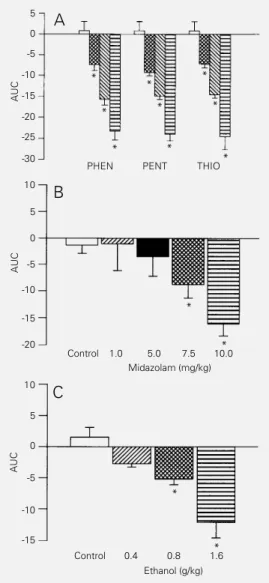
Intraperitoneal administration of pheno-barbital (5-50 mg/kg), pentopheno-barbital (17-33
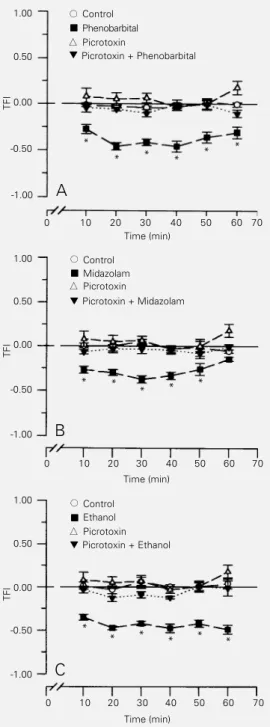
mg/kg) and thiopental (7.5-30 mg/kg) re-duced the latency for the tail-flick response in rats in a dose-dependent manner, there-fore inducing hyperalgesia, as shown in Fig-ure 1A. Doses higher than 50, 33 and 30 mg/ kg phenobarbital, pentobarbital and thiopen-tal, respectively, induced hypnotic effects in the rats, thus precluding the use of these doses in our experiments (data not shown). Significant hyperalgesia was observed 10 min after barbiturate administration, with a maximal effect being detected at 30 min, and remained significantly elevated for the sub-sequent 30 min of observation, as illustrated for 20 mg/kg phenobarbital in Figure 2A. This effect was observed with the three
bar-Figure 1 - Dose-response curves for barbiturate- (A), midazolam-(B) and ethanol- (C) induced hy-peralgesia in rats using the tail-flick method. Increasing doses of the barbiturates phenobarbi-tal (PHEN, 5, 20 and 50 mg/kg, ip), pentobarbital (PENT, 17, 25
and 33 mg/kg, ip), thiopental
(THIO, 7.5, 15 and 30 mg/kg, ip), midazolam (1-10 mg/kg, ip) and ethanol (0.4-1.6 g/kg, oral) were administered 10 min before the test. Control animals (open col-umn) received vehicles (propy-lene glycol:saline, 50:50, v/v) ip or oral saline. The results are ex-pressed as mean area under the tail-flick index (TFI) curves (AUC) ± SEM for 8 experiments. Hy-peralgesia is represented by negative values on the ordinate. *P<0.05 compared to control (one-way analysis of variance).
AUC
5
0
-5
-10
-15
-20
-25
-30
A
*
*
* *
*
PHEN PENT THIO
AUC
10
5
0
-5
-10
-15
-20
B
Control 1.0 5.0 7.5 10.0
Midazolam (mg/kg) *
*
*
*
AUC
10
5
0
-5
-10
-15
C
Control 0.4 0.8 1.6
Ethanol (g/kg) *
* *
20 mg/kg phenobarbital (Figure 2A). Differ-ent from phenobarbital, however, midazolam induced a hyperalgesia of shorter duration (50 min), whereas ethanol-induced hyperal-gesia was detected at 10 min of drug admin-istration and had a longer duration (2 h; data not shown). Administration of the various vehicles used did not induce a significant variation in the latency of the tail-flick re-sponse presented by the animals (control in Figures 1, 2 and 3).
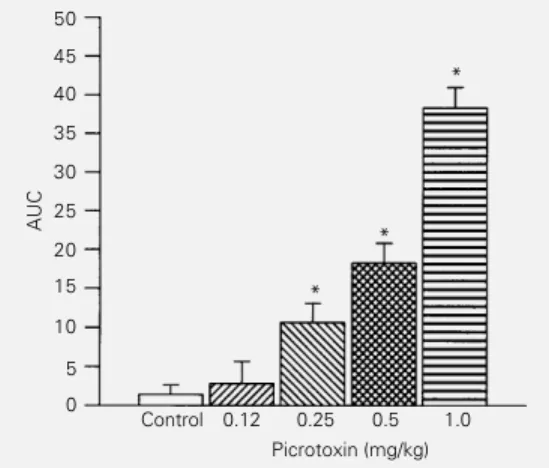
Intraperitoneal picrotoxin injection (0.12-1.0 mg/kg) induced a dose-dependent in-crease in the latency for the tail-flick re-sponse in rats, which characterized an anti-nociceptive effect (Figure 3). However, at the lower dose of 0.12 mg/kg, picrotoxin was not able to induce an antinociceptive effect
per se, although it could inhibit the hyperal-gesic effect induced by phenobarbital, mida-zolam and ethanol (Figure 2A, B and C, respectively).
Discussion
The precise effect of the administration of barbiturates or benzodiazepines on the mechanisms of pain modulation in humans or rats is still controversial. Analgesia, hy-peralgesia or no effect has been attributed to these drugs (13-19).
In the present study, we have shown that systemic administration of non-hypnotic doses of the barbiturates phenobarbital, pen-tobarbital and thiopental induced a dose-dependent hyperalgesia, as measured by the reduction of the latency for the tail-flick response in rats. Interestingly, non-hypnotic doses of the benzodiazepine midazolam and of ethanol systemically administered also induced a dose-dependent hyperalgesia us-ing the same method.
Barbiturates, benzodiazepines and etha-nol are known to be agonists of the GABA-A receptor complex which are ubiquitously distributed throughout the CNS, including the descendent inhibitory system (7,21). A
Figure 2 - Picrotoxin blocked the hyperalgesia induced by sys-temic phenobarbital (A), mida-zolam (B) or ethanol (C) adminis-tration to rats. Picrotoxin was ad-ministered ip 20 min before the tail-flick test. The agonists phe-nobarbital (20 mg/kg, ip), mida-zolam (10 mg/kg, ip) or ethanol (1.6 g/kg, oral) were adminis-tered 10 min before the test. Control animals were injected ip or orally treated with the respec-tive vehicles. Each point indi-cates the mean ± SEM of the data from 8 rats. Hyperalgesia is indicated by the negative val-ues on the ordinate; positive values indicate antinociception. *P<0.05 compared to control (Duncan test). TFI, Tail-flick in-dex.
TFI
1.00 !Control
àPhenobarbital
# Picrotoxin
ýPicrotoxin + Phenobarbital 0.50
0.00
-0.50
-1.00
0 10 20 30 40 50 60 70
Time (min)
!Control àMidazolam
ýPicrotoxin + Midazolam
!Control àEthanol
ýPicrotoxin + Ethanol
TFI
1.00
0.50
0.00
-0.50
-1.00
0 10 20 30 40 50 60 70
TFI
1.00
0.50
0.00
-0.50
-1.00
0 10 20 30 40 50 60 70
*
* * * *
*
* *
* * *
*
* * * * *
Time (min)
Time (min)
A
B
C
biturates in the dose range used (data not shown). However, barbiturate-induced hy-peralgesia was significantly reduced 2 h af-ter drug administration at the higher dose used (data not shown). In addition, mida-zolam (1.0-10 mg/kg) and ethanol (0.4-1.6 g/ kg) also induced a dose-dependent hyperal-gesia (Figure 1B and C, respectively), which showed a similar profile to that observed for
#Picrotoxin
facilitating action of the inhibitory neu-rotransmitter γ-aminobutyric acid (GABA) on the GABA-A receptor by these drugs could ultimately favor the expression of an inhibitory effect on the descending inhibito-ry system, with a consequent hyperalgesic behavior. This hypothesis was further rein-forced by the observed blockade of the hy-peralgesia induced by the association of bar-biturates, midazolam or ethanol with a low dose of the GABA-A antagonist picrotoxin and a clear-cut antinociceptive effect with higher doses of picrotoxin. If this is so, these results also indicate that there is a GABAergic tonus in the descendent inhibitory system.
The use of bicuculline, the specific an-tagonist of GABA-A receptor, also blocked the hyperalgesia induced by these agonists using the tail-flick test (Yokoro CM and Tatsuo MAKF, unpublished observations). A general depressant effect induced by these drugs at higher doses might obscure this hyperalgesic effect, thus explaining the anal-gesia or absence of effect formerly related to these drugs in the reported studies (18).
In the present study, however, associa-tion of various doses of picrotoxin with mi-dazolam only blocked the hyperalgesic ef-fect induced by the latter, without displaying an analgesic response as observed with bar-biturates and ethanol (data not shown). It has been described that the binding site of mida-zolam is distant from that at which barbitu-rates or ethanol interact with the GABA-A receptor (21,22). It is possible that the bind-ing of barbiturates or ethanol could facilitate
the close association of picrotoxin at the GABA-A receptor, which ultimately leads to the inhibition of the neurotransmitter ac-tion. In our experiments, this inhibitory fect was translated as an antinociceptive ef-fect. Midazolam, in turn, interacting with another site, such as the α-subunit of the GABA-A receptor (21), did not display this effect.
Our data demonstrate the involvement of the GABA-A receptor in the modulation of pain pathways. It is suggested that the allo-steric change of this receptor induced by barbiturates and ethanol is different from that induced by midazolam, since the asso-ciation of the latter with picrotoxin did not display the antinociceptive effect observed in the association of the former drugs with picrotoxin. We suggest that this hyperalge-sic effect should be taken into account in cases of barbiturate use or ethanol intoxica-tion, since non-hypnotic doses of these drugs are used under such conditions.
Figure 3 - Picrotoxin induced a dose-dependent antinociception in rats, as measured by the tail-flick method. Picrotoxin (0.12-1.0 mg/kg) was administered by the intraperitoneal route 20 min before the test. *P<0.05 com-pared to control (one-way analy-sis of variance). AUC, Area un-der the tail-flick index curve. *
*
AUC
50
45
40
35
30
25
Control 0.12 0.25 1.0
Picrotoxin (mg/kg) 0.5 20
15
10
5
0
References
1. Rall TW & Schleifer LS (1990). Drugs ef-fective in the therapy of the epilepsies. In: Goodman Gilman A, Rall TW, Nies AS &
Taylor P (Editors), The Pharmacological
Basis of Therapeutics. MacMillan, New York, 436-462.
2. Marshall BE & Longnecker DE (1990). General anesthetics. In: Goodman Gilman A, Rall TW, Nies AS & Taylor P (Editors), The Pharmacological Basis of Therapeu-tics. MacMillan, New York, 285-331. 3. Rall TW (1990). Hypnotics and sedative;
ethanol. In: Goodman Gilman A, Rall TW, Nies AS & Taylor P (Editors), The
Pharma-cological Basis of Therapeutics.
MacMillan, New York, 345-382.
4. Matsumoto RR (1989). GABA receptors: are cellular differences reflected in
func-tion? Brain Research Reviews, 14:
203-225.
5. Reynolds JN, Prasad A & MacDonald JF (1992). Ethanol modulation of GABA
re-ceptor-activated Cl- currents in neurons
of the chick, rat and mouse central ner-vous system. European Journal of Phar-macology, 234: 173-181.
6. Ticku MK & Kulkarni SK (1988). Molecular interactions of ethanol with GABAergic system and potential of Ro 15-4513 as an
ethanol antagonist. Pharmacology,
Bio-chemistry and Behavior, 30: 501-510. 7. Fields HL, Heinricher MM & Mason P
(1991). Neurotransmitters in nociceptive modulatory circuits. Annual Review of Neuroscience, 14: 219-245.
8. Heinricher MM & Kaplan HJ (1991). GABA-mediated inhibition in rostral ven-tromedial medulla: role in nociceptive modulation in the lightly anesthetized rat. Pain, 47: 105-113.
9. Zambotti F, Zonta N, Parenti M, Tammiso R, Vicentini L, Conci F & Mantegazza P (1982). Periaqueductal matter involve-ment in the muscimol-induced decrease of morphine antinociception. Naunyn-Schmiedebergs Archives of Pharmacolo-gy, 318: 368-369.
10. Moreau J-L & Fields HL (1986). Evidence for GABA involvement in midbrain control of medullary neurons that modulate
noci-ceptive transmission. Brain Research,
397: 37-46.
11. Behbehani MM, Jiang M, Chandler SD & Ennis M (1990). The effect of GABA and its antagonists on midbrain periaqueduc-tal gray neurons in the rat. Pain, 40: 195-204.
12. Ueda H, Ge M, Satoh M & Takagi H (1987). Subconvulsive doses of intracisternal bicuculline methiodide, a GABA-A recep-tor antagonist, produce potent analgesia as measured in the tail pinch test in mice. European Journal of Pharmacology, 136: 129-131.
13. Davidovich S, Niv D, Geller E & Urca G (1988). Ro 15-1788 produces naloxone-reversible analgesia in the rat. European Journal of Pharmacology, 146: 175-179. 14. Dundee JW (1960). Alterations in
re-sponse to somatic pain associated with anaesthesia. II. The effect of thiopentone
and pentobarbitone. British Journal of
Anaesthesia, 32: 407-414.
15. González-Darder JM, Ortega-Alvaro A, Ruz-Franzi I & Segura-Pastor D (1992). Antinociceptive effects of phenobarbital in tail-flick test and deafferentation
pain. Anesthesia and Analgesia, 75:
81-86.
16. Neal MJ (1965). The hyperalgesic action of barbiturates in mice. British Journal of Pharmacology, 24:170-177.
17. Niv D, Davidovich S, Geller E & Urca G (1988). Analgesic and hyperalgesic effects of midazolam: dependence on route of
administration. Anesthesia and Analgesia,
67: 1169-1173.
18. Stein C, Morgan MM & Liebeskind JC (1987). Barbiturate-induced inhibition of a spinal nociceptive reflex: role of GABA mechanisms and descending modulation. Brain Research, 407: 307-311.
19. Zambotti F, Zonta N, Tammiso R, Conci F, Hafner B, Zecca L, Ferrario P & Mantegazza P (1991). Effects of diazepam on nociception in rats. Naunyn-Schmiedebergs Archives of Pharmacolo-gy, 344: 84-89.
20. DAmour FE & Smith DL (1941). A method for determining loss of pain sensation. Journalof Pharmacology and Experimen-tal Therapeutics, 72:74-79.
21. MacDonald RL & Olsen RW (1994).
GABA-A receptor channels. Annual
Re-view of Neuroscience, 17: 567-602. 22. Sieghart W (1995). Structure and
pharma-cology of γ-aminobutyric acidA receptor