PEARLS
Chronobiomics: The Biological Clock as a New
Principle in Host
–
Microbial Interactions
Christoph A. Thaiss☯, Maayan Levy☯, Eran Elinav*
Immunology Department, Weizmann Institute of Science, Rehovot, Israel
☯These authors contributed equally to this work.
How Do Mammals Organize Their Biological Clocks?
The rotation of the Earth around its own axis creates a fundamental challenge for life on this planet, related to the need of all living organisms to modify their physiology in accordance with daily variations in multiple geophysical properties, including light, temperature, and avail-ability of nutrients. As a consequence, all domains of life have developed intrinsic timing sys-tems (“biological clocks”) in order to efficiently adapt organismal activity to the fluctuating environmental conditions [1]. The mechanisms by which different organisms have solved this challenge are manifold. In mammals, the molecular clock is classically understood as a network of transcription factors that are rhythmically operational in virtually all cells of the body [2]. Specifically, the core circadian clock is constituted by the transcription factors Period/Crypto-chrome and BMAL1/CLOCK, which not only control each other’s circadian expression pattern but also drive rhythmic oscillations in a large number of target genes, thereby orchestrating the daily activity profile of a cell [3]. Interestingly, mammalian molecular clocks are autonomous and self-sustained but can be entrained by external stimuli, such as light and nutrient availabil-ity, in order to adapt organism-intrinsic rhythmicity to fluctuating environmental conditions.
Are There Biological Clocks in Bacteria?
Until about 25 years ago, evidence for a biological clock had only been found in eukaryotes. Since then, however, bacterial circadian clocks have been well documented. Similar to eukaryotic clocks, they are endogenous, self-sustained, and can be entrained by environmental conditions. Of note, bacterial circadian rhythms have so far primarily been described in organisms that are light responsive, namely the cyanobacteriumSynechococcus elongates[4]. In this bacterium, the molecu-lar clock consists of three proteins (KaiA, KaiB, and KaiC). Remarkably, their oscillatory activity can be sustained in the absence of transcription and is characterized by rhythmic phosphorylation patterns [5]. In vitro reconstitution of this three-member clock leads to sustained rhythmic activity [6]. Of note, this rhythmic phosphorylation adapts to availability and intracellular storage of nutri-ents [7]. Although potential homologs in the genomic sequence of other bacteria have been found, their characterization awaits further studies. In addition, oxidation-reduction cycles of peroxire-doxin proteins have been found to be circadian across all domains of life [8]. Thus, circadian sys-tems have putatively evolved in multiple distinct ways in different forms of life.
What Happens to Biological Clocks in Places Where Eukaryotes
and Prokaryotes Share Their Habitats?
The study of diverse molecular clocks across the domains of life is especially interesting in sce-narios in which prokaryotes and eukaryotes interact to form symbiotic communities. The first OPEN ACCESS
Citation:Thaiss CA, Levy M, Elinav E (2015) Chronobiomics: The Biological Clock as a New Principle in Host–Microbial Interactions. PLoS Pathog
11(10): e1005113. doi:10.1371/journal.ppat.1005113
Editor:Deborah A. Hogan, Geisel School of Medicine at Dartmouth, UNITED STATES
Published:October 8, 2015
Copyright:© 2015 Thaiss et al. This is an open access article distributed under the terms of the
Creative Commons Attribution License, which permits unrestricted use, distribution, and reproduction in any medium, provided the original author and source are credited.
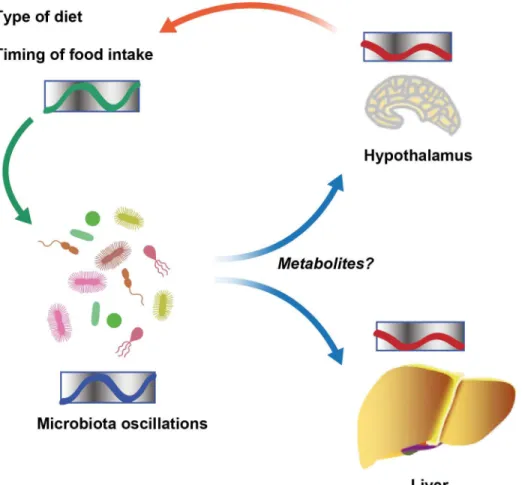
insight into such cross talk involving clock systems regulated across organisms came from a study of the squidEuprymna scolopesand its luminous endosymbiontVibrio fischeri[9].E. sco-lopesencodes genes for cryptochromes, whose oscillatory expression pattern is synchronized with and depends on symbiont luminescence in the light organ of the squid. Further evidence came from studies of the intestinal microbiota in mice, where it was observed that gut micro-bial colonization influences rhythmic signaling events in the ileal epithelium downstream of toll-like receptors (TLRs). This, in turn, regulates the organization of molecular clock activity and glucocorticoid production in the intestine [10]. The microbiota also impacts clock gene expression beyond the gastrointestinal track. Germ-free mice, which are born and raised under strictly sterile conditions in the absence of microorganisms, feature alterations in clock gene expression in the liver and the hypothalamus [11]. Together, these studies suggest that micro-bial colonization has a previously unappreciated function in the maintenance of circadian rhythms in the eukaryotic hosts. The underlying mechanisms for this activity remain obscure (Fig 1).
Recently, we uncovered that the circadian interactions between host and microbiota are not solely restricted to microbial control of host clock function but rather constitute a bidi-rectional cross talk [12]. We and others demonstrated that the intestinal microbiota under-goes rhythmic fluctuations in taxonomic composition and, consequently, genomic coding capacity [11–13]. As a result, different times of the day feature distinct microbial community configurations and microbiota functions. Thus, in addition to the intrinsic circadian timing systems identified in cyanobacteria, the intestinal microbiota undergoes community-scale rhythmicity on the level of metagenome composition [14]. These compositional fluctuations are controlled by the circadian clock of the host, since they cease in the absence of a func-tional host molecular clock [12]. Furthermore, the type of diet and the rhythmicity of food intake are major drivers of the oscillations in the intestinal microbial ecosystem [12,13]. In addition, recent insights using parenteral feeding raise the possibility that further, still-unidentified host factors are involved in regulating microbial oscillations [11]. Taken together, symbiotic microbial colonization is required for circadian homeostasis of the host. In turn, a functional host circadian clock ensures periodic oscillations of its symbiotic micro-bial ecosystem (Fig 1).
How Does the Biological Clock Influence the Antimicrobial
Response?
While the above examples represent homeostatic diurnal cross talk between eukaryotes and prokaryotes in symbiotic communities, it is interesting to consider whether the underlying reg-ulatory principles also apply to the specific cases in which the ecosystem is invaded by patho-gens. Such situations are characterized by loss of mucosal homeostasis and the instigation of a rapid immune response. Indeed, many aspects of antimicrobial pathway and innate immune response regulation involve the circadian clock [15,16], as was first discovered inDrosophila [17]. In mice, the molecular clock regulates diurnal expression of proinflammatory genes in macrophages, thereby generating characteristic profiles of cytokine expression over the course of a day [18]. Furthermore, leukocyte abundance in the circulation and recruitment to periph-eral tissues underlies strong circadian fluctuation [19]. The circadian clock also controls the expression of innate immune receptors, as has been described for TLR9 [20]. As a result, inflammatory responses, including susceptibility to sepsis, are strongly influenced by the time of day [19,20]. Major insights came from the study of cell-intrinsic clock functions in immune cells. Inflammatory monocytes with a cell type-specific deletion ofBmal1feature a disrupted diurnal trafficking pattern, predisposing mice to inflammatory diseases [21].
Science Foundation; the Minerva Foundation; the Rising Tide foundation; and the Alon Foundation scholar award. EE is the incumbent of the Rina Gudinski Career Development Chair. The funders had no role in study design, data collection and analysis, decision to publish, or preparation of the manuscript.
In addition to the circadian regulation of innate immunity, the development of adaptive immune cells, in particular T helper (TH) 17 cells, has also been suggested to be regulated by the circadian clock. The clock transcription factor REV-ERBαcontrols the TH17-controlling transcription factor RORγt through NFIL3 [22], such that TH17 lineage specification is under circadian control. Recently, however, it has been found that mice with a T cell-specific deletion ofBmal1do not feature defective adaptive immune responses [23], raising the possibility that the observed regulation of TH17 cells may involve cell-extrinsic factors.
As a result of the circadian variation in immune system potency, the susceptibility of the host to pathogenic infection varies over the course of a day. For instance, the degree of the immune response to oral infection withSalmonellaTyphimurium is more pronounced when the infection occurs during the active phase of the host [24], likely to anticipate a higher risk to acquire foreign microbial elements during the time of food intake. The time of day therefore also affects the ability of the host to clear infection. For bothS. Typhimurium andListeria monocytogenes, it has been found that pathogen clearance varies with circadian time, a phe-nomenon that is not apparent in mice with genetic deletion of clock components [21,24]. Whether the immune system is also involved in circadian variations in the antimicrobial response against commensals and whether such responses may regulate diurnal rhythms of the microbiome remain elusive.
Fig 1. Schematic showing diurnal cross talk between host and intestinal microbiota.
What Are the Consequences of Interkingdom Diurnal Rhythmicity?
The findings described above establish diurnal activity as a new principle in host–microbial interactions. The microbiota has emerged as a major mediator in the interaction of the host with its environment, so rhythmic adaptation of the eukaryotic and prokaryotic part of the “metaorganism”to the time of day might have been an important selective feature during evo-lution. There are three important conclusions that can be drawn from the first studies in this emerging field. First, it seems that biological clock systems are at work in a large range of bio-logical contexts, ranging from cell-intrinsic clocks consisting of only three proteins, to larger transcriptional networks, oscillations at the level of organ function, and whole-organism behavior, to even symbiotic community-wide cross regulation of diurnal activity between dif-ferent domains of life. The full spectrum of rhythmicity levels that are featured by the micro-biome remains to be investigated and might likewise encompass important cell-intrinsic, transcriptomic, and metabolomics oscillations. Such insights will be fundamental for the mech-anistic understanding of daily rhythmicity and its consequences in host–microbialinteractions.
Second, the diurnality in host–microbiota interactions might, at least in part, account for the critical role that the biological clock plays in regulation of the host’s metabolic homeostasis. Indeed, microbiota diurnal rhythms have been recently suggested to exist in humans, to be dis-turbed upon clock disruption of the host, and consequently to drive metabolic aberrations [12]. Thus, in addition to morbidity induced by pathogens, microbiome diurnal rhythmicity may also influence noninfectious disease pathogenesis, including common multifactorial dis-eases that have been linked to disruptions in the circadian clock [14].
Finally, the findings of interdependent diurnal behavior in symbiotic communities may have another important consequence. They suggest that a stable state in such an ecosystem is not characterized by the static maintenance of community structure and function, but rather by hour-scale fluctuations around a homeostatic set point. Such an oscillating system might be more capable of meeting the constraints imposed on the community by environmental and geophysical variations over the course of a day, since deviations from the normal state might be more rapidly achieved by modifying the amplitude or frequency of rhythmically occurring oscillations.
The field of circadian rhythms in host–microbial interactions is still in its infancy, and the major functional principles and mechanisms have yet to be understood. Nonetheless, the first studies have already shown the great promise that this field holds for our understanding of the factors regulating host–microbial interactions, ecosystem stability, susceptibility to infection, and metabolic disorders—a list that may be further expanded in the years to come.
References
1. Hardin PE, Panda S. Circadian timekeeping and output mechanisms in animals. Current opinion in neu-robiology. 2013; 23(5):724–31. doi:10.1016/j.conb.2013.02.018PMID:23731779
2. Dibner C, Schibler U, Albrecht U. The mammalian circadian timing system: organization and coordina-tion of central and peripheral clocks. Annual review of physiology. 2010; 72:517–49. doi:10.1146/
annurev-physiol-021909-135821PMID:20148687
3. Mohawk JA, Green CB, Takahashi JS. Central and peripheral circadian clocks in mammals. Annual review of neuroscience. 2012; 35:445–62. doi:10.1146/annurev-neuro-060909-153128PMID:
22483041
4. Kondo T, Strayer CA, Kulkarni RD, Taylor W, Ishiura M, Golden SS, et al. Circadian rhythms in prokary-otes: luciferase as a reporter of circadian gene expression in cyanobacteria. Proceedings of the National Academy of Sciences of the United States of America. 1993; 90(12):5672–6. PMID:8516317
6. Nakajima M, Imai K, Ito H, Nishiwaki T, Murayama Y, Iwasaki H, et al. Reconstitution of circadian oscil-lation of cyanobacterial KaiC phosphoryoscil-lation in vitro. Science. 2005; 308(5720):414–5. PMID:
15831759
7. Pattanayak GK, Phong C, Rust MJ. Rhythms in energy storage control the ability of the cyanobacterial circadian clock to reset. Current biology: CB. 2014; 24(16):1934–8. doi:10.1016/j.cub.2014.07.022
PMID:25127221
8. Edgar RS, Green EW, Zhao Y, van Ooijen G, Olmedo M, Qin X, et al. Peroxiredoxins are conserved markers of circadian rhythms. Nature. 2012; 485(7399):459–64. doi:10.1038/nature11088PMID:
22622569
9. Heath-Heckman EA, Peyer SM, Whistler CA, Apicella MA, Goldman WE, McFall-Ngai MJ. Bacterial bioluminescence regulates expression of a host cryptochrome gene in the squid-Vibrio symbiosis. mBio. 2013; 4(2). doi:10.1128/mBio.00167-13PMID:23549919
10. Mukherji A, Kobiita A, Ye T, Chambon P. Homeostasis in intestinal epithelium is orchestrated by the cir-cadian clock and microbiota cues transduced by TLRs. Cell. 2013; 153(4):812–27. doi:10.1016/j.cell.
2013.04.020PMID:23663780
11. Leone V, Gibbons SM, Martinez K, Hutchison AL, Huang EY, Cham CM, et al. Effects of Diurnal Varia-tion of Gut Microbes and High-Fat Feeding on Host Circadian Clock FuncVaria-tion and Metabolism. Cell host & microbe. 2015; 17(5):681–689. doi:10.1016/j.chom.2015.03.006PMID:25891358
12. Thaiss CA, Zeevi D, Levy M, Zilberman-Schapira G, Suez J, Tengeler AC, et al. Transkingdom control of microbiota diurnal oscillations promotes metabolic homeostasis. Cell. 2014; 159(3):514–29. doi:10.
1016/j.cell.2014.09.048PMID:25417104
13. Zarrinpar A, Chaix A, Yooseph S, Panda S. Diet and feeding pattern affect the diurnal dynamics of the gut microbiome. Cell metabolism. 2014; 20(6):1006–17. doi:10.1016/j.cmet.2014.11.008PMID:
25470548
14. Thaiss CA, Zeevi D, Levy M, Segal E, Elinav E. A day in the life of the meta-organism: diurnal rhythms of the intestinal microbiome and its host. Gut microbes. 2015; 6(2):137–42. doi:10.1080/19490976.
2015.1016690PMID:25901892
15. Curtis AM, Bellet MM, Sassone-Corsi P, O'Neill LA. Circadian clock proteins and immunity. Immunity. 2014; 40(2):178–86. doi:10.1016/j.immuni.2014.02.002PMID:24560196
16. Scheiermann C, Kunisaki Y, Frenette PS. Circadian control of the immune system. Nature reviews Immunology. 2013; 13(3):190–8. doi:10.1038/nri3386PMID:23391992
17. Shirasu-Hiza MM, Dionne MS, Pham LN, Ayres JS, Schneider DS. Interactions between circadian rhythm and immunity in Drosophila melanogaster. Current biology: CB. 2007; 17(10):R353–5. PMID:
17502084
18. Keller M, Mazuch J, Abraham U, Eom GD, Herzog ED, Volk HD, et al. A circadian clock in macro-phages controls inflammatory immune responses. Proceedings of the National Academy of Sciences of the United States of America. 2009; 106(50):21407–12. doi:10.1073/pnas.0906361106PMID:
19955445
19. Scheiermann C, Kunisaki Y, Lucas D, Chow A, Jang JE, Zhang D, et al. Adrenergic nerves govern cir-cadian leukocyte recruitment to tissues. Immunity. 2012; 37(2):290–301. doi:10.1016/j.immuni.2012.
05.021PMID:22863835
20. Silver AC, Arjona A, Walker WE, Fikrig E. The circadian clock controls toll-like receptor 9-mediated innate and adaptive immunity. Immunity. 2012; 36(2):251–61. doi:10.1016/j.immuni.2011.12.017
PMID:22342842
21. Nguyen KD, Fentress SJ, Qiu Y, Yun K, Cox JS, Chawla A. Circadian gene Bmal1 regulates diurnal oscillations of Ly6C(hi) inflammatory monocytes. Science. 2013; 341(6153):1483–8. doi:10.1126/
science.1240636PMID:23970558
22. Yu X, Rollins D, Ruhn KA, Stubblefield JJ, Green CB, Kashiwada M, et al. TH17 cell differentiation is regulated by the circadian clock. Science. 2013; 342(6159):727–30. doi:10.1126/science.1243884
PMID:24202171
23. Hemmers S, Rudensky AY. The Cell-Intrinsic Circadian Clock Is Dispensable for Lymphocyte Differen-tiation and Function. Cell reports. 2015; 11(9):1339–49. doi:10.1016/j.celrep.2015.04.058PMID:
26004187