Interaction of different tRNAs with translation
elongation factors 1A from lower and higher eukaryotes
P. V. Futernyk, B. S. Negrutskii, А. V. El’skaya
Institute of Molecular Biology and Genetics NAS of Ukraine 150, Zabolotnogo Str., Kyiv, Ukraine, 03680
Aim. The work is aimed at confirmation of earlier assumed mechanism of tRNA channeling. Methods. The methods of band shift assay and Forsters resonance energy transfer were used. Results. The affinities of mammalian tRNAs for two tissue specific isoforms of elongator factor eEF1A1 and eEF1A2 were compared. For the first time we have shown the ability of yeast eEF1A*GDP to form non-canonical ternary complex with deacylated tRNAs. The complexation of eukaryotic eEF1A with initiator tRNA, of both bacterial and mammalian origin, was also demonstrated. Conclusions. The formation of the non-canonical complexes of eEF1A*GDP with deacylated tRNAs is common for higher and lower eukaryotes, which is in favor of universality of eukaryotic tRNA-channeling.
Keywords: elongation factor, tRNA, translation, channeling, elongation.
Introduction. The process of protein biosynthesis is known to be functionally compartmentalized [1], and it is known that tRNA is never free in the cell and all the time is bound to some partners [2, 3]. The protein eEF1A forms a complex with aa-tRNA in a GTP-de-pendent manner and delivers it to the ribosomal A-site. In higher eukaryotes eEF1A*GDP is suggested to accept deacylated tRNA from the ribosomal E-site delivering it to aaRSes for recharge [1].
The formation of eEF1A*GDP*tRNA complexes was shown for several tRNA species, and KD of the
complexes were calculated [4–6]. It was found that the affinity of tissue specific isoforms of the factor, eEF1A1 and eEF1A2, to tRNA is different. KD for the
complexes of eEF1A2 with tRNAs usually is 2–4 fold lower than that for eEF1A1 [6]. Of interest is a re-latively high affinity of eEF1A to deacylated tRNAs
(KD ≤750 nM) in comparison with prokaryotic EF1A
(KD > 2200 nM [7–9]). A role of the tRNA body in the
ternary complex formation was discussed for years [10–12].
It was shown, that the affinity of all elongator aa-tRNA to prokaryotic EF1A*GTP is similar despite the different chemical properties of various amino acid residues [13]. Moreover, miss aminoacylated tRNAs usually posses higher or lower affinity for EF1A than normal aa-tRNA [13]. This may be in line with earlier found selectivity of ribosomes against EF1A*GTP with aa-tRNA bound tighter or slighter than regular binding [10]. Thus, the requirement of ribosomes for the stable thermodynamic conditions of aa-tRNA* EF1A*GTP complex may explain a possible functional role of this compensating mechanism in the selection of properly aminoacylated tRNA on ribosome.
The structure of aa-tRNA*EF1A*GTP ternary complex is known. X-ray crystallography [14, 15]
wed 1:1 stoichiometry of the ternary complex in which tRNA interacts with EF1A via amino acid residue at 5' end and double helix structure of the acceptor and T-stems. The detailed analysis of the crystallographic data revealed that EF1A interacts with tRNA pre-ferably through the saccharophosphate backbone of the tRNA and only two amino acid residues of EF1A make contacts directly with tRNA bases (these nucleosides are G in 63:51 base pair and C75). The only one confirmed site of prokaryotic EF1A affinity tuning is Glu390 (according to Thermus thermophilus EF1A numeration) which interacts with G in 63:51 base pair of tRNA T-stem, forms hydrogen bond, resulting in increasing an overall stability of the complex [14, 15]. Interestingly, in yeasts and plants an adenosine at 64:50 site in tRNAi
Met
is usually modified with O-phos-phoribosyl group, preventing binding of these tRNAs to eEF1A. Notably, the initiator tRNA from mammals does not contain any modifications at 64:50 site.
Thus, the base pairs in T-stem of tRNA acts as check points for excluding initiator tRNA from elon-gation, preventing its participation in yeast and plant eEF1A*GTP*aa-tRNA complex. We suggest, that the same base pairs of T-stem may be responsible for sequestering tRNAs by rabbit eEF1A*GTP.
In analogy with prokaryotic EF1A, in the structure of eukaryotic eEF1A there is amino acid residue Asp428 at the same position as Glu390 (according to the alignment of eEF1A to EF1A [16]). Asp and Glu residues in proteins are known to form hydrogen bonds with guanines in RNA structures [17–20]. So, it is plau- sible to suggest that Asp of eEF1A contacts guanine situated at 51:63 base pair of tRNA. Moreover, one can expect a difference between eEF1A and EF1A in affinity to tRNA, because Asp residue has shorter side chain than Glu, and probably will not reach the same depth in a minor groove of tRNA, resulting in the loss of contact with G at 63:51 base pair.
In this work the formation of stable complexes of yeast and rabbit eEF1A*GDP with deacylated tRNAs
in vitro was demonstrated by a band shift assay and confirmed by a FRET fluorescence technique. The ability of eEF1A to interact with deacylated initiator tRNAs has also been checked.
Recently, no interaction of deacylated tRNA with yeast eEF1A has been found by fluorescence technique
[21]. Here the formation of yeast non-canonical ternary complex eEF1A*GDP*tRNA was re-tested to answer the question about the universality of such complexes in higher and lower eukaryotes.
Materials and Methods. Materials. T4-polynuc-leotide kinase, T7-RNA polymerase, Calf intestine al-kaline phosphatase, NTP-set (ATP, CTP, UTP, GTP),
BshNI restriction endonuclease, DEPC-treated water («Fermentas», Lithuania); Qiagen Plasmid Midi Kit («Qiagen», USA); 1,5-IAEDANS («Invitrogen», USA); [14
C]-L-Lysine, [14
C]-L-Valine, [14
C]-L-tyrosi-ne, [3
H]-GDP («GE-Lifescience», UK); [1-14
C]-L-me-thionine («Moravec Biocemicals», USA); Trizma, GDP, GMP, phosphodiesterase of snake venom PDE I Type IV from Crotalus athrox venom, BD-cellulose
(«Sigma», USA); β-mercapthoethanol, Glycerol,
NH4Cl, MgCl2, DMF («Merck», Germany);
acryl-amide (double recrystalised), TEMED, PMSF, DTT, EDTA («Serva» Germany); Filters GF/C, DEAE-cellulose (DE52), phosphoDEAE-cellulose (P-11), CM-cel-lulose (CM52) («Whatman», UK); ammonium persul-phate, Cumassi R-250 («Bio-Rаd», UK); scintillation fluid OptiPhase «HiSafe» («Sed», USA); N,N-methy-lenbisacrylamide, Tris, HEPES, Na-dodecylsulphate (SDS) («Helicon», Russia).
Other reagents were marked «high grade» or «ultra pure».
tRNA-nucleotidyl transferase was purified from yeasts as described [22].
The total aaRS preparation from Escherichia coli
[23] and rabbit liver were purified as described [24]. tRNALeu from T. thermophilus was donated by Dr. O. P. Kovalenko and Dr. O. I. Gudzera.
The preparations of eEF1A1 from rabbit liver and eEF1A2 from rabbit muscles were kindly granted by Dr. V. F. Shalak and D. O. Vlasenko correspondingly. The eEF1A1 and eEF1A2 activity was verified in [3
H]GDP/GDP exchange reaction according to [25].
Transcription of tRNA3 Lys
. We transformed E. co-li-XL-Blue cells as described [26] with plasmid
pUC18-tRNA3 Lys
WT, which was designed in previous work [6], and prepared 200 ml overnight culture at 37 °C. Then the plasmid was purified with Qiagen Plasmid Midi Kit («Qiagen», USA), and used for transcription reaction with T7-RNA polymerase. The plasmid carried the gene of tRNA3
Lys
plasmid with BshNI endonuclease reduced this gene to 74 coding nucleotides, made it deficient on C75 and A76 at 3' end. The mixture containing 1X Buffer (40 mM Tris HCl, pH 7.9, 6 mM MgCl2, 10 mM DTT,
10 mM NaCl, 2 mM Spermidine), 50 µg of plasmid, NTPs (2 µM each), 50 µg of T7-RNA polymerase and 400 U of RNAsine («Promega», USA). After 2 h of incubation at 37 °C 50 µg of pyrophosphatase was added, and reaction was stopped after 4 h of incubation. The mixture was separated on 8 % PAAG with 7 M urea. The band of tRNA was detected under UV illumination and eluted as described previously [6] following with an additional step of purification on the
500 µl DEAE column (tRNA loaded in 50 mM
NH4Acetate, 10 mM MgCl2, and 10 mM NaCl, and
eluted in the same buffer with 1 M NaCl). tRNA was precipitated with 3 volumes of ethanol at –20 °C overnight. Finally tRNA was dissolved in DEPC-treated water and the activity was verified in the ami-noacylation reaction as described [6] (with addition of tRNA-nucleotidyl transferase, ATP and CTP to add the last two nucleotides of tRNA).
Fluorescence labeling of tRNA with 1,5-IAEDANS.
The tRNA3
Lys
was labeled with 1,5-IAEDANS as described [27]. The reaction of thiocytidine (S2
C) incorporation was performed in 20 mM Tris HCl buffer, pH 8.0, containing 0.5 mM DTT, S2
CTP, ATP and nucleotidyl-tRNA transferase for 1 h at 37 °C, and than mixture was precipitated with ethanol, the incorporation of S2
C and ATP was verified by a mobility assay on denaturing 10 % PAAG.
The alkylation reaction was performed in 100 mM NaAc buffer, pH 5.2, containing 100 mM NaCl, 10 mM MgCl2, 1,5-IAEDANS dissolved in N,N-DMF, for 4 h
at 37 o
C in the dark, and tRNA was purified on Se-phadex G25 microspin columns. The effectivity of la-beling was determined according to the formula [28]:
fa = (A336/εIAEDANS) ⋅ (MW[tRNA]/C[tRNA]; (1)
the εIAEDANS value is known to be 5700 M
–1
cm–1
and the labeling ratio 0.6257 was calculated.
Purification of individual tRNAs. The rabbit liver tRNA purification procedure was described previously [6]. The tRNA specificity was determined in ami-noacylation reaction using total aaRS preparation from
rabbit liver. Eukaryotic initiator tRNAi Met
unlike elon-gator tRNAe
Met
can be aminoacylated by the total aaRS preparation from E. coli, and this was used for the tRNAi
Met
identification.
Finally, tRNA was purified using 8 % PAAG elec-trophoresis with 7 M Urea. The individual tRNA sam-ples were treated with phosphodiesterase I for 20 min and then labeled by 3' end with [α-32
P]-ATP using yeast tRNA-nucleotidyl transferase as described [29].
The sample of tRNAfMet from E. coli was treated with Calf intestine phosphatase for 2 h at 37 °C fol-lowing by phenol extraction and the precipitation with ethanol. The [γ-32P] ATP and T4-polynucleotide kinase were used to incorporate radioactive label at 5' end of tRNAi
fMet
. Reaction was performed in PNK-Buffer for 1 h at 37 °C. The reaction mixture was loaded onto the 8 % PAAG with 7 M Urea and the radioactive band of tRNA was identified and eluted as described [6].
Purification of individual tRNAs from commer-cially available samples of total RNA resulted in lost of tRNA activity. The structure of yeast tRNAs generally is similar to the tRNAs from higher eukaryotes, thus we used mammalian tRNAs instead of yeast.
Purification of eEF1A from Saccaromyces cere-visiae. Purification of eEF1A was performed ac-cording to the modified scheme from [30, 31]. Prepa-rative amounts of the brewer’s yeast cells were kindly granted by the Quality Control Laboratory of the «Po-dil» Brewery Company (Kyiv, Ukraine). Cells were washed with start buffer (60 mM Tris HCl, pH 7.5, 50 mM NH4Cl, 5 mM MgCl2, 10 % Glycerol, 1 mM
DTT, 0.1 mM EDTA, pH 8.0, and «Complete» in-hibitor cocktail («Roche», USA), at amounts recom-mended by the manufacturer, three times and then destroyed in the orbital centrifuge with glass beads. Cell debris was removed by centrifugation at 12000 g
containing 0.5 M KCl. The released material and wash were combined and dialyzed overnight against buffer 1, containing 50 mM KCl. The supernatant was applied on CM-cellulose column (CM52, carboxymethyl cel-lulose, Whatman) pre-equilibrated with buffer 1 with 50 mM KCl. The elution was performed with a linear salt gradient from 50 to 300 mM KCl (ten column volu- mes) in buffer 1. The purity of the protein was found to be approximately 80 % according to SDS-polyac-rylamide gel electrophoresis. The activity of the factor was verified in the reaction of [3
H]GDP/GDP exchan-ge [25] and found similar to the activity of eEF1A puri-fied from rabbit liver and muscles (data not shown).
The Band Shift Assay. The band retardation assays were carried out as described previously [6].
Fluorescence Spectroscopy. All steady-state fluorescence measurements were performed with the Varian Cary Eclipse Fluorescence Spectrophotometer (Varian Australia Pty Ltd, Australia) using 10 mm ×
× 10 mm quartz cuvettes with a sample volume of 500 µl in the buffer, containing 20 mM Hepes-KOH, pH 7.5, 100 mM KCl, 10 % Glycerol, 0.1 mM EDTA, and 100 µM GDP. Tryptophan was excited at 280 nm, scans ranged from 290 to 540 nm. In all cases, the ex-perimental parameters were as follows: excitation slit width of 5 nm, emission slit width of 5 nm, integration time of 0.1 s, and photomultiplier voltage of 950 V. The FRET efficiency was measured by the energy transfer
E = (1 – (IDA / ID))/fa, (2)
where IDA is the fluorescence intensity of the donor in
the presence of the acceptor and ID is the fluorescence
intensity of the donor in the absence of the acceptor (the fluorescence intensities of the donor and donor-ac- ceptor pair were corrected for the impact of the buffer solution and acceptor itself in the buffer respectively). The apparent efficiencies were normalized by fa,
the fractional labeling with acceptor, as shown in eq. 1 [32]. The distance R between the donor and the acceptor was calculated by the Forster equation
R = (R0 6
/E6 – R0 6
)1/6, (3)
where the Forster radius R0 is 22 Е for the
Trp-IAEDANS pair [33, 34].
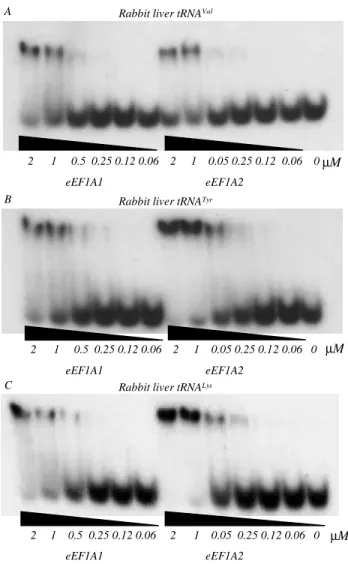
Results. Recently, we have examined the ability of a number of various deacylated tRNAs to form ternary complex with two tissue specific isoforms of eEF1A by band shift assay [4–6]. Here we used the same tech-nique for the comparative analysis of the ability of bacterial, yeast and mammalian elongation factors 1A to bind deacylated [32
P]-labeled tRNAs. tRNAVal
, tRNATyr
, tRNALys
, tRNAi Met
from rabbit liver, tRNAi fMet
from E. coli and tRNALeu from T. thermophilus were used. The apparent KDs of the complexes of tRNA
Val
, tRNATyr
and tRNALys
with rabbit liver eEF1A1*GDP
Rabbit liver tRNAVal
2 1 0.5 0.25 0.12 0.06 2 1 0.05 0.25 0.12 0.06 0 µM
eEF1A1 eEF1A2 A
Rabbit liver tRNATyr
2 1 0.5 0.25 0.12 0.06 2 1 0.05 0.25 0.12 0.06 0
eEF1A1 eEF1A2 B
µM
Rabbit liver tRNALys
2 1 0.5 0.25 0.12 0.06 2 1 0.05 0.25 0.12 0.06 0
eEF1A1 eEF1A2 C
µM
Fig. 1. The stability test for ternary complexes of tRNAs with eEF1A1*GDP and eEF1A2*GDP: A – Radioautograph of electro-phoregram of eEF1A1*GDP*tRNAVal and eEF1A2*GDP*tRNAVal complexes at eEF1A1/eEF1A2 concentration range from 2 µM to 0.06 µM, in non-denaturing (native) conditions; B – like A but eEF1A1*GDP*tRNATyr and eEF1A2*GDP*tRNATyr complexes;
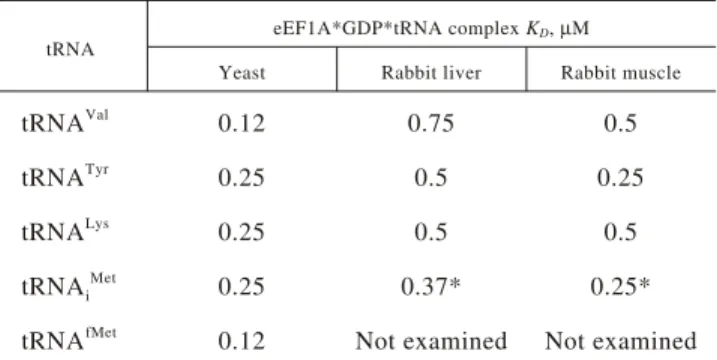
were estimated to be in the range from 0.5 to 1 µM (Fig. 1, A, B, C). The complexes of the same tRNAs with eEF1A2 are characterized with KDs in the range of
0.25–0.5 µM. KDs for the complexes of yeast eEF1A
with the same tRNA appears to be in the range of 0.1–0.25 µM (Fig. 2). The experimental data are summarized in Table.
The formation of an unusual complex of bovine initiator tRNAi
Met
with both isoforms of eEF1A was demonstrated by us previously [6]. These data con-firmed the absence of specific antideterminants for eEF1A in tRNAi structure [36–36]. Here we examined
whether the yeast eEF1A is able to form such complex with rabbit tRNAi
Met
or E. coli tRNAi fMet
. Importantly, it is known that tRNAi
Met
from yeast or plants, containing A64 O-phosphoribosyl modification, can not interact with eEF1A [16, 37–39]. We have found that both mammalian and E. coli initiator tRNA, which contains no such modification, can bind to the yeast eEF1A with a high affinity (Fig. 3). This observation indicates, that eEF1A by itself cannot discriminate between elongator and initiator tRNAs, and the antideterminants residue in tRNA structure. Noteworthy, EF1A from E. coli did not bind initiator tRNAi
fMet
even at very high concen-trations (Fig. 4). In agreement with the literature data [7–9], the elongator tRNALeu from T. thermophilus also was not bound by EF1A (KD >2 µM) (Fig. 4).
The FRET technique was used to characterize the non-canonical ternary complexes of yeast eEF1A, GDP and deacylated tRNA. The transcript tRNA3
Lys
was labeled with 1,5-IAEDANS bound to thiocytidine introduced at position 75. Near 50 % efficiency of the Forster’s resonance energy transfer from a Trp residue
Rabbit liver tRNAVal
2 1 0.5 0.25 0.12 0.06 0 2 1 0.5 0.25 0.12 0.06 0µM
eEF1A S. cerevisiae
A B Rabbit liver tRNATyr
Rabbit liver tRNALys
2 1 0.5 0.25 0.12 0.06 0 µM
eEF1A S. cerevisiae C
E. coli tRNAfMet
4 2 1 0.5 0.25 0.12 0 4 2 1 0.5 0.25 0.12 0
eEF1A S. cerevisiae
Rabbit liver tRNAiMet
µM
Fig. 3. Stability test of the complexes eEF1A from S. cerevisiae
with deacylated tRNAfMet from E. coli and tRNA
iMet from rabbit liver
Fig. 2. The stability test for eEF1A from S. cerevisiae ternary complexes with de-acylated tRNAs: A – tRNAVal; B – tRNATyr;
C – tRNALys
tRNA
eEF1A*GDP*tRNA complex KD, µM
Yeast Rabbit liver Rabbit muscle
tRNAVal 0.12 0.75 0.5
tRNATyr
0.25 0.5 0.25
tRNALys
0.25 0.5 0.5
tRNAi Met
0.25 0.37* 0.25*
tRNAfMet 0.12 Not examined Not examined
*Found in the previous work [6].
Affinity of tRNAs to yeast and rabbit eEF1A
E. coli tRNAfMet
16 8 4 2 1 0.5 0 16 8 4 2 1 0.5 0
eEF1A E. coli
T. thermophilus tRNALeu
µM
Fig. 4. Band Shift Assay of eEF1A from E. coli with tRNAfMet from
in yeast eEF1A to 1,5-IAEDANS attached to tRNA3 Lys
was observed (Fig. 5, see inset). According to the X-ray structure of the yeast eEF1A complex with truncated eEF1Bα [40, 41], only Trp78 residue of eEF1A is close enough to the hypothetic tRNA binding site to perform effective energy transfer (Fig. 6). The Forster’s distance ~2.2 nm was calculated between Trp78 of eEF1A and 1,5-IAEDANS of tRNA. Thus, formation of the unusual complex of yeast eEF1A*GDP with tRNA was confirmed by the FRET technique. The emission maximum of IAEDANS in water solution is known to be 490 nm.
In our experiments, the addition of eEF1A*GDP caused shift of fluorescence maximum of 1,5-IAEDANS from 490 to 500 nm, this indicates that CCA-end of tRNA with attached fluorescent dye turn into more compact hydrophobic surrounding when tRNA occurs in the complex with eEF1A.
Discussion. Similar affinity of yeast and rabbit eEF1A to deacylated tRNA as well as relatively high efficiency of FRET from yeast eEF1A to tRNA sug-gests essential likeness in the interaction of deacylated tRNA with eEF1A from both higher and lower eu-karyotes contrary to the authors of [21] we have ma-naged to find the complexes formation due to the higher concentration range of 100-1000 nM in comparison with the previous FRET and stopped flow kinetics studies. Moreover, we found the complexes of
yeast eEF1A*GDP with tRNA of different specificity. The affinity of the ternary complexes is relatively similar; it is much lower than observed for aa-tRNA but enough for the formation of stable complexes.
On the other hand, the mammalian initiator tRNA does not differ from elongator tRNAs as much as bacterial and yeast tRNAi
Met
does that may explain the formation of the complex between eEF1A*GDP and
mammalian tRNAi
Met
. The 51:63 base pair was considered to be the only site responsible for the tRNA affinity to eEF1A. The only one sequence-specific antideterminant for eEF1A present in eukaryotic initiator tRNAs is U51:A63. The presence of this base pair in mutant elongator aa-tRNA decreases their affinity to eEF1A*GTP*, but not dramatically, close to the level typical for deacylated elongator tRNAs [16, 37–39]. Some species of elongator tRNA contain G:U or even A:U in 51:63 site, however, this does not affect their ability to participate in the elongation [43]. According to the previous data [6] and those presented here the context of 51:63 base pair is not exclusive site of tuning the tRNA affinity to eEF1A. It seems the reason why tRNAi
Met
structure allows it to interact with eEF1A*GDP.
Thus, in terms of channeling eEF1A can bind ini-tiator tRNA after its participation in translation initia-tion step, sequester it and deliver to methionyl-tRNA synthetase for re-charging.
1000
800
600
400
200
0
In
te
n
si
ty
250 300 350 400 450 500
Wave lenght, nm
450 500 550
Wave lenght, nm
In
te
n
si
ty
14
12
10
8
6
4
2
0
A B
It was proposed [5] that non-canonical ternary complex tRNA*GDP*eEF1A is arranged similar to the known structure of ternary complex of aa-tRNA* GTP*EF1A from bacteria [14, 15]. In the latter CCA-terminus of tRNA is suggested to interact with a site in the cleft between I and II domain of eEF1A, and T-stem to interact with III domain. In this model, tRNA interaction with eEF1A is not specific considering the tRNA sequence, because all of hydrogen bonds are formed by saccharophosphate backbone of tRNA. The FRET experiments done here are in favor that CCA end of tRNA is apparently located in close proximity to the cleft between I and II domain of eEF1A. These data combined with our earlier observation about protection of the tRNAPhe
T and acceptor stems from RNAse hydrolysis by eEF1A [4], confirm the assumption, that tRNA binding to eEF1A is similar to that observed for prokaryotic analogue. When an amino acid residue is not present at CCA-terminus, both initiator and elongator tRNAs can exhibit similar potency for eEF1A binding.
In contrast to EF1A from bacteria, that is known to fall in deep structural rearrangement upon GTP hydrolysis, leading to the loss of its affinity to tRNA. The eEF1A conformation is not sensitive for GTP or GDP binding [40, 41]. This may allow eEF1A*GDP to interact with deacylated tRNA, protect it against RNAse hydrolysis, presumably accept free tRNA from E-site of ribosome and deliver it to aaRSes in the channeling cycle blocking non-specific recruitment of tRNAs out of the protein synthesis machinery. The experiment in vitro, presented here, suggest that eEF1A may provide tRNA channeling during both elongation and initiation steps of translation.
Therefore, by two independent methods we have proved the formation of the non-canonical complexes between several deacyalated tRNAs and eEF1A*GDP from eukaryotes contrary to the prokaryotic EF1A* GDP (or EF1A*GTP), where complexes with deacyla-ted tRNAs were not observed. This may be explained by the difference in the structure of prokaryotic EF1A and eukaryotic eEF1A, latter found to be not so mach sensitive to GDP/GTP state and aminoacid moiety. The formation of the non-canonical complexes of eEF1A* GDP with deacylated tRNAs seems to be universal for all eukaryotes.
The functional role of these complexes was assumed to serve the channeling of tRNA in the translation process of higher eukaryotes [4, 5], now we propose that the channeling of tRNA takes place in the lower eukaryotes as well.
This work was supported by grant from the State Fund for Basic Research of Ministry of Science and Education of Ukraine and Russian Fund for Basic Research of Russian Academy of Science, Agreement #F28/276-2009.
Acknowledgements. We thank Dr. Shalak for consulting and fruitful discussion.
П. В. Фу тер ник, Б. С. Нег руць кий, Г. В. Ельська
Взаємодія різних тРНК з фак то ра ми елон гації транс ляції 1А з ни жчих и ви щих еукаріотів
Ре зю ме
Мета. Підтвер ди ти за про по но ва ний раніше ме ханізм ка на лю -ван ня тРНК. Ме то ди. Зсув сму ги в поліак ри ламідно му гелі та Фор стерівське ре зо нан сне пе рене сен ня енергії (FRET). Ре зуль -та ти. Оцінено спорідненість тРНК ссавців з дво ма тка ни но-спе цифічни ми ізо фор ма ми фак то раe еEF1A1 та eEF1A2. Впер ше по ка за но фор му ван ня не ка нонічних потрійних ком -плексів дріжджо во го eEF1A*GDP з де а циль о ва ни ми тРНК. Про де мо нстро ва но та кож ком плек со ут во рен ня еу каріот но го eEF1A з ініціатор ною тРНК ссавців і бак терій. Вис нов ки. Фор му ван ня не ка нонічних ком плексів eEF1A*GDP з де а циль о -ва ни ми тРНК є за галь ним для ви щих і ни жчих еу каріотів, що підтвер джує універ сальність еу каріот но го ка на лю ван ня тРНК
Клю чові сло ва: фак тор елон гації, тРНК, транс ляція, ка на -лю ван ня, елон гація.
П. В. Фу тер ник, Б. С. Нег руц кий, А. В. Ельская
Вза и мо де йствие раз ных тРНК с фак то ра ми элон га ции транс ля ции 1А из низ ших и вы сших эу ка ри о тов
Ре зю ме
Цель. Под твер дить пред ло жен ный ра нее ме ха низм ка на ли ро -ва ния тРНК. Ме то ды. Сдвиг по ло сы в по ли ак ри ла мид ном геле и Фор сте ров ский ре зо нан сный пе ре нос энер гии (FRET). Ре зуль -та ты. Оце не но сро дство тРНК мле ко пи та ю щих с дву мя тка -нес пе ци фи чес ки ми изо фор ма ми фак то ра eEF1A1 и eEF1A2. Впер вые пока за но фор ми ро ва ние не ка нони чес ких трой ных ком плек сов дрож же во го eEF1A*GDP с де а ци ли ро ван ны ми тРНК. Так же про де мо нстри ро ва но ком плек со об ра зо ва ние эу -ка ри от но го eEF1A с ини ци а тор ной тРНК мле ко пи та ю щих и бактерий. Вы во ды. Фор ми ро ва ние не ка но ни чес ких ком плек сов eEF1A*GDP с де а ци ли ро ван ны ми тРНК яв ля ет ся об щим для вы сших и низ ших эу ка ри о тов, что под твер жда ет уни вер саль -ность эу ка ри от но го ка на ли ро ва ния тРНК.
REFERENCES
1. Negrutskii B. S., El’skaya A. V. Eukaryotic translation elon-gation factor 1a: structure, expression, functions, and possib-le ropossib-le in aminoacyl-tRNA channeling // Prog. Nucl. Acid Res. Mol. Biol.–1998.–60.–P. 48–77.
2. Negrutskii B. S., Deutscher M. P. A sequestered pool of ami-noacyl-tRNA in mammalian cells // Proc. Nat. Acad. Sci. USA.–1992.–89, N 8.–P. 3601–3604.
3. Negrutskii B. S., Stapulionis R., Deutscher M. P. Supramo-lecular organization of the mammalian translation system // Proc. Nat. Acad. Sci. USA.–1994.–91, N 3.–P. 964–968. 4. Petrushenko Z. M., Negrutskii B. S., Ladokhin A. S.,
Budke-vich T. V., Shalak V. F., El’skaya A. V. Evidence for the for-mation of an unusual ternary complex of rabbit liver EF-1 with GDP and deacylated tRNA // FEBS Lett.–1997.–407, N 1.–P. 13–17.
5. Petrushenko Z. M., Budkevich T. V., Shalak V. F., Negrutskii B. S., El’skaya A. V. Novel complexes of mammalian transla-tion elongatransla-tion factor eEF1A. GDP with uncharged tRNA and aminoacyl-tRNA synthetase. Implications for tRNA channeling // Eur. J. Biochem.–2002.– 269, N 19.–P. 4811– 4818.
6. Futernyk P. V., Negrutskii B. S., El’ska G. V. Noncanonical complexes of mammalian eEF1A with various deacylated tRNAs // Biopolymers and Cell.–2008.–24, N 6.–P. 453–462. 7. Berchtold H., Reshetnikova L., Reiser C. O., Schirmer N. K., Spinzl M., Hilgenfeld R. Crystal structure of active elongation factor Tu reveals major domain rearrangements // Nature.– 1993.–365, N 6442.–P. 126–132.
8. Abel K., Yoder M. D., Hilgenfeld R., Jurnak F. An alpha to beta conformational switch in EF-Tu // Structure.–1996.–4, N 10.–P. 1153–1159.
9. Polekhina G., Thirup S., Kjeldgaard M., Nissen P., Lippmann C., Nyborg J. Helix unwinding in the effector region of elon-gation factor EF-Tu-GDP // Structure.–1996.–4, N 10.– P. 1141–1151.
10. LaRiviere F. J., Wolfson A. D., Uhlenbeck O. C. Uniform bin- ding of amynoacyl-tRNAs to elongation factor Tu byn-thermodynamic compensation // Science.–2001.–294, N 5540.–P. 165–168.
11. Asahara H., Uhlenbeck O. C. The tRNA specificity of Ther-mus thermophilus EF-Tu // Proc. Nat. Acad. Sci. USA.– 2002.–99, N 6. –P. 3499–3504.
12. Dale T., Sanderson L. E., Uhlenbeck O. C. The affinity of elongation factor Tu for an aminoacyl-tRNA is modulated by the esterified amino acid // Biochemistry.–2004.–43, N 20.– P. 6159–6166.
13. Sanderson L. E., Uhlenbeck O. C. Exploring the specificity of elongation factor Tu for different tRNA bodies // Bioche-mistry.–2007.–46, N 21.–P. 6194–6200.
14. Nissen P., Kjeldgaard M., Thirup S., Polekhina G., Reshetni-kova L., Clark B. F. C., Nyborg J. Crystal structure of the ter-nary complex of Phe-tRNAPhe
, EF-Tu, and a GTP analog // Science.–1995.–270, N 5241.–P. 1464–1472.
15. Nissen P., Thirup S., Kjeldgaard M., Nyborg J. The crystal structure of Cys-tRNACys
–EF-Tu–GDPNP reveals general and specific features in the ternary complex in the tRNA // Structure.–1999.–7, N 2.–P. 143–156.
16. Dreher T. W., Uhlenbeck O. C., Browningi K. S. Quantitative assessment of EF-1a*GTP binding to aminoacyl-tRNAs, aminoacyl-viral RNA, and tRNA shows close
correspon-dence to the RNA binding properties of EF-Tu // J. Bol. Chem.–1999.–274, N 2.–P. 666–672.
17. Allers J., Shamoo Y. Structure-based analysis of protein-RNA interactions using the program ENTANGLE // J. Mol. Biol.–2001.–311, N 1.–P. 75–86.
18. Jones S., Daley D. T., Luscombe N. M., Berman H. M., Thorn- ton J. M. Protein-RNA interactions: A structural analysis // Nucl. Acids Res.–2001.–29, N 4.–P. 943–954.
19. Treger M., Westhof E. Statistical analysis of atomic contacts at RNA-protein interfaces // J. Mol. Recognit.–2001.–14, N 4.–P. 199–214.
20. Cheng A. C., Chen W. W., Fuhrmann C. N., Frankel A. D. Re-cognition of nucleic acid bases and base pairs by hydrogen bonding to amino acid side chains // J. Mol. Biol.–2003.–327, N 4.–P. 781–796.
21. Gromadski K. B., Schummer T., Stromgaard A., Knudsen C. R., Kinzy T. G., Rodnina M. V. Kinetics of the interactions between yeast elongation factors 1A and 1Bα, Guanine nuc-leotides, and aminocyl-tRNA // J. Biol. Chem.–2007.–282, N 49.–P. 35629–35637.
22. Sternbach H., von der Haar F., Schlimme E., Gaertner E., Cramer F. Isolation and properties of tRNA nucleotidyl transferase from yeast // Eur. J. Biochem.–1971.–22, N 2.– P. 166–172.
23. Muench K. H., Berg P. Purification of crude aminoacyl-tRNA synthetases from Escherichia coli // Meth. Enzymol.– 1968.–12.–P. 357.
24. Keller E., Zamechnic P. The effect of guanosine diphosphate and triphosphate on the incorporation of labeled amino acids into proteins // J. Biol. Chem.–1956.–222.–P. 45–50. 25. Shalak V. F., Budkevich T. V., Nergutskii B. S., El’skaya A. V.
A fast and effective method for purification of elongation factor 1a from rabbit liver // Ukr. Biochim. J.–1997.–69, N 2.–P. 104–109.
26. Maniatis T., Fritsch E. F., Sambrook J. Molecular cloning: a laboratory manual.–New York: Cold Spring Harbor Lab. press, 1989.–342 р.
27. Ott G., Faulhammer H. G., Spinzl M. Interaction of elongati-on factor Tu from Escherichia coli with aminoacyl-tRNA carrying a fluorescent reporter group on the 3' terminus // Eur. J. Biochem.–1989.–184, N 2.–P. 345–352.
28. Hudson E. N., Weber G. Synthesis and characterization of two fluorescent sulfhydryl reagents // Biochemistry.–1973.–
12, N 21.–P. 4154–4161.
29. Silberclang M., Gillum A. M., RajBhandary U. L. Use of in vitro32P labeling in the sequence analysis of nonradioactive tRNAs // Meth. Enzymol.–1979.–59.–P. 58–109.
30. Carvalho J. F., Carvalho M. D., Merrick W. C. Purification of various forms of elongation factor 1 from rabbit reticulocy- tes // Arch. Biochem. and Biophys.–1984.–234, N 2.–P. 591– 602.
31. Cavallius J., Merrick W. C. Site directed mutagenesis of ye-ast eEF1A. Variable mutants with altered nucleotide specifi-city // J. Biol. Chem.–1998.–273, N 44.–P. 28752–28758. 32. Li G., Levitus M., Bustamante C., Widom J. Rapid
sponta-neous accessibility of nucleosomal DNA // Nat. Struct. Mol. Biol.–2005.–12, N 1.–P. 46–53.
33. Wu P., Brand L. Conformational flexibility in a staphylococ-cal nuclease mutant K45C from time-resolved resonance energy transfer measurements // Biochemistry.–1994.–33, N 34.–P. 10457–10462.
35. Simsek M., RajBhandary U. L., Boisnard M., Petrissant G.
Nucleotide sequence of rabbit liver and sheep mammary gland cytoplasmic initiatory transfer RNAs // Nature.–1974.–
247, N 442.–P. 518–520.
36. Piper P. W., Clark B. F. Primary structure of a mouse mielo-ma cell initiator transfer RNA // Nature.–1974.–247, N 442.– P. 516–518.
37. Forster C., Chakraburtty K., Sprinzl M. Discrimination bet-ween initiation and elongation of protein biosynthesis in yeast: Identity assured by a nucleotide modification in the initiator tRNA // Nucl. Acids Res.–1993.–21, N 24.–P. 5679– 5683.
38. Kiesewetter S., Ott G., Sprinzl M. The role of modified purine 64 in initiator/elongator discrimination of tRNAi
Met
from yeast and wheat germ // Nucl. Acids Res.–1990.–18, N 16.– P. 4677–4682.
39. Astrom S. U., Bystrom A. S. Rit 1, a tRNA backbone modify-ing enzyme that mediates initiator and elongator tRNA discrimination // Cell.–1994.–79, N 3.–P. 535–546. 40. Andersen G. R., Pedersen L., Valente L., Chatterjee I., Kinzy
T. G., Kjeldgaard M., Nyborg J. Structural basis for
nuc-leotide exchange and competition with tRNA in the yeast elongation factor complex Eef1A:Eef1Bα // Mol. Cell.– 2000.–6, N 5.–P. 1261.
41. Andersen G. R., Valente L., Pedersen L., Kinzy T. G., Nyborg J. Crystal structures of nucleotide exchange intermediates in the Eef1A-Eef1Balpha complex // Nat. Struct. Biol.–2001.–
8, N 6.–P. 531–534.
42. Kanibolotsky D. S., Novosyl’na O. V., Abbott C. M., Negrut-skii B. S., El’skaya A. V. Multiple molecular dynamics simu-lation of the isoforms of human transsimu-lation elongation factor 1A reveals reversible fluctuations between «open» and «clo-sed» conformations and suggests specific for eEF1A1 affinity for Ca2+
-calmodulin // BMC Struct. Biol.–2008.–8.–P. 4. 43. Sanderson L. E., Uhlenbeck O. C. The 51–63 base pair of
tRNA confers specificity for binding by EF-Tu // RNA.– 2007.–13, N 6.–P. 835–840.