INTERPOLATIVE RELATIONS AND INTERPOLATIVE
PREFERENCE STRUCTURES
Dragan RADOJEVI
Ć
Mihajlo Pupin Institute Belgrade, Serbia & Montenegro [email protected]
Received: February 2005 / Accepted: July 2005
Abstract:Relations are very important mathematical objects in different fields of theory and applications. In many real applications, for which gradation of relations is immanent, the classical relations are not adequate. Interpolative relations (I-relations) (as fuzzy relations) are the generalization of classical relations so that the value (intensity) of a relation is an element from a real interval [0, 1] and not only from {0, 1} as in the classical case. The theory of I-relations is crucially different from the theory of fuzzy relations. I-relations are consistent generalizations of classical relations and, contrary to fuzzy relations, all laws of classical relations (set-theoretical laws) are preserved in general case. In this paper, the main characteristics of I-relations are illustrated on the interpolative preference structures (I-preference structures) as consistent generalization of classical (I-preference structures.
Keywords: Fuzzy relations, interpolative relations (I-relations), symbolic level of I-relations, structure of I-relations, primary, atomic and combined I-relations, valued level of I-relations, intensity of I-relations, generalized product, interpolative preference (I-preference) structure.
1. INTRODUCTION
Interpolative relations (I-relations), as fuzzy relations, are generalization of classical relations, so that the value (intensity) of a relation is from the real interval [0, 1] and not only from {0, 1} as in classical case. I-relations are consistent generalizations of classical relations and, contrary to fuzzy relations, all laws of classical relations (set-theoretical laws) are preserved in general case. I-relations have two levels: (a) symbolic (or qualitative) and (b) valued (or quantitative). On symbolic level I-relations are treated independently of their valued realization, and algebra of relations is Boolean algebra. Valued level of I-relations is concrete valued realization as a consequence of relations from symbolic level. Boolean nature (Boolean tautologies and/or contradiction) is preserved from symbolic level on valued level using interpolation immanent to I-relations.
The theory of I-relations is given in this paper and it is illustrated on generalization of preference structures. Preference structures are important relations in decision making and OR generally.
2. CLASSICAL RELATIONS
Classical relation is a subset of a finite Cartesian powerXn =X×X× ⋅⋅⋅×Xof a given set X (universe), i.e. a set of tuples ( ,...,x1 xn)of elements of X.
A subset n
R⊆X is called n-place, or n-ary, relation on X. The number n is called the rank, or type, of the relation R. A subset R⊆Xn is also called n-place, or n -ary, predicate on X. The notation R=( ,...,x1 xn) signifies that( ,... )x1 xn ∈R.
One-place relations are called properties. Two-place relations are called binary, three-place relations are called ternary, etc.
The set Xn and the empty subset ∅ are called, respectively, the universal relation and the zero relation of rank n on X. The diagonal of the set Xn, i.e. the set
(
)
{
x x x∈X}
=
Δ ,..., :
is called the equality relation on X.
If R and S are n-place relations on X, then the following subsets of Xn will also be n-place relations on X:
. \ ,
\ ,
, R S R X R and R S
S
R∪ ∩ c = n
The set of all n-ary relations on X is a Boolean algebra relative to the operations
, , '.
∪ ∩ An (n+1)-place relation F on X is called a function if for any elements x1,…,xn,
x, y from X it follows from (x1,…,xn, x)∈F and (x1,…,xn, y)∈F that x = y.
2.1. Boolean algebra, Boolean lattice
Boolean algebra (and/or Boolean lattice) is a partially ordered set of a special type. It is a distributive lattice with a largest element "1", the unit of the Boolean algebra, and a smallest element "0", the zero of the Boolean algebra, that contains together with each element a also its complement - the element ¬aor a, which satisfies the relations
{ , } 1, { , } 0.
The operations Sup and Inf are usually denoted by the symbols
∨
and∧
, and sometimes by ∪ and ∩ respectively, in order to stress their similarity to the set-theoretical operations of union and intersection. The notation a,a' or ¬a may be employed instead of Ca. The complement of an element in a Boolean algebra is unique.A Boolean algebra can also be defined in a different manner. Viz. as a non-empty set with the operations −,∧,∨, which satisfy the following axioms:
1) a∨b= ∨b a, a∧b= ∧b a;
2) a∨
(
b∨c) (
= a∨b)
∨c, a∧(
b∧c) (
= a∧b)
∧c; 3)(
a∧b)
∨b=b,(
a∨b)
∧b=b;4) a∧
(
b∨c) (
= a∧b) (
∨ a∧c)
, a∨(
b∧c) (
= a∨b) (
∧ a∨c)
; 5)(
a∧a)
∨b=b,(
a∨a)
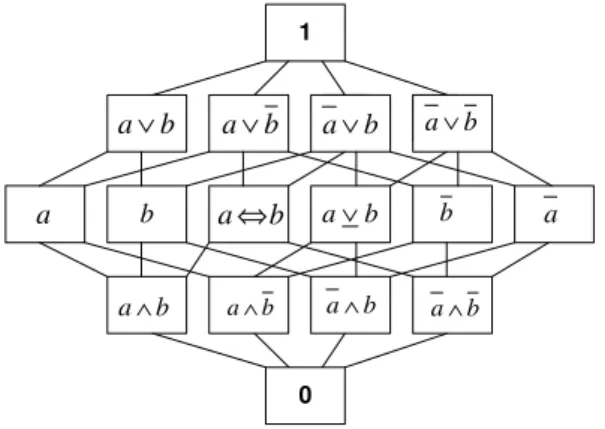
∧b=b.On the basis of the set Ω ={ , }a b with two relations (properties, propositions, etc.) by using Boolean operators, the following set of relations - Boolean lattice can be generated:
1
0
b
a∧ a∧b a∧b a∧b
a b a⇔b a∨b b a
b
a∨ a∨b a∨b a∨b
Figure 1: Boolean lattice generated by primary relations Ω ={ , }a b
Where: a⇔b=(a∧b)∨(a∧b) and a∨b=(a∧b)∨(a∧b).
The following truth table, in case that Ω ={ , }a b is a set of proposition, corresponds to analyzed Boolean lattice, from Figure 1:
Table 1: Truth table
b
a∧ a∧b a∧b a∧b a b a⇔b a∨b a b a∨b a∨b a∨b a∨b
The property that the truth value of combined proposition can be directly calculated on the base of truth value of its components – truth functionality principle, is kept as a fundamental principle and used in MV-logics [2] and fuzzy logic [8].
3. FUZZY RELATIONS
Motives for creation of fuzzy relations are similar to the motives for fuzzy sets. Fuzzy relations are generalized relations in the same way as fuzzy sets are generalized classical sets [8]. Fuzzy relations play an important role in fuzzy modeling, fuzzy diagnosis, and fuzzy control. They also have applications in fields such as biology, psychology, medicine, economics, and sociology [4].
Fuzzy relations are characterized as fuzzy sets by characteristic functions, which take the values from real interval [0, 1]. Fuzzy relations, as MV-logics and fuzzy logic, are based on the principle of truth functionality. Logic is truth functional if the truth value of a compound sentence depends only on the truth values of the constituent atomic sentences, not on their meaning or structure. According to [3] fuzzy logic is based on truth functionality, since: “This is very common and practically useful assumption”. On the other hand: (Truth functional) “Logic changes from its very foundations if we assume that in addition to truth and falsehood there is also some third logical value or several such values” [8]. It means that Boolean algebra is not the algebra of fuzzy relations. This is reason for serious problems in attempts of generalization of classical results (based on classical logic, classical theory of sets and/or classical relations) by fuzzy techniques. For example generalization of classical preference structures by fuzzy preference structures is impossible straightaway.
The following question is very important: Is it possible to generalize relations (to take the values from real interval [0, 1]) in framework of Boolean algebra (Boolean lattice)? The answer is positive [5], [6] and it is given in the following section.
4. INTERPOLATIVE RELATIONS (I-RELATIONS)
Since, (a) classical relations are not adequate in many real applications in a similar way as integers are not adequate in the problems which need real numbers and (b) fuzzy relations as fuzzy sets are not consistent generalizations of classical case (the laws of classical set algebra are not preserved in fuzzy case), the need for a consistent generalization of classical relations is very natural.
Interpolative relations (I-relations) are consistent generalization of classical relations. I-relations have two levels: (a) symbolic (or qualitative) and (b) valued (or quantitative).
4.1. I-relations: symbolic (qualitative) level
4.1.1. Primary I-relations and context
Qualitative context, Ω, is a finite set of primary I-relations. Primary I-relation can’t be relational (set) function of the rest I-relations from the analyzed qualitative contextΩ.
4.1.2. Algebra of I-relations
The set of all possible I-relations, Β Ω( ), generated by the qualitative context,
Ω, (set of primary I-relations) using Boolean operator (binary connectives join (∩) and meet (∪), and unary connective complement(c)) is algebra of relations. Algebra of I-relations, on symbolic level, is Boolean algebra. A Boolean algebra of I-relations is the algebraic structure ( ( ), , , )c
Β Ω ∩ ∪ , with the following four additional properties:
1.bounded below: There exists an element (constant zero I-relation) 0, such that A∪ =0 A for all Ain Β Ω( ).
2.bounded above: There exists an element (constant unit I-relation) 1, such that
1
A∩ = A for all Ain Β Ω( ).
3.distributive law: For all A,B,C in Β Ω( ), A∩(B∪C)=(A∩B)∪(A∩C). 4.existence of complements: For every A in Β Ω( ) there exists an element
(complement vector) Ac in Β Ω( ) such thatA∪Ac=1 and A∩Ac =0.
1
0
B A∩
B
(
)
Bc Ac(
A B)
B A
c c
∩ ∪
∩ ( )
(
Ac Bc)
B A
∩ ∪ ∩
c c
B
A ∪
B
A∪ Ac∪B c
B A∪
c
B
A∩ Ac∩B Ac∩Bc
A
Figure 2: Boolean lattice of I-relations for Ω=
{
A,B}
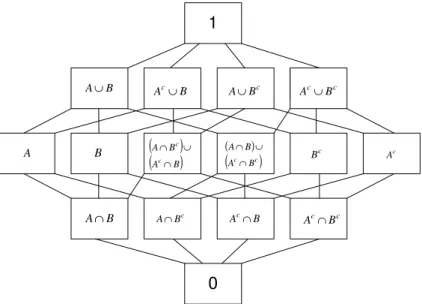
number of elements of Boolean algebra (different on the base of inclusion) is 22n . Two elements P and Q of Boolean algebra of I-relation are equal P = Q on symbolic level by inclusion, if and only if P⊂Q and Q⊂P. Otherwise they are different.
Boolean lattice of I-relations on symbolic level, for qualitative contextΩ ={ , }A B , and order defined by inclusion, is given in the Figure 2.
It is clear that lattice of I-relations and lattice of classical relations generated by the same qualitative contexts are the same on this level.
4.1.3. Combined I-relation
Combined I-relation is Boolean function of primary I-relations.
4.1.4. Atomic I-relation
Atomic I-relation has the simplest structure in the sense that it doesn’t include any other I-relation from algebra except itself and trivial constant zero. To every element of power set P(Ω) corresponds one atomic I-relation, defined by the following expression:
( )
\
i j
c
i j
A S A S
R S A A
α
∈ ∈Ω
= ∩ ∩
As a consequence, the number of corresponding atomic I-relations is 2Ω, since
( )
2P Ω = Ω.
Example: Atomic I-relations in the case of two primary logical relations Ω ={ , }A B are:
{
}
(
)
{ }
(
)
{ }
(
)
( )
c cc c
B A R
B A B R
B A B R
B A B A R
∩ = ∅
∩ =
∩ =
∩ =
α α α
α ,
4.1.5. Structure of I-relation
Any I-relation can be represented by atomic I-relations by disjunctive canonical form.Boolean lattice of I-relations in disjunctive canonical forms for context Ω={A, B}, is given in the Figure 3.
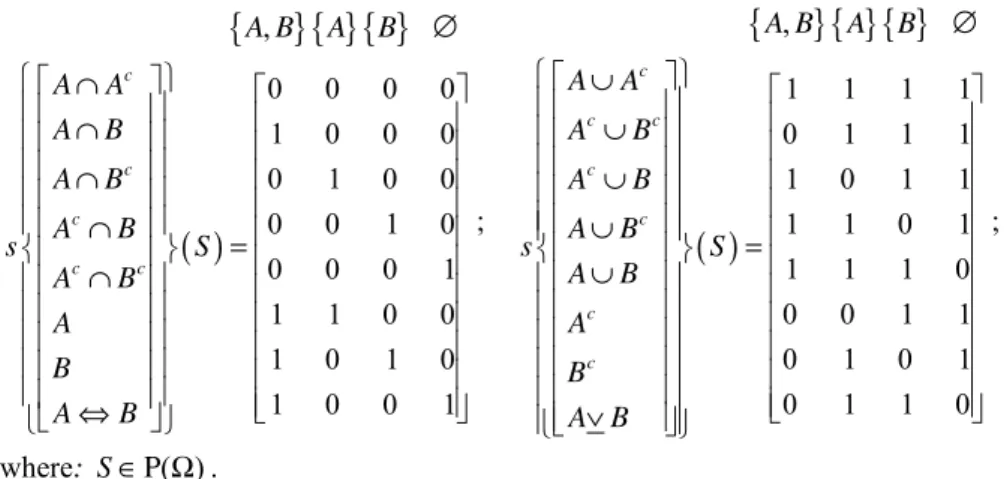
Structure of a I-relation is information on which atomic I-relations, generated by the analyzed context, are relevant for it (which are included in it) and/or which are not relevant (which are not included). Formally, structure of I-relation is characteristic function of the set of its relevant atomic relations:
: ( ) {0, 1},
s Ρ Ω →
1
0
(A∩B) ( c)
B
A∩
(
Ac∩B)
(Ac∩Bc)( )
(A B) B A
c∩
∪
∩ ( )
(Ac Bc) B A
∩ ∪
∩ ( )
(c c) c B A B A ∩ ∪ ∩ ( ) ( )
(A B) B A B A c c ∩ ∪ ∩ ∪ ∩ ( ) ( )
(c c)
c B A B A B A ∩ ∪ ∩ ∪ ∩ ( ) ( ) (c c)
c B A B A B A ∩ ∪ ∩ ∪ ∩ ( ) ( )
(c c)
c c B A B A B A ∩ ∪ ∩ ∪ ∩ ( )
( c)
B A B A ∩ ∪ ∩ ( )
(A B) B A c c ∩ ∪ ∩ ( )
(c c)
c B A B A ∩ ∪ ∩
Figure 3: Boolean lattice with elements in disjunctive canonical form
Note: Structure of I-relation is qualitative context- dependent (depends only on the set of primary relations as the symbols) and it is not value-dependent. It means that the structure of I-relation is irrelevant of a value realization and/or it is the same for classical (two-valued) case as in multi-valued case.
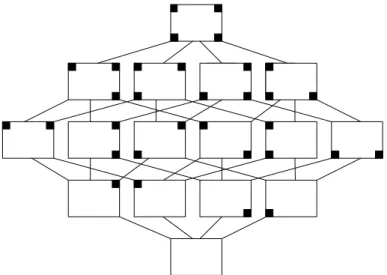
Illustration of notion the structure of I-relation is given in the following example: Example: In the case when context has two elements ( |Ω =| 2) the lattice ( )Β Ω as the function of atomic elements can be graphically represented in the following way:
or in the form of table:
Table 2: Structure of elements of lattice
0 0 0 0 0 1 0 0 0 1 0 0 0 0 0 0 0 1 0 0 1 1 1 1 0 0 1 0 0
1 0 0 0 1 1 1 0 1
0 1 0 1 1 1 0 1 1
0 1 1 0 1 0 1 1 1
1 0 1 1 0 1 1 1 1
For Ω ={ , }A B , on the base of table above the structures of corresponding I-relations are:
{
} { } { }
( )
,
0 0 0 0
1 0 0 0
0 1 0 0
0 0 1 0
0 0 0 1
1 1 0 0
1 0 1 0
1 0 0 1
c
c
c
c c
A B A B
A A A B A B A B s S A B A B A B ∅ ⎧⎡ ∩ ⎤⎫ ⎡ ⎤ ⎪⎢ ⎥⎪ ⎢ ⎥ ∩ ⎪⎢ ⎥⎪ ⎢ ⎥ ⎪⎢ ∩ ⎥⎪ ⎢ ⎥ ⎪⎢ ⎥⎪ ⎢ ⎥ ⎪⎢ ∩ ⎥⎪ ⎢ ⎥ = ⎨⎢ ⎥⎬ ⎢ ⎥ ∩ ⎪⎢ ⎥⎪ ⎢ ⎥ ⎪⎢ ⎥⎪ ⎢ ⎥ ⎪⎢ ⎥⎪ ⎢ ⎥ ⎪⎢ ⎥⎪ ⎢ ⎥ ⎪⎢ ⎥⎪ ⎢⎣ ⎥⎦ ⇔ ⎣ ⎦ ⎩ ⎭ ;
{
} { } { }
( )
,1 1 1 1
0 1 1 1
1 0 1 1
1 1 0 1
1 1 1 0
0 0 1 1
0 1 0 1
0 1 1 0
c c c c c c c
A B A B
A A A B A B A B s S A B A B A B ∅ ⎧⎡ ∪ ⎤⎫ ⎡ ⎤ ⎪⎢ ⎥⎪ ⎢ ⎥ ∪ ⎪⎢ ⎥⎪ ⎢ ⎥ ⎪⎢ ⎥⎪ ⎢ ⎥ ∪ ⎪⎢ ⎥⎪ ⎢ ⎥ ⎪⎢ ∪ ⎥⎪ ⎪ ⎪ ⎢ ⎥ = ⎢ ⎥ ⎨ ⎬ ⎢ ⎥ ∪ ⎢ ⎥ ⎪ ⎪ ⎢ ⎥ ⎢ ⎥ ⎪ ⎪ ⎢ ⎥ ⎢ ⎥ ⎪ ⎪ ⎢ ⎥ ⎢ ⎥ ⎪ ⎪ ⎢ ⎥ ⎢ ⎥ ⎪ ⎪ ⎢⎣ ⎥⎦ ∨ ⎢ ⎥ ⎪⎣ ⎦⎪ ⎩ ⎭ ;
where: S∈ Ρ Ω( ).
Structure of I-relations is defined in the following way:
Structure of primary I-relation, s A( ) A∈ Ω, is given by the following expression:
1
( )( ) ; ( ) ,
0
A S
s A S S A
A S
∈ ⎧
=⎨ ∈ Ρ Ω ∈ Ω
∉
⎩ ,
where: Ωis set of primary I-relations (qualitative context).
Structure of atomic I-relation, s(αR S( )),S∈ Ρ Ω( ), is given by the following expression:
1
( ( ))( ) ; , ( )
0
S SS
s R S SS S SS
S SS
α =⎧⎨ = ∈ Ρ Ω
≠
⎩ ,
Structure of arbitrary I-relation R for the set of primary I-relations Ω, is characteristic function of the set of relevant atomic I-relations :
1 ( )
( )( ) ; ( ).
0 ( )
R S R
s R S S
R S R
α α
⊂ ⎧
=⎨ ∈ Ρ Ω
⊄ ⎩
Any relations can be expressed in the following disjunctive form:
( ) ( )( ) ( )
S
R s R SαR S
∈Ρ Ω
= ∪
Since,
\
( )
i j
c
i j
A S A S
R S A A
α
∈ ∈Ω
= ∩ ∩ , it follows for any relations R corresponding canonical disjunctive form that:
( )
( )( )
⎟⎟⎠⎞ ⎜⎜
⎝ ⎛
∩ ∩ ∪
=
Ω ∈ ∈ Ω
Ρ
∈ j
c
S A i S A
S sR S A A
R
j
i \
,
whereΩ is the set of primary I-relations (qualitative context) and Ρ Ω( ) power set of Ω.
Structure of universal relation – I-relation constant 1:
( )( )
1 1,( )
s S = ∀ ∈ Ρ ΩS .
Structure of zero relation – I-relation constant 0:
( )( )
0 0,( )
s S = ∀ ∈ Ρ ΩS .
4.1.6. Principle of structural funcionality
Structure of any I-relations can be determined by principle of structural functionality. The principle of structural functionality says that structure of any I-relation can be uniquely calculated by the structures of its components (corresponding I-relations). This is achieved by defining the structure function of connective (formally equivalently to truth function of connective from classical propositional logic) as follows:
( )
0 1 0 10 1 0 0 0 0 0 1
1 0 1 0 1 1 1 1
− ∧ ∨
where: ∧is structure function of ∩, ∨ of ∪ and – of c.
Using this, each structure function s extends uniquely to a structure determination of all I-relations as follows:
(
)( )
( )( )
( )( )
(
)( )
( )( )
( )( )
( )
( ) ( ) ( )( )
( )
( )
,
,
,
, , .
c
s A B S s A S s B S
s A B S s A S s B S
s A S s A S
S A B
∩ = ∧
∪ = ∨
= −
Remark: This fundamental property has its isomorphism on the value level but only in classical case (values of logical variables and/or intensity of relations are from {0, 1}), known as principal of truth functionality. Principle of truth functionality is not fundamental and as a consequence it can’t be used in generalization.
4.2. I-relations: Valued level
Valued level of I-relations is only a consequence or a concrete realization of symbolic level. Valued context and/or universe relation of analyzed relations is a set
X X
Xn = ×...× of finite Cartesian product, where: power n is the rank or type of the I-relations and X set generator. I-relation on valued level is I-subset of universe relation (Cartesian productXn). The elements of I-relation (I-subset) have continuum of grades of memberships (intensities of relations).
Since relations on valued level are concrete realizations of relations defined on symbolic level, and symbolic level is valued-independent and Boolean in its nature, then a concrete realization or quantification on valued level has to preserve Boolean nature (Boolean tautologies and/or contradictions). This is achieved by interpolation immanent to valued level of I-relations, since interpolation preserved primitive (or starting) properties. The main notions on valued level in the light of valued context, are: intensity of I-relations: primary, atomic and combined; generalized product; superposition of atomic relation values.
4.2.1. Intensity of primary I-relation
Value or intensity of primary I-relation, A, element of the analyzed qualitative context Ωin general case has intensity from the real unit interval [0, 1] on valued-level, determined by quantitative context X:
(
1,...,)
[
0, 1 ,]
(
1,...,)
.n
n n
A x x ∈ x x ∈X
4.2.2. Intensity of atomic I-relation
Intensity of atomic I-relation is a function of intensities of primary I-relations:
( )(
)
( )
( )
(
)
(
)
( )
1 1 1
\
,..., n 1 K ,..., n ; ,..., n n,
A K S
K S
R S x x A x x x x X S
α
∈ ∪ ∈Ρ Ω
=
∑
− ⊗ ∈ ∈ Ρ Ω .Example: In the case of qualitative context Ω ={ , },A B and A x( ,...,1 xn), ( ,...,B x1 xn) values of atomic I-relations at ( ,...,1 )
n n
x x ∈X are calculated in the following way
{
}
(
)
(
)
(
)
(
)
{ }
(
)
(
)
(
)
(
)
(
)
{ }
(
)
(
)
(
)
(
)
(
)
( )
(
)
(
)
(
)
(
)
(
)
1 1 1
1 1 1 1
1 1 1 1
1 1 1 1 1
, ,..., ,..., ,...,
,..., ,..., ,..., ,...,
,..., ,..., ,..., ,...,
,..., 1 ,..., ,..., ,..., ,..., .
n n n
n n n n
n n n n
n n n n n
A B x x A x x B x x
A x x A x x A x x B x x
B x x B x x A x x B x x
x x A x x B x x A x x B x x
α
α
α
α
= ⊗
= − ⊗
= − ⊗
Operator ⊗( )n or abbreviated ⊗, is generalized n-product on real unit interval:
[
]
2[
]
: 0, 1 0, 1
⊗ → , such that for all vR1,....,vRn∈
[
0, 1]
the following five axioms aresatisfied [6]:
(T1) Commutativity
(
vR vRi, j)
(
vR vRj, i)
⊗ = ⊗ ,
(T2) Associativity
(
)
(
vRi, vR vRj, k)
(
(
vR vRi, j)
,vRk)
⊗ ⊗ = ⊗ ⊗ ,
(T3) Monotonicicity
(
vR vRi, j)
(
vR vRi, k)
whenever vRj vRk⊗ ≤ ⊗ ≤ ,
(T4) Boundary condition
(
vRi, 1)
vRi⊗ = ,
(T5) Non-negativity condition
( )
( )
( )
\
1 0,
i S
i vR A S
S A
vR A
∈ ∪ ∈Ρ Ω
− ⊗ ≥ ∀ ∈ Ρ Ω
∑
where:
{
1,...,}
[
0, 1]
n n
vR vR
Ω = ∈ .
Remark: Axioms (T1)-(T4) are the same as in the case of definition of T-norm, a non-negativity condition is new. The role of operator of generalized product is only for interpolation (it is not logic (or relation) operator as it is the case with T-norm in fuzzy relations).
Basic properties of atomic I-relations are:
( )(
)
( )
1,..., n 1 S
R S x x
α
∈Ρ Ω
=
∑
and
( )(
1,...,)
0,( )
,(
1,...,)
.n
n n
R S x x S x x X
α ≥ ∀ ∈ Ρ Ω ∀ ∈
Example: In the case of the following qualitative contextΩ=
{
A,B}
:{
}
(
,)
(
1,..., n)
(
{ }
)
(
1,..., n)
(
{ }
)
(
1,..., n)
( )
(
1,..., n)
1R A B x x R A x x R B x x R x x
α +α +α +α ∅ =
(
1,...,)
.n n
x x X
∀ ∈
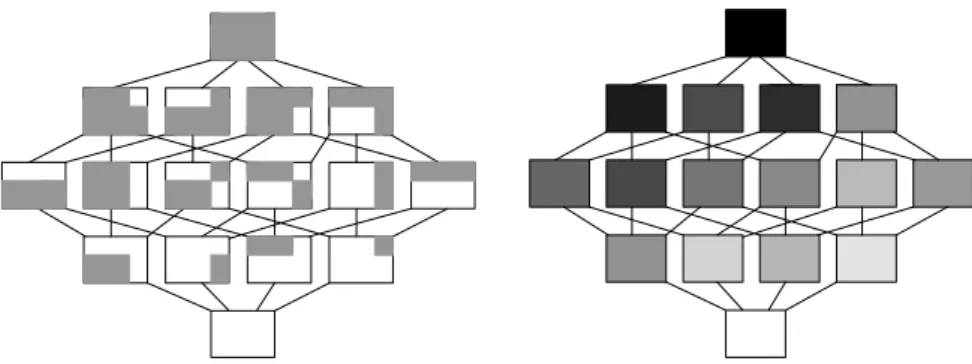
Figure 5a: Boolean lattice in the case of gradation
From this visualization of new result it is clear that this generalization preserves nature of Boolean lattice in any valued realization. Valued level of I-relation logic is actually interpolative level. On the valued level, intensity (value) of relation is calculated on the base of its structure (which atomic relations are relevant) and the values of atomic relations.
4.2.3. Intensita∧by of any I-relation
Since conjunction of any two different atomic vectors is equal to constant zero vector, combined logical vector is actually superposition of relevant atomic logic vectors.
(
)
( )( )
( )(
)
( )
(
)
1,..., 1,..., ; 1,..., .
n
n n n
S
R x x s R S αR S x x x x X
∈Ρ Ω
=
∑
∈In the function of intensities of primary relations:
(
)
( )
( )
( )
( )
( )
(
) (
)
1 1 1
\
,..., 1 K ,..., ; ,..., n.
n n n
A K S
S K S
R x x s R S A x x x x X
∈ ∪
∈Ρ Ω ∈Ρ Ω
=
∑
∑
− ⊗ ∈4.2.4. Intensity of relational constants
Intensity of universal relation (1) is:
(
1)
(
1)
1 ,... 1, ,..., ,
or
1 .
n
n n
n
x x x x X
X
= ∀ ∈
=
as in classical case. Value (intensity) of zero relation (0):
(
1)
(
1)
0 ,... 0, ,..., ,
or
0 .
n
n n
x x = ∀ x x ∈X
5. COMPARATIVE PRESENTATION OF RELATIONS
Here are compared classical, fuzzy and interpolative relations in the following sense:
A MEMBERSHIP FUNCTION
A classical case: A characteristic function of a relation mapsXn→
{
0, 1}
. A fuzzy case: A membership functions of a relation mapsXn→[
0, 1]
. An Interpolative case (I-case): The same as in a fuzzy case.Comment: In a fuzzy approach all relational operations reduce directly to operations with the values of membership functions, while in an I-case the values of membership functions are used only for interpolation purposes on a valued level.
EQUALITY OF RELATIONS
Comment: Even when two I-relations have the same elements (tuples) with the same values (intensities of relations) and are generated by different atoms (atomic relations) these two relations are not equal! But, if two I-relations are equal, then they have the same membership function.
A SUB-RELATION (SUBSET)
A classical case:If every tuples - element of relation A is also an element of relation B, a relation A is referred to as a sub-relation of relation B.
A fuzzy case: If the value of membership function (intensity of relation) of any element (tuples) of relation A is smaller than or equal to the membership function value of the same element of relation B, a relation A is then sub-relation of relation B.
A I-case: If set of relevant atomic I-relations of I-relation A is subset of relevant atomic I-relations of I-relation B, then I-relation A is sub-relation of I-set B.
A PROPER RELATION
A classical case: An I-relation B is proper sub-relation of I-relation A if, in the first place, B is sub-I-relation of I-relation A and, in the second, if B is not equal to I-relation A, or concisely B⊂A and B≠A.
A fuzzy case: A fuzzy relation B is a proper subset of fuzzy relation A if the values of the difference between membership functions (intensities of relations) of fuzzy relations A and B for all elements (tuples) are nonnegative and if this value is positive for at least one element.
COMPARABILITY
A classical case: Two relations A and B are comparable if A⊂BorB⊂A. In the opposite case, they are incomparable Anon⊂BandBnon⊂A.
A fuzzy case: Two fuzzy relations A and B are comparable if A x( ,...,1 xn)≤B x( ,...,1 xn) orB x( ,...,1 xn)≤A x( ,...,1 xn) for ( ,...,1 )
n n
x x X
∀ ∈ .
An I-case: Two I-relations A and B are comparable only if all relevant atomic relations of A are relevant atomic relations of B or vice versa.
Comment:Relations may satisfy the condition for a fuzzy case and be incomparable in I-case; the opposite is not possible. Thus, the fuzzy condition is just a necessary condition, but not a sufficient one for a real case.
DISJOINT RELATION
A classical case:If two relations A and B have not a single common element, then they are referred to as disjoint relations.
A fuzzy case: There is not a single element of the universal relation for which the values of membership functions of relations A and B are simultaneously larger than zero. An I-case: Two I-relations A and B are disjoint if they haven’t any one relevant atomic relation in common.
Comment: The disjoint of relations, in I-case, does not imply the impossibility of their being possessed simultaneously by the same tuples (element) of universal relation (quantitative context,Xn).
UNION OF RELATIONS
A classical case: The union of relations A and B is the relation which contains all elements of relations A and B.
A fuzzy case: The union of fuzzy relations A and B is a fuzzy relation – set of all tuples that belong to fuzzy relation A or fuzzy relation B, with values of membership function determined by a chosen S-norm and initial membership values.
A I-case: The union of I-relations A and B has as relevant atomic I-relations all relevant atomic I-relations of I-relation A or I-relation B. (Set of relevant atomic I-relations of union I-relations A and B is union of their relevant atomic I-relations).
INTERSECTION OF RELATIONS
A classical case: The intersection of relations A and B is the relation (set of tuples) common to A and B.
A fuzzy case: The intersection of fuzzy relations A and B is the fuzzy relation, set of tuples, that are common to A and B, with values of membership function determined by a chosen T-norm and initial membership values.
COMPLEMENT
A classical case: A complement to a relation A is the relation, Ac, whose elements do not belong to the relation A, i.e., a difference between the universal relationXnand relation A. A fuzzy case: A complement to a fuzzy relation A is a fuzzy relation,Ac, whose tuples have values of membership functions equal to difference between 1 (value of memberships of tuples in universal relationXn) and values of membership functions of corresponding tuples of fuzzy relations A.
A I-case: A complement to I-relation A is I-relation, Ac, composed of all atomic relations (generated by qualitative contextΩ) except those included in A.
Comment: In a classical case and I-case, the exclusion of the third and contradiction:
, ,
c n c
A∪A =X A∩A = ∅ apply, whereas these do not apply generally in a fuzzy case.
OPERATION ON COMPARABLE RELATIONS A classical case: The following properties hold:
, , c c.
A⊂B⇒A∩B= A A⊂B⇒A∪B=B A⊂B⇒B ⊂A
A fuzzy case: The stated properties don’t hold, in general case. A I-case: The stated properties hold always.
6. I-PREFERENCE STRUCTURES
The above results can be illustrated on the case of preference structure. Preference structure is the most basic concept of preference modeling. Consider a set of alternatives A (objects, actions etc.) and suppose that a decision maker (DM) wants to judge them by pairwise comparison. Given two alternatives, the DM can act in one of the following three ways, [1]:
1. DM prefers one to the other - strict preference relation (>) or (<) 2. two alternatives are indefferent to DM- indifference relation (=)
3. DM is unable to compare the two alternatives – incomparability relation (<>) For any (a, b) ∈A2, we classify:
(
a b,) ( )
∈ > ⇔ a>b DM prefers a to b ;(
a b,) ( )
∈ = ⇔ a=b a to b are indifferent to DM(
a b,) (
∈ <>)
⇔ a<>b DM is unable to compare a and b.A preference structure on A is a triplet {
( ) ( ) ( )
>, =, <> }6.1. I-preference structures: symbolic (qualitative) level
Qualitative context is set of primary relationsΩ=
{
( ) ( )
≤, ≥}
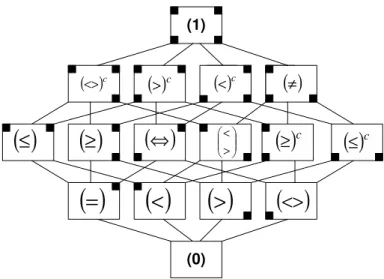
. Boolean algebra (Boolean lattice) generated by qualitative context is given in the following figure:(1)
(0)
( )
=
( )
<
( )
>
( )
<>
( )
≤
( )
≥
( )
⇔
( )
c≤
( )
c≥
⎟⎟ ⎠ ⎞ ⎜⎜ ⎝ ⎛ > <
( )
c<
( )
≠( )
c<>
( )
> cFigure 6: Boolean lattice generated by primary relations Ω=
{
( ) ( )
≤, ≥}
Atomic relations in functions of primary relations:
( ) ( ) ( )
( ) ( ) ( )
( ) ( )
( )
(
) ( )
( )
, , ,
. c
c
c c
= = ≤ ∩ ≥
< = ≤ ∩ ≥
> = ≤ ∩ ≥
<> = ≤ ∩ ≥
6.2. I-preference structures: valued (qualitative) level
Quantitative context is 2
A where A is set of analyzed alternatives. Intensity of atomic relations in functions of intensity primary relations
( )(
) ( )(
) ( )(
)
( )(
) ( )(
) ( )(
) ( )(
)
( )(
) ( )(
) ( )(
) ( )(
)
(
)(
)
( )(
) ( )(
) ( )(
) ( )(
)
(
)
2, , , ,
, , , , ,
, , , , ,
, 1 , , , , , , .
a b a b a b
a b a b a b a b
a b a b a b a b
a b a b a b a b a b a b A
= = ≤ ⊗ ≥
< = ≤ − ≤ ⊗ ≥
> = ≥ − ≤ ⊗ ≥
<> = − ≤ − ≥ + ≤ ⊗ ≥ ∈
For different generalized product operators we got the following results for atomic relations:
a. Values (intensity) of atomic relations for ⊗:=min
( )(
)
(
( )(
) ( )(
)
)
( )(
) ( )(
)
(
( )(
) ( )(
)
)
( )(
) ( )(
)
(
( )(
) ( )(
)
)
(
)(
)
( )(
) ( )(
)
(
( )(
) ( )(
)
)
(
)
2, min , , , ,
, , min , , , ,
, , min , , , ,
, 1 , , min , , , ,
, .
a b a b a b
a b a b a b a b
a b a b a b a b
a b a b a b a b a b
a b A
= = ≤ ≥
< = ≤ − ≤ ≥
> = ≥ − ≤ ≥
<> = − ≤ − ≥ + ≤ ≥
∈
b. Values (intensity) of atomic relations for ⊗:=*
( )(
) ( )(
) ( )(
)
( )(
) ( )(
) ( )(
) ( )(
)
( )(
) ( )(
) ( )(
) ( )(
)
(
)(
)
( )(
) ( )(
) ( )(
) ( )(
)
(
)
2, , , ,
, , , , ,
, , , , ,
, 1 , , , , ,
, .
a b a b a b
a b a b a b a b
a b a b a b a b
a b a b a b a b a b
a b A
= = ≤ ∗ ≥
< = ≤ − ≤ ∗ ≥
> = ≥ − ≤ ∗ ≥
<> = − ≤ − ≥ + ≤ ∗ ≥
∈
c. Values (intensity) of atomic relations for a⊗b: max=
(
a+ −b 1, 0)
, where(
)
2,
a b ∈A
( )(
)
(
( )(
) ( )(
)
)
( )(
) ( )(
)
(
( )(
) ( )(
)
)
( )(
) ( )(
)
(
( )(
) ( )(
)
)
(
)(
)
( )(
) ( )(
)
(
( )(
) ( )(
)
)
, max , , 1, 0 ,
, , max , , 1, 0 ,
, , max , , 1, 0 ,
, 1 , , max , , 1, 0 .
a b a b a b
a b a b a b a b
a b a b a b a b
a b a b a b a b a b
= = ≤ + ≥ −
< = ≤ − ≤ + ≥ −
> = ≥ − ≤ + ≥ −
<> = − ≤ − ≥ + ≤ + ≥ −
One conclusion in a relatively long history of fuzzy preference structures [1] was that fuzzy generalizations of classical preference structures are not possible straightaway. All results (a. b. and c.) correspond to known results for fuzzy preference structures [7] but crucially new is the fact that these results are direct generalizations of classical result.
Intensity of I-relations based on two atomic relations
( )(
) ( )(
) ( )(
)
( )(
) ( )(
) ( )(
)
(
)(
) ( )(
) (
)(
)
, , , ,
, , , ,
, , , ,
a b a b a b
a b a b a b
a b a b a b
≤ = < + =
≥ = > + =
⇔ = = + <>
(
) ( )(
) ( )(
)
( ) (
) ( )(
) (
)(
)
( ) (
) ( )(
) (
)(
)
(
)
2, , , ,
, , , ,
, , , , , .
c
c
a b a b a b
a b a b a b
a b a b a b a b A
< ⎛ ⎞
= < + >
⎜ ⎟ > ⎝ ⎠
≥ = < + <>
Intensity of I-relations based on three atomic relations
(
) (
) ( )(
) ( )(
) ( )(
)
( ) (
) ( )(
) ( )(
) (
)(
)
, , , , ,
, , , , ,
c
c
a b a b a b a b
a b a b a b a b
<> = = + < + >
> = = + < + <>
( ) (
) ( )(
) ( )(
) (
)(
)
( )(
) ( )(
) ( )(
) (
)(
)
(
)
2, , , , ,
, , , , , , .
c
a b a b a b a b
a b a b a b a b a b A
< = = + > + <>
≠ = < + > + <> ∈
Universal I-relation as a function of atomic relations
( )(
1 a b,) ( )(
= = a b,) ( )(
+ < a b,) ( )(
+ > a b,) (
+ <>)(
a b,)
, a b, ∈A.The values of all other relations for all
(
a b,)
∈A2 generated by two primary relations Ω={
( ) ( )
≤, ≥}
as the function of intensities of primary relations can be generalized in the following way too:(
)(
)
( )(
) ( )(
)
( )(
) ( )(
)
(
) ( )(
) ( )(
)
( )(
) ( )(
)
( ) (
)
( )(
)
( ) (
)
( )(
)
(
)
2 2, 1 , , 2 , , ,
, , , 2 , , ,
, 1 , ,
, 1 , , , .
c
c
a b a b a b a b a b
a b a b a b a b a b
a b a b
a b a b a b A
⇔ = − ≤ − ≥ + ≤ ⊗ ≥
<
⎛ ⎞
= ≤ + ≥ − ≤ ⊗ ≥
⎜ ⎟
>
⎝ ⎠
≥ = − ≥
≤ = − ≤ ∈
(
) (
) ( )(
) ( )(
) ( )(
) ( )(
)
( ) (
)
( )(
) ( )(
) ( )(
)
( ) (
)
( )(
) ( )(
) ( )(
)
( )(
)
( )(
) ( )(
)
(
)
2 2, , , , , ,
, 1 , , , ,
, 1 , , , ,
, 1 , , , , .
c
c
c
a b a b a b a b a b
a b a b a b a b
a b a b a b a b
a b a b a b a b A
<> = ≤ + ≥ − ≤ ⊗ ≥
> = − ≥ + ≤ ⊗ ≥
< = − ≤ + ≤ ⊗ ≥
≠ = − ≤ ⊗ ≥ ∈
Boolean lattice on valued level can be graphically represented as shown in Figure 7.
7. CONCLUSION
( )≤( , )a b⊗ ≥( )( , )a b ( ) ( ) ( )
( , ) ( , ) ( , )
a b
a b a b
≤
− ≤ ⊗ ≥
( ) ( ) ( )
( , ) ( , ) ( , )
a b
a b a b
≥
− ≤ ⊗ ≥
( ) ( ) ( ) ( )
1 ( , ) ( , ) ( , ) ( , )
a b a b
a b a b
− ≤ − ≥ + ≤ ⊗ ≥
( )≤( , )a b ( )≥( , )a b 1( )( )( , ) ( )( )( , )
2 ( , ) ( , )
a b a b
a b a b
− ≤ − ≥ + ≤ ⊗ ≥
( ) ( ) ( ) ( )
( , ) ( , ) 2 ( , ) ( , )
a b a b
a b a b
≤ + ≥
− ≤ ⊗ ≥ 1− ≥( )( , )a b 1− ≤( )( , )a b
( ) ( ) ( ) ( )
( , ) ( , ) ( , ) ( , )
a b a b
a b a b
≤ + ≥ − ≤ ⊗ ≥
( ) ( ) ( )
1 ( , ) ( , ) ( , )
a b
a b a b
− ≤ + ≤ ⊗ ≥
( ) ( ) ( )
1 ( , ) ( , ) ( , )
a b
a b a b
− ≤
+ ≤ ⊗ ≥ 1− ≤( )( , )a b⊗ ≥( )( , )a b
Figure 7: Boolean lattice of relational functions based on
( )(
≤ a,b)
and( )(
≥ a,b)
REFERENCES
[1] De Baets, B., and Fodor, J., Twenty Years of Fuzzy Preference Structures (1978-1998).
[2] Gottwald, S., A Treatise on Many-Valued Logics.Studies in Logic and Computation, Vol. 9, Research Studies Press Ltd., Baldock, 2001.
[3] Hajek, P., Metamathematics of Fuzzy Logic, Trend in Logica – Studia Logica Library, Kluwer Academic Publishers, Dodrecht/Boston/London, 1988.
[4] Klir, G., and Yuan, B., Fuzzy Sets and Fuzzy Logic, Theory and Applications, Prentice Hall, New Jersey, 1995.
[5] Radojevic, D., "New [0,1]-valued logic: A natural generalization of Boolean logic", Yugoslav Journal of Operational Research, 10 (2) (2000) 185-216.
[6] Radojevic, D., "Fuzzy preference structure based on syntactic structure and semantic convex logic", EUROFUSE 2002, Varenna, Italy, 2002, 231-236.
[7] Van de Walle, B., De Baets, B., and Kerre, E., "Characterizable fuzzy preference structures",
Annals of Operational Research, Special Issue "Prefference modelling“, 1997.