* Corresponding Author: Ali Tabrizi, Email: [email protected]
Original Article
Evaluating effects of pre-operative hydration on clinical outcome of
patients undergoing orthopedic surgery
Mohammadreza Bazavar1, Hossein Aslani2, Asghar Elmi2, Ali Sadighi2, Ali Tabrizi*3
1 Assistant Professor, Department of Orthopedic Surgery, School of Medicine AND Shohada Educational Hospital, Tabriz University of
Medical Sciences, Tabriz, Iran
2 Associate Professor, Department of Orthopedic Surgery, School of Medicine AND Shohada Educational Hospital, Tabriz University of
Medical Sciences, Tabriz, Iran
3 Assistant Professor, Department of Orthopedic Surgery, School of Medicine AND Emam Khomeini Educational Hospital, Urmia University
of Medical Sciences, Urmia, Iran
Citation: Bazavar M, Aslani H, Elmi A, Sadighi A, Tabrizi A. Evaluating effects of pre-operative hydration on clinical outcome of patients undergoing orthopedic surgery. J Anal Res Clin Med 2016; 4(1): 14-9. Doi: 10.15171/jarcm.2016.003
Introduction
Although fluid therapy is necessary in invasive measures and anesthesia process, its type, quantity, and exact time of prescription are still a question. Almost all patients undergoing general anesthesia will receive some intravenous fluid. There are ever-increasing evidence indicating that
Speaking about fluid therapy in surgery, three points should be taken into account: hypovolemia, hypervolemia, and tissue perfusion.6-10
In hypovolemia, the patients encounter decreases of tissue perfusion, and their different organs are damaged during or after surgery.6-9 The increase of body fluids and
retention of fluids after surgery results in hypervolemia and it leads to the longer intensive care unit (ICU) admission and more post-operative mortality rate.10 There are
more contradictions about pre-operative hydration, its quality, and clinical outcome of the patients. Cardiac and pulmonary function, tissue oxygenation, healing of wounds, post-operative ileus, renal function, and coagulation conditions may be affected by pre-operative fluid therapy.11 According
to recent studies, pre-operative hydration does not affect osmolality of the fasting operated patients, and the prescribed crystalloid fluids are not successful in preventing from hypotension during anesthesia.12 However, other studies believe
that prescribing appropriate volume of pre-operative intravenous fluids may be helpful in improving post-operative outcome.13
This study assumes that pre-operative crystalloid fluids may improve recovery process of the patients and decrease the need to use blood products during surgery. Therefore, the present study evaluates effects of pre-operative hydration on clinical outcome of patients undergoing orthopedic surgery.
This case-control study was conducted on 100 patients underwent orthopedic surgeries in Shohada Hospital, affiliated by Tabriz University of Medical Sciences, Iran. Patients with lower limb fractures (hip and femur shaft) where there is not necessary to use a tourniquet as well as patients without any records of systemic disease such as diabetes, cardiac, and renal diseases were qualified to enter the study. Patients were included with long bone lower fractures need to surgical fixation, who were not need to blood
transfusion before the operation, without systemic and metabolic disease, no solid organ damage or multilevel fractures.
The patients were randomly classified as case and control groups (n = 50) and compared. Patients of both groups were matched considering age, gender, and kind of surgery. According to surgery protocol of the hospital, both groups were fasting for 12 hours before surgery. The case group received 1.5 ml/kg crystalloid fluids (ringer) while they were fasting. If patients had cardiac heart failure or end-stage renal disease were excluded from the study.
The patients of the control group were fasting for 8 hours before surgery, according to the protocol of the hospital, and did not receive any intravenous fluid before surgery. Finally, the patients of both groups were followed up during and after surgery and compared considering intraoperative and post-operative complications.
All patients were completely justified about the study, and they submitted a letter of satisfaction for participating in the study. They were assured that their information will be kept confidentially, and their name and address will not be disclosed. There was not any extra intervention in this study, and the patients did not pay any extra costs.
All understudy data were analyzed using SPSS software (version 17, SPSS Inc., Chicago, IL, USA) and descriptive statistical methods [frequency, percentage, mean, and standard deviation (SD)]. Chi-square and
Fischer’s exact (if required) statistical tests
were used to compare qualitative findings, and quantitative variables were compared using independent t-test. In this study, P < 0.050 was considered meaningful.
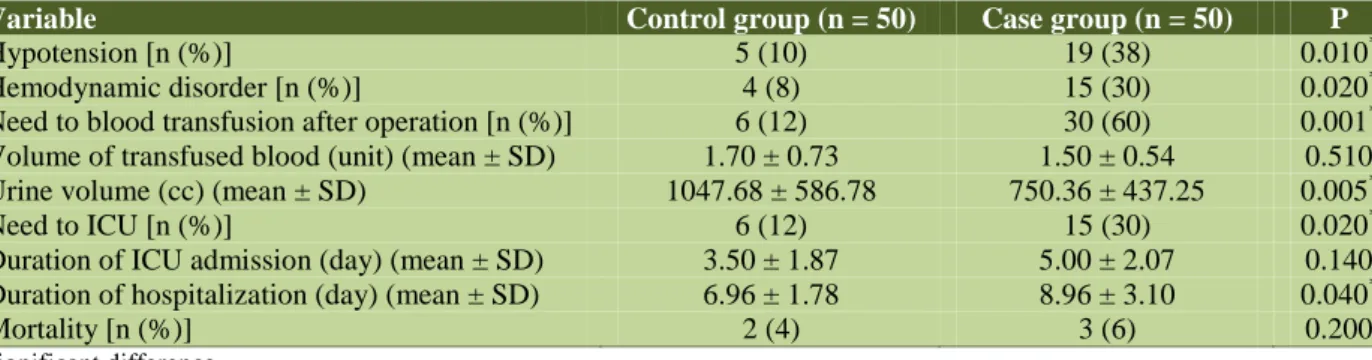
(P = 0.360). The intervention group was consisted of 33 male (66%) and 17 female (34%) patients. There were 35 (70%) male and 15 (30%) female patients in the control group. There was not any significant difference between two groups considering gender (P = 0.660). Table 1 compares intraoperative and other complications after surgery. According to table 1, mortality rate and needs to ICU care were compared. Hemodynamic disorders and hypotension in the intervention group were significantly less than that of the control one and 6 patients (12%) of the intervention, and 30 patients (60%) of the control group required blood transfusion (cell pack). As observed, need to blood transfusion in the intervention group was significantly less than the control one (P < 0.001). In addition, mean transfused blood was not statistically meaningful in the groups. There was higher mean urine volume in the pre-operative fluid therapy group. Furthermore, ICU admission in the intervention group was significantly less than that of the control group. There was no significant difference between the groups considering mortality rate.
The pre-operative fluid prescription is required for surgical care. Severity of disease, extent and duration of surgery, accompanying diseases, quality of patients’ body response to pain all affect the need to intraoperative and pre-operative hydration.12-15 However, high
and low fluid therapy is associated with some complications. Low fluid therapy may lead to organ insufficiency due to decrease of
intravenous fluid and adversely affect the performance of the heart, lungs, digestive system, and kidneys. It even affects tissue oxygenation and wound healing.9-11
However, high fluid therapy leads to some complications such as pulmonary edema, post-operative coagulopathy, and even compartment abdominal syndrome.14-16 In
spite of emphasize on pre-operative fluid therapy, there are still challenges about the volume of the prescribed fluids.17,18 In
orthopedic surgeries, as one of the major surgeries, appropriate fluid therapy may be useful in achieving better post-operative results. According to recent observations and studies, it was assumed that restrictive pre-operative fluid therapy may be associated with satisfaction results. Therefore, the present study classified the patients underwent lower limbs orthopedic surgery in two intervention group (pre-operative fluid therapy, n = 50) and control group (no pre-operative fluid therapy, n = 50). According to this study, pre-operative fluid therapy is associated with better results during and after surgery. According to previous studies, pre-operative hydration with appropriate volume of fluids may lead to better results and less post-operative complications.19,20
The present study suggested that pre-operative hydration is associated with less hemodynamic disorder and hypotension as well as less pack cell during surgery. Contrary to findings of the above study, Abraham-Nordling et al.21 observed that
more vasopressors are used in the restrictive fluid therapy group due to hypotension.
Table 1. Comparing complications of pre-operative fluid therapy and control groups
Variable Control group (n = 50) Case group (n = 50) P
Hypotension [n (%)] 5 (10) 19 (38) 0.010*
Hemodynamic disorder [n (%)] 4 (8) 15 (30) 0.020*
Need to blood transfusion after operation [n (%)] 6 (12) 30 (60) 0.001*
Volume of transfused blood (unit) (mean ± SD) 1.70 ± 0.73 1.50 ± 0.54 0.510
Urine volume (cc) (mean ± SD) 1047.68 ± 586.78 750.36 ± 437.25 0.005*
Need to ICU [n (%)] 6 (12) 15 (30) 0.020*
Duration of ICU admission (day) (mean ± SD) 3.50 ± 1.87 5.00 ± 2.07 0.140
Duration of hospitalization (day) (mean ± SD) 6.96 ± 1.78 8.96 ± 3.10 0.040*
Mortality [n (%)] 2 (4) 3 (6) 0.200
*
Significant difference
Similarly, Osugi et al.12 suggested that
pre-operative fluid therapy and hydration did not affect hypotension during surgery. The difference may be attributed to the type of surgery and the operated organ affecting need to hydration and its treatment outcomes. In addition, according to this study, there was not any difference in the mortality rate of the intervention group. However, the groups were different considering morbidity, intensive care costs, and hospitalization duration. There was not observed any major post-operative complication in this study. Furthermore, intraoperative complications were significantly less in the restrictive pre-operative fluid therapy group.
In a meta-analysis study, Boland et al.22
reported that restrictive fluid therapy does not affect post-operative complications. Contrary to the above findings, however, they observed that restrictive fluid therapy does not affect post-operative complications.23 Several studies reported
different results considering the mentioned complications. According to Brandstrup et al.,24 there was significantly fewer
complications in the patients received restrictive fluids in comparison with the group with the standard regime of intravenous fluids. Similar results were reported in the studies conducted by Abraham-Nordling et al.,21 de
Aguilar-Nascimento et al., 25 Kocian et al.,26 and
Weinberg et al.27 However, Warrillow et al.28
stated that pre-operative fluid therapy is associated with more complications (about 57%) in major surgeries of digestive system. Of course, it should be noted that accompanying background diseases, as well as type and location of surgery, may be involved in emerging of complications independent from fluid therapy.28 According
to the present study, patients with
pre-operative hydration significantly required less ICU admission as well as shorter hospitalization duration.
Contradictory findings were reported by the previous studies in this regard. Similar to this study, de Aguilar-Nascimento et al.25
suggested that restrictive fluid therapy protocol leads to shorter hospitalization period. According to Weinberg et al.,27
restrictive fluid therapy is associated with shorter hospitalization period. Contrary to the above-mentioned findings, Abraham-Nordling et al.21 stated that restrictive
pre-operative fluid therapy does not affect shorter hospitalization period. According to the metal-analysis study conducted by Boland et al.,22 restrictive fluid therapy does
not lead to shorter hospitalization period. Furthermore, Kocian et al.26 believe that
restrictive fluid therapy does not affect hospitalization duration. In general, as mentioned above, type, extension, and duration of surgery, as well as the accompanying background diseases may lead to more need to fluids and affect the type of fluid therapy. Therefore, the differences found in results of several studies may be attributed to above reasons. Interestingly, pre-operative fluid therapy significantly affects lower limbs orthopedic surgery.
According to results of the present study, it can be concluded that pre-operative fluid therapy leads to better intraoperative conditions, less hypotension, and shorter hospitalization period.
Authors have no conflict of interest.
This study was financially supported by Tabriz University of Medical Sciences.
1. Doherty M, Buggy DJ. Intraoperative fluids: how
much is too much? Br J Anaesth 2012; 109(1): 69-79. DOI: 10.1093/bja/aes171
2. Nisanevich V, Felsenstein I, Almogy G, Weissman
3. Lindenblatt N, Park S, Alsfasser G, Gock M, Klar E. [Intraoperative fluid management in pancreatic resections--the surgeon's view]. Zentralbl Chir 2008; 133(2): 168-75. DOI: 10.1055/s-2008-1004745
4. Holte K, Klarskov B, Christensen DS, Lund C,
Nielsen KG, Bie P, et al. Liberal versus restrictive fluid administration to improve recovery after laparoscopic cholecystectomy: a randomized, double-blind study. Annals of Surgery 2004; 240(5): 892-9.
DOI: 10.1097/01.sla.0000143269.96649.3b.
5. Holte K, Kristensen BB, Valentiner L, Foss NB,
Husted H, Kehlet H. Liberal versus restrictive fluid management in knee arthroplasty: a randomized, double-blind study. Anesth Analg 2007; 105(2): 465-74.
DOI: 10.1213/01.ane.0000263268.08222.19
6. Chappell D, Jacob M, Hofmann-Kiefer K, Conzen
P, Rehm M. A rational approach to perioperative fluid management. Anesthesiology 2008; 109(4): 723-40. DOI: 10.1097/ALN.0b013e3181863117
7. Chawla G, Drummond GB. Textbook coverage of a
common topic: fluid management of patients after surgery. Med Educ 2008; 42(6): 613-8. DOI: 10.1111/j.1365-2923.2008.03009.x
8. Soni N. British consensus guidelines on intravenous
fluid therapy for adult surgical patients
(GIFTASUP): Cassandra's view. Anaesthesia 2009; 64(3): 235-8.
DOI: 10.1111/j.1365-2044.2009.05886_1.x
9. Brandstrup B. Fluid therapy for the surgical patient.
Best Pract Res Clin Anaesthesiol 2006; 20(2): 265-83. DOI: 10.1016/j.bpa.2005.10.007
10.Kheterpal S, Tremper KK, Englesbe MJ, O'Reilly
M, Shanks AM, Fetterman DM, et al. Predictors of postoperative acute renal failure after noncardiac surgery in patients with previously normal renal function. Anesthesiology 2007; 107(6): 892-902. DOI: 10.1097/01.anes.0000290588.29668.38
11.Holte K, Kehlet H. Fluid therapy and surgical
outcomes in elective surgery: a need for reassessment in fast-track surgery. J Am Coll Surg 2006; 202(6): 971-89.
DOI: 10.1016/j.jamcollsurg.2006.01.003
12.Osugi T, Tatara T, Yada S, Tashiro C. Hydration
status after overnight fasting as measured by urine osmolality does not alter the magnitude of hypotension during general anesthesia in low risk patients. Anesth Analg 2011; 112(6): 1307-13. DOI: 10.1213/ANE.0b013e3182114df4
13.Grocott MP, Mythen MG, Gan TJ. Perioperative
fluid management and clinical outcomes in adults. Anesth Analg 2005; 100(4): 1093-106. DOI: 10.1213/01.ANE.0000148691.33690.AC
14.Chieveley-Williams S, Hamilton-Davies C. The
role of the gut in major surgical postoperative morbidity. Int Anesthesiol Clin 1999; 37(2): 81-110.
15.Lowell JA, Schifferdecker C, Driscoll DF, Benotti
PN, Bistrian BR. Postoperative fluid overload: not a benign problem. Crit Care Med 1990; 18(7): 728-33.
16.Jacob M, Chappell D, Conzen P, Finsterer U, Rehm
M. Blood volume is normal after pre-operative overnight fasting. Acta Anaesthesiol Scand 2008; 52(4): 522-9.
DOI: 10.1111/j.1399-6576.2008.01587.x
17.Brauer KI, Svensen C, Hahn RG, Traber LD,
Prough DS. Volume kinetic analysis of the distribution of 0.9% saline in conscious versus
isoflurane-anesthetized sheep. Anesthesiology
2002; 96(2): 442-9. DOI: 10.1097/00000542-200202000-00033
18.Connolly CM, Kramer GC, Hahn RG, Chaisson
NF, Svensen CH, Kirschner RA, et al. Isoflurane
but not mechanical ventilation promotes
extravascular fluid accumulation during crystalloid volume loading. Anesthesiology 2003; 98(3): 670-81.
19.Yogendran S, Asokumar B, Cheng DC, Chung F. A
prospective randomized double-blinded study of the effect of intravenous fluid therapy on adverse outcomes on outpatient surgery. Anesth Analg 1995; 80(4): 682-6. DOI: 10.1097/00000539-199504000-00006
20.Bennett J, McDonald T, Lieblich S, Piecuch J.
Perioperative rehydration in ambulatory anesthesia for dentoalveolar surgery. Oral Surg Oral Med Oral Pathol Oral Radiol Endod 1999; 88(3): 279-84. DOI: 10.1016/S1079-2104(99)70028-4
21.Abraham-Nordling M, Hjern F, Pollack J, Prytz M,
Borg T, Kressner U. Randomized clinical trial of fluid restriction in colorectal surgery. Br J Surg 2012; 99(2): 186-91. DOI: 10.1002/bjs.7702
22.Boland MR, Noorani A, Varty K, Coffey JC, Agha
R, Walsh SR. Perioperative fluid restriction in major abdominal surgery: systematic review and meta-analysis of randomized, clinical trials. World J Surg 2013; 37(6): 1193-202.
DOI: 10.1007/s00268-013-1987-8
23.Joshi GP. Intraoperative fluid restriction improves
outcome after major elective gastrointestinal surgery. Anesth Analg 2005; 101(2): 601-5. DOI: 10.1213/01.ANE.0000159171.26521.31
24.Brandstrup B, Tonnesen H, Beier-Holgersen R,
Hjortso E, Ording H, Lindorff-Larsen K, et al. Effects of intravenous fluid restriction on postoperative complications: comparison of two
perioperative fluid regimens: a randomized
assessor-blinded multicenter trial. Ann Surg 2003; 238(5): 641-8.
DOI: 10.1097/01.sla.0000094387.50865.23
25.de Aguilar-Nascimento JE, Diniz BN, do Carmo
925-30. DOI: 10.1007/s00268-009-9944-2
26.Kocian P, Neumann J, Majtan P, Hoch J. Fluid
therapy and surgical outcomes after low anterior resection. Rozhl Chir 2014; 93(9): 463-7. [In Czech].
27.Weinberg L, Wong D, Karalapillai D, Pearce B,
Tan CO, Tay S, et al. The impact of fluid intervention on complications and length of
hospital stay after pancreaticoduodenectomy
(Whipple's procedure). BMC Anesthesiology 2014; 14(35): 2-8. DOI: 10.1186/1471-2253-14-35
28.Warrillow SJ, Weinberg L, Parker F, Calzavacca P,