www.eerp.usp.br/rlae
Corresponding Author: Dirce Stein Backes
Centro Universitário Franciscano Rua dos Andradas, 1614 Centro
CEP: 97010-032, Santa Maria, RS, Brasil E-mail: [email protected]
The nursing care system from a Luhmannian perspective
Dirce Stein Backes
1Marli Stein Backes
2Camila Biazus Dalcin
3Alacoque Lorenzini Erdmann
4Objective: to investigate the socially-relevant communication of the nursing system from
the Luhmannian perspective. Method: the investigation process was based in grounded
theory. The data was collected between February and September 2011, through interviews
carried out with nurses and student nurses at a university in the South of Brazil. Results:
The central phenomenon – recognizing nursing care as an all-embracing interactive and
associative phenomenon – resulted from the inter-weaving of three categories: learning
the context of care as a whole, organizing the environment for the other professionals,
and visibilizing interactive and associative care. Conclusion: investing in a socially relevant
communication for nursing entails developing a code for functional differentiation, which may
strengthen health promotion and healthy living for individuals, families and communities.
Descriptors: Nursing Care; Nurse’s Role; Social Responsibility; Nursing Research.
1 PhD, Professor, Centro Universitário Franciscano, Brazil.
2 PhD, RN, Hospital Escola, Universidade Federal de Pelotas, Brazil.
Sistema de cuidado de enfermagem na perspectiva luhmanniana
Objetivo: conhecer a comunicação socialmente relevante do sistema de enfermagem
sob a perspectiva luhmanniana. Método: o processo de investigação foi baseado na
teoria fundamentada nos dados. Os dados foram coletados entre fevereiro e setembro de
2011, por meio de entrevistas realizadas com enfermeiros e estudantes de enfermagem
de uma universidade do Sul do Brasil. Resultados: o fenômeno central – reconhecendo
o cuidado de enfermagem como um fenômeno abrangente, interativo e associativo
resultou do entrelaçamento de três categorias: apreendendo o contexto de cuidado como um todo, organizando o ambiente para os outros proissionais e visibilizando o cuidado interativo e associativo. Conclusão: apostar em uma comunicação socialmente
relevante para a enfermagem implica o desenvolvimento de um código de diferenciação
funcional, que potencialize a promoção da saúde e o viver saudável de indivíduos,
famílias e comunidades.
Descritores: Cuidados de Enfermagem; Papel do Proissional de Enfermagem;
Responsabilidade Social; Pesquisa em Enfermagem.
Sistema de cuidado de enfermería en la perspectiva luhmanniana
Objetivo: conocer la comunicación socialmente relevante del sistema de enfermería en
la perspectiva luhmanniana. Método: el proceso de averiguación fue basado en la teoría
fundamentada en los datos. Los datos fueron colectados entre febrero y septiembre de
2011, por medio de entrevistas realizadas con enfermeros y estudiantes de enfermería
de una Universidad del Sur de Brasil. Resultados: El fenómeno central - reconociendo el
cuidado de enfermería como un fenómeno abarcador, interactivo y asociativo, resultó del
entrelazamiento de tres categorías: aprehendiendo el contexto de cuidado como un todo;
organizando el ambiente para los otros profesionales y percibiendo un cuidado interactivo
y asociativo. Conclusión: apostar en una comunicación socialmente relevante para la
enfermería implica en desarrollar un código de diferenciación funcional, que potencie la
promoción de la salud y vivirlo saludable de individuos, familias y comunidades.
Descriptores: Atención de Enfermería; Rol de la Enfermera; Responsabilidad Social;
Investigación en Enfermería.
Introduction
The system of nursing care has developed during
its process of professionalization through the code of
health-illness differentiation which is predominant in the
present health system. In this relationship, however, the
socially-relevant communication is the illness, and the
focus of attention is the curative actions(1-2).
The discussion about the health-illness code of
differentiation was initially proposed by the German
sociologist Niklas Luhmann, with the Theory of Social
Systems. For the different social systems, from a
Luhmannian perspective, communication is an element of the system’s afirmation and functional identiication, that is, in an instrument which is fundamental in the
evolutionary dynamic of functionally differentiated
systems. In this sense, the communication is developed
through the production of informative content and the
diffusion and acceptance of the same(3-5).
For Luhmann, communication is processed through
a code of differentiation, responsible for the production of information and in the identiication of noises, in the form of simgular information. According to this
understanding, the system determines what may be
communicated through the code and, consequently,
what must be selected from the surroundings. Thus, the
functional differentiation code is centered in responding
is not possible, the system needs to create a new code
capable of meeting the functional complexity(3,6).
For a speciied social system to be functionally differentiated, it needs to ensure its own communication
through a binary code. The system needs to develop
a code for distinguishing between two communicative
possibilities – such as, for example, the health-illness code, which identiies the health system and enables it
to create new communications(4).
Even though initial and partial, the discussion
around this issue has already stimulated various
enquiries between German sociologists and nurses
and, recently, among professional nurses in Brazil too.
Faced with the complexity of the milieu, scholars in the
area have increasingly sought to develop a functional differentiation code which is speciic to the area of nursing, a code whose socially-relevant communication
should be healthy living in individuals, families and
communities(7-10).
This investment is justiied, in the Brazilian context, by the need to re-think the health care model and to
propose references which are synchronized with the Uniied Health System’s principles and guidelines*. Focusing on primary care, the Uniied Health System (UHS) transcends the traditional medical-curative
model, through its broadened understanding of the
health-illness process and the centrality of healthy living
for individuals, families and communities. Thus, based
in the rationale presented, one may ask: Is it possible to think a speciic code for nursing, which is not the traditional health-illness code predominant in the health
system, whose socially-relevant communication is
illness? What is the nursing system’s socially-relevant
communication, and what distinguishes it from the other
social systems?
The present study aimed to investigate the
nursing system’s socially-relevant communication
from the Luhmannian perspective, so as to continue
the discussions already begun and to viabilize the construction of a code speciic to nursing, which might transcend the traditional health-illness code predominant
in the present health system.
Methodology
The investigative process was based in grounded
theory, which aims to identify, develop and relate concepts
based in the data, which has been collected, analyzed
and compared in a systematic, concomitant way. The
development of a theoretical framework denotes a set of
categories, constructed based on emerging issues and
concepts which indicate relationships which are capable
of forming a theoretical explanatory landmark of a social
phenomenon(11-12).
The data was collected between February and
September 2011, through interviews undertaken with
nurses directly involved in care (N), nurse lecturers (Nl),
and nursing students (Ns). All the participants, after
being informed of the research’s method and objectives,
signed the Terms of Free and Informed Consent, and
were guaranteed free access to the data collected. The participants were also informed that their names would
not be divulged and that they could withdraw from the
study at any time without restrictions. The project was
submitted to the Federal University of Santa Catarina’s
Research Ethics Committee and was approved under
number 052/07.
In compliance with the process of theoretical sampling, the irst sample group was made up of ive nurse lecturers who were members of the study and
research group in social entrepreneurship in nursing and health at UNIFRA**. The interviews were based in the following questions: How do you perceive the nursing
system? What differentiates the nursing system from other social systems?
The interviews were recorded and transcribed, and
the data was organized and analyzed with the aim of identifying the empirical indicators deined as codes, based in the technique of comparative analysis.
The analysis of the data collected from the irst sample group permitted the forming of initial properties and hypotheses which guided the formation of the
second group, comprised of twelve nurses directly
involved in care, members of the UNIFRA’s center for
discussion on management and leadership, and who
worked in care provision in hospitals or in specialized
health clinics. The question for the interviews was: in
your workplace, what distinguishes you from the other health care professionals? Why? When? How?
The data from the second group served to deepen
the theoretical model, strengthening the categories created with analysis of the irst group’s data and of the secondary data, and enabled supplementary information
which indicated the characteristics of the nursing system in the context of the shaping of, and the scenarios of,
practice. In this way, a third group of interviews was
Rev. Latino-Am. Enfermagem 2012 Sept.-Oct.;20(5):873-9.
decided on, with ten students in the last semester of
UNIFRA’s nursing course. These were selected randomly
from the institution’s registers and were interviewed
based on the following questions: Based on your
training, how do you perceive the nurse’s activities? What do you consider to be speciic to nursing, and what distinguished nursing from the other professions?
The empirical data was analyzed based in the
process of open, axial and selective coding(12). The codes
were organized according to their respective similarities
and differences, and were grouped into categories and
subcategories.
A central category was deined, based on the analysis of the relationships between the categories,
and after the structuring of the theoretical model which
represents the connection between the categories and
subcategories, the same was validated.
For the validation and explanatory description of
the theoretical model constructed, it was presented to ive of UNIFRA’s nursing researchers. These evaluated the theoretical model and presented suggestions which
were incorporated into this model.
Results
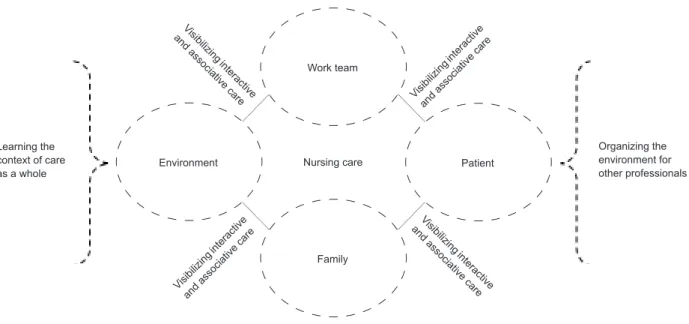
The theoretical model which is referent to the
nursing system’s socially relevant communication relects that nursing possesses possibilities and potential which guarantee its functional differentiation
in the health system. The circularity and integrality of
nursing care are expressed in the systemic interactions
and associations with the team, the patient, the family
and the dynamic environment.
Figure 1 – Recognizing nursing care as a comprehensive, interactive and associative phenomenon. Nursing care
Work team
Environment Patient
Family
Visi bilizi
ng in tera
ct ive an
d asso ci
ative ca
re Visi
bilizi ng in
tera ctive
and asso
ciat ive ca
re
Visi bilizi
ng inte
ra ctive an
d asso ci
ative ca
re Visi
bilizi ng in
tera ctive
and asso
ciat ive ca
re
Learning the context of care as a whole
Organizing the environment for other professionals
The central phenomenon – Recognizing nursing
care as a comprehensive, interactive and associative
phenomenon – resulted from the integration of three
categories: (I) Learning the context of care as a
whole, (II) Organizing the environment for the other
professionals, and (III) Visibilizing interactive and
associative care. The content of each of these three
categories, resulting from the organization and grouping
of their respective codes and subcategories, will be
presented below.
Grasping the context of care as a whole
The context of care is characterized as a
self-organizing complex, which cannot be reduced to a
formal institutionalized space, but which transcends the
physical space and involves relationships, interactions
and systemic associations.
Driven by professionals, service users and their
family members, the context of care in health appears
as a dynamic, self-feeding space. Woven together of
various threads, the care moves continuously from the
part to the whole and from the whole to the part. In
this dialogical and circular relationship, the nurse is
distinguished by her understanding and leadership of
the whole, while the other health care professionals,
frequently, are involved in or recognize only the part, as
one of the participants speciied in her comment: I think
for the whole. The nurse concerns herself even about where
and with whom the mother in hospital has left her children...
because the care involves the whole social network. (Nl).
The understanding of the whole, understood as the
nurse’s socially relevant communication, can also be
related to the capacity to transcend the linearity and
materiality of health care. Such an assessment, not
infrequently, creates discomfort and insecurity among
nursing professionals, as they understand by it that
their care has less impact than that of the other health
care professionals, as in the comment: When we do the
multiprofessional evaluation of the patients I have dificulty
talking about the exact role of the nurse… each professional
speaks about their part, while I speak about the whole. (N).
The nurse is to be found in all the places, deals with
the different processes of care and takes into account
the multiple dimensions and human relationships. However, the nurse frequently has dificulty in concretely visibilizing the object of her work. She perceives that
the care is everything and that it is not always possible
to decode it objectively, when compared to the work of
the other health professionals. In this sense, the nursing
care is expressed through sensitivity, interactivity and
comfort. So many patients tell us that they have gone through
great suffering and only found comfort in the nurse (N). Thus,
the nursing care is substantiated through individualized
care for to each human being, based on human attitudes which transcend the linearity of speciic actions.
Organizing the environment for the other professionals
Besides grasping and understanding the care as
a whole, the nurse deals with, organizes, dynamizes
and monitors the care environment for the other
professionals. The nurse ensures that the environment
should be clean, esthetic, well-lit and ventilated. She monitors the low of people through the unit, as well as the appropriate use and maintenance of material and
equipment. She fosters the integration of the work team
and how it inter-relates with the other professionals
involved in the care process. She intermediates in conlict situations, carries out referrals, and ensures the rapidity and organization of the work process.
Through her broad, interactive and intuitive view,
the nurse perceives and easily becomes involved in the
different movements which form part of the system’s
surroundings. Her way of thinking, managing and acting
is related to the interconnectivity and interactivity with
the patient, the family, the community and the team,
twenty-four hours a day. In this process, the nurse
does not care only for her functional part. This situation is
well illustrated by the following comment: The nurse arranges
everybody’s life and doesn’t leave anybody without an answer.
When a doctor from the primary care center refers a patient
to hospital, he doesn’t speak to a medical colleague, he calls
straight to a nurse, because he knows that straightaway she’ll
expedite and organize everything that’s needed for complete
care. (Ns).
Besides ensuring the organization and dynamicity
of the care environment, the nurse also concerns
herself with the system’s surroundings, in the sense
of processing new communications of meaning, as the
following comment highlights: No other professional is so
involved with the environment and everything that involves care,
whether it’s direct or indirect... the other professionals generally
deal with a speciic problem, their part, and then leave. (Nl). At the same time as the dynamization and
organization of the care environment, along with the
understanding of the system’s surroundings, favor a
widened, systemic nursing care, they also contribute to the invisibility of the speciic nursing care. In this regard, nurses frequently ask themselves: what is, really, the
object of the nurse’s work? What is the nurse’s identity?
Why does the nurse involve herself in so many activities which are not directly related to the care speciic to her? Why does the nurse feel responsible for everything and
everybody?
The socially-recognized communication of the
nurse, according to the interviewees, is related to the
capacity to understand and manage health care in
a way which is global, organized and safe. The nurse
demonstrates that her role goes beyond the linear care based on speciic actions, traditionally called for by the curative biomedical model.
Visibilizing interactive and associative care
Nursing care is recognized as broad, interactive
and associative. Thus, it is frequently presented as an
invisible, abstract care, principally in relation to the other
health professionals’ work object. This perception is even
more visible in hospital institutions, where the principal
focus of attention is the illness, and the centrality of the
therapeutic process is the biological dimension.
This relationship is different in community health; in
this space, health promotion and protection take priority,
and the focus of attention involves broad, contextualized
care. On this basis, the nurse stands out through her
interactive and associative care, integrated with the
social network: in hospital, the relevant communication
Rev. Latino-Am. Enfermagem 2012 Sept.-Oct.;20(5):873-9.
health promotion involves dealing with the family, education,
transport, and questions related to electricity, water and the
sewerage system the nurse does it well, because it’s related to
the whole social network. (N).
Through her interactive skills and proximity,
the nurse is able easily to identify the social needs of
individuals, families and communities. She seeks to
perceive and grasp the problems and human needs in
a broad and contextualized way. The data demonstrates
that the nurse identiies strongly with social questions. She
can make out the needs in a much more practical way... she
has the role of being responsible for health, rather than the
illness. She uses the other professionals’ arguments and tools
for establishing complete care (Nl).
Nursing has communicative characteristics which
distinguish it from the other functionally-differentiated
systems. In how she grasps, understands, dynamizes
and leads health care, the nurse demonstrates that
the object of her work transcends the materiality and
the linearity of health care. Through its emphasis on
global and systemic care, nursing demonstrates that it
is capable of going beyond the illness or ill individual.
It evidences, therefore, that it is possible to create new
communications focused on healthy living, through
appreciation of the human being as a unique and social
being.
Discussion: recognizing the part in the whole
and the whole in the part
To ensure the socially-relevant communication, by
means of a code of functional differentiation, entails
developing a distinction between two communicative
possibilities which is capable of identifying the system
and enabling it to create new communications(6).
In this study, the distinction of the nursing system’s
communicative possibilities is expressed in two ways:
through ‘competencies for care as a whole’ –
‘non-competencies for care as a whole’ and ‘‘non-competencies
for health promotion and protection for individuals,
families and community’ – ‘non-competencies for health
promotion and protection for individuals, families and
community’. This statement, which is in accordance with
Hohm’s ideas(7), addresses discussions(7)which refer to
“competency for care – non-competency for care”, which
ensures the functional differentiation, without excluding
the interactive and associative possibilities with the
other professions.
While the nurse grasps, understands and dynamizes
the care as a whole, the other health professionals limit
themselves, frequently, to the care of the ill individual
or the organ affected by the illness, for example the
diseased liver or fractured limb. In relation to this,
the nurse demonstrates that it is possible to learn the
singular in the multiple and the multiple in the singular.
This shows that the care is not limited to a linear, speciic action, but that it encompasses the totality of the dimensions and movements which dynamize healthy
living(1,13).
Differently from the traditional and hegemonic
code of health-illness, in which the focus of interest is
the illness-ill individual, nursing is distinguished by the
skills and competencies for understanding the multiple
variables involved in the process of living healthily. In
this sense, the nurse transcends the physio-pathological
dimension of the illness and perceives the environment
of care, in which multiple systemic relationships,
interactions and associations move and interact(10,14).
From a Luhmannian perspective, the care
environment or surroundings of the system are a
condition for maintaining the systems’ functional
communication, considering that identity is only possible
through differentiation(3). The nursing system, as it
establishes interactions and associations with the other
health professionals, does so based in the organization
and dynamization of the care environment. This being
so, the system is guided by its environment, not just
in an occasional way and by selective adaptation, but
in a special way through its interactive and adaptive
competences.
The nursing system’s differentiation does not
mean independence from the other systems. As it is only partially capable of inluencing healthy living in individuals, families and communities, Nursing needs to
be interconnected with the other systems to ensure its
socially-relevant communication. Thus, the interaction
with the system’s surroundings is indispensable to
ensure its own functional differentiation(4-5).
The construction of a code speciic to nursing, transcending the traditional health-illness code of the
present health system, whose focus is the illness, entails
developing new communicative possibilities focused on
the promotion and protection of health, as well as new
opportunities for social insertion.
Final considerations
The present study reveals that Nursing possesses
communicative possibilities and opportunities which
systems, due to: learning the context of care as a whole,
organizing the environment for the other professions,
and visibilizing an interactive, associative care. Through
its emphasis on systemic care, Nursing demonstrates
that it is capable of going beyond the illness and creating
new communications focused on the promotion and
protection of health and the valorization of the human
being as a singular and social being.
The results indicate the possibility of Nursing developing a speciic binary code: a code which has as its focus care as a complex phenomenon, which
encompasses the systemic interconnections with the
team, the patient, the families, the community and
the dynamic, changeable environment. This process,
however, requires innovation, creativity, daring and the
capacity to protagonize and visualize new spaces for
professional performance.
This research suggests the limitations of
qualitiative research, which is not intended to produce
generalizations. As contributions to the nursing system,
it is hoped that nurses might (re-)think the relational
and assistential model and, as a consequence, develop
strategies which consider healthy living as a
socially-relevant communication, and the human being as a
singular and social being, inserted in a complex and
multi-dimensional reality.
Investing in a socially-relevant communication for
the system of nursing entails, in short, developing a
code of functional differentiation, which optimizes the
promotion of health and is expressed in the systemic
interactions and associations with the team, the patient,
the family and the dynamic environment.
References
1. Backes DS. Vislumbrando o cuidado de enfermagem
como prática social empreendedora [tese de doutorado].
Florianópolis (SC): Programa de Pós-Graduação de
Enfermagem da Universidade Federal de Santa Catarina;
2008. 245 p.
2. Backes DS, Erdmann AL, Büscher A. Evidenciando
o cuidado de enfermagem como prática social. Rev.
Latino-Am. Enfermagem. 2009;17(6): 988-4.
3. Luhmann N. Soziale Systeme: Grundriβ einer allgemeinen Theorie. Frankfurt: Main; 1984. 815 p.
4. Luhmann L. The autopoiesis of Social Systems.
Sociocybernetic paradoxes. London (UK): BMJ Bo s/
Blackwells; 1996. 210 p.
5. Luhmann N. Sistemas Sociales. Lineamentos para una
teoría general. México: Universidade Iberoamericana;
1998. 310 p.
6. Luhmann N. Der medizinische Code. In: Luhmann
N. Soziologische Aufklärung: Konstrutivistische
Perspektiven. Opladen: Westdeutscher Verlang; 1990.
p. 183-5.
7. Hohm HJ. Das Pflegesystem, seine Organisationen
und Karrieren. Systemtheoretische Beobachtungen
zur Entstehung eines sekundären Funktionssystems.
Freiburg: Lambertus; 2002. 320 p.
8. Schroeter KR. Das soziale Feld der Pflege: Eine
Einführung in Strukturen, Deutungen und Handlungen.
München: Juventa; 2006. 270 p.
9. Bauch J. Pflege als soziales System. In: Bauch J,
editor. Gesundheit als System: Systemtheoretische
Beobachtungen des Gesundheitswesens. Hartung-Gorre
Verlang Konstanz; 2006. p. 139-50.
10. Backes DS, Backes MTS, Erdmann AL. Systemic
social practice of nurses in luhmann’s perspective. Rev
Esc Enferm USP. 2011;45(1):116-21.
11. Corbin J, Hildenbrand B. Qualitative Forschung.
In: Allhoff R, Schaeffer D, editor. Handbuch
Pflegewissenschaft. München: Juventa; 2003. p. 159-84.
12. Strauss A, Corbin J. Pesquisa qualitativa: técnicas
e procedimentos para o desenvolvimento de teoria
fundamentada. 2a ed. Porto Alegre (RS): Artmed; 2008.
320 p.
13. Falcón GCS, Erdmann AL, Backes DS. Significados
do cuidar na promoção da saúde. Rev. Latino-Am.
Enfermagem. 2008;16(3):419-24.
14. Backes MTS. A sustentação da vida no ambiente
complexo de cuidados em Unidade de Terapia Intensiva
[tese de doutorado]. Florianópolis (SC): Programa de
Pós-Graduação de Enfermagem da Universidade Federal
de Santa Catarina; 2011. 320 p.
Received: Feb. 15th 2012