Corresponding Author: www.eerp.usp.br/rlae
Corresponding Author: Verónica Guerra Guerrero
Universidad Católica del Maule. Departamento de Enfermería Avenida San Miguel n° 3605
Talca, Chile
E-mail: [email protected]
Quality of life in people with chronic hemodialysis: association with
sociodemographic, medical-clinical and laboratory variables
1Verónica Guerra-Guerrero
2Olivia Sanhueza-Alvarado
3Mirtha Cáceres-Espina
4Aim: determine the quality of life for people in chronic hemodialysis and its association
with sociodemographic, medical-clinical and laboratory variables. Method: exploratory,
descriptive, cross-sectional study with stratified probability sampling. Quality of life was
assessed using the KDQOL-36TM. Data were analyzed using SPSS statistical software.
Results: 354 people in chronic hemodialysis had low scores on most dimensions of quality
of life, mainly Burden of Disease, Physical and Mental Component. Age, sex, education,
income, time on dialysis, etiology of the disease, smoking, hospitalizations, albumin,
creatinine and transplants were related. The results reveal multiple factors related to quality
of life. Conclusion: there is a need to research on other aspects that permit focusing and
optimizing the nursing care for these people.
Descriptors: Quality of Life; Hemodialysis; Chronic Renal Failure.
1 Paper extrated from Doctoral Dissertation “Factores que influyen significativamente en la adherencia y calidad de vida de las
personas en hemodiálisis, considerando su experiencia de vida”, presented to Universidad de Concepción, Chile. 2 PhD, Professor, Departamento de Enfermería, Universidad Católica del Maule, Chile.
3 PhD, Professor, Departamento de Enfermería, Universidad de Concepción, Chile.
Qualidade de vida de pessoas em hemodiálise crônica: relação com variáveis sociodemográicas, médico-clínicas e de laboratório
Objetivo: determinar a qualidade de vida de pessoas em hemodiálise crônica e sua relação
com variáveis sociodemográicas, médico-clínicas e de laboratório. Método: estudo exploratório, descritivo, transacional com amostragem de probabilidade estratiicada.
Qualidade de vida foi avaliada mediante o instrumento KDQOL-36TM. Os dados foram
analisados com o programa estatístico SPSS. Resultados: 354 pessoas em hemodiálise
crônica apresentaram pontuações baixas na maioria das dimensões de qualidade de
vida, principalmente carga da doença, componente físico e mental. Foram encontradas
associações com idade, sexo, escolaridade, renda, tempo em diálise, etiologia da doença,
cigarro, hospitalizações, quantidade de remédios, albumina, creatina e transplantes.
Os resultados revelam múltiplos fatores relacionados à qualidade de vida. Conclusão:
existe a necessidade de se investigar outros aspectos que permitam enfocar e otimizar
o cuidado da enfermagem dirigido a essas pessoas.
Descritores: Qualidade de Vida; Hemodiálise; Insuiciência Renal Crônica.
Calidad de vida de personas en hemodiálisis crónica: relación con variables sociodemográicas, médico-clínicas y de laboratorio
Objetivo: determinar la calidad de vida de personas en hemodiálisis crónica y su
relación con variables sociodemográicas, médico-clínicas y de laboratorio. Método: estudio exploratorio, descriptivo, transaccional con muestreo probabilístico estratiicado.
Calidad de vida fue evaluada mediante el instrumento KDQOL-36TM. Los datos fueron
analizados con el programa estadístico SPSS. Resultados: 354 personas en hemodiálisis
crónica presentaron puntuaciones bajas en la mayoría de las dimensiones de calidad
de vida, principalmente Carga de la Enfermedad, Componente Físico y Mental. Edad,
sexo, escolaridad, ingresos económicos, tiempo en diálisis, etiología de la enfermedad,
cigarrillo, hospitalizaciones, número medicamentos, albúmina, creatinina, trasplantes
resultaron relacionados. Los resultados revelan múltiples factores relacionados con la
calidad de vida. Conclusión: existe necesidad de investigar otros aspectos que permitan
enfocar y optimizar el cuidado de enfermería dirigido a estas personas.
Descriptores: Calidad de Vida; Hemodiálisis; Insuiciencia Renal Crónica.
Introduction
Moreover, it is associated with high social and economic
costs for health systems(8). Although dialysis therapy
allows people to extend their lives and guarantee their
survival(9), it also affects the accomplishment of activities
of daily living and, in the long term, patients’ quality
of life. Moreover, the reduced quality of life has been
associated with increased morbidity and mortality risks
in this population(6).
The quality of life construct has been largely
studied in different illnesses and TCRF because of its
characteristics and treatment. It represents a permanent
concern for health professionals. In 1994, the World
Health Organization deined it as “individuals’ perception
Terminal chronic renal failure (TCRF) is a disease
with high prevalence and incidence levels around the
world(1-2). In recent decades, the number of patients has
signiicantly increased in Chile as well(3). It is a disease with mortal outcomes in the short or medium term(4)
and affects many body structures, which is why it is also
associated with a worse quality of life (QoL)(5-6).
Until date, there is no cure, although treatments
permit the maintenance and extension of life.
Hemodialysis (HD) is the most frequent therapy
globally(1,4,7) and in Chile as well(2). The treatment
is highly complex, demanding and potentially very
www.eerp.usp.br/rlae
of their position in life in the context of the culture and
value systems in which they live and in relation to
their goals, expectations, standards and concerns”(10).
Recently, it has been studied as one of the main results
of renal replacement therapy in distinct groups of
people and countries, and as one of the main indicators
of health and wellbeing(7-8). Studies and interest in
the theme have increased in recent years, in line with
the progressive increase in the number of people with
TCRF and their extended life. Studies agree that QoL is
worse in HD patients than in the general population and
even in kidney transplantation patients(6-7,11). Another
consensus is that the most deteriorated dimension or
area is the physical dimension, underlying the mental
dimension(12). Research has also centered on identifying
the factors that inluence quality of life with a view to the
establishment of intervention strategies. Some factors
related to QoL are: hemoglobin, albumin, creatinine,
hematocrit levels; psychosocial factors like marital
status, depression and anxiety; sociodemographic and
clinical factors like age, gender, duration of kidney
disease and dialysis, and concomitant illnesses(12-13).
It is an actual problem that chronic and terminal
illnesses like TCRF affect people’s QoL, as these inluence
different areas of their lives. QoL assessment is an
important outcome measure, especially in long-term
illnesses like TCRF, and generic and speciic instruments
can be used for this purpose(8). Studies to identify the
QoL of HD patients and its determinant factors are a
fundamental aspect to evaluate in this population with
a view to effective interventions. That is particularly the
case in nursing, which is directly related to this kind
of treatment, as health-related quality of life (HRQoL)
is often evaluated to determine the effectiveness
of healthcare and treatment, as well as resource
distribution and health policy development(7).
In spite of the above, in Chile, studies on HRQoL
in this population are still incipient. The same is true
for its association with socio-demographic,
medical-clinical and laboratory variables. The aim in this study
is to determine the relation between these variables and
quality of life among chronic hemodialysis patients in
the Seventh Region of Chile.
Methods
Exploratory, descriptive and cross-sectional
correlation study. Stratiied probabilistic sampling was
applied in function of the dialysis centers in the total
number of TRCF patients under HD, in 11 out of 13 dialysis
centers in the Seventh Region of Chile, corresponding
to 673 people until August 2010. The following centers
participated: Talca (Unidad de diálisis y Trasplante
Hospital Regional de Talca: 27 out of 50 participants;
Enferdial: 42 out of 83 participants; Hemodiálisis Talca:
47 out of 92 participants; Intermédica Diálisis Talca:
42 out of 82 participants); Linares (Nefrodial Linares:
31 out of 60 participants; Hemodiálisis Linares: 45 out
of 86 participants); Curicó (Diálisis Curicó Limitada:
46 out of 83 participants); Constitución (Intermédica
Diálisis Constitución: 11 out of 22 participants; Servicios
Hospitalarios del Centro: 7 out of 11 participants); Parral
(Hemodiálisis Parral: 43 out of 83 participants); and San
Javier (Nefrodial San Javier: 13 out of 21 participants).
The sample included people over 18 years of age, who
attended dialysis sessions thrice a week, submitted
to dialysis for at least three months, medically stable,
without diagnosed mental or cognitive deterioration and
who agreed to participate voluntarily.
Data collection started after ethical evaluation by
the School of Medicine at Universidad de Concepción,
approval from the Scientiic Ethics Committee at
Servicio de Salud del Maule and authorization from each
dialysis center. All participants were informed about the
research, voluntarily signed the Informed Consent term
and agreed to participate.
For QoL assessment, the Kidney Disease Quality of
Life (KDQOLTM) instrument was applied, developed by the
Kidney Disease Quality of Life Working Group as a speciic
self-reported health-related quality of life measure for
kidney disease patients undergoing hemodialysis(14). The
short version of the KDQOLTM was used in this study:
the KDQOL-36TM. This instrument consists of 36 items
or questions, divided in two components: one general
component, including 12 quality of life questions based
on the SF-12 (short version of the SF-36), and a speciic
24-question component about the kidney disease. At the
same time, each item or question is regrouped in ive
subscales or dimensions, where the general component
groups the SF-12 subscale Physical Functioning
(questions 1-12) and SF-12 subscale Mental Functioning
(questions 1-12); while the speciic component groups
the subscales Burden of Kidney Disease (questions
13-16), Symptoms and Problems (questions 17-28) and
Effects of Kidney Disease on Daily Life (questions 29-36)
(15). Item scores range from 0 to 100, with 0 indicating
the worst and 100 the best quality of life. The
KDQOL-36TM was validated in a Chilean population(16) and is
available in Spanish for public use(17). Sociodemographic,
medical-clinical and laboratory data were collected on
Registers for the three months before data collection
were considered. Data were collected through structured
interviews, held during the patients’ dialysis sessions,
between August and November 2010.
Data were ordered, coded and processed
electronically. SPSS statistical software, version 15.0
for Windows, was used for data analysis. The authors’
worksheet was used to calculate the patients’ QoL
scores(17). Frequency distribution, central trend and
dispersion measures were used for descriptive analysis of
the samples. Pearson’s correlation coeficient (numerical
variables), ANOVA and Student’s t-test (categorical
variables) were used to establish the relation between
the quality of life subscales and sociodemographic,
medical-clinical and laboratory variables and to compare
means. Statistical signiicance was set as p<0.05.
Internal consistency analysis of the KDQOL-36TM, using
Cronbach’s alpha, resulted in 0.80.
Results
Three of the selected participants refused
to participate. The inal sample consisted of 354
participants, corresponding to 50.7% of the total
population of chronic hemodialysis patients in the
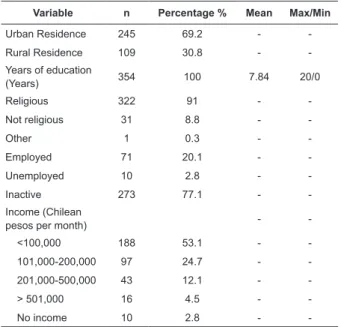
Seventh Region, Chile. Table 1 shows the hemodialysis
population’s sociodemographic characteristics. The
mean age was 58.82 years, and most participants
were male (57.9%), married (53.7%), with a partner
(68.6%), living with the family (89%) and in the urban
region (69.2%). On average, patients had 7.84 years of
education, the majority declared being religious (91%),
professionally inactive (77.1%) and monthly economic
revenues of less than 5,000 Chilean pesos (53.1%),
equivalent to less than 200 dollars per month.
Variable n Percentage % Mean Max/Min
Age (Years) 354 100 58.82 86/19
Male 205 57.9 -
-Female 149 42.1 -
-Single 74 20.9 -
-Married 190 53.7 -
-Separated/Divorced 40 11.3 -
-Widowed 50 14.1 -
-With partner 243 68.6 -
-No partner 111 31.4 -
-Lives alone 36 10.2 -
-Lives with the family 315 89 -
-Lives with friends/
others 3 0.9 -
-Table 1 – Sociodemographic characteristics of
hemodialysis population
(continue...) (continue...)
Table 1 - (continuation)
Variable n Percentage % Mean Max/Min
Urban Residence 245 69.2 -
-Rural Residence 109 30.8 -
-Years of education
(Years) 354 100 7.84 20/0
Religious 322 91 -
-Not religious 31 8.8 -
-Other 1 0.3 -
-Employed 71 20.1 -
-Unemployed 10 2.8 -
-Inactive 273 77.1 -
-Income (Chilean
pesos per month) -
-<100,000 188 53.1 -
-101,000-200,000 97 24.7 -
-201,000-500,000 43 12.1 -
-> 501,000 16 4.5 -
-No income 10 2.8 -
-Table 2 shows the medical-clinical and laboratory
characteristics. The main cause of the kidney disease
was unknown and the mean duration of dialysis
treatment was 47.62 months. 90.1% did not smoke
and 92.7% had never received transplantation. The
mean duration of each dialysis session was 3.66 hours
and mean residual diuresis 477.71 ml. 86.4% had not
been hospitalized in the last three months, 54.8%
used diuretics and took an average 8.2 medicines per
day. Concerning the laboratory parameters, the mean
hematocrit level was 28.33%, Kt/V 1.46, albumin 4.11
mg/dl, creatinine 7.72 mg/dl, PTH 414.04 pg/ml, ferritin
392.2 ng/mL, potassium 4.74 mEq/l, ureic nitrogen
57.65 mg/dl, calcium 8.74 md/d and phosphor 5.13
mg/dl.
Table 2 – Medical-clinical and laboratory characteristics
of hemodialysis population
Variable n Percentage % Mean Max/Min
Etiology kidney disease
Diabetic nephropathy 92 26 -
-Hypertensive
nephropathy 79 22.3 - -Obstructive uropathy/
glomerulonephritis 22 6.2 -
-Unknown 105 29.7 -
-Others 56 15.8 -
-Duration of dialysis
treatment (months) 354 100 47.62 201/3
Smoking 35 9.9 -
-No smoking 319 90.1 -
-Transplantations 26 7.3 -
-www.eerp.usp.br/rlae Quality of life
KDQOL-36TM Subscale Mean Range
% people
score ≤ 50
Specific component
1. Symptoms and Problems (S) 74.61 12.5-100 11.3%
2. Effects of the Kidney disease (E) 56.92 0-100 42.4%
3. Burden of the Kidney disease
(C) 31.88 0-100 76%
Generic component
4. SF-12 Physical Functioning
(PCS) 37.63 12.32-64 89% 5. SF-12 Mental Functioning
(MCS) 43.49
15.8-67.64 67.2%
Variables
KDQOL-36TM
Symptoms and Problems
Effects of the Kidney disease
Burden of the Kidney disease
SF-12 Physical functioning
SF-12 Mental functioning
r r r r r
Sociodemographic
Age -0.224* -0.088 -0.156* -0.203* -0.118*
Years of study 0.285* 0.174* 0.366* 0.196* 0.196*
Medical-Clinical
Duration of dialysis 0.037 0.028 0.061 -0.002 0.156*
Hours of dialysis 0.270 -0.025 -0.007 -0.128* 0.040
Residual diuresis 0.140* 0.163* 0.077 0.154* 0.053
Number of medicines -0.014 -0.007 0.043 -0.106* 0.092
Systolic arterial pressure -0.124* -0.057 -0.078 -0.115* -0.120*
Laboratory
Albumin 0.073 0.057 0.115* 0.021 0.105*
Creatinine 0.109* -0.057 0.061 0.102 0.119*
Ferritin -0.126* -0.045 -0.019 -0.053 -0.009
Ureic Nitrogen -0.009 -0.055 0.040 0.118* 0.008
Table 2 - (continuation)
Variable n Percentage % Mean Max/Min
Hours of dialysis 354 100 3.66 4.5/2.15
Residual diuresis (ml) 354 100 477.71 3.000/0
Hospitalizations 48 13.6 -
-No hospitalizations 306 86.4 -
-Use diuretics 194 54.8 -
-No use of diuretics 160 45.2 -
-Number of medicines 354 100 8.2 15/2
Hematocrit (%) 354 100 28.33 47.67/16.8
Kt/V 354 100 1.46 9.07/0.74
Albumin (mg/dl) 354 100 4.11 5.9/2.6
Creatinine (mg/dl) 354 100 7.72 15.74/1.06
PTH (pg/ml) 348 98.30 414.04 2624/2.55
Ferritin (ng/mL) 308 87 392.2 5034/4.29
Potassium (mEq/l) 352 99.43 4.74 7.5/3.3
Ureic nitrogen (mg/dl) 351 99.15 57.65 98.23/19.23
Calcium (mg/dl) 352 99.43 8.74 11.49/4.67
Phosphor (mg/dl) 352 99.43 5.13 11.27/1.87
QoL results based on the ive KDQOL-36TM subscales are displayed in Table 3. The subscales Burden of the
Kidney disease (C), SF-12 Physical Functioning (PCS)
and SF-12 Mental Functioning (MCS) showed the lowest
mean scores 31.88 – 37.63 and 43.49, respectively.
The highest mean scores were found in the Symptoms
and Problems (S) and Effects of the Kidney Disease (E)
subscales, with 74.61 and 56.92, respectively.
Table 4 – Correlation between sociodemographic, medical-clinical, laboratory data and KDQOL-36TM subscales
(r) Pearson’s Correlation. * Correlation signiicant at 0.05 (bilateral).
The relation between sociodemographic,
medical-clinical, laboratory characteristics (categorical variables)
and health-related quality of life is described in
Table 5. Only some QoL subscales were related with
sociodemographic characteristics: gender, type o
Table 4 shows the correlation between
sociodemographic, medical-clinical, laboratory
characteristics (numerical variables) and quality of life
assessed through the KDQOL-36TM. A correlation was
found between age, years of education, duration of
dialysis treatment, hours of dialysis session, residual
diuresis, number of drugs, systolic arterial pressure,
albumin, creatinine, ferritin and ureic nitrogen (p≤0.005). Table 3 – Health-related quality of life scores
(KDQOL-36TM)
relationship, family situation, residence, occupation,
economic revenues, with statistically signiicant
differences in mean values. The medical-clinical
characteristics were: etiology of the disease, cigarette
Table 5 – Comparison between mean values of sociodemographic, medical-clinical and laboratory data and
KDQOL-36TM subscales
Sociodemographic variables
Mean scores KDQOL-36TM
n Symptoms and
Problems
Effects of the Kidney disease
Burden of the Kidney disease
SF-12 Physical functioning
SF-12 Mental functioning Gender
Men 205 77.19* 59.87* 33.32 38.44 44.67*
Women 149 71.07* 52.87* 29.91 36.51 41.87*
Type relationship
Partner 243 75.93* 55.35 30.71 37.61 43.23
No partner 111 71.73* 60.36 34.46 37.66 44.06
Family situation
Lives alone 36 68.40* 57.64 33.50 37.27 44.56
Family 318 73.31* 56.67 31.44 37.67 43.45
Residence
Urban 245 75.14 57.67 34.48* 37.78 44.03
Rural 109 73.43 55.25 26.03* 37.27 42.28
Occupation
Employed 71 83.95* 63.60* 47.18 42.14* 48.14*
Unemployed 10 12.45 45.63 32.50 41.22 40.47
Inactive 273 72.22* 55.60* 27.88* 36.32* 42.39*
Income
≤ 100,000 188 71.60* 54.32* 26.46* 36.67 41.84*
> 100,000 156 78.05* 60.13* 38.70* 38.58 45.67*
No income 10 77.29 55.62 27.50 40.67 40.48
Medical-clinical variables
Mean scores KDQOL-36TM
n Symptoms and Problems
Effects of the Kidney disease
Burden of the Kidney disease
SF-12 Physical functioning
SF-12 Mental functioning Etiology of the disease
Diabetic Nephropathy 92 70.22 54.24 27.85 34.53* 42.05
Hypertensive Nephropathy 79 75.97 53.64 35.83 38.38* 44.11
Obstructive Uropathy /
Glomerulonephritis 22 78.21 61.93 38.06 45.92* 45.20
Unknown 105 75.61 59.61 30.95 37.15* 43.84
Others 56 74.61 58.93 32.25 39.25* 43.62
Smoking
Yes 35 78.21 59.11 41.79* 41.02* 41.41
No 319 74.21 56.68 30.80* 37.25* 43.72
Hospitalizations
Yes 48 72.22 52.01 31.25 34.11* 40.66
No 306 74.99 57.69 31.99 38.18* 43.94
Transplantations
Yes 26 82.45* 58.17 52.88* 43.67* 47.63
No 328 73.99* 58.82 30.22* 37.14* 43.16
Student’s T (t); Bilateral signiicance (p). Assistential/None (A/N). Fondo Nacional de Salud (F). *p<0.005. Mean values.
Discussion
Concerning QoL, a high percentage of patients
scoring below the reference value of 50 points (scale
from 1 to 100 points) was found in three of the ive
KDQOL-36TM subscales. Burden of the disease was the
subscale on which participants obtained the lowest
mean score, which 76% scoring below 50 points. The
same was true for the Physical and Mental Functioning
subscales, as more than 50% of patients scored less than
50 points on both. As for the Effects of the Disease and
Symptoms and Problems subscales, high percentages of
participants obtained average scores of more than 50
www.eerp.usp.br/rlae
and 57.6% on the Effects of the Kidney disease subscale.
Many people in the Seventh Region display low scores
in all QoL dimensions, in line with other studies(18-19).
Scores for Physical Functioning were also lower than for
Mental Functioning, in line with other studies(12,18,20). This
could relect people’s ability to psychologically adapt to
their situation over time, as the time variable reduces
the physical aspect of QOL, but not the mental aspect(12).
As for the correlation with numerical variables,
a relation was found with age, years of education,
duration of dialysis treatment, hours of dialysis, residual
dialysis, number of medicines, systolic arterial pressure,
albumin, creatinine, ureic nitrogen and ferritin. The
following categorical variables were related with QoL:
gender, type of relationship, family situation, residence,
occupation, social security income, etiology of the
disease, smoking, hospitalizations and transplantations.
Men scored better than women on the symptoms,
effects and mental functioning subscales. Like in other
studies(7,21) describing these differences, women score
lower, probably due to the psychological aspect some
authors consider determinant in this condition(15).
Other studies also describe that this relation does not
exist(2,18,22).
With regard to age, a negative correlation was
found in all subscales assessed, except in the Effects of
the Kidney disease dimension. People over 60 years of
age obtained lower QoL scores than people under that
age, but only on the symptoms, burden and physical
functioning subscales. The latter is a determinant aspect
as, according to some authors, QoL is lower in adult
people because it is related to greater deterioration in
physical exercise(21). The indings differ from(2,13,21) and
coincide(11,23) with authors who also describe higher
physical and mental functioning scores in younger
patients with shorter durations of dialysis treatment,
lower education levels and employed. These study
results suggest that advanced age is very important
in perceived QoL and represents a vulnerable group
that needs to be studied in further depth. On the other
hand, people with a partner showed better QoL than
people without, but only on the symptoms and problems
subscale.
People who live alone also scored lower on the
symptoms subscale when compared to people who live
with other persons. In this study, however, no signiicant
differences were found between people who are married,
single, separated or live in any other marital condition,
as described in other studies(11,21). Other indings show
higher mental functioning scores among people who were
married or were living in a relationship like marriage and
were employed(12).Authors(21) have indicated living alone
as an independent predictor of improvements in the
mental health component over time. In this study, the
results reveal a better perception of symptom-related
QoL among people living with other persons. Living with
someone more strongly inluences the perceived QoL
than people’s marital status.
As some authors appoint(21), the disease burden
and the limitations its treatment imposes also extend
to the caregivers and can signiicantly inluence the
perceived QoL. The degree of support received in the
family context has also been described as an important
predictor of mental QoL(12). It has also been described,
however, that the effects of family involvement have not
always been beneicial to patients, as these could vary
in both senses, between not giving care or exerting too
much control on people’s lives(2,12).
Concerning the place of residence, people living in
rural areas scored lower on the disease burden subscale
than people living in urban sectors. No studies were
found that evaluate this variable and its relation with
the QoL level, but the burden subscale is probably
determined by the distances people need to travel
from their place of residence, located in rural areas,
to the dialysis centers in the city. Transportation times
and conditions and, in some situations, the need for a
companion can act as negative factors in the perceived
QoL. On the other hand, a positive correlation was found
between years of education and all subscales. People
with more than eight years of education obtained better
QoL scores than people with lower education levels. This
situation coincides with other authors’ descriptions(19)
but differ from studies in which no relation was found(13).
A positive correlation was also found with the occupation
variable. Inactive or unemployed people with low income
levels showed an inferior QoL than people who were
active or employed or all subscales assessed.
People with a higher income scored higher
on the symptoms, burden and mental functioning
subscales than people gaining less than 200 dollars per
month. Some authors(21) signal that social factors like
unemployment, low education level and low purchasing
power are associated with a worse QoL, especially when
considering social functioning and role limitations due
to emotional problems. This is due to the fact that only
few people continue working and gaining income that
allows them to preserve their earlier condition. Being
unemployed contributes to the burden attributed to
family provide or family head. The role of work goes
beyond the inancial level.
For hemodialysis patients, independently of their
income, having a job is more important than the
money perceived(12). The duration of treatment and
hours of dialysis were positively correlated with the
mental functioning subscale, and the hours of dialysis
were negatively correlated with physical functioning.
According to some authors, the duration of treatment
can negatively inluence QoL. The highest scores
were found for people who had spent less time on
hemodialysis(12,21-22). In this study, however, people
who had spent fewer years on dialysis scored lower
on mental functioning than people with more years of
treatment. In line with some authors(21), more years of
treatment could help to perceive that the QoL improves
because people manage to adapt their life to the dialysis
and possibly because uremia levels decrease over
time, together with the disease symptoms. Residual
diuresis was positively correlated with the symptoms,
effects and physical functioning subscales. People with
a diuresis of more than 1000 ml showed a better QoL
than people with a lower residual diuresis. The results
coincide with another study(11), where it is considered
that a worse residual kidney function can lead to a worse
perceived QoL, due to increased awareness about the
total dependence on dialysis treatment.
In this study, no association could be identiied
between concomitant illnesses and QoL level, although it
could be established that people whose TCRF was caused
by diabetic nephropathy scored lower on the physical
functioning subscale than people with other causes. This
situation is similar to indings in other studies(11-12,21) that showed a strong relation between associated diseases,
especially diabetes mellitus, and worse QoL, although
the opposite has also been described(13).
As for smoking, smokers revealed a better QoL than
non-smokers on the burden and physical functioning
subscales. Similarly, people who had been transplanted
at some time in their lives showed better scores than
people who had not on four of the ive subscales
(symptoms/problems, burden, physical and mental
functioning).
Differences were also found between people who
had not and had been hospitalized in the last three
months. Regarding albumin levels, a positive correlation
was found with the burden and mental functioning
subscales. This positive correlation coincides with
other studies(15,21), showing that very low albumin and
creatinine levels separately or in combination affect QoL.
Albumin has been described(12,21) as an important factor
inluencing morbidity, mortality and QoL in hemodialysis
patients. High levels have been associated with better
QoL levels(20). Serum creatinine levels also showed a
positive correlation with the mental functioning subscale.
People with creatinine levels superior to 9.41 mg/dL
scored better on the symptoms and mental functioning
subscales. Creatinine levels also tend to be associated
with a better QoL(20).
Conclusion
The sociodemographic proile and medical-clinical
and laboratory characteristics of hemodialysis patients
in the Seventh Region of Chile contribute to low QoL
levels. Higher age, low education, living in rural areas,
low income, duration of hemodialysis treatment,
hospitalizations and absence of transplantations are
some related aspects. Strategies to improve health
levels in this population should probably focus on these
aspects. This is a quantitative study, which is why its
results only center on people’s objective aspects.
Further research could involve people’s subjectivity
in order to get a deeper understanding of other
QoL-related aspects, allowing health teams to deliver holistic
care to this population.
References
1. Welch J. Hemodialysis Patient Beliefs by Stage of Fluid
Adherence. Res Nurs Health. 2001;24(2):105-12.
2. Cruz M, Andrade C, Urrutia M, Draibe S,
Nogueira-Martins L, De Castro R. Quality of life in patients with
chronic kidney disease. Clinics. 2011;66(6):991-995.
3. Urzúa A, Pavlov R, Cortés R, Pino V. Factores
Psicosociales Relacionados con la Calidad de Vida
en Salud en Pacientes Hemodializados. Ter Psicol.
2011;29(1):135-40.
4. García F, Fajardo C, Guevara R, González P, Hurtado
A. Mala adherencia a la dieta en hemodiálisis: papel
de los síntomas ansiosos y depresivos. Nefrología.
2002;22(3):245-52.
5. Denhaerynck K, Manhaeve D, Dobbles F, Garzoni D,
Nolte C, De Geest S. Prevalence and Consequences of
Nonadherence to Hemodialysis Regimens. Am J Crit
Care. 2007;16(3):222-36.
6. Birmelé B, Le Gall A, Sautenet B, Aguerre C, Camus V.
Clinical, Sociodemographic, and Psychological Correlates
of Health-Related Quality of Life in Chronic Hemodialysis
Patients. Psychosomatics. 2012;53(1):30-7.
www.eerp.usp.br/rlae
Leal M. Factors associated with health-related quality
of life in elderly patients on hemodialysis. Rev Saúde
Pública. 2011; 45(6):1127-36.
8. Mendes de Abreau M, Walker D, Sesso R, Ferraz
M. Health-Related Quality of Life of Patients Receiving
Hemodialysis and Peritoneal Dialysis in Sao Paulo,
Brazil: A Longitudinal Study. Value in Health.
2011;14:(S119-S121).
9. García L, Calvanese N. Calidad de vida percibida y
locus control en pacientes con tratamiento sustitutivo de
la función renal: diálisis y trasplante renal. Anales Univ
Metropolitana. 2007;7(1):205-22.
10. Schwartzmann L. Calidad de vida relacionada
con la salud: Aspectos conceptuales. Cienc Enferm.
2003;9(2):9-21.
11. Merkus P, Jager K, Dekker F, Boeschoten E, Stevens
P, Krediet R. Quality of life in patients on chronic dialysis:
self-assessment 3 months after the start of treatment.
Am J Kidney Dis. 1997;29:584-92.
12. Bohlke M, Leite D, Scaglioni S, Kitamura C, Andrade
M, Ost Von-Gysel M. Predictors of quality of life among
patients on dialysis in southern Brazil. Sao Paulo Med J.
2008;126(5):252-6.
13. Rebollo P, Bobes J, González M, Saiz P, Ortega F.
Factores asociados a la calidad de vida relacionada
con la salud (CVRS) de los pacientes en terapia renal
sustitutiva (TRS). Nefrología. 2000;20:171-81.
14. Hays RD, Kallich JD, Mapes DL, Coons SJ, Carter
WB. Development of the kidney Disease Quality of Life
(KDQOLTM) Instrument. Qual Life Res.
1994;3(5):329-38.
15. Santos P, Franco L. Clinical and laboratory variables
associated with quality of life in Brazilian haemodialysis
patients: a single-centre study. Rev Med Chile.
2008;136(10):1264-71.
16. Zúñiga C, Dapueto J, Müller H, Kirsten L, Alid R,
Ortiz L. Evaluación de la calidad de vida en pacientes en
hemodiálisis crónica mediante el cuestionario “Kidney
Disease Quality of Life (KDQOL-36)”. Rev Med Chile.
2009;137:200-7.
17. KDQOL Working Group [internet].2011. [acesso 20
nov 2011]. Disponivel em: http://gim.med.ucla.edu/
kdqol/
18. Contreras F, Esguerra G, Espinoza J, Gutiérrez C,
Fajardo L. Calidad de vida y adhesión al tratamiento en
pacientes con insuficiencia renal crónica en tratamiento
de hemodiálisis. Univ Psychol. (Bogotá)
2006;5(3):487-99.
19. Díaz-Buxo J, Lowrie E, Lew N, Zhang H, Lazarus
J. Quality-of-life evaluation using Short Form 36:
comparison in hemodialysis and peritoneal dialysis
patients. Am J Kidney Dis. 2000;35(2):293-300.
20. Cindoncha M, Estévez I, Marín J, Anduela M,
Subyaga G, Diez de Baldeón S. Calidad de vida en
pacientes en hemodiálisis. Comunicaciones presentadas
al XXVIII Congreso Nacional de la Sociedad Española
de Enfermería Nefrológica. Comentado en: Univ Psychol.
(Bogotá) 2006;5(6):487-99.
21. Morsch C, Goncalves L, Barros E. Health-related
quality of life among haemodialysis patients-relationship
with clinical indicators, morbidity and mortality. J Clin
Nurs. 2006;15(4):498-504.
22. Ismael M, Bernardi C. Qualidade de vida de pessoas
com doenca renal cronica em tratamento hemodialítico.
Rev. Latino-Am. Enfermagem. 2005;13(5):670-6.
23. Valderrabano F, Jofre R, Lopez-Gomez J. Quality of
life in end-stage renal disease patients. Am J Kidney Dis.
2001;38(3):443-8.