(1) Associação de Assistência à Criança Deiciente, São Paulo, São Paulo, Brasil.
Conlict of interest: non-existent
Alimentary difficulties in cerebral palsy: proposal of a protocol
Dificuldades alimentares na paralisia cerebral: proposta de um protocolo
Marcela de Oliveira Conde(1)
Giuliana Tessicini(1)
Daniela Pimenta Bittar(1)
Ellen Cristina Siqueira Soares Ishigaki(1)
Received on: May 25, 2015 Accepted on: December 20, 2015
Mailing address:
Marcela de Oliveira Conde Avenida Miguel Yunes, 491 - Campo Grande
São Paulo – SP – Brasil CEP: 04444-000
E-mail: [email protected]
ABSTRACT
Purpose: to propose a protocol able to analyze both the sensibility as oral motor function in feeding for patients with cerebral palsy.
Methods: a selection of sensibility and oral motor function evaluation protocols was done. Then four speech-language pathologists developed tasks of the protocol for the analysis of alimentary dificulties. After its elaboration, the protocol was critically analyzed by 9 speech-language pathologists with experi-ence in orofacial motricity and care of patients with cerebral palsy, and one nutritionist. A consensual analysis was made among the authors of the protocol about the permanence or removal of the tasks following the 0.7 criterion of agreement among the judges. After this analysis the protocol was applied in three individuals with cerebral palsy, one with feeding dificulty complaint and two without complaint. Results: after the judges’ analysis, 100% of them agreed with the most of the tasks established in the pro-tocol, the proposed suggestions were: changes in nomenclature and of some foods used in some tasks, for a detailed test, and the possibility of the observation in the chewing function.
Conclusion: it was proposed the “Protocolo de Rastreio de Diiculdades Alimentares”, a screening tool of alimentary dificulties for individuals with cerebral palsy.
Keywords: Feeding Behavior; Protocols; Speech, Language and Hearing Sciences; Cerebral Palsy
RESUMO
Objetivo: propor um protocolo que permita analisar tanto a sensibilidade, quanto a função motora oral na alimentação para pacientes com paralisia cerebral.
Métodos: foi realizada uma seleção de protocolos de avaliação da sensibilidade e função motora oral. Em seguida, quatro fonoaudiólogas confeccionaram as tarefas do protocolo para análise das diiculdades alimentares. Após sua elaboração, o protocolo foi analisado criticamente por nove fonoaudiólogas com experiência na área de motricidade orofacial e no atendimento a pacientes com paralisia cerebral, e por uma nutricionista (juízes). Foi realizada análise consensual entre os autores do protocolo sobre a perma-nência ou retirada de tarefas, obedecendo ao critério de 0,7 de concordância entre os juízes. Após essa analise, o protocolo foi aplicado em três indivíduos com paralisia cerebral, sendo um com queixa de diiculdade alimentar e dois sem queixa.
Resultados: após a análise dos juízes, 100% deles concordaram com a maioria das tarefas estabelecidas no protocolo, as sugestões propostas foram: alteração de nomenclatura e de alguns alimentos utilizados para que fosse possível uma análise mais minuciosa, e a possibilidade de observação de algumas provas na função de mastigação.
Conclusão: foi proposto o Protocolo de Rastreio de Diiculdades Alimentares, um instrumento de rastreio de diiculdades alimentares para indivíduos com paralisia cerebral.
Descritores: Comportamento Alimentar; Protocolos; Fonoaudiologia; Paralisia Cerebral
Evaluation of feeding dificulties | 427
INTRODUCTION
Feeding dificulties occur when the individual is
unable or refuses to eat or drink a quantity or variety of food1. These dificulties can lead to complications such
as loss development and even malnutrition, depending on the severity of the clinical picture1.
It is estimated that there are some dificulties during feeding in 25% to 35% of children with typical development and 33% of children with developmental dificulties2. These feeding dificulties often represent
temporary manifestations in childhood, but when they
persist it is necessary the intervention of a specialist3.
Disorganization of the sensory system is one of
the factors that may cause these feeding dificulties. Among these dificulties are feeding selectivity, present when the individual ingests a restricted amount of food
and tends to reject various forms of preparation, and
food refusal when he shows little interest and pleasure in food and refuses to experiencing new foods3. Refusal
and food selectivity may prevent the individual to accept and / or manipulating food, bringing unpleasant experiences such as nausea or discomfort; and
conse-quently to improve the experience and learning new consistencies, textures and new lavors of food4.
Among the diseases that occur with feeding dificulties is Cerebral Palsy (CP), which runs with
tone changes, movement and body posture, due to non-progressive lesion of the central nervous system
(CNS), which may occur in the pre, peri and postnatal5.
Individuals with CP can have global and oral senso -rimotor system motor disorders. This system is affected in the individual CP due to neurological damage, thus
interfering with the development of orofacial struc -tures, and performance of speech functions, feeding,
swallowing and breathing6.
The speech therapist is the professional capable
of dealing with feeding problems from the intervention
on changes of organs and the stomatognathic system
functions and can also avoid language dificulties and
emotional and social relationships of the patient4. So,
for better therapeutic intervention in food dificulties in individuals with CP, it is necessary a detailed
assessment. This can be accomplished by observing behavior, feeding tasks (Informal assessment) or a
formal review. From the use of a protocol, the analysis
of the individual order is possible to determine
charac-teristics that deine the clinical picture and the selection
of therapeutic goals, in addition to making it possible to compare a particular behavior of this individual at different times, ie check results achieved during
the therapeutic process7. As the literature does not
have an assessment protocol capable of character-izing the sensitivity and oral motor function focusing
on individuals with eating dificulties, particularly in individuals with CP, it is necessary to create it.
The objective of this study is to propose a protocol capable of analyzing both the sensitivity like oral motor
function in feeding for patients with cerebral palsy.
METHODS
This study was approved by the Research Ethics
Committee of the Associação de Assistência à Criança
Deiciente (AACD), under nº. 033636/2013, and was
held at Ibirapuera unit Speech Therapy sector of this same institution.
From the idea of creating a capable protocol to analyze both the oral motor aspect as sensory oral
for screening feeding dificulties, were selected in the
national and international literature, more protocols currently used in speech therapy clinical practice to assess the sensitivity and / or oral motor function.
Four speech therapists with experience in the care of patients with PC selected the following protocols for
analysis:
• Myofunctional Orofacial protocol – MBGR8: an
extensive protocol that makes it possible for speech therapist conduct a comprehensive assessment of the entire stomatognathic system;
• Sensory Proile - item Oral Sensory sensitivity9: the
item allows a speciic analysis of oral sensory issues. Currently the Sensory Proile is the main sensory
evaluation protocol, and is validated and recognized internationally. It is a multidisciplinary instrument.
In this study, we performed a free translation of the
item Oral Sensory sensitivity of this test;
• Orofacial Myofunctional Assessment Protocol
with scores – AMIOFE10: It is also an instrument of
comprehensive evaluation functions and the stoma-tognathic system structures and has the advantage
of having been validated, which increases its
accuracy.
After analyzing the protocols, each of them the main evidence considered relevant to the making
of the inal protocol selected. Also tasks were made that were part of the established protocol, based on clinical experience. The instrument was created called «Feeding Dificulties Screening Protocol», consisting of
medical history and clinical examination.
speech motor orofacial area and a nutritionist, all with experience in the care of individuals with CP. Given the
importance of nutritionist and multidisciplinary
inter-vention in cases of feeding dificulties11, it was decided
to request the opinion of this professional.
It was asked judges to analyze carefully in each task contained in the protocol, writing your opinion
or criticism individually about each of them. From
the responses of the judges it was prepared a table showing the analysis of the data of the same in order to
facilitate consensus analysis conducted by the authors.
This analysis followed the criterion 0.7 of the agreement between them, on the permanence or removal of a
particular task.
After analyzing the protocol, it was applied in a male individual with complaints of feeding dificulty, CP diparesis spastic and 5 years old, and two individuals without complaints of feeding dificulties, also with CP, with a type spastic hemiparesis and female and another diparesis spastic and male, both with 5 years of age. These actions were carried out in order to verify
the feasibility of application of the instrument and, if necessary, then make changes in order to optimize the
application. The number of patients in this pre-test was
determined by consensus among the authors.
The application was carried out simultaneously by two of the speech therapists trained and who partici -pated in the drafting of the instrument, in a session
lasting 40 minutes, always being responsible for the implementation of clinical history, with questions
directed to caregivers of individuals, and the other by clinical examination, implementation of tasks in individuals. This method of application has been deter-mined so that both evaluators could participate in the application in the same individual.
Parents or guardians of patients previously autho-rized the application by signing the Informed Consent.
The results will be described qualitatively.
RESULTS
The following describes the results of this study. Semantic validation protocol was held, with the
selection and preparation of tasks to compose the instrument. This occurred after the selection of evalu-ation protocols both sensitivity and oral motor function, published in national and international literature8-10.
The instrument was created called «Feeding Dificulties Screening Protocol» (Annex 1), and contains
the medical history and clinical examination.
Clinical History: this part contains the individual
identiication data, brief history of family history and
clinical complications at birth and throughout the development, including information relating to possible
respiratory changes due to the inluence that this
function plays in feeding and orofacial development.
In addition, questions were also selected based on Sensory Proile9.
Clinical examination: This part consists of the
following tasks: muscle tone, Sensitivity, Mobility,
Feeding and breathing.
The procedures for application of the instrument are
described below. the use of inger cot instead of gloves was established due to the aversion that some children have in relation to the glove, which is determination
made after analysis by the judges.
With regard to muscle tone, there is a tone of tongue, lips and cheeks by palpation. For tongue and lips, the
evaluator should use inger cots. Should be given the
maximum score (one point) if the individual presenting appropriate muscle tone. In case of increased or decreased muscle tone is not assigned a score item (zero point).
Regarding the dedicated task to evaluate the sensi-tivity, the evaluator should make touches on extra oral region (skin of the cheeks) and intraoral regions
(tongue, buccal mucosa and gingiva) using inger cot,
the touches should be conducted bilaterally and, in the case of the gingiva, in all its quadrants. The maximum score (one point) should be given if the patient develops a typical reaction after the touch. If present hyper or hypo-response is no score to subsection (zero point).
Hyperresponsiveness are considered the following
reactions: nausea and behavioral negative responses,
such as turn away, walk away, pushing the hand
evaluator preventing touch and / or make faces, suggesting discomfort. The absence of oral reactions
like saliva, swallowing and tongue and lips movements
are considered hyporresponsiveness.
As regards mobility, must be requested verbally and sign and / or tactile support, if necessary, carrying out
speciic orofacial feeding structures movements:
• Lips: protrude, retract, lateralized (left and right); • Tongue: protrude, retract, lateralized (left and right),
raise and lower;
• Cheeks: inlate, sucked, lateralized air; • Mandible: lower and raise.
The maximum score for each item (one point) is assigned if the individual accomplish the movement
The chewing pattern if the person has alternate bilateral chewing are given two points; the chewing
unilateral type is assigned to only one point. In the absence of this process and the presence of kneading is not score (zero point). Furthermore, if joints presence of noise and / or the individual atypical muscle contrac-tions should also not receive score (zero point).
As the sealing lip, there is the occurrence of labial
during chewing. In this pattern the presence individual
receives a point and in the absence, zero.
In the breath item, it should be considered the predominant breathing mode presented by the individual during the tasks previously performed. In case he present nasal breathing, the individual receives
two points; if the breathing mode is oronasal the score
should be a point; and the absence score (zero) should be given only for the case of oral breathing.
The score should be scheduled after analysis of
each task individually in the protocol ield for it. In the end, there is another ield for the total score of the
protocol, this should be added the individual score for each task. The maximum score that can be achieved in this instrument is 51 points.
So that the protocol was made the way it was
presented, it had to go through the composition and adapt the instrument. For this, 100% of the judges
agreed with the permanence of the proposed tasks and suggested some modiications. The changes
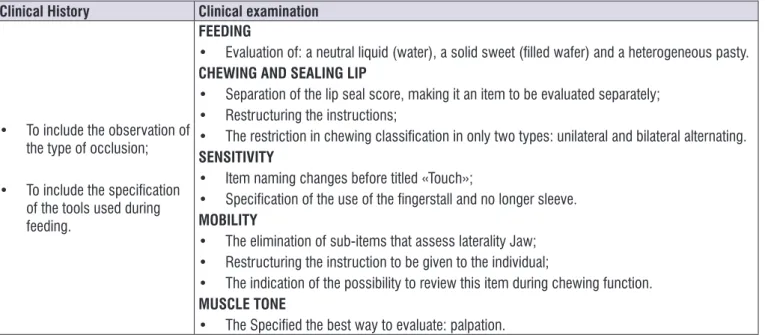
suggested and accepted by the authors are described in Figure 1.
After the restructuring of the protocol was part of adapting a pre-test: two trained speech therapists
applied the instrument in three individuals, one CP and
feeding dificulty, and two individuals with CP without feeding dificulties. From the need among pre-test, there were minor modiications related to: restructuring of questions to ask the mother during the interview of
the clinical history, and structural formatting protocol, including spaces for notes.
During the prior application of the Protocol, it found
that this screening tool for feeding dificulties can be
performed in a session of 40 to 60 minutes and requires
little food for analyzing food issues. The inal version was titled «Feeding Dificulties Screening Protocol» and
is presented in Annex 1.
For realization of feeding screening, we selected two types of food for each consistency, namely: water
and passion fruit juice for the liquid consistency and
the sour taste; French bread and illed wafer for solid consistency and salty and sweet lavors; porridge industrialized salt, with or without crushed biscuit lour; and yoghurt type Petit Suisse, with and without corn lakes to the pasty consistency both heterogeneous and homogeneous and salty lavors and sweet.
Food should be offered the tools which the individual
is used to use daily to prevent adverse reactions to intraoral touch unusual items. As for the amount of food, it is expected that the individual can consume a
minimal amount of food: a sip of water and a passion fruit juice; a bite of French bread and the stuffed sweet wafer; a spoonful of salt in porridge homogeneous
consistency, one in heterogeneous consistency, one for the homogeneous consistency of the yoghurt and the other for the same food in heterogeneous consis-tency, as proposed above.
From the supply of these foods, the observation of the intake and response of the individual to the different characteristics of food and given the corresponding score is performed. The maximum score (one point) the
task occurs when the person eats the food in question
and his response is considered typical. If the individual has ingested food, but presented a hyper or hiporres-posta, the item is not scored (zero point). The same is
true for the individual who does not eat food.
Hyperresponsiveness are considered the following
reactions: nausea, rejection of food (like spitting or not
swallow) and behavioral negative responses, such as turn away, walk away, pushing the hand of the appraiser
and / or grimacing, suggesting discomfort. As hyporre-sponsiveness are considered: the absence of any kind of orofacial reaction against a strong stimulus intensity.
Such responses (exacerbated, decreased or refusal) receive the same score as they are not expected and
thus considered in this study, feeding dificulty charac
-teristics, therefore has equal weight in the score. With regard to chewing and sealing Lip item from the
food offered, this screening protocol aims to analyze
aspects related to the incision and the chewing pattern,
and the presence or absence of the lip seal.
Clinical History Clinical examination
• To include the observation of
the type of occlusion;
• To include the speciication
of the tools used during feeding.
FEEDING
• Evaluation of: a neutral liquid (water), a solid sweet (illed wafer) and a heterogeneous pasty.
CHEWING AND SEALING LIP
• Separation of the lip seal score, making it an item to be evaluated separately; • Restructuring the instructions;
• The restriction in chewing classiication in only two types: unilateral and bilateral alternating.
SENSITIVITY
• Item naming changes before titled «Touch»;
• Speciication of the use of the ingerstall and no longer sleeve.
MOBILITY
• The elimination of sub-items that assess laterality Jaw; • Restructuring the instruction to be given to the individual;
• The indication of the possibility to review this item during chewing function.
MUSCLE TONE
• The Speciied the best way to evaluate: palpation.
Figure 1. Description of the changes suggested by the judges after protocol analysis
DISCUSSION
In clinical practice it has been observed incidence
of individuals with CP who have feeding dificulties, whether only one selective or total denial of food. Thus,
from the intention of improving the quality of therapeutic
intervention in individuals with CP, it was necessary to draw up a protocol specifying the feeding dificulties.
This screening protocol of feeding dificulties followed the criteria of adaptation of instruments
described in the literature8,12. A formal instrument with
careful semantic adaptation is important to ensure the error reduction interpretation by both the professional
who is analyzing the performance of an individual, as a
part of the individuals12.
Although this instrument has been built with the aim of analyzing the possible presence of feeding dificulties in individuals with PC, it is also designed for children with other diseases or healthy without restriction in
terms of age.
The proposed protocol in this study contains a Clinical History, composed of questions related to food and tasks related to the acceptance and reaction to
foods with different lavors and textures, the chewing
and lip seal. In addition to tests that examine the reaction to the extra touch and intraoral, mobility and muscle tone of speech organs and the breathing mode.
During the preparation of Clinical History questions
were selected concerning feeding functions and their
structures, such as breathing and dental occlusion.
Respiratory changes also common in children with CP
due to the global motor changes13.
In relation to breath, lies in the literature that the smell and taste are closely related, nasal obstruction leads to reduction of smell, reducing appetite, for the occurrence of some nutritional disorders14.
Issues related to dental occlusion were included
because studies refer to malocclusion as one of the responsible for the improper functioning of orofacial
functions, causing interference in chewing15.
Questions related to chewing food and analyzed
the individual, directed to the caregiver, are also part of the clinical history of the protocol proposed here. They
show the consistency, texture and taste of food that the individual supports and preferring to eat, or otherwise, it is dificult in literature reports to feed the infant devel -opment16. These issues contain information that are
also in the clinical examination in the form of tasks to
be analyzed by the evaluator, the purpose of which
are repeated to check the perception of the caregiver
towards chewing and feeding of the child.
The literature reports that the sensory characteristics of a food is very important to determine their accept-ability17, so the need to properly investigate both the
intake, the reaction of children to foods with different lavors18, textures, consistencies17.
Studies show that sour or too strong lavor are deter -mining factors for individuals reject certain foods. But
the sweet taste is the main factor that determines the
preference to certain foods19. Therefore, it is important
characteristics. In the proposed protocol in this study in addition to these characteristics, also part of the analysis of the salty taste, since it is the daily food
predominance of this lavor.
Authors say that the texture of the food has great
inluence on the acceptance of food standards for
children17. When a child presents feeding dificulties,
it may show signs of hypersensitivity, or the central
nervous system can not control the sensory properties4.
For this reason, we chose to evaluate different textures
of the same consistency, in this case the pasty
consis-tency with homogeneous and heterogeneous texture.
Children aged around three to six years tend to
eat fewer foods consistent with sound-soft texture and
predominantly pasty20. Thus, there was the need to
include in the protocol proposed notice of acceptance and reaction to different textures of foods, such as solid, liquid and pasty.
The data relating to the preference of children by
eating less consistent food are worrisome, because this kind of food does not demand great work of muscles related to chewing and may lead to loss of muscle
strength21. Thus, food-type hard, dry and ibrous are
important to stimulate chewing learning22. Also for this
reason, they have been incorporated into the protocol
foods with different characteristics: texture, lavor and
consistency.
According to the literature, the alternating bilateral
chewing allows a uniform distribution of masticatory
forces23, leading to a sync and functional muscular
balance from the rotation of the working side and the
muscle relaxing24. Unilateral chewing causes muscular
changes, affecting the performance of the entire masti-catory system25. Based on these data, and knowing the
importance of chewing to the stomatognathic system was included in the protocol masticatory type checking the assessed individual. In view of the condition being
assessed by the protocol and the alternating unilateral
and bilateral types, research absence of chewing was
included, ie only in the presence of food kneading.
It was decided to include the observation of the presence or absence of the initial phase of chewing,
the incision, due to the great importance of this phase
for chewing. It is during the incision arriving information
consistency, temperature and size of the food, to process the subsequent phases26.
The sealing lip during chewing may be absent due
to respiratory changes that can be found commonly in
subjects with CP. Mouth breathing tends to modify the
functioning and the stomatognathic system structures,
so the individual can not properly chew food due to the
need to breath27. For this reason it was also emphasized
in the study protocol to observe the lip seal related to
chewing.
The presence of atypical muscle contractions and
noise during chewing can be a consequence of any
deviation in the masticatory process, either by changes in the temporomandibular joint or related muscles28.
For this fact, it was also inserted into the protocol a topic for veriication of these factors.
The Sensitivity related task, which suggests
checking the individual’s reaction to the touch intra and
extra oral region, and analyze what the behavior. In clinical practice, it is known that a considerable number of individuals with sensorimotor disorders respond to this kind of stimulus with a reaction of discomfort,
this is due to disorganization in the sensory system29,
ie the ability of the central nervous system to capture, process and use sensory information. These changes
can lead a simple touch to generate a wealth of infor
-mation to the nervous system, so the individual will
be easily disturbed, reacting to stimulus unexpected
way29. It is believed that the observed hypersensitivity
may interfere acceptance and handling of food on
the oral cavity, bringing forward the food unpleasant
experience, and provide increased episodes of nausea and / or food discomfort4.
Regarding mobility, tasks were selected that are
able to verify the characteristics of the movements of
the lips, tongue, cheeks and jaw. It is known that the
masticatory function is very complex, and its smooth operation involves the interaction of said structures30.
The quality of the muscle tone of chewing was also evaluated, due to its importance for proper chewing
function 31.
According to the American Speech-Language-Hearing Association (ASHA), motor-oral alteration can
compromise breathing and chewing functions, deining
this change like oral myofunctional disorder that include abnormal anterior placement of the tongue, lip
incompetence, which may include phonoarticulatory changes, inluencing the chewing process and as a result, interfering with the feeding process32.
The analysis of expert judges (Figure 1) allowed an agreement on the stay, withdrawal or modiication
of protocol evidence. This analysis contributed to a
more speciic protocol to assist in feeding dificulty of
screening, in addition to promoting best adaptations for
The changes made to the protocol along the semantic validation (Figure 1) aimed at an easy and
complete analysis with selected tasks and adapted for individuals with CP. As an example, there is the use of low cost food and easy acceptance by all patients,
questions about the functions related to food and its structures like dental occlusion and breathing.
The elaborate instruments in accordance with the
criterion that the better the individual’s performance,
the higher your score, which is a sliding scale, ranging
from 0 to 2 points, depending on the task at hand and the expected result to normal. Despite scoring scale
not be comprehensive as in other instruments widely
used for oral myofunctional evaluation8,10, there was
a positive assessment of judges on the scale used in
this instrument and also there were no dificulties or
limitations applicable during the pre-test conducted.
The literature has protocols whose score shows little variation. However, it was possible to perform validation and widespread use, such as the Nordic Orofacial Test
- Screening33.
This protocol, as a screening tool, is rapid, which allows the professional expert briely to obtain a more
accurate diagnosis.
Considering that a screening tool selects people most likely to present particular disease in question
from a general population, and that when an individual show signs and symptoms of a particular disease, it must be subjected to a full and speciic evaluation34.It is
suggested that future studies are undertaken in larger populations to be tested and psychometric character-istics of validity of this instrument.
CONCLUSION
In this study, the Food Dificulties Screening Protocol was proposed, a screening tool for individuals with CP. The methods used for their adaptation enabled the creation of an instrument with lower risk of interpre -tation errors and tasks that analyze the risk of feeding
dificulties, trying to specify the change of the individual with CP.
REFERENCES
1. Polan HJ, Kaplan MD, Kessler DB, Shindledecker
R, Newmark M, Stern DN et al. Psychopathology in mothers of children with failure to thrive. Infant
Ment. Health J. 1991;12(1):55-64.
2. Palmer S, Horn S. Feeding problems in children. In: Palmer S, Ekvall S (eds.) Pediatric nutrition in
developmental disorders. Springield, Ill: Charles C.
Thomas, 1978. p.107-29.
3. Fontes BV, Morgan CM, Moraes DEB. Transtornos alimentares na infância. In: Claudino AM, Zanella MT, organizadores. Transtornos Alimentares e Obesidade. Barueri: Manole, 2005. p.79-87.
4. Silvério CC, Sant’Anna TP, Oliveira MF. Ocorrência
de diiculdade alimentar em crianças com
mielomeningocele. Rev CEFAC. 2005;7(1):75-81. 5. Piovesana AMSG. Paralisia Cerebral: Contribuições
do Estudo por Imagem. In: Souza AMC, Ferraretto I (organizadores). Paralisia Cerebral – Aspectos Práticos. São Paulo: Frôntis Editorial, 1998. p.9- 37. 6. Cesa CC, Ecco CT, Bersch R, Chiappetta ALML.
Desempenho das funções e relexos orais em
crianças com encefalopatia crônica infantil do tipo quadriparesia espástica. Rev CEFAC. 2004;6(2):158-63.
7. Felício CM. Desordem temporomandibular: avaliação e casos clínicos. In: Junqueira P, Dauden MTBC. Aspectos atuais em terapia fonoaudiológica. São Paulo: Pancast; 2002. p. 33-63.
8. Genaro KF, Berretin-Felix G, Rehder MIBC, Marchesan IQ. Protocolo Miofuncional Orofacial - Protocolo MBGR. Rev CEFAC. 2009;11(2):237-55. 9. Dunn W. The Sensory Proile: User’s manual. San
Antonio, TX: Psychological Corporation, 1999. 10. Felício CM, Ferreira CL. Protocol of orofacial
myofunctional evaluation with scores. Int J Pediatr Otorhinolaryngol. 2008;72:367-75.
11. Junqueira P. Aspectos sensório-orais e suas interferências no comportamento alimentar da criança. 2° Congresso Internacional Sabará de Especialidades Pediátricas; 2014 Set 12-14; São Paulo, SP. São Paulo: Blucher; 2014.
12. Radanovic M, Mansur LL. Performance of a Brazilian population sample in the Boston diagnostic aphasia examination: a pilot study. Braz J Med Biol Res. 2002;35:305-17.
13. Vivone GP, Tavares MMM, Bartolomeu RS, Nemr K, Chiappetta ALML. Análise da consistência alimentar e tempo de deglutição em crianças com paralisia cerebral tetraplégica espástica. Rev CEFAC. 2007;9(4):504-51.
14. Klein E. Obstrução nasal: um obstáculo à vida. Rev Bras Otorrinolaringol. 1987;53(4):106-10.
em fonoaudiologia. São Paulo: Revinter, 2003. p.279-87.
16. Kachani AT, Abreu CLM, Lisboa SBH, Fisberg M. Seletividade Alimentar da Criança. Pediatria. 2005;27(1):48-60.
17. Cunha CS, Castro CF, Pires CV, Pires ISC, Halboth NV, Miranda LS. Inluence of the texture on the acceptance of oat creams by people from different ages. Alim.Nutr. 2009;20(4):573-80.
18. Battochio JR, Cardoso JMP, Kikuchi M, Macchione
M, Modolo JS, Paixão AL et al. Peril sensorial
de pão de forma integral. Ciênc Tecnol Alim. 2006;26(2):428-33.
19. Valle JMN, Euclydes MP. A formação dos hábitos alimentares na infância: uma revisão de alguns aspectos abordados na literatura nos últimos dez anos. Rev APS. 2007;10(1):1-20.
20. Medeiros JS, Maciel CRB, Motta AR. Levantamento dos hábitos alimentares de crianças de 4 a 6 anos: base para um trabalho preventivo-comunitário. Rev CEFAC. 2005;7(2):198-204.
21. Oliveira AS, Silva VAP, Alves JJ, Fagundes D, Pires ISC, Miranda LC. Eating habits of preschoolers: the
inluence of mothers and breastfeeding. Alim. Nutr.
2012;23(3):377-86.
22. Franco MLZ. Mastigação bilateral: mito ou realidade. Rev Soc Bras Fonoaudiol. 1998;2(3):35-42.
23. Rahal A, Gofi-Gomes MVS. Avaliação
eletromiográica do músculo masseter em pessoas
com paralisia facial periférica de longa duração. Rev CEFAC. 2007;9(2):207-12.
24. Agostini TM, Santana CAM. Aspectos da mastigação em crianças com dentição mista. Rev CEFAC. 2003;5(3):259-63.
25. Coelho Jr PGP. O estudo da importância da mastigação para a manutenção do equilíbrio do sistema estomatognático [tese]. Contagem (MG): Instituto de ciências da saúde - FUNORTE / SOEBRÁS; 2011.
26. Tagliaro ML, Calvi CL, Chiappetta ALML. A fase de incisão no processo da mastigação: enfoque clínico. Rev CEFAC. 2004;6(1):24-8.
27. Silva MAA, Natalini V, Ramires RR, Ferreira LP. Análise comparativa da mastigação de crianças respiradoras nasais e orais com dentição decídua. Rev CEFAC. 2007;9(2):190-8.
28. Mancini MC, Alves ACM, Schaper C, Figueiredo EM, Sampaio RF, Coelho ZAC et al. Gravidade da paralisia cerebral e desempenho funcional. Rev Bras Fisioter. 2004;8(3):253-60.
29. Weiss-Salinas D. Sensory defensiveness: a theory of its effect on breastfeeding. J Hum Lact. 2001;17:145-51.
30. Whitaker ME, Trindade Júnior AS, Genaro KF. Proposta de Protocolo de avaliação clínica da função mastigatória. Rev CEFAC. 2009;11(3):311-23.
31. Felício CM. Fonoaudiologia aplicada à casos odontológicos: motricidade oral e audiologia. 1ª Ed. São Paulo: Pandcast; 1999.
32. American Speech-Language-Hearing Association. The role of the speech-language pathologist in assessment and management of oral myofunctional disorders. Ad Hoc Committee on Labial-Lingual Posturing Function. ASHA Suppl. 1991;33(5):7. 33. Bakke M, Bergendal B, McAllister A, Sjogreen
L, Asten P. Development and evaluation of a comprehensive screening for orofacial dysfunction.
Swed Dent J. 2007;31(2):75-84.
34. Goulart BNG, Chiari BM. Avaliação clínica fonoaudiológica, integralidade e humanização:
perspectivas gerais e contribuições para relexão.
Annex 1 - Feeding Dificulties Screening Protocol
Feeding Dificulties Screening Protocol
Conde, M.O.; Tessicini, G.; Bittar, D.P.; Soares-Ishigaki, E.C.S.
CLINICAL HISTORY
Name: ______________________________________________________________________
ID: ___________________ DB: ___ / ___ / ___ Age: _______________ Exam date: ___ / ___ / ___ Informer: ______________________
Diagnosis: _____________________________________ Motor Level (GMFCS): ________ Complaint: ______________________________________________________________________
Brief History (Family history, Complications during pregnancy and childbirth):
Medicines: RGE ( )
Breathing problems:
Frequent colds ( ) Tonsillitis ( ) Nasal obstruction ( ) Other:____________ Posture of the lips: Parted ( ) Closed ( )
Breast-feeding
Breast: yes ( ) no ( ) From _______ months to _______________ Bottle: yes ( ) no ( ) From _______ months to ________________ Increased nipples: yes ( ) no ( )
Tools for feeding:
( ) glass. Type: _____________ ( ) straw ( ) spoon. Type: ____________ ( ) fork
Occlusion: Normal ( ) Altered: Open: ( ) anterior ( ) lateral
( ) Butt ( ) Cross
CHEWING
Instruction – The evaluator will ask the responsible for the patient: “You realize that your son ...”
YES NO SOMETIMES
Need liquid to facilitate the chewing Feel any pain or discomfort in chewing Make a lot of effort to chew
Exhaust food during chewing Observations:
FEEDING
Instruction - The evaluator will ask the responsible for the patient: “You see his son ...”
YES NO SOMETIMES
Dificulty drinking liquid in the cup
Dificulty in accepting different consistencies Dificulty eating fruit
Dificulty eating vegetables Dificulty eating greens
Dificulty eating meat
Dificulty eating or drinking milk derivatives Dificulty eating foods with sugar
Dificulty in accepting different lavors
Dificulty in perceiving differences in the texture of the food Dificult to accept most foods
Dificulty in brushing teeth Dificulty in trying new foods
Dificulty notice of food remains on the lips Dificulty notice when the lips are wet Usually smell objects
Usually smell food
Dificulty accepting food with strong lavor (lemon, black pepper)
CLINICAL EXAM TONE
Instruction – The evaluator should touches lips, tongue and cheeks of the patient and check the tone of the structures.
Score – It is assigned a score of 1 if it is found suitable tone structure (normotonic); and a score of 0 if it is found increased or
decreased tone.
Normotonic Decreased tone Increased tone
Lips (1) (0) (0)
Tongue (1) (0) (0)
Cheeks (1) (0) (0)
TONE SCORE
SENSITIVITY
Instruction – Using inger cot, the evaluator will be expected to touch the locations described below.
Score – It is assigned a score of 1 if there is no overreaction (hyperresponsiveness) or very low reaction (hyporresponsiveness) to the
touch. A score of 0 is assigned if the patient presents overreaction (hyperresponsiveness), greatly reduced or absent touch.
Local Reaction to the touch
Typical Hyperresponsiveness Hyporresponsiveness
Right Extra Oral (cheek) (1) (0) (0)
Left Extra Oral (cheek) (1) (0) (0)
Right Tongue – lateral (the forward movement
from the middle of the tongue) (1) (0) (0)
Left Tongue – lateral (the forward movement
from the middle of the tongue) (1) (0) (0)
Right Intra Oral (inner cheeks) (1) (0) (0)
Left Intra Oral (inner cheeks) (1) (0) (0)
Gingiva: top right (from the upper labial
frenulum) (1) (0) (0)
Gingiva: top left (from the upper labial
frenulum) (1) (0) (0)
Lower right gingiva (from the upper labial
frenulum) (1) (0) (0)
Lower left gingiva (from the upper labial
frenulum) (1) (0) (0)
MOBILITY
Instruction – The evaluator must ask the patient verbally, by gesture or if necessary with tactile track, which perform the movements
below, whenever possible: «You should ...». The required movements can also be observed in the chewing function.
Score – The score 0 is given when the patient does not perform the movement in question and score 1 is assigned whenever the
patient perform the movement.
LIPS
“...Make a beak “(protrusion) (1) (0)
“...Give a smile “(retraction) (1) (0)
“...Make a beak on this side “(Right Sides) (1) (0)
“...Make a beak of this other side “(Left Sides) (1) (0)
LIPS MOBILITY SCORE
TONGUE
“...put out his tongue with mouth open “(protrusion) (1) (0)
“...put the tongue in the back of the mouth with open mouth “(retraction) (1) (0)
“...put the tongue on this side with an open mouth “(Right Sides) (1) (0)
“...put the tongue of this other side with an open mouth “(Left Sides) (1) (0)
“...touch the tip of the tongue on the upper lip with an open mouth “(Raise) (1) (0)
“...touch the tip of the tongue on the lower lip with an open mouth “(Lower) (1) (0)
TONGUE MOBILITY SCORE
CHEEKS
“...ill the cheeks of the air “(inlate) (1) (0)
“...put the cheeks inside “(suction) (1) (0)
“...ill the air cheek and take it from one cheek to the other “(lateralized) (1) (0)
CHEEKS MOBILITY SCORE
JAW
“...open your mouth “(Lower) (1) (0)
“...close your mouth now “(Raise) (1) (0)
JAW MOBILITY SCORE MOBILITY TOTAL SCORE
FEEDING
Instruction – The evaluator must offer the patient the following foods: water, passion fruit juice, stuffed sweet biscuits, French toast,
yoghurt type Petit Suisse or fruit baby food with and without corn lakes, salt porridge with and without cookie salted lour and observe the patient’s reaction.
Score – It is assigned a score of 1 if the patient ingest the food in question and there is no overreaction (hyperresponsiveness) or
very low (hyporresponsiveness) to food. A score of 0 is assigned if the patient does not accept the food in question, and if there is overreaction (hyperresponsiveness) or very low (hyporresponsiveness) to food.
Acceptance
Feed forms
Ingest Food reaction
Yes (1)
No
(0) Typical Hyperresponsiveness Hyporresponsiveness
Liquid (1) (0) (1) (0) (0)
Pasty Homogeneous (1) (0) (1) (0) (0)
Pasty Heterogeneous (1) (0) (1) (0) (0)
Solid (1) (0) (1) (0) (0)
Salty (1) (0) (1) (0) (0)
Sweet (1) (0) (1) (0) (0)
Sour (1) (0) (1) (0) (0)
CHEWING AND SEALING LIP
Instruction – The evaluator must offer French bread to the patient, and observe the pattern shown chewing, as well as the presence or
absence of noise and muscle contractions.
Score – The score 2 will be assigned only to patients presenting bilateral chewing pattern; A score of 1 should be given to the patient
who develops food incision, unilateral chewing pattern, and when it is observed the presence of lip seal and absence of noise, atypical muscle contractions and kneading. In the absence of lip sealing and presence of noise, atypical muscle contractions and kneading, the score should be 0.
CHEWING SEALING LIP
Incision (1) (0)
(1) (0)
Bilateral alternate (2)
Unilateral (1)
Noise (1) (0)
Atypical muscle contractions (1) (0)
Kneading (1) (0)
CHEWING SCORE SEALING LIP SCORE
BREATHING
Instruction – The evaluator should observe during the tasks requested that the respiratory pattern presented by the individual. Score – It is assigned a score of 2 when checked nasal breathing, one in the case of mixed breathing mode and 0 to oral breathing
mode.
Nasal Mixed Breathing Oral
(2) (1) (0)