STRESSING FACTORS AND COPING STRATEGIES USED BY ONCOLOGY NURSES
Andrea Bezerra Rodrigues1 Eliane Corrêa Chaves2
Rodrigues AB, Chaves EC. Stressing factors and coping strategies used by oncology nurses. Rev Latino-am Enfermagem 2008 janeiro-fevereiro; 16(1):24-28.
In the oncology specialty, many factors can result in occupational stress in nursing professionals. As an attempt to controlling this situation, individuals may use coping strategies. Coping is a cognitive and behavioral effort one uses to face a stressful situation. The aims of this study were to identify the stressful factors regarding oncology nurses, and to verify what coping strategies they use. Two questionnaires were used: a demographic data inventory, designed by the researcher, and the Folkman and Lazarus coping strategies inventory. The results showed that the main stressful factors for oncology nurses are patient death (28.6%), emergency situations (16.9%), relationship issues with the nursing team (15.5%), and work-process situations (15.5%). In the studied population, the main coping strategy used was positive reappraisal.
DESCRIPTORS: adaptation, psychological; nursing; stress; medical oncology
FACTORES ESTRESANTES Y ESTRATEGIAS DE COPING UTILIZADAS POR LOS
ENFERMEROS QUE ACTÚAN EN ONCOLOGÍA
En la especialidad de Oncología son muchos los factores que pueden conducir al profesional de enfermería al estrés ocupacional. Para tratar de controlar esa situación, el individuo puede utilizar estrategias de coping, que es un esfuerzo cognitivo y de comportamiento utilizado frente a un evento que causa estrés. Los objetivos de este estudio fueron identificar los factores que causan estrés en los enfermeros que actúan en Oncología y verificar las estrategias de coping utilizadas por los mismos. Se utilizaron dos cuestionarios: uno para el inventario de datos demográficos construido por la autora y otro para el inventario de estrategias de coping de Folkman y Lazarus. Los resultados de la investigación muestran que los factores considerados más estresantes por los enfermeros de Oncología son: la muerte de los pacientes (28,6%), las situaciones de emergencia (16,9%), los problemas de relación dentro del equipo de enfermería (15,5%) y las situaciones relacionadas al proceso de trabajo (15,5%). En la población estudiada, la estrategia de coping más utilizada fue la de reevaluación positiva.
DESCRIPTORES: adaptación psicológica, enfermería; estrés; oncología médica
FATORES ESTRESSANTES E ESTRATÉGIAS DE COPING DOS ENFERMEIROS ATUANTES EM
ONCOLOGIA
Na especialidade oncologia, são muitos os fatores que podem conduzir o profissional de enfermagem ao stress ocupacional. Para tentar controlar essa situação, o indivíduo pode utilizar estratégias de coping, que é um esforço cognitivo e comportamental utilizado frente a evento estressor. Os objetivos desse estudo foram identificar os fatores estressantes para enfermeiros que atuam em oncologia e verificar as estratégias de coping utilizadas pelos mesmos. Foram utilizados dois questionários: um inventário de dados demográficos, construído pela autora, e o inventário de estratégias de coping de Folkman e Lazarus. Os resultados da pesquisa mostram que os fatores considerados mais estressantes para os enfermeiros de oncologia são: o óbito dos pacientes (28,6%), as situações de emergência (16,9%), os problemas de relacionamento com a equipe de enfermagem (15,5%) e as situações relacionadas ao processo de trabalho (15,5%). Na população estudada, a estratégia de coping mais utilizada foi a reavaliação positiva.
DESCRITORES: adaptação psicológica; enfermagem; estresse; oncologia
Disponible en castellano/Disponível em língua portuguesa SciELO Brasil www.scielo.br/rlae 1 RN, Specialist in Oncology Nursing, Doctoral Student, University of São Paulo School of Nursing, Faculty, Hospital Israelita Albert Einstein School of Nursing, Brasil,
INTRODUCTION
D
ue to the complexity involved in caring for oncology patients, several studies have addressedthe problems that the involved health care
professionals have to face, especially concerning the
nursing team.
Nursing practice in the oncology specialty
r e q u i r e s g r e a t e r m e n t a l c o n t r o l a n d a c t i v i t y
compared to other areas, since it involves dealing
with a serious disease, caring for terminal patients
with no available treatment, the need for intensive
and prolonged care, and becoming very close with
t h e p a t i e n t ’s f a m i l y. T h u s , t h e s e h e a l t h c a r e
professionals experience emotional situations that
can be quite wearisome, and such factors can cause
occupational stress(1-3).
In the attempt to control a stressful situation,
individuals can use coping strategies. Coping is
referred to as “a cognitive and behavioral effort one
makes to take control over, tolerate, or reduce
external and internal demands”. According to those
authors, every event is subject to a cognitive
evaluation by the subject who experiences it. That
evaluation is a process of categorizing an encounter,
focused on its purpose or meaning(4).
The form by which individuals choose their
coping strategies is determined, in part, by their
internal and external resources, which include health,
beliefs, responsibility, support, social skills, and
material resources.
From a cognitivist perspective, a model has
b e e n p r o p o s e d , w h i c h d i v i d e s c o p i n g i n t w o
functional categories: problem- focused coping, and
emotion-focused coping. In the former, there is a
s e a r c h f o r s t r a t e g i e s d e r i v e d f r o m d e f e n s i v e
p r o c e s s e s , l i k e a vo i d a n c e , m o v i n g a wa y, a n d
seeking positive values in negative events as a form
of reducing the emotional relevance of the stressor.
In problem-focused coping, on the other hand, one
tries to define the problem, searching for alternative
solutions and choosing among them(4). There are
eight coping factors: confrontation, self-control,
social support, responsibility acceptance,
escape-a v o i d escape-a n c e , p r o b l e m s o l v i n g , escape-a n d p o s i t i v e
reappraisal.
The aims of the present study are to identify
the stressful factors for nurses working in oncology
and verify what coping strategies they use.
METHOD
This is a descriptive-exploratory study using
quantitative approach resources. The research was
carried out in Oncology wards of five large-scale
hospitals located in the city of Sao Paulo. The study
population consisted of 77 nurses with at least one
year of practice. To meet the objectives,
self-administered questionnaires were used. The first
questionnaire is a demographic data inventory
designed by the author, and the second is the Folkman
and Lazarus Coping Strategies Inventory, adapted for
the Portuguese language(5).
The Folkman and Lazarus Coping Strategies
Inventory contains 66 items about thoughts and
actions that people use to deal with internal and
external demands of a specific stressful event,
besides ‘distractive’ questions that are not scored
on the conversion scale. All questions are scored
using the Likert scale, ranging from 0 - I did not
use this strategy; 1 - I used it a little; 2 - I used it;
3 - I used it very much. The scale consists of eight
d i f f e r e n t ‘ f a c t o r s ’ s u g g e s t e d b y t h e f a c t o r i a l
analysis: confrontation, withdrawal, self-control,
social support, responsibility acceptance,
escape-a v o i d escape-a n c e , p r o b l e m s o l v i n g , escape-a n d p o s i t i v e
reappraisal.
The research was performed after being
a p p r o v e d b y t h e i n s t i t u t i o n s ’ r e v i e w b o a r d s ,
receiving authorization from the hospitals’ managers,
a n d o b t a i n i n g w r i t t e n c o n s e n t f r o m a l l t h e
participants.
The interviewees were asked to think about
a professional situation they have experienced in a
typical workweek, which caused worry and stress.
The referred week had to be, specifically, the week
before the interview. Next, the nurses filled out the
Coping Strategies Inventory, in which they scored
each phrase according to how they dealt with the
situation they described in the beginning of the
inventory.
After data collection, the information was
stored in a data bank using MS Excel 2002. Cronbach
Alpha Coefficient was used to verify the reliability of
the research instruments. The instrument was
considered reliable and with internal consistency for
RESULTS
Table 1 - Distribution of oncology nurses according to gender, age group, marital status, being an oncology
specialist, and choice to work in oncology. Sao Paulo,
2005
Table 3 - Distribution of oncology nurses according to
the stressful situation which they had to cope with.
Sao Paulo, 2005
It is noticed that the population is mainly
composed of women (94.8%), in the age group
31-40 years (50.6%). The prevalent marital status is
married (42.9%). Most participants are not oncology
specialists (70.1%), and they chose to work in
oncology (72.7%).
Table 2 - Cronbach alpha reliability coefficient for the coping factors. São Paulo, 2005
Cronbach alpha values above 0.70 were
considered appropriate. In this analysis, Cronbach
alpha values were appropriate for the following
factors: escape-avoidance (0.727), problem solving (0.732), and positive reappraisal (0.752),
as observed in Table 2.
e l b a i r a
V N %
r e d n e G e l a
M 4 5.2
e l a m e
F 73 94.8
) s r a e y ( p u o r g e g A 0 3 o t 0
2 26 33.8
0 4 o t 1
3 39 50.6
0 5 o t 1
4 12 15.6
s u t a t S l a t i r a M d e i r r a
M 33 42.9
) r e n t r a p o n ( e l g n i
S 31 40.3
) r e n t r a p h t i w ( e l g n i
S 10 12.9
d e c r o v i
D 3 3.9
t s i l a i c e p S y g o l o c n O s e
Y 23 29.9
o
N 54 70.1
y g o l o c n o n i k r o w o t e s o h C s e
Y 56 72.7
o
N 21 27.3
s r o t c a
F Numberofitems CronbachAlpha
) n o it a t n o r f n o C ( 1
F 6 0.541
) l a w a r d h t i W ( 2
F 6 0.556
) l o r t n o c -fl e S ( 3
F 7 0.617
) t r o p p u s l a i c o S ( 4
F 6 0.530
) e c n a t p e c c a y t il i b i s n o p s e R ( 5
F 4 0.610
) e c n a d i o v a -e p a c s E ( 6
F 8 0.727
) g n i v l o s m e l b o r P ( 7
F 6 0.732
) l a s i a r p p a e r e v it i s o P ( 8
F 7 0.752
Table 3 outlines the stressful situation
described by the nurses, the number of nurses that
perceive that situation as a stressor, and the respective
percentage.
The main stressful situations that mobilize the
nurses toward coping are patient death (28.6%),
emergency situations (16.9%), relationship issues with
the nursing team (16.9%), and work-process situations
(15.5%).
A m o n g t h e e m e r g e n c y s i t u a t i o n s , t h e
n u r s e s r e p o r t e d c a r d i o r e s p i r a t o r y a r r e s t ,
a n a p h y l a c t i c r e a c t i o n s d u r i n g t h e u s e o f
chemotherapeutics, and cases when the patients’
condition worsens. Regarding the issues involving
the nursing team, the nurses reported situations of
arguments about some of his or her conducts that
were not accepted by the team, and how the work
shifts were determined.
Table 4 - Distribution of the scores for coping factors
presented by the nurses. São Paulo, 2005
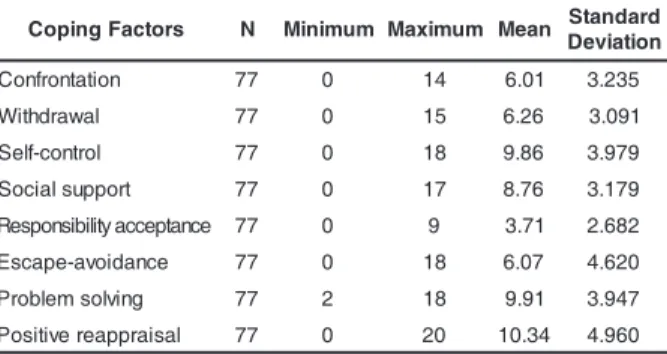
It is observed that the coping strategy most
used by the nurses is positive reappraisal (10.34),
followed by problem solving (9.91), and self-control
(9.86). However, in this study, the self-control strategy
did not show an appropriate Cronbach Alpha value
(0.617). The least used coping strategy is responsibility
acceptance. n o i t a u t i S l u f s s e r t
S N %
h t a e
D 22 28.6
y c n e g r e m
E 13 16.9
m a e t g n i s r u n e h t h t i w p i h s n o it a l e
R 13 16.9
s s e c o r P k r o
W 12 15.5
y li m a f r o t n e it a p e h t h t i w p i h s n o it a l e
R 10 13.0
n a i c i s y h p e h t h t i w p i h s n o it a l e
R 7 9.1
l a t o
T 77 100
s r o t c a F g n i p o
C N Minimum Maximum Mean Standard n o i t a i v e D n o it a t n o r f n o
C 77 0 14 6.01 3.235
l a w a r d h t i
W 77 0 15 6.26 3.091
l o r t n o c -fl e
S 77 0 18 9.86 3.979
t r o p p u s l a i c o
S 77 0 17 8.76 3.179
e c n a t p e c c a y t il i b i s n o p s e
R 77 0 9 3.71 2.682
e c n a d i o v a -e p a c s
E 77 0 18 6.07 4.620
g n i v l o s m e l b o r
P 77 2 18 9.91 3.947
l a s i a r p p a e r e v it i s o
DISCUSSION
Oncology is a field full of particularities that
are often unknown by nurses, because they usually
do not receive any specific training in the field, since
most Brazilian universities do not approach
cancerology in the nursing undergraduate course.
Therefore, the ‘true’ choice for working in
oncology can occur after some professional
experience in the field. This was observed in the study
by Ramalho, performed with nurses who worked in a
specialized hospital for children with cancer, in Sao
Paulo. The nurses reported they feel special and have
divine protection to deal with ‘failure’ as a challenge(6). Though most nurses (72.7%) chose the
specialty, 70.1% do not have specific training in
oncology. This data is relevant because the specialty
implies several venous devices that are very specific,
particular protocols for each type of cancer, and
treatments like radiotherapy, chemotherapy, and
immunotherapy, which demand specific knowledge.
In most Brazilian universities, nursing undergraduate
course curricula do not include these subjects. For
this reason, professionals who wish to work in the
field search for specialization as soon as they
complete their undergraduate course. However, that
was not observed in this study.
In this study, most nurses working in
oncology do not have any specific training in the field.
These nurses probably acquired their knowledge while
developing their functions at work. It should be
considered that these professionals have worked in
oncology for an average of 72.7 months, so it would
be expected that there would be more oncology
specialist nurses.
The nurses in this study reported that the
situations that most generated stress at work were
patient death (28.6%), emergency situations (16.9%),
relationship issues with the nursing team (15.5%),
and work-process situations (15.5%).
Similar to this study, others have reported
situations that nurses commonly realize as being
stressful, such as the relationship with patients without
any treatment possibilities, patient death, unexpected
and new situations, inadequate preparation for the
role they have to perform, interpersonal conflicts,
personnel shortage, the delay to receive medical care,
and excessive workload(7-9).
Among the death situations reported by the
nurses, special emphasis was given to deaths of
children and adolescents. Six (27.2%) of the 20 nurses
reported these situations, and two nurses stated they
felt stressed with that death. The death of a child or
adolescent is interpreted as the interruption of their
biological cycle, and can cause feelings of
helplessness, frustration, sadness, and distress in the
health care team(10).
The referred relationship issues, whether
intradisciplinary, interdisciplinary, or with patients and
their relatives is worrisome because it permeates
every activity that nurses perform, concerning either
health care or management.
The activity of exchanging experiences, which
could provide a means for identification and reflection
about the professional practice in oncology, could be
hindered by the intra and interdisciplinary relationships
referred by the nurses.
All these factors, considered stressful for
nurses who work in oncology, should be considered
potential triggers of burn out, a syndrome characterized
by emotional distress, despersonalization, and feelings
of professional incompetence, which could even cause
the nurse to abandon the specialty. Specifically in
oncology, this is a very negative repercussion since
there is a scarcity of specialist nurses.
One concern regarding the consequences of
burn out is the perception that patients have about the
quality of the care they are receiving. This factor has
been researched and reported in a study performed
with 711 nurses. The study associated developing burn
out with the satisfaction of the care they provided to
605 patients hospitalized in 16 different hospital units.
In units where nurses presented emotional distress
and despersonalization, the patients reported to be less
satisfied with the quality of the care they received(11). Coping could be a form to avoid occupational
stress. However, the studied population mostly uses
the emotion-focused coping, mainly the positive
reappraisal strategy. In this strategy, the person tries
to restructure the event with the aim to find aspects
that favor the event in some way. The person may
also talk to him/herself trying to reduce the severity
of the situation, and focus on the positive aspects of
the situation, as a way to reduce the emotional load
of the event, in the attempt to change the situation.
Another strategy used was the
problem-focused coping, i.e., problem solving. Some authors
refer that certain types of coping are more useful
than others, and emphasize that problem-focused
Some coping subscales, for example
responsibility acceptance and self-control, presented
low reliability for the studied population according to
Cronbach Alpha. These values range according to the
population, and it is worth emphasizing that coping
strategies can be learned.
Actually, there is no right or wrong coping
strategy. Coping strategies are either effective or
ineffective. Choosing a coping strategy is something
quite personal. While relaxation techniques work well
for some people, for others it can be rather stressful.
For this reason, respecting personal characteristics is
very important.
Further studies should be developed with
nurses working in oncology in order to evaluate the
correlations between coping strategies and variables
like personality, previous experiences, and social
support, factors that are implied in the use of coping
strategies.
This study shows that the most stressful
situations for the studied sample are patient death
(28.6%), emergency situations (16.9%), relationship
issues with the nursing team (15.5%), and
work-process situations (15.5%). The studied population
used emotion-focused coping the most, mainly
positive reappraisal.
REFERENCES
1. Chacón Roger M, Grau Abalo J. Burn out em enfermeros que brindan atención a pacientes oncológicos. Rev Cuba oncol 1997; 13(2):118-25.
2. Penson RT, Dignan FL, Canellos GP, Picard CL, Lynch TJ. Burn out: Caring for the caregivers. Oncologist 2000; (5):425-34. 3. Medland J, Howard-Ruben J, Whitaker E. Fostering psychosocial wellness in oncology nurses: addressing burn out and social support in the workplace. Oncol Nurs Forum 2004; 31(1):47-54.
4. Folkman S, Lazarus RS. Personal control and stress and coping processes: A theoretical analysis. Personality and Social Psychol 1984; 46:839-52.
5. Savóia MG, Santana PR, Mejias NP. Adaptação do inventário de estratégias de coping de Folkman e Lazarus para o português. Psicologia USP 1996; 7(1/2):183-201. 6. Ramalho MAN. Conhecendo as vivências dos cuidadores: estudo exploratório com profissionais da área de oncologia pediátrica. [dissertação]. São Paulo (SP): Escola de Ciências da Secretaria de Estado da Saúde de São Paulo; 2005. 7. Dewe JP. Identifying the causes on nurses stress: a survey of New Zeland nurses. Work Stress 1983; 1(1):15-24. 8. Barros ALBL, Humerez DC, Fakih FT, Michel JLM. Situações geradoras de ansiedade e estratégias para seu controle entre enfermeiras: estudo preliminar. Rev Latino-am Enfermagem 2003 setembro-outubro; 11(5):585-92.
9. Mendes AM, Linhares NJR. A prática do enfermeiro com pacientes da UTI: uma abordagem psicodinâmica. Rev Bras Enferm 1996; 49:267-80.
10. Spíndola T, Macedo MCS. A morte no hospital e seu significado para os profissionais. Rev Bras Enferm 1994; 47(2):108-17.
11. Leiter MP, Harvie P, Frizzell C. The correspondence of patient satisfaction and nurse burn out. Soc Sci 1998; 47(10):1611-17.
12. Jones MC, Johnston DW. Distress, stress and coping in first year student nurses. J Adv Nurs 1997; 26:475-82.