Cognitive integration of recognition information and additional cues
in memory-based decisions
Andreas Glöckner
∗Arndt Bröder
†Abstract
Glöckner and Bröder (2011) have shown that for 77.5% of their participants’ decision making behavior in deci-sions involving recognition information and explicitly provided additional cues could be better described by weighted-compensatory Parallel Constraint Satisfaction (PCS) Models than by non-weighted-compensatory strategies such as recognition heuristic (RH) or Take the Best (TTB). We investigate whether this predominance of PCS models also holds in memory-based decisions in which information retrieval is effortful and cognitively demanding. Decision strategies were analyzed using a maximum-likelihood strategy classification method, taking into account choices, response times and confidence ratings simultaneously. In contrast to the memory-based-RH hypothesis, results show that also in memory-based decisions for 62% of the participants behavior is best explained by a compensatory PCS model. There is, however, a slight increase in participants classified as users of the non-compensatory strategies RH and TTB (32%) compared to the previous study, mirroring other studies suggesting effects of costly retrieval.
Keywords: parallel constraint satisfaction, probabilistic inferences, recognition, strategy classification, decision time, confidence.
1
Introduction
How do people integrate different pieces of information to draw inferences about unknown criterion variables? For example, how do they infer which of two cities has the higher population? How do they infer which of two exotic bugs is more poisonous? Or how do they decide which of two desserts has more calories? In judgment and decision research, there is wide agreement that summary evalua-tions or inferences are arrived at by considering pieces of evidence (cues) or attributes of the decision objects (e.g., Brunswik, 1955; Doherty & Kurz, 1996; Karelaia & Hog-arth, 2008). For example, individuals will monitor the size as well as the cream and sugar content of a dessert to assess its calories. However, there is less agreement on how this cue information is processed. Whereas tradi-tional approaches assumed a full compensatory integration of available information (e.g., Brehmer, 1994), the sim-ple heuristics framework put forward by Gigerenzer, Todd, and the ABC Research Group (1999) challenged this view and pointed to various simple heuristics that operate only on subsets of available information. Despite their ignoring of information, these heuristics have been shown to be sur-prisingly accurate and robust in a variety of environments
Copyright: © 2013. The authors license this article under the terms of the Creative Commons Attribution 3.0 License.
∗University of Göttingen, Gosslerstrasse 14, D-37073 Göttingen,
Germany, Phone +49-551-39-33611, E-mail: [email protected] and Max Planck Institute for Research on Collective Goods, Bonn.
†University of Mannheim
(e.g., Czerlinski, Gigerenzer, & Goldstein, 1999; Davis-Stober, Dana, & Budescu, 2010; Hogarth & Karelaia, 2007; Todd & Gigerenzer, 2012). One particularly fru-gal strategy is the Recognition Heuristic (RH) promoted by Goldstein and Gigerenzer (2002). If you encounter two objects and recognize only one of them, then infer that the recognized object scores higher on the to-be-judged crite-rion. This simple strategy works well in domains where recognition is correlated with the criterion (e.g., city sizes, mountain heights, turnover rates of companies), and it has been proposed as a psychological model for these situa-tions. However, the non-compensatory nature of RH (peo-ple rely exclusively on recognition) has been debated ex-tensively (e.g., Bröder & Eichler, 2006; Hilbig, Erdfelder, & Pohl, 2010; Marewski, Pohl, & Vitouch, 2010, 2011a, 2011b; Newell, 2011; Newell & Fernandez, 2006; Pachur & Hertwig, 2006; Pachur, Todd, Gigerenzer, Schooler, & Goldstein, 2011, 2012; Pohl, 2011), and studies demon-strating the compensatory use of additional cue knowl-edge have helped to delineate the conditions under which RH might be used (see Goldstein & Gigerenzer, 2011; Gigerenzer, Hertwig & Pachur, 2011).
The experiment reported in this article pits the recog-nition heuristic and a sophisticated Take-The-Best (TTB) heuristic in a city size task against the parallel constraint satisfaction model (PCS; Glöckner & Betsch, 2008a) which assumes a compensatory automatic integration of all available cue information. It is an improved follow-up experiment to that of Glöckner and Bröder (2011), which had been criticized by Goldstein and Gigerenzer (2011)
for using an inferences from givens paradigm for which RH had not be formulated in the first place. Hence, the current experiment is important in extending the model comparison to memory-based inferences, thus fulfilling one major methodological desideratum for testing the RH against other models.
The current article is organized as follows: First, we will briefly summarize the debate on the alleged non-compensatory use of recognition information, including increasingly sophisticated methodological requirements. Second, we will introduce PCS and summarize the re-sults from Glöckner and Bröder (2011) as well as the criti-cism by Goldstein and Gigerenzer (2011). Finally, we will present the results of the new study and discuss how this further delineates RH’s range of applicability as a psycho-logical model.
2
Testing the recognition heuristic:
methodological debate
RH’s appeal as a cognitive model of inferences under par-tial ignorance stems from convincing demonstrations that it can be quite accurate in situations where the validity of the recognition cue is high (e.g., Goldstein & Gigerenzer, 2002). Further, all studies up to now examining the use of recognition information in situations with high recog-nition validity demonstrated that this meta-cognitive cue is indeed relied upon heavily in probabilistic inferences. The importance of this novel discovery notwithstanding, some stronger claims proposed by Goldstein and Gigeren-zer (2002) have been apprehended with more skepticism.
One example is the prediction concerning objects that “may be recognized for having a small criterion value. Yet even in such cases the recognition heuristic still pre-dicts that a recognized object will be chosen over an
unrecognized object.” (Goldstein & Gigerenzer, 2002,
p. 76). Oppenheimer (2003) took the challenge to test this claim by having people decide between unknown (fictitious) cities with Chinese-sounding names and well-known small cities, and he found that people did not fol-low the RH in these cases, thus falsifying this specific pre-diction which is therefore not seen as an essential feature of RH anymore (Gigerenzer, Hertwig, & Pachur, 2011, p. 59). Pachur and Hertwig (2006) termed these situations in which RH use is not expected as those involving “con-clusive criterion knowledge” (see also Pachur, Bröder, & Marewski, 2008; Hilbig, Pohl, & Bröder, 2009).
A more prominent controversial prediction is the non-compensatory use of the RH, described by Goldstein and Gigerenzer (2002, p. 82) as follows: “The recognition heuristic is a noncompensatory strategy: If one object is recognized and the other is not, then the inference is deter-mined; no other information about the recognized object
is searched for and, therefore, no other information can reverse the choice determined by recognition.” Numerous experiments have tested this claim and found counterev-idence (Bröder & Eichler, 2006; Hilbig & Pohl, 2009; Newell & Fernandez, 2006; Newell & Shanks, 2004; Pohl,
2006).1 These studies all suggested that some further
available cue information is integrated into the judgments in addition to or instead of mere recognition (although al-ternatives to RH are not directly tested). However, after the fact, most of these studies were criticized as violat-ing one or more alleged preconditions of RH. For exam-ple, some studies used a paradigm in which cue informa-tion was available on the computer screen during decision making (e.g., Newell & Shanks, 2004), whereas the RH is formulated for memory-based decisions. Other studies in-duced recognition by repeated confrontation with stimuli that had been unrecognized before (e.g., Bröder & Eich-ler, 2006; Newell & Shanks, 2004) rather than relying on “naturally” recognized objects. Or, the RH was tested in environments with demonstrably low recognition validity (Richter & Späth, 2006). Pachur et al. (2008) summarize and discuss several of these methodological caveats (see their Table 1). Their own Experiment 3 tried to come close to the ideal of a fair test of the RH by (a) avoiding induced object and cue knowledge, by (b) relying on memory-based decisions, (c) using the city size task with recog-nition validity known to be high, (d) controlling for the nature of additional cue knowledge, and (e) by not provid-ing cue information for unrecognized objects. As a depen-dent variable, Pachur et al. (2008) assessed the proportion of trials in which an individual made choices compatible with RH’s prediction (see Hilbig, 2010; Hilbig et al., 2010, for critiques). At the group level, Pachur et al. could show a significant influence of the nature and amount of cue knowledge participants had about the recognized cities, thus clearly ruling out that all participants used recogni-tion informarecogni-tion in a noncompensatory fashion. However, at the level of individual participants, 50% of them never departed from RH’s prediction and always chose the rec-ognized over the unrecrec-ognized object. Hence, at least 50% of Pachur et al.’s participants may have used the RH con-sistently.
However, the merely outcome-based adherence rate does not allow for strict conclusions about the cognitive processes involved: A perfect adherence to RH may occur even when a person considers all available cue informa-tion, but the available “conflicting” cues never suffice to overrule the weight of the recognition cue. Hence, the ad-herence rate at the individual level cannot tell us whether
1Note that there is further work that lead to ambiguous results.
someone used the RH even if it perfectly conforms to RH. On the other hand, even if adherence is not perfect, this could also be explained by unsystematic lapses if someone
consistently uses RH!2 Hence, adherence rates are only
ambiguous evidence for or against RH use (Hilbig, 2010).
3
The screen-based study by
Glöck-ner and Bröder (2011)
The ambiguity of mere choice outcome data in assess-ing decision strategies led Glöckner and Bröder (2011) to include reaction times and confidence ratings as fur-ther dependent variables in their experiment. Although different heuristics and strategies will often predict iden-tical choices (depending on the subjective weighting of cues), the different cognitive mechanisms can be differen-tiated by varying predictions for response times and con-fidence judgments across different item types. These de-pendent variables can be analyzed simultaneously in the Multiple-Measure Maximum Likelihood (MM-ML) ap-proach (Glöckner, 2009, 2010; Jekel, Nicklisch, & Glöck-ner, 2010) by determining the joint likelihood of choices, response times, and confidence judgments under each competing model. The MM-ML approach is described in detail in Appendix B. Participants are classified as users of the strategy which produces the highest joint likelihood of the data. However, to derive model predictions, it is necessary to have experimental control over the cues par-ticipants might possibly include in their judgments.
In their study, Glöckner and Bröder (2011) had German participants compare the population sizes for 16 medium-sized American cities in a full paired comparison (120 trials). Eight of these cities were mostly recognized, the other eight cities were mostly unrecognized according to a
pilot study.3 Both sets of cities comprised all possible
pat-terns of 3 binary cues (state capital, diocese, major univer-sity). Note that the cue values were veridical, so no invalid information was ever presented to the participants. During the decision phase, participants were provided with the city names along with the cue patterns (in a matrix for-mat containing “+” and “-” for positive and negative cue values, respectively). They chose one of the cities as the more populous, and response times were recorded. Each trial was followed by a confidence assessment.
The goal of the study by Glöckner and Bröder (2011) was to assess the strategies participants would use in such a task, pitting RH, TTB and two variants of the PCS model
2Of course, there must not be more lapses than compatible choices.
At the group level, however, the systematic effect demonstrated by Pachur et al. implies that at leastsomeparticipants must have integrated cue knowledge in their judgments (i.e., some of the remaining 50% that did not show total adherence with RH predictions).
3The actual model predictions were based on the individual
recogni-tion judgments of each participant, however.
against each other. For RH it was assumed that, in cases where one object is recognized and the other is not, peo-ple would rely exclusively on the recognition cue with-out considering further information. In case of a non-discriminating recognition cue, we expected that partic-ipants commence in a TTB-like manner (that is, going through the attributes in a fixed order of decreasing va-lidity until one of them discriminates the two options; see Gigerenzer & Goldstein, 1996). TTB in our version did not necessarily consult the recognition cue first, but it searched recognition and the other cues in order of de-creasing subjectively estimated validity until one discrim-inating cue was found on which the decision could be based. Hence, TTB and RH could both be applied to any comparison between cities, including decisions between cities that were both known or unknown and strategy pre-dictions could still differ. The PCS model by Glöckner and Betsch (2008a) is a network model in which activa-tion spreads through the network until a stable and consis-tent representation is found (e.g., Holyoak & Simon, 1999; McClelland & Rumelhart, 1981; Read, Vanman, & Miller, 1997; Simon, Snow, & Read, 2004; Thagard & Millgram, 1995). All cues are processed in parallel, and reaction time predictions can be derived from the number of cycles the network needs to settle in the stable state. In contrast to RH and TTB, PCS is a fully compensatory model which includes all available cue information. Confidence judg-ments are predicted by comparing the final activation of both option nodes.
Details about the network specifics are provided in Ap-pendix A, and recent developments can be found in sev-eral current publications (e.g., Betsch & Glöckner, 2010; Glöckner & Betsch, 2012; Glöckner & Bröder, 2011). Al-though the PCS model is an overarching single-strategy model, it allows for taking into account individual dif-ferences in sensitivity to cue validities. This difference can potentially be captured by a continuous parameter, but Glöckner and Bröder (2011) used the strategy in a low (i.e., PCS1) and a high (i.e., PCS2) cue-sensitivity
imple-mentation only.4
4More precisely, according to PCS individuals do not use
According to the MM-ML classification taking into ac-count the full set of 120 tasks (including comparisons be-tween two recognized or two unrecognized cities), 77.5% of the participants appeared to follow a PCS model (either PCS1 or PCS2), whereas the remaining 22.5% of partici-pants were classified as using one of the two noncompen-satory strategies RH or TTB. These results suggested that the noncompensatory strategies played only a minor role
in this paradigm. Note, however, that the result doesnot
imply that people did not rely on the recognition cue, but they did obviously not rely on it exclusively. The pattern of response times and confidence judgments across items favored the interpretation that the other cues were used as well. The results furthermore showed that it is useful to take individual differences in cue-sensitivity in PCS into account, given that participants were classified in both cat-egories (i.e., PCS1: 47.5% and PCS2: 30%).
In using natural recognition, stimuli without conclusive criterion knowledge, a domain with high recognition va-lidity, control of additional cue knowledge, and real (rather than artificial) stimuli, Glöckner’s and Bröder’s (2011) ex-periment fulfilled five of the eight ideal preconditions for-mulated by Pachur et al. (2008) that may foster the use of RH. In addition, the study aimed at model comparisons rather than just refuting claims of the RH. This was also a desideratum formulated by researchers favoring the fast and frugal heuristics approach (Marewski, Gaissmaier, et al., 2010; Marewski, Schooler, & Gigerenzer, 2010).
In order to derive precise model predictions, people were provided with cue values of the decision objects in the lab, also for the unrecognized cities. Furthermore, de-cisions were screen-based (i.e., cue information was pre-sented on screen) rather than memory-based. In the cur-rent study we again provide cue values for unrecognized objects and we will come back to this potential issue of debate in the discussion. The second point concerning screen-based decisions was criticized by Goldstein and Gigerenzer (2011) as the main weakness of the study, ne-glecting a major boundary condition of RH use. There-fore, the current study addresses this major shortcoming and investigated inference decisions from memory rather than from givens. This is also important because evidence reported by Glöckner and Hodges (2011) indicates that the prevalence of PCS seems to be reduced in memory-based decisions. In a similar vein, results from Söllner, Bröder, and Hilbig (2013) suggest that usually high prevalence rates for PCS in decisions from screen are reduced if the presentation formats differs from the matrix-like presenta-tion format used by Glöckner and Bröder (2011).
There-(2011), controlling for flexibility by comparing PCS with (the same) two parameters against two heuristics that (when considered jointly) have the same degree of flexibility. Future research might also involve more com-prehensive model comparisons including sensitivity parameter estima-tion for PCS on the level of participants and cross-predicestima-tion of choices (for a similar approach see e.g., Glöckner & Pachur, 2012).
fore, the current experiment is another important step in delineating the conditions of RH use. Using the common paradigm introduced by Bröder and Schiffer (2003b) to investigate memory-based decisions, we had participants learn cue values of different natural objects (American cities) by heart before the decision phase. Hence, partic-ipants might later retrieve this information from memory to reach their decisions, or they might rely solely on the recognition cue.
4
Experiment
We investigated the use of recognition information in in-ferences from memory. Thereby, the paradigm used in Glöckner and Bröder (2011) was extended by adding a learning phase in which participants acquired cue infor-mation. In the learning phase, participants were presented with three pieces of information about each of 16 Ameri-can cities, approximately half of them being known and
half of them being unknown. The same stimuli as in
Glöckner and Bröder (2011) were used. Afterwards par-ticipants decided in an incentivized task repeatedly which of two of these American cities has more inhabitants. For this decision they were not provided with any information but they could potentially retrieve information from mem-ory. However, they could also rely on recognition exclu-sively or search cues sequentially in accordance with TTB, ignoring some of the information (Bröder & Gaissmaier, 2007; but see also Bröder & Schiffer, 2003b; Bröder & Schiffer, 2006).
4.1
Method
4.1.1 Participants and design
Sixty-one students of different subjects took part in the experiment (37 female, mean age 23.8 years). The ex-periment lasted about 50 minutes. Participants received performance-contingent payment between 4.53 Euros and 11.83 Euros for the study. No between-subjects manipu-lation was used but the structure of the decision task was manipulated within subjects (see below).
4.1.2 Materials
We used the materials from Glöckner and Bröder (2011), which consisted of 2 sets of 8 mid-size US-American cities between 50.000 and 300.000 inhabitants which were
mainly known or mainly unknown, respectively.5 The
5The unknown cities were Hialeah, Carson City, Mobile, Tempe,
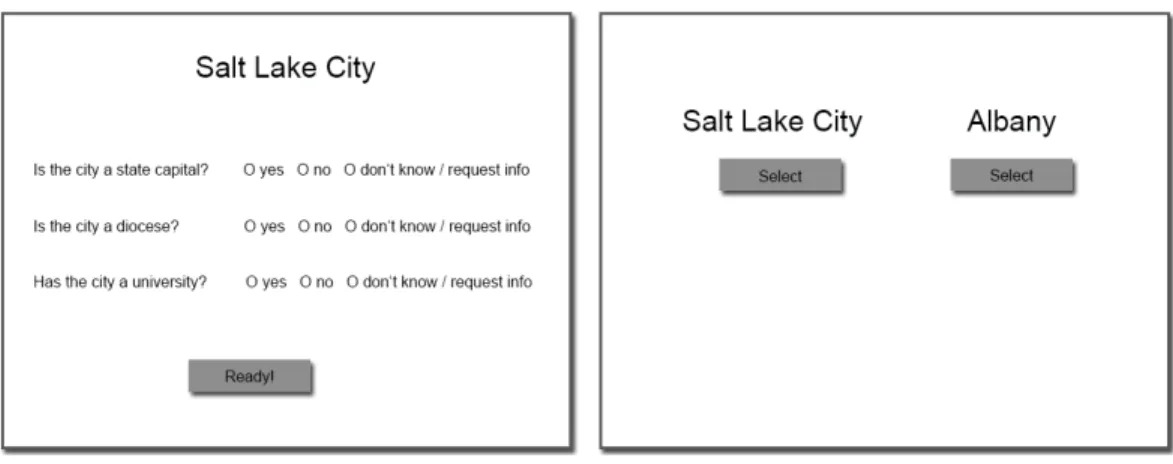
Figure 1: Learning task (left) and decision task (right).
cities were selected so that they had specific properties concerning the cues used in this study which were: a) is the city a state capital or not? b) is the city a diocese / does it have a bishop or not? c) does the city have a major uni-versity (with more than 4000 students) or not? Cities were selected so that they represented all eight possible (i.e.,
23) cue combinations for known cities as well as for
un-known cities. The 16 times 3 (= 48) pieces of information for the cities were learned in the learning phase. All 16 cities were compared to each other in the main experiment resulting in 120 decision tasks.
4.1.3 Procedure
The learning phase and the decision phase were presented to the participants as two separate experiments. Partici-pants were first informed only about an incentivized task to learn information about American cities. They were informed about the decision tasks only after they had suc-cessfully completed this learning phase. Participants were informed that it would take several learning trials to reach the threshold of 90% correct knowledge. Each trial con-sisted of a learning part and a test part. In the learning part the 16 cities were presented in random order and the par-ticipants could ask for information about each cue value or directly indicate the cue values. Only after all three pieces of information for one city were indicated correctly was the next city shown. In the test phase all cities were presented in random order, the participants indicated each cue value and received feedback whether the values were correct. At the end of the test phase participants received feedback about their learning performance. If the perfor-mance was above 90% correct they continued with the test phase. The learning phase was aborted after 30 min. Specifically, participants entered the decision phase after finishing the respective learning trial in which they crossed the time-deadline. The learning phase was incentivized in that participants could receive up to 5 Euros for reaching
this threshold quickly and with as few errors as possible.6
In the decision phase, participants were informed that they should make decisions concerning which of two US-American cities has more inhabitants and that they would receive 10 Cent for each correct answer and lose 1 Cent for each wrong answer. The city names were presented on the screen without any further information and choices were indicated by mouse-click. Participants received feedback concerning the correctness of their choices only at the end of the experiment. They were informed that in case there are different US-cities with the same name, the larger one is referred to. Finally, they were introduced to the confi-dence measure which was presented after the decision and they were instructed to make good decision and to pro-ceed as fast as possible. Participants solved a warm-up trial. If there were no more questions, participants started working on the 120 decisions, which were presented in in-dividually randomized orders. The presentation order of the two cities on each screen (i.e., left / right) was also randomized. Confidence was measured on a scale from
very uncertain(-100) tovery certain(100) using a hori-zontal scroll-bar. Decision trials were separated by blank screen with a continue button. A pause screen announcing a voluntary 1-minute-break was presented after half of the tasks to reduce effects of decreasing attention.
After the choices were completed we measured partic-ipants’ cue-usage, cue order, and perceived cue-validity. First, participants indicated how much they relied on each of the three cues when making their decision and how
6The instruction did not explain the incentives in more detail to the
much they relied on whether they knew the city before on
a scale fromnot used (0) tovery much used (100).
Par-ticipants indicated which of the four pieces of information (3 cues plus recognition of the city) predicts the size of US-cities best by ranking the four pices (i.e., assigning numbers between 1 and 4). Participants were asked about their prior knowledge about the cities on a three point scale (1-unknown, 2-I knew the name, 3-I knew more than the name). Finally we measured subjective estimations of cue-validities directly by asking participants to indicate how many of 100 US-cities with the respective property are larger than cities without it for the three cues and recogni-tion using a horizontal scroll-bar (scale: 50-100).
4.2
Results
4.2.1 Learning phase, manipulation check and cue validities
Participants were successful in acquiring cue information. The average rate of correctly reproduced cue information in the last test phase was 90%. Most participants (61%) reached the criterion of 90% correct answers, the others came close to it. Also our manipulation of recognition was efficient. For the eight “unknown cities” across partic-ipants we found that 76% of them were indeed unknown. For the “known cities” we found that 87% were known. Each “unknown city” was unknown to the majority of the participants and the reverse was true for the “known cities”. Individuals’ explicated cue-hierarchies (according to the ordering of the predictive power of the information) were very heterogeneous. Most participants said that state capital (43%) or recognition (43%) is the best predictor whereas much less indicated diocese (2%) or university (13%). A similar order was found in the subjective nu-merical cue-validity ratings (in the same order with SE in parentheses): 80 (1.8), 76 (2.0), 57 (1.1), and 75 (1.6); and in the subjective cue-usage rating: 71 (3.8), 70 (3.7), 23 (2.7), and 60 (4.3). Participants were rather consistent in their answers to all three measures. Order of cues
corre-lated highly negative with cue usage (Md(ρ) =−.80) and
cue validity (Md(ρ) =−.80); and the latter also correlated
highly with each other (Md(ρ) = .80).
4.2.2 Aggregated analysis
We calculated strategy predictions for RH, TTB, and the two versions of PCS (i.e., PCS1: low sensitivity to dif-ferences in cue validities = cue usage transformation lin-ear; PCS2: high sensitivity = cue usage transformation quadratic) for the 120 decision tasks concerning choices, decision time and confidence in the same manner and with the same parameters as in Glöckner and Bröder (2011). PCS with two sets of parameters was used to take into
account individual differences in sensitivity to cue validi-ties and to put PCS and the heuristic toolbox on equal footing concerning flexibility. Details concerning PCS and the other strategies are described in Appendix A. We again took into account individuals’ cue hierarchies (based on ratings of subjective cue usage) and individuals’ true recognition of cities. The only difference was that we also took into account the acquired cue knowledge instead of the true cue values, in that we set all cue values that indi-viduals were not able to correctly report in the last learning test to 0 (i.e., no cue information). This individualization of choices occasionally led to inconclusive comparisons (no strategy predictions possible in 3.5% of the cases), which were excluded from the analysis.
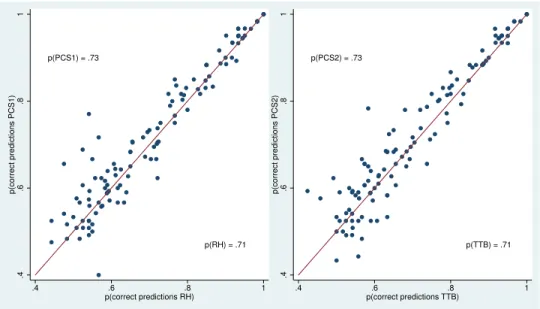
Choices. The two versions of PCS predicted on average 73% of the choices correctly, whereas RH and TTB pre-dicted 71% correctly. Figure 2 plots proportion of correct predictions for the 120 decision tasks comparing PCS1 against RH (left) and PCS2 against TTB (right). Each dot indicates one comparison of two cities and the axis pro-vide the proportion of participants that chose in line with the prediction of the strategy for this task. Dots above the 45 degree line indicate that for the respective decision task the PCS models prediction was correct for more par-ticipants than the RH/TTB prediction (and vice versa for dots below the line). Note that the specific selection of the strategy pairings is arbitrary and does not follow a spe-cial logic except that PCS strategies should be paired with heuristics.
Decision time. Participants followed the instruction and
made rather quick decisions (M = 3316 ms, sd = 2973
ms, Md = 2287 ms, Skew = 4.4, Kurt = 43.4). To
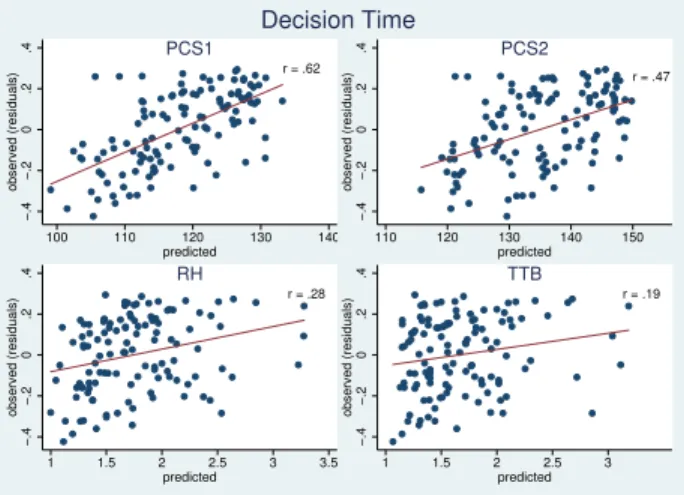
re-duce skewness and the influence of outliers, decision times were log-transformed, and, to correct for learning order ef-fects, the trial number was partialled out for further anal-yses (see Glöckner, 2009, p. 197). To investigate at an aggregated level whether the time predictions of the dif-ferent strategies fit with observed decision times, we com-pare predicted time and observed time scores (i.e., time-residual after log-transformation and partialling out order effects) of all 120 decision tasks, averaged across partici-pants. Figure 3 shows that the two version of PCS1 were much better able to predict average decision time observed in the 120 tasks than RH and TTB.
Confidence. As in Glöckner and Bröder (2011), partic-ipants indicated that they were not very confident in their
decisions and showed high variance,M= 14.7,sd= 47.9
(scale:−100 to 100). To analyze whether confidence
Figure 2: Mean proportion of correct choice predictions for each of the 120 decision tasks (dots) plotted against each other for the considered strategies.
p(PCS1) = .73
p(RH) = .71
.4
.6
.8
1
p(correct predictions PCS1)
.4 .6 .8 1
p(correct predictions RH)
p(PCS2) = .73
p(TTB) = .71
.4
.6
.8
1
p(correct predictions PCS2)
.4 .6 .8 1
p(correct predictions TTB)
data after averaging for each of the 120 decision tasks across participants. Again, the two versions of PCS pre-dicted the pattern of confidence better than RH and TTB (Figure 4).
4.2.3 Individual-level analysis
As in Glöckner and Bröder (2011), to investigate strate-gies at an individual level, we analyzed the overall behav-ioral data simultaneously (i.e., choices, confidence, and response time) using a Multiple-Measure Maximum Like-lihood (MM-ML) strategy classification method (Glöck-ner, 2009, 2010; Jekel et al., 2010), which is described in more detail in Appendix B. We again take into account the full vector of behavioral observations from all choice tasks (i.e., 120 choices, 120 response times, 120 confi-dence ratings per participant) and compare them against the predictions of each strategy. As can be seen in Ap-pendix B, the (maximum) likelihood for the total data vec-tor is calculated as product of three components. The first component is the likelihood for observing the pattern of choices assuming a constant application error according to a binomial distribution as suggested by Bröder and Schif-fer (2003a). The second and third component are likeli-hoods that follow from regressing observed decision time and confidence on the respective strategy predictions ac-cording to standard maximum-likelihood regressions as-suming normally distributed residuals. Hence, concep-tually MM-ML integrated two correlations for response time and confidence and a fit index for choices into one overall measure weighting all of them equally. Doing so by simultaneously considering choices, decision times and
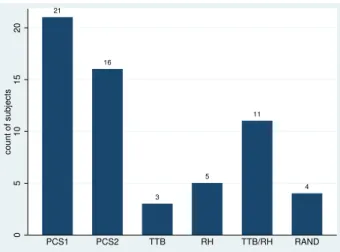
confidence in MM-ML leads descriptively to a majority of classification of PCS users (62%) and fewer users of non-compensatory strategies (32%) (Figure 5). Note that equal fits of RH and TTB were classified as RH/TTB meaning that either model could fit the data equally well. There were four persons classified as random choosers and one person could not be classified (not reported in Figure 5).
The reliability of MM-ML strategy classification can be evaluated by inspecting error rates and the Bayes factor. We found that average estimated error rates for strategy application of the strategies were between 21 and 26%. Error rates were on average higher than in decisions from givens (Glöckner & Bröder, 2011: 14 to 28%), which might be explained by memory errors and has been ob-served in memory-based experiments before (Bröder & Schiffer, 2003b). The Bayes-factors (comparing the like-lihood of the best and the second best strategy) were a bit
lower than in previous research (Md(BF) = 6.6) indicating
a moderate reliability of strategy classification. Adding a global misfit-test (Moshagen & Hilbig, 2011) did not influence the results in that the distribution of strategies remained the same and no previous user of a systematic strategy had to be excluded.
For robustness checks we also analyzed results using cue-validities instead of cue-usage as cue weights in PCS1
and PCS2 (w= ((v−50)/100)1;w= ((v−50)/100)2) as done
in some other work (Glöckner & Betsch, 2012).
Figure 3: Mean observed decision times (y-axis) for each of the 120 decision tasks (dots) plotted against the inter-val scaled predictions (x-axis) of each strategy (different plots).
r = .62
−.4 −.2 0 .2 .4 observed (residuals)
100 110 120 130 140 predicted
PCS1
r = .47
−.4 −.2 0 .2 .4 observed (residuals)
110 120 130 140 150 predicted
PCS2
r = .28
−.4 −.2 0 .2 .4 observed (residuals)
1 1.5 2 2.5 3 3.5 predicted
RH
r = .19
−.4 −.2 0 .2 .4 observed (residuals)
1 1.5 2 2.5 3 predicted
TTB
Decision Time
Note. Predictions of RH and TTB for each choice are derived from the number of cues needed to differentiate between options (range 1 to 4). The predictions of PCS are derived from the num-ber of activation updating cycles that network needs to settle in a coherent state (typical range 80 to 180 cycles).
In a second step, we analyzed whether results change if we do not replace wrongly remembered cue values by 0 in generation of model predictions but use the cue values that people reported in the memory test. This did not change the qualitative pattern of results for strategy classification (54% PCS1 & 2; 37% TTB & RH) but tended to reduce strategies ability to predict decision time, confidence as well as choices. Hence, based on these findings, it seems more appropriate to represent unavailable cue information as missing values.
Third, we tested whether strategy classification de-pended on individuals’ learning rate in the learning phase. The results were again robust in that the relative distri-bution of strategies remained the same (i.e., more than 60% PCS users) when excluding participants with learn-ing rates below 70%, 80% or 90%.
Furthermore, for the conclusions to be valid it has to be assured that none of the strategies is put at a system-atic disadvantage in the analysis. One potential issue con-cerns decision time predictions. Decision time will clearly be influenced not only by the time necessary to integrate the information. It will also depend on the time required for retrieving cue information. That is, for the recognition cue, it will be important how long it takes to recognize that a city is known or not. For the other cues, decision time will be influenced by the time it takes to activate or re-trieve them from memory (if they are used). Both factors are not taken into account in the implementation of the
Figure 4: Mean observed confidence ratings (y-axis) for each of the 120 decision tasks (dots) plotted against the interval scaled predictions (x-axis) of each strategy (dif-ferent plots).
r = .49
−20 0 20 40 60 observed
1.4 1.45 1.5 1.55 1.6 predicted
PCS1
r = .45
−20 0 20 40 60 observe
1.45 1.5 1.55 1.6 predicted
PCS2
r = −.01
−20 0 20 40 60 observed
65 70 75 80 85 predicted
RH
r = .12
−20 0 20 40 60 observed
65 70 75 80 85 predicted
TTB
Confidence
Note. Predictions of RH and TTB for each choice are derived from the validity of the discriminating cue in percent and can range from 50 to 100. The predictions of PCS are derived from difference in activation between option nodes in the network and can range from−2 to 2.
strategies considered here. Hence, correlations between model predictions and observed decision time underesti-mate the true relation. Given that the variance for recog-nition and cue activation can be assumed to be additive, strategies that take into account more information will be affected more strongly by the problem than strategies that consider less information. For the RH, for example, recog-nition information has to be retrieved only but for the PCS strategies recognition information and all other cues have to be retrieved. PCS strategies are therefore put at a disad-vantage. Given that PCS still clearly accounted better for decision times this influence seems to be not crucially im-portant. To check the robustness of our findings, we still reran the MM-ML analysis without decision time, includ-ing choices and confidence only. The results remained the same (60% PCS1 & PCS2, 33% RH & TTB).
Finally, we investigated the effect of dropping confi-dence and decision time data and analyzing choices only. We found that the majority of persons was not uniquely classifiable to one strategy or they were classified as user of a random strategy (52%). From the remaining partici-pants there were 19 persons classified as RH or TTB and 10 classified as PCS.
5
Discussion
Figure 5: Strategy use based on multiple measure maxi-mum likelihood strategy classification.
21
16
3 5
11
4
0
5
10
15
20
count of subjects
PCS1 PCS2 TTB RH TTB/RH RAND
Note. Bars with labels containing multiple-strategy (e.g., “TTB/RH”) indicate that behavioral data were equally likely for both strategies.
Bröder (2011) comparing the ability of RH, TTB, and PCS to explain probabilistic inference decisions. Instead of us-ing a screen-based design and providus-ing cue information during the decision process, all judgments investigated in the current study were memory-based. Nevertheless, the results were quite similar to the former study: The major-ity of participants was best described by a compensatory PCS model, whereas a minority could be classified as us-ing RH or TTB. Still, when comparus-ing across studies, the prevalence of users of non-compensatory strategies was somewhat increased (but see below) when using memory-based decision as compared to the screen-memory-based decisions (see Glöckner & Bröder, 2011). Both findings resonate with results from Glöckner and Hodges (2011) who fo-cused on the comparison of TTB and PCS, however. In-terestingly, even the distribution of participants over the two versions of PCS could be replicated. As in Glöckner and Bröder (2011), although there were considerable in-dividual differences, more participants were classified as users of PCS strategy with lower (i.e., PCS1) as compared to higher (i.e., PCS2) sensitivity to differences in cue va-lidities. Note, that this is the case although PCS2 has been shown to more closely approximated the naïve Bayes solu-tion (Jekel, Glöckner, Fiedler, & Bröder, 2012) that could be considered the rational solution if cues are assumed to be stochastically independent
In demonstrating the limited role of RH, the current re-sults add to a growing literature delineating the narrow boundary conditions of the noncompensatory use of RH. However, there are still two further potentially critical as-pects of this study which will be discussed next. After that, we will speculate on the differences between the results of
the screen-based and the memory-based studies. Finally, we will end with an amicable assessment of recognition in probabilistic inferences.
The current study fulfilled one important demand by Marewski, Gaissmaier et al. (2010) to contrast competing models directly rather than trying to refute RH without proposing an alternative (see also Marewski & Mehlhorn, 2011; Marewski & Schooler, 2011, for alternative
ap-proaches). The latter goal, however, was followed by
much of the previous work (e.g., Bröder & Eichler, 2006; Newell & Fernandez, 2006; Newell & Shanks, 2004; Op-penheimer, 2003; Pohl, 2006; Richter & Späth, 2006) not specifying how the compensatory alternatives could be spelled out in terms of cognitive mechanisms. Here, we went one step further in precisely specifying a competitor, namely PCS. Hence, in accordance with modern falsifi-cationist philosophy, a theory should be refuted only if a better one is available (Lakatos, 1970). The main improve-ment of our experiimprove-ment was to move from screen-based to memory-based inferences as demanded by Goldstein and Gigerenzer (2011). Memory retrieval appears to be costly and thus induces an increased prevalence of frugal decision making (Bröder & Gaissmaier, 2007; Bröder & Schiffer, 2003b, 2006; Platzer & Bröder, 2012) and some reduction of the prevalence of PCS (Glöckner & Hodges, 2011). Hence, the need to retrieve cue information from memory is probably one major factor inducing frugal de-cision making. However, as our results show, meeting this requirement did not lead to a preponderance of noncom-pensatory decision making, let alone RH-use. Concerning Pachur et al.’s (2008) list of methodological desiderata to test RH, the current study fulfilled 6 of 8, in our judgment the most important ones. However, two potentially criti-cal aspects remain: First, cue values were learned in the experiment rather than being part of participants’ seman-tic knowledge. Second, we also taught parseman-ticipants cue values of unrecognized cities.
in-formation during a study generally induces a demand ef-fect suggesting to participants to use all pieces of informa-tion. Hence, we see no theoretical or empirical reason why teaching cue values during the study would render a test of RH implausible. Furthermore, at group level Pachur et al. (2008) had demonstrated a clear effect of additional cue
knowledge in a situationwithoutteaching cue information
beforehand, ruling out this demand effect. However, they did not propose an alternative model.
Goldstein and Gigerenzer (2011) also bemoaned that many studies testing the RH (including Glöckner & Bröder, 2011) taught participants cue values of unrecog-nized objects. They argue: “If one has not heard of an object, its cue values cannot be recalled from memory” (Gigerenzer & Goldstein, 2011, p. 108). We agree with the authors that in an absolute sense, this must be true. However, Pachur, Todd, Gigerenzer, Schooler, and Gold-stein (2012, p. 132) convincingly argue that if people are confronted for the first time with objects in a lab, the kind of “recognition” induced by this learning episode is quite different from the recognition based on previous encoun-ters with the object. The former is based on episodic mem-ory (“I heard the city name in this lab”), whereas the latter is semantic (“I knew this city name before”). Following this argument, these objects therefore can technically still be viewed as “unrecognized” because participants can at-tribute the episodic recognition to the experimental con-text. Hence, there is no inherent contradiction to retrieve information about technically unrecognized objects that were not part of semantic memory before entering the ex-perimental setting. In fact, Glöckner and Bröder (2011) argue that information about unrecognized objects may quite often be available, notably in consumer contexts (see their footnote 1). Other authors have found evidence for the existence of cue knowledge for unrecognized cities as well that is conveyed by the mere name (see Marewski et al., 2011b, p. 367, for a discussion; Pohl, Erdfelder,
Hilbig, Liebke, & Stahlberg, 2013). The above
argu-ment of the difference between “real” (pre-experiargu-mental, semantic) recognition and experimenter-induced recogni-tion (e.g. Bröder & Eichler, 2006; Newell & Shanks, 2004) was used to criticize studies which used this kind of experimenter-induced recognition to test the RH. If this view is retained, the current study’s teaching of cue values for unrecognized object must be considered unproblem-atic. If however, the current study is criticized for induc-ing “real” recognition in the experiment, thus blurrinduc-ing the distinction between “recognized” and “unrecognized” ob-jects, then the argument in turn cannot be used to discredit the above-mentioned studies. A related objection might be that in the test of city recognition (i.e., asking whether participants knew the city before the study or not), people could have confused prior knowledge and learned infor-mation and might have erroneously identified cities as
rec-ognized although they did not know them before. Against this objection speaks that the recognition rate observed in the current study was even slightly lower than in the study by Glöckner and Bröder (2011) that did not involve learn-ing (i.e., 74% vs. 76% of the cities intended to be unknown were indicated to be not known in the previous vs. in the current study).
The MM-ML procedure used here demands for precise predictions of all strategies as well as items that can dis-criminate between the strategies. Therefore, the model comparison requires full experimenter control over cue knowledge. Again, we point to Experiment 3 of Pachur et al. (2008), where an effect of additional cues was ob-served at group level without this teaching of any cues for unknown objects. This study did not compare mod-els, however. In tandem, we think that both studies sug-gest that RH is rarely, if ever, a viable model of memory-based decisions, and that PCS is a promising alternative for many situations. However, it is also possible that our result is confined to situations in which participants were taught information about unrecognized objects. This adds another boundary condition for the use of RH.
Considering the results of the robustness checks for the MM-ML it is apparent that the advantage of PCS models over RH and TTB partially rests on taking into account not only choices but also decision times and confidence. Al-though we used standard assumptions for predicting con-fidence and decision time for RH and TTB (Appendix A), one might consider that the empirical validity of both strategies might be improved by including different mech-anism for predicting both variables. One might, for exam-ple assume that (a) participants form choices and confi-dence judgments based on different strategies in that they choose based on recognition only but afterwards retrieve more cues from memory to form confidence judgments or (b) use their confidence in recognizing the city as con-tinuous variable. Specifying such improved mechanisms might be promising and allow for more efficient tests of RH and TTB in future research. For explaining the data in the current study we think that both alternative expla-nations seem implausible. Given that persons made 120 choices and subsequent confidence judgments in about 15 min, the application of a second independent strategy for determining confidence judgments after choices that in-cludes active cue retrieval seems unlikely. Concerning the second possibility, it seems implausible to base choices on dichotomous recognition/no-recognition judgments only and to use continuous confidence in recognition for sub-sequent confidence judgements. We see no reason why people should use less precise information in their incen-tivized main task than they use in a less important periph-eral task.
per-centage of alleged RH/TTB users was descriptively some-what higher than in Glöckner and Bröder (2011). Almost a third of the sample was classified as using some non-compensatory strategy, compared to one fifth in the pre-vious study. The difference between experiments was not
significant, however,χ2(df=1,n=136) = 2.12,p= .14. In
addition, it is always risky to compare across different ex-periments because of non-randomized participant pools, etc. Hence, we interpret the descriptive difference with great caution. But if the increase in noncompensatory se-quential heuristics due to memory-based search were exis-tent, it would fit other work showing that memory retrieval tends to increase the use of noncompensatory heuristics like TTB (Bröder & Schiffer, 2003b; 2006; Glöckner & Hodges, 2011). Furthermore, even in screen-based de-cisions, Söllner et al. (2013) have recently shown that imposing information search costs reduced the success of PCS to explain participants’ behavior and boosted se-quential strategies. Hence, PCS, compensatory sequen-tial strategies, and simple heuristics like TTB and RH can perhaps be aligned along a continuum of costs associated with information acquisition. According to this interpre-tation, automatic integration of multiple pieces of infor-mation in a PCS-like fashion may be predominant in sit-uations with easily accessible information. As shown by Glöckner and Betsch (2008b) increasing costs of informa-tion search seems to hinder the applicainforma-tion of strategies based on automatic-parallel processing. It might trigger compensatory sequential strategies or noncompensatory strategies. As the current study suggests, memory retrieval
per semay not be too costly if information is coded in a convenient fashion like the binary features in the city size task. One alternative interpretation (particularly also with respect to the results by Söllner et al., 2013 and Glöckner & Hodges, 2011) might be that the memory retrieval pro-cess adds “noise” to the response time generated by the decision process itself, therefore reducing the possibility to identify the underlying PCS process in MM-ML.
Overall, the current study adds to the mounting evi-dence that PCS is a valuable model to account for peo-ples’ behavior in probabilistic inference tasks and beyond. Besides the fact that PCS is the only prominent model that can account for the ubiquitously observed coherence-effect (i.e., information distortions in the decision pro-cess to support the later on favored option) (e.g., DeKay, Patino-Echeverri, & Fischbeck, 2009; Engel & Glöckner, 2013; Glöckner, Betsch, & Schindler, 2010; Holyoak & Simon, 1999; Russo, Carlson, Meloy, & Yong, 2008; Si-mon, Pham, Le, & Holyoak, 2001), as well as for find-ings concerning arousal (Glöckner & Hochman, 2011; Hochman, Ayal, & Glöckner, 2010), and information in-trusion (Söllner, Bröder, Glöckner, & Betsch, in press) the current study again demonstrates PCS’s high capac-ity to precisely model individuals’ choices, decision times
and confidence judgments (e.g., Glöckner & Betsch, 2012; Glöckner & Bröder, 2011; Hilbig & Pohl, 2009). Still, further critical tests of PCS are necessary to more clearly understand its limitations and weaknesses. As in other do-mains, also for recognition-based judgments other com-pensatory models based on automatic processing might be developed (e.g., based on ACT-R or evidence accumula-tion models) that could be tested against PCS in future
re-search.7 Furthermore, an improved version of PCS might
be tested that takes into account individual differences in sensitivity concerning cue validity on a more fine-grained manner by allowing the exponent of the transformation function to vary continuously between participants (see
wvin Table A1; see also Glöckner & Betsch, 2012).
Concerning the noncompensatory use of RH, the stud-ies reported to date point to a restricted range of situations in which this heuristic works as a descriptive model. In our view, too much of the debate has concerned the prevalence
of the RH (see e.g., the three special issues ofJudgment
and Decision Makingon this debate). Excessive attention to the bold claim that recognition information is processes in a noncompensatory fashion has blinded the research community to the truly remarkable discovery by Goldstein and Gigerenzer (2002; see also Gigerenzer & Goldstein, 1996, and Gigerenzer, Hoffrage, and Kleinbölting, 1991): People indeed do not only rely on “objective” features of objects as cues, but they also include meta-cognitive knowledge about correspondences between the world and their own cognitive states as a rational basis for deci-sion making. Each and every properly conducted study so far has confirmed this amazing observation, which is the really important discovery associated with the ABC Research Group’s work on recognition-based inference.
7We thank an anonymous reviewer for the suggestion to also
True Brunswikians should rejoice about this remarkable
demonstration ofvicarious functioning(Brunswik, 1955):
People are obviously able to exploit whatever valid in-formation they have for ecologically rational decisions— even if it is the distinction between their own knowledge and their own ignorance. Given this remarkable ability, why should they ignore other easily available and poten-tially relevant information in the first place?
6
References
Betsch, T., & Glöckner, A. (2010). Intuition in judgment and decision making: Extensive thinking without effort.
Psychological Inquiry, 21, 279–294.
Brehmer, B. (1994). The psychology of linear judgement
models.Acta Psychologica, 87, 137–154.
Bröder, A., & Eichler, A. (2006). The use of recogni-tion informarecogni-tion and addirecogni-tional cues in inferences from
memory.Acta Psychologica, 121, 275–284.
Bröder, A., & Gaissmaier, W. (2007). Sequential process-ing of cues in memory-based multiattribute decisions.
Psychonomic Bulletin & Review, 14, 895–900.
Bröder, A., & Schiffer, S. (2003a). Bayesian strategy
as-sessment in multi-attribute decision making.Journal of
Behavioral Decision Making, 16, 193–213.
Bröder, A., & Schiffer, S. (2003b). Take The Best ver-sus simultaneous feature matching: Probabilistic infer-ences from memory and effects of reprensentation for-mat. Journal of Experimental Psychology: General,
132, 277–293.
Bröder, A., & Schiffer, S. (2006). Stimulus Format and Working Memory in Fast and Frugal Strategy Selection.
Journal of Behavioral Decision Making, 19, 361–380. Brunswik, E. (1955). Representative design and the
prob-ability theory in a functional psychology.Psychological
Review, 62, 193–217.
Czerlinski, J., Gigerenzer, G., & Goldstein, D. G. (1999). How good are simple heuristics? In G. Gigerenzer &
P. M. Todd (Eds.),Simple heuristics that make us smart
(pp. 97–118). New York, NY: Oxford University Press. Davis-Stober, C. P., Dana, J., & Budescu, D. V. (2010).
Why recognition is rational: Optimality results on
single-variable decision rules. Judgment and Decision
Making, 5, 216–229.
DeKay, M. L., Patino-Echeverri, D., & Fischbeck, P. S. (2009). Distortion of probability and outcome
informa-tion in risky decisions. Organizational Behavior and
Human Decision Processes, 109, 79–92.
Doherty, M. E., & Kurz, E. M. (1996). Social judgment
theory.Thinking & Reasoning, 2, 109–140.
Engel, C., & Glöckner, A. (2013). Role induced bias in
court: An experimental analysis.Journal of Behavioral
Decision Making, 24, 272–284.
Gigerenzer, G., & Goldstein, D. G. (1996). Reasoning the fast and frugal way: Models of bounded rationality.
Psychological Review, 103, 650–669.
Gigerenzer, G., Hertwig, R., & Pachur, T. (Eds.). (2011).
Heuristics: The foundations of adaptive behavior. New York: Oxford University Press.
Gigerenzer, G., Hoffrage, U., & Kleinbölting, H. (1991). Probabilistic mental models: A Brunswikian theory of
confidence.Psychological Review, 98, 506–528.
Gigerenzer, G., Todd, P. M., & the ABC Research Group
(1999). Simple heuristics that make us smart. New
York, NY: Oxford University Press.
Glöckner, A. (2001). The maximizing consistency
heuris-tic: Parallel processing in human decision making. Un-published Diploma Thesis, University of Heidelberg, Germany. Heidelberg.
Glöckner, A. (2006).Automatische Prozesse bei
Entschei-dungen [Automatic processes in decision making]. Hamburg, Germany: Kovac.
Glöckner, A. (2009). Investigating intuitive and deliber-ate processes statistically: The Multiple-Measure
Max-imum Likelihood strategy classification method.
Judg-ment and Decision Making, 4, 186–199.
Glöckner, A. (2010). Multiple measure strategy classifi-cation: Outcomes, decision times and confidence
rat-ings. In A. Glöckner & C. L. M. Witteman (Eds.),
Foun-dations for tracing intuition: Challenges and methods.
(pp. 83–105). London: Psychology Press & Routledge. Glöckner, A., & Betsch, T. (2008a). Modeling option and strategy choices with connectionist networks: Towards an integrative model of automatic and deliberate
deci-sion making. Judgment and Decision Making, 3, 215–
228.
Glöckner, A., & Betsch, T. (2008b). Multiple-reason
de-cision making based on automatic processing. Journal
of Experimental Psychology: Learning, Memory, and Cognition, 34, 1055–1075.
Glöckner, A., & Betsch, T. (2012). Decisions beyond boundaries: When more information is processed faster
than less.Acta Psychologica, 139, 532–542.
Glöckner, A., Betsch, T., & Schindler, N. (2010).
Coher-ence shifts in probabilistic inferCoher-ence tasks. Journal of
Behavioral Decision Making, 23, 439–462.
Glöckner, A., & Bröder, A. (2011). Processing of recog-nition information and additional cues: A model-based analysis of choice, confidence, and response time.
Judgment and Decision Making, 6, 23–42.
Glöckner, A., & Hochman, G. (2011). The interplay of experience-based affective and probabilistic cues in de-cision making: Arousal increases when experience and
additional cues conflict. Experimental Psychology, 58,
132–141.
Glöckner, A., & Hodges, S. D. (2011). Parallel constraint
Psychology, 58, 180–195.
Glöckner, A., & Pachur, T. (2012). Cognitive models of risky choice: Parameter stability and predictive
accu-racy of Prospect Theory.Cognition, 123, 21–32.
Goldstein, D. G., & Gigerenzer, G. (2002). Models of
ecological rationality: The recognition heuristic.
Psy-chological Review, 109, 75–90.
Goldstein, D. G., & Gigerenzer, G. (2011). The beauty of simple models: Themes in recognition heuristic
re-search.Judgment and Decision Making, 6, 392–395.
Hilbig, B. E. (2010). Reconsidering ‘evidence’ for fast
and frugal heuristics. Psychonomic Bulletin & Review,
17, 923–930.
Hilbig, B. E., Erdfelder, E., & Pohl, R. F. (2010). One-reason decision-making unveiled: A measurement
model of the recognition heuristic. Journal of
Exper-imental Psychology: Learning, Memory, & Cognition,
36, 123–134.
Hilbig, B. E., & Pohl, R. F. (2009). Ignorance- versus evidence-based decision making: A decision time
anal-ysis of the recognition heuristic.Journal of
Experimen-tal Psychology: Learning, Memory, and Cognition, 35, 1296–1305.
Hilbig, B. E., Pohl, R. F. & Bröder, A. (2009). Crite-rion knowledge: A moderator of using the recognition
heuristic? Journal of Behavioral Decision Making, 22,
510–522.
Hochman, G., Ayal, S., & Glöckner, A. (2010). Physi-ological arousal in processing recognition information:
Ignoring or integrating cognitive cues? Judgment and
Decision Making, 5, 285–299.
Hogarth, R. M., & Karelaia, N. (2007). Heuristic and lin-ear models of judgment: Matching rules and
environ-ments.Psychological Review, 114, 733–758.
Holyoak, K. J., & Simon, D. (1999). Bidirectional
reason-ing in decision makreason-ing by constraint satisfaction.
Jour-nal of Experimental Psychology: General, 128, 3–31. Jekel, M., Glöckner, A., Fiedler, S., & Bröder, A. (2012).
The rationality of different kinds of intuitive decision
processes.Synthese, 189, 147–160.
Jekel, M., Nicklisch, A., & Glöckner, A. (2010). Im-plementation of the Multiple-Measure Maximum Like-lihood strategy classification method in R: Addendum to Glöckner (2009) and practical guide for application.
Judgment and Decision Making, 5, 54–63.
Karelaia, N., & Hogarth, R. M. (2008). Determinants of linear judgment: A meta-analysis of lens model studies.
Psychological Bulletin, 134, 404–426.
Lakatos, I. (1970). Falsification and the methodology of
scientific research programmes. In I. Lakatos & A.
Musgrave (Eds.), Criticism and the growth of
knowl-edge(pp. 91–196). Cambridge: Cambridge University
Press.
Marewski, J. N., Gaissmaier, W., Schooler, L., Goldstein, D. G., & Gigerenzer, G. (2010). From recognition to de-cisions: Extending and testing recognition-based
mod-els for multi-alternative inference. Psychonomic
Bul-letin & Review, 17, 287–309.
Marewski, J. N., & Mehlhorn, K. (2011). Using the ACT-R architecture to specify 39 quantitative process models
of decision making.Judgment and Decision Making, 6,
439–519.
Marewski, J. N., Pohl, R. F., & Vitouch, O. (2010). Recognition-based judgments and decisions:
Introduc-tion to the special issue (Vol. 1). Judgment and
Deci-sion Making, 5, 207–215.
Marewski, J. N., Pohl, R. F., & Vitouch, O. (2011a). Recognition-based judgments and decisions:
Introduc-tion to the special issue (II). Judgment and Decision
Making, 6, 1–6.
Marewski, J. N., Pohl, R. F., & Vitouch, O. (2011b). Recognition-based judgments and decisions: What we
have learned (so far). Judgment and Decision Making,
6, 359–380.
Marewski, J. N., & Schooler, L. J. (2011). Cognitive
niches: An ecological model of strategy selection.
Psy-chological Review, 118, 393–437.
Marewski, J. N., Schooler, L. J., & Gigerenzer, G. (2010). Five principles for studying people’s use of heuristics
Acta Psychologica Sinica, 42, 72–87.
McClelland, J. L., & Rumelhart, D. E. (1981). An inter-active activation model of context effects in letter
per-ception: I. An account of basic findings. Psychological
Review, 88, 375–407.
Moshagen, M., & Hilbig, B. E. (2011). Methodological notes on model comparisons and strategy classification:
A falsificationist proposition. Judgment and Decision
Making, 6, 814–820.
Newell, B. R. (2011). Recognising the recognition
heuris-tic for what it is (and what it’s not). Judgment and
De-cision Making, 6, 409–412.
Newell, B. R., & Fernandez, D. (2006). On the binary quality of recognition and the inconsequentially of fur-ther knowledge: Two critical tests of the recognition
heuristic. Journal of Behavioral Decision Making, 19,
333–346.
Newell, B. R., & Shanks, D. R. (2004). On the role of
recognition in decision making.Journal of
Experimen-tal Psychology: Learning, Memory, and Cognition, 30, 923–935.
Oppenheimer, D. M. (2003). Not so fast! (and not so
fru-gal!): Rethinking the recognition heuristic. Cognition,
90, B1–B9.
Pachur, T., Bröder, A., & Marewski, J. N. (2008). The recognition heuristic in memory-based inference: Is
recognition a non-compensatory cue? Journal of
Pachur, T., & Hertwig, R. (2006). On the psychology of the recognition heuristic: Retrieval primacy as a key
de-terminant of its use. Journal of Experimental
Psychol-ogy: Learning Memory and Cognition, 32, 983–1002. Pachur, T., Todd, P. M., Gigerenzer, G., Schooler, L. J., &
Goldstein, D. G. (2011). The recognition heuristic: a
review of theory and tests.Frontiers in Psychology, 2.
Pachur, T., Todd, P. M., Gigerenzer, G., Schooler, L. J., & Goldstein, D. G. (2012). When is the recognition heuristic an adaptive tool? In P. M. Todd, & G.
Gigeren-zer (Eds.), Ecological Rationality: Intelligence in the
World (pp. 113–143). New York: Oxford University Press.
Platzer, C., & Bröder, A. (2012). Most people do not ignore salient invalid cues in memory-based decisions.
Psychonomic Bulletin & Review, 19, 654–661.
Pohl, R. F. (2006). Empirical tests of the recognition
heuristic. Journal of Behavioral Decision Making, 19,
251–271.
Pohl, R. F. (2011). On the use of recognition in inferential
decision making: An overview of the debate.Judgment
and Decision Making, 6, 423–438.
Pohl, R. F., Erdfelder, E., Hilbig, B. E., Liebke, L., & Stahlberg, D. (2013). Effort reduction after self-control depletion: The role of cognitive resources in use of
sim-ple heuristics. Journal of Cognitive Psychology, 25,
267–276.
Read, S. J., Vanman, E. J., & Miller, L. C. (1997). Connec-tionism, parallel constraint satisfaction processes, and Gestalt principles: (Re)introducing cognitive dynamics
to social psychology. Personality and Social
Psychol-ogy Review, 1, 26–53.
Richter, T., & Späth, P. (2006). Recognition is used as one cue among others in judgment and decision mak-ing. Journal of Experimental Psychology: Learning, Memory, and Cognition, 32, 150–162.
Russo, J. E., Carlson, K. A., Meloy, M. G., & Yong, K. (2008). The goal of consistency as a cause of
informa-tion distorinforma-tion. Journal of Experimental Psychology:
General, 137, 456–470.
Schwarz, G. (1978). Estimating the dimension of a model.
The Annals of Statistics, 6, 461–464.
Simon, D., Pham, L. B., Le, Q. A., & Holyoak, K. J. (2001). The emergence of coherence over the course of
decision making.Journal of Experimental Psychology:
Learning, Memory, and Cognition, 27, 1250–1260. Simon, D., Snow, C. J., & Read, S. J. (2004). The redux
of cognitive consistency theories: Evidence judgments
by constraint satisfaction. Journal of Personality and
Social Psychology, 86, 814–837.
Söllner, A., Bröder, A., Glöckner, A., & Betsch, T. (in press). Single-process versus multiple-strategy models of decision making: Evidence from an information
in-trusion paradigm.Acta Psychologica.
Söllner, A., Bröder, A., & Hilbig, B. E. (2013). Delib-eration versus automaticity in decision making: Which presentation format features facilitate automatic
deci-sion making?Judgment and Decision Making, 8, 278–
298.
Thagard, P., & Millgram, E. (1995). Inference to the best plan: A coherence theory of decision. In A. Ram & D.
B. Leake (Eds.),Goal-driven learning (pp. 439–454).
Cambridge, MA: MIT Press.
Todd, P. M., & Gigerenzer, G. (Eds.). (2012).
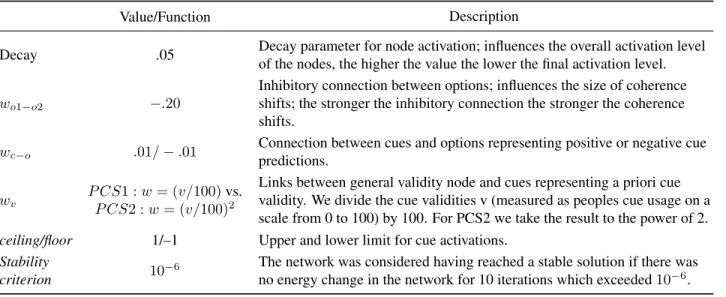
Appendix A
Predictions of strategies were calculated in exactly the same way as in Glöckner and Bröder (2011). For completeness, a shorted version of their appendix is reprinted in the following:
The predictions for RH were calculated by implementing a RH strategy with afterwards applying a TTB strategy, if necessary. The recognition cue was always used as most valid cue and the following cues were ordered according to participants’ explicitly expressed ordering of cues (as indicated by assigned numbers 1 to 4; see methods section). For the TTB strategy, all cues including the recognition cue were ordered according to individuals cue ordering. For both strategies time predictions were derived based on the steps necessary to differentiate (Bröder & Gaissmaier, 2007; Glöckner, 2001). Specifically, the interval-scaled time prediction for comparisons in which the cue considered first differentiated was 1. If the second cue had to be retrieved as well, the prediction was 2 etc. Confidence predictions were derived from participants evaluation concerning cue-validity (i.e., participants estimations concerning how many cities with a positive cue value are larger than cities without it; see methods section) of the differentiating cue (Gigerenzer et al., 1991). Note, that if the first cue differentiates between cities no further information is retrieved. Therefore, the subjective cue validity of the first cue is the only information available to assess confidence and according to Gigerenzer et al. (1991) persons base their confidence judgment on it. If the second cue has to be retrieved and differentiates, the validity of this cue is used as confidence estimate etc. According to this plausible prediction, we use the subjective validity of the differentiating cue as contrast weight for predicting confidence for RH and TTB.
For the simulation of PCS we used the network model proposed by Glöckner and Betsch (2008a). Spreading activation in the network is simulated by an iterative updating algorithm which uses a sigmoid activation function proposed by McClelland and Rumelhart (1981):
ai(t+ 1) =ai(t) (1−decay)+
(
if inputi<0 inputi(ai(t)−f loor)
if inputi≥0 inputi(ceiling−ai(t))
with
inputi(t) =
X
j=1→n
wijaj(t).
ai(t)represents the activation of the node iat iteration t. The parametersfloor andceilingstand for the minimum
and maximum possible activation (in our model set to a constant value of -1 and +1). Inputi(t)is the activation nodei
receives at iterationt, which is computed by summing up all products of activations and connection weightswijfor node