production of a decade in the Intercom events
DOI: 10.1590/1809-58442015212
Myrian Del Vecchio de Lima Eloisa Beling Loose
Danielle Mei Thaís Schneider Valéria Duarte Higor Lambach
(Universidade Federal do Paraná, Pró-Reitoria de Pesquisa e Pós-Graduação, Programa de Pós-Graduação em Comunicação e Programa de Pós-Graduação em Meio Ambiente e Desenvolvimento. Curitiba – PR, Brasil)
Abstract
This article focuses on the interface between Journalism and the Environment. It presents a mapping (2003-2012) and an analysis on the Journalism research development at the space of research that addresses the environmental issues in the congress of Intercom. It seeks to verify the growth and the diversity of approaches in the area of Environmental Journalism in that decade, in this event. The article is based on a bibliographical research, followed by quantitative/ qualitative analysis of some categories defined from the data collected. Emerge from this process, as a result, questions of epistemological order on relations of this interface, emphasizing that the work allowed to observe that the Environmental Journalism presents itself, in the period examined, as an area that still requires investigations which emphasize the complex relationships between the practices and discourses that interconnect the two fields of knowledge.
Introduction
T
his paper analyzes the development of the research that includes the Journalism and environment binomial in the work teams dedicated to this subject in the most traditional national communication event in Brazil, Intercom, organized by the Sociedade Brasileira de Estudos Interdisciplinares da Comunicação (Brazilian Society of Interdisciplinary Studies of Communication). For this, a state-of-the-art mapping of the specific Journalism and environment papers of the last decade is prepared, presented in the aforementioned academic event, from 2003 until 2012, to identify the recurring authors, themes and research corpus.In Brazil, according to Ferreira (2002), especially starting at the end of the 1980’s, many scientific papers have been produced based on bibliographic surveys called “state-of-the-art”, trying to map approaches and subject areas of specific fields of study. The Communication area follows this trend, which can be evidenced by the several papers thus characterized in recent years in debate spaces such as the Associação Brasileira de Pesquisadores em Jornalismo (Brazilian Association of Journalism Researchers) (SBPJor) and Intercom – e.g.: Jornalismo Ambiental: como as pesquisas acadêmicas abordam o tema? (Environmental Journalism: how do the academic surveys handle the subject?) (DELAVATI; FAUSTO NETO, 2011) and Análise dos estudos sobre jornalismo ambiental: primeiras incursões (Analysis of the studies on environmental journalism: first incursions (AGUIAR, 2011). Ferreira (2002) affirms that there is a significant set of research, also known as “state of knowledge”:
Under this methodological perspective, a survey was made, presenting the theme and corpus recurrences of the set of papers that focus on the interface between Journalism and environment, the research interest of the group of authors, as well as the institutional origins and the qualification of the authors interested in this relationship. The mapping of those papers were based on the discussion spaces of the Intercom meeting dedicated to the scientific communication, which historically receives analyses and reflections on the environmental theme.
It is important to emphasize that at the time of classification of the categories to be used as a bases for the analysis, there was a discussion involving the interface definition among the examined areas – Journalism and environment – as well as in which “empirical intersection”, in the papers that were not limited to reflection, this interface was configured. This debate about what would really be the interface relationship between both areas ended up establishing two main analysis categories: one connected to the environmental theme under discussion and the other linked to the concreteness where this contact happens.
It must be noted that the Intercom events include a variety of thematic divisions and are separated per level of education (undergraduate students and post-graduate researchers). This paper privileged the Research Nucleus (NP) of Scientific and Environmental Communication, the only space in the yearly/ national congress that evidences the incorporation of the environmental issue in the title of a work group.
It is important to explain that the Research Nucleus of the Intercom event tries to analyze and accept contributions from a specific Communication area, defined by a previously agreed agenda. In 2007, Intercom was reformulated, and, for two consecutive years, the environmental word was removed from the NP title. For this reason, in 2007 and 2008 the papers that focused on the environment were diluted in other NPs1.
Starting in 2009 other structural changes have happened in the Intercom organization, with the emergence of Research Groups
(GPs), gathered under common Thematic Divisions (DTs). In this new phase, the environmental issue obtained again an explicit space under the title of “Communication, Science, Environment and Society”. The description of this DT, found in the society’s website (http://www.intercom.org.br/), establishes its content as follows:
Research, reflections, empiric studies and applied research on the social practices of the Communication related to sciences, technologies and environment: scientific journalism; scientific divulging; popularization of the science; public communication of the science; scientific medialogy; scientific culture; marketing of the science; reception of the scientific, technological and environmental information; relationships between science, technology and society; [...] possibilities and limits of alternative media for the scientific and environmental dissemination [...]. Theoretical problematization of critical issues such as: the risks and social, cultural, environmental, political, economic and geopolitical impacts of scientific procedures and technological choices, including the bioethics, the biotechnology and the bio politics; the silence, the concealment and/or the media sensationalism of the scientific, technological and environmental controversies; the role of the traditional knowledge in the construction of the knowledge of the world; the clash between the discourse of ecological modernization and sustainability; reflections about the power relations involved in the dealing of these issues by the mass media; the dialogue and the clash of the professional ethos of communicators and scientists; profile and necessity of continuous training of communication professionals [...] and of science propagators [...] for the scheduling of scientific, technological and environmental issues relevant for the Brazilian society; interfaces and interactions of the work of editorial journalists and communication consultants in CT&I organizations; facing the challenges imposes to the democratization of the information and communication [...] including the debate about copyrights, shared rights and free access publications.
It is evidenced that the scope of this DT2 is wide, but that the interface between Journalism and environment may be found in the set of papers presented in it in the examined ten years. It is important to stress that, even though Journalism is part of the field of studies of Communication, in this paper we focused exactly on the papers that dealt with the products, processes or
reflections linked to the construction of the News and reports to correspond to the specificity of Journalism. Thinking about the interface issue, one may be say that the investigation is focused in what popularly is called “environmental journalism”. Bueno (2007, p.29) affirms that:
The environmental journalism longs for a concept that extrapolates the one of the traditional scientific journalism (committed to a significant portion of the scientific community that has privileged the continuation of its research, without contextualizing its repercussions), which is not to be confused, under no circumstances, with the economic journalism [...]. The environmental journalism must build its own ethos, despite sharing a significant portion of its DNA with all types of journalisms (specialized or not) that are practiced.
Thus, even though many authors nowadays point at specific assumptions of the environmental Journalism, which extrapolate the journalistic appropriation of the environmental theme, for this paper we considered every paper that dealt with Journalism with some interface with the environment, due to the historical moment adopted. We do not distinguish environmental Journalism and Journalism of/about the environment. This criterion was used because the discussions of premises and specific characteristics of this specialized type of Journalism are still recent and little discussed in epistemological terms.
Methodology
Before starting the quantitative-qualitative analysis, it must be warned that the survey of the papers was done directly from the annals of the events, shared online by Intercom, taking into consideration titles, abstracts, key words and information on the authors of the articles. For Ferreira (2002, p.268), the abstracts, as a type of discourse, bring a thematic content that presents the aspects of the research that correspond to:
that not every abstract brings in itself and in an identical manner all the conventions expected by the type of discourse: some lack the conclusion of the research; others lack the methodological path, and others may use a more narrative style.
According to this, considering the examined abstracts, we noticed several construction problems: the content(s) did not always reflect the ideas of the texts or were incomplete. The key words, which should function as signals that immediately refer to the study areas and thematic emphases of research (they are fundamental in the evaluating systematic of institutions as the Coordination for the Improvement of Higher Education Personnel – Capes – because they evidence strong relation with the research lines from where the production of the authors of academic papers originates, in some few cases, did not correspond exactly to the contents of the analyzed papers either.
Even so, it was the careful reading of the titles (which in thesis should also take the reader to the thematic universe approached), abstracts and key words that allowed the classification of the used categories. In many cases, however, this triad of aspects was insufficient to continue the proposed classifications, requiring the reading of the article with an exchange of ideas among the researchers of the group to minimize the doubts. Finally, to deal with the institutional origins and the schooling of the authors, we used the data made available by them in their paper published in the annals of the event.
Environmental and interface themes: some consideration
The analysis of the DTs material brought many doubts, for the Communication field is, due to its nature, interdisciplinary and constantly linked to interface papers (BRAGA, 2011). It is understood that, as environmental communication is result of the contact and of the exchanges between the fields of Communication and Environment (LIMA et al., 2013); the environmental Journalism is also a product of this interchange, even if as a sub-field of Communication.
Journalism cannot be seen as a space of multiple interdisciplinary exchanges, as its doing depends on the facts that derive from other fields. Without this appropriation relation, its main product – the news – would not be possible. Raynaut (1996, p.25), dealing with the interdisciplinarity, affirms that its objects
[...] are generally acknowledged from a social position that forces us to consider the real as it is presented in its raw form: that is, as a set of relationships that do not allow us to become prisoners of the division instituted by the disciplines. This position is, essentially, of the action — from the moment it considers the necessity of being informed by an objective knowledge of the field about what it intends to work with.
questions for the 21st century”, of the United Nations Program for the Environment – Pnuma (2012), which establishes global thematic priorities that the author intended to analyze.
In this context, we decided for our own classification, based on the analysis of the corpus, but there were still some “disturbances”: in some moments, we were dealing with environmental themes themselves, which could be themes of any other interfaces of knowledge (Education or Geography, for example), such as biodiversity or climate change; in others, the categories seemed specific to Journalism. Thus, we decided for another classification: besides the category “environmental theme”, we felt the need to work with the category “interfaces between Journalism and environment”.
of the idea of sustainable development; 9) Environmental events, linked to any programmed event with environmental character, such as the Day of the Tree or Rio+20; and 9) Environmental information, which includes the focus on the environmental information in a broad manner, without prioritizing a specific theme; it exposes the theoretical and epistemological aspects about communication and environmental Journalism. In the graph that deals with the environmental theme one can also observe the category Others, which groups specific bioethics papers (1) and public environmental policies (1).
The creation of the category “interfaces between Journalism and environment” required a revision of some reflections on the involved perspectives. One of them, more evident, corresponds to the overlapping points where the theoretical fields of both areas, Journalism and environment, not only touch (juxtaposition of knowledge), but also overlap, increasing the degree of complexity of both scientific fields and allowing a dialogue between both know-hows, built from inter-disciplinarities inherent to themselves. To make it clear, besides the interface between the field of environmental knowledge and the journalistic one, any other interface of knowledge could be examined, such as, for example, Journalism and Science (scientific Journalism, which goes beyond a simple specialization of the Journalism); Journalism and Education (educommunication); or going beyond both scientific fields: Journalism, Education and Environment (social-environmental educommunication).
coverage, a set of News, a group of social actors. These objects (when observed and analyzed) will allow the construction of an empirical interface. Evidently, this does not occur when the research is purely theoretical.
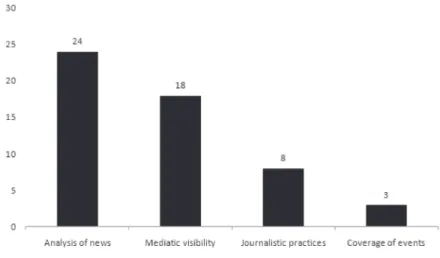
The interface sub - categories were also classified as the analyses emerged: 1) Analysis of news, which refers to the news about environmental themes, while products of Journalism, under different perspectives: analyses of content and discourse, mapping of sources and identification of the frameworks; this category includes varied pieces of news, without the characteristic of coverage of event; 2) Coverage of events, which includes the analysis of all types of coverages of environmental events, such as the Environment Day; 3) Mediatic visibility, which deals with approaches related to the space destined to the environmental themes in journalistic publications or specific spaces, such as programs and editorials, analyses of the perception of actors on the environmental theme in the press and studies of agenda setting and of the processes of script composition linked to the environmental themes; 4) Journalistic Practices, which includes studies related to the professional routines of the journalists that cover environmental themes and the social role of the Journalism, as well as the relationship with sources, criteria of news worthiness and ethics.
Analysis of the papers on Journalism and environment
to the total number) and we focuse our research efforts to the workspaces which traditionally receiving this theme (that is, the 331 papers were maintained as a starting point).
In connection to the total corpus of this analysis, it is important to notice the significant number of articles submitted in the communication and environment area, and, more specifically, of Journalism and environment. In the analyzed decade, 32% of the papers dealt directly the aspects and themes of the environmental field. Of these 32%, which correspond to 104 papers, 14% represent only the ones on Journalism and environment, which add to 45 papers. On the other hand, considering the communication and environment articles as being the total (100%), the ones on environmental Journalism corresponded to 45% of them.
It was observed that, despite this DT accepting papers of different types and interfaces, it is significant the space the environmental themes receive. This draws attention especially for the tradition of scientific communication inherent to the group of researchers who participate in the DT and the absence of other spaces that prioritize the communication (and here we include Journalism) and its contact with other fields.
Still analyzing Figure 1, it can be seen that the largest percentages are divided between Communication and Science (33%) and the total of the percentages of Communication and Environment3 and Journalism and Environment (32%). The latter,
even though separated in the graphic for the purpose of this paper, integrates the area of environmental communication. Thus, it can be seen that more than one third of all the papers presented about environmental communication corresponds to Journalism and environment studies. The percentages of Communication and Science (33%) and the total mentioned above (32%), very close, reflect the dominance of the DT themes in observation, totaling 65% of all the papers.
Figure 2 – Total of papers presented in the Scientific Communication DT per year/local
The graph above shows a list of papers submitted in the aforementioned DT per year, with the place where the congress happened, and with the amount of papers linked to the binomial Journalism and environment. It can be seen that the peak of papers received in the scope of the analyzed interface happened in 2008, exactly when the national event happening in the city of Natal had as its general theme “Media, Ecology and Society”. It can also be observed that there is a certain constancy in the
presence of Journalism and environment papers in the discussion spaces of Intercom which, primarily, had in the denomination emphasis only in the Science, and, later, added the word “environmental” to its name. In other words, the inclusion of the term “environmental” to the DT did not imply in the increasing or decreasing of the yearly average of presented papers. The general average of papers presented in this last decade is 4.5.
It must be taken into consideration that the place where the congress happens may influence the amount of submitted papers, because the continental dimensions of Brazil not always allow the researchers to attend the events annually. The issue of the general theme chosen by Intercom also tends to reinforce the presence of determined researchers due to the round tables and speeches related to specific interests in studies.
As for the analyses of the Journalism and environment binomial, Figure 3 shows the institutional origin of the authors per region:
Figure 3 – Percentages of the institutional origin of the authors
to 2000, Gomes (2001) also emphasized the Southeast as the best participation, pointing at the fact that the Post-Graduation Program in Communication of the Universidade Metodista do Estado de São Paulo (Umesp) there is an area of concentration in Scientific and Technological Communication, which has a close relationship with the scope of this group. Even though the analysis has not observed papers on Journalism and environment, several scientific communication researchers encounter environmental subjects and write about this relationship. Such affirmation is verified in the trajectory of many researchers who started to investigate the scientific Journalism and added the environmental Journalism to their interests, such as Wilson Bueno (Umesp), Isaltina Gomes (UFPE) and Myrian Del Vecchio de Lima (UFPR).
In the register of institutional precedence by regions, North comes next, with 27% of the papers. This is an interesting piece of information, since, different from the Southeast, the region still presents few programs. However, because it include(s) Amazonia, this connection is understandable. Example: of the 45 papers found, 9 dealt with issues linked to Amazonia, representing 20% of the total.
South and Northeast are in third place, with 13% each. Besides the existence or not of research groups in each region, it is observed that of the ten meetings analyzed, three of them were located in the South and three in the Northeast. In the West-central, only one event happened and there is not a significant number of communication universities, what can explain the participation of only 9% of the researchers.
Figure 4 – Absolute numbers of authors that deal with environmental Journalism classified by academic titles4
Next, the themes covered were analyzed. Following the categorization exposed, a classification of the most frequent environmental themes in the last ten years was done (Figure 5). It can be seen that there is a diversity of themes, but the categories of Environmental Information (28.8%), Biodiversity (20%), Climate Changes (13.3%) and Degradation and Pollution (8.8%) were evident.
In relation to the most frequent environmental themes – Environmental information, Biodiversity and Climate Changes – there were no surprises in relation to the two last ones: the decade was marked by the discussion, sometimes polemic, about the climate changes of anthropogenic origin as well as series of events linked to the so-called crisis of the global biodiversity. The prevailing category, Environmental information, seems to show a preference of the researchers dedicated to the binomial in question for a theme intrinsically linked to the journalistic field itself, the information. Even if in some of the investigated papers it appears with a different meaning, such as the environmental information in networks, it is inside the journalistic information
or the journalistic medias themselves that the biggest thematic interest of the research resides.
Figure 5 – Number of papers presented classified by environmental themes
Some papers of the corpus showed specific characteristics of more than one of the defined categories, as “Agenda ambiental y rutinas noticiosas: un estudio de caso de la prensa regional”, presented in 2003, which was inserted in Analysis of news, Mediatic visibility and Journalistic practices. The biggest recurrence of articles included in Analisis of news (45.3%) is not surprising, since it is very common in Journalism research to investigate products, especially through the analyses of discourse and content. Here, the selected environmental themes are researched inside the empirical space represented by a certain set of news. In a prior analysis, from 1992 to 2000, even though it deals with all the papers presented in the aforementioned session, Gomes (2001) also verified the predominance of papers on studies of the discourse.
In the case of the Mediatic visibility, which corresponds to 34% of the total, the studies of scheduling of environmental themes were highlighted. In Journalistic practices (15%), however, besides what is considered as productive routines, it should also be noticed the objective of verifying what is the social role of environmental Journalism and also its relationship with the educational area.
The less recurrent interface category was Coverage of events (5.7%), which was also expected by the specific and ephemerous character of these activities.
Final considerations
(EICA), in 2011, may also dilute audiences, which, by different reasons, cannot be present in several scientific events every year. Due to the coverage of interface themes in the Intercom work group, besides the nature of Communication itself, which is interdisciplinary, the DT has not shown significant changes in terms of presentation of papers, considering that some researchers migrated or divided themselves among the different events. It is supposed that the different meetings contribute to the increasing of the discussions, with specific approaches, but with possibilities of convergence.
It is recognized that beyond identifying, classifying and quantifying the recurrences of the corpus being analyzed, this paper has generated concerns of reflexive order on how the interfaces between the knowledge fields are constructed and articulated among the knowledge fields, and here, specifically, between the Journalism and the environment fields. Two questions emerge from this process, which need to be detailed in future studies: 1) in what measure do the scientific Journalism and environmental Journalism (sub-fields inserted in a same Intercom DT, for example) approximate and differ? 2) what does the interface between the journalistic and environmental fields really means, beyond the environmental communication?
scientific, economic, cultural, technical, social etc. However, one can observe the lack of consensus and theoretical deepening about these interdisciplinary implications.
In relation to the second question, it can be noticed the necessity of more precision about what this interface relationship actually means. As there already are discussion on the differences between environmental Journalism and Journalism about environment, considering that the former has an intersection of epistemological order between the fields and the latter simply appropriates the environmental theme, one understands that it is necessary to reflect more analytically about the meaning the term interface acquires in the meetings of fields.
Finally, one must mention that other categories or analyses could have appeared in this paper of “study of art”, as the methodological aspects, which can be seen under the light of the crossing of fields. It is also believed that the deepening of the interdisciplinarity issue and of the epistemological interfaces are provocative problems that still show themselves as fragile when verified in the Journalism sub-field. In light of this, one can observe in the environmental Journalism a propitious space for the research of the complex relationships between the practices and the discourses that interconnect this interface.
References
AGUIAR, Sônia. Análise dos estudos sobre jornalismo ambiental: primeiras incursões. In: 9º Encontro Nacional de Pesquisadores de Jornalismo. Anais... Rio de Janeiro: Universidade Federal do Rio de Janeiro, 2011.
ABRANCHES, Sérgio. Os temas ambientais emergentes neste século e a Rio + 20. Ecopolítica, 2012. Online. Available in: www.ecopolitica.com. br/2012/02/24/os-temas-ambientais-criticos-neste-seculo-e-a-rio20/. Consulted on: March 22, 2012.
BUENO, Wilson. Comunicação, jornalismo e meio ambiente: teoria e pesquisa. São Paulo: Mojoara Editorial, 2007.
DELEVATI, Amanda; FAUSTO NETO, Antônio. Jornalismo forma de enfrentamento dos dilemas socioambientais. In: Encontro Ambiental: como as pesquisas acadêmicas abordam o tema? In: XII Congresso de Ciências da Comunicação na Região Sul Intercom. Anais... Londrina–PR: Universidade Estadual de Londrina, 2011.p.1-14.
FERREIRA, Norma S. A. As pesquisas denominadas “estado da arte”.
Educação & Sociedade, Campinas, ano XXIII, n. 79, p.257-272, August/2002. Available at: http://www.scielo.br/pdf/es/v23n79/10857.pdf. Consulted on: March 5, 2012.
GOMES, Isaltina M. A. M. Do Grupo de Trabalho Comunicação e Ciência ao Núcleo de Pesquisa Comunicação Científica e Ambiental. In: XXIV Congresso Brasileiro da Comunicação da Sociedade Brasileira de Estudos Interdisciplinares da Comunicação (Intercom). Anais... Campo Grande, 2001.
LIMA, Myrian Del Vecchio et al. A comunicação ambiental como
Interdisciplinar de Comunicação Ambiental (EICA)-2, 2013, Sergipe. Anais...
Sergipe: Universidade Federal de Sergipe, 2013. p.1-13.
RAYNAUT, Claude. Processo de construção de uma proposta interdisciplinar.
Cadernos de Desenvolvimento e Meio Ambiente, Curitiba, n.3, p.23-33, 1996.
SALATI, Eneas et al.Temas Ambientais Relevantes. Estudos Avançados, São Paulo, v.20, n. 56, p.107-127, 2006. Available at: http://www.scielo.br/scielo. php?script=sci_arttext&pid=S0103-40142006000100009. Consulted on: April 25, 2012.
Myrian Del Vecchio de Lima
Eloisa Beling Loose
Master in Communication and Information by the Universidade Federal do Rio Grande do Sul (UFRGS). Doctoral student in Environment and Development by the Universidade Federal do Paraná. Member of the Environmental Journalism Research Group (UFRGS) and of the Interfaces Research Group – Communication, Education and Environment (UFPR). Doctoral internship, with Capes financing, at the Centro de Estudos de Comunicação e Sociedade da Universidade do Minho, in Braga, Portugal. Email: [email protected]
Danielle Scheffelmeier Mei
Master in Communication and Society by the Universidade Federal do Paraná. Member of the Interfaces Research Group – Communication, Education and Environment (UFPR). Email: [email protected]
Thaís Cristina Schneider
Master in Environment and Development by the Universidade Federal do Paraná (UFPR). She had a Capes scholarship, performing research based on the praxeological approach of the communication. Member of the Interfaces Research Group – Communication, Education and Environment (UFPR). E-mail: [email protected].
Valéria Duarte
Master in Environment and Development by the Universidade Federal do Paraná (UFPR) – (Capes Scholarship). Member of the Interfaces Research Group – Communication, Education and Environment (UFPR). Email: [email protected]
Higor Francisco Lambach
Undergraduate student in Social Communication with habilitation in Journalism by the Universidade Federal do Paraná (UFPR). Member of the Interfaces Research Group – Communication, Education and Environment (UFPR). CNPq scholarship in Scientific Initiation. Email: higor.f.lam@gmail. com