America: the Brazilian campaign to promote
ISDB-Tb according to governmental actors’
narratives
DOI: 10.1590/1809-5844201527
Angela S. Brandão
(Pontificia Universidad Católica de Chile, Facultad de Comunicaciones, Doctorado en Ciencias de la Comunicación. Santiago de Chile – Región Metropolitana, Chile)
Abstract
In 2006, Brazil became the first country to import the Japanese Terrestrial Digital Television standard. Its decision was followed by almost all countries of South America. From an interdisciplinary approach between Communication and International Relations studies, this article investigates the Brazil’s role in the adoption process of ISDB-Tb by neighboring countries. With qualitative methods (semi-structured interviews with a purposive sample), this paper analyzes the speeches of Brazilian authorities, based on studies of narratology. The goal is to understand what were the motives, subjects, values and secondary actors behind this Brazilian promotional action. The findings suggest that the Brazilian influence on the neighbors was intentional, and compatible with Soft Power strategies adopted by Brazil during the administration of President Lula.
Keywords: Brazil. Soft Power. Digital Television. Narratology. Actantial Model.
I
n 2006, Brazil became the first country in importing“Japanese-Brazilian”. From the second half of 2009, the adoption of the ISDB-Tb is a trend in most of South America, completely changing the map of distribution of digital TV standards in the world (ANGLE; CALZADA; ESTRUCH, 2011).
What does it lead a country to invest time, financial resources and political capital to promote a technology created across the world? What was the main message of this action? To whom is it addressed?
The answers to these questions are vital to understand how the dynamics of international relations impact on Communication policies in South America. After all, more than a mere technological issue, the digitization of television broadcasting is a historical gap for the sector (GALPERIN, 2004a; GALPERIN, 2004b; BUSTAMANTE, 2008) and a significant opportunity to develop new industries and markets (BRITTOS ; BOLAÑO, 2007 BUSTAMANTE, 2004).
This study stems from the premise that the accounts of the international campaign are an important (though obviously not exhaustive) source of answers to those questions. In the search for these stories, they are performed semi-structured interviews with the Brazilian authorities responsible for the promotional action. From them, the research is based on the tools of narratology – more specifically in the actantial model of Greimas (1966) – to understand what the senders, subjects, objects, beneficiaries, opponents and helpers in action are described.
This work is important and innovative in several aspects. First, because it is the first study that has been reported about the campaign of expansion of ISDB-Tb led by Brazil, presenting data and analytical approaches that point to the need for future research. After because it presents as an efficient tool of narratology, systematization and analysis of the collected material on Communication policies. Finally, its interdisciplinary reaffirms the importance of international relations in the definition of policies on the television sector.
Finally, considering that the subjectivity of the researcher is inevitable in the qualitative strategy of approaching the object of study, it is worth mentioning that this work is framed by the experience of fifteen years as a political journalist in Brazil, and the production of many media interviews and reports dealing at least partially of the issues presented here. Printouts generated by that experience obviously recorded in the investigation, although only as a backdrop of the object to be scientifically analyzed.
Brazilian domestic context about the Digital Television
groups: first, telecommunications (supporting the European pattern) and other TV stations (for the Japanese model). In mid-2006, the government’s decision is officially announced and it is considered one of the broadcasting industry victories (BADILLO MATOS, 2012; Cross, 2006; ANGLE; CALZADA; ESTRUCH, 2011). Months later, the government began to design standard promotional activities among neighbors.
The campaign to promote the ISDB-Tb as foreign policy decision
Theoretically, the decision to promote the ISDB-Tb can be interpreted internationally under many paradigms. One is the “rational” decision-making model in which, according to Mintz and De Rouen (2010, p.7), “decisions can be made by to person or to small group searching for the optimal outcome. The executive relies on bureaucrats to provide information for the decision process, and after the decision is made, the bureaucracy implements the decision”. From this model, the government is internationally an unitary actor working to maximize profits and minimize losses.
Applying this model to the case treated here, we can say that public officials act primarily seeking political advantage of the campaign, that is, the manifest interest of the country to hold and strengthen its regional leadership position. According Gratius (2007), that leadership is limited to South (once in the rest of the American continent remains the dominant player USA) America and, therefore, promote South American integration must be one of the key instruments of foreign policy of Brazil. The author notes that even in Brazil that despite an emerging global power, its foreign policy differs from that of countries like China and India because it has the rather limited military component, becoming more dependent projection by use of Soft Power. In fact, the Latin American country has projected itself as “the first great world Soft Power” (Leahy, 2013).
attraction rather than coercion or payment” (p.94). In other words, the tools of action of that kind of power are essential in modern foreign policy. To Gallaroti it is possible to infer the results of a policy of Soft Power “by states emulating policies consistent with the roles of a model nation (apud COUTAIN, 2011, p.151). So Gallarotti considered ‘emulation’ (when nations adopt policies of another state) as a powerful manifestation of soft power” (GALLAROTTI, 2010, p.22).
Considering the description above, this study is based on the hypothesis that the action of Brazilian promotion of ISDB-Tb is part of a Soft Power strategy.
The definition of the interviewed agents and methodological tools
There are very few academic and library materials dedicated to the international promotion campaign of ISBT-Tb. Thus, it was based on the analysis of documentary materials (laws, agreements and memo of understanding signed by government agencies), articles in the media and with semi-structured interviews with expert sources on the subject1, that it became possible to detect which were the public bodies – within each one of them, who were the responsible directly involved in the process of decision making on Digital TV. From there, three names stand out clearly from the collected material, indicated as the “architects” of the campaign2: André Barbosa Filho, Special Advisor of the Civil House (2004-2012) and one of the main articulators of the choice of the
1 Among them: Igor Villas-Boas, president of SBTVD Project Management
Group for eight months, and one of the coordinators of the work developed by the CPqD; Benedito Fonseca Filho, director of the Department of Science and Technology of MRE Topics; Eduardo Kosmiskas Terada, secretary in the DCT; Cosette Castro coordinator of Digital Content Group for Latin America ELAC / ECLAC (Economic Commission for Latin America and the Caribbean); and José Roberto Elias, former director of Telecommunication SET – Brazilian Society of Television Engineering.
2 While the other respondents clearly speak from the perspective of analysis,
standard Japanese Digital TV; Hadil da Rocha Vianna, Director of the Department of Science and Technology of the Ministry of Foreign Issues (2006-2010), and responsible for coordinating the signing of most of the agreements and memo signed between Brazil and neighboring South American that adopted the Japanese-Brazilian digital television standard; and Roberto Pinto Martins, Secretary of Telecommunications, Ministry of Communications (2005-2011), and one of the main partners in the discussions on Digital Television in the Ministry, who participated personally in several Brazilian government negotiations with authorities in other countries that came to adopt the ISDB.
All contacted authorities agreed to grant recorded interviews. They were made in September of 2012, in the workplace of the interviewees, and they took approximately an hour and a half each. Such interviews are in Portuguese, and were conducted – and translated – by the author, a native speaker of the language.
Integral transcription of the interviews allowed countless systematic and profound readings, to search for “features”, phrases and narrative structures that indicate which are the active of each story. From there, the investigation of the convergent and divergent points between the descriptions found active proceeded considering implementing the campaign as “key” action of the stories to be analyzed.
The testimonies of Brazilian agents as ‘stories’
is the context or occasion in which the story is presented); 2) the sequence of events (the structure of the story that signals that allow us to understand the events as ordered in time); 3) disruption of worlds (when the story presents events that produce a crisis and reorganization of the world narrated; 4) the qualia (element of the story that accounts for human experience in the history narrated). The structure designed by the author can thus expand narratological scope of analysis beyond the literary and artistic works (in fact, Hermann applied himself their model to the interaction face-to-face between two people).
The analysis of these four elements in the testimonies of Brazilian agents makes clear its definition as narrative phenomena. This because they have an explicit situation (political, technological and continental Brazilian context), a sequence of events (choosing a digital TV standard, the attempt to persuade neighboring countries to follow suit, challenges and victories on the road etc.), disruption of world imposed by the need for migration to digital technology and the qualia, from expressing their experiences, feelings and conclusions throughout the process.
About the reports from greimas model application
For Greimas ([1966] apud HÉRBERT, 2006) analysis of the narrative should be understood from the action. And any action can be broken up into components, called active, which basically relate within a structure (for details, see LORENZINI GOMEZ, 2009).
subject’s action toward the subject: while the assistant supports, the opponent is the more difficult.
The actantial analysis is defined as an agent listed in every action that occurs in the story (theoretically, can be an actantial model for each). However, the model Greimas does not allow that such actions are performed in whole or, in the case of analysis of a story as a whole, you can choose the action that best synthesizes to be scrutinized.
Actantial relations in the reports of the Brazilian agents
Roberto P. Martins Ministry of Communications
Andre Barbosa Filho Civil House
Hadil Viana Jr. Ministry of Foreign Relations Mandator The opportunity
to “geopolitical advantages”. The projection of Brazil.
Memory failure Pal-M. A response to domestic critics of the Brazilian election.
An opportunity to “improve the Brazilian image” abroad President Lula Minister Dilma
President Lula and his project of “leading Brazil”. Fear of isolation from the experience of Pal-M.
Diplomatic opportunity “positive tone” among countries in the region
Valuable object The campaign as an attempt to “share an experience” with neighbors. It is the “good neighbor policy”
Economic development opportunity for Brazil and other countries. What is offered is “relationship policy”, the association for joint and shared development.
Opportunity for regional integration, from adequate to the regional reality technology.
Leaders/ Subject-agents (relative to the value object)
The Brazilian government, under the coordination designed by MRE. At times, Lula and ministers Helio Costa and Dilma Roussef are also presented as “subjects”.
“We”: Roberto (Pinto Martins), Hadil (Viana Jr.) and I, representatives of the Ministry of Communications, the MRE (Itamaraty) and the Civil House respectively. MRE is presented as manager action.
A large group of experts and entrepreneurs, under the political leadership of the government (MRE as campaign strategist). Subject-presidents Beneficiaries
South America was
the initial focus. Neighbors in South America and, later, Latin America and Africa.
Countries in South America (Latin America should “be later”)
Helpers Japan: decisive, adding credibility to the technology to be adopted. The adoption Argentina: I knew that there was going to achieve expansion.
The accession of Argentina, “the universe conspired”. Japan: Late assistant. Companies and Brazilian researchers linked the issue. The choice by Argentina: a watershed.
Opponents Representatives of the European model. Critics of the Brazilian election.
Authorities and representatives of the European and American standards.
Mainly the representatives of the European standard. Table 1 – Definition of actants of each story from Greimasian model
Three stories, a narrative training: definition and analysis of the common actantial structure testimonials
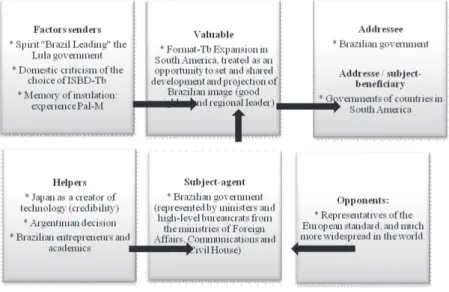
From the points of convergence between the actantial models found in the three stories analyzed, it can reach an overall design of the action understood as the campaign promoting the ISDB-Tb in South America (see Table 2). The study focuses, then, that narrative analysis training, understanding it as a synthesis of political thought that permeated the Brazilian government decisions.
Table 2 – Actancial Synthetic Model of the analyzed Stories
Senders: Political context and technological expertise as decisive factors
Factor 1: Spirit ‘Leading Brazil’ President Lula and the opportunity to project the Brazilian image
good theme of “positive agenda”, able to strengthen regional integration under the leadership role Luiz Inácio Lula da Silva sought by President and his “spirit of leading Brazil”.
André Barbosa, the campaign was also an international reaffirmation of a “less imperialistic” foreign policy, with the construction of a Brazilian image as “friendly power” neighbors. In the countries that sense, the campaign was “an indicator” of a new “policy exchange and fellowship”. In addition, the economic point of view, there was a possibility of market expansion, positive as well as importer and producer of technology associated with the Japanese standard.
Factor 2: the domestic context and response to the critics Two of the stories mention that the expansion of the ISDB-Tb standard for the continent was an unequivocal “critical” of the Brazilian decision to import the ISDB-Tb response. This is because, months earlier, the decision favorable to the ISDB-Tb had generated a strong internal challenge to the government, primarily by certain sectors of society, such as academy. Public leaders came to evaluate, then, that the choice of that standard by neighboring countries would be an “important signal to critics pattern” (Pinto Martins, 2012). Barbosa tells how the reviews (especially those of the Brazilian academic sector) to elect the ISDB-Tb was concern in the Civil House:
At that time, well, very important that teachers do not want to mention by name, UNB faculty and communications area themselves, were bitter pills of choice (standard). I showed it to the (minister) Dilma, saying, ‘look, are criticizing, and we’re going to have to face it.’
Factor 3: the fear of insulation (the memory of the experience with the PAL-M) and the opportunity to open markets
happened at the time when Brazil chose Pal-M as its standard color. Tells Vianna (2012):
I remember a comment made by the Minister Dilma in one of the meetings. She said: ‘How Brazil will be the only to adopt that system? Do other countries in the region are not going to adopt? And that question was not answered. And all of us involved with the topic, we started thinking about what happened when Brazil adopted the standard color (...) So I think one of the reasons (for the campaign) was to prevent it happening again.
valuable: expansion of ISDB-Tb as political and economic opportunity
By promoting its DTT standard among South American countries, Brazil introduced the ISDB-Tb as the “most suited to the regional reality” standard (Pinto Martins, 2012; VIANNA, 2012), a reality with a significant presence on broadcast television, and high levels of social and digital exclusion. In addition, Brazil transformed Ginga – middleware model developed for the system – free software, allowing other countries to use and develop this technology without charging copyright or patents. Thus, the Brazilian authorities reinforced their stance of seeking “partners” instead of “buyers”. Pinto Martins says (2012):
We did not go where they sell the system, as the Americans tried to sell theirs, as the European had sold theirs. We were where they have passed on experience in choosing the system. We said, ‘Look, we have invested many years in this process, we invest heavily in the process definition, and we want to share our experience’.
Pinto Martins recognizes that each country can understand from their different needs. He cites as an example the conflicting interests of Argentina (who wanted to promote the internal pole of television production) and Chile (which would ensure the election of a product with many international producers, to reduce dependence on any one country) that resulted in similar policy decisions.
Addressee: Brazilian government as a subject-agent, South American governments as subject-beneficiaries
The campaigns have started in 2006, with visits from Brazilian delegations to neighboring countries – calls roadshows by the team of diplomats that coordinated – for meetings, graphical presentations and demonstrations of technology. While delegations could eventually include representatives of businesses, parliamentarians and academics, they are raised in the reports as “supporters” of a subject-agent clearly defined: the Brazilian government and more specifically the ministries of Communications, Foreign Affairs and the Civil House, strongly influenced by the “must do”. In the speeches of Pinto Martins Vianna, the government is represented not only by bureaucrats from these organs but also by ministers and by the President Lula, as head of the action. André Barbosa, is basically personified by the three respondents mentioned here.
Reflecting a “spirit of southern priority” present in Brazilian foreign policy, the Brazilian diplomacy focused the investment promotion efforts ISDB-Tb in South America, transforming the governments of the region in the subject-beneficiaries of the campaign. Tells Vianna (2012):
Opponents and helpers: european representatives as strong competition, cyclical Argentina decision as assistant, Japan as an important assistant
Brazilian players were clear that the main opposition to the expansion of ISDB-Tb were the promoters of US technologies and the European model, whose international development is mainly founded on the consolidated and successful DVB-T on the planet. In fact, for all respondents, they were the main European representatives “competence” of the ISDB-Tb and therefore, “the hardest thing was to convince the first country” to join Brazil (PINTO MARTINS, 2012) .The Brazilian bet was that, in so far as more countries adopt the ISDB-Tb, receptivity and increase undecided neighbors. Thus, in Peru (first country visited, together with Chile, by Brazilian delegations), President Lula and Minister Helio Costa were directly involved in the negotiations (VIANNA, 2012; Pinto Martins, 2012) and this was also the first country to announce the election in favor of ISDB-Tb. But Argentina was the accession, some months later, it served as an important “watershed” in the process, becoming essential for Brazilians agents perceive that the expansion of the ISDB-Tb standard in South America was really an achievable goal. (VIANNA, 2012; PINTO MARTINS, 2012; BARBOSA FILHO, 2012). In the stories of agents, the announcement of Argentina, Brazil’s main partner in Mercosur, pointing to the evidence of a regional trend. From there, in fact, the accession of other countries pass more quickly: in just one year, eight other countries had followed the same way.
Another factor was the assistant partnership with Japan. According to Pinto Martins:
To Hadil Viana Jr., the Japanese had no initial intention of making a promotion campaign in South America ISDB-Tb. However, realizing the action – with the possibility of success – the Brazilian government, the scenario changed. Viana tells Jr:
When they realized that we went out to disclose – and perhaps get other countries to adopt the ISDB-T, they saw ‘all horses’ and helped us a lot because they have mechanisms to provide financial cooperation (countries) that we did not have.
Final Considerations
This paper makes clear that, in the contemporary world, technology and Communication issues may have a central role in strategies and foreign policy decisions of countries and vice-versa. Thus, the social sciences are challenged to an increasingly integrated and multidisciplinary issues such as the choice of a standard digital terrestrial television by a country, and its impact on citizens and governments look.
According to the stories presented here, the idea of a campaign of expansion of ISDB-Tb in South America was a “Brazilian diplomatic effort” (VIANNA 2012) and an international demonstration of its leadership. The data confirm, therefore, the hypothesis that this was a political decision of foreign policy regarding the use of Soft Power (VIANA, 2012).
However, the research also suggests that, beyond the “rational” analysis model of foreign policy decisions, there were “psychological” factors as the personality of the leader and the context in which the decision befalls (MINTZ; DE ROUEN, 2010) – that contributed strongly to propel the campaign. In other words, it is important to understand, considering the personality of President Luis Inácio Lula da Silva and the internal environment of “critical” to the ISDB-Tb as key drivers of that action.
and results clearly important for understanding the development of the television industry – the largest media segment – in South America. Such evidence should become important elements for future studies. New research should incorporate the perspectives of other key players in the process both public and private-not only in Brazil, but obviously in other countries.
In addition, the findings presented here reinforce the interdisciplinary nature of the analyzed subject, inviting researchers from various fields to a more active and profound dialogue. Finally, this paper hopes to have contributed to decrease the alarming shortage of academic about a milestone equipment – and a matter of strategic integration – Communications: the migration of the South American digital television broadcasts.
References
ANGULO, Jorge; CALZADA, Joan; ESTRUCH, Alejandro. Selection of standards for digital television: The battle for Latin America.
Telecommunications Policy, v. 35, n. 8, p.773-787, 2011.
BADILLO MATOS, A. Economía política de la comunicación, políticas públicas y estándares de televisión digital: el caso de América Latina.
Cuadernos de Información, n.31, 53-68, 2012.
BAL, Mieke; CREWE, Jonathan V.; SPITZER, Leo. Acts of memory: Cultural recall in the present. Upne, 1999.
BARBOSA FILHO, Andre. André Barbosa Filho: depoimento [set. 2012]. Entrevistadora: Angela S. Brandão. Brasília: EBC, 2012. Arquivo sonoro digital. Entrevista concedida com exclusividade para esta investigação.
BARTHES, Roland et al. Introducción al análisis estructural de los relatos.
Análisis estructural del relato, v. 4, 1977.
BRITTOS, V. C.; BOLAÑO, C. R. Políticas de comunicação, governo Lula e TV digital. Liincem Revista, v. 3, n. 2, p.90-100, 2007.
_______. Modelos Internacionales de TDT: La política y los lobbies pueden a frustrar las expectativas de diversidad. Diálogos de la Comunicación, v. 77, p.1-23, deciembre de 2008.
CABRAL, E. D.; CABRAL FILHO, A. V. TV Digital terrestre no Brasil: oportunidades perdidas. Cuadernos de Información, v. 31, p.89-100, deciembre de 2012.
COUTAIN, B. Cosmopolitan power in international relations: a synthesis of realism, neoliberalism, and constructivism.Journal of Political Power.v. 4, n.1, p.150-155, 2011.
CRUZ, Renato B. Fora da Caixa: o processo de decisão sobre o sistema de TV digital no Brasil.2006. Tese de doutorado. São Paulo: Universidade de São Paulo.
GALLAROTTI, Giulio M. Cosmopolitan power in international relations:
a synthesiso frealism, neoliberalism, and constructivism. Cambridge University Press, 2010.
GALPERIN, Hernan. Comunicación e integración en la era digital: un balance de la transición hacia la televisión digital en Brasil y Argentina.
Comunicación y Sociedad, n. 1, p.30-51, 2004a.
GALPERIN, Hernan. New television, old politics: the transition to digital TV in the United States and Britain. Cambridge UniversityPress, 2004b.
GENETTE, G. Figuras III. Editora Lumen. Barcelona, 1989. ISBN 84-264-2358-2.
GÓMEZ LORENZINI, M. P. Chile 2000-2006: La propuesta Política del Presidente Ricardo Lagos.Análisis Semiótico de los Mensajes a la Nación.2009.Tese de doutorado. Madrid: Universidad Complutense de Madrid.
GRATIUS, Susanne. Brasil en las Américas:¿ Una potencia regional pacificadora?. Documentos de Trabajo FRIDE, n.35, p.1, 2007.
HERMANN, D. Storytelling and the sciences of mind: Cognitive narratology, discursive psychology, and narratives in face-to-faceiInteraction.. Narrative, v.15, n.5, p.306-334, 2007.
LEAHY, J. Brazil: the first big soft power. Financial Times. 22 de February de 2013. Available in: http://www.ft.com/intl/cms/s/2/37685ª5c-7bbd-11e2-95b9-00144feabdc0.html#axzz2TxX4qf3L. Consulted on: May.2./2013.
MINTZ, Alex; DEROUEN, Karl. Understanding foreign policy decision making. Cambridge University Press, 2010.
NYE, Joseph S. Public diplomacy and soft power.The Annals of the American Academy of Political and Social Science, v. 616, n. 1, p.94-109, 2008.
PINTO MARTINS, Roberto. Roberto Pinto Martins: depoimento [set. 2012]. Entrevistadora: Angela S. Brandão. Brasília: ANATEL, 2012. Arquivo sonoro digital. Entrevista concedida com exclusividade para esta investigação.
VIANNA, Hadil da Rocha. Hadil da Rocha Vianna: depoimento [set. 2012]. Entrevistadora: Angela S. Brandão. Brasília: MRE, 2012. Arquivo sonoro digital. Entrevista concedida com exclusividade para esta investigação.
ZIMMERMANN, P. Após vazamento, Costa diz que vai divulgar relatório sobre TV Digital. Folha de S. Paulo, 16 de fevereiro de 2006. Available in:: http://www1.folha.uol.com.br/folha/dinheiro/ult91u105318.shtml. Consulted on: Oct.15. 2013.
_______. Conversor do modelo japones da TV digital é o mais caro, diz CPqD. Folha de S. Paulo.Brasilia, 16 de febrero de 2006. Available in: http:// www1.folha.uol.com.br/folha/dinheiro/ult91u105324.shtml. Consulted on: Oct.15. 2013.
Angela S. Brandão
PhD candidate in Communication Sciencies at Pontifícia Universidad Católica de Chile. Master’s in Communication Sciencies for the same university. MBA in Digital Television and New Media from the Universidade Federal Fluminense (UFF), Rio de Janeiro (Brazil). Journalist graduated from PUC – Rio. Communication Legislative Analist in the Federal Senate of Brazil since 1998. Her interests include political Communication, digital television, new media, docudramas and mediatization. She published articles in indexed journals in the Communicational area, among them, Cuadernos.info (Scopus) and Mass Communication and Society (ISI). Email: [email protected]