a scientometrical view of the main trends and gaps
Padial, AA.
a, Bini, LM.
a* and Thomaz, SM.
b*
aDepartamento de Biologia Geral, Instituto de Ciências Biológicas,
Universidade Federal de Goiás – UFG,
Rodovia Goiânia-Nerópolis, Km 5, Setor Itatiaia, Campus II, CEP 74001-970, Goiânia, GO, Brazil
bNúcleo de Pesquisa em Limnologia, Ictiologia e Aqüicultura – Nupélia,
Universidade Estadual de Maringá – UEM,
Av. Colombo, 5790, Jardim Universitário, CEP 87020-900, Maringá, PR, Brazil *e-mail: [email protected], [email protected]
Received September 21, 2008 – Accepted September 21, 2008 – Distributed November 30, 2008 (With 9 figures)
Abstract
Aquatic macrophytes comprises a diverse group of organisms including angiosperms, ferns, mosses, liverworts and some macroalgae that occur in seasonally or permanently wet environments. Among other implications, aquatic mac-rophytes are highly productive and with an important structuring role on aquatic environments. Ecological studies involving aquatic plants substantially increased in the last years. However, a precise view of researches devoted to aquatic macrophytes in Neotropics is necessary to reach a reliable evaluation of the scientific production. In the cur-rent study, we performed a scientometrics analysis of the scientific production devoted to Neotropical macrophytes in an attempt to find the main trends and gaps of researches concerning this group. The publication devoted to macro-phytes in Neotropics increased conspicuously in the last two decades. Brazil, Argentina, Mexico and Chile were the most productive among Neotropical countries. Our analyses showed that the studies dealt mostly with the influences of aquatic macrophytes on organisms and abiotic features. Studies with a predictive approach or aiming to test eco-logical hypothesis are scarce. In addition, researches aiming to describe unknown species are still necessary. This is essential to support conservation efforts and to subsidize further investigations testing ecological hypotheses.
Keywords: macrophytes, Neotropics, scientometrics, trends, lacks.
O estudo de macrófitas aquáticas na região neotropical:
uma visão cienciométrica dos principais padrões e lacunas
Resumo
Macrófitas compreendem um diverso grupo de organismos macrofíticos, incluindo angiospermas, samambaias, musgos, hepáticas e algumas macroalgas que ocorrem em ambientes sazonalmente ou permanentemente inundados. Dentre outras implicações, as macrófitas aquáticas são altamente produtivas e com um importante papel na estrutu-ração nos ambientes aquáticos. Estudos ecológicos envolvendo plantas aquáticas cresceram substancialmente nos últimos anos. Entretanto, uma visão precisa das pesquisas sobre macrófitas na região Neotropical é necessária para uma avaliação confiável da produção científica. No presente estudo, uma análise cienciométrica sobre macrófitas Neotropicais foi realizada com o intuito de identificar os principais padrões e lacunas nas pesquisas sobre esse grupo biológico. As publicações sobre macrófitas na região Neotropical cresceu conspicuamente nas últimas duas décadas. Brasil, Argentina, México e Chile foram os mais produtivos dentre os países Neotropicais. As análises mostraram que os estudos enfocaram principalmente as influências das macrófitas nos organismos e nas características abióticas. Estudos com uma abordagem preditiva ou testando hipóteses ecológicas são escassos. Adicionalmente, pesquisas com o objetivo de descrever espécies desconhecidas ainda são necessárias. Isso é essencial para subsidiar esforços de conservação e investigações futuras testando hipóteses ecológicas.
publications about aquatic macrophytes in Neotropical ecosystems are essential to the progress of this relevant research field.
In a critical analysis using papers published until 2000, Thomaz and Bini (2003) highlighted that papers about aquatic plants in Brazil were scarce. On the other hand, these authors showed a rapid growth on the number of papers, mainly after the 80’s. Accordingly, the scien-tific production of Latin America also increased steeply in the last twenty years (Hill, 2004). In addition, lim-nological studies clearly increased in Brazil after 1970 (Melo et al., 2006). In spite of many trends detected by Thomaz and Bini (2003) regarding aquatic macrophytes, the investigation was done just in studies carried out in Brazil. Thus, an evaluation of publications of the whole Neotropics is still necessary.
In a recent review, Chambers et al. (2008) argue that the overall diversity of aquatic plants is highest in Neotropics. However, these authors also affirm that there are unknown species to be described, mainly in tropical areas, impairing estimations of species richness and geo-graphic distribution. Accordingly, the knowledge of bio-diversity is inadequate and plagued by Linnean (i.e. that species not yet formally described) and Wallace (i.e. that for most taxa the geographic distribution is still poorly understood) pitfalls (Bini et al., 2006). These authors ar-gue that the best way to circumvent both Wallacean and Linnean pitfalls is to invest in biodiversity inventories, but due to increasing threats, the use of biodiversity sur-rogates could be a way to select priority areas for con-servation when data on species distributions are lacking. This highlights the importance and urgency of an evalu-ation of ecological studies of aquatic macrophytes in this region. Moreover, this appraisal could subsidize biodi-versity conservancy efforts, since macrophytes are key for conservation of several aquatic (e.g., fish and inver-tebrate) and even terrestrial (e.g., mammals and birds) organisms.
In the current study, we performed a scientomet-ric analysis of the scientific production devoted to Neotropical macrophytes in an attempt to find the main trends and gaps of researches devoted to this group. Specifically, we asked the following questions: i) how fast is increasing the scientific production on macro-phytes in the Neotropical region? ii) Where are the stud-ies being conducted and how frequent is scientific co-operation? iii) Where are these results being published? and iv) What are the main characteristics and gaps of the scientific production on Neotropics regarding aquatic habitats, macrophyte life forms, approaches (e.g. ex-perimental, observational or theoretical), and levels of organization?
2. Methods
The analysis was based on abstracts of papers pub-lished between 1991 and April 2007. We used datasets from the Thomson Institute for Scientific Information
1. Introduction
The Danish book “Lagoa Santa. Et Bidrag til den biologiske Plantegeografi”, is one of the first publi-cation concerning Neotropical aquatic macrophytes (Thomaz and Bini, 2003). This classical book was pub-lished in 1892 by Eugene Warming who is considered by Arthur Tansley “the father of the modern plant ecol-ogy” (Godwin, 1977). The systematic, distribution, phy-togeography and ecology of the terrestrial vegetation surrounding Santa Lagoon were the main issues of this book. However, Warming also described the aquatic and amphibian vegetation of this lagoon in details, making the first inferences about aquatic plant zonation and suc-cession.
The aquatic plant community (or macrophytes) com-prises a diverse group of macrophytic organisms includ-ing angiosperms, ferns, mosses, liverworts and some freshwater macroalgae that occur in seasonally or perma-nently wet environments (Lacoul and Freedman, 2006; (Chambers et al., 2008). Commonly, four morphotypes (or life forms) are used to classify aquatic macrophytes: submerged, floating-leaved, emergent and free-floating (Sculthorpe, 1985). These plants are capable of coloniz-ing several kinds of aquatic environments (e.g. lakes, la-goons, wetlands, rivers, reservoirs, waterfalls and even bromeliad tanks) with a wide range of limnological fea-tures, presenting high plasticity and adaptation ability (Sculthorpe, 1985; Esteves, 1998). In fact, when grow-ing in suitable habitats several species are considered aquatic weeds due to massive colonization and negative effects upon aquatic diversity and ecosystem functioning (Camargo et al., 2003).
Among other implications, aquatic macrophytes are known as highly productive (Wetzel, 2001) and with an important structuring role on aquatic environments (Jeppensen et al., 1998; Dibble and Harrel, 1997). This is extremely relevant, since aquatic biodiversity has been related to spatial heterogeneity (Grenouillet et al., 2002). Thus, ecological studies carried in aquatic environments must consider the aquatic macrophyte community as an essential component for ecosystem functioning and aquatic biodiversity conservation.
Ecological studies involving aquatic plants substan-tially increased just after the 60’s, following the increase of studies in shallow ecosystems, globally more numer-ous in comparison to deep aquatic environments (Esteves 1998; Wetzel, 2001; Thomaz and Bini, 2003). However, a precise view of ecological studies using aquatic mac-rophytes is necessary to reach a reliable evaluation of the scientific production.
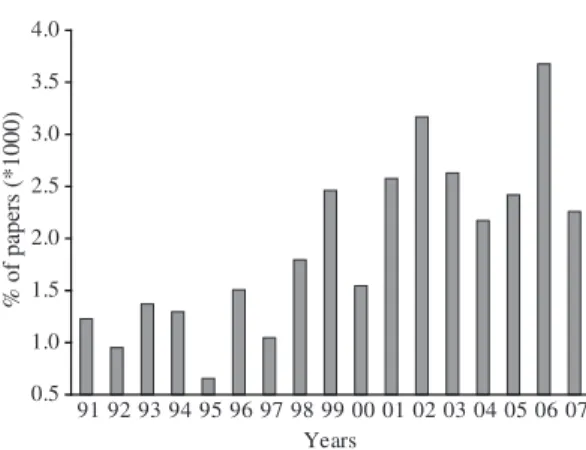
system functioning by Neotropical limnologists can be one reason for this faster increase. In fact, Wetzel (2001) argued that the aquatic macrophyte community can be considered one of the most productive communities in the world. Another reason for the ascendant interest in aquatic plants can be related with the recent focus on the structuring role of macrophytes in aquatic habitats. This spatial structure provides refuge against predators and suitable spawning and foraging substrate, hanging more individuals and species of invertebrate and fish (Lansac-Tôha et al., 2003; Takeda et al., 2003; Pelicice et al., 2005), hence, promoting biological diversity. Finally, problems caused by the excessive growth of aquatic veg-etation, especially in reservoirs can also be another fac-tor accounting for this trend (Thomaz and Bini, 2003).
Most of the 382 papers have at least one author from Brazil (n = 185; 48% of the papers), Argentina (n = 92; 24%) and Mexico (n = 50; 13%) (Figure 2a). Accordingly, even considering authors from other coun-tries, studies were also frequently conducted in these three countries (Brazil: n = 169; 44%; Argentina: n = 85; 22%; Mexico: n = 40; 10%) (Figure 2b). An explanation is that these countries are the three largest economies among Neotropical countries (World Bank, 2007). In fact, high scientific production is associated with eco-nomic development (May, 1997). Additionally, consider-ing the whole scientific production of Latin America, pre-vious investigations demonstrated that Brazil, Mexico, Argentina and Chile were the more productive countries (Hill, 2004; Hermes-Lima et al., 2007). Furthermore, in a study evaluating the scientific impact of nations, Brazil was the only Neotropical country among the 31 most im-portant countries worldwide, occupying the 20th position in number of published papers (King, 2004). Thomaz and Bini (2003) stressed that the variety of environments is also an important factor accounting for the interest on aquatic macrophytes in Brazil.
(ISI) (www.isiknowledge.com) and Scopus (www.sco-pus.com). The papers were selected using the following combination of words on the search field: “aquatic plant* or macrophyte* or aquatic weed*”. After this, only the pa-pers authored by researchers from Neotropical countries (Mexico, Mesoamerican countries and South American countries) were selected by using the information on the country of affiliation of the authors. The scientific pro-duction per year was also recorded to calculate the per-centage of papers concerning macrophytes in Neotropics in relation to total number of papers. The title, abstract, author addresses, publication years and publication jour-nals were recorded for our analyses. Further information to address our questions were taken from abstracts:
i) Ecosystem type: Lakes/lagoons, rivers/streams, reservoirs, wetlands, marine habitats, artificial garden and cenotes (a type of water body found mainly in Venezuela formed in limestone sink-holes).
ii) Aquatic macrophyte ecological groups: sub-merged, emergent, rooted with floating-leaves, and free-floating;
iii) Level of ecological organization: ecosystem, com-munity, population, individual;
iv) Type of study (that reflects how data were collect-ed): survey, experimental (macro, meso or micro scale), taxonomical, modeling and review; and v) Main subject: influences of the environment upon
aquatic macrophytes (including studies aiming the management of macrophyte populations and com-munities), influences of other communities upon aquatic macrophytes, influences of aquatic mac-rophytes upon the environment and other com-munities, plant features, community description, taxonomy, primary production, evolution, paleo-climate description, diversity estimation, fossil de-scription, commercial use and methods to estimate growth rate. Since some abstracts did not provide all information, the number of papers analyzed concerning each variable varied.
3. Results and Discussion
A total of 382 papers were analyzed, considering the criteria delineated in our Methods. The total number of papers increased conspicuously in the last two decades (11 in 1990 to 52 in 2006). This tendency is coherent with the clear enhancement in the Latin American scien-tific production over the last decade (Hill, 2004; Hermes-Lima et al., 2007). Melo et al. (2006) also demonstrated an augmentation of Brazilian publication in international journals between 1970 and 2004.
It is important to note that not only the total number of papers, but also the percentage of papers (in relation to the total scientific production) concerning aquatic macrophytes in Neotropics indexed in Scopus and ISI increased steeply from 1991 to 2006 (Figure 1). The rec-ognition of the importance of aquatic plants on the
eco-91 92 93 94 95 96 97 98 99 00 01 02 03 04 05 06 07 Years
0.5 1.0 1.5 2.0 2.5 3.0 3.5 4.0
% of papers (*1000)
Figure 1. Percentage ( in relation to total scientific
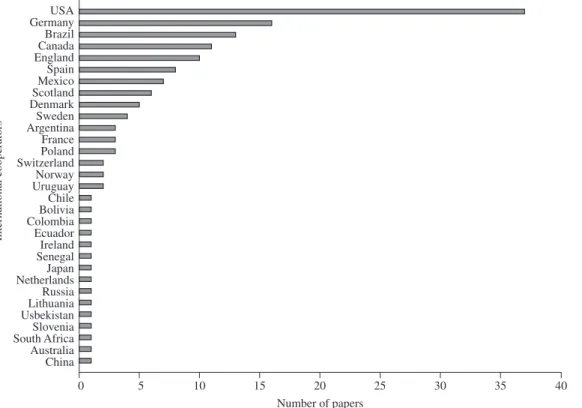
Almost one third of the papers (147 out of 382) were done by researchers of at least two different coun-tries (what indicates international cooperation). The country with more cooperation with Neotropical na-tions was the United States of America (n = 37, 25% of the papers) (Figure 3). This is not a surprise, since this is the country with more scientific expression world-wide (Hermes-Lima et al., 2007). In addition, USA is located in the same continent, what probably facilitates the cooperation with Neotropical countries. Melo et al. (2006) also showed that USA was the country with more cooperation in limnological articles published by Brazilians. Germany had also a large cooperation (n = 16, 11% of the papers) (Figure 3), probably due to the historical importance of this country in modern Limnology (Esteves, 1998). It is also interesting to note that Brazil had some cooperation with other Neotropical countries (n = 13, 9% of the papers) (Figure 3), high-lighting the leadership of this country concerning pub-lications about macrophytes in Neotropics. Besides Brazil, other seven Neotropical countries presented co-operation (Mexico, Argentina, Uruguay, Chile, Bolivia, Colombia and Ecuador), but all with relatively lower importance (<5% of the papers each) (Figure 3). This suggests that international cooperation of Neotropical countries among themselves is still not conspicuous and should be stimulated.
A great variety of journals (150) were used to pub-lish studies on aquatic plants and “Hydrobiologia” 0 20 40 60 80 100 120 140 160 180 200
Brazil Argentina Mexico Chile Uruguay Venezuela Colombia Cuba Belize Bolivia Peru Ecuador Paraguay Costa Rica Dom Rep Jamaica Nicaragua
A
uth
or
sh
ip
0 20 40 60 80 100 120 140 160 180 200 Number of papers
Brazil Argentina Mexico Chile Several Uruguay Venezuela Colombia Belize Cuba Ecuador Bolivia Nicaragua Peru Costa Rica Dom Rep Paraguay Jamaica
Studied Countries
a
b
Figure 2. Distribution of a) authorship and b) country of
study (n = 382) of studies concerning macrophytes in Neo-tropics. Dom Rep = Dominican Republic. Several = studies realized in more than one country.
0 5 10 15 20 25 30 35 40
Number of papers USA
Germany Brazil Canada England Spain Mexico Scotland Denmark Sweden Argentina France Poland Switzerland Norway Uruguay Chile Bolivia Colombia Ecuador Ireland Senegal Japan Netherlands Russia Lithuania Usbekistan Slovenia South Africa Australia China
International cooperators
ward more scarce or rare ecosystems, but they are rather carried in the most common type of ecosystem. Lakes and lagoons (n = 70, 26% of the papers) were other eco-system types highly studied. In addition, although not informed in the abstracts, if we consider the studies car-ried in lagoons, we would possibly reach the conclusion that these habitats are shallows and located in wetlands. In fact, Esteves (1998) stressed the high abundance of floodplain shallow lagoons in Neotropics, compared to deep lakes, mostly found in temperate regions. Rivers (and streams) (n = 42, 15% of the papers) and reservoirs (n = 27, 10% of the papers) were at an intermediate posi-tion (Figure 5). Thomaz and Bini (2003) also recorded few articles studying aquatic macrophytes in Brazilian rivers. According to these authors, the variation in hy-drological levels, high turbidity and flow velocity of Brazilian lotic ecosystems limit the development of mac-rophytes in river main channels, what is a probable cause for the small number of studies in these ecosystems. However, they emphasize that there are some fascinat-ing exceptions, since the aquatic flora is well developed in some rivers (e.g. in the Serra da Bodoquena region; was the main one, publishing ca. 16% of the papers
(Figure 4). This journal was also the favorite by interna-tional Brazilian articles on limnology until 2004 (Melo et al., 2006). Aquatic Botany was the second journal in number of papers concerning aquatic macrophytes in Neotropics (Figure 4). As it is a specific journal in the field, this seems to be the most reasonable choice. In spite of this, “Hydrobiologia”, which publishes articles in all sub-fields of Limnology with no bias regarding organisms (Melo et al., 2006), had more papers about macrophytes in Neotropics. The great variety of journals suggests that aquatic plants have been studied for several purposes beyond biology or ecology. For example, there were some articles published in medical journals, since many species have been pointed as shelters for disease vectors, or even have been used in medicine.
Concerning the type of ecosystem investigated, almost a half of the studies were carried in wetlands (n = 119, 44% of the papers) (Figure 5). Wetlands are numerous and occupy large areas in Neotropics (Esteves, 1998) what can explain this tendency. These results in-dicate that studies with macrophytes are not biased
to-0 20 40 60 80 100 120 140 160 180 200
Number of papers Others
ActSci EcoFresFis EnBioFis JouVecEco MarEcoPS WatAiSoPo Wetlands Amazon FisMaEco SciTotEn FreshBio WatRes Chemos StNeoFa Interc ArchfHy WatSci BrArch AqBot Hydro
Sources
Figure 4. Journals indexed in Scopus and ISI used to publish studies concerning aquatic macrophytes in Neotropics
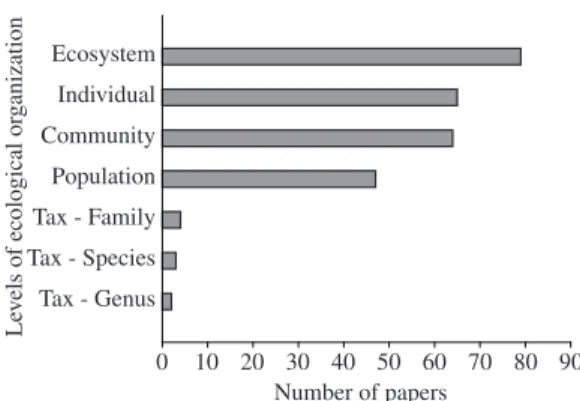
(e.g. Neiff, 1990; Junk, 1997; Esteves, 1998). Studies at individual (n = 65, 25% of the papers) and community (n = 64, 24% of the papers) levels appeared with almost the same importance (Figure 7). Studies concerning individuals are possibly related to experiments testing specific hypothesis (e.g. Menone et al., 2005). On the other hand, studies at community level frequently aim to evaluated patterns in the distribution of the abundance and in the diversity of plant communities, as well as the environmental variables affecting these metrics (e.g. Rolon and Maltchik, 2005). These studies are essential nowadays, since they can support conservation efforts. However, taxonomic studies are still extremely scarce (only nine articles; Figure 7). This is strikingly, since taxonomy is a central issue for ecological and conser-vational researches (Brandon et al., 2005). Moreover, a reliable assessment of the biological diversity is only reached by improving taxonomical knowledge (Brandon et al., 2005). In fact, as mentioned earlier, Chambers et al. (2008) highlighted the problem of unknown species in tropical areas to species richness estimations. Scremin-Dias et al., 1999). The studies conducted in
res-ervoirs are probably related to the problems that aquatic macrophytes cause due to excessive growth. Accordingly, excessive growth of aquatic plants in reservoirs has been extensively reported (Thomaz et al., 2003). Finally, few articles also studied aquatic macrophytes in marine en-vironments (n = 13, 5% of the papers), artificial garden (n = 1, 0.4% of the papers) and cenotes (n = 1, 0.4% of the papers) (Figure 5). The low number of papers in marine environments is surprisingly, since Brazil has a wide coastal shoreline (more than 8,000 km wide) with a great variety of habitats (e.g. beaches, swamps, reefs, bays, coastal lagoons) that support high biological diver-sity (Ab’sáber, 2001).
Submerged, free-floating and emergent macrophytes received almost equal attention and were relatively more investigated than floating-leaved plants (n = 94, 30% of the papers; n = 91, 29% of the papers; n = 85, 27% of the papers; n = 11, 3% of the papers; respectively) (Figure 6). Submerged aquatic plants probably received high atten-tion due to the important structuring role that this group provides in aquatic habitats (Jeppensen et al., 1998). Also, submerged, together with free-floating aquatic plants, are targets of interest in impacted habitats such as reservoirs, since they can cause serious troubles for energetic pro-duction and water use (e.g. Thomaz et al., 2003; Aguilar et al., 2003; Marcondes et al., 2003). Furthermore, free-floating aquatic macrophyte species are highly produc-tive in suitable environments (Cook, 1990; Carignan and Neiff, 1994; Talling and Lemoalle, 1999). Emergent aquatic macrophytes are also highly studied, possibly due to the importance of this plants that may have extremely high primary production (Piedade et al., 1991).
The majority of studies using aquatic macrophytes were carried out following an ecosystemic approach (n = 69, 30% of the papers) (Figure 7). This could also be explained by the high importance of aquatic plant com-munities for the production of organic matter (Piedade et al., 1991). Additionally, the historical roots of limnol-ogy in Neotropical regions are strongly correlated to in-vestigations about ecosystem processes and functioning
0 20 40 60 80 100 120 140
Number of Papers Wetlands
Lakes/Lagoons
Rivers/Streams
Reservoir
Marine
Artificial Garden
Cenotes
Ecosystem type
Figure 5. Ecosystem type studied in papers concerning
aquatic macrophytes in Neotropics and indexed in Scopus and ISI between 1991 and 2007 (n = 273).
0 10 20 30 40 50 60 70 80 90 100 Number of papers
Submerged
Free-floating
Emergent
All
Floating-leaves
Aquatic macroph
yte groups
Figure 6. Number of studies carried out in Neotropical
re-gions with different groups of aquatic plants (n = 315).
0 10 20 30 40 50 60 70 80 90 Number of papers
Ecosystem Individual Community Population Tax - Family Tax - Species Tax - Genus
Le
vels of ecological or
ganization
Figure 7. Level of ecological organization used in papers
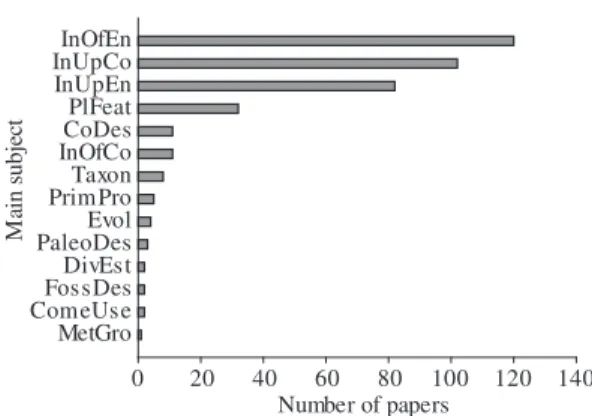
concerning the management and control of macrophytes. Influences of aquatic macrophyte on other communities was another subject highly investigated (n = 102, 24%) (Figure 9). This highlights especially the recognition of the role of aquatic plants as key components for the bio-diversity of aquatic ecosystems (Jeppensen et al., 1998). Another subject highly investigated was the influences of aquatic macrophytes on the environment (n = 82, 21%) (Figure 9). The high attention of this subject reflects the recognition that macrophytes cause strong changes in aquatic ecosystems (e.g., changing water and sediment pH, concentrations of gases and nutrients) and to the common use of aquatic plants on waste water treatments (e.g. Henry-Silva and Camargo, 2006). Plant features (such as chemical composition) had an intermediate in-terest (n = 36, 8%) (Figure 9). The other subjects were all less studied (< 4%) (Figure 9). Again, it is interest-ing to note the scarcity of papers dealinterest-ing with taxonomy (n = 8, 2%), community description (n = 11, 3%) and estimation of diversity (n = 2, 0.5%). This observation is shocking in Neotropical regions, since this region con-tain seven hotspots (global priority conservation areas) out of the 25 postulated by Myers et al. (2000) and the knowledge (or estimation) of biodiversity is essential to subsidize conservation efforts. Finally, it is also worth to note the lack of investigations directed to “hot” fields of Ecology, such as the impacts of invasive species, the role of plants as foundation species (mechanism of facilita-tion) and the debates on stability and diversity-ecosystem functioning, among others.
Surveys were the preferable approach in studies about aquatic plants in Neotropical regions (n = 254, 67% of the papers) (Figure 8). According to Peters (1991), theories/hypothesis is firstly generated through observa-tional studies. The test of these hypotheses could be done by experiments could be then reached by experiments. Thus, our results concerning studies of macrophytes in Neotropics indicate that most investigations are still car-ried in a preliminary way. Accordingly, experiments that complement surveys on the knowledge construction, in any spatial scale, are still rarely carried (Experiment in microscale: n = 64, 17% of the papers; Experiment in mesoscale: n = 19, 5%; Experiment in macroscale: n = 19, 5%) (Figure 8). However, taxonomic studies, the basic step for any ecological study, are also scarce (n = 9, 2%) (Figure 8). In fact, Irgang and Gastal Jr (2003) pointed the lack of taxonomical studies in Brazil. These authors stress that this lead to several doubts about the geographic distribution of species and argue that inves-tigations are essential to describe new species in threat-ened areas. Thus the study of aquatic macrophytes in Neotropical regions still needs basic researches to pro-vide scientific progress. The low number of articles us-ing modelus-ing techniques and articles of review (Figure 8) highlights the primitivism of the investigations carried with this community, since these approaches need ba-sic researches to be applied. Moreover, these approaches have a predictive power, and therefore, are also essential in conservation efforts (Pace, 2001).
Concerning the subjects investigated, the major-ity of studies evaluated the influences of environment (response to limnological features) on aquatic macro-phyte populations and communities (n = 120, 31%) (Figure 9). This indicates the concern of the researches in identifying the main variables affecting aquatic plant growth, decomposition and community structure (e.g. Rolon and Maltchik, 2005; Padial and Thomaz, 2006). Additionally, these papers were also related to studies
0 40 80 120 160 200 240 280
Number of papers Survey
ExpMi
ExpMa ExpMe Taxonomic
Modeling Review
Study type
Figure 8. The number of papers on aquatic macrophytes
published in the period 1991-2007 using different ap-proaches (see classifications in Methods section; n = 381). ExpMi = Experiment in microscale; ExpMa = Experiment in macroscale; ExpMe = Experiment in mesoscale.
0 20 40 60 80 100 120 140
Number of papers InOfEn
InUpCo InUpEn PlFeat CoDes InOfCo Taxon PrimPro Evol PaleoDes DivEst FossDes ComeUse MetGro
M
ai
n
su
bj
ec
t
Figure 9. Main subjects of the papers concerning aquatic
CHAMBERS, PA., LACOUL, P., MURPHY, KJ. and THOMAZ, SM., 2008. Global diversity of aquatic macrophytes in freshwater. Hydrobiologia, vol., 595, no. 1, p. 9-26. COOK, CDK., 1990. Aquatic plant book. The Netherlands: SPB Academic, The Hague. 228 p.
DIBBLE, ED. and HARREL, SL., 1997. Largemouth diet in two aquatic plant communities. J. aquat. plant manage., vol. 35, julho, p. 74-78.
ESTEVES, FA., 1998. Fundamentos de Limnologia. 2 ed. Rio de Janeiro: Interciência. 602 p.
GODWIN, H., 1977. Sir Arthur Tansley: the man and the subject. J. ecol., vol. 65, no. 1, p. 1-26.
GRENOUILLET, G., PONT, D. and SEIP, KL., 2002. Abundance and species richness as a function of food resources and vegetation structure: juvenile fish assemblages in rivers. Ecography, vol. 25, no. 6, p. 641-650.
HENRY-SILVA, GG. and CAMARGO, AFM., 2006. Chemical composition of floating aquatic macrophytes used to treat of aquaculture wastewater. Planta daninha, vol. 24, no. 1, p. 21-28.
HERMES-LIMA, M., SANTOS, NCF., ALENCASTRO, ACR. and FERREIRA, ST., 2007. Whither Latin America? Trends and Challenges of Science in Latin America. IUBMB Life, vol. 59, no. 4, p. 199-210.
HILL, DL., 2004. Latin America shows rapid rise in S&E articles. InfoBrief-NSF 04-336. p. 1-9. Available from: <http://www.nsf. gov/sbe/srs/infbrief/nsf04336/start.htm>. [14. 08. 2007].
IRGANG, BE. and GASTAL-JUNIOR, CVS., 2003. Problemas taxonômicos e distribuição geográfica de macrófitas aquáticas do sul do Brasil. In: THOMAZ, SM. and BINI, LM. (Eds.). Ecologia e manejo de macrófitas aquáticas. Maringá: Eduem. p. 163-170.
JEPPESEN, E., SØNDERGAARD, MA., SØNDERGAARD, MO. and CRISTOFFERSEN, K., 1998. The structuring role of submerged macrophytes in lakes. New York: Springer. 423 p. JUNK, WJ., 1997. The central Amazon floodplain: ecology of a pulsing system. Berlim: Springer. 520 p.
KING, DA., 2004. The scientific impact of nations. Nature, vol. 430, no. 6997, p. 311-316.
LACOUL, P. and FREEDMAN, B., 2006. Environmental influences on aquatic plants in freshwater ecosystems. Environ. rev., vol. 14, no. 2, p. 89-136.
LANSAC-TÔHA, FA., VELHO, LFM. and BONECKER, CC., 2003. Influência de macrófitas aquáticas sobre a estrutura da comunidade zooplanctônica. In THOMAZ, SM and BINI, LM (Eds). Ecologia e manejo de macrófitas aquáticas. Maringá: Eduem. p. 231-242.
MARCONDES, DAS., VELINI, ED., MARTINS, D., TANAKA, RH., CARVALHO, FT., CAVENAGHI, AL. and BRONHARA, AA., 2003. Eficiência de fluridone no controle de plantas aquáticas submersas no reservatório de Jupiá. Planta Daninha, vol. 21, p. 69-77. Available from: http://www.scielo.br/scielo. php?script=sci_arttext&pid=S0100-83582003000400010.
MAY, RM., 1997. The scientific wealth of nations. Science, vol. 275, no. 5301, p. 793-796.
The scientometrics research can be considered the area of research that utilizes information contained in publications to obtain a scientific output of its trends and lacks (Verbeek et al., 2002). Based on scientomet-rics, our investigation helped us to identify several pat-terns and gaps in the study of aquatic macrophytes in Neotropical regions. Despite the rapid growth in number of publications about this community, which was even faster than in other areas of limnology, there are rela-tively few articles and the majority of the studies were carried in a few countries. In addition, the cooperation among Neotropical countries is still scarce. In general, our analyses showed that the studies dealt mostly with the influences of aquatic macrophytes on organisms and abiotic features. Although these approaches are adequate for macrophytes, they usually lack a deeper conceptual framework necessary to be included in “hot” areas of Ecology. Together with these investigations, basic re-searches aiming to describe unknown species are also necessary. In consequence, studies with a predictive approach or aiming to test ecological hypothesis, essen-tial to direct conservation efforts, are also rare. In fact, biodiversity inventories (a basic research) and the use of biodiversity surrogates (an approach to predict biologi-cal diversity) are the best ways to select priority areas for conservation (Bini et al., 2006). Hence, our results showed the paucity of studies on macrophyte biodiver-sity, essential to support conservation efforts and to sub-sidize further investigations testing ecological hypoth-eses.
Acknowledgements — A. A. Padial receives a student fellowship from Coordenação de Aperfeiçoamento de Pessoal de Nível Superior (CAPES). L. M. Bini and S. M. Thomaz are researchers of the Brazilian Council of Research (CNPq) and acknowledge this agency for long-term funding.
References
AB’SÁBER, AN., 2001. Litoral do Brasil. São Paulo: Metalivros. 289 p.
AGUILAR, JÁ., CAMARENA, OM., CENTER, TD. and BOJORQUEZ, G., 2003. Biological control of water hyacinth in Sinaloa, Mexico with the weevils Neochetina eichhorniae and N. bruchi. Biocontrol, vol. 48, no. 5, p. 595-608.
SCREMIN-DIAS, E., POTT, VJ., HORA, RC. and SOUZA, PR. (Org.), 1999. Nos jardins submersos da Bodoquena: guia para identificação de plantas aquáticas de Bonito e região. Campo Grande: Ed. UFMS. 160 p.
SCULTHORPE, CD., 1985. The biology of aquatic vascular plants. Königstein-West Germany: Koeltz Scientific Books. 597 p.
TAKEDA, AM., SOUZA-FRANCO, GM., MELO, SM. and MONKOLSKI, A., 2003. Invertebrados associados às macrófitas aquáticas da planície de inundação do alto rio Paraná. In THOMAZ, SM and BINI, LM. (Eds.). Ecologia e manejo de macrófitas aquáticas. Maringá: Eduem. p. 243-260.
ALLING, JF. and LEMOALLE, J., 1998. Ecological Dynamics of Tropical Inland Waters. Cambridge: Cambridge University Press. 441 p.
THOMAZ, SM. and BINI, LM., 2003. Análise crítica dos estudos sobre macrófitas aquáticas desenvolvidos no Brasil. In THOMAZ, SM and BINI, LM (Eds). Ecologia e manejo de macrófitas aquáticas. Maringá: Eduem. p. 19-38.
THOMAZ, SM., BINI, LM. and PAGIORO, TA., 2003. Macrófitas aquáticas em Itaipu: ecologia e perspectivas de manejo. In THOMAZ, SM and BINI, LM (Eds). Ecologia e manejo de macrófitas aquáticas. Maringá: Eduem. p. 319-341. VAN RAAN, AFJ., 1997. Scientometrics: State-of-the-Art. Scientometrics, vol. 38, no. 1, p. 205-218.
VERBEEK, A., DEBACKERE, K., LUWEL, M. and ZIMMERMANN, E., 2002. Measuring progress and evolution in science and technology. I: the multiple uses of bibliometric indicators. Int. j. manage. rev., vol. 4, no. 2, p. 179-211. WETZEL, RG., 2001. Limnology: Lake and River ecosystems. 3 ed. Philadelphia: Academic Press. 1006 p.
WORLD BANK, 2007. 2007 World Development Indicators database. Available from: <http://siteresources.worldbank.org/ DATASTATISTICS/Resources/GDP.pdf>. [10. 08. 2007]. MELO, AS., BINI, LM. and CARVALHO, P., 2006. Brazilian
articles in international journals on Limnology. Scientometrics, vol. 67, no. 2, p. 187-199.
MENONE, ML., STEINBERG, CEW. and PFLUGMACHER, S., 2005. Evaluation of photosynthetic oxygen production, pigment pattern, glutathione content and detoxication enzymes activity in the aquatic macrophyte Ceratophyllum demersum exposed to cypermethrin. J. appl. bot. food qual., vol. 79, no. 2, p. 77-82.
MYERS, N., MITTERMEIER, RA., FONSECA, GAB. and KENT, J., 2000. Biodiversity hotspots for conservation priorities. Nature, vol. 403, no. 6772, p. 853-858.
NEIFF, JJ., 1990. Ideas para la interpretacion ecológica del Paraná. Interciencia, vol. 15, no. 6, p. 424-441.
PACE, ML., 2001. Prediction and aquatic sciences. Can. j. aquat. sci., vol. 58, no. 1, p. 63-72.
PADIAL, AA. and THOMAZ, SM., 2006. Effects of flooding regime upon the decomposition of Eichhornia azurea (Sw.) Kunth measured on a tropical, flow-regulated floodplain (Paraná River, Brazil). River res. appl., vol. 22, no. 7, p. 791-801. PELICICE, FM., AGOSTINHO, AA. and THOMAZ, SM., 2005. Fish assemblages with Egeria in a tropical reservoir: investigating the effects of plant biomass and diel period. Acta Oecologica, vol. 27, no. 1, p. 9-16.
PETERS, RH., 1991. A critique for Ecology. Cambridge: Cambridge University Press. 354 p.