doi: http://dx.doi.org/10.3391/ai.2014.9.4.10
© 2014 The Author(s). Journal compilation © 2014 REABIC
Open Access
Research Article
An analysis of publications on invasive macrophytes in aquatic ecosystems
Heloísa B.A. Evangelista1*, Sidinei Magela Thomaz1 and Cristiane Akemi Umetsu2
1Núcleo de Pesquisas em Limnologia Ictiologia e Aquicultura, Departamento de Biologia, Universidade Estadual de Maringá,
Av. Colombo, 5790, CEP 87020-900, Maringá, PR, Brazil
2Programa de Pós-graduação em Aquicultura, Universidade Estadual Paulista, Jaboticabal, São Paulo CEP 14884-900, Brazil
*Corresponding author E-mail: [email protected]
Received: 4 December 2013 / Accepted: 20 August 2014 / Published online: 1 October 2014 Handling editor: Vadim Panov
Abstract
In this study, we performed a scientometric analysis of published scientific papers on the biological invasion of macrophytes in freshwater ecosystems to assess the main trends and gaps in research concerning this group of organisms. The analysis showed that publications on invasive macrophytes increased exponentially in the last decade. However, the activity index (a comparison of the quantitative trends of invasive macrophytes in relation to all of the papers on macrophytes) indicated that invasive macrophytes have not been consistently studied more than other topics in the field of limnology over the last decade. The most studied macrophyte species were Myriophyllum spicatum, Hydrilla verticillata, Phragmites australis and Eichhornia crassipes. Certain gaps were related to the limited number of studies on the important species threatening tropical ecosystems, under-representation of investigations on the impacts of invasive macrophytes on fish and lack of studies associating macrophytes with microorganisms (bacteria and fungi). Studies that encompassed several levels of biological complexity were also scarce, indicating that the studies were fragmented at specific levels. Finally, there was a clear geographical bias, with fewer studies occurring in Neotropical and Afrotropical regions. Identification of these gaps may be useful for addressing future studies that might help evaluate the causes of invasion by macrophytes and the impacts of such invasions on freshwater ecosystems.
Key words: exotic plants, non-native macrophytes, invasibility, invasiveness
Introduction
In general, most of the attention directed towards invasion biology is devoted to terrestrial organisms instead of aquatic organisms (Davis 2000; Jeschke et al. 2012). Specifically, plants have been the most studied group in terrestrial environments (Pysek and Richardson 2006; Pysek et al. 2008). Among the studies related to terrestrial environments, we highlight the long-term studies of systems such as forests (Matlack and Schaub 2011) and studies of pests in agriculture (Hummel et al. 2002) to illustrate the greater concern for the conservation and restoration of environments and systems of direct economic importance (Steedman et al. 1996). However, studies of aquatic ecosystems are scarce when considering their ecological and economic importance (Johnson et al. 2009; Jeschke et al. 2012). Furthermore, compared to terrestrial ecosystems, aquatic ecosystems have a higher diversity per unit area (Balian et al. 2008), higher rate of extinction (Jenkins 2003),
and appear to be especially vulnerable to invasive species (Sala et al. 2000; Capers et al. 2007). Thus, the assessment of causes and consequences of inva-sions are especially relevant in these ecosystems.
Macrophytes have adaptations that enable their rapid spread and growth (Santamaria 2002) and increase their invasive potential. Furthermore, these organisms are important in structuring aquatic environments, promoting increased habitat comple-xity at different scales and supporting the functional diversity of other assemblages (Taniguchi et al. 2003). Freshwater ecosystems are highly impacted by human beings (e.g., through eutrophication), which increases the invasibility of these systems by macrophytes (Engelhardt 2011).
plants in transforming aquatic ecosystems, the identification of gaps in the literature on invasive macrophytes is still required to better address future studies designed to determine the causes and effects of macrophyte invasions.
In the current study, we intend to answer the following questions: i) What is the temporal trend in publications on biological invasions related to aquatic macrophytes? ii) What species, life forms, biogeographic regions and approaches (e.g., theoretical, experimental or observational) receive the most focus? (iii) What level of organisation (genetic, population, community and ecosystem) and what communities associated with invasive aquatic macrophytes are studied most frequently? Thus, the aim of this study is to understand the characteristics of the scientific literature related to aquatic invasions by macrophytes and determine the scientific gaps in the field.
Materials and methods
A survey was conducted in January 2013 using the Thomson Reuters database (ISI Web of Science, http://thomsonreuters.com/thomson-reuters-web-of-science/) and applying the following combinations: ("macrophyte*" OR "aquatic plant*") AND ("exotic* "OR" inva*") to filter words such as macrophyte, macrophytes, aquatic plant, aquatic plants, invasion, invader, invasibility, invasive-ness and invasive or exotic in the search fields by title, abstract and keywords. Only studies that treated macrophytes as exotic, invasive or both were considered. Articles from 1970 to December 2012 were separated into five-year periods and eight groups for analysis; 890 articles were found, and 533 were retained for further analysis. The remaining articles contents did not match our goals. Based on this dataset, we evaluated the number of articles published per five-year period and the number of articles published in different journals.
During the five-year periods from 1976–1980 and 1981–1985, we did not find any articles related to invasive macrophytes. However, because of the large number of items analysed in other years (533 articles), a random sampling was conducted of 30% of the items for each five-year period to maintain the proportional representation of each period. We also found only one article from the five-year periods from 1970–1975 and 1986–1990, and it was retained for further analysis. This sampling procedure resulted in 161 articles, which were fully analysed (Appendix 1).
We classified the articles according to the following topics: (i) species of studied exotic and/or invasive macrophytes, (ii) the taxonomic group or assembly associated with the studied exotic and/or invasive macrophyte, (iii) type of study (observational/in situ, experimental (in situ
or in laboratory/greenhouse) or theoretical, and (iv) the level of organisation that was investigated. Regarding the last topic, we divided the studies into four organisational levels (according to Parker et al. 1999; Gherardi 2007): (i) population dynamics (e.g., abundance and population growth), (ii) genetics (including hybridisation), (iii) community (e.g., richness, diversity and trophic structure), and (iv) ecosystem processes (e.g., nutrient availability and primary productivity). Because of the large number of studies addressing the economic aspects (economic damage caused by the introduction of species), we included this topic as a fifth category.
We also grouped the studies according to three other issues (following Carrillo-Gavilán and Vilà 2010): invasiveness (invasive potential/reproduction and dispersal), invasibility (ecosystem attributes associated with susceptibilityto colonisation and establishment of introduced species), both (invasiveness/invisibility) and impact (any change associated with the presence of invasive macro-phytes). Finally, to identify any geographical bias in the studies on invasive macrophytes, we separated studies by country and geographic region (Palaearctic, Nearctic, Neotropical, Afrotropical, Australasian and Oriental).
Data analysis
We fit the total number of publications over the years with an exponential regression. To evaluate the progress of the scientific publications on the biological invasion using macrophytes, we compared the publications related to invasive macrophytes to all of the publications related to macrophytes in the same period. To accomplish this task, we used the Activity Index (AI):
AI=(CY/CT)/(TY/TT); where CY is the number of articles on invasive macrophytes published in a given year (y); CT is the total number of articles on invasive macrophytes published in all years;
evaluations (see Kumari 2006; Caliman et al. 2010; and references therein), and AI = 1 indicates that papers on invasive macrophytes were published at the same relative rate as those in the overall literature (in our case, articles with macrophytes that addressed topics other than invasion biology).
AI > 1 indicates that invasive macrophytes articles were published at a higher relative frequency compared to the overall literature. AI < 1 indicates that invasive macrophyte articles were published at a relatively lower frequency compared to the overall literature. Because of the low number of papers in certain years, we analysed the AI using 5-year intervals. To estimate the AI values, we only used the articles published in the five journals in our survey with the highest number of publications. We used this criterion because publi-cations on macrophytes were spread throughout 175 journals (see Results), and we preferred to be conservative and analyse the production of articles on invasive macrophytes according to the most important journals used by researchers in the field.
Results
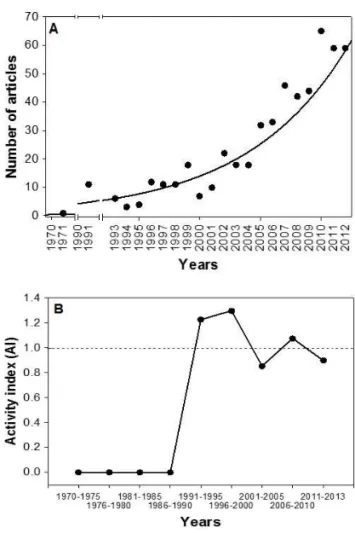
The number of papers over time was explained with an exponential equation (R = 0.70; Figure 1A). However, the AI based on the five journals that published more papers on invasive macrophytes was highly variable and approached 1.0 between 2000 and 2013 (Figure 1B), indicating that the frequency of articles on biological invasion was similar to the frequency of articles focusing on other topics related to aquatic macrophytes. Values higher than 1.0 were found for 1990– 2000 (Figure 1B).
The retrieved papers were published in 175 journals, and Hydrobiologia, Aquatic Botany,
Journal of Aquatic Plant Management, Biological Invasion and Freshwater Biology were the most representative in terms of the number of publications on the subject, which consisted of 33.5% of the articles. The journals Biological Invasions and Diversity and Distribution represent the highest impact journals in the field of biological invasion, and they published only 4.8% and 0.4% of the assessed papers, respectively.
Of the 161 articles that were completely reviewed, 65 species of aquatic macrophytes were studied. The most frequently investigated species were Myriophyllum spicatum L. (41 articles), Hydrilla verticillata (L.f.) Royle (21 articles), Phragmites australis (Cav.) Steud. (16 articles), Eicchornia crassipes (Mart.) Solms-
Figure 1. (A) Temporal trend in the number of papers published per year relating to the invasion of exotic and/or invasive aquatic plants. (B) Temporal trend of the activity index (AI) in research output that focuses on invasive macrophytes relative to all of the studies investigating aquatic macrophytes in the same period.
Figure 2. Taxonomic group or aquatic assemblage associated with invasive macrophytes. The gray area
Laubach (13 articles) and Elodea nuttallii
(Planchon) St. John (12 papers); these species represented 45.17% of the investigated species.
Regarding the taxonomic groups or assemblages associated with invasive macrophytes, native species of macrophytes received the most attention (36% of the studies), whereas zooplankton was the assemblage that received the least attention in the investigations (<1% of the total) (Figure 2). Phytoplankton, macro-invertebrates and fish were the subject of an intermediate number of studies (Figure 2). Among the macroinvertebrates, 36% of the investigations focused on Coleoptera
Euhrychiopsis lecontei (Dietz), a native species to North America.
Regarding the type of study, experiments were the most representative and constituted 75.2% of the studies, which were grouped into laboratory/ greenhouse (58.7%) and in situ (41.3%). Studies using an observational approach accounted for 9.9% of the total, whereas theoretical studies (e.g., reviews and surveys) composed 3.1% of the total. Investigations employing a combination of two or more types of studies (experimental and observational) accounted for 11.8% of the total. Among the 161 articles, 50.2% considered the macrophytes both as exotic and invasive, 47.2% of the articles considered them as exotic, and 2.6% considered only native invasive macrophytes. Thus, our analysis relied mostly on non-native invasive species.
The results of assessing the level of organisation used in the investigations indicated that 28.9% of the investigations studied population dynamics (e.g., growth of invasive species), 23.9% employed an approach related to the community level (e.g., effects of invasive macrophytes on native diversity or vice-versa), 14.5% studied the economical aspect, 11.9% used an ecosystem perspective (e.g., productivity of invasive species and effects on environmental features) and 19.5% approached more than one level of organisation. Finally, studies of the genetics of these species were sparse and represented only 1.3% of the total.
Concerning the importance of plant traits or ecosystem properties related to invasions, 32.9% of all of the investigations were related to macrophyte invasiveness, 9.3% considered the invasibility of communities and 8.1% of the investigations studied both subjects simultaneously. Impacts were addressed in 24.2% of the studies. And 25.5% does not fit into the other categories. Finally, 51% of the studies were conducted in the Nearctic region (77 investigations in the USA)
and 25% were conducted in the Palearctic region (mainly in China and France, with 10 studies each). The Australasian region was investigated in 13% of the studies (Australia and New Zealand had 20 studies each) and the Afrotropical, Neo-tropical and Oriental regions were investigated in less than 10% of the studies each. Only one study was conducted in two countries belonging to two different biogeographic regions (USA and France).
Discussion
Our results demonstrated that there was a signifi-cant increase in the number of papers related to aquatic macrophyte invasions especially after the 1990's, and the number has increased more rapidly in the last decade. An increase in the ecological studies of aquatic macrophytes has been observed since the 1960's (Padial et al. 2008), but our data showed that the focus on invasive species has occurred only in the last 10 years, which is consistent with the field of invasion biology in general (Richardson and Pyšek 2008). The temporal trend confirms that biological invasions have attained a level of importance in general, which has also been observed by others (e.g., Qiu and Chen 2009; Puth and Post 2005; Gurevitch et al. 2011). However, invasive macro-phytes have not seemed to receive more attention than other topics related to macrophytes after 2000 because the AI values have remained close to 1.0.
of studies in freshwater ecosystems testing the main hypotheses in the field of invasion biology is much lower than the number of studies conducted in terrestrial ecosystems (Jeschke et
al. 2012), which corroborates the few studies
concerning macrophytes that were published in leading journals of the field. Despite being under-utilised in the investigation of broader aspects of invasion biology, macrophytes can be considered an appropriate means of connecting to the issues in this field because they are key elements in waterscapes (Wetzel 2001), and invasive macrophytes can cause serious ecological and economic damage worldwide (e.g., Pieterse and Murphy 1990).
The high percentage of research found in our study that involved experimental approaches should be noted because observational studies generally outweigh experimental studies in the field of limnology (Bourget and Fortin 1995). The high number of experimental investigations compared to observational investigations suggests that research on macrophyte invasions is mainly designed to determine the processes and mecha-nisms behind invasions. We noted that the majority of experiments attempt to understand the invasiveness and impacts, which are appropriate fields to be investigated through an experimental approach. In this sense, our survey differs from studies that focus on aquatic invasive species in general, which usually record a higher percentage of studies using an observational approach compared to an experimental approach (Olyarnik et al. 2008). Although we recognise the importance of experiments for determining mechanisms associated with invasions, the few investigations conducted under more realistic and applied situations (in situ) is a gap that should be fulfilled because these investigations complement experi-ments conducted under more controlled conditions.
According to our expectations, the current knowledge of macrophyte impacts is restricted to certain exotic dominant species because of their high invasion potential (e.g., M. spicatum, P. australis, H. verticillata, E. nuttallii and E. canadensis) (Hershner and Havens 2008; Sousa et al. 2010). Furthermore, these species mainly invade more developed temperate countries and subtropical zones and demonstrate the need for a larger number of investigations in tropical ecosystems. For example, the macrophyte M. spicatum was the most frequently studied, and it is considered invasive in most of the world, but especially in the United States. In addition, M. spicatum can inhabit a variety of aquatic
eco-systems, such as lakes, ponds, rivers and irrigation canals (Eiswerth et al. 2000). However, E. crassipes, which is among the 100 major weeds in the world (IUCN 2000), was the fourth most studied species. Other free-floating species such as S. molesta and P. stratiotes are highly invasive in the tropics (Coetzee et al. 2011) but have been poorly studied. The gap between the high invasive potential and low number of studies on these free-floating species can be attributed to the fact that they primarily invade warmer regions where financial resources and hence studies are scarce.
Macroinvertebrates is the second group most studied, the preference for studying macro-invertebrates may be a result of the influence macrophytes have on their colonisation, predation, distribution, trophic relationships and food availability (van der Berg et al. 1997). Moreover, the ease of studying macroinvertebrate organisms compared to other organisms, such as fish or microscopic organisms, may partially explain this preference. In general, the analysed studies assessed the distribution, abundance and species richness of macroinvertebrates when coupled with exotic species of aquatic macrophytes. In particular, the Coleoptera E. lecontei (Dietz) was the most studied species, and it is directly associated with research on the species M. spicatum
because E. lecontei can be used in the biological control of M. spicatum (Sheldon and Creed 1995; Lambrinos 2004).
According to our records, studies investigating plankton and fish associated with invasive macro-phytes within ecosystems are poorly represented. This gap relating invasive macrophytes with fish is surprising because macrophytes have an important role in fish communities (Gomes et al. 2012). In addition, associated fish have a known role in economic aspects, relating to recreational and commercial fishing (Hoeinghaus et al. 2009) and may affect ecosystem structure and functioning (Pendleton et al. 2014). Thus, changes to fish stocks caused by invasive macrophytes may impact economic and ecological aspects. Even more surprising was the lack of studies associating the role of macrophyte invasions on microorganisms (bacteria and fungi) and vice-versa. For example, studies have shown that mycorrhizae play a key role in terrestrial plant invasions (Pringle and Wolfe 2011) and mycorrhizae are also associated with macrophytes (Beck-Nielsen and Madsen 2001); however, the links between invasive macrophytes and fungi have apparently been ignored.
which is most likely because a majority of invasive species overcome dispersal barriers to their esta-blishment and spread to new regions where they proliferate and are considered exotic (Ricciardi and Cohen 2007). The major concern with proportionate invasions by exotic species stems from the ability of these species to reduce the diversity of native species (Richardson et al. 2000; Wilson and Ricciardi 2009), compete with other macrophyte species (Mony et al. 2007; Sousa et al. 2009) and change the composition of other aquatic communities (e.g., Douglas and O'Connor 2003; Wilson and Ricciardi 2009; Casatti et al. 2009).
Studies conducted at the population and commu-nity level dominated our dataset, but ecosystems were less studied. This organisational level should be investigated more frequently because the overall impacts to ecosystems are not readily detected and sometimes remain undetecteded (Simberloff et al. 2013). In addition, entire ecosystems may change in response to invasions (Yarrow et al. 2009; Strayer 2010). Studies employing more than one level of organisation were also underrepresented. This trend parallels the trends of terrestrial ecosystems in which studies concerning the impact of invasive plants on different trophic levels are scarce (Pyšek et al. 2012).
When considering the invasiveness of macro-phytes compared to the invasibility of ecosystems, the former has received more attention, showing that the study of attributes related to macrophyte species that facilitate invasion is preferred by aquatic investigators studying macrophytes. Our data set also showed that few investigations addressed invasiveness and invasibility together (8.07%), and the results were less than those found for terrestrial invasive plants (13.5%, according to Peternon and Pivelli 2006). Thus, our results highlight that additional knowledge on the environmental factors that affect invasions by macrophytes and studies that address both invasiveness and invasibility are still required. Studies that address both invasiveness and invasibility are becoming increasingly common in invasion biology (Richardson and Pyšek 2006; Thuiller et al. 2010) because the analysis of these two factors can result in an improved understanding and ability to predict the spread and impact of invasive species, which are the primary topics of applied ecology. Hypotheses that combine invader-ecosystem interactions have a greater potential to improve the knowledge of invasions than separate studies of invaders or habitat features (Jeschke et al. 2012).
Finally, our study also showed a clear geographical bias in the studies of invasive macrophytes, which are more frequent in the Nearctic (nearly half of all studies are conducted in the USA) and Palearctic regions. The same bias occurs in the field of biological invasion in general (Qiu and Chen 2009), and it may limit a better understanding of invasions because tropical and more diverse regions are investigated less frequently (Fridley et al. 2007; Pyšek et al. 2008). The lack of studies developed simultaneously in two different biogeographic regions is also a gap that should be addressed because the combination of results from native and invaded ranges contributes to a better understanding of the mechanisms that regulate invasion success (e.g., Thiébaut 2011).
In summary, our study shows that there is a diverse array of topics covered in the studies of invasive macrophytes, but there is a lack of integration between topics, meaning that invasive species and the environments that are invaded are analysed separately. This can limit the available information on the ecology and impacts of invasive macrophytes. Thus, the effects of invasive species on native communities and ecosystem dynamics (e.g., primary productivity, nutrient cycling, etc.), susceptibility of native ecosystems to invasion by non-native species, and predictability of potentially invasive species may be misunderstood. Moreover, studies with invasive macrophytes are rare in the leading journals of the biological invasion field, indicating that these plants are seldom used to test more general theories in the field. Finally, few articles have focused on important invaders in the tropics, fish-macrophyte and microorganism-macrophyte interactions, genetics and the impact of invasive macrophytes on more than one level of organisation. These are important and necessary issues for conservation, and they are areas that should receive a greater degree of emphasis in future research on invasive macrophytes.
Acknowledgements
References
Balian EV, Segers H, Lévêque C, Martens K (2008) The freshwater animal diversity assessment: an overview of the results. Hydrobiologia 595: 627–637, http://dx.doi.org/10.1007/ s10750-007-9246-3
Beck-Nielsen D, Madsen TV (2001) Occurrence of vesicular-arbuscular mycorrhiza in aquatic macrophytes from lakes and streams. Aquatic Botany 71: 141–148, http://dx.doi.org/ 10.1016/S0304-3770(01)00180-2
Bourget E, Fortin MJ (1995) A commentary on current approaches in the aquatic sciences. In: Space Partition within Aquatic Ecosystems. Springer Netherlands, pp 1–16, http://dx.doi.org/10.1007/978-94-011-0293-3_1
Caliman A, Pires AF, Esteves FA, Bozelli RL, Farjalla VF (2010) The prominence of and biases in biodiversity and ecosystem functioning research. Biodiversity and Conservation 19: 651– 664, http://dx.doi.org/10.1007/s10531-009-9725-0
Capers RS, Selsky R, Bugbee GJ, White JC (2007) Aquatic plant community invasibility and scale-dependent patterns in native and invasive species richness. Ecology 88: 3135–3143, http://dx.doi.org/10.1890/06-1911.1
Carrillo-Gavilán MA, Vilà M (2010) Little evidence of invasion by alien conifers in Europe. Diversity and Distributions 16: 203–213, http://dx.doi.org/10.1111/j.1472-4642.2010.00648.x Casatti L, de Paula Ferreira C, Carvalho FR (2009)
Grass-dominated stream sites exhibit low fish species diversity and dominance by guppies: an assessment of two tropical pasture river basins. Hydrobiologia 632: 273–283, http://dx.doi.org/10. 1007/s10750-009-9849-y
Coetzee JA, Hill MP, Byrne MJ, Bownes A (2011) A Review of the Biological Control Programmes on Eichhornia crassipes (C.Mart.) Solms (Pontederiaceae), Salvinia molesta D. S. Mitch. (Salviniaceae), Pistia stratiotes L. (Araceae), Myrio-phyllum aquaticum (Vell.) Verdc. (Haloragaceae) and Azolla filiculoides Lam. (Azollaceae) in South Africa. African Entomology 19: 451–468, http://dx.doi.org/10.4001/003.019.0202 Davis ME (2000) Invasion Biology. Oxford University Press Inc.,
New York, 259 pp
Douglas MM, O'Connor RA (2003) Effects of the exotic macrophyte, para grass (Urochloa mutica), on benthic and epiphytic macroinvertebrates of a tropical floodplain. Freshwater Biology 48: 962–971, http://dx.doi.org/10.1046/j. 1365-2427.2003.01072.x
Eiswerth ME, Donaldson SG, Johnson WS (2000) Potential environmental impacts and economic damages of Eurasian Watermilfoil (Myriophyllum spicatum) in Western Nevada and Northeastern California. Weed Technology 14: 511–518,
http://dx.doi.org/10.1614/0890-037X(2000)014[0511:PEIAED]2.0.CO;2
Engelhardt KA (2011) Eutrophication aquatic. In: Simberloff D, Rejmánek M (eds), Encyclopedia of biological invasions. University of California Press, Berkeley, USA, pp 209–213 Fridley JD, Stachowicz JJ, Naeem S, Sax DF, Seabloom EW,
Smith MD, Stohlgren TJ, Tilman D, Von Holle B (2007) The invasion paradox: reconciling pattern and process in species invasions. Ecology 88: 3–17, http://dx.doi.org/10.1890/0012-9658(2007)88[3:TIPRPA]2.0.CO;2
Gherardi F (2007) Understanding the impact of invasive crayfish. In: Biological invaders in inland waters: Profiles, distribution, and threats. Springer Netherlands, pp 501–542 Gomes LC, Bulla K, Agostinho AA, Vasconcelos LP, Miranda
LE (2012) Fish assemblage dynamics in a Neotropical floodplain relative to aquatic macrophytes and the homogenizing effect of a flood pulse.Hydrobiologia 685: 97–101, http://dx.doi.org/10.1007/s10750-011-0870-6
Gurevitch J, Fox GA, Wardle GM, Taub D (2011) Emergent insights from the synthesis of conceptual framework for biological invasions. Ecology Letters 14: 407–418, http://dx.doi.org/10.1111/j.1461-0248.2011.01594.x
Hershner C, Havens KJ (2008) Managing invasive aquatic plants in a changing system: strategic consideration of ecosystem services. Conservation Biology 22: 544–550, http://dx.doi.org/ 10.1111/j.1523-1739.2008.00957.x
Hoeinghaus DJ, Agostinho AA, Gomes LC, Pelicice FM, Okada EK, Latini JD, Kashiwaqui EAL, Winemiller KO (2009) Effects of River Impoundment on Ecosystem Services of Large Tropical Rivers: Embodied Energy and Market Value of Artisanal Fisheries. Conservation Biology 23: 1222–1231, http://dx.doi.org/10.1111/j.1523-1739.2009.01248.x
Hummel RL, Walgenback JF, Hoyt GD, Kennedy GG (2002) Effects of production system on vegetable arthropods and their natural enemies. Agriculture Ecosystems and Environ-ment 93: 165–176, http://dx.doi.org/10.1016/S0167-8809(01)00345-0
IUCN Species Survival Commission (2000) "IUCN Red List of threatened species."World Conservation Union, Gland, Switzerland (http://www.redlist.org)
Jenkins M (2003) Prospects for biodiversity. Science 302: 1175– 1177, http://dx.doi.org/10.1126/science.1088666
Jeschke J, Aparicio LG, Haider S, Heger T, Lortie C, Pyšek P, Strayer D (2012) Support for major hypotheses in invasion biology is uneven and declining. NeoBiota 14: 1–20, http://dx.doi.org/10.3897/neobiota.14.3435
Johnson PTJ, Olden JD, Solomon CT, Zanden MJV (2009) Interactions among invaders: community and ecosystem effects of multiple invasive species in an experimental aquatic system. Oecologia 159: 161–170, http://dx.doi.org/10. 1007/s00442-008-1176-x
Kumari L (2006) Trends in synthetic organic chemistry research. Cross-country comparison of activity index. Scientometrics 67: 467–476, http://dx.doi.org/10.1556/Scient.67.2006.3.8
Lambrinos JG (2004) How interactions between ecology and evolution influence contemporary invasion dynamics. Ecology 85: 2061–2070, http://dx.doi.org/10.1890/03-8013 Madsen JD, Sutherland JW, Bloomfield JA, Eichler LW, Boylen
CW (1991) The decline of native vegetation under dense Eurasian watermilfoil canopies. Journal of Aquatic Plant and Management 29: 94–99
Matlack GR, Schaub JR (2011) Long–term persistence and spatial assortment of nonnative plant species in second-growth forests. Ecography 34(4): 649–658, http://dx.doi.org/10.1111/ j.1600-0587.2010.06654.x
Mony C, Koschnick TJ, Haller WT, Muller S (2007) Competition between two invasive Hydrocharitaceae (Hydrilla verticillata (Lf) (Royle) and Egeria densa (Planch)) as influenced by sediment fertility and season. Aquatic Botany 86: 236–242, http://dx.doi.org/10.1016/j.aquabot.2006.11.007
Olyarnik SV, Bracken MES, Byrnes JE, Hughes AR, Hultgren KM, Stachowicz JJ (2008) Ecological factors affecting community invisibility. In: Rilov G, Crooks JA (eds), Biological invasions of marine ecosystems: ecological, mana-gement and geographic perspectives. Springer, Heidelberg, Germany, pp 587–617
Padial AA, Bini LM, Thomaz SM (2008) The study of aquatic macrophytes in Neotropics: a scientometrical view of the main trends and gaps. Brazilian Journal of Biology 68: 1051– 1059, http://dx.doi.org/10.1590/S1519-69842008000500012 Parker IM, Simberloff D, Lonsdale WM, Goodell K, Wonham M,
Kareiva PM, Goldwasser L (1999) Impact: toward a framework for understanding the ecological effects of invaders.Biological Invasions1: 3–19, http://dx.doi.org/10.1023 /A:1010034312781
Pendleton RM, Hoeinghaus DJ, Gomes LC, Agostinho AA (2014) Loss of rare fish species from tropical floodplain food webs affects community structure and ecosystem multi-functionality in a mesocosm experiment. PloS ONE 9(1):
Peternon D, Pivello VR (2006) Plantas invasoras: representa-tividade da pesquisa dos países tropicais no contexto mundial. Natureza and Conservação 6: 65–77
Pieterse AH, Murphy KJ (1990) Aquatic weeds: the ecology and management nuisance aquatic vegetation. Oxford University Press, Oxford, 612 pp
Pringle A, Wolfe B (2011) Mycorrhizae. In: Simberloff D, Rejmánek M (eds), Encyclopedia of biological invasions. University of California Press, Berkeley, USA, pp 468–471 Puth LM, Post DM (2005) Studying invasion: have we missed the
boat? Ecology Letters 8: 715–721, http://dx.doi.org/10.1111/ j.1461-0248.2005.00774.x
Pyšek P, Richardson DM (2006) The biogeography of naturalization in alien plants. Journal of Biogeography 33: 2040–2050, http://dx.doi.org/10.1111/j.1365-2699.2006.01578.x Pyšek P, Richardson DM, Pergl J, Jarošík V, Sixtová Z, Weber E
(2008) Geografical and taxonomic biases in invasion ecology. Trends in Ecology & Evolution 23: 237–244, http://dx.doi.org/10.1016/j.tree.2008.02.002
Pyšek P, Jarošík V, Hulme PE, Pergl J, Hejda M, Schaffner U, Vilà M (2012) A global assessment of invasive plant impacts on resident species, communities and ecosystems: the interaction of impact measures, invading species’ traits and environment. Global Change Biology 18: 1725–1737, http://dx.doi.org/10.1111/j.1365-2486.2011.02636.x
Qiu H, Chen Y (2009) Bibliometric analysis of biological invasions research during the period of 1991 to 2007. Scientometrics 3: 601–610, http://dx.doi.org/10.1007/s11192-008-2207-4
Ricciardi A, Cohen J (2007) The invasiveness of an introduced species does not predict its impact. Biological Invasions 9: 309–315, http://dx.doi.org/10.1007/s10530-006-9034-4
Richardson DM, Allsopp N, D'Antonio CM, Milton SJ, Rejmanek M (2000) Plant invasions—the role of mutualisms. Biological Reviews 75: 65–93, http://dx.doi.org/10.1017/S000 6323199005435
Richardson DM, Pyšek P (2006) Plant invasions: merging the concepts of species invasiveness and community invisibility. Progress in Physical Geography 30: 409–431, http://dx.doi.org/10.1191/0309133306pp490pr
Richardson DM, Pyšek P (2008) Fifty years of invasion ecology– the legacy of Charles Elton. Diversity and Distributions 14: 161–168, http://dx.doi.org/10.1111/j.1472-4642.2007.00464.x Sala OE, Chapin FS, Armesto JJ, Berlow E, Bloomfield J, Dirzo
R, Wall DH (2000) Global biodiversity scenarios for the year 2100. Science 287: 1770–1774, http://dx.doi.org/10.1126/science. 287.5459.1770
Santamaria L (2002) Why are most aquatic plants widely distributed? Dispersal, clonal growth and small-scale heterogeneity in a stressful environment. Acta Oecologica 23: 137–154, http://dx.doi.org/10.1016/S1146-609X(02)01146-3 Sheldon SP, Creed RP (1995) Use of native insect as a biocontrol
for an introduced weed. Ecological Applications 5: 1122– 1132, http://dx.doi.org/10.2307/2269359
Simberloff D, Martin JL, Genovesi P, Maris V, Wardle DA, Aronson J, Courchamp F, Galil B, García-Berthou E, Pascal M, Pyšek P, Sousa R, Tabacchi E, Vilá M (2013) Impacts of biological invasions: what’s what and the way forward. Trends in Ecology & Evolution 28: 58–66, http://dx.doi.org/10. 1016/j.tree.2012.07.013
Sousa WTZ, Thomaz SM, Murphy, KJ, Silveira MJ, Mormul RP (2009) Environmental predictors of the occurrence of exotic Hydrilla verticillata (Lf) Royle and native Egeria najas Planch. in a sub-tropical river floodplain: the Upper River Paraná, Brazil. Hydrobiologia 632: 65–78, http://dx.doi.org/ 10.1007/s10750-009-9828-3
Sousa WTZ, Thomaz SM, Murphy KJ (2010) Response of native Egeria najas Planch. and invasive Hydrilla verticillata (L.f.) Royle to altered hydroecological regime in a subtropical river. Aquatic Botany 92: 40–48, http://dx.doi.org/10.1016/ j.aquabot.2009.10.002
Steedman RJ, Whillans TH, Behnm AP, Bray KE, Cullis KI, Holland MM, Stoddart SJ, White RJ (1996) Use of historical information for conservation and restoration of Great Lakes aquatic habitat. Canadian Journal of Fisheries and Aquatic Sciences 53: 415–423, http://dx.doi.org/10.1139/f96-017
Strayer DL (2010) Alien species in fresh waters: ecological effects, interactions with other stressors, and prospects for the future. Freshwater Biology 55: 152–174, http://dx.doi.org/10.11 11/j.1365-2427.2009.02380.x
Taniguchi H, Nakano S, Tokeshi M (2003) Influences of habitat complexity on the diversity and abundance of epiphytic invertebrates on plants. Freshwater Biology 48: 718–728, http://dx.doi.org/10.1046/j.1365-2427.2003.01047.x
Theel HJ, Dibble ED, Madsen JD (2008) Differential influence of a monotypic and diverse native aquatic plant bed on a macroinvertebrate assemblage; an experimental implication of exotic plant induced habitat. Hydrobiologia 600: 77–87, http://dx.doi.org/10.1007/s10750-007-9177-z
Thiébaut G (2011) Invasion success of non-indigenous aquatic and semi-aquatic plants in their native and introduced ranges. A comparison between their invasiveness in North America and in France. Biological Invasion 9: 1–12, http://dx.doi.org/ 10.1007/s10530-006-9000-1
Thuiller W, Gallien L, Boulangeat I, De Bello F, Münkemüller T, Roquet C, Lavergne S (2010) Resolving Darwin’s naturalization conundrum: a quest for evidence. Diversity and Distributions 16: 461–475, http://dx.doi.org/10.1111/j.1472-4642.2010.00645.x
van der Berg MS, Coops H, Noordhuis R, van Schie J, Simons J (1997) Macroinvertebrate communities in relation to submerged vegetation in two Chara-dominated lakes. Hydrobiologia 342: 143–150, http://dx.doi.org/10.1023/A:101 7094013491
Wetzel RG (2001) Limnology: Lake and river ecosystems. Academic Press, San Diego, 1006 pp
Wilson SJ, Ricciardi A (2009) Epiphytic macroinvertebrate communities on Eurasian watermilfoil (Myriophyllum spicatum) and native milfoils Myriophyllum sibericum and Myriophyllum alterniflorum in eastern North America. Canadian Journal of Fisheries and Aquatic Sciences 66(1): 18–30, http://dx.doi.org/10.1139/F08-187
Yarrow M, Marín VH, Finlayson M, Tironi A, Delgado LE, Fischer F (2009) The ecology of Egeria densa Planchon (Liliopsida: Alismatales): A wetland ecosystem engineer? Revista Chilena de Historia Natural 82: 299–313
The following supplementary material is available for this article:
Appendix 1. List of papers and information retained for analysis.