ISSN 0100-879X
BIOMEDICAL SCIENCES
AND
CLINICAL INVESTIGATION
www.bjournal.com.br
www.bjournal.com.br
Volume 43 (3) 182-267 March 2011
Braz J Med Biol Res, March 2011, Volume 44(3) 212-216
doi: 10.1590/S0100-879X2011007500011
Increased expression of keratinase and other peptidases by
Candida
parapsilosis
mutants
T.R. Duarte, S.S. Oliveira, A. Macrae, S.M.L. Cedrola, A.M. Mazotto, E.P. Souza, A.C.N. Melo and A.B.
Vermelho
Faculdade de Medicina de Ribeirão Preto Campus
Ribeirão Preto
Institutional Sponsors
The Brazilian Journal of Medical and Biological Research is partially financed by
analiticaweb.com.br S C I E N T I F I C Hotsite of proteomics metabolomics
Increased expression of keratinase and other
peptidases by
Candida parapsilosis
mutants
T.R. Duarte, S.S. Oliveira, A. Macrae, S.M.L. Cedrola, A.M. Mazotto,
E.P. Souza, A.C.N. Melo and A.B. Vermelho
Laboratório Proteases de Microrganismos, Departamento de Microbiologia Geral, Instituto de Microbiologia Paulo de Góes, Universidade Federal do Rio de Janeiro, Rio de Janeiro, RJ, Brasil
Abstract
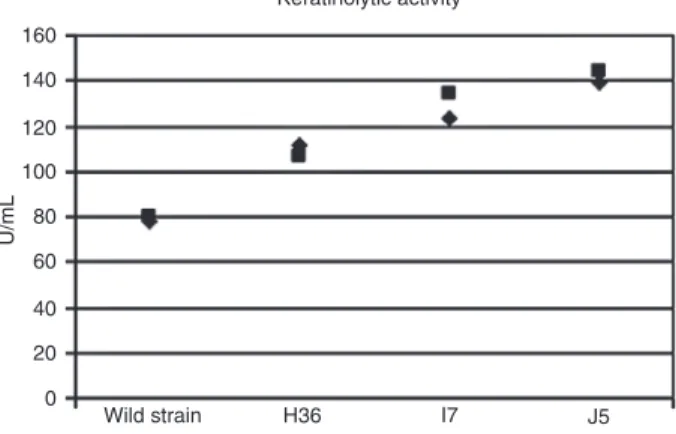
Keratinases are enzymes of great importance involved in pathogenic processes of some fungi. They also have a widespread ecological role since they are responsible for the degradation and recycling of keratin. On the one hand, studying them fur-thers our knowledge of pathogenicity mechanisms, which has important implications for human health, and on the other hand, understanding their ecological role in keratin recycling has biotechnological potential. Here, a wild-type keratinolytic Candida parapsilosis strain isolated from a poultry farm was treated with ethyl methanesulfonate in order to generate mutants with increased keratinase activity. Mutants were then cultured on media with keratin extracted from chicken feathers as the sole source of nitrogen and carbon. Approximately 500 mutants were screened and compared with the described keratinolytic wild type. Three strains, H36, I7 and J5, showed enhanced keratinase activity. The wild-type strain produced 80 U/mL of keratinolytic activity, strain H36 produced 110 U/mL, strain I7, 130 U/mL, and strain J5, 140 U/mL. A 70% increase in enzyme activity was recorded for strain J5. Enzymatic activity was evaluated by zymograms with proteic substrates. A peptidase migrating at 100 kDa was detected with keratin, bovine serum albumin and casein. In addition, a peptidase with a molecular mass of 50 kDa was observed with casein in the wild-type strain and in mutants H36 and J5. Gelatinase activity was detected at 60 kDa. A single band of 35 kDa was found in wild-type C. parapsilosis and in mutants with hemoglobin substrate.
Key words: Candida parapsilosis; Keratinase; Ethyl methanesulfonate; Mutants
Introduction
Correspondence: A.B. Vermelho, Laboratório Proteases de Microrganismos, Departamento de Microbiologia Geral, Instituto de Microbiologia Paulo de Góes, Bloco I, CCS, UFRJ, 21941-590 Rio de Janeiro, RJ, Brasil. Fax: +55-21- 2560-8344.
E-mail: [email protected]
Received April 4, 2010. Accepted January 10, 2011. Available online January 28, 2011. Published March 7, 2011. Keratin is the major structural protein of feathers, skin
and wool (1), is insoluble in water and has high mechanical stability and resistance to proteolysis (1,2). Keratin stability
results from a high degree of cross-linking of disulfide bonds,
hydrogen bonding and hydrophobic interactions. Despite their stability, keratins do not accumulate in nature and can be hydrolyzed by some microorganisms (3). Feathers, which are a byproduct of commercial poultry production, may rep-resent a waste problem and consequently need adequate
management (4). Since feathers are almost pure protein (keratin), they are potentially a less expensive alternative source of protein for animal feed. Feathers can be converted to feather meal via physical and chemical treatments and is used as animal fodder. Conversion generally requires
significant energy inputs and also destroys certain amino
acids (5). It follows that degradation of feather keratin by microorganisms represents an alternative method to
im-prove the nutritional value of feather waste and to prevent environmental contamination (6). Keratinolytic enzymes are produced by fungi, the actinomycetes, and other bacteria and have been frequently isolated from soils (7,8). The industrial potential for keratinases is linked to recycling keratin-containing wastes from the leather, detergent and textile industries (9). Although keratinolytic activity is be-lieved to be widespread in fungi, particularly yeasts, there have been relatively few studies demonstrating this. An aspartic peptidase keratinase from Candida albicans has been described (10), indicating that yeasts are a group with largely unexplored potential.
Keratinase in Candida parapsilosis mutants 213
of these findings and of the overall increase in the number
of infections caused by Candida spp, there is increased interest in understanding the factors that control yeast-host cell interactions. Among these factors are the peptidases whose physiological role during the microorganism-host cell interaction can be the degradation of mucus and cell walls, facilitating pathogen invasion. Other roles include the degradation of host proteins for nutrition and degradation of proteins involved in the host defense system associ-ated with lymphocytes and macrophages (13). Previous clinical studies have described the production of Candida
peptidases closely connected with environmental factors and have described the production of these peptidases as virulence factors for these microorganisms (14). In 1993, Fusek et al. (15) described two aspartic peptidases of C. parapsilosis with the capacity to degrade bovine serum albumin (BSA) and hemoglobin. In the present study, we found that these yeasts can also be isolated outside clinical environments and that they continue to produce peptidases that can degrade residues of biotechnological/ecological importance.
In view of the industrial interest in these enzymes, methods have been developed to explore their potential. One route involves recombinant DNA technology and ge-netic engineering. This approach has been instrumental in converting many biological functions into industrialized processes. The isolation and cloning of keratinase genes is one pathway that ensures improved enzyme yields (16). Another method, also reported here, is bioprospection from novel habitats and mutagenesis (17). Mutagenesis is a quick and inexpensive way to generate novel strains, some of which are high yielding enzyme producers (18,19). In the present study, a wild-type keratinolytic C. parapsilosis
strain (20) was selected for mutagenesis and its increased keratinolytic activity is reported.
Material and Methods
Chemicals
Gelatin, casein, hemoglobin, and BSA were obtained from Merck (Germany). The reagents used for electrophore-sis were purchased from Amersham Life Science (England). Yeast extract broth was obtained from Oxoid Ltd. (England). All other reagents were of analytical grade.
Yeast strain
The wild-type keratinolytic C. parapsilosis yeast strain used in this study was collected from poultry waste and was
isolated on keratin agar and identified (20). Briefly, strains
were incubated in tubes containing 0.5% yeast extract, 0.5% peptone, 2% KCl, and 2% sucrose solution, in a total volume of 5 mL, at 28°C for 4 days. Strains were then streaked on keratin agar and single colonies screened for their ability to grow in phosphate-buffered saline (PBS; 150 mM NaCl, 20 mM phosphate buffer, pH 7.2) supplemented with 1% feather
keratin for 20 days at 28°C. Yeast strains were maintained in PBS (150 mM NaCl, 20 mM phosphate buffer, pH 7.0) supplemented with 1% feather keratin.
Culture media
Keratin agar medium (0.2 M Na2HPO4, 0.1 M citric acid,
0.01% yeast extract, and 1% feather keratin substrate) was used for screening the yeasts on plates. Sabouraud broth medium [2% glucose (w/v); 1% peptone (w/v); 0.5% yeast extract (w/v)] was used for yeast preparations.
Mutagenesis and screening
The C. parapsilosis strains were grown in 10 mL Sa-bouraud broth medium at 37°C for 24 h, after which 3% ethyl methanesulfonate (EMS) was added and incubated at 37°C for 1 h (21). Cells were then centrifuged at 2800 g
for 15 min and washed with sterile saline. Successive serial dilutions were prepared and 0.1-mL aliquots were spread on Sabouraud agar medium. Mutant colonies of C. parap-silosis that appeared after 48 h of incubation at 37°C were selected. Colonies were streaked on keratin agar medium for 20 days. Plates were stained with Coomassie blue and colonies surrounded by large clear halos were selected for quantitative keratinase assays.
Feather keratin substrate
Chicken feathers obtained from poultry waste were washed with water and detergent and then dried at 60°C overnight. Lipids were removed by chloroform:methanol (1:1, v/v) washes and feathers were dried again at 60°C. Keratin powder was obtained from 10 g lipid-free dried
feathers and heated in a reflux condenser at 100°C for
80-120 min with 500 mL DMSO. Keratin was then precipi-tated by adding two volumes of acetone and maintained at 4°C for 24-48 h. The keratin precipitates were collected by centrifugation (2000 g for 15 min) twice, washed twice with distilled water, and dried at 4°C. The keratin powder thus produced served as a substrate for keratin agar plates, zy-mograms and for spectrophotometric analysis. The method used here to produce keratin powder was described by Wawrzkiewicz et al. (22).
Quantitative keratinase assay
Substrate gel electrophoresis
Keratinases were assayed and characterized by sub-strate gel electrophoresis. The gel consisted of 12.5% sodium dodecyl sulfate-polyacrylamide with co-polymerized keratin feather powder (20), 0.1% (w/v) gelatin, casein, BSA, or hemoglobin incorporated as substrate (25-27). After electrophoresis, gels were incubated for 48 h at 37°C in 50 mM phosphate buffer, pH 5.5. To detect the presence of peptidases, gels were stained for 1 h with 0.2% Coomassie blue R-250 in methanol-acetic acid-water (50:10:40) and destained in the same solvent. Gels were then dried, scanned and processed digitally. Phosphorylase b (94 kDa), BSA (67 kDa), ovalbumin (43 kDa), carbonic anhydrase (30 kDa), soybean trypsin inhibitor (20.1 kDa),
and α-lactalbumin (14.4 kDa) were used as molecular mass
standards (GE Healthcare, Brazil).
Results
Mutagenesis
Approximately 500 colonies were analyzed and com-pared to the wild-type keratinase-producing C. parapsilosis
strain. Comparisons were made after growth on keratin agar followed by staining with Coomassie blue. Three mutant strains produced larger degradation halos than the wild-type
strain and were identified as H36, I7 and J5 (Figure 1). The
enzymatic assay of Grzywnowicz et al. (23) was used to quantify and compare differences in the enzyme activities. The keratinolytic activity of strain J5 was a serine peptidase 70% higher than that of the wild-type strain (Figure 2).
Enzymatic activity of mutants on gelatin, keratin, casein, BSA, and hemoglobin
Supernatant solutions from the three mutant strains were concentrated 20 times by dialysis using a 9000-Da
membrane and PEG 4000. The proteolytic profiles were
analyzed by zymography using keratin and gelatin as substrates. A band with a molecular mass of 60 kDa was observed on the gel with gelatin and a band of 100 kDa was observed for keratin (Figure 3). Zymograms using BSA, hemoglobin and casein as substrates also showed bands. Bands of 100 kDa were observed for BSA, bands of 35 kDa for hemoglobin, and two bands, 100 and 50 kDa, were observed for casein (Figure 3).
Discussion
We have recently reported the isolation of a kera-tinolytic wild-type yeast that produced an extracellular serine peptidase with keratinolytic activity (20). In the present study, mutagenesis was used as a tool to modify that original wild-type strain and resulted in a collection of ~500 C. parapsilosis mutant strains. The collection was screened and treatment with EMS yielded three strains with higher keratinolytic activity than the wild type. EMS
was used by Shu-Fei et al. (28) to increase the production
of β-mannanase from Aspergillus niger LW-1. Nanmori et
al. (29) used nitrosoguanidine to increase exo-β-amylase
production from a Bacillus cereus mutant. The present
Figure 1. Extracellular keratinase activity on agar plates con-taining feather keratin as substrate (for details, see Material and Methods). The plate was stained with Coomassie blue. Candida parapsilosis is the wild strain and I7, H36 and J5 are mutants ob-tained from the C. parapsilosis with 3% ethyl methanesulfonate. Clear zones/halos correspond to degradation of keratin.
Keratinase in Candida parapsilosis mutants 215
study is the first report using EMS to induce mutagenesis
in favor of keratinase production. We found that this simple method provided strains that produced more enzyme than the wild type from which it was derived.
Caiet al. (17) reported the successful use of chemical mutagenesis to increase the expression of keratinase in
Bacillus subtilis using N-methyl-N-nitro-N-nitrosoguanidine. In their study, a mutant strain called KD-N2 showed twice the activity of their wild strain. Our results with a yeast, rather than a bacterium, are similar to those of Cai et al. (17). Cai et al. inferred keratinase activity based on agar media with casein and not keratin because of the general lack of commercially available keratin in powder form.
From the zymograms shown in Figure 3, we can see that all 4 yeast strains produced a 100-kDa band with keratin
and BSA. Specific substrates will be needed to determine
if these are the same substrate (17).
The data in Figure 3 suggest that the enzyme activity
produced by the EMS mutants resulted in brighter bands on the zymograms and presumably increased peptidase activity compared to the wild-type strain.
It is interesting to note that, although potentially patho-genic, this strain was isolated from residues from a local poultry farm. It is possible that this yeast strain belongs to a microbial consortium ofkeratin decomposers adapted to feather degradation and representing a source of other strains of biotechnological interest.
Acknowledgments
We would like to thank the technical assistance of Ms. Denise da Rocha de Souza, supported by fellowships from MCT/CNPq. Research supported by CAPES, FAPERJ, MCT/CNPq, Conselho de Ensino para Graduados e Pes-quisas (CEPG/UFRJ), and Fundação Universitária José Bonifácio (FUJB).
References
1. Bradbury JH. The structure and chemistry of keratin fibers.
Adv Protein Chem 1973; 27: 111-211.
2. Parry DA, North AC. Hard alpha-keratin intermediate fila -ment chains: substructure of the N- and C-terminal domains and the predicted structure and function of the C-terminal domains of type I and type II chains. J Struct Biol 1998; 122: 67-75.
3. Brandelli A. Bacterial keratinases: useful enzymes for bio-processing agroindustrial wastes and beyond. Food Biopro-cess Technol 2008; 1: 105-116.
4. Shih JCH. Recent development in poultry waste digestion and feather utilization - A review. Poultry Sci 1993; 72: 1617-1620.
5. Papadoulos MC, Ketelaars EH. Effects of processing time and moisture content on amino acid composition and nitro-gen characteristics of feather meal. Anim Feed Sci Technol
1986; 14: 279-290.
6. Park GT, Son HJ. Keratinolytic activity of Bacillus mega-terium F7-1, a feather-degrading mesophilic bacterium.
Microbiol Res 2009; 164: 478-485.
7. Kaul S, Sumbali G. Keratinolysis by poultry farm soil fungi.
Mycopathologia 1997; 139: 137-140.
8. Riffel A, Brandelli A. Keratinolytic bacteria isolated from feather waste. Braz J Microbiol 2006; 37: 395-399. 9. Li J, Shi PJ, Han XY, Meng K, Yang PL, Wang YR, et al.
Functional expression of the keratinolytic serine protease gene sfp2 from Streptomyces fradiae var. k11 in Pichia pastoris. Protein Expr Purif 2007; 54: 79-86.
10. Hattori M, Yoshiura K, Negi M, Ogawa H. Keratinolytic pro-teinase produced by Candida albicans. Sabouraudia 1984; 22: 175-183.
11. Krcmery V, Barnes AJ. Non-albicansCandida spp causing fungaemia: pathogenicity and antifungal resistance. J Hosp Infect 2002; 50: 243-260.
12. Cheng MF, Yu KW, Tang RB, Fan YH, Yang YL, Hsieh KS, et al. Distribution and antifungal susceptibility of Candida spe-cies causing candidemia from 1996 to 1999. Diagn Microbiol Infect Dis 2004; 48: 33-37.
13. Hube B. Extracellular proteinases of human pathogenic fungi. Contrib Microbiol 2000; 5: 126-137.
14. Santos ALS, Carvalho IM, Silva BA, Portela MB, Alviano CS, Soares RMA. Secretion of serine peptidase by a clinical strain of Candida albicans: influence of growth conditions
and cleavage of human serum proteins and extracellular matrix components. FEMS Immunol Med Microbiol 2005; 46: 209-220.
15. Fusek M, Smith EA, Monod M, Foundling SI. Candida parap-silosis expresses and secretes two aspartic proteinases.
FEBS Lett 1993; 327: 108-112.
16. Gupta R, Ramnani P. Microbial keratinases and their
pro-spective applications: an overview. Appl Microbiol Biotech-nol 2006; 70: 21-33.
17. Cai CG, Lou BG, Zheng XD. Keratinase production and keratin degradation by a mutant strain of Bacillus subtilis. J Zhejiang Univ Sci B 2008; 9: 60-67.
18. Tan TW, Zhang M, Wang BW, Ying CH, Deng L. Screening of high lipase producing Candida sp and production of lipase by fermentation. Process Biochem 2006; 39: 459-465.
19. Wang CL, Li DF, Lu WQ, Wang YH, Lai CH. Influence of cul -tivating conditions on the alpha-galactosidase biosynthesis from a novel strain of Penicillium sp in solid-state fermenta-tion. Lett Appl Microbiol 2010; 39: 369-375.
20. Vermelho AB, Mazotto AM, de Melo AC, Vieira FH, Duarte
TR, Macrae A, et al. Identification of a Candida parapsilosis
strain producing extracellular serine peptidase with kerati-nolytic activity. Mycopathologia 2010; 169: 57-65.
21. Lindegren G, Hwang YL, Oshima Y, Lindegren CC. Genetical mutants induced by ethyl methanesulfonate in Saccharomy-ces. Can J Genet Cytol 1965; 7: 491-499.
22. Wawrzkiewicz K, Lobarzewski J, Wolski T. Intracellular kera-tinase of Trichophyton gallinae. J Med Vet Mycol 1987; 25: 261-268.
23. Grzywnowicz G, Lobarzewski J, Wawrzkiewicz K, Wolski T. Comparative characterization of proteolytic enzymes from
Trichophyton gallinae and Trichophyton verrucosum. J Med Vet Mycol 1989; 27: 319-328.
24. Mazotto AM, Cedrola SM, Lins U, Rosado AS, Silva KT, Chaves JQ, et al. Keratinolytic activity of Bacillus subtilis
AMR using human hair. Lett Appl Microbiol 2010; 50: 89-96.
25. Heussen C, Dowdle EB. Electrophoretic analysis of plasmi-nogen activators in polyacrylamide gels containing sodium dodecyl sulfate and copolymerized substrates. Anal Bio-chem 1980; 102: 196-202.
26. Chaia AA, De Simone G, Petinate SDG, Lima APCA,
Bran-quinha MH, Vermelho AB. Identification and properties of
two extracellular proteases from Brevudimonas diminuta.
Braz J Microbiol 2000; 31: 25-29.
27. Lopes BG, Santos AL, Bezerra CC, Wanke B, Dos Santos LM, Nishikawa MM, et al. A 25-kDa serine peptidase with keratinolytic activity secreted by Coccidioides immitis. My-copathologia 2008; 166: 35-40.
28. Shu-Fei Z, Jia-Huan S, Min-Chen W, Jin-Ping S, Jian-Fang L. Mutation breeding of Aspergillus niger strain LW-1 for
high-yield β-mannanase production. J Agric Biotec 2008; 16: 346-350.