Culture of bovine ovarian follicle wall sections
maintained the highly estrogenic profile under
basal and chemically defined conditions
R.B. Vasconcelos
1, L.P. Salles
2, I. Oliveira e Silva
1, L.V.M. Gulart
1, D.K. Souza
1,3, F.A.G. Torres
2,
A.L. Bocca
4and A.A.M. Rosa e Silva
1 1Laborato´rio de Biotecnologia da Reproduc¸a˜o, Departamento de Cieˆncias Fisiolo´gicas, Instituto de Cieˆncias Biolo´gicas, Universidade de Brası´lia, Brası´lia, DF, Brasil 2
Laborato´rio de Biologia Molecular, Departamento de Biologia Celular, Instituto de Cieˆncias Biolo´gicas, Universidade de Brası´lia, Brası´lia, DF, Brasil 3Faculdade de Ceilaˆndia, Universidade de Brası´lia, Ceilaˆndia, DF, Brasil 4Departamento de Biologia Celular, Instituto de Cieˆncias Biolo´gicas, Universidade de Brası´lia, Brası´lia, DF, Brasil
Abstract
Follicle cultures reproducein vitrothe functional features observedin vivo. In a search for an ideal model, we cultured bovine antral follicle wall sections (FWS) in a serum-free defined medium (DM) known to induce 17b-estradiol (E2) production, and in a
nondefined medium (NDM) containing serum. Follicles were sectioned and cultured in NDM or DM for 24 or 48 h. Morphological features were determined by light microscopy. Gene expression of steroidogenic enzymes and follicle-stimulating hormone (FSH) receptor were determined by RT-PCR; progesterone (P4) and E2concentrations in the media were
measured by radioimmunoassay. DM, but not NDM, maintained an FWS morphologyin vitrothat was similar to fresh tissue. DM also induced an increase in the expression of all steroidogenic enzymes, except FSH receptor, but NDM did not. In both DM and NDM, there was a gradual increase in P4throughout the culture period; however, P4concentration was significantly
higher in NDM. In both media, E2concentration was increased at 24 h, followed by a decrease at 48 h. The E2:P4ratio was
higher in DM than in NDM. These results suggest that DM maintains morphological structure, upregulates the expression of steroidogenic enzyme genes, and maintains steroid production with a high E2:P4ratio in FWS cultures.
Key words: Ovary follicle wall section; FSH receptor; Gene expression; Steroidogenic enzymes; Hormone steroids; Morphological aspect
Introduction
Maintenance of 17b-estradiol (E2) production and
increasing cholesterol side-chain cleavage A1 (CYP11A1) and aromatase (CYP19) expression are characteristics of healthy ovarian follicles growingin vivo(1,2). One of the main goals of follicle culture is to reproduce in vitro the functional and biochemical features observed in vivo, including the expression of steroidogenic enzymes and the production of steroids (1-3) closely related to the fate of the follicle. In addition, follicle cell cultures allow study of the regulation of steroidogenesis and steroidogenic enzyme activity (4-7). This procedure contributes to understanding the physiology of steroidogenesis and, consequently, folliculogenesis.
One of the most relevant uses of follicle cell culture is to study factors that influence regulation of the steroidogenesis
pathway and the fate of follicles bothin vivoandin vitro. The upregulation of steroidogenic enzyme expression is related to follicular health and dominance (1,2).
The luteinization process of isolated cultures of ovarian follicle cells, such as granulosa cells (GC), is characterized by increased progesterone (P4) and decreased E2in the
presence of serum (4,5). Gutierrez et al. (6) used a defined medium that allows steroid production andCYP19activity
in vitro. Under defined culture conditions, insulin-like growth factor 1 (IGF-1) and insulin stimulate bovine GC replication and steroid synthesis, and increase gene
expression and the activity of CYP11A1 and CYP19
steroidogenic enzymes, independent of the presence of follicle-stimulating hormone (FSH) in the culture medium (6,7), so both hormones tend to be prodominance factors.
Correspondence: A.A.M. Rosa e Silva, Departamento de Cieˆncias Fisiolo´gicas, Instituto de Cieˆncias Biolo´gicas, Universidade de Brası´lia, 70910-900 Brası´lia, DF, Brasil. Fax: ++55-61-3107-2926. E-mail: [email protected]
In the literature, there have been many reports of short-term cultures, most of which have used serum. The present report describes the development of a follicle wall section (FWS) culture system and the behavior of FWS in serum-free defined medium (DM) under basal and chemically defined conditions in the absence of FSH. Nondefined medium (NDM) is a commercial, luteinizing medium that includes serum (4,5), and DM contains growth factors and antioxidants that positively affect cultured cells (6). Other DMs, as developed by Gutierrez et al. (6), allow bovine GC to respond, even in absence of FSH, and produce high levels of steroids (8), characteriz-ing an ideal model for the study of factors intervencharacteriz-ing in steroidogenesis, markers of follicle fate; and, conse-quently, the dominance, atresia, or luteinization pro-cessesin vitro. For these reasons, we studied the effect of a DM previously known to induce estrogen production in short-term culture of bovine follicle walls. We aimed to construct anin vitromodel as similar as possible to the wall of the growing follicle for study of the cross-talk between the oocyte and surrounding granulosa cells as in a preovulatory follicle.
Material and Methods
Preparation of bovine ovarian FWS
Bovine ovaries (Bos taurus) at various stages of the estrous cycle were obtained from a slaughterhouse, transported to the laboratory in saline solution (0.9% NaCl, w/v, and 100 mg/L streptomycin), and maintained at 30-356C. Follicles were selected by size (4-5 mm), shape (spherical), fluid appearance (clear), and vascular-ization (well vascularized). Follicles 4-5 mm in diameter are thought to be at a stage capable of further develop-ment (9,10).
Eighty-four follicles were isolated from different animals and dissected free of stroma in 376C phosphate-buffered solution (PBS) under sterile conditions using surgical instruments (11,12). FWS were derived from slices of intact bovine antral follicle wall sections and were composed of granulosa cells attached to the basement membrane and to some layers of mural theca cells. Isolated FWS weighed around 7 mg and were maintained in 376C PBS until transferred to culture medium (one FWS per well). Different FWS obtained from the same follicle were allocated to DM and NDM to compare the effects of culture in each medium.
FWS culture media
The media used for FWS culture were: 1) NDM: TCM-199 with Earl’s salts (Invitrogen-Gibco/BRL, USA), supple-mented with 10% fetal calf serum, 11 mg/mL pyruvic acid, 200 ng/mL FSH (Sigma-Aldrich, USA), 5 IU/mL penicillin and streptomycin as described by Channing (5); or 2) serum-free DM: minimum essential medium alpha (Invitrogen-Gibco/BRL), supplemented with polyvinyl
alcohol (PVA; Sigma-Aldrich), bovine insulin (Sigma-Aldrich), human recombinant IGF-1 (Invitrogen Life Technologies, USA), androstenedione (Sigma-Aldrich), nonessential amino acids (Invitrogen-Gibco/BRL), human transferrin (Invitrogen-Gibco), sodium selenium (AcrosOrganics, USA), 10 mM sodium bicarbonate (Invitrogen-Gibco/BRL), 0.02 M HEPES, and 10,000 IU penicillin and streptomycin (Sigma-Aldrich), as described by Gutierrez et al. (6) and modified as described previously (13,14) (Patent PI No. 0803140-1, deposit date December 5, 2008, applicant: Fundac¸a˜o Universidade de Brası´lia).
Both media were distributed on 96-well plates (Nunc) and pre-exposed to culture conditions (38.56C, 5% CO2:95% air atmosphere with 95% humidity) for at least
2 h before FWS were added and cultured for 24 or 48 h. The medium was not changed during the culture period.
Morphological analysis
Morphological analysis was performed using an optical microscope. For evaluation, follicles were divided into three groups (n=30 FWS per group). One group was immediately processed (fresh tissue) and used as a control. The other two groups were incubated in either 100mL NDM or DM for 24 or 48 h as described above.
After culture, the FWS in each group were washed with PBS and immediately processed.
The FWS in each group were fixed in 4% formalin overnight and embedded in paraffin. Samples were cut at 5-6mm thickness from paraffin blocks with a rotary
microtome (Leica Microsystems, Germany) and mounted on glass microscope slides (Superfrost Plus; Fisher, USA). Slices were stained with hematoxylin and eosin and analyzed by light microscopy using a Zeiss Axiophot microscope (Germany). Two slices from each FWS were prepared for microscopy, with three sequential cuts of each slice.
Steroid assays
Media were recovered from FWS (n=21 FWS per group), following culture for 24 or 48 h, and stored at -206C until steroid hormone analysis was performed. P4
and E2 concentrations in the culture media were
measured using radioimmunoassay kits (Coat-A-Count, Diagnostic Products, USA). The values obtained from radioimmunoassay were used to calculate the E2:P4
ratio for each FWS. The assay sensitivity for P4 was
0.03 ng/mL, and intra- and interassay coefficients of variation were 13.2 and 14.8%, respectively. The assay sensitivity for E2was 10 pg/mL and intra- and interassay
coefficients of variation were 7 and 8.1%, respectively.
Total RNA isolation and reverse transcription
while the other two parts were cultured in 100mL NDM or
DM, for 24 or 48 h. Follicles were immediately processed after the pre-established culture periods. All experiments were performed in triplicate.
Fresh and cultured FWS (NDM or DM; 24 or 48 h) were homogenized in Trizol reagent and total RNA was extracted by the guanidium acid-isothyocyanate-phenol-chloroform method following the manufacturer’s protocol (Invitrogen). RNA quality was assessed spectrophotometrically using the A260/A280 ratio (GeneQuant Pro UV/Vis
spectro-photometer RNA/DNA calculator, Amersham Bioscience, USA). RNAs were reverse transcribed using the Superscript III First-Strand Synthesis System (Invitrogen). Briefly, 2mg total RNA was reverse transcribed with
oligo(dT) in first-strand buffer (3 mM MgCl2, 75 mM KCl,
50 mM Tris-HCl, pH 8.3) containing 500mM
deoxynucleo-tide triphosphates (dNTPs), 10 mM dithiothreitol, 200 U Superscript III RNase H-free reverse transcriptase, and 200 ng oligo(dT). Total reaction volume was 40mL.
Measurement of mRNA
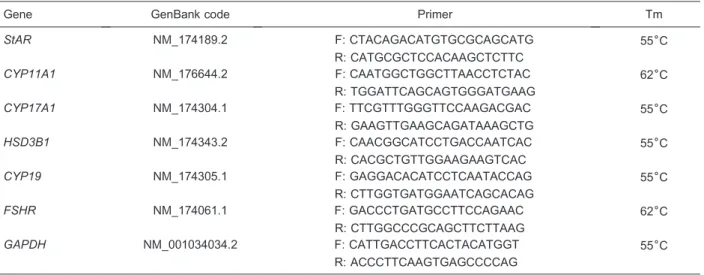
RT-PCR analyses for bovine steroidogenic acute regulatory protein (StAR),CYP11A1, cytochrome P450 17 alpha-hydroxylase (CYP17A1), 3 beta-hydroxysteroid
dehydrogenase 1 (HSD3B1), CYP19, FSH receptor
(FSHR), and the housekeeping
glyceraldehyde-3-phosphate dehydrogenase (GAPDH) gene as an internal control were performed on the target cDNAs prepared from the fresh or cultured FWS using specific primers (Table 1). First, reaction mixes were prepared for each follicle template sample (first-strand reaction), containing all the PCR components except the specific primers, and distributed into 46mL aliquots for target gene amplification procedures.
All PCR reactions contained 2.5 mM MgCl2, 2000mM
dNTPs, 1.5 U Taq DNApol (GE Healthcare Life Sciences, USA), and 2mL cDNAs (first-strand reaction derived from
the RT-PCR procedure), as templates in 50 mM Tris-HCl, pH 8.3, reaction buffer. At the end, 2500mM of a forward
and a reverse primer were added to the reaction mixture and placed in a thermal cycler. Target cDNAs were amplified following the hot-start PCR cycles as follows: 946C for 2 min, 29 cycles at 946C for 30 s, specific melting temperature (shown in Table 1) for 40 s, and 726C for 60 s. The number of cycles was controlled to standardize analysis of the fold-increase in expression of each gene at the log phase.
Aliquots of PCR products (10mL) were electrophoresed
on 2% agarose gels and visualized with ethidium bromide staining. The relative integrated density of each band was scanned and digitalized using a TyphoonTM 86 Variable
Mode Imager (Molecular Dynamics, Amersham Pharmacia Biotech, USA). The ratios of densitometric readings of the amplified target cDNAs andGAPDHwere also calculated on GelEval 1.22 for Macintosh. The relative integrated density of all PCR products was scanned and digitalized using the TyphoonTM86 Variable Mode Imager.
Statistical analysis
Data obtained from NDM and DM groups were analyzed by two-way ANOVA followed by the Bonferroni least-significant difference test. Differences among NDM or DM data during the period of culture were tested for significance by one-way ANOVA also followed by the Bonferroni least-significant test. Differences between NDM and DM groups for each culture time were analyzed by the Studentt-test. All data are reported
Table 1. Sequences of target bovine gene primers and melting temperatures.
Gene GenBank code Primer Tm
StAR NM_174189.2 F: CTACAGACATGTGCGCAGCATG 556C
R: CATGCGCTCCACAAGCTCTTC
CYP11A1 NM_176644.2 F: CAATGGCTGGCTTAACCTCTAC 626C
R: TGGATTCAGCAGTGGGATGAAG
CYP17A1 NM_174304.1 F: TTCGTTTGGGTTCCAAGACGAC 556C
R: GAAGTTGAAGCAGATAAAGCTG
HSD3B1 NM_174343.2 F: CAACGGCATCCTGACCAATCAC 556C
R: CACGCTGTTGGAAGAAGTCAC
CYP19 NM_174305.1 F: GAGGACACATCCTCAATACCAG 556C
R: CTTGGTGATGGAATCAGCACAG
FSHR NM_174061.1 F: GACCCTGATGCCTTCCAGAAC 626C
R: CTTGGCCCGCAGCTTCTTAAG
GAPDH NM_001034034.2 F: CATTGACCTTCACTACATGGT 556C
R: ACCCTTCAAGTGAGCCCCAG
as means±SD and P,0.05 was considered to be statistically significant.
Results
FWS morphology
Fresh FWS controls (Figure 1A) had round GC with a low cytoplasm-to-nucleus ratio, and similar results were observed in DM culture after 24 h (data not shown) and 48 h (Figure 1C). FWS cultured in NDM for 24 (data not shown) and 48 h (Figure 1B) revealed that cells lost their polyhedral shape and acquired an irregular and elongated fibroblast-like form.
Steroid concentrations
Concentration of P4in the culture medium increased
gradually from 24 to 48 h of culture in both experimental groups (DM and NDM; Table 2). However, P4
concentra-tions observed in the DM group were two times lower than the concentrations in the NDM group, in both culture periods (P,0.0001).
Concentrations of E2were higher after 24 h of
incuba-tion in both experimental groups, with higher concentraincuba-tions in the NDM group than in the DM group. Lower, but stable, concentrations of E2were observed in both the NDM and
DM groups cultured in FWS for 48 h (Table 2). There were no significant differences in E2concentration in the NDM
and DM groups (P=0.12, two-way ANOVA).
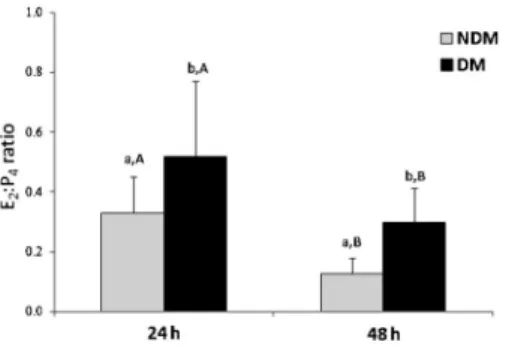
The E2:P4ratio was higher in DM than in NDM at each
culture time (Figure 2); however, the ratio decreased in both groups during the culture period. There were no significant differences between the DM and NDM groups during the whole period of culture (P=0.27, two-way ANOVA).
StAR, steroidogenic enzyme gene expression and
FSHR
Analyses of bovine StAR, steroidogenic enzymes (CYP11A1, CYP17A1, HSD3B1, and CYP19), and
FSHR mRNA expression were performed in fresh FWS
and FWS cultured in NDM or DM for 24 or 48 h. Gene expression was very low in fresh FWS; incubation in NDM did not alter expression of steroidogenic enzymes (Figure 3). Expression of all genes was enhanced in DM culture compared with fresh FWS or NDM culture (Figure 3). However, culture in DM for 24 or 48 h was followed by increased expression of steroidogenic-related genes.
Higher expressions of StAR (Figure 3A), CYP11A1
(Figure 3B), CYP17A1 (Figure 3C), and HSD3B1
(Figure 3D) were observed after 24 and 48 h of culture in DM compared with NDM.CYP19 (Figure 3E) showed augmented expression after 48 h of culture. OnlyFSHR
(Figure 3F) was not significantly enhanced by DM culture. The banding pattern of steroidogenic enzymes andFSHR
gene expression at 48 h is shown in Figure 4.
Figure 1.Morphological characteristics of granulosa cells (GC) and theca cells (TC) inA, fresh bovine ovarian follicle wall sections (FWS), FWS cultured inB, nondefined medium (NDM) or inC, defined medium (DM) after 48 h revealed by hematoxylin-eosin staining. Note the similar morphology between GC inPanels AandCand fibroblast-like GC inPanel B. The results of 24 h were similar to those observed at 48 h (data not shown). Bar=20mm.
Table 2. Concentrations of progesterone and 17b-estradiol in media of cultured bovine FWS.
NDM DM
P4(ng?mL-1?100 mg-1)
Fresh 1.4 ± 0.09 1.5 ± 0.13
24 h 180.8 ± 43.2a,A 84.1 ± 24.2b,A 48 h 255.1 ± 32.5a,B 101.1 ± 19.2b,B E2(pg?mL-1?100 mg-1)
Fresh 12.4 ± 2.46 15.9 ± 5.62
24 h 56.58 ± 15.30a,A 41.52 ± 19.84b,A 48 h 31.74 ± 12.39a,B 29.41 ± 11.28a,B
Discussion
To our knowledge, this is the first study to describe the morphological, endocrine, and molecular events asso-ciated with culture of FWS in DM under basal and strictly
chemically defined conditions (developed by our group) and NDM containing serum (5). The study also analyzed the steroid profile of cultured FWS, and established the fate of folliclesin vitro. GC and theca cell (TC) co-culture of FWS for 24 and 48 h using a modified serum-free DM without FSH demonstrated, for the first time, the condi-tions under which FWS maintains the morphology of
Figure 2.E2:P4ratio of nondefined medium (NDM) and defined medium (DM) after 24 and 48 h of culture. a,bSignificant differences between NDM and DM (t-test, P,0.05). A,BSignificant differences between data obtained at 24 and 48 h
in NDM or DM (one-way ANOVA, P,0.05). Two-way ANOVA indicated no significant differences between groups (P=0.27).
Figure 3.Semi-quantitative analysis of mRNA expression of steroidogenic acute regulatory protein (StAR), steroidogenic enzymes, andFSHR. Circles represent data for follicle wall sections (FWS) cultured in defined medium (DM) and squares represent data for FWS cultured in nondefined medium (NDM).A, Steroidogenic acute regulatory protein (StAR).B, Cholesterol side-chain cleavage A1 (CYP11A1).C, Cytochrome P45017A1(CYP17A1).D, 3 Beta-hydroxysteroid dehydrogenase 1 (HSD3B1).E, Aromatase (CYP19).F, Follicle-stimulating hormone receptor (FSHR). Data of fresh follicle mRNA were used as a control. Each transcript level of target genes was normalized on the basis of the glyceraldehyde-3-phosphate dehydrogenase (GAPDH) level. One-way ANOVA followed by the Bonferroni least-significant test were used to verify differences among NDM or DM data during the period of culture. Differences between NDM and DM groups for each time of culture were identified using the Studentt-test. *P,0.05, significantly different between culture periods and within group medium type.
growing healthy follicles, upregulates steroidogenic enzymes, and sustains a high E2:P4ratio.
In NDM culture, the morphology of FWS cells exhibited an elongated fibroblast-like appearance when compared with fresh FWS. The fibroblast phenotype may be related to culture conditions (15), the absence of the oocyte inside the folliclein vitro(16), the advance of the atresic processin vivo(17), or the absence of connections between GC and TC in monoculture and during luteiniza-tion (5,18). Gutierrez et al. (6) also described the same fibroblast-like cells in the presence of high FSH concen-trations. NDM also contains serum, which includes unknown concentrations of several molecules such as growth factors, steroids, cholesterol, and peptides that may affect the physiological processes of tissues (19,20) and consequently cell morphology.
The concentration of P4in NDM was at least twice as
high as that observed in DM, and E2 levels were
increased after 24 h of culture and decreased after 48 h. The increased levels of P4may be related to the
luteinization process observed in the presence of serum in the culture medium (5). In addition, the E2:P4ratio was
lower in NDM than in DM at 24 and 48 h, demonstrating the luteinizing process in vitro. However, more experi-ments are needed to determine the fate of FWS cultured in NDM. NDM also did not alter gene expression ofStAR,
steroidogenic enzymes, and FSHR when compared to
fresh FWS. The presence of serum decreased the expression of various genes in culture, as described previously (21) and as seen in our results.
A serum-free condition in vitro is crucial for under-standing and control of the identity of all the constituents of serum that affect cultured cells (8,22). Serum-free medium can be achieved by replacing serum with PVA, a synthetic polymer that does not have any negative effects on cells in cultures (23). In addition to PVA, DM is comprised of IGF-1, insulin, androstenedione, nonessential amino acids, selenium, and transferrin (6,13,14). Insulin and IGF-1 can modulate the expression of steroidogenic enzymes, including CYP19, as well as steroidogenesis (6,7), and insulin-transferrin-selenium can maintain GC viability in culture (24). Transferrin and selenium are essential trace elements that may have antioxidant activity in biological systems (24).
FWS cultured in DM maintained the round shape and high nucleus-to-cytoplasm relationship as seen in fresh FWS. The same result was reported by Gutierrez et al. (6) and Piccinato et al. (8), demonstrating the beneficial effects of our DM. P4values in DM were at least one-half
of those observed in NDM and, in addition, maintained a higher E2:P4 ratio, indicating that DM maintains
steroidogenesis and avoids luteinization in vitro. In our results, the P4 increase was concomitant with
increased expressions of CYP11A1, CYP17A1, and
HSD3B1, demonstrating a possible relationship between steroidogenesis and expression of these genes.
E2 concentration was stimulated after 24 h and
decreased after 48 h of DM culture, andCYP19 expres-sion was higher only at 48 h. A possible explanation is that we can obtain higher levels of estrogens, maintained by higher levels of androstenedione supplementation in our DM, not only by CYP19 expression. In addition, our previous results (Vasconcelos RB, Oliveira e Silva I, Gulart LVM, Rosa e Silva AAM, unpublished data) demonstrated that changing 70% of the medium after 48 h of culture significantly enhanced the production of E2
in DM culture, reversing a possible inhibition of E2
synthesis in the DM that was caused by the depletion of androstenedionein vitro. More experiments are needed to determine the E2profile during culture in DM.
DM also increased mRNA gene expression of enzymes related to steroidogenesis, with no FSH or luteinizing hormone (LH) present in the medium. The addition of insulin to GC culture medium inducedCYP19
mRNA (7,25); and after treatment with IGF-1, resulted in a significant increase in CYP11A1, HSD3B1, and CYP19
mRNA expression (26,27) in the absence of FSH and LH. In cultures of theca cells, the presence of inhibin produced by GC increased the expression of StAR, CYP17, and
HSD3B, demonstrating the interaction of the two cell types in steroidogenesis (28).
Our results showed a positive effect of DM, resulting in increased levels ofStAR,CYP11A1,CYP17A1,HSD3B1, andCYP19mRNA expression. It is well known that insulin and IGF-1, as well as other regulators produced by follicular cells, regulateStAR,CYP11A1, andHSD3Bexpression of various species in culture (29). Previous reports of GC in culture did not show an increase inStARexpression (30); however, our results corroborate the data reported by Zhang et al. (31) that demonstrated upregulation ofStAR
gene expression in TC culture with insulinin vitro. It is well known that LH controlsCYP17A1expression in theca cells (32); however, our results demonstrate that DM significantly enhanced CYP17A1 expression, inde-pendently of the presence of gonadotropins. It was demonstrated previously that insulin can influence
CYP17 expression in cultures of porcine TC (31), as seen in our results.
The presence of theca cells in culture with GC (33) and IGF-1 (34) meant they were able to enhanceCYP19
expression, and that no FSH was necessary to sustain E2
production and CYP19 activityin vitro (6,8). In addition,
CYP19decreased significantly if no IGF-1 or insulin were included in the culture medium (7). These data demon-strate that, depending on the conditions of the defined culture medium, expression and activity of aromatase can be sustained independent of the gonadotropins, as seen in other papers and in our results. It should be noted that in DM culture at 48 h, enzyme expression, including
CYP19, had increased, and the E2:P4 ratio decreased
significantly probably because E2 inhibited synthesis
While the steroidogenic enzymes were upregulated by DM, FSHR expression was not altered during 48 h of culture. Usually,FSHRexpression is enhanced by FSH (34), and there is some evidence that IGF-1 enhances
FSHRexpressionin vitrowith no FSH in the medium (27). Our previous data (Vasconcelos RB, Oliveira e Silva I, Gulart LVM, Rosa e Silva AAM, unpublished data)
demonstrated that FSHR mRNA expression was
enhanced only after 72 h of culture, demonstrating the positive effect of DM.
In conclusion, ourin vitroserum-free FWS-DM model was able to maintain cell morphology, steroid profile, and enhanced levels of steroidogenic enzyme mRNAs. Cell morphology observed in growing follicles was sustained by the presence of major ovarian steroids (E2and P4) and
a high E2:P4 ratio. Increased expression of follicular
dominance markers, (e.g.,CYP19andCYP11A1mRNA
expression), strongly indicates that FWS was similar to the follicular wall of the growing and dominant follicle. Based on the results obtained, this in vitro FWS-DM model could be used to study the effect of gonadotropins
independent of putative pro-dominant and pro-atretic factors, in follicular steroidogenesis and folliculogenesis. These results also allow construction of anin vitromodel of a growing and/or dominant follicle, in which both follicular wall and oocyte may be present, to study the cross-talk between the germinal and somatic compart-ments involved in the in vitro regulation of oocyte maturation.
Acknowledgments
We thank Frigorı´fico Ponte Alta, Brası´lia, DF, Brazil, for supplying bovine ovaries, Izabel Cristina Rodrigues da Silva for helping with the statistical analysis, and the Molecular Biology Laboratory group for their support with the RT-PCR assay. We also thank Valter and Lair Gabriel for technical aid. Their help was possible through scientific initiation fellowships granted by CNPq. Research supported by FAP-DF, CNPq, FINATEC, and CAPES. R.B. Vasconcelos was the recipient of a CAPES fellowship of the Medical Sciences Program/University of Brası´lia.
References
1. Bao B, Garverick HA, Smith GW, Smith MF, Salfen BE, Youngquist RS. Changes in messenger ribonucleic acid encoding luteinizing hormone receptor, cytochrome P450-side chain cleavage, and aromatase are associated with recruit-ment and selection of bovine ovarian follicles. Biol Reprod 1997; 56: 1158-1168, doi: 10.1095/biolreprod56.5.1158. 2. Xu Z, Garverick HA, Smith GW, Smith MF, Hamilton SA,
Youngquist RS. Expression of messenger ribonucleic acid encoding cytochrome P450 side-chain cleavage, cytochrome p450 17 alpha-hydroxylase, and cytochrome P450 aromatase in bovine follicles during the first follicular wave.Endocrinology 1995; 136: 981-989, doi: 10.1210/en.136.3.981.
3. Cheng Y, Inoue N, Matsuda-Minehata F, Goto Y, Maeda A, Manabe N. Changes in expression and localization of connexin 43 mRNA and protein in porcine ovary granulosa cells during follicular atresia.J Reprod Dev2005; 51: 627-637, doi: 10.1262/jrd.17035.
4. Luck MR, Rodgers RJ, Findlay JK. Secretion and gene expression of inhibin, oxytocin and steroid hormones during thein vitrodifferentiation of bovine granulosa cells.Reprod Fertil Dev1990; 2: 11-25, doi: 10.1071/RD9900011. 5. Channing CP. Effects of stage of the menstrual cycle and
gonadotrophins on luteinization of rhesus monkey granu-losa cells in culture. Endocrinology1970; 87: 49-60, doi: 10.1210/endo-87-1-49.
6. Gutierrez CG, Campbell BK, Webb R. Development of a long-term bovine granulosa cell culture system: induction and maintenance of estradiol production, response to follicle-stimulating hormone, and morphological characteristics.Biol Reprod1997; 56: 608-616, doi: 10.1095/biolreprod56.3.608. 7. Silva JM, Price CA. Insulin and IGF-I are necessary for FSH-induced cytochrome P450 aromatase but not cytochrome P450 side-chain cleavage gene expression in oestrogenic bovine granulosa cells in vitro. J Endocrinol 2002; 174:
499-507, doi: 10.1677/joe.0.1740499.
8. Piccinato CA, Montrezor LH, Collares CA, Vireque AA, Rosa e Silva AA. Norepinephrine stimulates progesterone produc-tion in highly estrogenic bovine granulosa cells cultured under serum-free, chemically defined conditions. Reprod Biol Endocrinol2012; 10: 95, doi: 10.1186/1477-7827-10-95. 9. McNatty KP, Heath DA, Henderson KM, Lun S, Hurst PR,
Ellis LM, et al. Some aspects of thecal and granulosa cell function during follicular development in the bovine ovary. J Reprod Fertil1984; 72: 39-53, doi: 10.1530/jrf.0.0720039. 10. Ginther OJ, Wiltbank MC, Fricke PM, Gibbons JR, Kot K. Selection of the dominant follicle in cattle.Biol Reprod1996; 55: 1187-1194, doi: 10.1095/biolreprod55.6.1187. 11. Komar CM, Berndtson AK, Evans AC, Fortune JE. Decline
in circulating estradiol during the periovulatory period is correlated with decreases in estradiol and androgen, and in messenger RNA for p450 aromatase and p450 17alpha-hydroxylase, in bovine preovulatory follicles. Biol Reprod 2001; 64: 1797-1805, doi: 10.1095/biolreprod64.6.1797. 12. Richard FJ, Sirard MA. Effects of harvest methods of bovine
oocytes co-cultured with follicular hemisectionsin vitroon nuclear maturation.Theriogenology1996; 46: 1243-1250, doi: 10.1016/S0093-691X(96)00295-6.
13. Montrezor LH, Piccinato CA, Rosa e Silva AAM. Polyvinyl alcohol is effective in a defined medium long-term bovine granulosa cell culture in the maintenance of 17b-estradiol production.Biol Reprod2002; 66 (Suppl 1): 211 (Abstract), doi: 10.1095/biolreprod66.1.211
14. Piccinato CA, Montrezor LH, Rosa e Silva AAM. Norepinephrine stimulates steroidogenesis in bovine granulosa cells cultured under chemically defined conditions (PVA).Biol Reprod2002; 66 (Suppl 1): 210 (Abstract). 15. Allegrucci C, Hunter MG, Webb R, Luck MR. Interaction of
co-culture system. Reproduction2003; 126: 527-538, doi: 10.1530/rep.0.1260527.
16. Nekola MV, Nalbandov AV. Morphological changes of rat follicular cells as influenced by oocytes.Biol Reprod1971; 4: 154-160.
17. Pedersen HG, Watson ED, Telfer EE. Analysis of atresia in equine follicles using histology, fresh granulosa cell mor-phology and detection of DNA fragmentation.Reproduction 2003; 125: 417-423, doi: 10.1530/rep.0.1250417.
18. Tajima K, Orisaka M, Yata H, Goto K, Hosokawa K, Kotsuji F. Role of granulosa and theca cell interactions in ovarian follicular maturation.Microsc Res Tech2006; 69: 450-458, doi: 10.1002/jemt.20304.
19. Gardner DK. Mammalian embryo culture in the absence of serum or somatic cell support.Cell Biol Int1994; 18: 1163-1179, doi: 10.1006/cbir.1994.1043.
20. Mingoti GZ, Garcia JM, Rosa-e-Silva AA. Steroidogenesis in cumulus cells of bovine cumulus-oocyte-complexes maturedin vitro with BSA and different concentrations of steroids.Anim Reprod Sci2002; 69: 175-186, doi: 10.1016/ S0378-4320(01)00187-7.
21. Calder MD, Caveney AN, Sirard MA, Watson AJ. Effect of serum and cumulus cell expansion on marker gene transcripts in bovine cumulus-oocyte complexes during maturation in vitro.Fertil Steril2005; 83 (Suppl 1): 1077-1085, doi: 10.1016/j.fertnstert.2004.12.012.
22. Faes MR, Caldas-Bussiere MC, Viana KS, Dias BL, Costa FR, Escocard RM. Nitric oxide regulates steroid synthesis by bovine antral granulosa cells in a chemically defined medium. Anim Reprod Sci 2009; 110: 222-236, doi: 10.1016/j.anireprosci.2008.01.018.
23. Vireque AA, Camargo LS, Serapiao RV, Rosa e Silva AA, Watanabe YF, Ferreira EM, et al. Preimplantation develop-ment and expression of Hsp-70 and Bax genes in bovine blastocysts derived from oocytes matured in alpha-MEM supplemented with growth factors and synthetic macro-molecules. Theriogenology 2009; 71: 620-627, doi: 10.1016/j.theriogenology.2008.09.028.
24. Quirk SM, Harman RM, Cowan RG. Regulation of Fas antigen (Fas, CD95)-mediated apoptosis of bovine granulosa cells by serum and growth factors. Biol Reprod2000; 63: 1278-1284, doi: 10.1095/biolreprod63.5.1278.
25. Silva JM, Price CA. Effect of follicle-stimulating hormone on steroid secretion and messenger ribonucleic acids encoding cytochromes P450 aromatase and cholesterol side-chain
cleavage in bovine granulosa cells in vitro. Biol Reprod 2000; 62: 186-191, doi: 10.1095/biolreprod62.1.186. 26. Magoffin DA, Weitsman SR. Insulin-like growth factor-I
stimulates the expression of 3 beta-hydroxysteroid dehydrogenase messenger ribonucleic acid in ovarian theca-interstitial cells. Biol Reprod 1993; 48: 1166-1173, doi: 10.1095/biolreprod48.5.1166.
27. Mani AM, Fenwick MA, Cheng Z, Sharma MK, Singh D, Wathes DC. IGF1 induces up-regulation of steroidogenic and apoptotic regulatory genes via activation of phospha-tidylinositol-dependent kinase/AKT in bovine granulosa cells. Reproduction 2010; 139: 139-151, doi: 10.1530/ REP-09-0050.
28. Young JM, McNeilly AS. Inhibin removes the inhibitory effects of activin on steroid enzyme expression and androgen production by normal ovarian thecal cells.J Mol Endocrinol2012; 48: 49-60, doi: 10.1530/JME-11-0134. 29. Lavoie HA, King SR. Transcriptional regulation of
steroido-genic genes: STARD1, CYP11A1 and HSD3B. Exp Biol Med2009; 234: 880-907, doi: 10.3181/0903-MR-97. 30. Sahmi M, Nicola ES, Silva JM, Price CA. Expression of
17beta- and 3beta-hydroxysteroid dehydrogenases and steroidogenic acute regulatory protein in non-luteinizing bovine granulosa cellsin vitro. Mol Cell Endocrinol2004; 223: 43-54, doi: 10.1016/j.mce.2004.05.010.
31. Zhang G, Garmey JC, Veldhuis JD. Interactive stimulation by luteinizing hormone and insulin of the steroidogenic acute regulatory (StAR) protein and 17alpha-hydroxylase/17,20-lyase (CYP17) genes in porcine theca cells.Endocrinology 2000; 141: 2735-2742, doi: 10.1210/en.141.8.2735. 32. Murayama C, Miyazaki H, Miyamoto A, Shimizu T. Luteinizing
hormone (LH) regulates production of androstenedione and progesterone via control of histone acetylation of StAR and CYP17 promoters in ovarian theca cells.Mol Cell Endocrinol 2012; 350: 1-9, doi: 10.1016/j.mce.2011.11.014.
33. Orisaka M, Mizutani T, Tajima K, Orisaka S, Shukunami K, Miyamoto K, et al. Effects of ovarian theca cells on granulosa cell differentiation during gonadotropin-indepen-dent follicular growth in cattle.Mol Reprod Dev2006; 73: 737-744, doi: 10.1002/mrd.20246.