Health network assisting users of alcohol, crack, and other drugs
Rede de saúde no atendimento ao usuário de álcool, crack e outras drogas
Red de salud en la atención a los usuarios de alcohol, crack y otras drogas
Danielle Souza Silva Varela1 Isabela Maria Magalhães Sales2 Fernanda Mendes Dantas e Silva2 Claudete Ferreira de Souza Monteiro2
1. Universidade Estadual do Piauí,
Teresina - PI, Brazil.
2. Universidade Federal do Piauí,
Teresina - PI, Brazil.
Corresponding author:
Danielle Souza Silva Varela. E-mail: [email protected]
Submited on 07/08/2015. Accepted on 01/18/2016.
DOI: 10.5935/1414-8145.20160040
A
bstrActObjective: This study has the goal to analyze the articulation of the health network to assist users of alcohol, crack and other
drugs from a nurses' perspective. Methods: This is an observational, descriptive, and exploratory study with a quantitative
approach. It was conducted in the health network in a coastal city in the state of Piaui, Brazil, with 56 nurses who answered a questionnaire. Results: The majority of nurses (82.0%) reported that the place where they work is articulated with other health
network services for assistance to users of alcohol, crack and other drugs. Mainly, it happens by using the referral to a mental health service (48.8%). The integration among the health staf (46.3%), and the responsibility with the user and his/her family was considered fair (51.2%). In fact, nurses who said that they use strategies to overcome this situation also informed the presence of diiculties on the integration process. Among the diiculties that were reported, 40.5% of them was related to disrespect for the reference and counter reference system. Conclusion: Thus, it is necessary to promote debates in order to discuss the
functioning and coordination of the health network that assist these users.
Keywords: Nurses, male; Delivery of health care; Drug users; Health services; Mental health.
r
esumoObjetivo: Analisar, na perspectiva dos enfermeiros, a articulação de uma rede de saúde para o atendimento aos usuários de álcool, crack e outras drogas. Métodos: Estudo observacional, descritivo, exploratório, com abordagem quantitativa, desenvolvido
em um município litorâneo do estado do Piauí, Brasil, com 56 enfermeiros por meio da aplicação de questionários. Resultados:
A maioria dos enfermeiros (82,0%) airmou que os locais de saúde onde trabalham articulam-se com outros serviços da Rede de
Saúde na assistência ao usuário de álcool, crack e outras drogas, principalmente por meio do encaminhamento a um serviço de
saúde mental (48,8%). A integração entre as equipes (46,3%) e a corresponsabilidade ao usuário e sua família foi considerada razoável (51,2%). A presença de diiculdades no processo de articulação foi informada pelos enfermeiros que airmaram utilizar estratégias para superá-las. Dentre as diiculdades informadas, 40,5% estiveram relacionadas ao desrespeito ao sistema de referência e contra referência. Conclusão: Ressalta-se a necessidade da realização de debates para tratar do funcionamento
e articulação em rede para atenção a esses usuários.
Palavras-chave: Enfermeiros; Assistência à saúde; Usuários de drogas; Serviços de saúde; Saúde mental.
r
esumenObjetivo: Analizar, según la perspectiva de los enfermeros, la articulación de la red de salud para atender a los usuarios de
alcohol, crack y otras drogas. Métodos: Estudio observacional, descriptivo y exploratorio, con enfoque cuantitativo, desarrollado,
en una ciudad costera en el estado de Piauí, Brasil, con 56 enfermeros a través del uso de cuestionarios. Resultados: La mayoría
de los enfermeros (82,0%) dijo que los locales de salud donde trabajan son articulados con otros servicios de la Red de Salud en la asistencia a los usuarios de alcohol, crack y otras drogas, principalmente a través de la derivación a un servicio de salud mental (48,8%). La integración de los equipos (46,3%) y la corresponsabilidad al usuario y su familia se consideró razonable (51,2%). La presencia de diicultades en el proceso de integración fue informada por los enfermeros que dijeron que usan estrategias para superarlas. Entre las diicultades señaladas, 40,5% estuvieron relacionadas con la falta de respeto al sistema de referencia y contra referencia. Conclusión: Hacemos hincapié en la necesidad de debates para discutir el funcionamiento
y articulación en red para la atención a estos usuarios.
INTRODUCTION
The use and abuse of and dependency on alcohol, crack and other drugs, considered a serious public health problem in contemporary society, has become the center of various Brazilian public policies requiring properly organized, articulated and resolving actions and services, especially from the Single Health System (SUS), towards the problem.
Federal Law nº 10.216/2001 legalizes the psychiatric reform movement in the area of mental health in Brazil. With its validation, the interest of policies on drugs in the country became visible in the sense of prioritizing the network of extra-hospital care and directing eforts contemplating integral health care to the public directly involved with the consumption of drugs1.
Aligned to the principle of integral care, there was the recognition that the multifactor nature of problems involving the use of such substances requires a diversity of interventions, in their turn imposing the extension of coverage and the spectrum of action of health professionals to meet the needs of the users. Despite some ideological collisions, politics started to focus on preventive actions on the misuse of drugs, psychosocial rehabilitation of users and the approach of harm reduction as a philosophy of work1.
The recommendation of the Ministry of Health is to provide support to users of alcohol, crack and other drugs at all levels of attention of the SUS, since the objective is to build a network of diversiied mental health care. In this network, the user entering the system should be able to count on diferent locations of support to his problem2.
The policy of Integral Attention to users of alcohol and other drugs was emphatic in pointing out that strengthening a network of assistance centered on community attention associated with the network for social and health services, is a compromise that should be executed as a way of coping with collective situations related to this issue. Strengthening the network character sets out on a path for the integral attention of alcohol users, crack and other drugs, because it is the network that, in constant interaction, creates various entrances, welcomes, forwards, prevents, treats, rehabilitates and reconstructs existences, enabling efective alternative coping2.
In this sense, the realization of the linkage between the constituting entities of the network proves crucial, because it encourages co-responsibility in addition to potentiating therapeutic practices in an axis that does not split care, opening the way for extended treatments3. It is also important
to emphasize that not only health services, but all individuals (relatives, friends, neighbors), territorial social provisions and organizations, either or not governmental, must share in the assistance, forming partnerships and networks of social support, so as to promote sector-crossing completeness of actions4.
However, Brazilian studies on the topic in question evidence that the constitution of this network of care is a challenge. Despite the gap of researches that assess the articulation of diferent health services to meet users of alcohol, crack and other drugs, in the literature there are records of situations that sprout signs of fragility in the attention to users that certainly interfere in the realization of this process and consequently, in care and in resolvability of cases.
There is, for instance, evidence of disconnection between basic healthcare services and services of mental health, as to the continuity of care to the user within his territory4. In addition, some
health professionals ignore the responsibility of health services in the Network for assistance to users of alcohol, crack and other drugs5,6. Moreover, professionals are unprepared to assist these users, especially in the primary level of assistance5,7,8.
Thus, this research seeks to know, from the nurses, the process of articulation of a network of health care to users of alcohol, crack and other drugs, to understand the scarcity of studies related to the topic. Besides, it opts to deine the need to discuss the consummation of this process in certain realities, in order to highlight potential and/or diiculties, useful to the un -derstanding of problems involving the attendance to these users. In this way, the present study has as objective to analyze the articulation of a network of health care to users of alcohol, crack and other drugs through a nurses' perspective.
METHODS
This is a study with a quantitative and experimental observational, descriptive, exploratory, cross-sectional approach, conducted in a city in the north of the coastal state of Piaui, Brazil.
Nurses from 27 Family Health Units (FHU), two general hospitals (a state and a philanthropic), a Municipal Emergency Room, a Mobile Emergency Care Service (MECS) and a Psychosocial Attention center Alcohol and Drugs type III (CAPSad III) took part in the study. This set of services is in this study named as "Health Network".
Of the 72 nurses within this Health Network, 56 constituted the sample of this research, meeting the criteria of inclusion of having worked for at least six months in the researched health institution. Nurses on license/expulsion or vacation in the period of the study were excluded.
The collected data were tabulated using Microsoft Excel 2010 and subsequently exported to the Statistical Program of Social Science is Windows 18.0 (SPSS), to be processed by descriptive manipulation with calculations of absolute frequency and percentage, and are presented in tables. The responses of the open questions were grouped by category according to thematic similarity of the information written by professionals.
All participants signed a Free and Informed Consent Term (FICT) ensuring the fulillment of Resolution nº 466/2012 of the National Health Council, which establishes the guidelines and regulatory standards for research involving human beings. The project was approved by the Ethics Committee in Research of the Federal University of Piaui (CAAE 19905913.4.0000.5214/ Opinion 372.348).
RESULTS
Characterization of the participants of the study showed a predominance of married females, aged between 24 and 43 years, linked to the USF, working time ive years or more and absence of trainings on alcohol, crack and other drugs.
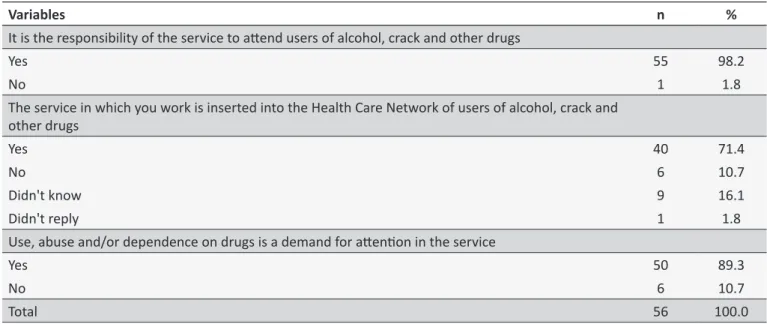
Table 1 shows, in relation to the articulation of health services with network of care to users of alcohol, crack and other drugs, from nurses' perspective, if it is the responsibility of the service meet these users, if the network includes the service and the demand for the service.
According to the presented data, it veriies that 98.2% of the participants consider it the responsibility of the health services in which they work to attend users of alcohol, crack and other drugs; 71.4% reported that these services are inserted in the Network
of Health attending users of alcohol, crack and other drugs; and 89.3% that use, abuse and/or dependency of drugs is among the demands attended in these health institutions (Table 1).
Table 2 discusses the articulation of Health Network in analysis, presenting the form of this articulation and performance.
It is observed that for the professionals who have declared the use, abuse and/or drug addiction as a demand met in service (n = 50), 82.0% indicated that the health service works in conjunction with other services of the Health Care network to provide assistance to the user of these substances. The form of this cooperation was for 48.8% the forwarding to a mental health service; 26.8% the establishing of a support matrix; 12.2% hospital care and for 9.8% other reasons. As for the performance of the cooperation, 51.2% qualiied the integration/ communication between the teams as reasonable and 46.3% considered the responsibility shared by the user and his family reasonable as well.
The professionals also reported diiculties for the service where they work to connect with the Health Network to attend the user of alcohol, crack and other drugs. Among the diiculties informed, 40.5% related to disrespect to the system of reference and against reference and 33% on the unpreparedness of the Health Care network for the care of users (lack of psychiatric beds, protocols of visits and worklow diagrams (Figure 1).
To overcome the difficulties of articulation of the health care network, 52.0% of participants stated they seek help from other professionals/health institutions; 24.0% is studying the matter and demand information on services/actions for users (Figure 2).
Table 1.
Responsibility, inserion and demand of health services assising users of alcohol, crack and other drugs in
a coastal city of the State of Piaui, Brazil, 2013 (n = 56)
Variables
n
%
It is the responsibility of the service to atend users of alcohol, crack and other drugs
Yes
55
98.2
No
1
1.8
The service in which you work is inserted into the Health Care Network of users of alcohol, crack and
other drugs
Yes
40
71.4
No
6
10.7
Didn't know
9
16.1
Didn't reply
1
1.8
Use, abuse and/or dependence on drugs is a demand for atenion in the service
Yes
50
89.3
No
6
10.7
Table 2.
Ariculaion, shape and performance of the Health Network to meet users of alcohol, crack and other drugs
in a coastal city of the state of Piaui, Brazil, 2013 (n = 50)
Variables
n
%
The service is linked to other health network services to assist the users of alcohol, crack and
other drugs
Yes
41
82.0
No
9
18.0
Ariculaion form (n = 41)
Referral to a mental health service
20
48.8
Matrix support
11
26.8
Hospital care
4
12.2
Other reasons
5
9.8
Did not answer
1
2.4
Integraion/Communicaion Performance between the ariculated teams (n = 41)
Nonexistent
1
2.4
Precarious
16
39.1
Reasonable
21
51.2
Saisfactory
3
7.3
Performance of shared responsibility by the user and his family (n = 41)
Nonexistent
3
7.3
Precarious
17
41.5
Reasonable
19
46.3
Saisfactory
2
4.9
Figure 1. Distribuion of the diiculies of ariculaion of the Health Care network to atend users of alcohol, crack and other drugs in a coastal
Figure 2. Distribuion of the strategies used by nurses to overcome the diiculies of ariculaion of Health network of a coastal city of the
State of Piaui, Brazil, 2013 (n = 56).
DISCUSSION
In this study, the prevalence of women was already expected, seeing it is in the area of nursing professionals, whose universe is mostly composed of the female sex. To attention comes the fact that few of the participants have training/training in the area of attention to users of alcohol, crack and other drugs. This datum is worrying, as the representativeness of the sample covers various services of a health network and therefore signals a weakness shared by many workers.
However, this inding is not particular to this study. Research conducted with nurses of extra - hospital services in municipalities of Rio de Janeiro and the Family Health Strategy (ESF) in Joao Pessoa/PB verified low empowerment/training of nurses in this area of attention. They even pointed out that the absence of training can have negative repercussions on the assistance ofered to the user of alcohol, crack and other drugs, and even interfere with the low of these users within the network7,9. The study of John Person stressed that the lack of such training has resulted in measures, restricted to the forwarding of users to more specialized services in mental health and, in some cases, advice to seek these services7.
In terms of the insertion of the institution within the health network to people with needs arising from the use of alcohol, crack and other drugs and on the responsibility of the services to attend them, was a positive inding. Non-recognition of a health service as a place of support for the chemical dependent in a health network by the professional working with the person
patients, compromising the operation of the network, and certainly the coping strategies of local problems.
This recognition is attributed to the inluence of the expansion and strengthening of the public attention in the SUS context that diversiication of devices encourages a shared responsibility between the sectors, allowing the expansion of actions, facilitating access and certainly, awareness among health professionals regarding the cause10.
Another important information identiied in the results refers to the fact that 89.3% of the participants have stated that the health services where they work deal with use/abuse/dependency. This data indicates the existing daily demand on these institutions for problems related to drugs and demonstrates, be it supericially, the presence of diferent points of support available to the user on the Health Network, which reinforces the importance of the qualiication of professionals for the provision of care to the vulnerable and consuming public.
The participants who reported the presence of demand in service, 82.0% said that the services where work will be articulated with other health services to provide assistance to the user of alcohol, crack and other drugs, taking the referral to a mental health service (CAPSad (III) as the main reason. The search for partnerships with CAPSad also was described in a study held among nurses of the FHT of Porto Alegre-RS, with the aim to obtain success and continuity of treatment of this public11.
concern. It is emphasized that the form with which the forwarding is performed is fundamental in the positive or negative outcome of a problem. Authors criticize that the focus on routing can cause the user to wander in the system, the bonds are removed and the direction of the integrality of care forgotten12. In addition to the tendency to practice a piecemeal assistance, there is also a danger of institutionalization of the chemical dependent to specialized services and disregard of power of intervention and resolution of the other levels of care7.
It is worth emphasizing that articulation consists in the establishment of connections between professionals/services with views to qualify the care to the user. Thus, the recommended procedure in fact is to exchange information. In the event of routing, the system of reference and counter-reference needs to be respected and not be summarized into the "transfer" of the patient from one institution to the other. It should be cherished by efective communication and invest in the co-responsibility of health services for the care of the user/family. The attendance must be carried out according to the technical competence of each service, in order to avoid unnecessary referrals to the patient13.
With regard to this issue, the search for support matrix has been an alternative of coping, used in the scenario researched, being the second largest reason for linkage. This signals that a considerable part of the services is walking towards care and resolution of cases in loco, which shows a breakthrough in the functioning of the network. Recourse to the matrix support team, especially by the team of basic attention, proves a promising strategy in the care of the cases of mental health, because it allows increasing the efectiveness of the shared work, reinforcing the completeness and resolvability of actions at primary level, by means of shared managing of the health attendance14.
In this research participants perceived the diiculties of articulation of the health care network ofering care to drug users. These diiculties centralized on disregard of the reference system/reference and unpreparedness against the Health Network for users of alcohol, crack and other drugs.
Coordinators of health services participating in a study developed in the Network of Mental Health Care in the municipality of Santa Maria/RS perceived similar diiculties. In this location, the coordinators have mentioned that structural diiculties and, mainly, of organizational nature of services, interfere in the articulation of the network for the efective care of cases of mental health. The authors of that study found a close relationship between them, where the emergence of one predisposes the appearance of the other, and that together, they tend to dismember integrality in the network13.
In the municipality of this study, it is believed that the interaction between the diiculties of articulation mentioned by
nurses also has repercussions on the integrality of care ofered and the performance of linkage performed. This understanding parts from results to show that from the point of view of shared responsibility for the user and his family and integration/ communication between the articulated teams, performance ranged between reasonable and precarious, with a slight overlap of the irst. This information shows that the relations between the teams need elaboration, as well as more instrumentation13. Some evidences in the literature reinforce the results of this research when they raise situations that can interfere in the process of responsibility/integration between the services/ health teams and, consequently, in the linkage and resolvability of network. It concerns the lack of training/knowledge of health professionals on the theme, encouraging motivation to act with these users11 and the insuiciency of records, not only impeding communication among professionals of a service, but also hinder the task of professionals of reference, interfering in continuity and resolvability of actions15. In addition, there ate the disrespect for the reference counter-reference system and the matrix practice, summarized into the transfer of responsibility16 and the lack of an organizational chart of services17.
Interpretation along these lines sees the ofer of permanent health education on the matter and promotion of spaces for dialog and discussion between the management and the teams assisting in approximation of services researched, in the understanding of the dynamic operation of the network regarding the service of cases related to the use of alcohol, crack and other drugs. A research developed in the South of Brazil, which evidences the meetings of "mental health in wheel" as an alternative found to make reality the exchange of information, the linkage between the services and professional yet the professional qualiication13 shows a result that corroborates with this understanding.
In addition, the elaboration and implementation of the protocols and speciic programs for the work with the users of these substances in the health services would be an alternative to avoid heterogeneity and discontinuity in the conduct of cases. Literature has already emphasized that the absence of these interferes negatively on the performance of the nurse9, and consequently of the team.
This is not the irst report on the use of strategies to overcome diiculties in the attention to the drug user by nurses. According to a study performed in CAPSad (of São Paulo/SP), in the absence of skills and expertise, the nurses informed to seek information and knowledge reading books and articles, besides the exchanging experiences with other health professionals, especially of the team18.
Thus, although not enough to face diiculties experienced, the data in this study show that the professionals are not inert towards encountered obstacles; but build alternative methods to overcome them. However, it is worth mentioning that it does not obviate the need for a greater attention and intervention on the part of the competent bodies for the resolution of these problems.
CONCLUSION
The presented results reveal the existence of a health network for people with needs arising from the use of alcohol, crack and other drugs in the municipality studied. This is based on information by nurses involved in local health care services recognizing the insertion of workplaces in this network of attention and inform responsibility of these services ofer care to the public even airming that already have demand for this service.
The articulation as actuation of work was present in statements of 82.0% of the participants who have user demand in the health service where they work. Forwarding to a mental health service was the way of conducting this joint more pointed out. However, this link from the point of view of shared responsibility and the integration of teams presented failed to oscillate between reasonable and precarious nurses said. It is believed that the diiculties encountered in the process of articulation evidenced by the participants of the study have justiied this classiication of performance.
Other inding of this research is the need to empower the nurses to work better with people who use, abuse and/or are dependent on alcohol, crack and other drugs. Additionally, the research suggests meetings with the teams/services of Health Network researched in order to provide elements that allow a better understanding about operations and networking, parting from spaces for debate, enabling the overcoming many diiculties encountered.
Regarding the limitations of the study assumes that by virtue of the object in the analysis and collection instrument used, it was not possible to evaluate if, articulating them if this way, the network of the city under study has reached a better level of resolvability of cases. Such questions are left as a suggestion for investigation in other researches.
REFERENCES
1. Machado LV, Boarini ML. Políticas sobre drogas no Brasil: a estratégia de redução de danos. Psicol. cienc. prof. 2013 mar;33(3):580-95. 2. Ministério da Saúde (BR). A política do ministério da saúde para a
atenção integral a usuários de álcool e outras drogas. 2a ed. Brasília (DF): Ministério da Saúde; 2004.
3. Schneider ARS. A rede de atenção em saúde mental: a importância da interação entre a atenção primária e os serviços de saúde mental. Cienc. saude colet. 2009 jul/dez; 2(2):78-84.
4. Schneider JF, Roos CM, Olschowsky A, Pinho LB, Camatta MW, Wetzel C. Atendimento a usuários de drogas na perspectiva dos proissionais da estratégia saúde da família. Texto Contexto Enferm. 2013 jul/set; 22(3):654-61.
5. Moretti-Pires RO, Ferro SBG, Büchele F, Oliveira HM, Gonçalves MJF. Enfermeiro de Saúde da Família na Amazônia: conceitos e manejo na temática do uso de álcool. Rev. Esc. Enferm. USP. 2011 ago;45(4):926-32.
6. Schneider DR, Lima DS. Implicações dos modelos de atenção à dependência de álcool e outras drogas na rede básica em saúde. Psico. 2011 abr/jun;42(2):168-78.
7. Rosenstock KIV, Neves MJ. Papel do enfermeiro da atenção básica de saúde na abordagem ao dependente de drogas em João Pessoa, PB, Brasil. Rev. Bras. Enferm. 2010 jul/ago;63(4):581-6.
8. Moretti-Pires RO, Lima LAM, Katsurayama M. A formação dos médicos de saúde da família no interior da Amazônia sobre a problemática do abuso de álcool. Rev. Bras. Promoç. Saude. 2010 jan/mar;23(1):56-62. 9. Gonçalves SSPM, Tavares CMM. Atuação do enfermeiro na atenção ao usuário de álcool e outras drogas nos serviços extra-hospitalares. Esc. Anna Nery. 2007 set/dez;11(4):586-92.
10. Ministério da Saúde (BR). Saúde Mental no SUS: As novas fronteiras da reforma psiquiátrica. 1a ed. Brasília (DF): Ministério da Saúde; 2011. 11. Souza LM, Pinto MG. Atuação do enfermeiro a usuários de álcool e de outras drogas na Saúde da Família. Rev. Eletr. Enf. [on line]. 2012 abr/ jun [citado 2013 dez 10]; 14(2): 374-83. Disponível em: http://www.fen. ufg.br/revista/v14/n2/v14n2a18.htm.
12. Zambenedetti G, Perrone CM. O processo de construção de uma rede de atenção em saúde mental: desaios e potencialidades no processo de reforma psiquiátrica. Physis. 2008 abr/jun;18(2): 277-93.
13. Paes LG, Schimith MD, Barbosa TM, Righ LB. Rede de atenção em saúde mental na perspectiva dos coordenadores de serviços de saúde. Trab. Educ. Saude. 2013 maio/ago; 11(2):395-409.
14. Delini PSS, Sato MT, Antonelli PP, Guimarães POS. Parceria entre CAPS e PSF: o desaio da construção de um novo saber. Cienc. saude colet. 2009;14(supl.1):1483-92.
15. Mororó MEML, Colvero LA, Machado AL. Os desaios da integralidade em um centro de atenção psicossocial e a produção de projetos terapêuticos. Rev. Esc. Enferm. USP. 2011 set/out; 45(5):1171-6. 16. Azevedo DM, Gondim MCSM, Silva DS. Matrix support in mental health:
the perception of professional in territory. R. Pesq.: cuid. Fundam. Online [online]. 2013 jan/mar [citado 2014 maio 30]; 5(1): 3311-22. Disponível em:http://www.seer.unirio.br/index.php/cuidadofundamental/article/ view/1951/pdf_689