Rev Saúde Pública 2006;40(1) www.fsp.usp.br/rsp
INTRODUCTION
In Brazil, from the 1990s onwards, restructuring of production systems has caused profound changes in their technical and organizational basis.5 Both the
greater flexibility of production structures and the organization and social division of labor have de-fined enormous changes in the nature, meaning and content of work. With the new labor configuration, guaranteed social rights are now the privilege of a
The individual’s status in the labor market and
health inequity in Brazil
Luana Giatti and Sandhi Maria Barreto
Programa Pós-Graduação de Saúde Pública. Faculdade Medicina. Universidade Federal de Minas Gerais. Belo Horizonte, MG, Brasil
Received on 10/2/2005. Approved on 25/7/2005.
Correspondence: Luana Giatti
Rua Antônio Dias, 339/03
31130-150 Belo Horizonte, MG, Brasil E-mail: [email protected]
Keywords
Work, employment. Unemployment. Labor force. Health inequity.
Abstract
Objective
To investigate inequalities in personal health conditions and in the utilization of healthcare services according in relation to the individual’s status in the labor market.
Methods
This study was based on 39,925 males aged 15 to 64 years living in 10 Brazilian metropolitan regions, who took part in the 1998 National Household Survey. They were classified as formal labor, informal labor, unemployed or outside of the labor market. Each category was compared with formal labor regarding sociodemographic characteristics, health status indicators and healthcare utilization. This analysis was by means of Pearson’s Chi-square test. Multinomial logistic regression was used to investigate independent associations between labor market status, health status indicators and healthcare utilization.
Results
The classification of the participants’ status was that 52.2% were formal labor, 27.7% informal labor, 10% unemployed and 10.2% were outside of the labor market. There were significant differences between these categories with respect to age, schooling, household income, household status and region of residence. Independent of the sociodemographic characteristics, unemployment, informal labor status and, especially, exclusion from the labor market remained associated with poor health status.
Conclusions
The individual’s status in the labor market is expressed through a gradient of inequality in health conditions. These findings reinforce the need to also consider the individual’s status in the labor market in studies on healthcare inequalities.
restricted group of workers, while precarious contracts have proliferated along with unemployment.
Unemployment is probably the main factor leading to social exclusion.13 Workers who are excluded from
exclu-Rev Saúde Pública 2006;40(1) www.fsp.usp.br/rsp
Labor market status and health Giatti L & Barreto SM
formal labor (working with formally signed employ-ment docuemploy-ments and/or making social security con-tributions); informal labor (working without formally signed employment documents and without making social security contributions); unemployed (not work-ing but seekwork-ing work); outside of the labor market (not working and not seeking work). For this classifi-cation, the following variables were used: activity status (economically active or not), occupational sta-tus (working or not), formally signed employment documents (yes or no), social security contribution (yes or no). Public service workers and military per-sonnel were classified as formal labor. Students who were not working or who were not seeking work were excluded from the analysis.
The sociodemographic characteristics studied were age group (15-24, 25-34, 35-44, 45-54, or 55-64 years); number of years of schooling (0-3, 4-7, 8-10, 11+ years); per capita household income, calcu-lated as the total household income divided by the number of people forming the household, and grouped in quintiles; household status (reference person: yes or no); and the metropolitan region. These regions were grouped according to macro-regions: Southeast (São Paulo, Rio de Janeiro and Belo Horizonte); South (Curitiba and Porto Alegre); Northeast (Fortaleza, Recife and Salvador); North (Belém) and the Federal District.
The health indicators utilized were: self-percep-tion of health, time off any of the usual activities during the last two weeks, time spent bedridden over the last two weeks, and reports of any chronic dis-eases. Self-perception of health was assessed by the question “In a general manner, do you consider your state of health to be…?” The answers were grouped into three categories: very good/good, regular and bad/very bad. A further category (another inform-ant) was also used in constructing the variable, in which the information was not obtained directly from the individual. This was done because of the subjective aspects of self-perception of health that can only be picked up when the individual himself gives answers in the interview. Time off the usual activities during the last two weeks (yes or no) was assessed by means of the question “During the last two weeks did you fail to perform any of your usual activities for health reasons?” Time spent bedrid-den over the last two weeks (yes or no) was assessed by means of the question “Have you been bedrid-den over the last two weeks?” The variable of re-ports of chronic diseases was obtained from infor-mation regarding one or more of the following con-ditions: arthritis or rheumatism; cancer; diabetes; bronchitis or asthma; hypertension; heart disease; sion from work is the broadest form of exclusion,14 and
its victims are probably also excluded from the major-ity of other social networks and are placed on a path-way leading to increasing vulnerability.
Studies have shown the central importance of so-cioeconomic conditions for determining morbidity-mortality patterns in populations, with a positive as-sociation between the socioeconomic level and bet-ter health conditions.8 There are different ways of
measuring the extent and magnitude of the associa-tions between socioeconomic inequalities and health: income, schooling, social class and other composite variables. Occupation-based social classes, which are most frequently used in the United Kingdom, iden-tify a gradient between social class and health.3
“Em-ployment grade” is a health marker with an influence that goes beyond the workplace.4 Marmot10 observed
that less qualified workers presented higher preva-lence of cardiovascular diseases, worse perception of their own health, and differences relating to habits of life, social activities and work characteristics, thus suggesting an agglomeration of potential risk fac-tors. However, such studies do not include people without work. The importance of including individu-als without work in these analyses is acknowledged in several studies,9 either because of the growing
num-bers of unemployed individuals or because such in-clusion would magnify the differences found.
In Brazil, employment/unemployment status is rarely used in investigations regarding health ineq-uities. Therefore, the present study had the objective of investigating the inequalities in personal health conditions and healthcare service utilization in rela-tion to the individual’s status in the labor market.
METHODS
Data from the National Household Survey (Pesquisa Nacional por Amostra de Domicílios, PNAD) carried out in 1998 were used in this study. PNAD was con-ducted between September 20 and 26, 1998, by the Brazilian Institute for Geography and Statistics (Instituto Brasileiro de Geografia e Estatística, IBGE). It was a nationwide population survey de-signed to be representative of the whole population.7
This study included 39,925 men residing in the metropolitan regions of Belém, Fortaleza, Recife, Salvador, Belo Horizonte, São Paulo, Rio de Janeiro, Curitiba, Porto Alegre and the Federal District, with ages ranging from 15 to 64 years.
!
Rev Saúde Pública 2006;40(1) www.fsp.usp.br/rsp
Labor market status and health Giatti L & Barreto SM
Table 1 - Proportional distribution of the male population aged 15 to 64 years living in metropolitan regions, according to their status in the labor market and sociodemographic characteristics. Brazil, 1998.
Variables Status in the labor market
Formal labor Informal labor Unemployed Outside of the market
(N=20,135) (N=11,865) (N=3,814) (N=4,111)
Age (years) p<0.000
15-24 18.9 28.7 50.0 21.0
25-34 29.8 25.0 21.7 11.5
35-44 28.3 22.7 15.0 11.2
45-54 16.8 15.0 9.9 21.3
55-64 6.15 8.7 3.5 34.9
Schooling (years) p<0.000
0-3 11.1 21.8 15.0 27.7
4-7 26.6 38.0 37.5 36.0
8-10 21.6 19.2 27.9 15.6
≥11 40.7 20.9 19.6 20.7
Reference person in the household p<0.000
Yes 67.3 57.7 31.7 57.5
No 32.7 42.3 68.3 42.5
Per capita household income (in R$) p<0.000
≤78.89 10.9 23.0 45.2 30.0
78.89 | 150.00 18.5 23.0 21.7 20.0
150.00 | 255.00 20.9 20.1 14.6 19.0
255.00 | 500.00 23.7 18.2 12.3 16.3
≥500.00 26.1 15.7 6.2 14.8
Region of residence p<0.000
Southeast 68.5 60.0 66.8 66.3
South 13.06 12.8 9.9 9.4
Northeast 13.3 20.5 18.5 18.7
North 1.3 2.8 1.3 2.0
Federal district 3.9 3.9 3.5 3.6
p value: Pearson Chi-square test
chronic renal disease; and cirrhosis. These were all transformed into a single dichotomous variable, i.e. presence or absence of chronic disease. The health-care service utilization was assessed by the following variables: medical consultations, by asking “What was the principal health attendance you received?”; the number of medical consultations over the last year, by asking “How many times did you go to the doctor over the last 12 months?”; and the number of hospi-tal admissions over the last year, by asking “Over the last 12 months, how many times were you admitted to hospital?”. Coverage by private health insurance plans (yes or no) was also considered.
The associations between status in the labor mar-ket and sociodemographic characteristics, health in-dicators and healthcare service utilization were meas-ured by means of the Pearson Chi-square test and the raw odds ratio with its confidence interval.
Since the dependent variable has three levels, multinomial logistic regression was used in order to investigate the independent associations between status in the labor market and each of the health indicators, and also in relation to the usage of health services included in the study. The reference cat-egory for the analyses was formal labor. In the mul-tivariate analyses, each variable of interest was ad-justed for age, schooling, per capita household in-come, reference person status in the household, macro-region of residence, retired status and inform-ant. The variable of self-perception of health was
not adjusted for the informant. Indicators for the usage of services were adjusted for health plans and all other variables listed above.
The Stata software was used for data analysis. A variable was created according to the algorithm sup-plied by IBGE, in order to correct for the effects of the sampling design. Incorporation of this variable in the analyses enabled better approximations for standard error estimates to be obtained. This procedure was adopted because the standard error is also influenced by the clustering of the units and the stratification derived from the sampling design of the multiple stages of PNAD.
RESULTS
The proportional distribution according to status in the labor market showed that 52.2% of the men aged between 15 and 64 years living in Brazilian metropolitan regions in 1998 were classified as for-mal labor, 27.7% as inforfor-mal labor, 10% as unem-ployed and 10.2% as individuals outside of the labor market.
" Rev Saúde Pública 2006;40(1) www.fsp.usp.br/rsp
Labor market status and health Giatti L & Barreto SM
individuals, the majority were young men, and there were low percentages of individuals with 11 years of schooling or more and individuals who were the reference in their household and in the higher house-hold income group. Among those who were outside of the labor market, the majority were older indi-viduals and those with zero to three years of school-ing (Table 1).
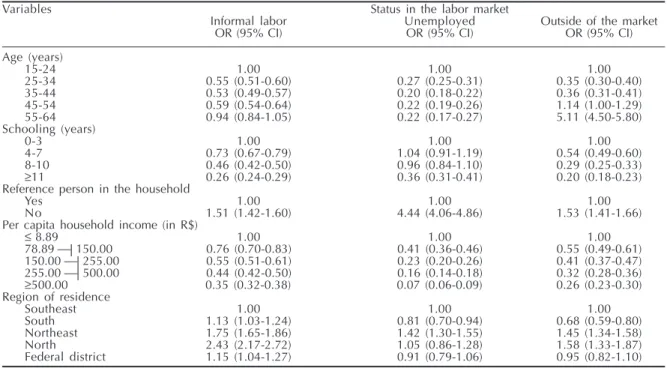
From the univariate analysis, formal labor status was compared with the other categories, in relation to the sociodemographic characteristics. It was ob-served that the informal labor category consisted of younger individuals with less schooling, less like-lihood of being the reference person in the house-hold and lower per capita househouse-hold income. Those who were unemployed were also younger, with less schooling and lower per capita household income. They were less frequently the reference person in the household and they more frequently lived in the northeastern region of the country. Those who were outside of the labor market were older, with less schooling and lower per capita household in-come. They were less likely to be the reference per-son in the household and less likely to live in the southern region of the country (Table 2).
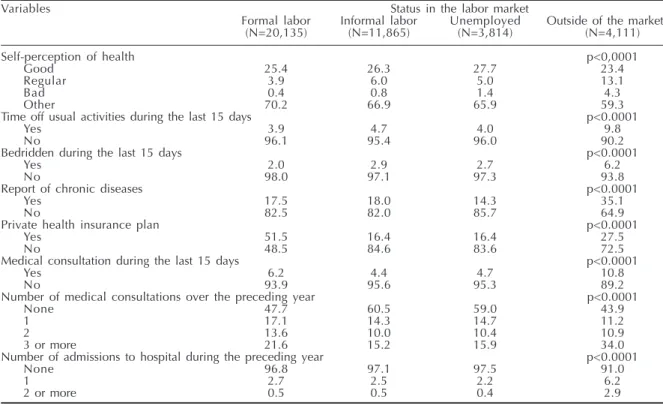
With regard to health indicators, the highest per-centages of indicators of poor health conditions and high usage of healthcare services were observed among individuals who were outside of the labor market (Table 3).
Table 4 shows the results from the analysis of status in the labor market in relation to indicators of health and usage of healthcare services, adjusted for age, schooling, per capita household income, reference person status in the household, region of residence, retired status and informant. The indicators of health-care service utilization were also adjusted for the ex-istence of a private health insurance plan.
The results showed that, in relation to formal labor status, the individuals in the informal labor category presented worse self-perception of health, were more often bedridden over the last 15 days, and also had attended fewer medical consultations over the last 15 days and during the preceding year. They also less frequently had private health insurance plans.
Those who were unemployed also had worse self-perception of health, were more often bedridden over the last 15 days, and reported higher frequency of chronic diseases than did the individuals with formal status. It was also less frequent for the unemployed individuals to possess private health insurance plans.
Individuals who were outside of the labor market reported worse self-perception of health, were more frequently off their usual activities during the last 15 days, were more frequently bedridden, and reported higher frequency of chronic diseases than did the in-dividuals with formal status. Likewise, they had less coverage by private health insurance plans, had con-sulted a doctor less frequently during the last 15 days
Table 2 - Sociodemographic characteristics associated with status in the labor market among the male population aged 15 to 64 years, Brazil 1998 (reference category = formal employment).
Variables Status in the labor market
Informal labor Unemployed Outside of the market
OR (95% CI) OR (95% CI) OR (95% CI)
Age (years)
15-24 1.00 1.00 1.00
25-34 0.55 (0.51-0.60) 0.27 (0.25-0.31) 0.35 (0.30-0.40)
35-44 0.53 (0.49-0.57) 0.20 (0.18-0.22) 0.36 (0.31-0.41)
45-54 0.59 (0.54-0.64) 0.22 (0.19-0.26) 1.14 (1.00-1.29)
55-64 0.94 (0.84-1.05) 0.22 (0.17-0.27) 5.11 (4.50-5.80)
Schooling (years)
0-3 1.00 1.00 1.00
4-7 0.73 (0.67-0.79) 1.04 (0.91-1.19) 0.54 (0.49-0.60)
8-10 0.46 (0.42-0.50) 0.96 (0.84-1.10) 0.29 (0.25-0.33)
≥11 0.26 (0.24-0.29) 0.36 (0.31-0.41) 0.20 (0.18-0.23)
Reference person in the household
Yes 1.00 1.00 1.00
No 1.51 (1.42-1.60) 4.44 (4.06-4.86) 1.53 (1.41-1.66)
Per capita household income (in R$)
≤ 8.89 1.00 1.00 1.00
78.89 | 150.00 0.76 (0.70-0.83) 0.41 (0.36-0.46) 0.55 (0.49-0.61)
150.00 | 255.00 0.55 (0.51-0.61) 0.23 (0.20-0.26) 0.41 (0.37-0.47)
255.00 | 500.00 0.44 (0.42-0.50) 0.16 (0.14-0.18) 0.32 (0.28-0.36)
≥500.00 0.35 (0.32-0.38) 0.07 (0.06-0.09) 0.26 (0.23-0.30)
Region of residence
Southeast 1.00 1.00 1.00
South 1.13 (1.03-1.24) 0.81 (0.70-0.94) 0.68 (0.59-0.80)
Northeast 1.75 (1.65-1.86) 1.42 (1.30-1.55) 1.45 (1.34-1.58)
North 2.43 (2.17-2.72) 1.05 (0.86-1.28) 1.58 (1.33-1.87)
Federal district 1.15 (1.04-1.27) 0.91 (0.79-1.06) 0.95 (0.82-1.10)
#
Rev Saúde Pública 2006;40(1) www.fsp.usp.br/rsp
Labor market status and health Giatti L & Barreto SM
Table 3 - Distribution of the male population according to status in the labor market and indicators of health and healthcare service utilization. Brazil, 1998.
Variables Status in the labor market
Formal labor Informal labor Unemployed Outside of the market
(N=20,135) (N=11,865) (N=3,814) (N=4,111)
Self-perception of health p<0,0001
Good 25.4 26.3 27.7 23.4
Regular 3.9 6.0 5.0 13.1
Bad 0.4 0.8 1.4 4.3
Other 70.2 66.9 65.9 59.3
Time off usual activities during the last 15 days p<0.0001
Yes 3.9 4.7 4.0 9.8
No 96.1 95.4 96.0 90.2
Bedridden during the last 15 days p<0.0001
Yes 2.0 2.9 2.7 6.2
No 98.0 97.1 97.3 93.8
Report of chronic diseases p<0.0001
Yes 17.5 18.0 14.3 35.1
No 82.5 82.0 85.7 64.9
Private health insurance plan p<0.0001
Yes 51.5 16.4 16.4 27.5
No 48.5 84.6 83.6 72.5
Medical consultation during the last 15 days p<0.0001
Yes 6.2 4.4 4.7 10.8
No 93.9 95.6 95.3 89.2
Number of medical consultations over the preceding year p<0.0001
None 47.7 60.5 59.0 43.9
1 17.1 14.3 14.7 11.2
2 13.6 10.0 10.4 10.9
3 or more 21.6 15.2 15.9 34.0
Number of admissions to hospital during the preceding year p<0.0001
None 96.8 97.1 97.5 91.0
1 2.7 2.5 2.2 6.2
2 or more 0.5 0.5 0.4 2.9
p value: Pearson Chi-square test
and the preceding year, and were admitted to hospi-tal more often and in greater numbers over in the pre-ceding year.
DISCUSSION
Inequalities in health have been studied in two ways. The first way is in relation to the likelihood of becoming ill, which reflects the unequal distribu-tion of social, cultural, and environmental determi-nants of diseases. The second way is in relation to the specific access to healthcare services by differ-ent social groups.1
In the present study, status in the labor market was associated with health conditions and the utilization of healthcare services. Individuals in the formal la-bor category presented the best health indicators. In-dividuals who were outside of the labor market showed the worst health conditions and greatest uti-lization of healthcare services, probably because they were more frequently ill. On the other hand, although individuals in the informal labor category were more frequently bedridden over the last 15 days, in com-parison with those with formal status, they reported less utilization of the healthcare services, thus point-ing towards a difference in access to healthcare. Those who were unemployed were more frequently bedrid-den and reported more chronic diseases, but did not present differences in relation to the utilization of
healthcare services. It can be affirmed that there is a gradient in the associations between status in the la-bor market and the indicators of heath and utiliza-tion of healthcare services. In this, the extremities are occupied by individuals with formal status and by those outside of the labor market.
Individuals with informal status, unemployed indi-viduals and those who were outside of the labor mar-ket more frequently self-assessed their health as regu-lar or bad. Perception of health is a subjective indica-tor, but studies have consistently pointed towards an association between poor perception and greater use of healthcare services,11 hospital admittance6 and
mor-tality.15 However, a significant percentage (67%) of
the participants did not answer this question directly, and this may have influenced the results, although it cannot be estimated in which direction.
The status in the labor market expresses other as-pects of the social inequalities. The individuals with formal status had a higher level of schooling, thus pointing towards higher professional qualifications, and they lived in households with higher per capita income. Another matter to be considered is the ex-tremities of the age groups studied. As already identi-fied in studies,12 younger individuals had higher
$ Rev Saúde Pública 2006;40(1) www.fsp.usp.br/rsp
Labor market status and health Giatti L & Barreto SM
Table 4 - Indicators of health and healthcare service utilization, according to status in the labor market among the male population. Brazil, 1998.
Variables Status in the labor market
Informal labor Unemployed Outside of the market
Adjusted OR (95% CI) Adjusted OR (95% CI) Adjusted OR (95% CI)
Self-perception of health
Good 1.00 1.00 1.00
Regular 1.28 (1.18-1.39) 1.26 (1.12-1.40) 1.27 (1.19-1.37)
Bad 1.24 (1.08-1.43) 1.88 (1.45-2.42) 2.01 (1.64-2.45)
Other informant 0.58 (0.50-0.61) 0.43 (0.41-0.45) 0.37 (0.25-0.39)
Time off usual activities during the last 15 days
No 1.00 1.00 1.00
Yes 1.04 (0.93-1.17) 0.90(0.74-1.09) 2.05 (1.62-2.60)
Bedridden during the last 15 days
No 1.00 1.00 1.00
Yes 1.36 (1.14-1.63) 1.34 (0.87-2.07) 2.83 (2.04-3.93)
Report of chronic diseases
No 1.00 1.00 1.00
Yes 1.02 (0.93-1.11) 1.06 (0.95-1.17) 1.41 (1.22-1.63)
Private health insurance plan
No 1.00 1.00 1.00
Yes 0.21 (0.18-0.24) 0.35 (0.30-0.40) 0.38 (0.33-0.44)
Medical consultation during the last 15 days*
No 1.00 1.00 1.00
Yes 0.88 (0.80-0.98) 1.08 (0.78-1.50) 1.58 (1.34-1.86)
Number of medical consultations over the preceding year*
None 1.00 1.00 1.00
1 0.82 (0.75-0.90) 0.95 (0.79-1.15) 0.81 (0.71-0.93)
2 0.81 (0.72-0.91) 0.99 (0.86-1.12) 0.95 (0.80-1.13)
3 or more 0.82 (0.75-0.90) 1.03 (0.83-1.28) 1.57 (1.36-1.79)
Number of admissions to hospital over the preceding year*
None 1.00 1.00 1.00
1 1.09 (0.93-1.28) 1.02 (0.73-1.43) 2.04 (1.67-2.49)
2 or more 0.98 (0.66-1.46) 0.96 (0.62-1.49) 3.54 (2.27-5.52)
Notes: Reference category: formal labor; Adjusted OR (95% CI): Odds ratio with 95% confidence interval, adjusted for age, schooling, per capita household income, reference person in the household, region of residence, retired status and informant *Adjusted for private health insurance plan, in addition to all the other factors cited.
those who were outside of the labor market were older and, as already discussed, this group presented worse health conditions independently of age, and there-fore were more vulnerable to exclusion from the la-bor market.
The categories relating to status in the labor mar-ket utilized in the present analysis did not form inter-nally homogenous groups. Thus, there is still a need to investigate certain characteristics, such as working hours, workplace and occupation, and how these fac-tors are different between workers in the formal and informal labor categories. It is also necessary to in-vestigate the relationship between status in the labor market and women’s health. Women participate in the labor market at a clear disadvantage: their occupa-tions are more precarious than men’s, they earn less12
and also have to bear a double workload, taking into account their domestic work.
Because this was a cross-sectional study, the expo-sure to risk factors and the event of interest were de-termined simultaneously. It was therefore not possi-ble to establish a temporal relationship between them. Another limitation of questionnaire-based studies is the different mortality rates, i.e. individuals with worse living conditions tend to die earlier. However, the effect of such survival bias made the estimates more conservative. In one cohortof workers, it was observed
that there was a more intense association between low socioeconomic level and morbidity in the seg-ment than on the baseline.4 The effect of healthy
work-ers represents a selection and survival bias, as ob-served in occupational epidemiological studies. Ac-cording to Bartley,2 the selective and excluding
ef-fects of work are influenced by oscillations in the economic situation. During periods of greater eco-nomic recession, the group of workers who are most vulnerable regarding health would be excluded from the economically active population, thus reducing the contrast in health between unemployed and em-ployed individuals.
The present study has confirmed that health is in-fluenced by socioeconomic position. This relation-ship works in several ways that may involve behav-ior, biological effects or psychosocial factors, or may relate to different resources for treatment, prevention and promotion of health. Unemployment, informal labor status and, most of all, exclusion from the labor market were associated with worse health condition among adult Brazilians. In addition to the differences determined by type of work, there are also the differ-ences regarding gender, age and schooling, among others. The inequalities created in the social struc-ture are reflected in the process of becoming ill.
consid-%
Rev Saúde Pública 2006;40(1) www.fsp.usp.br/rsp
Labor market status and health Giatti L & Barreto SM
REFERENCES
1. Barreto ML. Por uma epidemiologia da saúde coletiva. Rev Bras Epidemiol 1998;1(2):104-30.
2. Bartley M. Unemployment and health selection. Lancet 1996;348(9032):904.
3. Bartley M, Owen C. Relation between
socioeconomic status, employment, and health during economic change, 1973-93. BMJ
1996;313(7055):445-9.
4. Ferrie J, Shipley MJ, Stansfeld SA, Smith GD, Marmot M. Future uncertainty and socioeconomic inequalities in health; the Whitehall II study. Soc Sci Med 2003;57(4):637-46.
5. Gomez CM, Thedim-Costa SMF. Precarização do trabalho e desproteção social: desafios para a saúde coletiva. Ciênc Saúde Coletiva 1999;4(2):411-21.
6. Guerra HL, Firmo JOA, Uchoa E, Lima-Costa MFF. The Bambuí Health and Aging Study (BHAS): factors associated with hospitalization of the elderly. Cad Saúde Pública 2001;17(6):1345-56.
7. Instituto Brasileiro de Geografia e Esttística (IBGE) 2000. Pesquisa Nacional por Amostra de Domicílios: acesso e utilização de serviços de saúde. Rio de Janeiro.
8. Kaplan GA. Upstream approaches to reducing socioeconomic inequalities in health. Rev Bras Epidemiol 2002;5 Supl 1:18-27.
9. Manderbacka K, Lahelma E, Rahkonen O. Structural changes and social inequalities in health in Finland, 1986-1994. Scand J Public Health Suppl 2001;55:41-54.
10. Marmot M, Stansfeld S, Patel C, North F, Head J, White I et al. Health inequality among British civil servants: the Whitehall II study. Lancet
1999;337(8754):1387-93.
11. Meer JBW van der, Bos J van den, Mackenbach JP. Socioeconomic differences in the utilization of health services in a ducth population: the contribution of health status. Health Policy 1996;37(1):1-18.
12. Montali L. Família e trabalho na reestruturação produtiva: ausência de políticas de emprego e deterioração das condições de vida. Rev Bras Ciênc Soc 2000;15(42):55-71.
13. Sen A. Inequality, unemployment and contemporary Europe. Int Labour Rev [periódico on-line]
1997;136(2):155-71. Disponível em URL: http:// www.ilo.org/public/english/support/publ/revue/ download/pdf/sen.pdf [2003 mar 22]
14. Singer P. Globalização e desemprego, diagnóstico e alternativas. São Paulo; Contexto; 2000.
15. Sundquist J, Johansson SE. Self reported poor health and low educational level predictors for mortality: a population based follow up study of 39,156 people in Sweden. J Epidemiol Community Health
1997;51(1):35-40. ered, but also the differences in status in the labor
market, unemployment and exclusion from the la-bor market are considered in investigations of health inequities, an important aspect of such inequalities is revealed, which few health studies in Brazil have dealt with.