ORIGIN
AL RESEAR
CH
Adhesion of older women to a home exercise
program post ambulatory training
Adesão de idosas a um programa de exercícios domiciliares pós-treinamento ambulatorial
Adhesión de mujeres mayores a un programa de ejercicios domicilarios post-entrenamiento
ambulatorio
Alexandra Miranda Assumpção Picorelli1, Daniele Sirineu Pereira2, Diogo Carvalho Felício3,
Danielle Aparecida Gomes4, Rosângela Corrêa Dias4, Leani Souza Máximo Pereira4
Mailing address: Alexandra Miranda Assumpção Picorelli – Rua Bernardo Guimarães 1020/1202 – Funcionários – CEP 30350-150 – Belo Horizonte (MG), Brazil. E-mail: [email protected] – Phone: +55 31 3586 4898 / 8805 5654
Research Ethics Research of Minas Gerais Federal University – Presentation: Aug. 2014 – Accepted for publication: Sept. 2015 – Financing sources: none – Conlicts of interest: nothing to declare – Approval of an addendum. Brazilian Clinical Trials Registry – REBEC RBR9v9cwf – Protocol no. ETIC 38/2010.
Rehabilitation Laboratory for Pain and Inlammation and Aging Studies (LADIREE), Physiotherapy Department, Universidade Federal de Minas Gerais – Belo Horizonte (MG), Brazil.
1Doctoral Student at School of Health and Rehabilitation Science at University of Queensland – Brisbane (QLD), Australia. 2Doctor Professor, Universidade Federal de Alfenas (UNIFAL) – Alfenas (MG), Brazil.
3Doctoral Student at Universidade Federal de Minas Gerais – Belo Horizonte (MG), Brazil. Professor, Universidade Federal de Juiz de Fora (UFJF) – Juiz de Fora (MG), Brazil.
4Doctor Professor of the Physiotherapy Department, Universidade Federal de Minas Gerais (UFMG) – Belo Horizonte (MG), Brazil.
ABSTRACT | Practice of therapeutic exercises for older adults aims at better functional performance. It is an everyday practice on physiotherapy, the prescription of home exercises; although its efectiveness depends on adhesion, which is usually very low. The aim of the study was to evaluate older women´s adhesion to and retention in a home program and to identify the factors associated with this practice. This study is exploratory and observational, n=96 older women, (71.3 years old ±5.16) subjected to a program of home exercises. Clinical and functional measures were applied with an adhesion questionnaire to identify motivational factors and barriers. Retention rate was 86% and adhesion was 36%, with a minimum frequency of 85%. Regression models applied were not signiicant and comparative static analysis between groups veriied a high occurrence of negative factors. Correlation absence between worse functional and physical performance with low adhesion highlights such outcome is complex, has multi factors and should also be explored regarding social, emotional and cultural aspects.
Keywords | Exercise Therapy; Aged; Patient Compliance; Exercises.
RESUMO | A prática de exercícios terapêuticos por idosos visa melhorar o desempenho funcional. A prescrição de exercícios domiciliares é uma prática rotineira na isioterapia, mas sua efetividade depende da adesão dos idosos, que frequentemente é muito baixa. Avaliaram-se a adesão e retenção de idosas a um programa domiciliar 291
pós-atendimento ambulatorial e identiicaram-se fatores associados a essa prática. Este estudo é observacional exploratório, composto por 96 idosas, (71,3±5,16 anos) submetidas a um programa de exercícios em casa. Foram avaliadas medidas clínicas, funcionais e um questionário de adesão para identiicar os fatores motivadores e as barreiras. A taxa de retenção foi de 86% e a de adesão foi de 36%, com o mínimo de 85% de frequência. Os modelos de regressão aplicados não foram signiicativos, e nas análises estatísticas comparativas entre grupos foi veriicada alta incidência de fatores negativos. A ausência de correlação entre pior desempenho funcional e físico com a baixa adesão evidencia que esse desfecho é complexo e multifatorial, e deve ser explorado também sob aspectos sociais, emocionais e culturais.
Descritores | Terapia por Exercício; Idoso; Cooperação do Paciente; Exercícios.
funcionales y un cuestionario de adhesión para identiicar los factores motivadores y las barreras. La tasa de retención fue del 86% y la de adhesión fue del del 36%, con un mínimo del 85% de frecuencia. Los modelos de regresión aplicados no fueron signiicativos y en los análisis estadísticos comparativos entre grupos se comprobó alta incidencia de factores negativos. La
ausencia de correlación entre peor desempeño funcional y físico con la baja adhesión demuestra que este resultado es complejo y multifactorial, y que debe ser explorado también en los aspectos sociales, emocionales y culturales.
Palabras clave | Terapia por Ejercicio; Anciano; Cooperación del Paciente; Ejercicios.
INTRODUCTION
In parallel with demographic transition in Brazil, in which the number of people with more than 65 years old has increased continually, a transition related to the change in the morbid mortality proile with infectious contagious diseases being replaced by chronical degenerative diseases also occurs1,2. Such reality points
out for a growing complexity of attention regarding older adults’ needs due to health impacts, as well as the independence and autonomy levels of this population2.
he beneits of exercises for older adults are well established in the literature: they reduce fragility syndrome, increase walking speed, and improve performance on Daily Life Activities (DLA), proportioning independence and life quality3-5.
After discharge from ambulatory treatment, the prescription of home exercises is a frequent practice on physiotherapy5,6. Studies demonstrated that patients who
adopt home programs conirm to have less pain and more muscular strength due to the beneits of regular physical exercises7,8. A muscular training has reversibility
as a physiologic principle, which means the muscular gains obtained in what regards strength and muscular resistance are reversed with the interruption of exercises practice. In this way, it is essential to follow the guidelines prescribed by the physical therapist to ensure eicacy7,9,10.
he concept of adhesion is controversial on the literature3,8,11. he most used concept deines adhesion
to an exercise program as the ratio between performed sessions and the number of ofered sessions12. According
to the literature, this ratio is usually very low. Evidences suggest 50% of the population who initiate an exercise program interrupt it in up to six months12,13.
he minimum adhesion preconized is between 80% and 85% for intervention results to be satisfactory7.
Another concept that must be diferentiate is retention, which consists on maintain the bond of an individual to an exercise program, either in an experimental or clinical
character14. However, the participant may have been
retained in a program, i.e., the participant was present from beginning to end, but misses a lot of sessions, and for this reason adhesion is not satisfactory8. Adhesion
and retention may be explained by diferent variables14,15.
he current proile of Brazilian older adults indicates prevalence of women, a phenomenon deined by geriatric and gerontology specialists as feminization in old age11.
here is more prevalence of incapability and functional dependence in older adults, especially women6.
Active aging must be the goal care in long term throughout life, and the presence of some functional incapability justiies the investigation, care and rehabilitation16,17. Further research are required to
identify eicacy of guidelines to home exercises through usage of verbal orientations or booklets guidelines, since the activity is a constant service of physical therapists10.
Few intervention studies analyzed adhesion as a primary outcome, and there is no standard golden instrument to evaluate adhesion of older adults to exercises17.
he hypothesis of the study are: a) adhesion and retention rates of a home program are lower than recommended; b) older women with worse functional performance and with more related comorbidity have less adhesion to an exercise program without direct supervision.
he goals of this study were: a) to verify adhesion and retention rates of older women to home exercises programs; b) to identify factors associated to older women adhesion to a home exercise program performed with indirect supervision of physical therapists; c) to investigate what motives and barriers have more prevalence for older women who adhered or not to the exercise program.
METHODOLOGY
University, under decree no. ETIC 38/2010, with the approval of an addendum.
Details of the original project can be found on the Brazilian Clinical Trials Registry – REBEC RBR9v9cwf. his study was a continuation of a previous clinical trial. he training protocol of the home program was exactly the same of the outpatient study registered on REBEC.
Sample
Convenience sample constituted by community older women aged 65 years or older. hey all signed a free and informed consent form.
he older women were recruited from a clinical trial, post ambulatory training, in which 30 sessions of muscular strengthening exercises were performed during 10 weeks, with 50 minutes of duration each.
Older women who presented cognitive alterations detectible by the Mini Mental State Examination, who went through orthopedic surgeries on lower limbs, and/or had history of fractures in the last six months, presented neurological diseases, and with clinical and sensorial conditions that made impossible to perform exercises were excluded from the study18,19.
he calculation of the size of the sample was performed from the model regression formula: 10 (K+1), in which K represents the number of the model’s explanatory variables20. Eight clinical and functional
variables, eight motives, and eight barriers were selected, according to theoretic reference, and therefore 10 (8+1) = 90 older women should participate on the study. hree logistic regression models were performed to identify factors associated to adhesion to home program.
Measure Instruments
To characterize the sample, social and demographic data, and clinical conditions, as fall occurrences, pain and comorbidities were obtained through a structured questionnaire built and applied by researchers, previous to the home intervention. he questionnaire was idealized for this study, and can be found in annex. Functional tests were performed at the same moment.
his study used the Mini Mental State Examination score as the explanatory variable for the regression model to evaluate the adhesion association with cognitive capacity of the volunteers. he adapted version for the Brazilian population used as reference has as cutting
points: 13 points for illiterate, 18 for average school level and 26 points for individuals with high school level18,19.
he Geriatric Depression Scale (GDS)21-23 was used
to evaluate the presence of depression symptoms.
Functional Tests
To evaluate functional capacity, three functional tests were selected: walking speed evaluation, Timed Up and Go,and to sit and get up from a chair. he three tests are easily carried out on physiotherapy practice, are quick to apply, and are valid and trustworthy for older adults17.
To assess regular walking speed, the relation distance/ time (meters/second) was used, within a space of 10 meters25. he participants were instructed to walk in a
self-selected speed. he walking speed was registered only on the central six meters of the running track, laterally identiied by tape marks to avoid acceleration and deceleration bias25.
he Timed Up and Go Test was used to evaluate mobility. he tests consists in evaluate the performance and time spent by the individual to get up from a standard armless chair with a 45 cm seat in a sitting position, walk for three meters, rotate, return to the chair and sit again26,27.
he functional performance evaluation of sitting and getting up is used as an indirect measure of proximal muscle strength of lower limbs, associated to functional decline and also to incapacity. A standard 45 cm chair was used, having the loor as height reference28.
Adhesion Questionnaire
An adhesion questionnaire validated and adapted for the Brazilian older adult population is not available yet. herefore, based on the literature, and on Brazil’s cultural, economic, and social contexts, we developed an adhesion questionnaire with three principles: reason for absence on sessions; motivating factors; and barriers. To elaborate this instrument, a pilot study was performed, and it was applied to 10 older women who were participating of the physical activity programs8. We adjusted and adapted it as required to
Procedure
he clinical trial that preceded the study was performed with a group of older women in a program of muscular strengthening. he group of muscular strengthening was constituted by exercises of lower limbs, on concentric and eccentric contractions, three series of 8 repetitions of each exercise. Details of this clinical trial can been found on a previous published study29.
Once the muscular strengthening program is concluded, an indirect follow-up for older women with exercises performed at home to maintain functional capacity was proposed. A meeting with the volunteers was held, in which goals of the new stage of the research was presented, and those who had agreed to participate have been trained on the home program. Home exercises performed by the volunteers were the same strengthening exercises that were been carried out during ambulatory care, but without the load to avoid compensations and triggering of painful conditions. he weight of the limb itself against gravity already represents a stimulation to the muscle, and it may be able to keep a suitable functional level7.
he participants received a booklet with illustrative photos, explanations and training of the exercises in a detailed way, divided by weeks. It should be illed out with dates and hours the exercises were performed at home30. his booklet with the guidelines to the exercises
can be found in annex. hose activities were monitored fortnightly by phone calls made by the researchers. he home program also had a 10 weeks term, with three weekly sessions of approximately 50 minutes and indirect supervision. During these ten weeks, each participant received ive phone calls. After this period, they were reevaluated and the adhesion questionnaire wash applied. In this moment, an adhesion diary with all registers was made by participants, and were then collected for analysis.
In this study, we considered as adherents the older women who had 85% or higher frequency of performing the exercise program14. In the thirty
proposed sessions, ive absences were allowed. As the program was performed at home, the non-performance of the exercises was considered as absence. herefore, older women who had not inished the program or the ones who missed six or more exercise sessions during the ten weeks of intervention were considered excluded from the research.
Statistical Analysis
he sample description was performed through measures of central tendency (average and standard deviation) and frequencies for social-economical and clinical variables. For data analysis distribution, we used the Kolmogorov-Smirnov test.
hree models of multiple logistic regression aiming to identify the contribution of selected variables to explain the adhesion of older women to the exercise program were developed. he explanatory variables that illed out the model were determined by theoretical reference. he statistical analysis was blinded, performed without knowledge of the questions involved and without any involvement with the volunteers.
he irst model had as a goal to identify the contribution of clinical and functional variables – presence of pain, recurring fall history, comorbidities number, cognitive capacity, depression symptoms and functional capacity evaluated through three tests: walking speed, timed up and go, and the test of sitting and getting up from the chair18-21,25-28.
he other two models veriied if there was an association of motivators (8 items) and barriers (8 items) of the adhesion questionnaire with adhesion of older women to diferent therapeutic exercise programs. hose items were evaluated through the adhesion questionnaire developed by the researchers. he interpretation of logistic regression was deined by relative risk of occurrence of non-adhesion.
To compare between groups of adherents and non-adherents, we used the independent Test-t or the Man-Whitney U, according to data distribution. To compare variables in attendance the Chi-square test was used. he level of signiicance accepted was of a 5% α for all the analysis performed.
he analyses were performed by the Statistical Package for the Social Sciences (SPSS) program for Windows (Version 17.0).
RESULTS
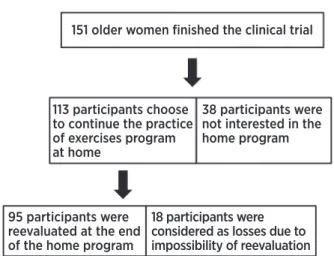
reevaluated after 10 weeks. Eighteen participants were lost. Reasons to refuse to perform the reevaluations were: surgery, travel, family problems or lack of interest in the study. he average age of the home groups was 71.3 years old. Figure 1 is a lowchart of the losses. Table 1 has descriptive characteristics of the sample, and Table 2 presents the clinical and functional tests.
151 older women finished the clinical trial
113 participants choose to continue the practice of exercises program at home
38 participants were not interested in the home program
95 participants were reevaluated at the end of the home program
18 participants were considered as losses due to impossibility of reevaluation
Figure 1. participants lowchart
he retention rate of the program was of 84.07% and adhesion rate was 33.09%, calculated from 113 participants who initiated the home program.
Twenty-three more participants took part of the home exercises than was required, based on the sample calculation = 90.
he irst regression model, with clinical and functional variables did not present signiicant statistics (p=0.09). he multiple logistic regression model was also not signiicant with motivator for exercise practice (p=0.053), neither with the barriers (p=0.053).
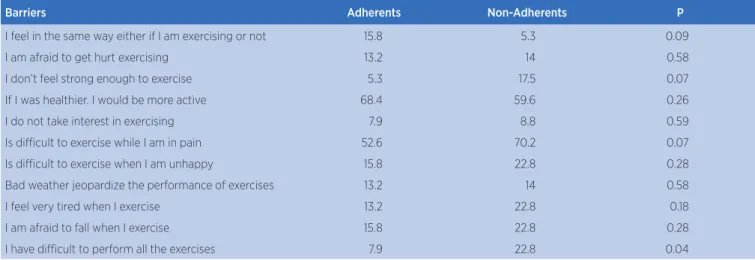
he most frequent barrier reported by older women who had adhered to the program was not considering to have good health (68.4%) – “If I was healthier, I would be more active”. For those ones considered as losses on the study, the most frequent barrier was pain – “It is diicult to exercise when I’m in pain”. However, pain was the most important barrier in both categories, adherent and non-adherent.
Comparing the two groups, the only item that had statistic diference between adherents and non-adherents was the barriers “I have diicult to perform the exercises” (p=0.04). However, although non-adherent older women reported more diicult, this does not justify the lack of adhesion on the regression model. Results of this analysis can been found in Table 3.
Regarding the motives, the item that has been less frequent for non-adherent older women was “Exercise is one of my favorite hobbies”. Results of this analysis can been found in Table 4.
Table 1. Social-demographic and clinical characteristics from the sample
Variable
Adherents (n=30) Non-Adherents (n=83)
%(n) Average (+/- DP) %(n) Average (+/- DP)
Age (years) 71.36 (5.16) 70.72 (5.18)
Marital Status
Married 20 (6) 38.6 (32)
Single 13.3 (4) 13.3 (11)
Divorcee 13.3 (4) 13.3 (11)
Widow 53.3 (16) 34.9 (29)
Weight (kg) 68.20 (9.17) 70.93 (12.89)
Height (m) 1.53 (5.41) 1.54 (5.61)
Have children (yes) 90 (27) 86.7 (72)
Comorbidities (yes)
Heart Disease 0 (0) 9.6 (8)
SAH 70 (21) 72.3 (60)
CVA 3.3 (1) 1.2 (1)
Diabetes 13.3 (4) 21.7 (18)
Arthritis 30 (9) 43.4 (36)
Pulmonary Disease 6.7 (2) 8.4 (7)
Variable Adherents (n=30) Non-Adherents (n=83)
%(n) Average (+/- DP) %(n) Average (+/- DP)
Depression 16.7 (5) 18.1 (15)
Osteoporosis 20 (6) 24.1 (20)
Urinary Incontinence 30 (9) 16.9 (14)
Labyrinthitis 16.7 (5) 16.9 (14)
Vascular Disease 20 (60) 19.3 (16)
Captions: SAH = Systemic Arterial Hypertension; CVA= Cerebrovascular Accident
Table 2. Explanatory variables
Variable
n Average Standard Deviation Frequency (%)
p
Adherents
Non-Adherents Adherents
Non-Adherents Adherents
Non-Adherents Adherents
Non-Adherents
MMSE** 30 83 26.7 25.89 2.42 2.85 0.86
GDS** 30 83 3 4.03 2.95 2.7 0.31
Falls*** 30 83 8 (26.7) 30 (36.1) 0.26
No. Comorbidities** 30 83 2.26 2.48 1.43 1.45 0.34
Walking speed* 30 83 5.63 5.19 0.84 1.23 0.13
TUG* 30 83 11.22 11.24 2.45 9 0.18
Sit and get up test* 30 83 14.51 14.68 3.52 2.95 0.81
Pain symptoms*** 30 83 22 (73.3) 69 (83.1) 0.23
MMSE: Mini-mental state examination; GDS: Geriatric Depression Scale, TUG: Timed up and Go *Test-T
**Man Whitney U ***Chi-Square
Table 3. Descriptive Analysis of Barriers
Barriers Adherents Non-Adherents P
I feel in the same way either if I am exercising or not 15.8 5.3 0.09
I am afraid to get hurt exercising 13.2 14 0.58
I don’t feel strong enough to exercise 5.3 17.5 0.07
If I was healthier. I would be more active 68.4 59.6 0.26
I do not take interest in exercising 7.9 8.8 0.59
Is diicult to exercise while I am in pain 52.6 70.2 0.07
Is diicult to exercise when I am unhappy 15.8 22.8 0.28
Bad weather jeopardize the performance of exercises 13.2 14 0.58
I feel very tired when I exercise 13.2 22.8 0.18
I am afraid to fall when I exercise 15.8 22.8 0.28
I have diicult to perform all the exercises 7.9 22.8 0.04
*Captions: % of older women that reported the described item was a barrier to perform the proposed exercise
Table 4. Descriptive Analysis of Motives
Motives Adherents Non-Adherents P
To exercise regularly improves my health 100 100
-I’d rather follow a supervised exercise program 84.2 93 0.15
I’d rather exercise in groups than to exercise at home 89.5 93 0.40
I’d like to continue the exercise program 97.4 94.7 0.47
I feel more in high spirits when I am performing physical activity 100 98.2 0.60
I become fulilled when I exercise 100 100
-Exercises improve my concentration 94.7 96.5 0.53
Table 1. Continuation
DISCUSSION
he irst hypothesis was conirmed through the study – adhesion and retention rates to a home program are lower than recommended. When compared to described data on the literature, the adhesion rate found in this study was lower than in programs with supervision, this low uptake might be due to lack of social interactions and variability on suggested programs. A supervised exercise program allow older adults more technical support, both in professional terms and equipment, more safety and socialization opportunities30.
he importance of socialization is relected in many daily cultural activities performed by each individual, such as family meetings and religious cults, and it may explain why adhesion to exercises at home was very low23. In a similar study, a group that performed the
intervention with direct supervision had proximally four times more adhesion to fulill the study than the group that only accomplished the exercises on their own14.
herapeutic attention provided to older adults is important to engage in the program. If older adults receive social supports and feel cared, they feel motivated to keep vigilant regarding the exercises30. here is evidence in the
literature that older women with higher adhesion are the most inclined to get involved in other health promotion programs, and this is directly linked to behavior. hus, adhesion may be a marker for a personality trait linked to motivation and self-eiciency24,30.
he second hypothesis was not conirmed, in other words, there were no correlation between adhesion and the clinical and functional conditions evaluated. We veriied through functional tests and clinical evaluation that the participants presented functional level and health condition good enough to be able to continue exercising through a home program. However, statistical analyses demonstrated that good health conditions do not favor adhesion to the home program.
A positive aspect of this study is that older women previously participated of an ambulatory exercise program
with direct supervision, and during the permanency they received stimulation and proper guidance to continue. he exercises were taught correctly, minimizing fear of incorrect performance, which could increase pain intensity, and they also received guidance about the harms of a sedentary life31.
Strategies to promote adhesion and to contribute for rehabilitation process should be encouraged by clinical physical therapists23. Simpler guidelines,
motivational encouragements of exercises beneits, ofer of social support and positive reinforcement, providing reminders as booklets and phone call are some of those strategies. he assistance of professionals with experience may be onerous, especially in long terms programs, for this reason we have the need to search for alternative care10,23,30.
Randomized clinical trials that aim at demonstrating interventions efectiveness usually are performed in extremely controlled environment conditions, which does not match clinical reality. Adhesion to what is being proposed is a mandatory condition to any outcome intervention to be positive, and for that investigations are required to allow the extrapolation of results for clinical practice and incentive patients to adhere. Qualitative studies may clarify the comprehension on the theme, and they must be encouraged.
Study’s limitation
he study’s duration was short, and it may have contributed for higher adhesion rates than reality, although it was indeed low. Long term exercises are more diicult to maintain.
On the other hand, one factor that could have contributed in a negative way is the development of a program constituted of generic exercises, without a speciic and individualized goal. According to some of the authors, preventive exercises are less stimulating than healing ones, which have as goal to relieve some health problems21. he study’s participants were not
performing the exercise for rehabilitation of some
Motives Adherents Non-Adherents P
Exercises help me spiritually 97.4 89.5 0.15
I exercise even if I am not willing to 81.6 68.4 0.12
Exercise is one of my favorite hobbies 78.9 66.7 0.14
I feel less pain when I exercise on a regular basis 84.2 91.2 0.23
I become less stressed when I exercise 84.2 94.7 0.09
*Captions: % of older women that reported the described item was a motive to perform the proposed exercise
lesion; instead, they aimed at maintaining health condition and preventing possible problems.
he instrument we used to evaluate motives and adhesion barriers might not have been sensitive enough to detect factors that explain adhesion, as the chosen clinical and functional variables.
he results of this study may only be extrapolated for older women, considering the sample was exclusively feminine.
CONCLUSION
his study has not presented direct relation of worse health conditions with low adhesion rates. It means that the lack of adhesions to home exercises program does not have a direct impact on having a higher number of associated comorbidities or a worse functional performance. understanding adhesion is a challenge to managers and health professionals and for that, it must be deeply investigated under all health, physical, emotional and social aspects.
To minimize barriers and encourage reasons for steady exercises practices may be a determining factor on health grievances prevention, and for the maintenance of the physical and functional independence for older adults.
REFERENCES
1. Paixão Jr CM, Eichenheim ME. Uma Revisão Sobre Instrumentos de avaliação do estado funcional do idoso. Cad. Saúde Pública. 2005;21(1):7-19.
2. Carvalho JAM, Garcia RAO. Envelhecimento da população brasileira: um enfoque demográico. Cad Saúde Pública. 2003; 19(3): 725-33.
3. Hardage J, Peel C, Morris D, Graham C, Brown CJ, Foushee R, Braswell J. Adherence to exercise scale for older patients (AESOP): A measure for predicting exercise adherence in older adults after discharge from home health physical therapy. J Geriat Phys Ther. 2007;30:69-70.
4. Hughes SL, Seymour RB, Campbell RT, Whitelaw Bazzarre T. Best-practice physical activity programs for older adults: indings from the national impact study. Am J Public Health. 2009;99(2):362-8.
5. Fielding RA, Katula J, Miller ME, Abbot-Pillola K, Jordan A, Glynn NW, Goodpaster B, Walkup MP, King AC, Rejeski J. Activity adherence and physical function in older adults with functional limitations. Med Sci Sport Exerc. 2007;39(11):1997-2004.
6. Benedetti TRB, Mazo GZ, Gobbi S, Amorim M, Gobbi LTB, Ferreira L, Hoefelmann C. Valores Normativos de Aptidão Funcional em Mulheres de 70 a 79 Anos. Rev Bras Cineantropom Desempenho Hum. 2007;9(1):28-36.
7. Ilife S, Kendrick D, Morris R, Skelton D, Gage H, Dinan S, Stevens Z, Pearl M, Masud T. Multi-centre cluster randomised trial comparing a community group exercise programme with home based exercise with usual care for people aged 65 and over in primary care: protocol of the proact 65+ trial, Trials. 2010;11(6):1-12.
8. Pisters MF, Veenhof C, Schellevis FG, Twisk JW, Dekker J, De Bakker DH. exercise adherence improving long term patient outcome in patients with osteoarthritis of the hip and/or knee. Arthr Care Res. 2010;62(8):1087-94.
9. Jette AM, Rooks D, Lachman M, Lin TH, Levenson C, Heislen D, Giorgetti MM, Harris BA. Home-based resistance training predictors of participation and adherence. Gerontologist. 2011;38(4):412-21.
10. Dorgo S, King GA, Brickey GD. The application of peer mentoring to improve itness in older adults. J Aging Phys Activ. 2009;17:344-61.
11. Huberty JL, Vener J, Waltman Ott C, Twiss J, Gross G, Mcguire R, Dwyer A. Development of an instrument to measure adherence to strength training in postmenopausal breast cancer survivors. Oncol Nurs Fórum. 2009;36(5):266-73. 12. Henry KD, Rosemond C, Eckert LB. Efect of number of
home exercises on compliance and performance in adults over 65 years of age. Phys Ther. 1999;79(3):270-7.
13. Medina-Mirapeix F, Escolar-Reina P, Gascón-Cánovas JJ, Montilla-Herrador J, Collins SM. Personal characteristics inluencing patients adherence to home exercise during chronic pain: a qualitative study. J Rehabil Med. 2009;41:347-52.
14. Schmidt JA, Gruman C, King MB, Wolfson LI. Attrition in an exercise intervention: a comparison of early and later dropouts. JAGS. 2000;48:952-60.
15. Jansen MJ, Hendriks EJ, Oostendorp RAB, Dekker J, De Bie RA. Quality indicators indicate good adherence to the clinical practice guideline on “osteoarthritis of the hip and knee” and few prognostic factors inluence outcome indicators: a prospective cohort study. Eur J Phys Rehabil Med. 2010;46 (3):337-45.
16. Giacomin K. Epidemiologia da incapacidade funcional em idosos na comunidade: inquérito de saúde de Belo Horizonte e tradução e coniabilidade do instrumento de avaliação funcional SMAF no projeto Bambuí. Belo Horizonte, Fundação Oswaldo Cruz: Tese (Doutorado). Programa De Pós-Graduação Em Ciências Da Saúde. Centro De Pesquisa René Rachou. Belo Horizonte, 2008.
17. Macchi CP, Cecchi F, Zipoli R, Soi F, Romanelli A, Pepi L, Sibilio M, Lipoma M, Petrilli M, Molino-Lova R. One-year adherence to exercise in elderly patients adherence to exercise in elderly patients receiving postacute inpatient rehabilitation after cardiac surgery. Am J Phys Med Rehabil. 2009;88(9):727-34.
18. Bertolucci MO. Mini-exame do estado mental em uma população geral. Arq Neuropsiquiatr. 1994;52(1):1-7.
20. Porteney LG, Watkins M: Foundations Of Clinical Research: Applications To Practice. 3th. Ed.: Prentice Hall Health, 2008.
21. Lourenço RA, Veras R, Ribeiro CC. Coniabilidade teste-reteste do mini-exame do estado mental em uma população idosa assistida em uma unidade ambulatorial de saúde. Rev Bras Geriatr Gerontol. 2008;11(1):7-16.
22. Paradela EM, Lourenço RA, Veras R. Validação da escala de depressão geriátrica em um ambulatório geral. Rev Saúde Pública. 2005; 39 (6):918-23.
23. Batistonil SST, Neril AL, Cupertinoll AFB. Validade da escala de depressão do center for epidemiological studies entre idosos brasileiros. Rev Saúde Pública, 2007;41 (4):598-605. 24. Stineman MG, Strumpf Kurichi JE, Charles J, Grisso JA,
Jayadevappa R. Attempts to reach the oldest and frailest: recruitment, adherence, and retention of urban elderly persons to a falls reduction exercise program. Gerontologist. 2011;51(1):59-72.
25. Findforr MJ, Wyman JF, Gross CR. Predictors of long-term exercise adherence in a community sample of older women. J Women’s Health. 2009;18(11):1769-76.
26. Fritz S, Lusardi M. “White Paper: Walking Speed: The Sixth Vital Sign,” J Geriatr Phys Ther. 2009; 32:2-4.
27. Podsiadlo D1, Richardson S. The timed “up & go”: a test of basic functional mobility for frail elderly persons. J Am Geriatr Soc. 1991;39(2):142-8.
28. Bohannon RW. Reference Value for the timed up and go test: a descriptive metaanalysis. J Geriatr Phys Ther. 2006;29:64-8.
29. Whitney SL, Wrisley DM, Marchetti GF, Gee MA, Redfern JMF. Clinical measurement of sit-to-stand performance in people with balance disorders: validity of data for the ive-times-sit-to-stand test. Phys Ther. 2005;85 (10):1034-45. 30. Lustosa L, Coelho FM, Silva J, Pereira DS, Parentoni A, Dias JMD,
Dias RC, Pereira LSM. The Efects of a muscle resistance program on the functional capacity, knee extensor muscle strength and plasma levels of il-6 and tnf-in pre-frail elderly women: a randomized crossover clinical trial - a study protocol. Trials. 2010;11(82). doi:10.1186/1745-6215-11-8.
ATTACHMENTS
SOCIO-DEMOGRAPHIC QUESTIONNAIRE
Date:_____/_____/_____
Name:____________________________________________________________________________; Address: Street_______________________________________________________No:_____________ Neighborhood______________________________; ZIP Code: ______________; City ____________________ Contact telephone numbers: ________________________________________________________________ Age:______years; Date of birth: _____/_____/_____
What is your marital status?
1. Married/Living with partner 3. Divorced, separated
2. Single 4. Widower
What is your color/race?:
1. White 3. Mulatto/Pardo
2. Black 4. Yellow/Asiatic
5. Indigenous
What was your profession for most of your adult life? _____________________
Are you able to read and write a simple note? (if the person responded that he/she learned to read and write, but forgot, or is able to sign his/her own name, mark “no”)
1. Yes 2. No
Until which school year did you attend school?
1. Never went to school (never got to complete the irst grade or course of adult literacy) 2. Adult literacy course
3. Elementary school (1st to 4th grade) 4. Middle school (5th to 8th grade) 5. High school
6. Higher Education
7. Graduate studies, obtaining a Masters degree or PhD
How many years of school did you attend? _____________________________________________
Do you have kids?
Who do you live with? 1. Alone
2. With spouse or partner 3. With children or stepchildren 4. With grandchildren
5. With great-grandchildren 6. With other relatives 7. With friend(s)
8. Companions, caregivers, maid
PERCEIVED PHYSICAL HEALTH
Last year, a doctor said that you have any of the following health problems?
Heart disease such as angina, myocardial infarction or heart attack?
1. Yes 2. No
High blood pressure?
1. Yes 2. No
Stroke/ischemia?
1. Yes 2. No
Diabetes Mellitus?
1. Yes 2. No
Malignant neoplasm/cancer?
1. Yes 2. No
Arthritis or rheumatism?
1. Yes 2. No
Lung disease (bronchitis or emphysema)?
1. Yes 2. No
Depression?
1. Yes 2. No
Osteoporosis?
1. Yes 2. No
Urinary incontinence?
1. Yes 2. No
Parkinson’s disease?
Labyrinthitis?
1. Yes 2. No
Peripheral vascular disease (circulatory issues)?
1. Yes 2. No
USE OF MEDICINES
How many medicines have you used on a regular basis in the last 3 months, prescribed by the doctor or on your own? __________
What are the names of the medication(s) you use? WRITE DOSAGE
___________________________________________________________________________________________ ___________________________________________________________________________________________ ___________________________________________________________________________________________
Do you smoke?
1. Never smoked 3. Smoke For how long?______________
2. Smoked and quit
Do you consume alcoholic beverages?
1. Never 4. 2-3 times a week
2. Once a month or less 4 or more times a week
3. 2-4 times per month
Family income:
1. 1 minimum wage; 4. 4 minimum wages;
2. 2 minimum wages; 5. 5 or more wages
3. 3 minimum wages; 6. Other: ______________________________
Own income: 1. No; 2. Yes
1. Retirement; 3. Retirement and pension;
2. Pension; 4. Other:__________________________;
Do you currently exercise any remunerated activities?
1. No; 2.Yes; Which? ___________________________
Do you have a health plan or insurance?
In the last year, did you consult a doctor? 1. No
2. Yes
1. Clinician 3. Gynecologist
2. Ophthalmologist 4. Other:__________________________
Did you underwent surgery?
1. No; 2. Yes;
If so, what was the reason?
Do you perform physiotherapy or other type of rehabilitation activity (occupational therapy; speech therapy)? 1. No.
2. Yes. How many sessions a week?________________________________________________
What type of treatment? ____________________________________________________
Have you you ever performed physiotherapy or other rehabilitation treatment?
1. No; 3. Do not remember;
2. Yes; When? Reason?_________________________________________________________
PAIN
Do you feel any pain in your body?
1. No; 2. Yes;
Place of pain: __________________________________________________________________
For how long have you been feeling this pain?
1. Acute; 2. Chronicle;
What is the intensity of this pain? (for each area of pain reported)
________________________________________________
0 1 2 3 4 5 6 7 8 9 10 (without pain) (maximum pain)
FALLS
Last year did you sufer some fall/fell? 1. No;
2. Yes; How many times?__________________________________________________________
What was the reason of the fall_____________________________________________________________
Where did the fall occur?
What was the reason of the fall?
1. Accidental 2.. Non-accidental
Did you sufer a fracture because of the fall?
1. No 2. Yes. Where: ________________________
Did you have to seek the health service or a doctor because of the fall?
1. No; 2. Yes;
After the fall, did you stop doing any daily activity?
1. No; 2. Yes;
Which daily activities did you stop doing? ______________________________________________ ________________________________________________________________________________
SUBJECTIVE WELL-BEING:
How your health is generally:
1. Poor 2.. Relatively good 3. Good
How is your health, compared to other people your age:
1. Poor 2.. Relatively good 3. Good
Overall satisfaction with life
Are you satisied with your life today?
1. Little 2. More or less 3. Very much
Comparing with other people your age, would you say you are satisied with your life?
1. Little 2. More or less 3. Very much
ANTHROPOMETRIC MEASUREMENTS
Now we will take some measurements:
Weight Height
GUIDE: ADHESION – Semi-structured Interview
NAME: _______________________________________________________________
After home intervention Completed the home program
Was it a reason for you (1, 2,3)? ANSWER YES OR NO:
1 and 3 – Skip the exercise session? 2 – Do not do the exercises at home?
SIM NÃO
Change in your state of health
If so, what happened? __________________________________
Have you performed another type of exercise, for example, a more intense walk. Which? _____________________
Family problems Lack of motivation
hought the session was too long
hought the exercises were uncomfortable hought the exercises were too diicult
Did not have the equipment necessary to perform the exercises Did not know exactly how to do the exercises
Lack of available Lack of time
Lack of interest in the exercises
Did not understand the instructions that were given Forgot
Did not have company to do the exercises Depression or sadness
Lack of proper professional supervision Did not want to do them because was in pain.
If so, where? __________________________________
I am going to read a few sentences about physical exercises, and you shall answer me if you AGREE or NOT
with the following statements. Answer based on the exercise program that you performed:
MOTIVATORS YES NO
Exercising regularly improves my health
I would like to continue with the exercise program I feel more disposed when I am doing physical activities I feel satisied when I exercise
Exercises improve my concentration Exercises help me spiritually
I exercise even when I am not in the mood Exercise is one of my favorite hobbies I feel less pain when I exercise regularly I am less stressed when I exercise
he companions of the group help me deal with my problems
BARRIERS YES NO
I feel the same way if I exercise or not I am afraid to get hurt doing exercises
I feel like I do not have the strength to do exercises If my health was better, I would be more active I am not interested in exercises
It is hard to exercise when I am in pain It is hard to exercise when I am sad
Diiculty of transport gets in the way of doing the exercises Bad weather gets in the way of doing the exercises
I feel very tired when I exercise I am afraid of falling when I exercise I ind it diicult to perform all exercises
HOW SHOULD YOU DO THE EXERCISES?
he exercises should be performed 3 times per week, in the days you prefer.
• Follow the instructions correctly!
• Every you exercise, you should write them down in the diary you received.
• It is very important that you register in the diary exactly how you performed the exercises.
• We will contact you every 15 days to check if everything is all right.
• After 10 weeks of exercising, we will contact you to make a new evaluation and change the exercises.
MINI-SQUAT
Using a chair as support or a ixed furniture, place the feet slighlty apart from each other and lined in front. Squat as if you were going to seat in a chair, without throwing the body forward and without bending the knees beyond the feet. Descend slowly eight times and go up returning to the initial position. Repeat 3 times.
HIP ADDUCTOR
Lie down facing up, bend your legs up and press a small ball or a pillow between your legs. At the same time, raise your butt 8 times. Repeat 3 times.
HIP FLEXOR
Lie down facing up and bend one of your legs. Raise the other one without bending the knee 8 times. he leg should go up and down. Repeat 3 times for each leg.
KNEE FLEXOR
Lie down facing down. Bend one knee in the direction of the butt 8 times. Place a roll below the knee being exercised. Keep the other leg stretched. Repeat 3 times for each leg.
HIP EXTENDER
Lie down facing down. Raise one leg, removing it entirely from the mattress, ang return, 8 times. Be careful when rotating the body – only the leg goes up and down. Repeat 3 times for each leg.
HIP ABDUCTOR
Lie down on your side, with the bottom leg bent and the top one stretched. Raise the leg 8 times. Repeat 3 times for each leg.
KNEE EXTENSOR