Brazilian Journal of Physics, vol. 34, no. 3A, September, 2004 829
Recent Results from PHOBOS at RHIC
B.B.Back
1, M.D.Baker
2, M.Ballintijn
4, D.S.Barton
2, B.Becker
2, R.R.Betts
6, A.A.Bickley
7,
R.Bindel
7, A.Budzanowski
3, W.Busza
4, A.Carroll
2, M.P.Decowski
4, E.Garc´ıa
6,
T.Gburek
3, N.George
1,2, K.Gulbrandsen
4, S.Gushue
2, C.Halliwell
6, J.Hamblen
8,
A.S.Harrington
8, G.A.Heintzelman
2, C.Henderson
4, D.J.Hofman
6, R.S.Hollis
6, R.Hoy´nski
3,
B.Holzman
2, A.Iordanova
6, E.Johnson
8, J.L.Kane
4, J.Katzy
4,6, N.Khan
8,
W.Kucewicz
6, P.Kulinich
4, C.M.Kuo
5, J.W.Lee
4, W.T.Lin
5, S.Manly
8, D.McLeod
6,
A.C.Mignerey
7, R.Nouicer
2,6, A.Olszewski
3, R.Pak
2, I.C.Park
8, H.Pernegger
4,
C.Reed
4, L.P.Remsberg
2, M.Reuter
6, C.Roland
4, G.Roland
4, L.Rosenberg
4,
J.Sagerer
6, P.Sarin
4, P.Sawicki
3, I.Sedykh
2, W.Skulski
8, C.E.Smith
6,
P.Steinberg
2, G.S.F.Stephans
4, A.Sukhanov
2, J.-L.Tang
5, M.B.Tonjes
7, A.Trzupek
3,
C.Vale
4, G.J.van Nieuwenhuizen
4, R.Verdier
4, G.I.Veres
4, F.L.H.Wolfs
8, B.Wosiek
3,
K.Wo´zniak
3, A.H.Wuosmaa
1, B.Wysouch
4, and J.Zhang
4 1Physics Division, Argonne National Laboratory, Argonne, IL 60439-4843, USA2Chemistry and C-A Departments, Brookhaven National Laboratory, Upton, NY 11973-5000, USA
3Institute of Nuclear Physics, Krak´ow,Poland
4Laboratory for Nuclear Science, Massachusetts Institute of Technology, Cambridge, MA 02139-4307, USA
5Department of Physics, National Central University,Chung-Li, Taiwan
6
Department of Physics, University of Illinois at Chicago, Chicago, IL 60607-7059, USA 7
Department of Chemistry, University of Maryland,College Park, MD 20742, USA 8Department of Physics and Astronomy, University of Rochester, Rochester,NY 14627, USA
Received on 26 September, 2003
PHOBOS is one of the four heavy ion experiments currently running at the Relativistic Heavy Ion Collider (RHIC). In this paper we will present some of the current results from PHOBOS: the study of charged multi-plicity distribution as function of pseudorapidity and centrality at√sN N= 19.6, 130 and 200 GeV, a discussion of multiplicity scaling, and a measurement of transverse momentum spectra (pT) of charged hadrons produced in d+Au and Au+Au interactions at√sN N= 200 GeV. The dependence of the Au+Au yields as function of centrality is found to be independent ofpT. A strong suppression in the Au+Au hadron spectra relative top¯p at highpT is observed. The spectral shape for d+Au collisions is significantly different from the observations in Au+Au, the yield suppression is not observed in d+Au.
The fundamental theory of strong interactions predicts that a Quark-Gluon Plasma (QGP) will be formed in hadronic systems at sufficiently high energy density [1]. The QGP is the state of matter that is believed to have existed about 10 micro-seconds after the Big Bang, and is a con-glomerate of free quarks and gluons. The goal of the rela-tivistic heavy ion physics program over the past two decades has been to find signatures of the formation of the QGP. From data collected at the AGS, the SPS and so far from RHIC, it is clear that the search for the QGP requires a sys-tematic effort of the entire heavy ion physics community. In this paper we present PHOBOS’ contribution to this task. The data described in this paper were taken during the RHIC 2000 run, Au+Au at√sN N =19.6 and 130 GeV, the 2001
Au + Au run at√sN N =200 GeV, and the 2003 d + Au run
at√sN N =200 GeV. A full description of the PHOBOS
detector used during these runs as well a description of the
event selection process can be found at [2,3].
One of the important contributions of PHOBOS to the field is the measurement of charged particle multiplicity as over a large pseudorapidity (η) coverage. Fig. 1 summarizes all the Au+Au multiplicity measurements taken by PHO-BOS. Details of the analysis procedures can be found in Ref. [4]. The centrality of the collisions is characterized by the average number of participants (Npart). For the 130
and 200 GeV data sets this was estimated from the data us-ing two sets of 16 plastic scintillator counters (the “paddle” counters), with acceptance of3<|η|<4.5. It was found that the truncated mean of the ADC signals from these coun-ters is proportional to the charged multiplicity in their accep-tance.Npartis then extracted for a specified fraction of the
830 B.B. Backet al.
η
-5 0 5
η
/d
ch
dN
0 100 200 300
400 19.6 GeV
η
/d
ch
dN
0 200 400 600
130 GeV
η
/d
ch
dN
0 200 400 600
800 200 GeV
0- 6% 6-15% 15-25%
25-35% 35-45% 45-55%
Figure 1. Charged particle pseudorapidity distributions,dNch/dη, measured for Au + Au at√sN N =200, 130, and 19.6 GeV for the specified centrality bins. These bins range from 0–6%central to 45–55%in the case of the higher energy data and 0–6%to 35– 45%for the 19.6 GeV data. Statistical errors are negligible and typical systematic errors (90%C.L.) are shown as shaded bands for selected centrality bins.
monotonic relation was verified using the correlation be-tween the paddle counters and the zero degree calorimeters. The calculation ofNpartand the associated systematic
er-rors is outlined in Ref [5]. For the√sN N =19.6 GeV data
set, the lower beam rapidity precludes use of this method; instead a different quantity was constructed “EOCT”. This quantity is proportional to the path-length corrected sum of the energy deposited in the octagon detector. As for the pad-dle counters, it is assumed only that EOCT varies monoton-ically withNpart. Finally, for the d+Au data set, the silicon
ring detectors were use in a similar way to determine cen-trality bins.
An empirical observation derived from the multiplicity measurements is the scaling of the multiplicity distributions withNpart. Fig. 2, shows the total charged multiplicity per
participant pair as a function of the number of participants for Au + Au at three different energies. Also shown in the figure are results forp¯pande+e−systems at the same value
part
N
0
200
400
〉
/2
part
N
〈
/
ch
N
0
10
20
30
-e
+
e p p pp/ PHOBOS
19.6 GeV 130 GeV 200 GeV
Figure 2. Nch/Npartvs. Npart for√sN N =19.6, 130, and 200 GeV (closed symbols). The error includes contributions from the uncertainty on overallNchscale andNpartscale. The shaded band shows the uncertainty on the extrapolation procedure for largerη. The open symbols show UA1p¯pdata at 200 GeV and interpolated results for the lower energies. The dotted lines show the values fore+
e−.
(GeV/c)
T
p
0 1 2 3 4
-2
(GeV/c)
Tdp
πN/dy
2
d
-1
)
T
p
π
(2
10-910-6
10-3
1
103 0-6%
) -1 6-15% (x10
) -2 15-25% (x10
) -3 25-35% (x10
) -4 35-45% (x10
) -5 45-50% (x10
)/2 + h + (h
Figure 3. Invariant yields of charged hadrons for√sN N =200 GeV Au+Au collisions as a function ofpT for 6 centrality bins. For clarity, consecutive bins are scaled by factors of 10.
of√s. The total multiplicity in Au + Au scales approxi-mately with the number of participants and is the same as the production fore+e−at the same energy. On the other
hand, production inp¯pis reduced, in comparison to Au + Au. A detailed discussion on this scaling behavior is found in Ref. [6].
Brazilian Journal of Physics, vol. 34, no. 3A, September, 2004 831
0.5 1 1.5 2
Phobos
UA1 200 GeV = 0.45 GeV/c
T
p
0.5 1 1.5
= 2.3 GeV/c T p
0 100 200 300 0
0.5 1 1.5
= 3.6 GeV/c T p
= 1.45 GeV/c
T
p
= 3.1 GeV/c T p
0 100 200 300
= 4.25 GeV/c
T
p
part
N
/Peripheral Fit
〉
/2
part
N
〈
Yield/
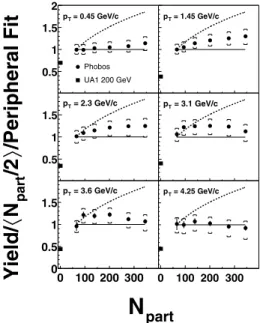
Figure 4. Charged hadron yields per participant pair in 6 different transverse momentum bins, plotted as a function ofNpart. The data are normalized to the yield in the most peripheral central-ity bin. The dashed (solid) line shows the expectation forNcoll (Npart) scaling from peripheral to central collisions. The brackets indicate the systematic uncertainty for the centrality evolution of this ratio at the 90%C.L.
and negative hadrons as a function of transverse momen-tum for √sN N =200 GeV Au+Au collisions. Data are
shown for 6 centrality bins, ranging fromNpart = 58to
Npart = 344. The spectra exhibit a smooth fall with
in-creasingpT, with a slightly concave shape. Details of the
analysis and a broader discussion of thepT spectra are in
Ref. [2].
In order to study the evolution of the spectra with cen-trality in detail Fig. 4 shows the multiplicity yield per par-ticipant pair for sixpT values, divided by afit to the most
peripheral bin plotted as a function of the number of par-ticipants. For reference p¯pdata are included in the plot. The dashed and solid lines represent the expectation for
NcollandNpartscaling. The data seem to scale closer
toNpartthan toNcollfor allpT bins and centralities.
We also observe surprisingly that the spectra do not depend on centrality.
Figure 5 shows the yield per participant pair divided by a fit to the invariant cross section for proton-antiproton col-lisions (200 GeV UA1) plotted as a function ofpT, for the
most peripheral and most central bin. The dashed and solid lines show the expectation ofNcollandNpartscaling.
The brackets show the systematic uncertainty. We can see, again, that the general shape of the curves is only weakly dependent on the centrality and that, forpT values up to 2
GeV/c there is an increase of the yield in Au+Au collisions compared top¯p. After 2 GeV/c the relative yield decreases, for all centrality bins.
2 4 6
45-50% scaling
coll N
0 1 2 3 4
2 4 6
0-6%
scaling
coll
N
(GeV/c)
Tp
fit
p
/p+
〉
/2
part
N
〈
Yield/
Figure 5. Ratio of the yield of charged hadrons in Au+Au as a func-tion ofpTfor the most peripheral and the most central bin to afit of proton antiproton data scaled byNpart/2. The dashed(solid) line shows the expectation ofNcoll(Npart) scaling relative top¯p collisions. The brackets show the systematic uncertainty.
Two possible explanations have been suggested for the this yield “quenching”. Thefirst (“initial state”) model sug-gest that the effect is due to a modification of the wave func-tions of the nucleons in the colliding ions. This produces an effective increase of the interaction length in such way that the nucleons in an ion will interact coherently with all the nucleons in the other ion in the longitudinal dimension [7]. This model predicts not only the yield quenching at highpT, but also the scaling of the yield with the number
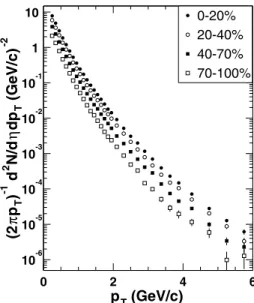
of participants. The second (“final state”) model suggests that the suppression comes from an increase of the energy loss of the partons traveling through the hot dense medium formed in the Au+Au collisions [8]. One way to discrimi-nate between these models is to reduce the size of the hot and dense medium, by colliding d+Au instead of Au+Au. RHIC’s 2003 run was dedicated mainly to d+Au collisions at√sN N =200 Gev. Fig. 6 shows the measured invariant
yield of charged hadrons for d+Au collisions as function of pT. Details of the analysis and a broader discussion ofpT
spectra are given in Ref. [3].
In Fig. 7 we present the nuclear modification factor RdAuas function ofpT for four centrality bins defined as the
ratio of the d+Au invariant cross section divided by thep¯p
UA1 yield, scaled by the proton-antiproton invariant cross section (41 mb) andNcoll. For all the centrality bins we
observe a rapid rise ofRdAufrom lowpT reaching a
maxi-mum at 2 GeV/c. For comparison this factor is also plotted for the most central bin from central Au+Au collisions at
√s
N N =200 GeV. In striking contrast to the behavior of
RdAu,RAuAualso increases initialy as function ofpT but
832 B.B. Backet al.
(GeV/c)
T
p
0 2 4 6
-2
(GeV/c)
T
dp
η
N/d
2
d
-1 )
T
p
π
(2
10-6 10-5 10-4 10-3 10-2 10-1 1
10 0-20%
20-40% 40-70% 70-100%
Figure 6. Invariant yields of charged hadrons for√sN N =200 GeV d+Au collisions as a function ofpTfor 4 centrality bins. Only statistical errors are shown.
0.5 1 1.5 2
70-100%
0 2 4
0 0.5 1 1.5
20-40%
40-70%
2 4 6
0-20%
dAu
R
(GeV/c)
T
p
Figure 7. Nuclear modification factorRdAuas a function ofpTfor four centrality bins. For the most central bin, the spectral shape for central Au+Au data relative top+ ¯pis shown for comparison. The shaded area shows the uncertainty inRdAu due to the systematic
uncertainty inNcolland the UA1 scale error (90%C.L.). The
brackets show the systematic uncertainty of the d+Au spectra mea-surement (90%C.L.).
In Fig. 8 the nuclear modification factor as a func-tion ofNcollin four pT bins is presented. The “initial
state” parton saturation model predicts a decrease of 25 -30 % for RdAu for Ncoll ≥ 6. At pT = 4 GeV/c,
RdAu(Ncoll = 14.6)/RdAu(Ncoll = 5.4) =1.08±0.06.
The data therefore disfavor the initial state interpretation of high-pT hadron suppression. Thus, the yield
quench-ing of highpT in Au+Au collisions can not be accounted
by initial state interactions that should be also present in d+Au. The suppression of the inclusive yield observed in central Au+Au is consistent withfinal-state interactions with a dense medium generated in such collisions.
0.5 1 1.5 2
= 1 GeV/c T p
5 10 15 0
0.5 1 1.5
= 3 GeV/c T p
= 2 GeV/c T p
5 10 15 20 = 4 GeV/c T p
〉
coll
N
〈
dAu
R
Figure 8. Nuclear modification factorRdAuas a function of
cen-trality in four bins of transverse momentum. The brackets indicate the point-to-point systematic error, dominated by the uncertainty in the number of collisions for each centrality bin. The grey band shows the overall scale uncertainty at eachpT. Systematic errors are at 90%C.L.
This work was partially supported by U.S. DOE grants DE-AC02-98CH10886, DE-FG02-93ER40802, DE-FC02-94ER40818, 94ER40865, DE-FG02-99ER41099, and W-31-109-ENG-38, US NSF grants 9603486, 9722606 and 0072204, Polish KBN grant 2-P03B-10323, and NSC of Taiwan contract NSC 89-2112-M-008-024.
References
[1] J. P. Blaizot, Nucl.Phys. A661, 3 (1999). [2] B. B. Back et al., hep-ex/0210006.
[3] B. B. Back et al., hep-ex/0306025.
[4] B. B. Back et al., Phys. Rev. Lett.87, 102303 (2001). [5] B. B. Back et al., Phys. Rev. C65, 061901R (2002). [6] B. B. Back et al., hep-ex/0301017.
[7] D. Kharzeev, E. Levin, and L. McLerran, hep-ex/0210332.