
Meson Loops and the
g
D∗DπCoupling
F. O. Dur˜aes1,2, F.S. Navarra2, M. Nielsen2, and M.R. Robilotta2 1Departamento de F´ısica, Centro de Ciˆencias e Humanidades,
Universidade Presbiteriana Mackenzie, 01302-907, S ˜ao Paulo, SP, Brazil
2Instituto de F´ısica, Universidade de S˜ao Paulo, C.P. 66318, 05389-970 S˜ao Paulo, SP, Brazil
Received on 19 August, 2006
TheD∗Dπform factor is evaluated at low and moderateQ2in a hadronic loop model, for off-shellDmesons. The results contain arbitrary constants, which are fixed so as to match a previous QCD sum rule calculation valid at higherQ2. The form factor obtained in this way is used to extract the coupling constant, which is in very good agreement with the experimental value.
Keywords: Effective Lagrangian; Chiral symmetry; Hadronic loop model; Heavy form factor; QCD sum rule
I. INTRODUCTION
The measurement of the D∗Dπ coupling, made by the CLEO collaboration [1], yielding the result gD∗Dπ=17.9±
0.3±1.9, created embarrassment in the community of QCD sum rules (QCDSR) which, by means of various schemes, had predicted much smaller values. Several different approaches of QCDSR were employed: two point function combined with soft pion techniques [2, 3], light cone sum rules (LCSR) [4, 5], light cone sum rules including perturbative corrections [6], sum rules in a external field [7], double momentum sum rules [8] and double Borel sum rules [9]. The LCSR prediction made in ref. [4] became even smaller after the radiative cor-rections have been included [6]. The upper limit of these pre-dictions was gD∗Dπ=13.5 [6] and it turned out to be 30%
lower than the central value of the CLEO measurement. Although the QCD sum rule approach certainly suffers from large uncertainties, in several other cases good agree-ments with experiment were obtained. Therefore, we cannot simply be skeptical about the whole sum rule approach. The gD∗Dπcoupling constant does not seem, a priori, to be
partic-ularly exotic and other theoretical approaches did not produce such large discrepancies for this quantity. A careful discussion meant to reduce the uncertainties presented by quark mod-els, performed in the framework of Dirac equation [10], and prior to the experimental measurement, has led to the result gD∗Dπ≃18. It should be stressed that this result has been
ob-tained in the heavy quark limit. The recent (quenched) lattice QCD calculation has producedgD∗Dπ=18.8±2.3+1.1
−2.0[11]. It is therefore important to understand the specific difficulty which the standard sum rule approach seems to encounter in this case.
After the appearance of experimental data, three works [12– 14] tried to reconcile the LCSR estimates with the measured figure. In [12], it was noted that the inclusion of an explicit radial excitation contribution to the hadronic side of the LCSR (often referred to as the left hand side of the sum rule) could significantly improve the value ofgD∗Dπand, at the same time,
the stability of the sum rule with respect to the Borel parame-terM2.
In the standard QCDSR approach of [9], a modification in the continuum contribution (such as the explicit inclusion of a radial excitation) does not seem to be neither necessary nor
promising, because there the Borel suppression is much more effective. In ref. [9] thegD∗Dπ(Q2)form factor was estimated
as a function of the off-shell pion momentumQ2. Since the sum rule obtained from the three-point function adopted is not valid atQ2=0, in order to determine theD∗Dπcoupling, it was necessary to extrapolate theQ2behaviour of the form fac-tor. Of course there are large uncertainties in this procedure, and, the value ofgD∗Dπ=5.7±0.4 obtained was much smaller
than the experimental result. In a subsequent calculation of theDDρvertex [15], theDDρform factor was calculated for bothDandρoff-shell mesons and the QCDSR results were parameterized by analytical forms such that the respective ex-trapolations to theDandρpoles provided consistent values for thegDDρ coupling constant. This method of double pa-rameterization plus matching at the on-shell point was then employed in [16] to recalculate theD∗Dπcoupling and led to the value
gD∗Dπ=14.0±1.5. (1)
While this number is much closer to the experimental value, there is still a discrepancy. Moreover, the procedure of fitting the QCDSR points in the deep euclidian region and extrapo-lating them to the time-like region still contains uncertainties, such as, for examplethe analytical form chosen for the para-meterizations, i.e., monopole, exponential or gaussian.
In the present work we return to this question and employ hadronic loops, calculated by means of effective field theories (EFT),in order to produce a better parameterization forD∗Dπ
II. EFFECTIVE DYNAMICS
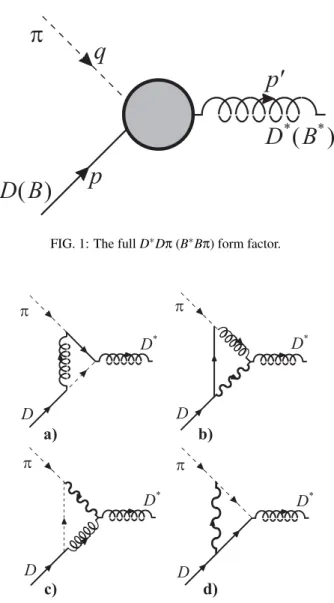
The fullD∗Dπvertex function is shown in Fig. 1. Leading contributions to this vertex when the external particles are not too off-shell come from both the tree interaction and the three classes of diagrams depicted in Figs. 2, 3 and 4. Meson loops are a necessary consequence of quantum field theory and do contribute to several hadronic observables. In practice, due to problems associated with infinities, renormalization becomes unavoidable in the evaluation of loop corrections to observ-ables. Nowadays, this kind of procedure is rather well estab-lished at the hadronic level, in processes such as pion-pion and pion-nucleon scatterings. In the case ofDmesons, on the other hand, the theory is much less developed and hence we resort to an alternative. The basic idea is to isolate the un-known loop parameters into some basic constants, in such a way that they can be determined by matching the results of loop and QCDSR results.
FIG. 1: The fullD∗Dπ(B∗Bπ) form factor.
FIG. 2: Meson loop contributions to theD∗Dπform factor: “trian-gle” diagrams.
Before proceeding, some remarks are in order. We first note
FIG. 3: Meson loop contributions to theD∗Dπform factor: “quartic couplings”.
that some diagrams, such as, for instance, that in Fig. 2a, con-tain internal vertices involving theD∗Dπcoupling. In general, a full calculation is self consistent, since one uses theD∗Dπ
form factor in order to calculate theD∗Dπ form factor. On
the other hand, in the framework of perturbation theory, there are differences between the internal particles and the external ones. The former are always virtual, whereas the latter may be either real or put on mass shell in the extraction of the cou-pling constant.
In perturbation at leading order, internal particles are treated as elementary, without structure. They are assumed to be point-like and the evaluation of leading terms does not re-quire the use of internal form factors. Consistently, one must use bare coupling constants for these interactions.
Nevertheless, our results do not depend on the values of these constants, since they are absorbed into the renormaliza-tion constants.
There are heavy mesons circulating in the loops shown in Figs. 2-4 and one might be tempted to argue that other states should also be included. We do have, for example, fermion-antifermion components such as ¯NNor ¯ΛcΛcin the loops. An incoming positive pion can split into applus a ¯n, and so on. However, in a different context [17], it has been shown that this kind of splitting is suppressed with respect to the pion
→meson-meson splitting, by one order of magnitude. The neglect of this kind of contribution seems therefore justified. The same holds for the possibility of strangeness circulating in the loop, by means of the excitation of ass¯pair from the sea. As this pair is heavy, the hadronic loops would involve correspondingly heavier virtual states such asDs,D∗s,K and K∗, which would also be suppressed, due to their high masses. Moreover, in the QCDSR analysis of theD∗Dπvertex the
strange quarks appear only asα2
s corrections or in terms
FIG. 4: Meson loop contributions to theD∗Dπ form factor: “self energies”.
loops and baryon loops as well. Using onlyπ’s,ρ’s,D’s and D∗’s we do cover properly the lowQ2regions of the form fac-tor. Thus it is enough to our purposes to work with a simple effective theory, involving onlyπ’s,ρ’s,D’s andD∗’s that, as
has been discussed elsewhere, [18], has proven to be phenom-enologically successful. The same happens in this work.
The diagrams considered in this calculation have been di-vided into three classes. The first one, represented in Fig. 2, involves only triangular loops. The processes in Fig. 3, on the other hand, contain bubble-type loops and four-leg ver-tices associated with the gauge structure ofρinteractions. Fi-nally, diagrams given in Fig. 4 involve bubble loops as well as single-particle propagators. This last feature might suggest that these interactions should be considered as mass correc-tions. However, the nature of the effective interactions de-scribed below is such that, in some terms, contributions of the form [A+B(p2−m2)]/(p2−m2)arise. Whenever this hap-pens, the factors proportional to B do correspond to proper three-point functions and are kept in the evaluation of the form factor. This kind of pole cancellations are indicated by crosses
FIG. 5: TheD∗Dπform factor. Dots: QCDSR from [16]; solid, dash and dash-dotted lines are fits obtained with eq. (12), (18) and (19), respectively.
FIG. 6: The same as Fig. 5 for theB∗Bπform factor.
in Fig. 4.
Leading effects are described by an effective Lagrangian constrained bySU(2)flavor and chiral symmetries, as well as gauge invariance. TheπDD∗interaction is given by [18–21]
L
πDD∗=igˆπDD∗D¯τaD∗µ−D¯
∗
µτaD
∂µφa. (2)
whereτaare the Pauli matrices,φa denotes the pion isospin triplet, whileD≡(D0,D+) andD∗≡(D∗0,D∗+)represent
the pseudoscalar and vector charm meson doublets, respec-tively. Thehaton top of the coupling constant indicates its bare nature.
Theρcouplings are assumed to be universal and are imple-mented by covariant derivatives of the form
D
µ=∂µ−igˆρT·ρµ, (3)where ˆgρ is the universal coupling constant and T is the isospin matrix suited to the field
D
µit is acting upon. In thisD
µD=∂µ−igˆρ τ 2·ρµD,
(4)
D
µD¯ =D¯∂µ+igˆρ τ2·ρ
µ, (5)
D
µφa=∂µ+gˆ
ρεabcρµb
φc. (6)
Using this prescription in eq. (2), we obtain
L
ρπDD∗=igˆρgˆπDD∗D¯τbD∗µ−D¯
∗
µτbD
εbcaρµcφa. (7)
For the other couplings, we depart from the free La-grangians and have
L
ππ = 12 ∂µφa∂
µφa→
L
ρππ=gˆρεabcφa∂µφbρµc, (8)
L
¯DD = ∂µD¯∂µD→
L
ρDD= i2 gˆρ[D¯ τc∂µD−∂µD¯τcD]ρ
µ
c, (9)
L
¯D∗D∗ = −
1 2
∂µD¯∗ν−∂νD¯∗µ
[∂µD∗ν−∂νD∗µ]→
L
ρ¯D∗D∗ = −
i 2 gˆρ[D¯
∗ντc
∂µD∗ν−∂νD∗µ
−∂µD¯∗ν−∂νD¯∗µ
τcD∗ν]ρµc. (10)
With these Lagrangians we can write and evaluate the con-tributions of Figs. 2-4 to the total vertex function.
III. RESULTS
Theπa(q)D(p)D∗
α(p′)vertex functionΓaα(p2)for an off-shellDis written as
Γa
α(p2) =−τaqαG(p2), (11) whereG(p2)is a form factor, such that the physical coupling constant isgπDD∗ =G(m2
D). We consider two kinds of loop
corrections to this vertex, containing pion and rho intermedi-ate stintermedi-ates, denoted respectively byFπ(p2) andFρ(p2). The perturbative evaluation of these functions gives rise to
diver-gent integrals and G(p2) can be determined only up to yet unknown renormalization constants.
The use of standard loop integration techniques, such as di-mensional regularization andMSsubtraction of divergences, for all diagrams, allows one to write the form factor as
G(p2) =K+CπFπ(p2) +CρFρ(p2), (12) whereK,CπandCρ are constants. These constants incorpo-rate the bare couplings ˆgπDD∗ and ˆgρ, the usual parameters
associated with renormalization and, in this work, are deter-mined by comparing the general structure ofG(p2)with the results from QCD sum rules.
Keeping only the terms which depend on p2, the explicit evaluation of the diagrams given in Figs. 2-4 yields:
Fπ = 1
(4π)2
(m2D∗−m2D)−
1 4m2
D∗
(m2D∗−m2D+µ2)2 Π(π001)
DD∗
− 1
4m2D∗
(m2D∗+m2D−µ2)Π(π01D∗)+6(m2D∗−m2D+µ2)Π(π00D∗)
, (13)
Fρ = 1
(4π)2
−
2m2D∗−2m2D−2µ2+m2ρ Πρπ(000D)+Πρπ(010D)+Π(ρπ001D)
+
m2D∗−m2D+µ2
2Π(ρπ000D∗)+Π
(001)
ρπD∗
+2
m2D∗−m2D
Π(ρπ010D)∗
− 1
2
m2D∗+m2D−µ2
Π(ρ000DD)∗
−1
8
m2D∗+3m2D−µ2
Π(ρ010DD)∗
− 1
8
−m2D∗+5m2D−5µ2
Π(ρ001DD)∗
+3
8Π
(00)
ρD
whereµis the pion mass. The functionsΠxyzandΠxyentering these results are Feynman integrals, with lower labels indicating the intermediate propagating states. Upper indices represent the Lorentz tensor structure, which is realized in terms of the external variablesq,pandp′, and defined by the relationships
Π(xyzklm) = −
1
0 da a
1
0
db[−(1−a)]k[−a(1−b)]l[−ab]m[1/Dxyz], Dxyz = (1−a)m2x+a(1−b)m2y+ab m2z
− a(1−a)(1−b) (px−py)2−a(1−a)b(px−pz)2−a2b(1−b) (py−pz)2, (15)
and
Π(xykl) = −
1
0
da[−(1−a)]k[−a]l ln[Dxy/D¯xy], Dxy = (1−a)m2x+a m2y−a(1−a) (px−py)2,
¯
Dxy = (1−a)m2x+a m2y. (16)
Using (13) and (14) into (12), we obtain the form factor as a function of p2, the Dfour-momentum squared. At this stage, it still contains three unknown parameters, which are determined by adjusting the functionG(p2)to the QCD sum rule points taken from ref. [16]. Those results are displayed in Fig. 5, whereP2≡ −p2, together with our best fit (χ2∼10−3) represented by the solid line. Computing the value ofG(p2) atp2=m2
D, we arrive at the following value for the coupling
constant:
gD∗Dπ=17.5±1.5, (17)
in very good agreement with experiment. The errors quoted come from the QCDSR points, which are typically about≃
10 %. In the same figure we also show the results of the fits of the QCDRS points with two mixed monople-dipole structures with three free parameters, namely
GFI(p2) = C
Λ2 1−m2D Λ2
1−p2
+
Λ2 2−m2D Λ2
2−p2 2
, (18)
GFII(p2) = C1
Λ2−m2 D Λ2−p2 +C2
Λ2−m2 D Λ2−p2
2
, (19)
which yieldχ2
I ∼10−3 (dashed line) andχ2II ∼10−2
(dash-dotted line), respectively. Inspecting Fig. 5 one learns that these alternative structures, reasonable as they are, diverge significantly from the loop calculation in the region where the D is not too off-shell, stressing the importance of a proper hadronic treatment of the form factor in that region.
In this work we also consider theB∗Bπvertex with an off-shellB, which can be obtained by a straightforward replace-ment of the charmed particles with those containing the quark bin the results described above. Using the same Lagrangians
and fitting procedure with results from ref. [16], we obtain the curve shown in Fig. 6. The resulting coupling constant is:
gB∗Bπ=44.7±1.0, (20)
in good agreement with lattice estimates.
As far as practical applications are concerned, our numer-ical results for the form factors GD∗Dπ(p2) and GB∗Bπ(p2),
in the whole range m2D(B) ≤ p2<−5 GeV, are very well described by the mixed monopole-dipole structure given by eq.(18) with the parameters
GD∗Dπ(p2)→C=8.7 ;Λ1=5.1GeV;Λ2=2.9GeV,
GB∗Bπ(p2)→C=22.4 ;Λ1=7.8GeV; Λ2=7.1GeV(21).
Our good results allow us to believe that the use of me-son loops can significantly reduce the uncertainty in the ex-trapolation of form factors, computed in the space-like region by means of QCDSR, to the time-like region, with the corre-sponding increase in the reliability of predictions for coupling constants. It is worth stressing that, apart from the approxima-tions described in the introduction, our procedure has no new source of errors.
IV. CONCLUSIONS
The matching between chiral and QCDSR results is well justified from the following physical point of view: in the in-termediate and largeQ2regions the relevant degrees of free-dom are the quarks and gluons, with non-perturbative correc-tions taken into account through the QCD condensates. The opposite happens for low values ofQ2, where sum rules cal-culations become non-reliable. At this point, the meson ex-change dynamics becomes the most reliable tool, but it de-pends on unknown constants associated with the renormaliza-tion of the mesonic vertices.
Although the exact frontier between meson dynamics and QCDSR cannot be precisely known, the success of the method
in the instances considered here supports the view that the matching may become useful in increasing the predictive power of both procedures. In order to validate this assump-tion, it would be useful to apply it to other processes of the same kind. This encourages us to reconsider our previous form factor studies.
Acknowledgements
This work has been supported by CNPq and FAPESP. FOD was also supported by Instituto Presbiteriano Macken-zie, through MACKPESQUISA.
[1] S. Ahmedet al., [CLEO Collaboration], Phys. Rev. Lett.87, 251801 (2001); A. Anastassovet al., [CLEO Collaboration], Phys. Rev. D65, 032003 (2002).
[2] P. Colangeloet al., Phys. Lett. B339, 151 (1994).
[3] V.L. Eletsky and Ya.I. Kogan, Z. Phys. C28, 155 (1985); A.A. Ovchinnikov, Sov. J. Nucl. Phys.50, 519 (1989).
[4] V.M. Belyaevet al., Phys. Rev.D51, 6177 (1995). [5] P. Colangelo and F. De Fazio, Eur. Phys. J. C4, 503 (1998). [6] A. Khodjamirianet al., Phys. Lett. B457, 245 (1999). [7] A.G. Grozin and O.I. Yakovlev, Eur. Phys. J. C2, 721 (1998). [8] H.G. Dosch and S. Narison, Phys. Lett. B368, 163 (1996). [9] F.S. Navarra, M. Nielsen, M.E. Bracco, M. Chiapparini, and
C.L. Schat, Phys. Lett. B489, 319 (2000).
[10] D. Becirevic and A. LeYaouanc, JHEP9903, 021 (1999). [11] A. Abadaet al., Phys. Rev. D66, 074504 (2002).
[12] D. Becirevic, J. Charles, A. LeYaouanc, L. Oliver, O. P`ene, and
J.C. Raynal, JHEP0301, 009 (2003).
[13] H.C. Kim, Su Houng Lee, Eur. Phys. J. C22, 707 (2002). [14] H.C. Kim, J. Korean Phys. Soc. 42, 475 (2003);
hep-ph/0206170.
[15] M.E. Bracco, M. Chiapparini, A. Lozea, F.S. Navarra, and M. Nielsen, Phys. Lett.B521, 1 (2001).
[16] F.S. Navarra, M. Nielsen, and M.E. Bracco, Phys. Rev. D65, 037502 (2002).
[17] A. Szczurek, H. Holtmann, and J. Speth, Nucl. Phys. A605, 496 (1996).
[18] Z. Lin and C.M. Ko, Phys. Rev. C62, 034903 (2000). [19] S.G. Matinyan and B. M¨uller, Phys. Rev. C58, 2994 (1998). [20] Y. Oh, T. Song and S.H. Lee, Phys. Rev. C63, 034901 (2001). [21] F.S. Navarra, Marina Nielsen, and M.R. Robilotta, Phys. Rev.
![FIG. 5: The D ∗ Dπ form factor. Dots: QCDSR from [16]; solid, dash and dash-dotted lines are fits obtained with eq](https://thumb-eu.123doks.com/thumbv2/123dok_br/18981885.457332/3.892.127.405.74.649/fig-factor-dots-qcdsr-solid-dotted-lines-obtained.webp)
