Ar
ti
cle
*e-mail: [email protected]; [email protected]
Synthesis of Novel Room Temperature Chiral Ionic Liquids. Application as Reaction
Media for the Heck Arylation of Aza-endocyclic Acrylates
Julio C. Pastre,a Yves Génisson,*,b Nathalie Saffon,c Jany Dandurandd and
Carlos R. D. Correia*,a
aInstituto de Química, Universidade Estadual de Campinas, CP 6154,
13083-970 Campinas-SP, Brazil
bLaboratoire de Synthèse et Physicochimie des Molécules d’Intérêt Biologique UMR-CNRS 5068,
Université Paul Sabatier, 118 route de Narbonne, 31062, Toulouse Cedex 9, France
cSFTCM, FR2599, Université Paul Sabatier, 118 route de Narbonne, 31062 Toulouse Cedex 9, France
dLaboratoire de Physique des Polymères, Université Paul Sabatier, 118 route de Narbonne,
31062 Toulouse Cedex 9, France
Novos líquidos iônicos aquirais e quirais foram preparados utilizando-se rotas sintéticas inéditas e/ou otimizadas. Estas séries de líquidos iônicos do tipo imidazolínico, imidazólico e piridínico foram totalmente caracterizadas, incluindo-se análises por calorimetria diferencial de varredura (DSC). O desempenho desses líquidos iônicos (LIs) foi demonstrado empregando-se a arilação de Heck de aza-acrilato endocíclicos com sais de arenodiazônio ou iodetos de arila. As arilações de Heck realizadas na presença destas entidades iônicas quirais, seja como um solvente ou um aditivo, foram eicazes levando à completa conversão do substrato, em bons a excelentes rendimentos do aduto de Heck na maioria dos casos, apesar de não ser observada indução assimétrica em nenhum dos casos estudados. Dois novos complexos quirais de paládio do tipo carbeno N-heterocíclico foram preparados em bons rendimentos a partir de um sal imidazólico quiral e suas estruturas caracterizadas por difração de raios-X. De modo geral, a arilação de Heck empregando tetraluoroboratos de arenodiazônio em líquidos iônicos demonstrou ser mais eiciente do que os protocolos tradicionais em termos de reatividade e rendimentos de reação.
New achiral and chiral RTILs were prepared using novel and/or optimized synthetic routes. These new series of imidazolinium, imidazolium, pyridinium and nicotine-derived ionic liquids were fully characterized including differential scanning calorimetry (DSC) analysis. The performance of these achiral and chiral room temperature ionic liquids (RTILs) was demonstrated by means of the Heck arylation of endocyclic acrylates employing arenediazonium salts and aryl iodides. The Heck arylations performed in the presence of these ionic entities, either as a solvent or as an additive, were effective leading to complete conversion of the substrate and good to excellent yield of the Heck adduct. In spite of the good performances, no asymmetric induction was observed in any of the cases studied. Two new diastereoisomeric NHC-palladium complexes were prepared in good yields from a chiral imidazolium salt and their structure characterized by X-ray diffraction. Overall, the Heck arylations employing arenediazonium tetraluoroborates in RTILs were more effective than the traditional protocols employing aryl iodides in terms of reactivity and yields.
Keywords: ionic liquids, chiral ionic liquids, Heck arylation, arenediazonium salts, aryl iodides
Introduction
Room temperature ionic liquids (RTILs) have been proposed as a safer and more eco-friendly alternative
to classical organic solvents.1 In addition, they can
offer unique opportunities to modulate the course of a reaction, which combined with their highly adaptable structure opens up almost unlimited prospects in
synthesis.2 In the context of homogenous catalysis, in
highly beneicial, contributing to catalyst stabilization,
immobilization and recovery.3
Among the Pd(0)-catalyzed C-C coupling reactions employed in multi-step synthesis, the Heck reaction plays a preponderant role. However, Heck arylations employing arenediazonium salts as electrophiles have received relatively less attention in comparison to the more
traditional aryl halide- or trilate-based arylation protocols.4
Yet, arenediazonium salts offer several economical, environmental and practical advantages over aryl halides. Arenediazonium salts are easily prepared, are often less expensive than the aryl halides, provide faster palladium-catalyzed arylation reactions, are used under phosphine-free conditions and allow more user-friendly open-air experimental conditions. Surprisingly, the Heck arylation employing arenediazonium salts have been scarcely studied
in RTILs.5
In view of the increasing importance of RTILs as reaction media in organic synthesis, several groups have recently focused on the synthesis of chiral ionic liquids (CILs), particularly for their potential applications to chiral
discrimination and to optical resolution of racemates.6
Main advantages of using water-immiscible CILs
as solvents include the following: (i) the CILs are
inexpensively, easily made, and can be recycled;
(ii) enantiomers of the ionic liquids can be synthesized;
(iii) they are easily removed from the reaction mixture,
and as a result the analyses are usually simpler and more accurate. Additionally, because of their high degree of organization and ionic properties there is also a potential for a more effective solvent-solute interaction and ion-paring formation. The impact of the latter effect on chirality transfer
has been illustrated by Wasserscheid and co-workers7 who
reported the asymmetric hydrogenation of a prochiral imidazolium salt embedding a chiral camphorsulfonate anion with the enantioselectivity reaching 94%.
However, despite the large variety of CILs reported so far, their use as reaction media in asymmetric transformations has met with limited success in term of
chiral induction.8 For example, Armstrong et al.9 reported
on an enantioselective photoisomerisation induced
by a chiral ionic liquid (12% ee), and Vo-Thanh and
co-workers10 demonstrated that asymmetric inductions of
up to 44% ee could be achieved using CILs as reaction
media for the Baylis-Hillman reaction. More recently,
Afonso et al.11 disclosed the application of CILs as
an asymmetric inducing agent in the catalytic Rh(II)
carbenoid C-H insertion (27% ee) and in the Sharpless
dihydroxylation (85% ee). Finally, the highest level of
induced enantioselectivity reported to date by a solvent as the only source of chirality in an asymmetric reaction
was described by Leitner and co-workers.12 Using a
speciically designed ionic liquid with a chiral anion,
enantioselectivities of up to 84% ee were obtained in the
aza-Baylis-Hillman reaction. These results are comparable with the values obtained with the best catalysts for the enantioselective aza-Baylis-Hillman reaction in
conventional solvents (94% ee,13 83% ee14).
These results indicate that the key to effective chirality transfer lies in strong intermolecular interactions such as electrostatic attraction and hydrogen bonding between the solvent molecules and the intermediates or the transition states of the enantioselective reaction step.
In view of their intrinsic structural lexibility, RTILs also offer wide prospects for potential chirality transfer in
organometallic catalysis. This includes in situ generation of
the active catalyst through carbene palladium complexes. Indeed, the participation of 1,3-dialkylimidazolium-type ionic liquids in the stabilization of catalytic Pd species, related to the so-called “non-innocent” nature of these
cations, has been proposed in several cases.15 In particular,
in the course of Heck arylation16 and Suzuki
cross-coupling,17 1,2-diaminocarbenes formed in situ from an
imidazolium-based ionic liquid have been suggested to be involved as Pd ligands.
However, examples of asymmetric versions of this approach based on the use of chiral ionic reaction
medium remain scarce. Kiss et al.18 have notably studied
the influence of a 1-((S)-2-methylbutyl)imidazolium hexaluorophosphate on the stereochemical course of a Heck oxyarylation reaction. Although the enantioselectivities
observed were very modest (4-5% ee), this interesting
precedent validated the concept.
The eventuality of creating a stereogenic center in a stereocontrolled manner in the course of the Heck reaction would certainly contribute to strengthen its synthetic potential. In line with our continuous efforts to widen the scope and demonstrate the potential of the Heck arylation with arenediazonium in multi-step synthesis of bioactive
compounds,19 we recently reported a new synthesis of the
antidepressant drug (±)-paroxetine (4) (Scheme 1).20
Our synthetic route was based on a fast, clean and simple palladium-catalyzed arylation of a substituted acrylate in
CH3CN/H2O (2:1) with Pd(OAc)2 as catalyst. Application
of this protocol to the aza-endocyclic acrylate 1 afforded
an eficient access to an arylated tetrahydropyridine 2.
Results and Discussion
The aza-endocyclic acrylate 1 was employed in our
previous total synthesis of (±)-paroxetine (4). However,
in the context of the present study, it was found more
advantageous to employ the N-phenoxycarbonyl starting
tetrahydropyridine 6, since it can be prepared in one step
from arecoline hydrobromide (5), in 76% yield (Scheme 2).
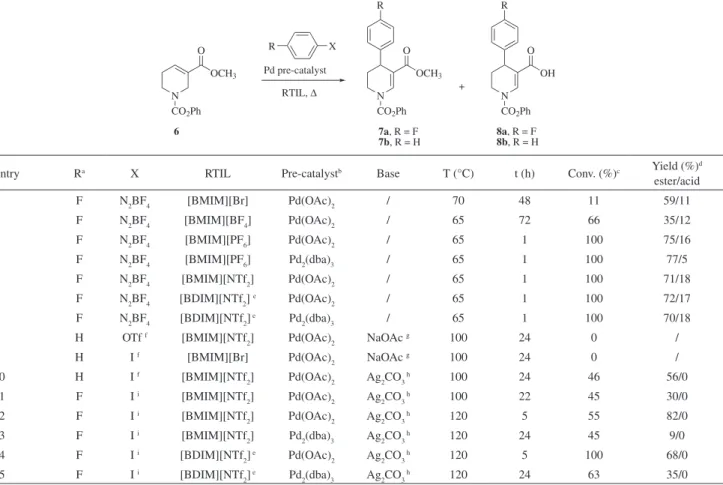
Use of achiral ionic media for the key Heck arylation
We first screened a series of 1-n
-butyl-3-methylimidazolium (BMIM) salts as a reaction media for the Heck arylation reaction (Table 1). A standard protocol was established as follows: the arenediazonium salt and
the Pd(OAc)2 were simultaneously added to a solution of
the olein in the RTIL and the reaction mixture was rapidly heated to 65-70 °C. Alternatively, complete solubilization of the palladium acetate could be irst ensured by a brief sonication before addition of the arenediazonium salt, giving essentially the same results. The expected Heck product was accompanied by a side product which revealed to be the carboxylic acid derivative generated by acidic hydrolysis
of the α,β-unsaturated methyl ester. The feasibility of
the palladium catalyzed process was found to be highly
dependent on the nature of the imidazolium counter-ion.21
These observations paralleled Kabalka’s study.5 Heck
arylations were sluggish in [BMIM][Br] and [BMIM]
[BF4], providing low conversion and decomposition under
forced conditions (Table 1, entries 1 and 2). On the other hand, the reaction proceeded smoothly in the hydrophobic
RTILs embedding an hexaluorophosphate (PF6–) as well
as a bis(triluoromethanesulfonyl)imide (NTf2–) anion.22
Complete and clean conversions were observed after only one hour at 65 °C, thus allowing isolation of the expected adduct in good yields (Table 1, entries 3 to 5). Interestingly, the
reaction worked equally well in [BDIM][NTf2] (1-n
-butyl-2,3-dimethylimidazolium bis(trifluoromethanesulfonyl) imide) where the critical C-2 position of the imidazolium cation is substituted with a methyl group (Table 1, entries
5 and 6). The use of Pd(OAc)2 or Pd2(dba)3 as pre-catalyst
gave comparable results (compare entries 3 and 4 or entries
6 and 7). Several bases were also tested in [BMIM][NTf2]
in order to neutralize the HBF4 produced in the course of the
reaction. Remarkably, the presence of 2 equivalents of either
DIPEA, K2CO3 or NaOAc totally precluded the reaction.
The same trend has previously been observed in protic solvents and might be imputed to the relative instability of the arenediazonium salt in basic media.
In order to better evaluate the performance of arenediazonium salts in RTILs, the reactivity of other electrophiles was also assessed. A irst set of experiments was run at 100 °C. Phenyl trilate revealed ineffective in the
presence of NaOAc in [BMIM][NTf2] (Table 1, entry 8) and
the same outcome was observed using iodobenzene with NaOAc in [BMIM][Br] (Table 1, entry 9). An encouraging result was obtained with the iodobenzene thanks to the
use of Ag2CO3 in [BMIM][NTf2] (Table 1, entry 10).
Since a comparable result was obtained with 1-luoro-4-iodobenzene (Table 1, entry 11) we briely optimized these conditions (Table 1, entries 12 to 15). Running the reaction
at 120 °C for 5 h with Pd(OAc)2 in [BDIM][NTf2] gave rise
to a reasonably eficient process (Table 1, entries 14) while
the use of Pd2(dba)3 proved much less eficient. Altogether,
these observations confirmed the higher reactivity of arenediazonium salts as compared to other electrophilic reagents, even in ionic media.
With the feasibility of the key Heck arylation step of our synthesis of paroxetine in RTILs ensured, we then turned our attention toward the use of chiral media. A chiral environment surrounding the metal might indeed lead to some asymmetric induction in the course of the migratory insertion step during which the stereogenic center is created. Ordinary asymmetric induction in the course of the Heck coupling with arenediazonium salts is a challenging task
Scheme 1. The Heck arylation with an arenediazonium salt as a key step
of the synthesis of (±)-paroxetine (4).7
N CO2CH3 F N O F O O (±)-Paroxetine (4) H N CO2CH3 OH F N OCH3 CO2CH3 O F N2BF4 Pd(OAc)2 OCH3 O
CH3CN/H2O (2 : 1)
3 steps 2 steps (87%) (52%) (41%) 1 2 3
Scheme 2. Preparation of the tetrahydropyridine precursor.
N
OCH3 O
2. PhOCOCl, CH2Cl2 0 ºC - rt, 24 h CH3
N
OCH3
CO2Ph O 1. NaHCO3
HBr
(76%)
6 Arecoline hydrobromide (5)
though, partly because of the arenediazonium instability in the presence of the phosphine ligands. Moreover, the use of chiral RTILs as medium for the more traditional Heck reactions employing aryl halides and aryl trilates as arylating agents were also evaluated.
Use of C-2 unsubstituted imidazolinium and imidazolium chiral ionic liquid
In the irst part of this study we focused on the possible interaction between the palladium-based catalytic species and the chiral imidazolium cation of the ionic liquid through the C-2 position, bearing in mind the opportunities for the
in situ formation of imidazol-2-ylidene metal complexes.
Preparation of the chiral ionic liquids
Access to C-2 unsubstituted chiral imidazolinium/ imidazolium salts was envisioned from the corresponding imidazoline/imidazole through a straightforward quaternarisation/anion metathesis sequence (Scheme 3).
The imidazolinic precursors were prepared according to our previously described route based on the condensation
between an orthoester and the chiral diamine 9.23 Preparation
of the latter was carefully optimized: slow addition
(2 mL h-1) of a concentrated (5.4 mol L-1) aqueous solution
of 2-chloroethylamine to neat chiral amine (2 equiv.) at 80 °C provided, after workup, a crude mixture from which the excess of chiral amine was distilled off
(40-50 °C/3 × 10-2 mbar). A bulb to bulb distillation
(90-100 °C/3 × 10-2 mbar) allowed isolation of the pure chiral
diamine 9 in 60% yield. The use of triethylorthoformate as the
orthoester gave access to C-2 unsubstituted imidazoline 10.
Aromatising dehydrogenation then produced the corresponding
imidazole 14.23 We found that this transformation can be
accomplished in a few minutes by the use of the commercially
available NiO2 (8 equiv.) in acetonitrile under microwave
activation (200W irradiation while cooling with compressed air so as to maintain the temperature at 90 °C). The imidazole
14 was thus obtained in 50% yield after a simple iltration
over grade III alumina. Alternatively, this compound can
be prepared by means of a cyclocondensation reaction24
Table 1. The key Heck arylation reaction in various RTILs
N CO2Ph N
OCH3
CO2Ph O
Pd pre-catalyst OCH
3 O R
R X
RTIL, ∆ N
CO2Ph OH O R
+
6 7a, R = F
7b, R = H
8a, R = F 8b, R = H
Entry Ra X RTIL Pre-catalystb Base T (°C) t (h) Conv. (%)c Yield (%)d
ester/acid
1 F N2BF4 [BMIM][Br] Pd(OAc)2 / 70 48 11 59/11
2 F N2BF4 [BMIM][BF4] Pd(OAc)2 / 65 72 66 35/12
3 F N2BF4 [BMIM][PF6] Pd(OAc)2 / 65 1 100 75/16
4 F N2BF4 [BMIM][PF6] Pd2(dba)3 / 65 1 100 77/5
5 F N2BF4 [BMIM][NTf2] Pd(OAc)2 / 65 1 100 71/18
6 F N2BF4 [BDIM][NTf2] e Pd(OAc)
2 / 65 1 100 72/17
7 F N2BF4 [BDIM][NTf2] e Pd
2(dba)3 / 65 1 100 70/18
8 H OTf f [BMIM][NTf
2] Pd(OAc)2 NaOAc g 100 24 0 /
9 H I f [BMIM][Br] Pd(OAc)
2 NaOAc g 100 24 0 /
10 H I f [BMIM][NTf
2] Pd(OAc)2 Ag2CO3 h 100 24 46 56/0
11 F I i [BMIM][NTf
2] Pd(OAc)2 Ag2CO3 h 100 22 45 30/0
12 F I i [BMIM][NTf
2] Pd(OAc)2 Ag2CO3 h 120 5 55 82/0
13 F I i [BMIM][NTf
2] Pd2(dba)3 Ag2CO3 h 120 24 45 9/0
14 F I i [BDIM][NTf
2] e Pd(OAc)2 Ag2CO3 h 120 5 100 68/0
15 F I i [BDIM][NTf
2] e Pd2(dba)3 Ag2CO3 h 120 24 63 35/0
a Unless otherwise stated, 1.5 equiv. of electrophile were used; b Pd(OAc)
2 10 mol%; Pd2(dba)3 5 mol%; c Conversion calculated on the basis of the recovered
starting material; d Isolated yields, based on starting material recovering, when appropriate; e [BDIM] = 1-n-butyl-2,3-dimethylimidazolium; f 2.0 equiv. of
from glyceraldehyde, α-methylbenzylamine, formaldehyde and ammonium acetate using the Saigo’s procedure (70%
yield).25 Prolonged relux of the imidazoline 10 or imidazole
14 in 1,1,1-trichloroethane in the presence of an excess of
1-bromopentane furnished the expected 3-pentyl derivatives
11 and 15, respectively. Treatment of the imidazole 14 with
methyl iodide at room temperature in acetonitrile smoothly
delivered the 3-methylimidazolium 16. In order to enhance
chances of interactions between the catalytic palladium species and the imidazolium nucleus of the ionic solvent
we also prepared the imidazolium salt 17 in which the alkyl
chain bears a coordinating nitrile functionality.26 Indeed,
mechanistic studies from our laboratories have shown the role of the solvent acetonitrile in stabilizing catalytic species
generated from Pd2(dba)3 in the course of the Heck arylation
with arenediazonium salts.27
At this stage, it appeared critical to control the enantiomeric
purity of our derivatives. This was realized by 1H NMR
analysis of the representative imidazolium bromide 15. The
chiral shift reagent
tris[3-triluoromethylhydroxymethylene)-D-camphorato] europium III allowed splitting (∆δ = 0.1 ppm)
of the H-2 signal of the racemate at 12.78 ppm in CDCl3.
Analysis of the enantiopure material under the same conditions clearly demonstrated the absence of any detectable racemization. This high degree of enantiomeric purity was independent of the procedure used to prepare the chiral imidazole precursor.
The preparation of the targeted ionic liquids required a final anion metathesis step, which was performed using known procedures (Scheme 3). The imidazolinium
hexafluorophosphate salt 12 was prepared from the
corresponding acid (64% yield) as a solid melting at 86-87 °C. The bis(triluoromethanesulfonyl)imide was introduced by mean of the corresponding lithium salt
yielding imidazolinium 13 (80% yield), and imidazolium
18-20 (79-88% yield). Interestingly, 1H NMR analysis
of the imidazolium 20 revealed that the H-2 proton
had become highly exchangeable with deuterium, thus indicating an increased acidity.
All these salts are liquid at room temperature and differential scanning calorimetry (DSC) analyses were recorded in order to characterize the thermal behaviour of these new chiral ionic liquids. In sharp contrast with its hexaluorophosphate counterpart (mp 86-87 °C), the
imidazolinium bis(trifluoromethanesulfonyl)imide 13
displayed glass transition (Tg) at –59 °C. A comparable
Tg of –57 °C was found for the corresponding n-pentyl
imidazolium salt 18. This behaviour parallels, yet to a lesser
extent, what we previously observed in the C-2-substituted series in which the aromatic imidazolium salts displayed
Tg values 7 to 11 °C higher than the corresponding
imidazolinium derivatives. Overall, the lack of substituent at C-2 lowered the Tg values which were of –55 °C and –48 °C for the corresponding 2-ethyl derivatives. Finally the side chain was also found to exert a certain inluence on the thermal behaviour of these salts since a slightly higher
Tgof –50 °C was observed for the methyl imidazolium
bis(triluoromethanesulfonyl)imide 19, whereas the nitrile
substituted derivative 20 displayed a glass transition at
–46 °C.
Evaluation of the chiral ionic liquids
In order to evaluate the asymmetric induction effectively, analytical conditions were sought for the key
arylated product. The enantiomers of 7a were readily
resolved by HPLC using a Chiralcel OD column (Hexane/
i-PrOH 70:30 (v:v), Rt = 6.6 min and 11.5 min). Separation
was suficient to allow isolation of an enantiomerically pure sample of each enantiomers on a semi-preparative
column. Characterization of the arylated compound 7a in an
enantiopure form allowed assessment of its conigurational stability. Importantly, no racemisation was observed, as judged by chiral HPLC analysis, after prolonged heating of
7a in basic media (Ag2CO3, [BMIM][NTf2], 120 °C, 24 h).
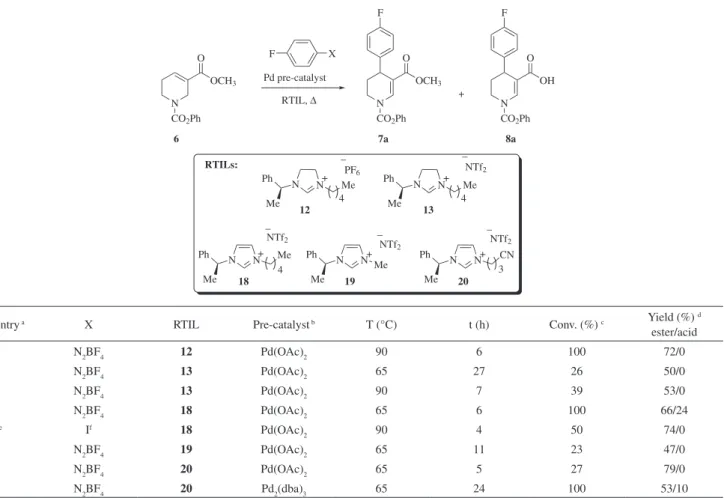
On a strictly chemical standpoint, the nature of the RTIL was found to have a certain inluence on the course of the reaction. In the imidazolinium series the
N N Ph Me N N Ph Me N N Ph Me N N Ph Me R Me n 4
+ +X
_ Br
_
n-PentBr, Cl3CCH3
MeI, MeCN or Cl(CH2)3CN,
MeCN
15, n = 4, R = Me, X = Br (100%) 16, n = 0, R = Me, X = I (100%) 17, n = 3, R = CN, X = Cl (100%)
N N Ph Me Me 4 + X _ N N Ph Me R n + LiNTf2,
H2O
NTf2
_
18, n = 4, R = Me (88%) 19, n = 0, R = Me (79%) 20, n = 3, R = CN (81%) 12, X = PF6 ( 64%)
13, X = NTf2 (80%)
HPF6, H2O
or LiNTf2, H2O
NiO2, CH3CN
MW, 90 °C
n-PentBr, Cl3CCH3
or
10 (48% over 2 steps ) 14 (50%)
11 (96%)
NH NH2
Ph
Me 9 ref. 23
bis(triluoromethanesulfonyl)imide salt 13 revealed less
favourable, even under more vigourous conditions, than
the hexaluorophosphate salt 12 which allowed smooth
and clean conversion of the starting acrylate (Table 2, entries 1, 2 and 3). As far as the imidazolium salts were
concerned, the 3-pentyl derivative 18 gave the best result.
Unexpectedly, the reaction proved rather sluggish when
the less hindered 3-methyl imidazolium salt 19 was used,
which might be correlated to an increase in viscosity (Table 2, entry 6). A complete conversion was achieved with
the nitrile-functionalized salt 20 after prolonged heating
with Pd2(dba)3 as a pre-catalyst which presented a marked
contrast with Pd(OAc)2 (Table 2, entries 7 and 8).
Several of these chiral RTILs gave rise to an eficient transformation, although the enantiomeric excess of the isolated product was found negligible, independently of the chiral ionic liquid used. In order to ensure that this behavior was not due to a mechanistic particularity of the Heck arylation employing arenediazonium salts, we performed the Heck arylation with the corresponding aryl iodide.
When the olein 6 was treated with 1-luoro-4-iodobenzene
in the chiral imidazolium 18 a satisfactory transformation
was obtained (Table 2, entry 5), but unfortunately no asymmetric induction was evidenced in the Heck adduct.
Preparation and use of imidazolium-derived diaminocarbene Pd complexes
Aiming at increasing the interaction between the imidazolium nucleus of the RTIL and the palladium catalyst, we also studied the use of imidazolium-derived
pre-formed diaminocarbene palladium complexes.28
T h u s , w e fi r s t p r e p a r e d t h e 1 -n bu t y l 3
-methylimidazolium bromide-derived N-heterocyclic
carbene palladium complex 22 described by Xiao
(Scheme 4).16 The latter was generated from Pd(OAc)
2 in
reluxing THF in 77% isolated yield as the sole trans isomer
(anti/syn, 1:1). When evaluated in our model reaction of
6 with 4-luorobenzenediazonium tetraluoroborate, this
entity proved poorly active in [BMIM][Br] (20 mol%, 80 °C, 48 h, 9% yield bsmr at 60% of conversion) and
totally ineficient in [BMIM][PF6] (20 mol%, 65 °C, 24 h).
Table 2. The Heck arylation in various imidazolinium and imidazolium chiral RTILs
PF6 _ 12 N N Ph Me Me 4 + NTf2 _ 13 4 + NTf2 _ 18 NTf2 _ 19 3 NTf2 _ 20 RTILs: N N Ph Me Me + N N Ph Me Me + N N Ph Me CN N N Ph Me Me + 4 N CO2Ph
N
OCH3
CO2Ph
O
Pd pre-catalyst OCH
3
O F
F X
RTIL, ∆ N
CO2Ph
OH O F
+
6 7a 8a
Entry a X RTIL Pre-catalyst b T (°C) t (h) Conv. (%) c Yield (%) d
ester/acid
1 N2BF4 12 Pd(OAc)2 90 6 100 72/0
2 N2BF4 13 Pd(OAc)2 65 27 26 50/0
3 N2BF4 13 Pd(OAc)2 90 7 39 53/0
4 N2BF4 18 Pd(OAc)2 65 6 100 66/24
5e If 18 Pd(OAc)
2 90 4 50 74/0
6 N2BF4 19 Pd(OAc)2 65 11 23 47/0
7 N2BF4 20 Pd(OAc)2 65 5 27 79/0
8 N2BF4 20 Pd2(dba)3 65 24 100 53/10
a 1.5 equiv. of the arenediazonium salt was used; b Pd(OAc)
2 10 mol%; Pd2(dba)3 5 mol%; c Conversion calculated on the basis of the recovered starting
material; d Isolated yields, based on starting material recovering; e 1.1 equiv. of the base Ag
In parallel, the behaviour of our chiral imidazolium
cation in the presence of Pd(OAc)2 was also explored by
means of the reaction of the bromide 15 with 0.5 equiv.
of the palladium salt in reluxing THF (Scheme 3). A
smooth transformation occurred after heating 15 with
Pd(OAc)2 for 6 h, allowing isolation of the expected
palladium complex 23 in 54% yield as a 1:1 mixture of
isomers according to 1H and 13C NMR. Assignment of
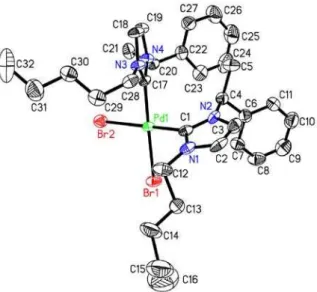
the stereochemical identity of these diaminocarbenes complexes was not trivial. Gratifyingly, a single crystal suitable for X-ray diffraction analysis could be obtained for each isomer thus allowing to identify the two
products as the trans-anti isomer 23a along with the
quite unexpected cis-syn derivative 23b (Figure 1).29 A
π-stacking interaction between the phenyl groups of each
diaminocarbene moieties might account for the formation of this strained isomer.
The mixture of isomers 23a, b was evaluated in our
key Heck arylation with 4-fluorobenzenediazonium tetraluoroborate. However, the use of 10-20 mol% of
these complexes in either THF (relux, 24 h), CH3CN
(relux, 24 h), or [BMIM][PF6] (100 °C, 24 h) failed
to induce any transformation. The same behavior was observed when 1-luoro-4-iodobenzene was used
(3.0 equiv. Ag2CO3, DMF, 130 °C, 24 h). The intrinsic
stability of these bis-diaminocarbene palladium complexes might be responsible for their lack of catalytic activity.
Use of an hydroxylated chiral ionic liquid
In the course of the development of our synthetic methodology we found out that the key Heck reaction could be run eficiently in MeOH. The beneicial effect of protic solvents prompted us to explore the inluence of hydroxyl-containing chiral ionic liquids for this transformation.
We took advantage here of the preparation of the
phenylglycinol derivative 26 we reported recently.30
This ionic liquid was synthesized from pyridinium 25
employing a route previously described by us based
on the use of the Zincke reaction (Scheme 5).31 The
bis(triluoromethanesulfonyl)imide anion was selected
on the basis of previous studies.32 To our satisfaction, it
was found that this hydroxylated derivative displayed a Tg of –45 °C measured by DSC analysis as compared to
–30 °C for the its non-hydroxylated counterpart 24.32 The
latter was also considered for the matter of comparison.
The unsubstituted α-methylbenzylamine-derived
salt 24 gave rise to a smooth transformation with
4-luorobenzenediazonium tetraluoroborate (Table 3, entry 1). Despite the high tolerance of the key Heck coupling for alcoholic media, the reaction in the
hydroxylated derivative 26 proved much less eficient,
irrespectively to the pre-catalyst (Table 3, entries 2 and 3). The conversions were not altered, but the yields were strongly affected. For the sake of comparison, the iodide was also evaluated as under the reaction conditions determined previously (Table 3, entries 4 and 5). As
observed before, Pd(OAc)2 was more efficient than
Pd2(dba)3. Notably, in this case the halide gave rise
to a better transformation than the corresponding arenediazonium salt. Unfortunately, no enantiomeric excess was detected from the analysis of the isolated products.
N N
R + nMe
_ Br
21, R = Me, n = 3 15, R = (S)-Ph(Me)CH, n = 4
Pd(OAc)2 (0.5 equiv.)
THF, reflux
22, R = Me, n = 3 (trans-syn/trans-anti 1:1) (77%) 23, R = (S)-Ph(Me)CH, n = 4 (cis-syn/trans-anti 1:1) (54%)
PdBr2 N N Me R n 2
Scheme 4. Preparation of palladium complexes from imidazolium salts.
Figure 1. X-ray structure of the trans-anti23a (left) and cis-syn23b (right)
diaminocarbene Pd complexes obtained from the chiral imidazolium 15
and Pd(OAc)2.19
+ _ N Me Ph NTf2 N NO2 NO2 + Cl _ + _ N Ph NTf2 OH ref. 30 ref. 32
24 (74%) 25 26 (61%)
The use of chiral ionic liquid bearing a basic functionality as a potential coordination site
In the last part of this study we adopted an alternative strategy. In order to drive the interaction between the ionic liquid and the catalytic species we opted for the use of
chiral ionic entities bearing a N-heterocycle susceptible to
coordination to the metal centre. Indeed, several studies
by Shreeve and co-workers33 have recently described
catalytically active entities based on the complex between a palladium salt and an ionic liquid bearing a basic functionality. To the best of our knowledge, no examples of chiral derivative of that kind were reported so far. We reasoned that such electron-rich entities might interact signiicantly with the cationic palladium species involved in the catalytic cycle operating in the case of arenediazonium salts.
We irst focused on the readily accessible nicotine derivative. Albrecht has recently used such a pyridinium halide as a carbene precursor to prepare a catalytically active
palladium complex.34 The quaternarization of nicotine had
already been described earlier by Shibagaki et al.35 who
showed that it was possible to chemoselectively N-alkylate
the pyridine nucleus versus the pyrrolidine ring on the basis of steric considerations. However, as the yields and conversion reported were not satisfactory we irst optimized
the access to the required pyridinium salt. In this regard, the use of microwave activation proved highly eficient.
Indeed, treatment of the nicotine (27) with i-propyl iodide
in CH3CN at 100 °C under microwave irradiation led to the
clean and eficient formation of the expected pyridinium
iodide 28 in only 2 h (Scheme 6). Anion metathesis
proceeded uneventfully for this iodide salt to afford the desired chiral pyridinium bis(triluoromethanesulfonyl)
imide 29. The latter displayed a glass transition at –56 °C
measured by DSC.
We then evaluated the inluence of this chiral pyridinium as an additive in the course of our model arylation (Table 4).
Since HBF4 is formed during thetransformation, 1.2 equiv. of
the basic ionic liquid were used. On the other hand, the C-2
methyl derivative [BDIM][NTf2] was selected as a potentially
“innocent” ionic media, although carbene formation at C-4
and C-5 of the imdazolium ring has also been reported.36 The
presence of the additive strongly changed the conversion in
Table 3. The Heck arylation in hydroxylated and non-hydroxylated chiral pyridinium RTILs
+ _ N Ph NTf2 OH 26 + _ N Me Ph NTf2 24 RTILs: N CO2Ph
N
OCH3
CO2Ph
O
Pd pre-catalyst OCH3 O F
F X
RTIL, ∆
N CO2Ph
OH O F
+
6 7a 8a
Entry X a RTIL Catalyst b T (°C) t (h) Conv. (%) c Yield (%) d
ester/acid
1 N2BF4 24 Pd(OAc)2 65 1 100 53/18
2 N2BF4 26 Pd(OAc)2 65 1.5 100 34/4
3 N2BF4 26 Pd2(dba)3 65 1.5 100 21/3
4 e I 26 Pd(OAc)
2 120 1 100 80/0
5 e I 26 Pd
2(dba)3 120 2 100 51/0
a 1.5 equiv. of arenediazonium salt and 3.0 equiv. of iodide were used; b Pd(OAc)
2 10 mol%; Pd2(dba)3 5 mol%; c Conversion calculated on the basis of the
recovered starting material; d Isolated yields, based on starting material recovering; e 1.1 equiv. of the base Ag
2CO3 was used.
N N Me i-PrI N N Me Me Me + I _ N N Me Me Me + NTf2 _
29 (66%)
Nicotine (27) 28 (92%)
MeCN MW, 100 °C
LiNTf2 H2O
the case of 4-luorobenzenediazonium tetraluoroborate and of the aryl iodide counterpart. In spite of lower conversions, yields were higher using the aryl halide (Table 4, entries 3 and 4). This observation might be related with some decomposition of the arenediazonium salt in the reaction media.
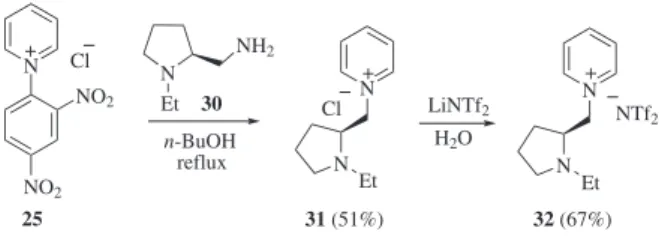
Another pyridinium ionic liquid bearing a chiral pyrrolidine moiety was prepared by the Zincke reaction (Scheme 7). Thus, treatment of the so-called Zincke salt
by the commercially available chiral primary amine 30
afforded the desired pyridinium chloride 31, which upon
anion metathesis provided the bis(triluoromethanesulfonyl)
imide salt 32 in 35% overall yield. A Tg of –52 °C was
measured by DSC for this chiral ionic liquid.
The impact of the chiral pyridinium ionic liquid 32 on
the outcome of the Heck reaction is similar that observed
previously for the ionic liquid 29 (Table 4). The basic nature
of the additive seems to hamper the transformation, although to a lesser extent than that observed with the
nicotine-Table 4. The Heck arylation in an achiral ionic media in the presence of different chiral ionic additives
N N Me Me Me + NTf2 _ 29 N N Me Ph N n-Bu NTf2 35 N
CO2Ph
N
OCH3
CO2Ph
O
Pd pre-catalyst OCH3
O F
F X
solvent, ∆
6 7a
29 or 32 or 35
(1.2 equiv.) 32 N N Et NTf2
Chiral ionic additives:
N
CO2Ph
OH O F
+
8a
Entry Additive X a Solvent Pre-catalyst b T (°C) t (h) Conv. (%) c Yield (%) d
ester/acid
1 29 N2BF4 [BDMIM][NTf2] Pd(OAc)2 65 24 31 47/0
2 29 N2BF4 [BDMIM][NTf2] Pd2(dba)3 65 24 23 52/0
3e 29 I [BDMIM][NTf
2] Pd(OAc)2 120 24 9 80/0
4e 29 I [BDMIM][NTf
2] Pd2(dba)3 120 24 12 92/0
5 32 N2BF4 [BDIM][NTf2] Pd(OAc)2 65 24 47 57/0
6 32 N2BF4 [BDIM][NTf2] Pd2(dba)3 65 24 32 47/0
7 32 N2BF4 THF Pd(OAc)2 65 24 19 100/0
8 32 N2BF4 THF Pd2(dba)3 65 24 11 31/0
9 e 32 I [BDIM][NTf
2] Pd(OAc)2 120 24 29 91/0
10 e 32 I [BDIM][NTf
2] Pd2(dba)3 120 24 14 70/0
11 35 N2BF4 [BDIM][NTf2] Pd(OAc)2 65 24 100 90/0
12 35 N2BF4 [BDIM][NTf2] Pd2(dba)3 65 24 100 96/0
13 35 N2BF4 THF Pd(OAc)2 65 3 54 84/0
14 35 N2BF4 THF Pd2(dba)3 65 3 31 86/0
15 e 35 I [BDIM][NTf
2] Pd(OAc)2 120 7 100 58/0
16 e 35 I [BDIM][NTf
2] Pd2(dba)3 120 24 45 55/0
a 1.5 equiv. of arenediazonium salt and 3.0 equiv. of iodide were used; b Pd(OAc)
2 10 mol%; Pd2(dba)3 5 mol%; c Conversion calculated on the basis of the
recovered starting material; d Isolated yields, based on starting material recovering; e 1.1 equiv. of the base Ag
2CO3 was used. N NO2 NO2 + Cl n-BuOH reflux N+ N Et Cl
31 (51%) N NH2 Et 25 30 N + N Et NTf2
32 (67%) LiNTf2
H2O
Scheme 7. Synthesis of the chiral pyridinium RTIL 33 by means of the
derived pyridinium salt. For comparison, the reaction with the 4-luorobenzenediazonium tetraluoroborate was
also carried out in THF instead of [BDIM][NTf2] and the
conversions were even lower in this molecular solvent (Table 4, entries 7 and 8).
Finally, in an attempt to reduce the basicity of the chiral additive, we turned our attention to the possibility of introducing a heteroaromatic appendage into the structure of the ionic liquid. Shreeve has described a series of achiral 2-imidazolyl or 2-pyridylimidazolium
salt useful for the preparation of palladium complexes.33
In line with this work we envisioned the synthesis of such compounds from a chiral primary amine by means of a one-pot multi-component reaction. Although application of this route to the preparation of chiral 2,2’-bisimidazole
did not appear viable,37 we succeeded in preparing a
2-pyrydylimidazole. Indeed, after careful optimization
it was found that treatment of α-methylbenzylamine
with glyoxal, ammonium hydroxide and
pyridine-2-carboxaldehyde furnished imidazole 33 in 18% yield
(Scheme 8).
Quaternarization of the more basic imidazole nucleus was then carried out in a highly convenient and eficient manner. Microwave activation and anion metathesis step
provided the expected chiral ionic liquid 35 in 76% overall
yield (Scheme 8). Despite the presence of the aromatic substituent at C-2, this bis(triluoromethanesulfonyl)imide salt displayed a Tg of –40 °C as measured by DSC.
The less basic additive 35 was found to be fully
compatible with the use of 4-luorobenzenediazonium tetraluoroborate in our key palladium-catalyzed arylation (Table 4). The expected product was isolated in high yield, although the transformation appeared to be slower in
[BDIM][NTf2] (Table 4, entries 11 and 12). Remarkably, in
this particular case the pre-catalyst Pd2(dba)3 gave a better
result than Pd(OAc)2. A sluggish, yet clean, reaction was
also observed in THF (Table 4, entries 13 and 14). The aryl iodide also gave a reasonably eficient reaction thanks to
the use of Pd(OAc)2 (Table 4, entries 15 and 16).
Conclusions
Eight new chiral RTILs were prepared using novel and/or carefully optimized synthetic routes. This series of imidazolinium, imidazolium and pyridinium ionic liquids were fully characterized, including differential scanning calorimetry (DSC) analysis. The Heck reaction of substituted aza-endocyclic acrylates using arenediazonium tetraluoroborates and aryl iodides as electrophiles were investigated in these new RTILs. A strong inluence of the counter-ion was observed, with the lipophilic RTILs providing the best results. The Heck arylations performed in these chiral ionic entities, either as a solvent or an additive, were effective leading to complete conversion of the substrate and good to excellent yield of the Heck adduct. In spite of the overall performance of the Heck arylations in all the cases studied no asymmetric induction was detected. Two new diastereoisomeric NHC-palladium complexes were prepared in moderate yields and their structure characterized by X-ray diffraction analysis thus allowing
the identiication of the unusual cis-syn stereoisomer 23b.
Overall, the Heck arylations employing arenediazonium tetraluoroborates in RTILs were more effective than the traditional protocols employing aryl iodides in terms of reactivity and yields. Applications of the new chiral RTILs described herein to other synthetic transformations are in progress and the results concerning these studies will be reported in due course.
Experimental
General
Reagents and solvents are commercial grade and were used as supplied, except when speciied in the experimental
procedure. CH2Cl2 was distilled from calcium hydride and
THF was distilled from Na. Reactions were monitored by TLC analysis using Merck Silica Gel 60 F-254 thin layer plates. Flash column chromatography was performed on Acros
silica gel 60, 0.040-0.063 mm. 1H NMR and 13C NMR data
were recorded on a Varian Gemini 2000 (300 MHz for 1H and
75 MHz for 13C NMR), Varian Inova (500 MHz for 1H and
125 MHz for 13C NMR) or Bruker Avance (250 MHz for 1H
and 63 MHz for 13C NMR or 300 MHz for 1H and 75 MHz for
13C NMR) spectrometer using as internal standard the residual
nondeuterated solvent (CHCl3, CH3OH, acetone or DMSO) or
TMS (1H NMR). Data are reported as follows: chemical shift
N N
n-BuI, CH3CN, MW, 100 ºC H O O H NH4OH + Ph Me
NH2 Me
Ph
N
N CHO
33 (18%)
N N
Me Ph
N
35 (92%) n-Bu NTf2 i-PrOH N N Me Ph N
34 (83%) n-Bu
I 80 ºC
LiNTf2
H2O
in ppm (d), multiplicity (s = singlet, d = doublet, t = triplet, q = quartet, m = multiplet, br = broad signal), coupling constant (Hz), integration. High-resolution mass spectra (HRMS) were measured on a VG Auto-spec-Micromass spectrometer (EI) or in a Waters Q-Tof Ultima API (ESI). Infrared spectra (IR) were obtained on a Thermo-Nicolet IR-200 spectrometer and absorptions are reported in reciprocal centimeters. Melting points were recorded on an Electrothermal 9100 melting point apparatus and are uncorrected. Differential scanning calorimetry (DSC) analyses were recorded on a DSC Diamond Perkin Elmer.
General procedures for the quaternarization
A solution of imidazoline 10 or imidazole 14 (1 equiv.)
and alkyl halide (3.0-5.0 equiv.) in 1,1,1-trichloroethane
or acetonitrile (0.6 mL mmol-1) was reluxed until TLC
monitoring showed complete consumption of the starting material (2-3 days). For the reaction in 1,1,1-trichloroethane, the insoluble oily material was separated by decantation and washed several times with 1,1,1-trichloroethane to give the expected halide salt. For the reaction in acetonitrile, the mixture was concentrated to dryness and partitioned between
Et2O and water. After two additional extractions with Et2O,
the aqueous phase was concentrated to dryness to give the expected halide salt.
General procedure for the anion metathesis with lithium bis(triluoromethanesulfonyl)imide
A solution of halide salt (1.0 equiv.) in water (6.5 mL mmol-1)
containing lithium bis(trifluoromethanesulfonyl)imide (1.1 equiv.) was heated with stirring at 70 °C for 2 h and allowed to stand at room temperature overnight. The insoluble oily material was extracted with dichloromethane and the organic layer was separated and washed with water and brine,
dried over Na2SO4, iltered and concentrated to dryness to give
the expected bis(triluoromethanesulfonyl)imide salt.
General procedure for the Heck coupling with arenediazonium salts in ionic liquids
To a solution of olein 6 (1 equiv., typically 0.25 mmol) in
ionic liquid (4.0 mL mmol-1) was added, at once, a mixture of
the 4-luorobenzenediazonium tetraluoroborate (1.5 equiv.) and Pd pre-catalyst (5-10 mol%). The reaction mixture was immersed in an oil bath and heated under stirring (see tables for the temperature and reaction time). After cooling, the
mixture was extracted (6 × 40 mL mmol-1) with Et
2O and
with 1,1,1-trichloroethane (3 × 40 mL mmol-1). The combined
organic layers were then concentrated to dryness and puriied
by lash column chromatography over silica gel (petroleum
ether/ethyl acetate, 4:1) to furnish the desired Heck adduct 7a
and, in some cases, the corresponding acid 8a.
General procedure for the Heck coupling with aryl iodides in ionic liquids
To a solution of olein 6 (1 equiv., 0.25 mmol) in ionic
liquid (4.0 mL mmol-1) was added the aryl iodide (3 equiv.),
Ag2CO3 (1.1 equiv.) and Pd pre-catalyst (5-10 mol%). The
reaction mixture was immersed in an oil bath and heated under stirring (see tables for the temperature and reaction time). After
cooling, the mixture was extracted with Et2O (6 × 10 mL) and
with 1,1,1-trichloroethane (3 × 10 mL). The combined organic layers were then concentrated to dryness and puriied by lash column chromatography over silica gel (petroleum ether/ethyl
acetate, 4:1) to furnish the arylated product 7a,b.
Speciic procedures and compounds data
3-Pentyl-1-((1S)-1-phenylethyl)-4,5-dihydro-1H-imidazolium bromide (11)
Prepared from imidazoline 10 (1.0 g, 5.75 mmol)
according to the general procedure for quaternarization
in 1,1,1-trichloroethane. Bromide 11 (1.80 g, 96%) was
obtained as light brown liquid. [α]25
D –6.8 (c 1.20, CHCl3);
IR νmax/cm-1: 2933, 2872, 1646, 1495, 1455, 1382, 1255, 1201,
1142, 703 (thin ilm); 1H NMR (300 MHz, CDCl
3) d 9.76 (s,
1H), 7.28-7.42 (m, 5H), 5.06 (q, J 7.0 Hz, 1H), 3.95-3.84 (m,
2H), 3.79-3.64 (m, 4H), 1.79 (d, J 7.0 Hz, 3H), 1.71-1.60 (m,
2H), 1.35-1.23 (m, 4H), 0.87 (t, J 7.0 Hz, 3H); 13C NMR (75
MHz, CDCl3) d 156.6 (CH), 137.3 (C0), 129.0 (CH), 128.6
(CH), 126.7 (CH), 57.6 (CH), 48.2 (CH2), 48.0 (CH2), 46.3
(CH2), 28.1 (CH2), 26.8 (CH2), 21.9 (CH2), 19.5 (CH3), 13.6
(CH3); MS (ESI +) m/z: 245 [M+]; MS (ESI–) m/z: 79, 81
[Br–]; HRMS (ESI +) m/z: Calcd for C
16H25N2 [M+] 245.2018,
Found 245.2021.
3-Pentyl-1-((1S)-1-phenylethyl)-4,5-dihydro-1H-imidazolium hexaluorophosphate (12)
To a stirred solution of imidazolinium bromide 11
(1.97 g, 6.04 mmol) in water (12 mL) at 0 °C was added
hexaluorophosphoric acid (1.16 mL of a 60% solution in H2O,
7.85 mmol, 1.3 equiv.). The stirring was continued at 0 °C for 2 h and the solution was allowed to stand at room temperature overnight. The reaction mixture was then extracted with
CH2Cl2 and the combined organic layers were washed with
water, dried over Na2SO4, iltered and concentrated to dryness
to give 12 (1.52 g, 64%), obtained as a light yellow solid.
[α]25
D –4.0 (c 1.50, CHCl3); mp 86-87 °C; IR νmax/cm-1: 2935,
705 (thin ilm); 1H NMR (300 MHz, CDCl
3) d 7.98 (s, 1H),
7.46-7.26 (m, 5H), 4.76 (q, J 6.8 Hz, 1H), 3.96-3.81 (m, 2H),
3.80-3.68 (m, 2H), 3.50 (t, J 7.6 Hz, 2H), 1.72 (d, J 6.9 Hz,
3H), 1.69-1.59 (m, 2H), 1.40-1.21 (m, 4H), 0.89 (t, J 6.9 Hz,
3H); 13C NMR (75 MHz, CDCl
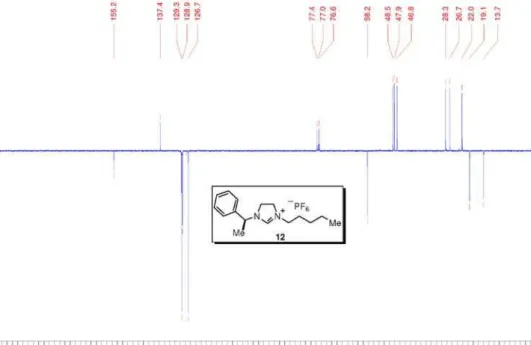
3) d 155.2 (CH), 137.4 (C0),
129.3 (CH), 128.9 (CH), 126.7 (CH), 58.2 (CH), 48.5 (CH2),
47.9 (CH2), 46.8 (CH2), 28.3 (CH2), 26.7 (CH2), 22.0 (CH2),
19.1 (CH3), 13.7 (CH3); MS (ESI +) m/z: 245 [M+]; MS
(ESI –) m/z: 145 [PF6–]; HRMS (ESI +)m/z: Calcd for C16H25N2
[M+] 245.2018, found 245.2028; HRMS (ESI +) m/z: Calcd
for PF6 [PF6–] 144.9642, found 144.9635.
3-Pentyl-1-((1S)-1-phenylethyl)-4,5-dihydro-1H-imidazolium bis(triluoromethanesulfonyl)imide (13)
Prepared from imidazolinium bromide 11 (1.80 g,
5.54 mmol) according to the general procedure for the anion metathesis with lithium bis(triluoromethanesulfonyl)imide.
Salt 13 (2.32 g, 80%) was obtained as a light yellow liquid.
[α]25
D –2.7 (c 1.49, CHCl3); Tg –59 °C; IR νmax/cm-1: 2961,
1649, 1456, 1350, 1186, 1136, 1056, 788, 739, 703 (thin ilm);
1H NMR (300 MHz, CDCl
3) d 8.05 (s, 1H), 7.46-7.34 (m, 3H),
7.32-7.27 (m, 2H), 4.80 (q, J 7.0 Hz, 1H), 3.96-3.84 (m, 2H),
3.82-3.70 (m, 2H), 3.48 (t, J 7.6 Hz, 2H), 1.71 (d, J 6.9 Hz, 3H),
1.68-1.58 (m, 2H), 1.39-1.20 (m, 4H), 0.89 (t, J 7.0 Hz, 3H); 13C
NMR (75 MHz, CDCl3) d 155.3 (CH), 137.1 (C0), 129.4 (CH),
129.1 (CH), 126.7 (CH), 119.8 (q, JC-F 321.3 Hz, SO2CF3), 58.2
(CH3), 48.6 (CH2), 48.0 (CH2), 46.7 (CH2), 28.3 (CH2), 26.8
(CH2), 22.0 (CH2), 19.1 (CH3), 13.7 (CH3); MS ESI +)m/z: 245
[M+]; MS (ESI –) m/z: 280 [NTf
2–]; HRMS (ESI +) m/z: Calcd
for C16H25N2 245.2018 [M+], found 245.2029; HRMS (ESI –)
m/z: Calcd for C2NO4F6S2 279.9173 [NTf2–], found 279.9190.
3-Pentyl-1-((1S)-1-phenylethyl)-1H-imidazolium bromide (15)
Prepared from imidazole 14 (284 mg, 1.65 mmol)
according to the general procedure for quaternarization in
1,1,1-trichloroethane. Imidazolium 15 (530 mg, quant.) was
obtained as light brown liquid. [α]25
D –13.2 (c 1.80, CHCl3);
IR νmax/cm-1: 3056, 2957, 2871, 1672, 1561, 1456, 1382,
1162, 732(thin ilm); 1H NMR (300 MHz, CDCl
3) d10.77
(s, 1H), 7.47-7.41 (m, 2H), 7.40-7.32 (m, 4H), 7.28-7.25 (m,
1H), 5.99 (q, J 7.0 Hz, 1H), 4.35 (t, J 7.4 Hz, 2H), 2.00 (d, J
7.4 Hz, 3H), 1.92 (quintet, J 7.4 Hz, 2H), 1.37-1.24 (m, 4H),
0.85 (t, J 7.0 Hz, 3H); 13C NMR (75 MHz, CDCl3) d 137.5
(CH), 135.1 (C0), 128.5 (CH), 128.4 (CH), 126.2 (CH), 121.9
(CH), 120.4 (CH), 58.9 (CH), 49.2 (CH2), 29.2 (CH2), 27.5
(CH2), 21.3 (CH2), 20.5 (CH3), 13.1 (CH3); MS (ESI +) m/z:
243 [M+]; MS (ESI –) m/z: 79, 81 [Br–]; HRMS (ESI +)m/z:
Calcd for C16H23N2 [M+] 243.1861, found 243.1865.
3-Methyl-1-((1S)-1-phenylethyl)-1H-imidazolium iodide (16)
A solution of imidazole 14 (166 mg, 0.96 mmol) and
iodomethane (120 μL, 1.30 mmol, 1.35 equiv.) in acetonitrile (2.0 mL) was stirred at room temperature for 20 h. The solution
was concentrated to dryness to give 16 (300 mg, quant.) as
a light yellow oil. [α]25
D +4.3 (c 5.3, CHCl3); IR νmax/cm-1:
3120, 2934, 1604, 1572, 1496, 1330, 1156, 721 (thin ilm);
1H NMR (300 MHz, CDCl
3) d 10.19 (s, 1H), 7.57 (t, J 1.7
Hz, 1H), 7.51-7.37 (m, 5H), 7.34 (t, J 1.8 Hz, 1H), 5.89 (q,
J 7.0 Hz, 1H), 4.14 (s, 3H), 2.06 (d, J 7.0 Hz, 3H); 13C NMR
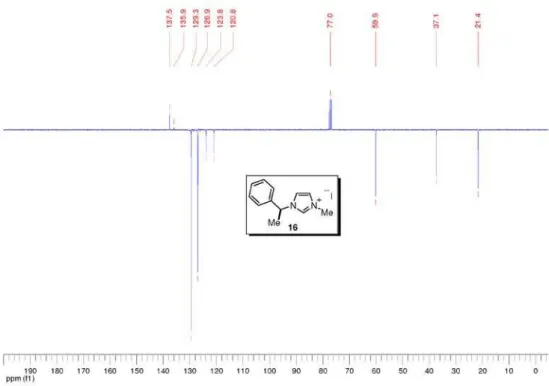
(75 MHz, CDCl3) d 137.5 (CH), 135.9 (C0), 129.3 (CH),
126.9 (CH), 123.8 (CH), 120.8 (CH), 59.9 (CH), 37.1 (CH3),
21.4 (CH3); MS (ESI +) m/z: 187 [M+]; MS (ESI –) m/z: 127
[I–]; HRMS (ESI +) m/z: Calcd for C
12H15N2 [M+] 187.1235,
found 187.1237.
3-(3-cyanopropyl)-1-((1S)-1-phenylethyl)-1H-imidazolium chloride (17)
Prepared from imidazole 14 (1.04 g, 6.03 mmol) according
to the general procedure for quaternarization in acetonitrile.
Chloride 17 (1.66 g, quant.) was obtained as light yellow oil.
[α]25
D –1.2 (c 1.07, CHCl3); IR νmax/cm-1: 3057, 2938, 2467,
2247, 1558, 1496, 1456, 1258, 1158, 1014, 878, 853, 753,
706, 660 (thin ilm); 1H NMR (300 MHz, CDCl
3) d 10.68 (s,
1H), 7.82 (s, 1H), 7.27-7.21 (m, 5H), 7.15 (s, 1H), 5.68 (q,
J 6.9 Hz, 1H), 4.57 (t, J 6.7 Hz, 2H), 2.58 (t, J 6.9 Hz, 2H),
2.28 (quintet, J 6.7 Hz, 2H), 1.89 (d, J 6.9 Hz, 3H); 13C NMR
(75 MHz, CDCl3) d 137.7 (CH), 129.3 (CH), 126.7 (CH),
123.0 (CH), 120.7 (CH), 118.6 (C0), 60.0 (CH), 48.3 (CH2),
26.1 (CH2), 21.1 (CH3), 14.4 (CH2); MS (ESI +) m/z: 240
[M+]; HRMS (ESI +)m/z: Calcd for C
15H18N3 [M+] 240.1501,
found 240.1481.
3-Pentyl-1-((1S)-1-phenylethyl)-1H-imidazolium bis(triluoromethanesulfonyl)imide (18)
Prepared from imidazolium bromide 15 (909 mg,
2.81 mmol) according to the general procedure for the anion metathesis with lithium bis(triluoromethanesulfonyl)imide.
Salt 18 (1.30 g, 88%) was obtained as a light yellow liquid.
[α]25
D –8.1 (c 1.73, CHCl3); Tg –57 °C; IR νmax/cm-1: 3146,
2962, 1557, 1557, 1457, 1349, 1186, 1136, 1055, 789, 704
(thin ilm); 1H NMR (300 MHz, CDCl
3) d 8.87 (s, 1H),
7.46-7.37 (m, 3H), 7.36-7.32 (m, 2H), 7.31-7.28 (m, 1H),
7.25-7.22 (m, 1H), 5.67 (q, J 7.0 Hz, 1H), 4.18 (t, J 7.5 Hz,
2H), 1.95 (d, J 7.0 Hz, 3H), 1.86 (quintet, J 7.5 Hz, 2H),
1.42-1.22 (m, 4H), 0.88 (t, J 7.0 Hz, 3H); 13C NMR (75 MHz,
CDCl3) d 137.5 (CH), 134.3 (C0), 129.5 (CH), 126.7 (CH),
122.5 (CH), 121.0 (CH), 119.8 (q, JC-F 321.4 Hz, SO2CF3),
60.1 (CH), 50.2 (CH2), 29.7 (CH2), 28.0 (CH2), 21.8 (CH2),
20.6 (CH3), 13.6 (CH3); MS (ESI +) m/z: 243 [M+]; MS
(ESI –) m/z: 280 [NTf2–]; HRMS (ESI +)m/z: Calcd for
C16H23N2 [M+] 243.1861, found 243.1865; HRMS (ESI –)
3-Methyl-1-((1S)-1-phenylethyl)-1H-imidazolium bis(triluoromethanesulfonyl)imide (19)
Prepared from imidazolium iodide 16 (300 mg, 0.95 mmol)
according to the general procedure for the anion metathesis
with lithium bis(triluoromethanesulfonyl)imide. Salt 19
(350 mg, 79%) was obtained as a light yellow liquid. [α]25
D
–4.3 (c 2.8, CHCl3); Tg –50 °C; IR νmax/cm-1: 3154, 2989,
1621, 1572, 1457, 1345, 1194, 1137, 1055, 707 (thin ilm);
1H NMR (300 MHz, CDCl
3) d8.73 (s, 1H), 7.45-7.36 (m,
3H), 7.35-7.30 (m, 2H), 7.28 (t, J 1.8 Hz, 1H), 7.21 (t, J 1.8
Hz, 1H), 5.60 (q, J 7.0 Hz, 1H), 3.91 (s, 3H), 1.93 (d, J 7.0
Hz, 3H); 13C NMR (75 MHz, CDCl
3) d 137.3 (CH), 135.0
(C0), 129.6 (CH), 129.5 (CH), 126.7 (CH), 123.8 (CH),
121.0 (CH), 119.8 (q, JC-F 318.7 Hz, SO2CF3), 60.2 (CH),
36.4 (CH3), 20.6 (CH3); MS (ESI +) m/z: 187 [M+]; MS
(ESI –) m/z: 280 [NTf2–]; HRMS (ESI +)m/z: Calcd for
C12H15N2 [M+] 187.1235, found 187.1235; HRMS (ESI –)
m/z: Calcd for C2NO4F6S2 [NTf2–] 279.9173, found 279.9164.
3-(3-cyanopropyl)-1-((1S)-1-phenylethyl)-1H-imidazolium bis(triluoromethanesulfonyl)imide (20)
Prepared from imidazolium chloride 17 (1.66 g,
6.03 mmol) according to the general procedure for the anion metathesis with lithium bis(triluoromethanesulfonyl)imide.
Salt 20 (2.54 g, 81%) was obtained as a light yellow liquid.
[α]25
D –4.5 (c 1.78, CH3OH); Tg –46 °C; IR νmax/cm-1: 3153,
2251, 1561, 1457, 1351, 1180, 1141, 1054, 740, 704, 614,
570 (thin ilm); 1H NMR (300 MHz, acetone-d
6) d 9.23 (t,
J 1.6 Hz, 1H), 7.82 (t, J 1.9 Hz, 1H), 7.76 (t, J 1.9 Hz, 1H),
7.44-7.34 (m, 5H), 5.84 (q, J 7.0 Hz, 1H), 4.48 (t, J 7.1 Hz,
2H), 2.59 (t, J 7.4 Hz, 2H), 2.32 (quintet, J 7.2 Hz, 2H), 1.96
(d, J 7.0 Hz, 3H); 13C NMR (75 MHz, CD
3OD) d 140.0 (CH),
130.5 (CH), 130.3 (CH), 127.9 (CH), 124.1 (CH), 123.1 (CH),
121.2 (q, JCF 320.5 Hz, SO2CF3), 119.8 (C0), 61.4 (CH), 49.7
(CH2), 26.8 (CH2), 21.2 (CH3), 14.7 (CH2); MS (ESI +) m/z:
240 [M+]; MS (ESI –) m/z: 280 [NTf
2–]; HRMS (ESI +) m/z:
Calcd for C15H18N3 [M+] 240.1501, found 240.1481.
Diaminocarbene palladium complexes 23a,b
Pd(OAc)2 (47 mg, 0.21 mmol) and 3-pentyl-1-[(1S
)-1-phenylethyl]-1H-imidazolium bromide 15 (135 mg, 0.42
mmol) were dissolved in 7.0 mL of dry THF. After reluxing for 6 h under argon and cooling to room temperature, the mixture was iltered through a pad of silica gel. The solvent was removed under vacuum and the crude product was puriied by lash column chromatography (petroleum ether/ethyl
acetate, 4:1) to furnish a 1:1 mixture of compound 23a,b (85
mg, 54%), obtained as a pale yellow amorphous solid. [α]25
D
–190.0 (c 1.17, CHCl3); mp: 114-116 °C; IR νmax/cm-1: 3156,
3124, 3094, 3060, 2957, 2929, 2867, 1602, 1560, 1497, 1453,
1425, 1378, 1216, 1184, 770, 734, 703 (thin ilm); 1H NMR
(300 MHz, CDCl3) d 7.67 (d, J 7.1 Hz, 2H), 7.57 (d, J 6.8 Hz,
2H), 7.43-7.28 (m, 6H), 6.86 (q, J 7.2 Hz, 1H), 6.80 (d, J 1.8
Hz, 1H), 6.78 (d, J 1.8 Hz, 1H), 6.76 (q, J 7.2 Hz, 1H), 6.57
(apparent d, J 7.1 Hz, 1H), 6.55 (apparent d, J 1.9 Hz, 1H),
4.61-4.35 (m, 4H), 2.19-2.04 (m, 4H), 2.01 (d, J 7.1 Hz, 3H),
1.89 (d, J 7.1 Hz, 3H), 1.50-1.40 (m, 4H), 1.37-1.27 (m, 4H),
0.96 (apparent t, J 6.9 Hz, 3H), 0.80 (apparent t, J 6.8 Hz, 3H);
13C NMR (75 MHz, CDCl
3) d 168.9 (C0), 168.8 (C0), 140.2
(C0), 139.9 (C0), 128.6 (CH), 128.6 (CH), 128.0 (CH), 127.9
(CH), 127.8 (CH), 127.7 (CH), 58.3 (2 CH), 51.2 (CH2), 51.1
(CH2), 30.6 (CH2), 30.5 (CH2), 29.2 (CH2), 29.0 (CH2), 22.4
(CH2), 22.3 (CH2), 20.3 (CH3), 20.2 (CH3), 14.0 (CH3), 13.9
(CH3); MS (ESI +) m/z: 671 [M-Br] (most abundant isotopic
distribution); HRMS (ESI +)m/z: Calc. for C32H44N4BrPd
[M-Br] 671.1783, found 671.1818 (most abundant isotopic distribution).
1-isopropyl-3-((S)-1-methylpyrrolidin-2-yl)pyridinium iodide (28)
A solution of (–)-nicotine (27) (406 mg, 2.50 mmol) and
2-iodopropane (250 μL, 2.55 mmol) in acetonitrile (2.5 mL) was heated at 100 °C in a sealed tube under microwave irradiation (150 W) for 2 h. Next, the volatiles were removed under reduced pressure and the residue obtained was dissolved in water (50 mL). The resulting solution was extracted with diethyl ether (2 × 60 mL) and the aqueous layer was concentrated to dryness under reduced pressure to give the
desired pyridinium iodide 28 (1.49 g, 92%), obtained as a dark
red viscous oil. [α]25
D –65.3 (c 1.68, CH3OH); IR νmax/cm-1:
3023, 2971, 2789, 1497, 1462, 1269, 1149, 731, 691 (thin
ilm); 1H NMR (300 MHz, CD
3OD) d 9.18 (s, 1H), 9.07 (d,
J 6.1 Hz, 1H), 8.67 (d, J 8.0 Hz, 1H), 8.14 (apparent t,
J 7.4 Hz, 1H), 5.12 (septet, J 6.7 Hz, 1H), 4.00-3.75 (m,
1H), 3.42 (apparent t, J 9.6 Hz, 1H), 2.67 (apparent q,
J 8.6 Hz, 1H), 2.58-2.30 (superposed multiplet, 1H and a singlet
centered at 2.40, 3H), 2.19-1.85 (m, 3H), 1.75 (d, J 6.7 Hz,
6H); 13C NMR (75 MHz, CD
3OD) d 146.2 (CH), 145.2 (C0),
143.5 (CH), 143.1 (CH), 129.7 (CH), 68.8 (CH), 66.7 (CH),
57.8 (CH2), 40.6 (CH), 35.5 (CH2), 23.8 (CH2), 23.3 (CH3),
23.2 (CH3); MS (ESI +) m/z: 205 [M+]; HRMS (ESI +) m/z:
Calcd for C13H21N2 [M+] 205.1705, found 205.1713.
1-isopropyl-3-((S)-1-methylpyrrolidin-2-yl)pyridinium bis(triluoromethanesulfonyl)imide (29)
Prepared from pyridinium iodide 28 (1.07 g, 3.23 mmol)
according to the general procedure for the anion metathesis with lithium bis(triluoromethanesulfonyl)imide. Pyridinium
29 (1.04 g, 66%) was obtained as a light brown oil. [α]25
D
–69.2 (c 1.59, CHCl3); Tg –56 °C; IR νmax/cm-1: 3073, 2977,
2948, 2791, 1499, 1465, 1352, 1268, 1196, 1138, 1059, 739
(thin ilm); 1H NMR (300 MHz, CDCl