Short Report
S
Printed in Brazil - ©2014 Sociedade Brasileira de Química 0103 - 5053 $6.00+0.00*e-mail: [email protected] †In memoriam
Synthesis and
in vitro
Evaluation of New Benzenesulfonamides as Antileishmanial Agents
Julio C. Borges,*,a Adriana V. Carvalho,b Alice M. R. Bernardino,a César D. Oliveira,a
Luiz C. S. Pinheiro,a Roberta K. F. Marra,a Helena C. Castro,c Solange M. S. V. Wardell,d
James L. Wardell,e,f Veronica F. Amaral,g Marilene M. Canto-Cavalheiro,b
Leonor L. Leonb and Marcelo Genestra†,b
aPrograma de Pós-Graduação em Química, Departamento de Química Orgânica Universidade
Federal Fluminense, Outeiro de São João Baptista, s/n, 24020-141 Niterói-RJ, Brazil
bLaboratório de Bioquímica de Tripanosomatídeos, IOC, Fundação Oswaldo Cruz,
21040-900 Rio de Janeiro-RJ, Brazil
cPrograma de Pós-Graduação em Ciências e Biotecnologia e LABiEMol, GCM,
Instituto de Biologia, Universidade Federal Fluminense, Outeiro de São João Batista, s/n, 24020-141 Niterói-RJ, Brazil
dCHEMSOL, 1 Harcourt Road, Aberdeen, AB15 5NY, Scotland
eInstituto de Tecnologia em Fármacos, Fundação Oswaldo Cruz, Farmanguinhos,
21041-250 Rio de Janeiro-RJ, Brazil
fChemistry Department, University of Aberdeen, Meston Walk, Old Aberdeen, AB243EU, Scotland
gPrograma de Pós-Graduação em Ciências e Biotecnologia, Departamento de Imunobiologia,
Instituto de Biologia, Universidade Federal Fluminense, Outeiro de São João Baptista, s/n, 24020-141 Niterói-RJ, Brazil
Este artigo descreve a síntese e a atividade antileishmania de novos derivados pirazolil benzenossulfonamídicos. Estes foram elucidados por métodos espectrométricos. Alguns compostos mostraram uma atividade in vitro significativa contra Leishmania amazonensis, destacando-se
o derivado 1e. Nenhum dos derivados pirazolil benzenossulfonamídicos mostraram qualquer toxicidade em macrófagos murinos.
This paper describes the synthesis and the antileishmanial activity of new pyrazolyl benzenesulfonamide derivatives. These were elucidated by spectrometric methods. Some compounds showed a significant in vitro activity against Leishmania amazonensis, highlighting
the derivative 1e. These pyrazolyl benzenesulfonamide derivatives did not show any toxicity in murine macrophage.
Keywords: pyrazolyl benzenesulfonamides, synthesis, antileishmanial activity
Introduction
Leishmania species are the casual agents of several clinical
manifestations called leishmaniasis,which aretransmitted to human and others mammals by the bite of an infected female Phlebotomine sandfly.Depending on the causative
species, it can be manifested as cutaneous, mucocutaneous, diffuse cutaneous, and visceral leishmaniasis.1 More than
miltefosine, an alkylphosphocholine derivative originally developed as an anticancer drug, which has been registered in India, Germany and Colombia for oral treatment of visceral leishmaniasis (VL). However, it is not indicated in pregnant women and shows severe gastrointestinal side effects.5,6 Azole antifungals ketoconazole, miconazole and itraconazole have been used to treat cutaneous leishmaniasis with variable success rates.7
There is a great interest in the synthesis of pyrazole derivatives, since they show a wide range of pharmacological properties including antimicrobial, anti-inflammatory, analgesic, antipyretic and antileishmania.8-11 Our research group reported the synthesis of various pyrazole derivatives that showed antileishmanial activity, among them we can highlight 1-aryl-4-(4,5-dihydro-1H-imidazol-2-yl)-1H
-pyrazoles,12 1H-pyrazole-4-carbohydrazides,13,14 1-aryl-1H-pyrazole-4-carboximidamides15 and 4-(1H
-pyrazol-1-yl)benzenesulfonamides.16 The sulfonamide group, in particular benzenesulfonamide, has proven importance in medicinal chemistry. A considerable number of sulfonamides are well known as antibacterial,17 anti-inflammatory18 and anticancer19 agents.
Based on the above report and in the continuation of our studies on chemotherapy of leishmaniasis, herein we described synthesis of some new pyrazolyl benzenesulfonamic derivatives, as well as the evaluation of their antileishmanial activity and cytotoxicity.
Results and Discussion
The synthesis of sulfonamide derivatives (1) was performed by reaction between 2-(1H-pyrazol-3-yl)anilines
(2) and corresponding sulfonyl chlorides. The sequence is outlined in Scheme 1. The 4-hydroxyquinolines (4) can be readily made via the Gould-Jacobs method.20-22 The compounds (4) were easily chlorinated in refluxing phosphorus oxychloride at 120 ºC over a period of 24 h, affording the 4-chloroquinolines (3).20,22 We previously described the preparation of 2-(1H
-pyrazol-3-yl)anilines (2) in mild conditions and excellent yields from 4-chloroquinolines (3).22 4-chloroquinolines react with an excess of hydrazine in diethyleneglycol initally at 90-100 ºC for one hour. Nucleophilic aromatic substitution of the chlorine atom in 3 by hydrazine occur in this temperature range to generate intermediate 4-hydrazinoquinolines, which on raising the temperature to 130-140 ºC, react further over a period of six hours to favor the rearrangement, affording the products 2.22 The preparation of new pyrazolyl benzenesulfonamide derivatives (1a-g) was performed through a substitution reaction between derivatives 2-(1H-pyrazol-3-yl)anilines
(2) and excess of sulfonyl chloride. Benzenesulfonyl chlorides are electrophilic reagents that react readily with primary and secondary amines, such as NH of pyrazole and NH2 of the benzene ring in 2.23
All products were obtained with high purity levels and excellent yields, ranging from 91-82%, as shown in Table 1. These compounds were generally identified by 1H nuclear magnetic resonance (1H NMR), 13C NMR, Fourier transform infrared absorption (FT-IR) spectroscopies and high-resolution mass spectrometry (HR-MS). In particular, the structure of 1e was obtained by X-ray diffraction.
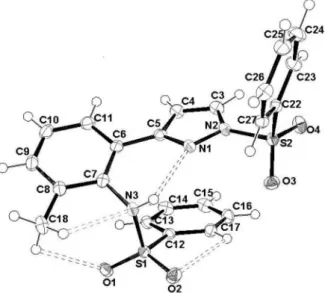
The atom arrangements and atom numbering scheme for molecule 1e are shown in Figure 1. The bond angles
and bond lengths are all in the expected regions. The angle between the best planes through the pyrazole and aminoaryl rings in 1e is 20.53 (0.11), compared to that in the recently published 3-(2’-amino-3’-methylphenyl) pyrazole22 of 12º. A strong intramolecular hydrogen bond, N(3)–H(3)---N(1), is present in 1e, while a series of weak C–H---O intermolecular interactions generate chains and dimers.
In order to correlate the infectivity of parasite and susceptibility to drugs, sulfonamide derivatives were evaluated in different growth stages of Leishmania
amazonensis. Also, the toxicity of those compounds to
the host cell was evaluated and did not show any toxicity in murine macrophage at 320 µg mL-1 of concentration.
Variations in the efficacy of drugs for the treatment of leishmaniasis are frequently a consequence of the immune status of the patient, the pharmacokinetic properties of
the drug and the intrinsic differences in drug sensitivities of each Leishmania species.13 Data from literature report that those different sensitivities occur among species and even in developmental growth stages.24 The life cycle
of Leishmania spp. includes sequential development of
invertebrate-stage promastigotes from a noninfective to an infective stage. Promastigotes obtained during the stationary phase of growth within the fly or culture is more infective for a vertebrate host than during their logarithmic phase. Thus, the putative metacyclics in the stationary phase showed increased infectivity compared with log phase cells.25 Metacyclogenesis consists in a life cycle differentiation process known to occur naturally in the developmental stage of Leishmania parasites.26 During this process, besides the structural modifications, several proteins with functions in protein synthesis, protein metabolism, protein folding and messenger RNA (mRNA) processing are down-regulated25,27 while several other surface macromolecules are over expressed, such as a lipophosphoglycan (LPG) and a protease (GP63), which are related to the infective capacity of those forms.26
L. amazonensis reach the higher amount of metacyclic
forms (about 73%) at the 3rd day of growth, while at 24 h in culture none of those forms are detected, using lysis complement test.28 Based in our data, we can suggest that the highest susceptibility of logarithmic forms would be associated with the lack of metacyclic forms, which are the infective ones.
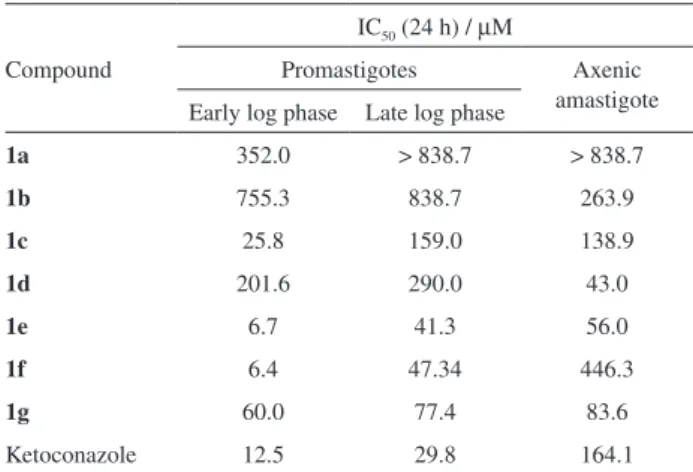
Against axenic amastigotes, only three compounds (1d, 1e and 1g) showed good activity superior to that obtained with ketoconazole. The difference encountered for IC50 values between promastigotes and amastigotes would be explained by the differences in the culture conditions (temperature, pH and fetal calf serum concentration), resulting in low drug availability, since some amount of drug could be linked to the serum albumin. However, we cannot explain the good result obtained for compound 1d, assayed at the same conditions. Alternatively, the overall activity profile of the tested compounds 1 could be compared with the antileishmanial properties shown by previously described sulfonamides.16 Thus, we found that there is significant difference in the antipromastigote activity by addition of the sulfonamide group.
The most active sulfonamide compound against
L. amazonensis promastigotes was the compound 1e. This
compound was also effective against axenic amastigote, as well as compound 1d. Also, the derivatives 1d and 1e showed an activity about 50-52% higher against axenic amastigotes, when compared to ketoconazole. Furthermore, none of the compounds showed toxicity to murine macrophage at 320 µg mL-1 of concentration.
Table 1. Yields of compounds 1a-g
Compounda,b R / R’ Yield / %c
1a 2-CH3 / CH3 82
1b 4-CH3 / CH3 84
1c 4-Cl / CH3 91
1d 4-Br / CH3 88
1e 2-CH3 / H 81
1f 4-Cl / H 84
1g 4-Br / H 89
aIdentified by 1H NMR, 13C NMR, FT-IR and HR-MS; ball compounds were recrystallized from ethanol; cisolated yields.
Conclusions
Our results seem promising since pyrazolyl benzenesulfonamide derivative 1e showed to be active
in vitro against L. amazonensis promastigotes and
axenic amastigotes. Furthermore, the in vitro experiment
with macrophage demonstrated that, in a concentration equivalent to IC50, the compound is not hazardous to the host cells, afact that is a stimulus to continue our studies with this class of compounds.
Experimental
1H and 13C nuclear magnetic resonance (NMR) spectra
were obtained at 300.00 and 75.00 MHz, respectively, on a Varian Unityplus instrument equipped with a 5 mm probe, using tetramethylsilane as the internal standard. Chemical shifts (d) are reported in ppm and coupling constants (J)
in Hz. Samples were dissolved in the solvents specified, CDCl3 or DMSO-d6. Fourier transform infrared (FT-IR) absorption spectra were recorded on a Perkin-Elmer Spectrum One FT-IR spectrophotometer by reflectance in KBr. The experimental analysis of electrospray ionization high-resolution mass spectrometry (ESI/MS) were performed in a high-resolution Micromass apparatus, model Q-TOF. Melting points (m.p.) were determined with a Fisatom model 430 D apparatus.
Preparation of pyrazolyl benzenesulfonamides derivatives (1a-g): 0.9 mmol of 2, 7.0 mL of THF, 200 mg of triethylamine and 2.0 mmol of the sulfonyl chloride were stirred under reflux for 3 hours. Later, the solvent was evaporated and the mixture was dropped in a beaker with ice and water. The formed crystals were recrystallized from ethanol.
4-Methyl-N-(2-methyl-6-{1-[(4-methylphenyl)sulfonyl]-1H -pyrazol-3-yl}phenyl)benzenesulfonamide, 1a: R = 2-CH3;
R’ = CH3
m.p.: 149 ºC; FT-IR (KBr) νmax/cm-1: 3275.8, 1335.9, 1163.7, 1595.3, 1524.8, 1380.4, 1304.3, 1115.4, 1089.9, 1036.1; 1H NMR (CDCl
3, 300.00 MHz): d 5.87 (d, 1H,
J 2.7 Hz, H4), 7.80 (d, 1H, J 2.7 Hz, H5), 7.02 (d, 1H, J 7.8 Hz, H4’), 7.15 (t, 1H, J 7.8 Hz, H5’), 7.30 (d, 1H, J 7.8 Hz, H6’), 8.00 (dd, 2H, J 8.4, 1.8 Hz, H2’’and H6’’),
6.71 (dd, 2H, J 8.4, 1.8 Hz, H3’’ and H5’’), 7.46 (d, 2H, J 8.1 Hz, H2’’’ and H6’’’), 6.78 (d, 2H, J 8.1 Hz, H3’’’ and
H5’’’), 2.66 (s, 3H, CH3), 2.46 (s, 3H, CH3), 2.26 (s, 3H, CH3), 8.79 (s, 1H, NH); 13C NMR (CDCl3, 75.00 MHz): d 154.9 (C3), 106.6 (C4), 132.3 (C5), 132.4 (C1’), 139.6 (C2’), 127.5 (C3’), 126.9 (C4’), 126.3 (C5’), 128.3 (C6’), 146.5 (C1’’), 130.3 (C2’’ and C6’’), 126.7 (C3’’ and C5’’), 133.2 (C4’’), 142.6 (C1’’’), 128.4 (C2’’’ and C6’’’), 126.2 (C3’’’ and C5’’’), 134.4 (C4’’’), 21.6 (CH3), 21.2 (CH3), 19.7 (CH3); ESI-HRMS (M + H+) calcd.: 482.5972; found: 482.1410.
4-Methyl-N-(4-methyl-2-{1-[(4-methylphenyl)sulfonyl]-1H -pyrazol-3-yl}phenyl)benzenesulfonamide, 1b: R = 4-Me; R’ = CH3
m.p.: 163 ºC; FT-IR (KBr) νmax/cm-1: 3144.0, 1339.5, 1161.1, 1594.8, 1520.8, 1506.8, 1455.3, 1400.1, 1382.6, 1319.1; 1H NMR (CDCl
3, 300.00 MHz): d 6.50 (d, 1H,
J 2.8 Hz, H4), 8.08 (d, 1H, J 2.8 Hz, H5), 7.58 (d, 1H, J 8.3 Hz, H3’) 7.07 (dd, 1H, J 8.3, 2.0 Hz, H4’), 7.19 (d, 1H, J 2.0 Hz, H6’), 8.08 (dd, 1H, J 8.6, 1.8 Hz, H2’’ and H6’’),
7.36 (dd, 2H, J 8.6, 1.8 Hz, H3’’ and H5’’), 7.45 (dd, 2H, J 8.5, 1.8 Hz, H2’’’ and H6’’’), 6.98 (dd, 2H, J 8.5, 1.8 Hz,
H3’’’ and H5’’’), 2.43 (s, 3H, CH3), 2.27 (s, 3H, CH3), 2.26 (s, 3H, CH3), 10.11 (s, 1H, NH); 13C NMR (CDCl3, 75.00 MHz): d 155.3 (C3), 106.4 (C4), 131.1 (C5), 119.7 (C1’), 130.6 (C2’), 121.4 (C3’), 128.9 (C4’), 132.9 (C5’), 133.6 (C6’), 143.0 (C1’’), 130.4 (C2’’ and C6’’), 128.6 (C3’’ and C5’’), 136.0 (C4’’), 146.4 (C1’’’), 128.9 (C2’’’ and C6’’’), 126.9 (C3’’’ and C5’’’), 21.6 (CH3), 21.1 (CH3), 20.5 (CH3); ESI-HRMS (M + H+) calcd.: 482.5972; found: 482.0807.
N-(4-Chloro-2-{1-[(4-methylphenyl)sulfonyl]-1H -pyrazol-3-yl}phenyl)-4-methylbenzenesulfonamide, 1c: R = 4-Cl; R’ = CH3
m.p.: 144 ºC; FT-IR (KBr) νmax/cm-1: 3143.4, 1341.2, 1165.7, 1595.2, 1516.9, 1493.5, 1466.4, 1384.6, 1314.6, 1089.0; 1H NMR (CDCl
3, 300.00 MHz): d 6.52 (d, 1H,
J 2.7 Hz, H4), 8.12 (d, 1H, J 2.7 Hz, H5), 7.65 (d, 1H, J 9.0 Hz, H3’) 7.22 (dd, 1H, J 9.0, 2.4 Hz, H4’), 7.38
(d, 1H, J 2.4 Hz, H6’), 8.08 (d, 2H, J 8.1 Hz, H2’’ and
H6’’), 7.40 (d, 2H, J 8.1 Hz, H3’’ and H5’’), 7.46 (d, 2H, J 8.1 Hz, H2’’’ and H6’’’), 7.03 (d, 2H, J 8.1 Hz, H3’’’ and
Table 2. IC50 (compound concentration required to kill parasites by 50% ± standard deviation) of pyrazolyl benzenesulphonamide compounds against L. amazonensis. All assays were performed three times, in triplicate
Compound
IC50 (24 h) / µM
Promastigotes Axenic amastigote Early log phase Late log phase
1a 352.0 > 838.7 > 838.7
1b 755.3 838.7 263.9
1c 25.8 159.0 138.9
1d 201.6 290.0 43.0
1e 6.7 41.3 56.0
1f 6.4 47.34 446.3
1g 60.0 77.4 83.6
H5’’’), 2.44 (s, 3H, CH3), 2.29 (s, 3H, CH3), 10.27 (s, 1H, NH); 13C NMR (CDCl
3, 75.00 MHz): d 153.9 (C3), 106.4 (C4), 134.6 (C5), 122.4 (C1’), 135.8 (C2’), 126.9 (C3’), 129.2 (C4’), 121.2 (C5’), 131.4 (C6’), 146.7 (C1’’), 131.4 (C2’’ and C6’’), 130.5 (C3’’ and C5’’), 116.6 (C4’’), 143.4 (C1’’’), 130.7 (C2’’’ and C6’’’), 128.5 (C3’’’ and C5’’’), 132.7 (C4’’’), 21.6 (CH3), 21.3 (CH3); ESI-HRMS (M + H+) calcd.: 503.0154; found: 503.0162.
N-(4-Bromo-2-{1-[(4-methylphenyl)sulfonyl]-1H -pyrazol-3-yl}phenyl)-4-methylbenzenesulfonamide, 1d: R = 4-Br; R’ = CH3
m.p.: 128 ºC; FT-IR (KBr) νmax/cm-1: 3143.2, 1340.3, 1164.0, 1594.6, 1517.7, 1492.5, 1386.7, 1314.7, 1088.6; 1H NMR (CDCl
3, 300.00 MHz): d 6.53 (d, 1H, J 2.7 Hz, H4), 8,13 (d, 1H, J 2.7 Hz, H5), 7.59 (d, 1H, J 8.7 Hz, H3’), 7.35
(dd, 1H, J 8.7, 2.4 Hz, H4’), 7.53 (d, 1H, J 2.4 Hz, H6’), 8.08
(d, 2H, J 8.4 Hz, H2’’ and H6’’), 7.42 (d, 2H, J 8.4 Hz, H3’’
and H5’’), 7.46 (d, 2H, J 8.1 Hz, H2’’’ and H6’’’), 7.04 (d,
2H, J 8.1 Hz, H3’’’ and H5’’’), 2.44 (s, 3H, CH3), 2.30 (s, 3H, CH3), 10.29 (s, 1H, NH); 13C NMR (CDCl3, 75.00 MHz): d 154.0 (C3), 106.3 (C4), 134.1 (C5), 121.0 (C1’), 135.8 (C2’), 122.3 (C3’), 129.2 (C4’), 127.8 (C5’), 131.4 (C6’), 143.6 (C1’’), 130.5 (C2’’ and C6’’), 129.1 (C3’’ and C5’’), 132.7 (C4’’), 146.7 (C1’’’), 129.6 (C2’’’ and C6’’’), 126.9 (C3’’’ and C5’’’), 21.6 (CH3), 21.3 (CH3); ESI-HRMS (M + H+) calcd.: 547.4667; found: 547.4677.
N-{2-Methyl-6-[1-(phenylsulfonyl)-1H-pyrazol-3-yl]phenyl} benzenesulfonamide, 1e: R = 2-Me; R’ = H
m.p.: 138 ºC; FT-IR (KBr) νmax/cm-1: 3146.5, 1344.9, 1170.9, 1584.2, 1524.1, 1481.3, 1449.2, 1427.6, 1386.1, 1092.2; 1H NMR (CDCl
3, 300.00 MHz): d 5.88 (d, 1H,
J 3.0 Hz, H4), 7.80 (d, 1H, J 3.0 Hz, H5), 7.05-7.01 (m,
1H, H4’), 7.17 (t, 1H, J 7.8 Hz, H5’), 7.32 (d, 1H, J 7.8 Hz,
H6’), 8.15-8.12 (m, 2H, H2’’ and H6’’), 6.99-6.96 (m, 3H, H3’’, H4’’ and H5’’), 7.76-7.66 (m, 2H, H2’’’ and H6’’’), 6.84-6.80 (m, 3H, H3’’’, H4’’’ and H5’’’), 2.67 (s, 3H, CH3), 8.85 (s, 1H, CH3); 13C NMR (CDCl3, 75.00 MHz): d 155.0 (C3), 106.9 (C4), 135.0 (C5), 127.9 (C1’), 139.6 (C2’), 132.4 (C3’), 126.7 (C4’), 126.3 (C5’), 128.2 (C6’), 137.2 (C1’’), 131.8 (C2’’ and C6’’), 129.7 (C3’’ and C5’’), 127.0 (C4’’), 136.3 (C1’’’), 132.2 (C2’’’ and C6’’’), 130.7 (C3’’’ and C5’’’), 127.4 (C4’’’), 19.7 (CH3); ESI-HRMS (M + H+) calcd.: 454.5440; found: 454.0550.
N-{4-Chloro-2-[1-(phenylsulfonyl)-1H-pyrazol-3-yl]phenyl} benzenesulfonamide, 1f: R = 4-Cl; R’ = H
m.p.: 154 ºC; FT-IR (KBr) νmax/cm-1: 3134.1, 1336.0, 1166.8, 1584.2, 1524.8, 1497.0, 1449.2, 1397.4, 1091.3; 1H NMR (CDCl
3, 300.00 MHz): d 6.51 (d, 1H, J 3.0 Hz,
H4), 8.13 (d, 1H, J 3.0 Hz, H5), 7.85 (d, 1H, J 8.4 Hz, H3’),
7.24 (dd, 1H, J 8.4, 1.5 Hz, H4’), 7.41 (d, 1H, J 1.5 Hz,
H6’), 8.22-8.18 (m, 2H, H2’’ and H6’’), 7.50-7.44 (m, 3H, H3’’, H4’’ and H5’’), 7.75-7.59 (m, 2H, H2’’’ and H6’’’), 7.50-7.44 (m, 3H, H3’’’, H4’’’ and H5’’’), 10.25 (s, 1H, NH); 13C NMR (CDCl
3, 75.00 MHz): d 154.1 (C3), 106.6 (C4), 135.2 (C5), 121.2 (C1’), 138.7 (C2’), 122.8 (C3’), 129.9 (C4’), 126.8 (C5’), 132.6 (C6’), 135.8 (C1’’), 132.6 (C2’’ and C6’’), 131.4 (C3’’ and C5’’), 127.9 (C4’’), 136.7 (C1’’’), 133.5 (C2’’’ and C6’’’), 131.6 (C3’’’ and C5’’’), 128.7 (C4’’’); ESI-HRMS (M + H+) calcd.: 474.9622; found: 474.9761.
N-{4-Bromo-2-[1-(phenylsulfonyl)-1H-pyrazol-3-yl]phenyl} benzenesulfonamide, 1g: R = 4-Br; R’ = H
m.p.: 156 ºC; FT-IR (KBr) νmax/cm-1: 3133.1, 1335.2, 1164.0, 1583.8, 1525.1, 1493.9, 1448.8, 1379.2, 1090.8; 1H NMR (CDCl
3, 300.00 MHz): d 6.52 (d, 1H, J 3.0 Hz, H4), 8.13 (d, 1H, J 3.0 Hz, H5), 7.60 (d, 1H, J 8.4 Hz, H3’),
7.40-7.37 (m, 1H, H4’), 7.53 (d, 1H, J 2.4 Hz, H6’),
8.22-8.19 (m, 2H, H2’’ and H6’’), 7.52-7.48 (m, 3H, H3’’, H4’’ and H5’’), 7.74-7.68 (m, 2H, H2’’’ and H6’’’), 7.26-7.24 (m, 3H, H3’’’, H4’’’ and H5’’’), 10.29 (s, 1H, NH); 13C NMR (CDCl3, 75.00 MHz): d 154.0 (C3), 106.6 (C4), 135.1 (C5), 116.9 (C1’), 138.5 (C2’), 122.8 (C3’), 129.8 (C4’), 121.4 (C5’), 132.6 (C6’), 134.4 (C1’’), 132.6 (C2’’ and C6’’), 130.8 (C3’’ and C5’’), 126.8 (C4’’), 135.8 (C1’’’), 132.7 (C2’’’ and C6’’’), 131.6 (C3’’’ and C5’’’), 128.5 (C4’’’); ESI-HRMS (M + H+) calcd.: 519.4135; found: 519.9426.
Biological and cytotoxity assays
Parasites
Promastigotes (early log/24 h and late log/72 h growth phases) of L. amazonensis (MHOM/BR/77/LTB0016
strain), were grown at 26 °C in Schneider’s medium at pH 7.2 supplemented with 10% (v/v) heat-inactivated fetal calf serum (FCS), 100 UI mL-1 penicillin, 100 µg mL-1 streptomycin and 1 mmol L-1 L-glutamine. Promastigote metacyclogenesis rate from early to late logarithmic growth curve was evaluated through complement lysis
test. L. amazonensis axenic amastigotes were cultured at
32 ºC in Schneider’s insect medium pH 5.5 supplemented with 20% (v/v) FCS, 0.5 mmol L-1 Hepes, 60 UI mL1 and 60 µg mL1 streptomycin.28
Drug assay
cultures for screening, in a concentration range from 320 to 0.15 µg mL-1 solubilized in dimethyl sulfoxide (DMSO) and the final concentration of the solvent in the experiments never exceeding 1.6%, considered not hazardous for the parasite.29 Ketoconazole (Sigma-Aldrich) was used as reference drug. After 24 h of incubation at specific temperatures (26 oC for promastigotes and 32 oC for axenic amastigotes), the number of surviving parasites was counted in Neubauer’s chamber and the percentage of growth inhibition was calculated comparing to the controls (parasites without drug). The IC50/24 h values were calculated by Origin 5.0 software (Microcal Software, Inc.) with a specific toolbox for estimating curves.
Cytotoxic assay
The cytotoxic effect of the pyrazolyl benzenesulfonamide compounds was assayed on mice peritoneal macrophages. The cells were isolated from peritoneal cavity of BALB/c mice with cold Roswell Park Memorial Institute (RPMI) 1640 medium, supplemented with 1 mmol L-1 L-glutamine, 1 mol L-1 HEPES, penicillin G (105 IU L-1) and streptomycin sulfate (0.10 g L-1). The 2 × 10⁶ cells per well were cultivated on microplate and incubated at 37 °C in a humidified 5% CO2 atmosphere. After 2 h of incubation, no adherent cells were removed and the adhered macrophages were washed twice with RPMI. Compounds were added to the cell culture at concentration of the respective IC50/24 h for axenic amastigotes of L. amazonensis and incubated for 48 h. After that, 3-[4,5-dimethylthiazol-2-yl]-2,5-diphenyl-tetrazolium bromide (MTT) was added and after 2 h the reaction was interrupted with DMSO.30 The results were read in a MicroQuant spectrophotometer (Biotek-Instrument Inc., Winooski, VT) at a wavelength of 570 nm.
Statistical analyses
Each experiment was done three to four times, in triplicate. Significance was determined using a non-paired Student t-test and Mann-Whitney analyses. Differences
were considered to be significant when p < 0.05.
Crystallography
Data were obtained at 120(2) K with Mo-Kα radiation by means of the Bruker-Nonius 95mm CCD camera on k-goniostatr of the EPSRC crystallographic service, based at the University of Southampton. Data collection was carried out under the control of the program COLLECT31 and data reduction and unit cell refinement were achieved with the COLLECT31 and DENZO32 programs. Correction for absorption was achieved in each case by a semi-empirical
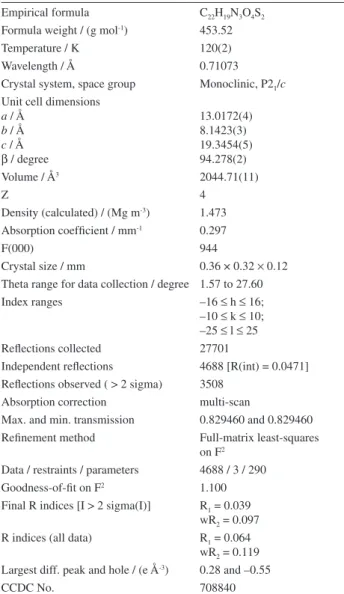
method based upon the variation of equivalent reflections with the program SADABS 2007/2.33 The ORTEP-3 for Windows34 program was used in the preparation of the Figures. SHELXL-9735 and PLATON36 were used in the calculation of molecular geometry. The structures were solved by direct methods using SHELXL-97 and fully refined by means of the program SHELXL-97. Difference map peaks provided positions for the hydrogen atoms of the NH groups for which the coordinates, along with isotropic displacement parameters, were fully refined. All other hydrogen atoms were placed in calculated positions. Crystal data and structure refinement details are listed in Table 3.
Supplementary Information
Supplementary data (FT-IR, 1H NMR, 13C NMR, HR-MS and crystallographic data) are available free of charge at http://jbcs.sbq.org.br as PDF file.
Table 3. Crystal data and structure refinement details Empirical formula C22H19N3O4S2 Formula weight / (g mol-1) 453.52
Temperature / K 120(2)
Wavelength / Å 0.71073
Crystal system, space group Monoclinic, P21/c
Unit cell dimensions
a / Å
b / Å
c / Å
β / degree
13.0172(4) 8.1423(3) 19.3454(5) 94.278(2)
Volume / Å3 2044.71(11)
Z 4
Density (calculated) / (Mg m-3) 1.473 Absorption coefficient / mm-1 0.297
F(000) 944
Crystal size / mm 0.36 × 0.32 × 0.12 Theta range for data collection / degree 1.57 to 27.60 Index ranges –16 ≤ h ≤ 16;
–10 ≤ k ≤ 10; –25 ≤ l ≤ 25 Reflections collected 27701
Independent reflections 4688 [R(int) = 0.0471] Reflections observed ( > 2 sigma) 3508
Absorption correction multi-scan
Max. and min. transmission 0.829460 and 0.829460 Refinement method Full-matrix least-squares
on F2 Data / restraints / parameters 4688 / 3 / 290 Goodness-of-fit on F2 1.100 Final R indices [I > 2 sigma(I)] R1 = 0.039
wR2 = 0.097 R indices (all data) R1 = 0.064
wR2 = 0.119 Largest diff. peak and hole / (e Å-3) 0.28 and –0.55
Acknowledgments
We thank Coordenação de Aperfeiçoamento de Pessoal de Nível Superior (CAPES), Conselho Nacional de Desenvolvimento Científico e Tecnológico (CNPq), Fundação de Amparo à Pesquisa do Estado do Rio de Janeiro (FAPERJ), Pró-Reitoria de Pesquisa, Pós-graduação e Inovação (PROPPi, UFF). The use of the National Crystallographic Service at Southampton, UK and the valuable assistance of the staff there are gratefully acknowledged.
References
1. World Health Organization (WHO); Leishmaniasis: Epidemiology and Access to Medicines - An Update Based on the Outcomes of WHO Regional Meetings, Literature Review and Experts’ Opinion; Geneva, 2012. Available at http://www.
who.int/leishmaniasis/resources/leishmaniasis_epidemiology_ access_to_medicine/en/, accessed in March, 2014.
2. Alvar, J.; Vélez, I. D.; Bern, C.; Herrero, M.; Desjeux, P.; Cano, J.; Jannin, J.; den Boer, M.; PLoS One2012, 7, e35671.
3. Singh, N.; Mishra, B. B.; Bajpai, S.; Singh, R. K.; Tiwari, V. K.;
Bioorg. Med. Chem.2014, 22, 18.
4. Croft, S. L.; Olliaro, P.; Clin. Microbiol. Infect. 2011, 17, 1478. 5. Dorlo, T. P. C.; Balasegaram, M.; Beijnen, J. H.; Vries, P. J.;
J. Antimicrob. Chemother. 2012, 67, 2576.
6. Pandley, K.; Singh, D.; Lal, C. S.; Das, V. N. R.; Das, P.;
J. Postgrad. Med.2013, 59, 306.
7. Macedo-Silva, S. T.; Urbina, J. A.; Souza, W.; Rodrigues, J. C.;
PLoS One2013, 8, e83247.
8. Gilman, A. G.; The Pharmacological Basis of Therapeutics,
11th ed.; McGraw Hill: New York, USA, 2006.
9. Abdel-Wahab, B. F.; Abdel-Latif, E.; Mohamed, H. A.; Awad, G. E.; Eur. J. Med. Chem.2012, 52, 263.
10. El-Hawash, S. A.; Badawey, E. A. M.; El-Ashmawey, I. M.;
Eur. J. Med. Chem.2006, 41, 155.
11. Sánchez-Moreno, M.; Gómez-Contreras, F.; Navarro, P.; Marín, C.; Ramírez-Macías, I.; Olmo, F.; Sanz, A. M.; Campayo, L.; Cano, C.; Yunta, M. J. R.; J. Antimicrob. Chemother.2012, 67, 387.
12. Santos, M. S.; Oliveira, M. L. V.; Bernardino, A. M. R.; Léo, R. M.; Amaral, V. F.; Carvalho, F. T.; Leon, L. L.; Canto-Cavalheiro, M. M.; Bioorg. Med. Chem. Lett.2011, 21, 7451.
13. Bernardino, A. M. R.; Gomes, A. O.; Charret, K. S.; Freitas, A. C. C.; Machado, G. M. C.; Canto-Cavalheiro, M. M.; Leon, L. L.; Amaral, V. F.; Eur. J. Med. Chem.2006,41, 80. 14. Charret, K. S.; Lagrota-Cândido, J.; Carvalho-Pinto, C. E.;
Hottz, C. F.; Lira, M. F.; Rodrigues, M. F.; Gomes, A. O.; Bernardino, A. M.; Canto-Cavalheiro, M. M.; Leon, L. L.; Amaral, V. F.; Exp. Parasitol. 2013, 133, 201.
15. Santos, M. S.; Gomes, A. O.; Bernardino, A. M. R.; Souza, M. C.; Khan, M. A.; Brito, M. A.; Castro, H. C.; Abreu, P. A.; Rodrigues, C. R.; Léo, R. M. M.; Leon, L. L.; Canto-Cavalheiro, M. M.; J. Braz. Chem. Soc. 2011, 22, 352.
16. Marra, R. K. F.; Bernardino, A. M. R.; Proux, T. A.; Charret, K. S.; Lira, M. F.; Castro, H. C.; Souza, A. M.; Oliveira, C. D.; Borges, J. C.; Rodrigues, C. R.; Canto-Cavalheiro, M. M.; Leon, L. L.; Amaral, V. F.; Molecules2012, 17, 12961.
17. Kamal, A.; Swapna, P.; Shetti, R. V. C. R. N. C.; Shaik, A. B.; Rao, M. P. N.; Gupta, S.; Eur. J. Med. Chem. 2013, 62, 661.
18. Chandna, N.; Kumar, S.; Kaushik, P.; Kaushik, D.; Roy, S. K.; Gupta, G. K.; Jachak, S. M.; Kapoor, J. K.; Sharma, P. K.;
Bioorg. Med. Chem. 2013, 21, 4581.
19. Luo, Y.; Li, Y.; Qiu, K.; Lu, X.; Fu, J.; Zhu, H.; Bioorg. Med. Chem. 2011, 19, 6069.
20. Price, C. C.; Roberts, R. M.; J. Am. Chem. Soc. 1946, 68, 1204.
21. Mitscher, L. A.; Chem. Rev.2005, 105, 559.
22. Borges, J. C.; Oliveira, C. D.; Pinheiro, L. C. S.; Marra, R. K. F.; Khan, M. A.; Wardell, J. L.; Wardell, S. M. S. V.; Bernardino, A. M. R.; J. Braz. Chem. Soc. 2007, 18, 1571.
23. Shriner, R. L.; Fuson, R. C.; Cutin, D. Y.; Identificação Sistemática dos Compostos Orgânicos, 6ª ed.; Guanabara Dois:
Rio de Janeiro, Brasil, 1983.
24. Silva, E. F.; Canto-Cavalheiro, M. M.; Braz, V. R.; Cysne-Finkelstein, L.; Leon, L. L.; Echevarria, A.; Eur. J. Med. Chem.
2002, 37, 79.
25. Bates, P. A.; Tetley, L.; Exp. Parasitol.1993, 76, 412. 26. Sacks, D. L.; Perkins, P. V.; Am. J. Trop. Med. Hyg.1985, 34,
456.
27. Mojtahedi, Z.; Clos, J.; Kamali-Sarvestani, E.; Exp. Parasitol.
2008, 119, 422.
28. Cysne-Finkelstein, L.; Temporal, R. M.; Alves, F. A.; Leon, L. L.; Exp. Parasitol. 1998, 89, 58.
29. Canto-Cavalheiro, M. M.; Echevarria, A.; Araújo, C. A.; Bravo, M. F.; Santos, L. H.; Jansen, A. M.; Leon, L. L.; Microbios1997,
90, 51.
30. Denzinot, F.; Lang, R.; J. Immunol. Methods1986, 89, 271. 31. Hooft, R. W. W.; COLLECT; Nonius B. V.: Delft, The
Netherlands, 1998.
32. Otwinowski, Z.; Minor, W. In Macromolecular Crystallography in Methods in Enzymology; Carter, C. W.; Sweet Jr., R. M., eds.; Academic Press: New York, USA, 1997, vol. 276, part A. 33. Sheldrick, G. M.; SADABS Version 2007/2; Bruker AXS Inc.:
Madison, Wisconsin, USA, 2007.
34. Farrugia, L. J.; J. Appl. Crystallogr. 1997, 30, 565.
35. Sheldrick, G. M.; Acta Crystallogr., Sect. A: Found. Crystallogr.
2008, 64, 112.
36. Spek, A. L.; J. Appl. Crystallogr.2003, 36, 7.