Early postnatal hospital discharge:
the consequences of reducing length
of stay for women and newborns
*ALTA PÓS-PARTO PRECOCE: AS CONSEQUÊNCIAS DA REDUÇÃO DO TEMPO DE HOSPITALIZAÇÃO PARA MULHERES E RECÉM-NASCIDOS
ALTA POSTPARTO PRECOZ: LAS CONSECUENCIAS DE LA REDUCCIÓN DEL TIEMPO DE HOSPITALIZACIÓN PARA MUJERES Y RECIÉN NACIDOS
RESUMO
O objetivo deste estudo é examinar a lite-ratura e identificar os resultados mais rele-vantes da alta precoce pós-parto para as mulheres, recém-nascidos e o sistema de saúde. Uma estratégia de busca eletrônica foi projetada, incluindo as seguintes fontes: Web of Science, Scopus, ProQuest e PubMed/MEDLINE utilizando-se os seguin-tes termos: (precoce e alta hospitalar), ou (duração e permanência) e (pós-parto ou pós-natal) e (efeito de resultado ou * ou resultado). A análise de conteúdo foi utili-zada para identificar e sintetizar os resulta-dos e os métoresulta-dos resulta-dos trabalhos de investi-gação. A evidência disponível não é sufici-ente para rejeitar ou apoiar a prática da alta precoce no pós-parto porque os estudos apresentaram resultados diferentes para as mulheres e os recém-nascidos. A necessi-dade de realizar estudos clínicos, de forma sistemática, é discutida.
DESCRITORES
Alta do paciente Período pós-parto Mulheres Recém-nascido Avaliação de resultados
* Extracted from the part of the research Project “Innovative modality of assistance in childbirth: birth family for women in low-risk obstetric public system”, School of Nursing, Pontificia Universidad Católica, Funded by Fondo de Fomento al Desarrollo Científico y Tecnológico. 1 Nurse. PhD Student. Department of Primary
Care and Public Health, School of Medicine, Cardiff University, UK. Instructor Department of Woman’s Health, School of Nursing, Pontificia Universidad Católica de Chile. Santiago, Chile. [email protected] 2 Nurse midwife. Master in Humanization in Health. Associate Professor Department of Woman’s Health, School
of Nursing, Pontificia Universidad Católicade de Chile. Santiago, Chile. [email protected] 3 Nurse midwife. Master in Social Psychology. Associate Professor
A
R
TIGO
DE
R
EVISÃO
Paulina Bravo1, Claudia Uribe2, Aixa Contreras3
ABSTRACT
The objective of this study is to examine the literature and identify most salient out-comes of early postnatal discharge for women, newborns and the health system. An electronic search strategy was designed including the following sources: Web of Sci-ence, Scopus, ProQuest and PubMed/ MEDLINE, using the following terms: (early AND discharge) OR (length AND stay) AND (postpartum OR postnatal) AND (effect* OR result OR outcome). Content analysis was used to identify and summarise the find-ings and methods of the research papers. The evidence available is not enough to ei-ther reject or support the practice of early postnatal discharge; different studies have reported different outcomes for women and newborns. The need of systematic clini-cal research is discussed.
DESCRIPTORS
Patient discharge Postpartum period Women. Infant, newborn Outcome assessment
RESUMEN
Este estudio objetivó examinar la literatu-ra e identificar los resultados más relevan-tes del alta precoz postparto para las muje-res, recién nacidos y el sistema de salud. Una estrategia de búsqueda electrónica fue proyectada, incluyendo las siguientes fuen-tes: Web of Science, Scopus, ProQuest y PubMed/MEDLINE utilizando los siguientes términos: (precoz y alta hospitalaria), o (du-ración y permanencia) y (postparto o post-natal) y (efecto de resultado o resultado). El análisis de contenido fue utilizado para identificar y sintetizar los resultados y los métodos de los trabajos de investigación. La evidencia disponible no es suficiente para rechazar o apoyar la práctica del alta precoz en el postparto porque los estudios presentaron resultados diferentes para las mujeres y los recién nacidos. La necesidad de realizar estudios clínicos, de forma sis-temática. es discutida
DESCRIPTORES
Alta del paciente Periodo de posparto Mujeres
Recién nacido
INTRODUCTION
Postnatal hospital stay has two main objectives; the first, to identify any complication for both mother and newborn and the second, to provide the necessary support to the new mother for her return home(1). During the last 60 years
there has been a worldwide tendency to reduce the length of time women stay in the hospital after giving birth. In 1992, the American Academy of Pediatrics and the American Col-lege of Obstetricians and Gynecologists defined early post-natal discharge (ED) as a stay of less than 48hrs for women who had vaginal deliveries and less than 96hrs those who had cesarean sections(2). The two main reasons for this
change in the service provided are to improve women’s satisfaction during this period and to reduce the cost to the health system(3).
Despite the efforts of several researchers around the world systematically assessing and evaluating the effects of this new service on women and newborns(1,4-9), there is
still uncertainty about what the pros and cons of the shorter hospital postnatal stay are. In the context of a pioneer Chil-ean project which aims to develop an innovative modality of childbirth, including a reduction in the length of postna-tal stay, we aimed to review the literature available and to examine the advantages and disadvantages of early post-natal discharge for both the healthy mother and child and the consequent repercussions for the health system which should be considered when proposing a reduction in the length of stay after childbirth.
METHOD
A search strategy was designed to identify publications which described outcomes of early postnatal discharge for both healthy women and newborns and the health services. The search strategy included electronic searches of the
fol-lowing sources: Web of Science, Scopus, ProQuest and PubMed/MEDLINE. The following terms were used: (early AND discharge) OR (length AND stay) AND (postpartum OR postnatal) AND (effect* OR result OR outcome). All lan-guages were included; using articles from 2000 to 2010. The search was conducted from January to March 2010. Articles were included if they described the effects of early postnatal discharge on healthy women and newborns and health system implications. All types of research method-ology were considered eligible. Literature review articles were excluded, however their references were assessed. All titles available were first evaluated for relevance by one author (PB); in a second step, article abstracts were scruti-nized to assess suitability for inclusion, according to the aim of this review. Included articles were studied for relevance and content. Data was extracted under the following head-ings: research identification (authors, year of publication, country of study sample, and study population), research methods and the principal findings. The data for analysis were the study methods, findings and conclusions. Follow-ing a content analysis method, the authors analyzed these data to identify the consistent and most salient codes, ex-planations and relationships throughout the studies.
RESULTS
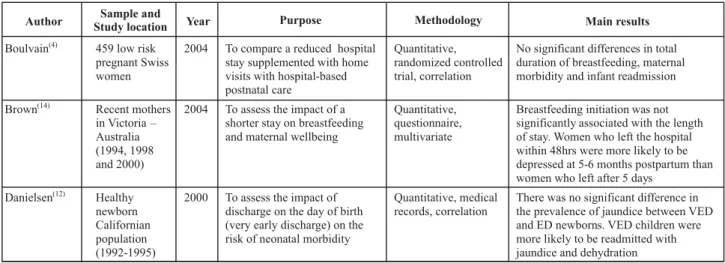
A total of 340 citations were retrieved, and 289 articles were removed after title scanning. Fifty one abstracts were read and, after assessment, 36 full articles were subjected to detailed assessment. Twenty one of these 36 were re-moved because of lack of relevance or due to not being first author articles. This review finally included 15 articles for full data extraction and analysis. All the included stud-ies used quantitative methods; five out of the 15 were ran-domized controlled trials. All the studies included low risk pregnant women and/or their healthy child for analysis pur-poses. Detailed descriptions are given in Table 1.
Table 1 - Summary of the studies which described outcomes of a short postpartum hospital stay
Author Study locationSample and Year Purpose Methodology Main results
Boulvain(4) 459 low risk
pregnant Swiss women
2004 To compare a reduced hospital
stay supplemented with home visits with hospital-based postnatal care
Quantitative, randomized controlled trial, correlation
No significant differences in total duration of breastfeeding, maternal morbidity and infant readmission
Brown(14) Recent mothers
in Victoria – Australia (1994, 1998 and 2000)
2004 To assess the impact of a
shorter stay on breastfeeding and maternal wellbeing
Quantitative, questionnaire, multivariate
Breastfeeding initiation was not significantly associated with the length of stay. Women who left the hospital within 48hrs were more likely to be depressed at 5-6 months postpartum than women who left after 5 days
Danielsen(12) Healthy
newborn Californian population (1992-1995)
2000 To assess the impact of
discharge on the day of birth (very early discharge) on the risk of neonatal morbidity
Quantitative, medical records, correlation
There was no significant difference in the prevalence of jaundice between VED and ED newborns. VED children were more likely to be readmitted with jaundice and dehydration
...Continuation
Author Study locationSample and Year Purpose Methodology Main results
Gözüm(15) 112 recent
Turkish mothers
2005 To determine the women’s
problems after an early postnatal discharge
Quantitative, structured interview, descriptive
The most salient problems experienced for early discharged women were fatigue, constipation, insomnia and breast problems. Nearly 42% of the women used health services due to their problems
Gupta(16) 1134 healthy
Indian newborns
2006 To assess the frequency and
causes of rehospitalization following ED
Quantitative, multivariate
In ED newborns the conditions likely to result in rehospitalization were jaundice, dehydration and feeding problems
Heck(17) 10,519 recent
Californian mothers
2003 To examine the association
between length of postpartum stay and breastfeeding cessation
Quantitative, survey, correlation
The length of stay (less than 1 night and more than 3 nights) was a significant predictor of breastfeeding cessation
Jackson(10) 7,021
American newborns from low risk pregnancies
2000 To study the frequency, time of
identification and types of problems of the newborns in order to evaluate the feasibility of ED
Quantitative, datasheet, prospective
8% of the infants delivered from low-risk pregnancies developed medical problems. The majority of newborn complications were identified between 5 and 24hrs postnatal
Madden(18) 20,366
American mother-child pairs
2003 To evaluate the effects of a ED
program on breastfeeding rates
Quantitative, medical records, correlation
The length of stay had no effect on breastfeeding
Malkin(13) Records of
American newborns (1989-1990)
2000 To assess the risk of newborn
mortality associated to ED (less than 24hrs)
Quantitative, medical records, regression
There was a significant positive association between ED and newborn mortality
McKeever(5) 101 Canadian
mother-newborn pairs
2002 To compare the effects of
routine hospital care and discharge with the effects of routine hospital care plus ED and domicile care support
Quantitative, randomized controlled trial, correlation
ED women presented significant higher rates of breastfeeding. Most of the women were satisfied with their care
Petrou(6) 459 Swiss
pregnant women without complications
2004 To compare the cost
effectiveness of ED and home midwifery support with a traditional postnatal hospital stay
Quantitative, randomized controlled trial, correlation
No significant difference between the groups in clinical and psychosocial outcomes. The proposed service was significantly cheaper
Saiz-Bueno(1) 430 Spanish
pregnant women
2005 To evaluate the advantages and
disadvantages of an ED program with domiciliary follow-up compared with traditional postpartum care
Quantitative, randomized controlled trial, correlation
No significant differences in maternal and neonatal pathology. Breastfeeding was higher at 3 months for the ED group. Most of the women were satisfied with the ED care
Waldenström(19) 3,293 Swedish
pregnant women
2004 To investigate the association
between length of stay and duration of breastfeeding and breastfeeding problems
Quantitative, questionnaire, multivariate
Early discharged women were more satisfied with the initiation of breastfeeding. There was no association between length of stay and breastfeeding problems or duration
Wall(11) 1442 American
newborns
2003 To examine the impact of ED
on newborn metabolic screening
Quantitative, medical records, descriptive
Newborn metabolic screening was not affected by the length of stay
Winterburn(7) 255 British
Pregnant women
2000 To examine the effects of
length of stay on breastfeeding rates at one month postpartum
Quantitative, randomized controlled trial, correlation
No significant difference on breastfeeding rates between early and late discharge
The effects of ED on infants
One of the major concerns about the ED program con-cerns the safety of newborns. Almost 50% of the included articles reported findings regarding this topic. A prospec-tive observational study(10) which aimed to identify and
characterize the main problems of neonates, noted that only 8% of the newborns delivered from low-risk
Although there is no conclusive evidence that proves infants discharged early have an increased risk of morbid-ity(1), in 2000 a medical records analysis suggested that
chil-dren who were discharged on the day of birth are more likely to be re-hospitalized with jaundice (p=0.01), however no difference was described in the prevalence of jaundice; also dehydration was higher in ED newborns (p=0.01) com-pared with those who were discharged later(12).
Further-more, one study(4) noted that infants who were discharged
early were more likely to be readmitted during the first six months postnatal compared with newborns discharged later (p= 0,004), nevertheless, the rate of neonate rehospi-talization during the first month postpartum was not sig-nificantly different among the groups. A retrospective study, which included the medical records of American infants(13),
found a significant positive association between a postpar-tum discharge within 24hrs and newborn mortality at 28 days of birth (OR 3.65, 95% CI 1.56, 8.54). However, the authors did not mention whether or not the infants received follow-up care after discharge.
One study in India(16), with 861 early discharged infants,
showed that 8.3% of them needed to be readmitted, with the three most common conditions being jaundice, dehy-dration or feeding difficulties, however no significant differ-ence was found when comparing with those discharged later.
The effects of ED on breastfeeding
Breastfeeding has been recognized as a key factor to en-sure the health and nutrition for newborns(20), therefore the
potential impact of the ED program on this was studied in 60% of the included articles. In a randomized controlled trial undertaken in Switzerland, which aimed to compare a reduced hospital stay supplemented with home visits and hospital-based postnatal care(4), no significant difference between the
groups was found when assessing breastfeeding initiation and duration. These results concur with the medical record analy-sis carried out in the USA(18). In terms of satisfaction with
breastfeeding initiation one study(19) noted that women
dis-charged early were significantly more satisfied (p=0.05). In an experimental study which compared the effects of routine hospital care with an ED program including home-based fol-low-up care, in a Canadian population(5), the group discharged
early presented higher rates of exclusive breastfeeding com-pared with the routine discharged group over the 12 days of postnatal follow-up (p=0.01); similar results were reported in a Spanish study(1), adding that women discharged early had
significantly higher rates of breastfeeding at 3 months post-partum (p=0.001). In a randomized controlled trial which aimed to examine the effects of postnatal stay on rates of breastfeeding at 1 month(7), there was no significant
differ-ence between the early and late discharge groups.
A study conducted in Australia(14), which assessed the
impact of ED on recent mothers at three time points, con-cluded that there was no association between the length of postpartum stay and breastfeeding initiation; this con-curred with a Swedish study, where no association was
found between early discharge and problems with breast-feeding and duration(19). Conversely, one study(17) with
10,519 American women found that there was an associa-tion between time of discharge and breastfeeding cessa-tion; women who were discharged within the first day and after 3 or more days were more likely to stop breastfeed-ing (relative risk 1.11 and 1.30, respectively), however the reasons remained unclear.
The effects of ED on new mothers
Another focus of concern regarding the results of an ED program is women’s health; 7 out of the 15 included publi-cations investigated this aspect. One study(15) evidenced the
four most prevalent problems for women after ED: almost 90% reported fatigue, 80% insomnia, 71% mentioned breast problems (pain, engorged breast and tenderness) and 61% constipation. Of the women with problems, 42% attended health services seeking help. However, regarding hospital readmission, there was no difference between those dis-charged earlier or later(1,4). Additionally, women who were
discharged within 48hrs after delivery were significantly more likely to be depressed at 5-6 months postpartum(14).
This finding does not concur with the results reported by two European randomized controlled trials, where no sig-nificant differences were found between early discharged and late discharged women(1,4).
A Spanish study(1) concluded that women who were
dis-charged early were more satisfied with the service than those who were in the traditional stay program (90% vs. 61% respectively). Similar results were reported by 97% of the ED Canadian women with home-based follow-up care, who were satisfied with the service and identified as ben-efits the comfort and privacy of being at home sooner and the return to normal family routines. However, 60% con-sidered a longer stay necessary for primiparous mothers who felt unprepared and afraid to return home(5).
The effects of ED on the health system
The consequences of the ED policy for the health sys-tem were described by a few articles. One of the most rel-evant issues for health management is the cost associated with this shorter length of postnatal stay. During a random-ized controlled trial which compared standard discharge with early discharge plus home-based follow-up, the costs of the new, shorter hospitalization were significantly lower without compromising the clinical outcomes of the woman and newborn(6). Similar findings were described when a new
early discharge program (less than 24hrs) with domiciliary follow-up was tested in a Spanish population; in this study the costs were reduced by up to 20%(1).
DISCUSSION
postnatal discharge. Similar findings have been reported in previous reviews(3,21-22). While consensus has not been
reached, a review of the Britain National Institute for Health and Clinical Excellence guidelines, suggested that the ideal postnatal management should incorporate an early dis-charge policy with very well established community follow-up care(23). One difficulty when synthesizing the available
research was that early postnatal discharge has not been consensually practiced. Although the American Academy of Pediatrics in 1992 defined early postnatal discharge as a stay of less than 48hrs for vaginal deliveries and less than 96hrs for caesarean sections(2), different definitions were
found throughout the included studies, some authors con-sidered ED specifically as the first 24hrs after delivery, oth-ers were more divoth-erse, including stays as long as 48hrs. Secondly, in terms of care policies after discharge, the stud-ies showed different follow-up services, with some dyads receiving programmed domicile-based care and some hos-pital-based care, while some studies did not describe the type of service available; this might have some effects when comparing the postnatal outcomes. Future research should
attempt to describe the effects of the early postnatal dis-charge policy on different follow-up settings, both domi-cile and hospital-based. This could help to understand whether the outcomes currently associated with ED could be controlled when professional support is offered after discharge. Regarding clinical implications, it seems neces-sary to state what would be considered early discharge and how the dyad will be supported after leaving the hospital. It is also believed that all pediatricians, nurse-midwives and obstetricians should continue working in a collaborative way in order to evaluate when the woman and newborn dyad can be discharged early, in order to avoid any undesirable outcome, always taking into consideration the perspectives of the women and their preferences.
CONCLUSION
The evidence available is not enough to either reject or support the practice of early postnatal discharge; different studies have reported different outcomes for women and new-borns. The need of systematic clinical research is discussed.
REFERENCES
1. Sainz-Bueno JA, Romano MR, Teruel RG, Benjumea AG, Palacin AF, Gonzalez CA, et al. Early discharge from obstetrics-pediatrics at the Hospital de Valme, with domiciliary follow-up. Am J Obstetr Gynecol. 2005;193(3):714-26.
2. Galbraith AA, Egerter SA, Marchi KS, Chavez G, Braveman PA. Newborn early discharge revisited: Are California newborns receiving recommended postnatal services? Pediatrics. 2003;111(2):364-71.
3. Grullon KE, Grimes DA. The safety of early postpartum discharge: a review and critique. Obstetr Gynecol. 1997;90(5):861-5.
4. Boulvain M, Perneger TV, Othenin-Girard V, Petrou S, Berner M, Irion O. Home-based versus hospital-based postnatal care: a randomised trial. BJOG. 2004;111(8):807-13.
5. McKeever P, Stevens B, Miller K-L, MacDonell JW, Gibbins S, Guerriere D, et al. Home versus hospital breastfeeding support for newborns: a randomized controlled trial. Birth. 2002;29(4):258-65.
6. Petrou S, Boulvain M, Simon J, Maricot P, Borst F, Perneger T, et al. Home-based care after a shortened hospital stay versus hospital-based care postpartum: an economic evaluation. BJOG. 2004;111(8):800-6.
7. Winterburn S, Fraser R. Does the duration of postnatal stay influence breast-feeding rates at one month in women giving birth for the first time? A randomized control trial. J Adv Nurs. 2000;32(5):1152-7.
8. Escobar GJ, Braveman PA, Ackerson L, Odouli R, Coleman-Phox K, Capra AM, et al. A randomized comparison of home visits and hospital-based group follow-up visits after early postpartum discharge. Pediatrics. 2001;108(3):719-27.
9. Riesco MLG, Oliveira SMJVd, Bonadio IC, Schneck CA, Silva FMBd, Diniz CSG, et al. Centros de Parto no Brasil: revisão da produção científica. Rev Esc Enferm USP. 2009;43(n. esp 2):1297-302.
10. Jackson GL, Kennedy KA, Sendelbach DM, Talley DH, Aldridge CL, Vedro DA, et al. Problem identification in apparently well neonates: implications for early discharge. Clin Pediatr (Phila). 2000;39(10):581-90.
11. Wall TC, Brumfield CG, Cliver SP, Jinrong-Hou BA, Ashworth CS, Norris MJ. Does early discharge with nurse home visits affect adequacy of newborn metabolic screening? J Pediatr. 2003;143(2):213-8.
12. Danielsen B, Castles AG, Damberg CL, Gould JB. Newborn discharge timing and readmissions: California, 1992-1995. Pediatrics. 2000;106(1 Pt 1):31-9.
13. Malkin JD, Garber S, Broder MS, Keeler E. Infant mortality and early postpartum discharge. Obstetr Gynecol. 2000;96(2):183-8.
15. Gözüm S, Kiliç D. Health problems related to early discharge of Turkish women. Midwifery. 2005;21(4):371-8.
16. Gupta P, Malhotra S, Singh D, Dua T. Length of postnatal stay in healthy newborns and re-hospitalization following their early discharge. Indian J Pediatr. 2006;73(10):897-900.
17. Heck KE, Schoendorf KC, Chaìvez GF, Braveman P. Does postpartum length of stay affect breastfeeding duration? A population-based study. Birth. 2003;30(3):153-9.
18. Madden JM, Soumerai SB, Lieu TA, Mandl KD, Zhang F, Ross-Degnan D. Effects on breastfeeding of changes in Maternity Length-of-Stay Policy in a Large Health Maintenance Organi-zation. Pediatrics. 2003;111(3):519-24.
19. Waldenstrom U, Aarts C. Duration of breastfeeding and breastfeeding problems in relation to length of postpartum stay: a longitudinal cohort study of a national Swedish sample. Acta Paediatr. 2004;93(5):669-76.
20. World Health Organization (WHO). Evidence for the ten steps to successful breastfeeding [Internet]. 1998 [cited 2010 Jan 15]. Available from: http://www.who.int/child_adolescent_health/ documents/9241591544/en/index.html
21. Brown S, Small R, Faber B, Krastev A, Davis P. Early postnatal discharge from hospital for healthy mothers and term infants. Cochrane Database System Rev. 2002(3):CD002958.
22. Brumfield CG. Early postpartum discharge. Clin Obstetr Gynecol. 1998;41(3):611-25.
Sellwood M, Huertas-Ceballo A. Review of NICE guidelines on routine postnatal infant care. Arch Dis Child Fetal Neonatal Ed. 2008;93(1):F10-3.