Microbial contamination of procedure gloves
after opening the container and during
exposure in the environment
*CONTAMINAÇÃO MICROBIANA DAS LUVAS DE PROCEDIMENTO APÓS A ABERTURA DA CAIXA E DURANTE SUA EXPOSIÇÃO AMBIENTAL
CONTAMINACIÓN MICROBIANA DE GUANTES DE PROCEDIMIENTO LUEGO DE LA ABERTURA DE LA CAJA Y DURANTE EXPOSICIÓN AMBIENTAL
RESUMO
Este trabalho teve como objetivo quantifi-car as Unidades Formadoras de Colônias (ufc) das luvas de látex para procedimentos no início, meio e fim das caixas na situação real (profissional) e controle (pesquisador) de enluvamento; avaliar a carga microbiana das luvas considerando o tempo de exposição ambiental. Trata-se de um estudo compara-tivo e prospeccompara-tivo realizado em uma unida-de unida-de terapia intensiva unida-de um hospital-esco-la. A coleta das amostras microbiológicas das luvas foi realizada por meio da digito-pres-são. Avaliaram-se microbiologicamente 186 pares de luvas, 93 no grupo controle e 93 na situação real de enluvamento. No grupo con-trole a média de ufc foi de 4,7 e na situação real de enluvamento 6,2, consequentemen-te, não houve diferença estatisticamente sig-nificante (p=.601). Também, as ufc no inicio, meio e fim das caixas não se observou dife-renças significante (p>.05). A cepa Staphylo-coccus spp. foi a mais freqüente. O tempo de exposição ambiental das luvas de látex não determinou aumento de ufc.
DESCRITORES Luvas cirúrgicas
Unidades de Terapia Intensiva Infecção hospitalar
* Extraído da tese “Avaliação da segurança microbiológica das luvas de látex para procedimentos em uma Unidade de Terapia Intensiva”, Escola de Enfermagem de Ribeirão Preto, Universidade de São Paulo, 2007. 1 Enfermeiro. Professor Doutor do Departamento de Enfermagem da Universidade
Federal de Mato Grosso do Sul. Três Lagoas, MS, Brasil. [email protected] 2 Enfermeira. Professora Livre Docente do Departamento de Enfermagem Geral
e Especializada da Escola de Enfermagem de Ribeirão Preto da Universidade de São Paulo. Centro Colaborador da Organização Mundial da Saúde para o Desenvolvimento da Pesquisa em Enfermagem. Ribeirão Preto, SP, Brasil. [email protected] 3 Doutor em Física e Pós-Doutor na Área de Estatística.
A
R
TIGO
O
RIGINAL
Adriano Menis Ferreira1, Denise de Andrade2, Vanderlei José Haas3
ABSTRACT
The objective of this study was to quantify the colony forming units (cfu) on latex pro-cedure gloves in the beginning, middle, and end of the containers in real (professional) and controlled (researcher) gloving situa-tions; evaluate the microbial load of the gloves, considering the time of exposure in the environment. This comparative prospec-tive study was conducted at an intensive care unit of a teaching hospital. The microbiologi-cal data was collected from the gloves using digital-pressure. Microbiological evaluations were performed on 186 pairs of gloves: 93 in the control group and 93 in real gloving situ-ations. In the control group, the average cfu was 4.7 against 6.2 in the real gloving situa-tion. Hence, no statistically significant differ-ence was found (p=.601). In addition, the cfu values of gloves in the beginning, middle and end of the containers also did not show any significant differences (p>.05). The most common strain was Staphylococcus spp. The time of exposure in the environment did not increase the cfu value of the latex gloves. DESCRIPTORS
Gloves, surgical Intensive Care Units Cross infection
RESUMEN
Trabajo que objetivó cuantificar las Unida-des Formadoras de Colonias (UFC) en guan-tes de látex para procedimientos al inicio, mitad y final de las cajas en situación real (profesional) y control (investigador) de uso de guantes: evaluar carga microbiana de guantes considerando tiempo de exposición ambiental. Estudio comparativo prospecti-vo realizado en unidad de terapia intensiva de hospital-escuela. La recolección de muestras microbiológicas de guantes se rea-lizó mediante dígito presión. Se evaluaron microbiológicamente 186 pares de guantes, 93 en grupo control y 93 en situación real de uso. En grupo control, la media de UFC fue de 4,7 y en situación real 6,2. Conse-cuentemente, no hubo diferencia estadísti-camente significativa (p>0,601). Tampoco se observó diferencia significativa de UFC en comienzo, mitad y final de cajas (p>0,05). La cepa Staphylococcus spp. fue la más fre-cuente. El tiempo de exposición ambiental de los guantes de látex no determinó au-mento de UFC.
DESCRIPTORES Guantes quirúrgicos
INTRODUÇÃO
The use of latex gloves is considered an effective re-source for health care workers safety against exposure to body fluids and their use is a practice most easily conducted in everyday practice, and thus avoids contamination to patients, materials, and the environment. Therefore, gloves are recommended in clinical practice in activities involving biological risks, such as venous punctures, intravenous medication administration, managing dressings, insertion of enteral feeding tubes, managing contaminated material such as clothes, and other procedures(1-4).
The wide range of procedures associated with biologi-cal risk and cross-infection are among the factors that have made it difficult to choose the most appropriate glove. For this reason, studies(4-12) about the use of procedure and ster-ile gloves remain contradictory from a microbiological safety viewpoint. In this sense, the indication of wearing procedure gloves in certain activities and preferring them to sterile gloves need further studies. Consequently, there are gaps regarding the microbiological safety of gloves from the beginning to the end of the box.
The hands of healthcare workers can be highly contaminated, especially during rou-tine care procedures when they are exposed to body fluids. In addition to hand hygiene, nonsterile gloves are an important tool in minimizing cross-transmission of microorgan-isms from one patient to another. However, healthcare workers must be aware that nonsterile disposable gloves could be con-taminated with a wide range of bacteria(3). Because bacteria can survive for several
months in the environment and because nonsterile dispos-able gloves are widely used for care procedures involving mucosa(13) and as the Brazilian manufacturing standards for nonsterile gloves only require physical testing, guidelines and quality norms on bacterial contamination of dispos-able gloves are needed.
Little information is available regarding microbial con-tamination of open box gloves before and during use. To our knowledge, this study is the first in Brazil to have in-vestigated the bacterial contamination of nonsterile dis-posable gloves in the hospital setting.
OBJECTIVES
Based on these considerations, this comparative, pro-spective study aimed to quantify Colony Forming Units (cfu) on procedure latex gloves at the beginning, middle and end of boxes in real situation and gloving control, and to evaluate the microbial load of the gloves considering the environment exposure time in an intensive care unit setting.
METHOD
This is a comparative and prospective study, performed at the intensive care unit (ICU) of the Clinics Hospital, the University of São Paulo at Ribeirão Preto College of Medi-cine. The study was approved by the hospital’s Research Ethics Committee protocol 0638/2005.
The gloves used in this study were commercially avail-able EMBRAMAC® powdered disposavail-able gloves latex, rec-ommended for hospital use and packaged in boxes of 100 units. The evaluation was performed using the technique of digit-pressure on Petri dishes with Mueller Hinton (MH) agar. A total of 31 boxes of procedure gloves were em-ployed. The boxes were labeled with the date, time of open-ing, and numbered from 1 to 31. The boxes were kept in counters with openings and disposed in places that were easy to see and access, to ensure that all gloves were ob-tained exclusively from the test-boxes.
The researcher opened the boxes, used for both control group and real health care situations, after performing ad-equate hand disinfection and wearing sterile gloves. This pro-cedure was performed to avoid contamination of the gloves while opening them. Therefore, when collecting control samples (beginning, middle, and end of boxes), the researcher wore sterile gloves under the procedure gloves. The fingertips of each gloved digit was placed on Petri dishes employing light pres-sure. After digit-pressure of the control-situa-tion, the researcher removed the gloves and waited for the moment to collect samples from the gloves used by a health worker (real health care situation). The sample was collected re-specting the demand of health care activities requiring glove use. This helped to preserve the reality of glove use in daily clinical practice. After the health worker gloved his or her hands, they were asked permission to collect the samples by digit-pressure of their right and left hands on separate Petri dishes and in different moments (beginning, middle, and end of boxes). To estimate the cfu on ungloved hands, digit-pressure was performed on nine health workers before they gloved their hands.
After collecting the samples, the Petri dishes (150mm) were stored in a polystyrene box and taken to the microbi-ology lab. The plates were incubated at 35°C for 48 hours under aerobic condition. After incubation each plate was inspected (counted cfu), in a class II microbiological safety cabinet to exclude airborne contamination, using a stereo-scopic microscope under reflected light. The microorgan-ism were then identified following a previously described method(5).
Statistical Package for the Social Science – SPSS 15.0 soft-ware was used to analyze and compare the data. To com-pare CFU numbers, analysis of variance (ANOVA) was used
...there are gaps regarding the microbiological safety of gloves from the beginning
with repeated measures and a same factor (within subject factor). The contamination rate of the gloves according to the different moments and exposure time was analyzed by means of the Cochrane non-parametric test, with level of significance at =0.05. The association between time of box opening and number of cfu, in either the control-situation or real gloving situations, was measured by the Spearman’s rank correlation coefficient (level of significance at =0.05).
Calculating the size of the sample in an analysis of vari-ance (ANOVA) with repeated measures for 6 comparisons is a complex procedure. However, a power analysis was carried out a posteriori and it was observed that, to detect a within-subject effect statistically significant (p = 0.02) in the 6 comparisons done for n = 31 boxes, the observed Power was of 0.728, applying Greenhouse-Geisser correc-tion. Despite this effect, no statistically significant differ-ence was detected applying Bonferroni correction for mul-tiple comparisons.
RESULTS
The bare hands of nine health workers revealed a 100% rate of contamination and a mean of 263 cfu.
A total of 186 pairs of gloves were obtained, 93 from control gloves and 93 from real health care situations, i.e., from the workers’ clinical practice. The contamination rate was 88.2% for the control group and 87.1% in real situa-tions, showing an increase in 1.1%. Of the gloves used in the control-situation, 82 pairs were contaminated, against 81 pairs in the real or routine situation. The mean colony density was 4.7 (SD 4.1) in the control group, and 6.2 (SD 4.9) in the real situation group, showing an average increase of 4.95 colonies per box.
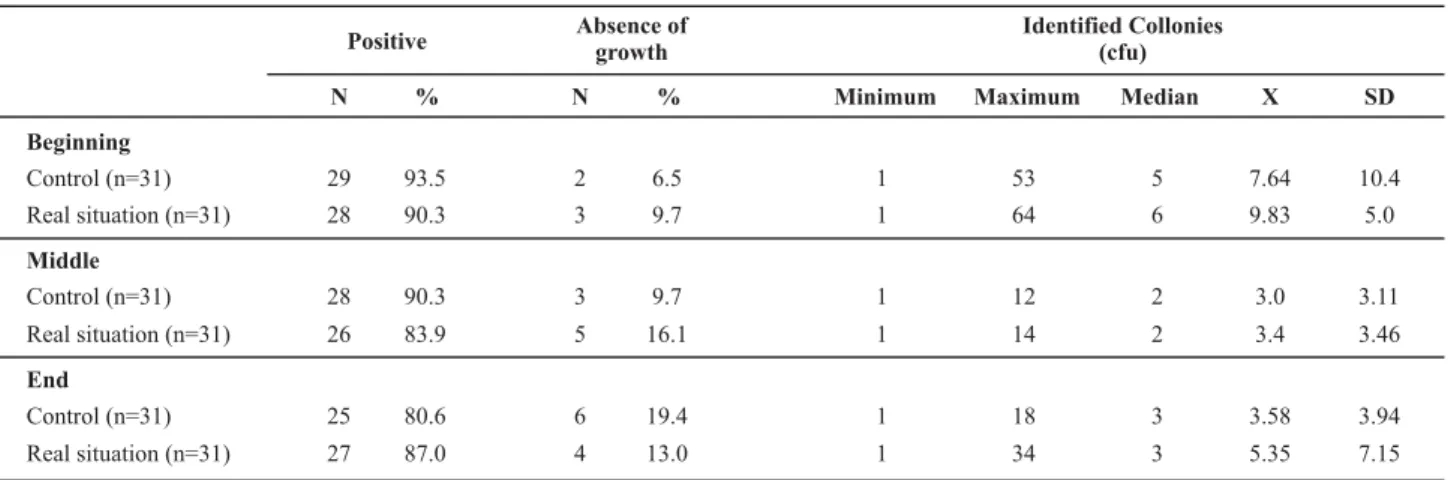
Table 1 displays the number of colonies on the gloves in the beginning, middle, and end in the 31 boxesfor the real and control situations.
Table 1 - Central tendency and variability of Colony Forming Units (CFU) for the pairs of gloves with and without colonies, according
to their position in the 31 boxes (begining, middle, end) in real and control situations - Ribeirão Preto - 2007
Positive Absence ofgrowth Identified Collonies(cfu)
N % N % Minimum Maximum Median X SD
Beginning
Control (n=31) 29 93.5 2 6.5 1 53 5 7.64 10.4
Real situation (n=31) 28 90.3 3 9.7 1 64 6 9.83 5.0
Middle
Control (n=31) 28 90.3 3 9.7 1 12 2 3.0 3.11
Real situation (n=31) 26 83.9 5 16.1 1 14 2 3.4 3.46
End
Control (n=31) 25 80.6 6 19.4 1 18 3 3.58 3.94
Real situation (n=31) 27 87.0 4 13.0 1 34 3 5.35 7.15
Table 1 show that the contamination density of the 186 pairs of gloves (31 pairs in each of the six conditions) did not exceed 64 colonies. Despite the high contamination rate (93.5% in the control group, and 90.3% in real situation), bacteria density was relatively low. In general, it is noticed that the cfu did not present a significant variability, which is shown by the obtained standard-deviation values.
The Cochran Test revealed no statistically significant dif-ference (p=0.601) regarding the boxes’ contamination rate between the control and real situation, as well as in the different moments (beginning, middle, and end).
In the control situation, the correlation between the contamination of the first pair of gloves and the pair in the middle of the box was not significant (p=0.327). The result remained the same between the first and last pairs (p=0.687), as well as between the middle and the last pairs (p=1.000). In the situation of routine glove use, the corre-lations between beginning, middle, and end of the boxes showed no statistically significant differences (p=0.262;
The contamination rate of gloves in the control situa-tion, in the beginning, middle, and end of the box was 93.5%, 90.3% and 80.6% respectively. However, the con-tamination density means were 7.64, 3.0 and 3.58 cfu. Simi-lar contamination rate results were observed in the real donning situation: 90.3%, 83.87%, and 87.08% under the same circumstances. The mean contamination density was 9.83; 3.4, and 5.35 cfu. From a global perspective, the sta-tistical tests point out that the contamination rates are not significant in the three positions of the gloves in the boxes.
Regarding the boxes’ time of exposure, there was no correlation with the presence or absence of contamina-tion of the last pair of gloves. In six boxes in which the last pair of gloves (control) did not show any microbial growth, the boxes remained open for an average of 5.8 hours (SD 1.68). In 25 boxes in which the last pair was colonized, the average time opened was 6.24 hours (SD 1.57).
aver-showed microbial growth were exposed for an average of 6.10 hours (SD 1.57). The correlation between time of box opening and contamination density was -0.12 (p=0.49).
Regarding the time that the boxes remained opened, (mean 6.3 hours) there was no correlation with the increase in the number of colonies in the last pairs of gloves in ei-ther the control or real situations. Using simple logistic regression, there is no statistically significant relation for the association between time of box opening and the oc-currence of colonization in the control (p=0.572) and in the real (p=0.576) donning situation.
The predominant microorganism (>90%) on the plates was Staphylococcus spp.
DISCUSSION
In accordance with standard precautions, the use of dis-posable gloves followed immediately by hand hygiene after removal is intended to minimize cross transmission of micro-organisms in the hospital setting. Therefore, it is recommended that health care workers wear gloves in a range of procedures that involve contact with mucosa and secretions(13).
The latex procedure gloves are stored in individual boxes and used during health care activities. The boxes remain open for several hours and are handled by different workers.
Another issue that emerges in this setting refers to re-moving gloves from the box. Even when hands have been disinfected, there still is a possibility of transferring native hand microbiota to the gloves that will be used in clinical practice as well as to those that remain in the box. Empiri-cally, it was observed that the workers rarely touch only the gloves they will use. In addition, low compliance to hand disinfection by health care workers can increase this con-tamination even more.
Even if a box of gloves is designated to a single patient or bed, it is still subject to being handled by different mem-bers of the health team, each with different methods of hand disinfection, if any. In addition, since these workers look after more than one patient, these boxes can function as reservoirs of microorganisms and cause cross contami-nation between workers and patients.
This fact can explain the results found in this study, which showed that, despite rigorous aseptic technique (control situation) when opening the boxes and donning gloves, there was a high contamination rate, although it was not significant. One possible explanation for this fact would be the external contamination of the box when re-moving the first pair of gloves; the worker could touch the box surface and contaminate the gloves. Other explana-tions would be that contamination of these gloves occurred during manufacture process(14), low adherence to hand hygiene or, still, environmental contamination, since the gloves are exposed to the surrounding air after the open-ing in mean 6.3 hours.
Health workers, themselves, have been pointed as mi-croorganism reservoirs and disseminators, of either their microbiota to the patient, or the patient’s microbiota to themselves, or, yet, as a vehicle of transmission between patients. In the chain of transmission, the health workers’ role represents a challenge that has been historically re-corded in national and international literature(15). The health worker’s hands are recognized as one of the main elements in the chain of transmission. With their hands, workers pro-vide care, touch different surfaces, and handle material that could be colonized by numerous microorganisms.
Since the 1980s, this issue has been the object of sev-eral studies, which demonstrate that the hands of health team members could be contaminated with S. aureus be-fore routine procedure glove use, with a mean of 1 x10⁴ cfu. Of the nurses working in a general hospital, 29% had these microorganisms on their hand (median: 3.8 x10²), while 78% who worked in hospitals with dermatology pa-tients had this agent on their hands with a median of 14.3 x 10⁶ cfu(16).
The results from this study show a low number of isolated cfu on procedure gloves donned in real conditions (mean of 6.2 cfu). It should be stressed that the workers seldom disin-fected their hands before donning the gloves(15-16). Although this variable was not evaluated in this study, the non-system-ized observations revealed that a considerable part of the workers did not disinfect their hands, though there was alco-hol gel and sinks in strategic locations. It cannot be stated, however, that the lack of compliance to hand disinfection af-fected the microbial rate and density recovered from the pro-cedure gloves in the real donning situation.
Based on the results of this study, it is recommended that procedure gloves be rationally used as long as asepsis measures are preserved. Hence, using procedure gloves in health care requires reflection and decision making.
Another issue that emerges in this setting is the identi-fication of the isolated microorganism on the gloves. In this sense, epidemiologic studies stress that staphylococcus are the causers of hospital infection, which are historically pointed out as one of the main agents. Its importance is also linked to the fact that they are skin and mucosa colo-nizers, which are the main physiological protection barrier of internal organs. Besides composing the native hand and mucosa microbiota, Staphylococcus spp.is also an impor-tant element of the transitory microbiota(17). In addition, about 30% of the individuals, though healthy, bear these bacteria in their nostrils. A lower percentage bears bacte-ria in other body parts, such as the axillas, the inguinal re-gion, perineum, and vagina. Some individuals can bear an even greater load of these microorganisms, due to an im-paired defense system. Examples of these individuals are diabetic patients, patients subjected to dialysis, and those with skin diseases among other aliments(17-18).
more contaminated with bacteria than those made of latex or polyvinyl(3). From a global view of the literature(3-8,12,19-20), the gene Staphylococcus has been reported as the most preva-lent microorganism on procedure gloves and their boxes.
A study(6), similar to ours, had the objective of identify-ing the type, rate burden , and pattern of contamination of boxed, clean, nonsterile gloves in an intensive care unit. The researchers found that 16 of 29 (55%) first pairs of gloves removed aseptically (control-situation) from boxes were con-taminated, with a mean bioburden of 1.8 colony-forming units (cfu). The percentage contamination and bioburden did not change significantly with the glove’s position in the box. There was only an 11% increased in the rate of con-tamination when gloves were removed without special pre-cautions (real health care situation) compared with control-situation. The length of time that boxes were open and be-ing used was unrelated to whether the final, aseptically re-moved pair was sterile or contaminated. Those gloves that were contaminated had an extremely small bioburden and conclude that boxed, clean, nonsterile gloves appears to be safe for routine use in the intensive care setting.
Compared to the anterior study, our results have shown greater contamination of the first pairs of gloves asseptically removed (control group), 82 of 31 (88.2%) pairs. The con-tamination rate (pairs with less than 1cfu) was of 88.2% in control and 87.1% in the real situation, showing a 1.1% raise.
Another study(20) evaluated a sample of open box gloves found in labour and delivery as potential fomites. A repre-sentative glove was sampled from in-use boxes from ten labour and delivery rooms. The gloves were removed with sterile forceps and placed in a sterile specimen bag. Sterile
broth medium was then poured into the bag and the fluid was agitated around all surfaces of the glove. The sampled glove was then removed and the fluid incubated. The open box glove results showed that nine out of ten open box gloves sampled were contaminated with bacteria, none of which were of high virulence, only common environmen-tal bacteria, being the bacterial specie coagulase-negative
Staphylococcus (CNS) the most frequent. Conclude that the bacteria found on the open box gloves are certainly less virulent than the bacteria commonly found in the vagina.
Studies(4-12,14-15,18) have shown that researchers correlate latex procedure gloves with sterile gloves in cases of infec-tion, and there appears to be no correlation as long as manufacturing, maintenance, and use policies are pre-served. Although procedure gloves host bacteria, it appears they are not sufficient to trigger infection when used in the various health care procedures.
CONCLUSION
In summary, latex procedure gloves used in an ICU of a General Teaching Hospital showed low microorganism den-sity. It is worth recalling that, after opened, the glove boxes remain exposed to the contact of different workers as well as to the environment. It is emphasized that the time of ex-posure of the gloves did not cause significant contamina-tion comparing the beginning, middle, and end of the box. As glove sampling occurred without the staff having been warned, and the rooms from which the gloves were sampled were in active use, it is highly probable that our results re-flect typical use. Therefore, the use of procedure gloves ap-pears to be safe from the microbiological viewpoint.
REFERENCES
1. Oliveira AC, Cardoso CS, Mascarenhas D. Contact precautions in Intensive Care Units: facilitating and inhibiting factors for professionals’ adherence. Rev Esc Enferm USP [Internet]. 2010 [cited 2010 Feb 13];44(1):161-5. Available from: http:// www.scielo.br/pdf/reeusp/v44n1/en_a23v44n1.pdf
2. Girou E, Chai SHT, Oppein F, Legrand P, Ducellier D, Cizeau F, et al. Misuse of gloves: the foundation for poor compliance with hand hygiene and potential for microbial transmission? J Hosp Infect. 2004;57(2):162-69.
3. Berthelot P, Dietemann J, Fascia P, Roset A, Mallaval FO, Lucht F, et al. Bacterial contamination of nonsterile disposable gloves before use. Am J Infect Control. 2006;34(3):128-30.
4. Sadowski DA, Polman S, Maley MP, Warden GD. Use of no sterile gloves for routine invasive procedures in thermally injured patients. J Burn Care Rehabil .1998;9:613-5.
5. Burke FJT. Use of non-sterile gloves in clinical practice. J Dent. 1990;18(2):79-89.
6. Rossoff LJ, Lam S, Hilton L, Borenstein M, Isenberg HD. Is the use of boxed gloves in an intensive care unit safe? Am J Med. 1993;94(6):602-7.
7. Giglio JA, Rowland RW, Laskin DM, Grenevicki L, Roland RW. The use of sterile versus nonsterile gloves during out-patient exodontia. Quintessence Int. 1993;26(8):533-34.
8. Cheung LK, Chow LK, Tsang MH, Tung LK. An evaluation of compications following dental extractions using either sterile or clean gloves. Int J Oral Maxillofac Surg. 2001;30(6):550-54.
9. Lawson C, Juliano L, Ratliff CR. Does sterile or nonsterile technique make a diference in wound healing by secondary intention? Ostomy Wound Management. 2003;29(10):56-60.
11. Adeyemo WL, Ogunlewe MO, Ladeinde AL, Bamgbose BO. Are sterile gloves necessary in nonsurgical dental extractions? J Oral Maxillofac Surg. 2005;63(7):936-40.
12. Chiu WK, Cheung LK, Chan HC, Chow LK. A comparison of post-operative complications following wisdom tooth surgery performed with sterile or clean gloves. Int J Oral Maxillofac Surg. 2006;35(2):174-79.
13. Pittet D, Allegranzi B, Boyce J; World Health Organization World Alliance for Patient Safety First Global Patient Safety Challenge Core Group of Experts. The World Health Organization Guidelines on Hand Hygiene in Health Care and their consensus recommendations. Infect Control Hosp Epidemiol. 2009;30(7):611-22.
14. Luckey JB, Barfield RD, Eleazer PD. Bacterial count comparisons on examination gloves from freshly opened bo-xes versus nearly empty bobo-xes and from examination gloves before treatment versus after dental dam isolation. J Endod. 2006;32(7):646-48.
15. Rhinehart BM, Murphy ME, Farley MF, Albertini JG. Sterile versus nonsterile gloves during mohs micrographic surgery: infection rate is not affected. Dermatol Surg. 2006;32(2):170-6.
16. Ayliffe GA, Babb JR, Davies JG, Lilly HA. Hand disinfection: a comparison of various agents in laboratory and ward studies. J Hosp Infect. 1988;11(3):226-43.
17. Tang YW, Stratton CW. Staphylococcus aureus: an old pathogen with new weapons. Clin Lab Med. 2010;30(1):179-208.
18. Giglio JA, Rowland RW, Laskin DM, Grenevicki L, Roland RW. The use of sterile versus nonsterile gloves during out-patient exodontia. Quintessence Int. 1993;24(8):543-5.
19. Rossoff LJ, Borenstein M, Isenberg HD. Is hand washing really needed in an intensive care unit ? Crit Care Med. 1995;23(7): 1211-6.