CLINICAL SCIENCE
Renal function in children with congenital
neurogenic bladder
Karen Previdi Olandoski,IVera Koch,IFlavio Eduardo Trigo-RochaII
IPediatria, Instituto da Crianc¸a – Hospital das Clinicas da Faculdade de Medicina da Universidade de Sa˜o Paulo, Sa˜o Paulo, Brazil.IIUrology, Hospital das
Clinicas da Faculdade de Medicina da Universidade de Sa˜o Paulo, Sa˜o Paulo, Brazil.
AIMS: Preservation of renal function in children with congenital neurogenic bladder is an important goal of treatment for the disease. This study analyzed the evolution of renal function in patients with congenital neurogenic bladder.
METHODS:We reviewed the records of 58 pediatric patients with respect to the following attributes: gender, age, etiology of neurogenic bladder, reason for referral, medical/surgical management, episodes of treated urinary tract infections, urodynamics, DMSA scintigraphy, weight, height, blood pressure, glomerular filtration rate, microalbuminuria and metabolic acidosis. Statistical analysis was performed, adopting the 5% significance level.
RESULTS:The mean age at presentation was 4.2¡3.5 years. Myelomeningocele was the most frequent etiology (71.4%). Recurrent urinary tract infection was the reason for referral in 82.8% of the patients. Recurrent urinary tract infections were diagnosed in 84.5% of the patients initially; 83.7% of those patients experienced improvement during follow-up. The initial mean glomerular filtration rate was 146.7¡70.1 mL/1.73 m2/min, and the final mean was 193.6¡93.6 mL/1.73 m2/min, p = 0.0004. Microalbuminuria was diagnosed in 54.1% of the patients initially and in 69% in the final evaluation. Metabolic acidosis was present in 19% of the patients initially and in 32.8% in the final assessment.
CONCLUSIONS:Patient referral to a pediatric nephrologist was late. A reduction in the number of urinary tract infections was observed with adequate treatment, but microalbuminuria and metabolic acidosis occurred frequently despite adequate management.
KEYWORDS: Neurogenic Bladder; Microalbuminuria; Acidosis; Children; Renal Function.
Olandoski KP, Kolch V, Trigo-Rocha FE. Renal function in children with congenital neurogenic bladder. Clinics. 2011;66(2):189-195.
Received for publication onOctober 9, 2010;First review completed onOctober 9, 2010;Accepted for publication onOctober 26, 2010
E-mail: [email protected]
Tel.: 55 41 3244-6510
INTRODUCTION
Neurogenic bladder is considered an important risk factor for chronic renal failure.1It is well established that the best way of preserving renal function is to allow the bladder to fill and be emptied regularly.2 Clean intermittent catheter-ization has a critical role in the prevention of urinary tract infections (UTIs) and in reducing bladder pressure.3,4 Anticholinergic agents help reducing bladder pressure and improve bladder capacity.5
The quantification of glomerular filtration rate (GFR) and the presence of microalbuminuria and metabolic acidosis are frequently utilized for the assessment of the glomerular and tubular functions in chronic kidney disease. The GFR, calculated from serum creatinine, and the evaluation of microalbuminuria, provide information on glomerular
function. Microalbuminuria has emerged as a risk marker for chronic renal disease and its use in the diagnosis of incipient chronic renal lesion of several causes has been stimulated.6Metabolic acidosis is a marker of tubular lesion and is commonly associated with renal function loss and also with obstructive uropathies.7
The aim of this study was to evaluate the evolution of glomerular and tubular renal function in patients with congenital neurogenic bladder treated by pediatric nephrol-ogists, identifying factors related to worsening of renal function in order to suggest treatment modifications.
PATIENTS AND METHODS
We have retrospectively reviewed the clinical records of 58 children with congenital neurogenic bladder treated at ‘‘Voiding Dysfunction Clinic’’, of ‘‘Instituto da Crianc¸a do Hospital das Clinicas da Faculdade de Medicina da Universidade de Sa˜o Paulo’’ (Sa˜o Paulo, Brazil), during the years 1998 – 2006. This study was approved by the institution ethics board.
Data were collected on: gender, age at presentation to our unit, follow-up period in our service, etiology of neurogenic Copyrightß2011CLINICS– This is an Open Access article distributed under
bladder, reason of referral, previous and follow-up medi-cal/surgical management, previous and follow-up epi-sodes of treated UTIs, initial urodynamic evaluation and DMSA scintigraphy, initial and follow-up weight, height and blood pressure, initial and follow-up levels of serum creatinine, microalbuminuria, venous pH and serum bicar-bonate.
As this is a retrospective study, we have defined treated UTI as every urinary tract infection episode registered as such in the patient’s records, either in the admission history or in the outpatient clinic follow-up, and for which antibiotic therapy was prescribed by the attending physician.
Z-scores were calculated for weight and height and values between -2 and +2 standard deviations were con-sidered normal.8,9GFR was established from serum creat-inine, based on Schwartz’s formula.10 Microalbuminuria analysis was performed based on a single urine sample and was defined as values higher than 30 mg/g of creatinine.11 Metabolic acidosis was defined as bicarbonate levels lower than 20 mEq/L, in a minimum of 2 consecutive venous blood samples, or when on alkali therapy.
A complementary analysis was performed regarding microalbuminuria:
– Group without microalbuminuria: patients in whom microalbuminuria was absent in the initial and final evaluations, or children in whom microalbuminuria was present in the initial assessment but disappeared during the follow-up study period.
– Group with microalbuminuria: patients in whom micro-albuminuria was present in the final assessment.
The occurrence of metabolic acidosis was evaluated in initially non –acidotic patients by Kaplan Meier curves. This analysis was done to identify factors possibly related to the start of metabolic acidosis. Data were compared according to gender (male/female), period of follow-up (less than 6 years/ equal to or more than 6 years), age at presentation to our service (less than 3 years of age/ equal to or more than 3 years of age), presence of renal parenchymal damage on initial DMSA scintigraphy (yes/no) and history of UTI (yes/no).
Another complementary analysis was performed for metabolic acidosis considering two groups of patients:
– Group without metabolic acidosis: patients in whom acidosis was absent in the initial and final evaluations or in whom acidosis was present initially but disappeared during follow-up.
– Group with metabolic acidosis: patients in whom acidosis existed in the first and final evaluations or in whom acidosis has developed during the follow-up study period and was present in the final assessment.
The obtained results were described as means, standard deviations, medians, minimum and maximum values, or as frequencies and percentages.
STATISTICS
Comparison between initial and final evaluations for continuous quantitative variables was done using the Student’s t-test for paired samples. The association between dichotomous variables was performed considering the Fisher’s exact test. For evaluation of patient’s outcomes and
comparison of subgroups defined by dichotomous variables, Kaplan-Meier curves were performed and Log-rank test was applied. P values,0.05 indicated statistical significance.
RESULTS
Of the 58 children studied, 33 were females (56.9%). The mean age at presentation to our unit was 4.2¡3.5 (0-12.8) years. The mean of follow-up period was 3.8¡ 3.1 (0.5 – 13.5) years. The mean age at the final evaluation was 8.0¡ 5.3 (0.7 – 19.2) years. The most frequent aetiology of neurogenic bladder was myelomeningocele (MMC) in 42 (71.4%), followed by sacral agenesis in 7 (12.1%), spina bifida occulta in 6 (10.4%), teratoma in 2 (3.4%) and flaccid tetraparesis in 1 patient (1.7%). The main reason that led to referral to our service was recurrent UTI in 48 (82.8%) patients, enuresis in 5 (8.6%) patients and urinary retention in 5(8.6%) patients.
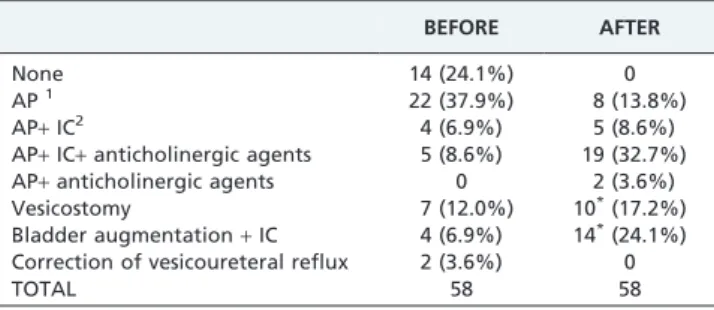
None of the 58 children had been evaluated by nephrol-ogists before referral to our service. Most of them were under the care of paediatricians or urologists. Therapeutic interventions for neurogenic bladder, performed before children arrived in our service and during follow-up are shown in Table 1.
Of the 49 patients with history of UTI, 41 showed improvement (83.7%). Lack of improvement or increase in UTI episodes occurred in 12 (20.7%) patients (table 2).
Of the 58 children, 41 (70.7%) had their first urodynamic evaluation performed after the arrival at our unit. In these children, bladder capacity was reduced in 23 (56.1%) and
Table 1 -Therapeutic interventions for neurogenic bladder performed before and after arrival at pediatric nephrology service.
BEFORE AFTER
None 14 (24.1%) 0
AP1 22 (37.9%) 8 (13.8%)
AP+IC2 4 (6.9%) 5 (8.6%)
AP+IC+anticholinergic agents 5 (8.6%) 19 (32.7%)
AP+anticholinergic agents 0 2 (3.6%)
Vesicostomy 7 (12.0%) 10*(17.2%)
Bladder augmentation+IC 4 (6.9%) 14*(24.1%)
Correction of vesicoureteral reflux 2 (3.6%) 0
TOTAL 58 58
1Antibacterial prophylaxis 2Intermittent catheterization
*During the follow-up period at our service, 4 children underwent
vesicostomy and 10 underwent bladder augmentation (1 of whom with closure of vesicostomy). In this way, in the final evaluation bladder augmentation was present in 14 children and vesicostomy in 10.
Table 2 -Initial and final evaluations regarding urinary tract infections (UTI), N = 58.
Initial evaluation Final evaluation
9 without history of UTI (15.5%)
5 remained free from UTI (8.6%)
4 had at least 1 episode of UTI (6.9%) 49 with history of
UTI (84.5%)
25 became free from UTI (43.1%)
16 had a reduction of at least 50% in episodes of UTI (27.6%)
8 maintained or had an increase in UTI episodes (13.8%)
Renal function in children with neurogenic bladder
detrusor-sphincter dyssynergia was found in 6 (14.6%). Mean detrusor leaking pressure was 46.1 cm H2O.
Of the 58 children, 45 (77.6%) had their DMSA scinti-graphy performed after the arrival at our unit and 24 (53.3%) of these patients had renal scars.
Mean initial and final z-score for weight were – 1.5¡2.1 (- 6.96 to+2.78) and – 1.5¡2.2 (- 6.91 to+2.53) respectively. Mean z-score for initial and final height were – 1.8 ¡ 1.8 (-5.27 to+1.37) and – 2.1¡1.8 (-6.19 to+1.08) respectively. Blood pressure was normal in 39 (68.4%) patients in the initial evaluation and in 38 (65.5%) in the final assessment. Pre-hypertension was diagnosed in 7 (12.3%) patients initially and in 2 (3.5%) in the final assessment. Hypertension was diagnosed in 12 (20.2%) children in the initial evaluation and in 18 (31%) in the final assessment. In the period before referral to our service only three of the 11 children with hypertension were taking medication. All of the children who were diagnosed as hypertensive in our service were started on antihypertensive agents. When there was coexistence with microalbuminuria, angiotensin con-verting inhibitors (ACE inhibitors) or angiotensin II recep-tor-1 blockers were preferred.
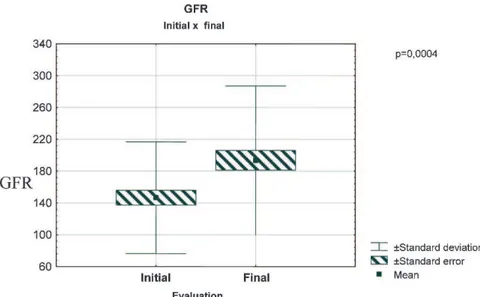
Mean initial and final GFR were 146.7 ¡ 70.1 mL/ 1.73 m2/min (50.2 to 445.5) and 193.6¡93.6 mL/1.73 m2/ min (90.2 to 605) respectively. A significant difference between mean initial GFR and mean final GFR was found (p = 0.0004) (figure 1).
Microalbuminuria analysis was possible in 37 patients (63.8%) initially and in 42 children (72.4%) in the final assessment. Microalbuminuria was found in 20 (54.1%) patients at presentation and in 29 children (69.0%) in the final assessment. None of patients with microalbuminuria at the time of presentation was taking medication on that account. Treatment with ACE inhibitors or angiotensin II receptor-1 blockers was initiated after identification of microalbuminuria in all of the patients.
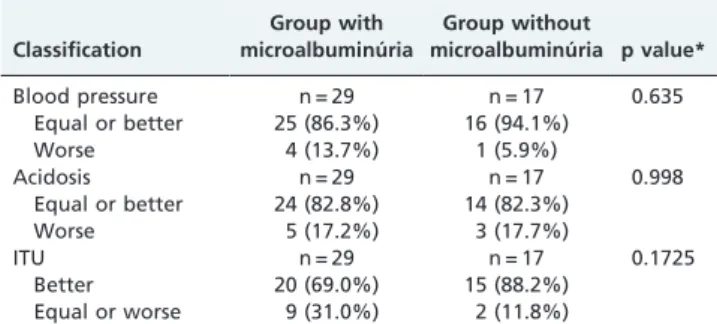
The comparison between the group without microalbu-minuria and the group with microalbumicroalbu-minuria is on the table 3, 4 and 5. There was no difference regarding gender, aetiology of neurogenic bladder, history of UTI, blood pressure, metabolic acidosis and number of urinary tract infections during follow up. There was also no significant
difference with regard to age at presentation, age in the final assessment, period of follow-up, initial/final weight z-score, difference of weight z-score, initial/final height z-score, difference of height z-score, initial/final GFR, and differ-ence of GFR.
Venous pH and serum bicarbonate levels were assessed in all patients. Metabolic acidosis was found in 11 (19%) patients initially and in 19 children (32.8%) in the final evaluation. Only 3 of the 11 patients with acidosis in the initial evaluation were on alkali therapy on referral to our service. All of the patients in whom acidosis was diagnosed in our service were started on sodium bicarbonate to maintain bicarbonate serum level$24 mEq/L.
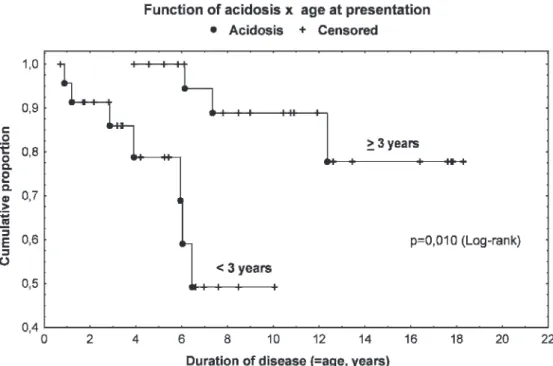
The 47 patients who did not present metabolic acidosis in the initial evaluation were analyzed by Kaplan-Meier curves for duration of disease (coincident with patient’s age).
A significant difference was confirmed with regard to age at presentation (children with less than 3 years of age versus children aged 3 or more). Initiation of metabolic acidosis during the follow-up period was more frequent in the
Figure 1 -Mean initial and final glomerular filtration rate in 58 children with congenital neurogenic bladder.
Table 3 -Comparison between the group without microalbuminuria and the group with microalbuminu´ria regarding gender, etiology of neurogenic bladder and history of UTI.
Classification
Group with microalbuminu´ria
Group without
microalbuminu´ria P value*
Gender n = 29 n = 17 0.545
Male 12 (41.4%) 9 (52.9%)
Female 17 (58.6%) 8 (47.1%)
Aetiology n = 29 n = 17 1**
Myelomeningocele 20 (69.0%) 11 (64.7%) Sacral agenesis 4 (13.8%) 2 (11.8%)
Teratoma 1 (3.4%) 1 (5.9%)
Spina bifida occulta 4 (13.8%) 2 (11.8%)
Flaccid tetraparesis - 1 (5.9%)
History of UTI n = 29 n = 17 0.083
Yes 27 (93.1%) 12 (70.6%)
No 2 (6.9%) 5 (29.4%)
(*) Fisher’s exact test
children who presented earlier to our service (figure 2). The development of metabolic acidosis did not present an association with male/female gender, duration of follow-up (,6 years/.= 6 years), presence/absence of history of UTI, presence/ absence of microalbuminuria in the initial evaluation, presence/absence of parenchymal damage on DMSA scintigraphy.
The comparison between the group without acidosis and the group with acidosis showed statistically significant lower values of final weight z-score (p = 0.048), initial height z-score (p = 0.047) and final height z-score (p = 0.022) in the group without acidosis. There was no significant difference between these two groups regarding other studied vari-ables: gender, aetiology of neurogenic bladder, history of UTI, blood pressure, metabolic acidosis, number of UTI episodes, age at presentation, age in final assessment,
duration of follow-up, initial weight z-score, difference of weight z-score, difference of height/stature z-score, initial/ final GFR, and difference of GFR (tables 6, 7 and 8).
DISCUSSION
A comprehensive renal function follow-up, preferably by a pediatric nephrologist, should be routinely performed in children with congenital neurogenic bladder starting early in the course of the disease, as they are at risk of developing permanent renal damage. Unfortunately, in the present study, the first renal evaluation occurred at a mean of 4.2 years of age. At the time of presentation, 7 patients had metabolic acidosis without therapy, 7 patients were hypertensive without antihypertensive treatment and 20 patients demon-strated microalbuminuria without antiproteinuric therapy. Ulsenheimeret alretrospectively analyzed 36 children with myelomeningocele in a Brazilian University Hospital and showed that only 45% had been submitted to an urinary tract evaluation.12 Kari reported on 11 children with neurogenic bladder in Saudi Arabia whose mean age at follow-up initiation was 6.6 years, all of them had a GFR lower than 50 mL/1.73 m2/min1. Dik et al4presented data on 176 patients with spina bifida who had been referred to an University Hospital in the newborn period and showed that an early start to therapy has helped to safeguard renal function.
MMC is the leading cause of congenital neurogenic bladder in world. Sacral agenesis is less common and is almost always associated with maternal insulin-dependent diabetes mellitus. We found that 71.4% children had MMC and 12.1% had sacral agenesis, in agreement with data from
Casset al, who found 78.2% MMC and 4.4% sacral agenesis
in 413 patients with neurogenic bladder.3
In our data, referral of 84.5% of children was motivated by UTI. Ghoniemet alshowed data on 61 patients with MMC
Table 4 -Comparison between the group without microalbuminuria and the group with microalbuminu´ria regarding blood pressure, metabolic acidosis and number of urinary tract infections during follow up.
Classification
Group with microalbuminu´ria
Group without
microalbuminu´ria p value*
Blood pressure n = 29 n = 17 0.635
Equal or better 25 (86.3%) 16 (94.1%)
Worse 4 (13.7%) 1 (5.9%)
Acidosis n = 29 n = 17 0.998
Equal or better 24 (82.8%) 14 (82.3%)
Worse 5 (17.2%) 3 (17.7%)
ITU n = 29 n = 17 0.1725
Better 20 (69.0%) 15 (88.2%)
Equal or worse 9 (31.0%) 2 (11.8%)
(*) Fisher’s exact test
Table 5 -Comparison between the group without microalbuminuria and the group with microalbuminu´ria regarding to age at presentation, age in the final assessment, period of follow-up, initial/final weight score, difference of weight z-score, initial/final height z-z-score, difference of height z-z-score, initial/final GFR, and difference of GFR.
variable Micro-albuminu´ria n medium minimum maximum Valor de p*
Age at presentation no 17 4.4 0.2 12.8 0.859
yes 29 4.6 0 12.6
Age in the final assessment no 17 8.5 2.2 19.2 0.873
yes 29 8.8 2.5 19.0
Period of follow-up no 17 4.1 0.8 8.0 0.951
yes 29 4.2 0.5 13.5
Initial weight z-score no 17 -1.6 -5.2 1.0 0.355
yes 29 -1.0 -6.9 2.8
Final weight z-scorel no 17 -1.2 -5.9 1.7 0.990
yes 29 -1.2 -7.0 2.5
Difference of weight z-score no 17 0.4 -1.8 2.9 0.071
yes 29 -0.2 -3.1 0.9
Initial height z-score no 17 -1.8 -5.2 0.7 0.769
yes 29 -1.6 -5.3 1.4
Final height z-score no 17 -1.9 -5.5 0.3 0.717
yes 29 -2.0 -6.0 1.1
Difference of height z-score no 17 -0.1 -1.4 2.2 0.248
yes 29 -0.5 -2.6 1.6
Initial GFR no 17 157.0 77 269.5 0.376
yes 29 139.1 56.4 445.5
Final GFR no 17 195.5 127.9 330.0 0.760
yes 29 205.0 90.2 605.0
Difference of GFR no 17 38.5 -66.4 171.4 0.349
yes 29 65.9 -48.1 487.7
(*) Student’s t-test for paired samples.
Renal function in children with neurogenic bladder
in whom history of UTI was present in 70.5%.2 We have observed a reduction of the number of UTI episodes after initiation of bladder catheterization, in agreement with the experience of Cass et al.5
In the present study, the mean z-scores for initial and final weight and for initial height were within the normal range, but the mean final height z score was below the expected levels, on account of five children with very low weight and height z-scores, which had a negative impact in the overall final weight and height mean z-scores. Our data is in agreement with Hayes-Allen13 who has studied children with MMC and observed that 88% were below the 10th percentile for height, and with Rosenblumet al,who have
studied 99 children with MMC and found that 50.5% were below the 3rdpercentile for height.14
An increase in GFR was demonstrated during the patients’ follow-up. Some children had very high rates of GFR, such as 600 mL/1.73 m2/min. and none presented a final GFR below 90 mL/1.73 m2/min. In the present study, no association was evident between GFR and microalbumi-nuria or metabolic acidosis, or between, microalbumimicroalbumi-nuria and maintenance or increase of the number of UTI episodes, in spite of the potential production of renal scarring, loss of renal parenchyma and secondary glomerulosclerosis which is related to repetitive episodes of UTI. There was also no association between microalbuminuria and systemic hyper-tension, although hypertension can be a cause or a consequence of renal injury with evolution to hyperfiltration
Figure 2 -Kaplan-Meier curves for the age at presentation to Nephrology Clinic and start of metabolic acidosis (comparing children aged less than 3 years to children with more than 3 years of age).
Table 6 -Comparison between the group without metabolic acidosis and the group with metabolic acidosis regarding gender, aetiology of neurogenic bladder and history of UTI.
Classification
Group with metabolic
acidosis
Group without metabolic
acidosis p value*
Gender n = 19 n = 39 0.399
Male 10 (52.6%) 15 (38.5%)
Female 9 (47.4%) 24 (61.5%)
Aetiology n = 19 n = 39 0.119**
Myelomeningocele 11 (57.9%) 31 (79.5%) Sacral agenesis 2 (10.5%) 5 (12.8%)
Teratoma 1 (5.3%) 1 (2.6%)
Spina bifida occulta 4 (21.0%) 2 (5.1%) Flaccid tetraparesis 1 (5.3%)
-History of UTI n = 19 n = 39 1
Yes 17 (89.5%) 33 (84.6%)
No 2 (10.5%) 6 (15.4%)
(*) Fisher’s exact test
(**) Myelomeningocele x?myelomeningocele
Table 7 -Comparison between the group without metabolic acidosis and the group with metabolic acidosis regarding blood pressure, microalbuminuria and number of urinary tract infections during follow up.
Classification
GrOup WITH METABOLIC acidosIS
GrOup WITHoUT METABOLIC
acidosIS p value*
Blood pressure n = 19 n = 39 0.987
Equal or better 17 (89.5%) 35 (89.7%)
Worse 2 (10.5%) 4 (10.3%)
Microalbuminuria n = 12 n = 21 0.997
Equal or better 10 (83.3%) 18 (85.7%)
Worse 2 (16.7%) 3 (14.3%)
UTI n = 19 n = 39 0.999
Better 16 (84.2%) 29 (74.4%)
Equal or worse 3 (15.8%) 10 (25.6%)
and microalbuminuria.15The absence of these associations is probably related to the retrospective design of the study, in which children in different stages of kidney function compromise are compared as a group. It is unfortunate that the only evaluation of glomerular filtration rate that was available for this restrospective study is creatinine/creati-nine clearance which may overestimate GFR in situations of low body muscle mass16 which is frequently the case of children with neurogenic bladder. Sutherland in 199717and del Gado et al in 200317 demonstrated that children with MMC had smaller kidneys than healthy children, so in spite of the eventual bias of measuring GFR using creatinine as marker, the marked incidence of microalbuminuria in the described patients and its inherent association with hyper-filtration, a possible component of renal hipoplasia, which might explain the glomerular hyperfiltration verified in most of our patients at initiation and during clinical follow up, cannot be discarded
Patients with obstructive uropathies may develop meta-bolic acidosis which can persist after decompression.7Two of the presently described patients recovered from acidosis after the relief of urinary obstruction. According to Mingin
et al19lower values of serum bicarbonate may be associated
with augmentation enterocystoplasty. Of the 19 patients with acidosis, 4(21.1%) have manifested a post-augmenta-tion reducpost-augmenta-tion of serum bicarbonate levels.
It is interesting that the children who presented earlier to our service (aged less than 3 years) developed metabolic acidosis more often than the late referrals. A possible reason for that finding is that, as a reference university service, our unit cares for children with a more severe pattern of disease. In fact, all the presently described patients were clearly symptomatic at arrival, with history of urinary retention or
UTIs, unfortunately we have not received any patient for purely preventive follow-up.
The presence of metabolic acidosis is usually associated with low weight/height gain,20 but in our study the children who developed acidosis presented significantly higher final weight score and initial and final height z-scores than the children without acidosis. A possible explanation for this finding is that we have used different criteria for diagnosing and treating metabolic acidosis. We have diagnosed metabolic acidosis with two consecutive venous serum bicarbonate below 20 mEq/L but our treatment goal for metabolic acidosis was a bicarbonate serum level $ 24 mEq/L. This discrepancy probably favoured the growth of the treated children. We have made that option to alleviate the burden of the caretaker, for whom the introduction of an unnecessary medication, four times a day, may change compliance into burn-out. Our findings suggest that for the benefit of the patients’ growth and development, the bicarbonate level for diagnosis of metabolic acidosis should be increased.
CONCLUSION
Children with congenital neurogenic bladder were referred late for renal evaluation, with a mean age of 4.2 years. Renal damage was evident in at least 53.3% of the patients on arrival to our service according to available DMSA scans. Despite adequate management, a significant number of patients developed microalbuminuria and meta-bolic acidosis, with GFR above normal range suggesting hyperfiltration. The data of this study strongly indicate that these patients should have initiated treatment much earlier, preferably immediately after birth. Close follow up of these
Table 8 -Comparison between the group without acidosis and the group with acidosis regarding to age at presentation, age in the final assessment, period of follow-up, initial/final weight z-score, difference of weight z-score, initial/final height z-score, difference of height z-score, initial/final GFR, and difference of GFR.
variable Acidosis n Mediam minimum maximum p value*
Age at presentation no 39 4.2 0 12.5 0.860
yes 19 4.4 0.4 12.8
Age in the final assessment no 39 7.8 0.7 18.3 0.560
yes 19 8.6 1.0 19.2
Period of follow-up no 39 3.6 0.3 13.5 0.427
yes 19 4.3 0.5 8.8
Initial weight z-score no 39 -1.8 -7.0 2.8 0.129
yes 19 -0.8 -3.4 2.7
Final weight z-scorel no 39 -1.9 -6.9 2.5 0.048
yes 19 -0.7 -3.6 1.9
Difference of weight z-score no 39 -0.1 -3.2 3.0 0.329
yes 19 0.2 -2.0 2.9
Initial height z-score no 39 -2.2 -5.3 0.7 0.047
yes 19 -1.2 -4.6 1.4
Final height z-score no 39 -2.5 -6.2 0.3 0.022
yes 19 -1.4 -4.9 1.1
Difference of height z-score no 39 -0.3 -2.5 1.7 0.617
yes 19 -0.2 -2.6 2.3
Initial GFR no 39 146.6 50.2 371.2 0.993
yes 19 146.8 56.4 445.5
Final GFR no 39 201.0 92.4 605.0 0.388
yes 19 178.2 90.2 467.5
Difference of GFR no 39 54.4 -228.2 487.7 0.272
yes 19 31.4 -48.1 160.9
(*) Student’s t-test for paired samples.
Renal function in children with neurogenic bladder
patients is desirable in order to treat complications as soon as possible to prevent further renal damage.
REFERENCES
1. Kari JA. Neurophatic bladder as a cause of chronic renal failure in children in developing countries. Pediatr Nephrol. 2006; 21:517-20, doi: 10.1007/s00467-006-0034-5.
2. Ghoniem GM, Roach MB, Lewis VH, Harmon EP. The value of leak pressure and bladder compliance in the urodynamic evaluation of meningomyelocele patients. J Urol. 1990; 144:1440-2.
3. Cass AS, Luxenberg M, Johnson CF, Gleich P. Management of the neurogenic bladder in 413 children. J Urol. 1984;132:521-5.
4. Dik P, Klijn AJ, van Gool JD, van Steenwijk CCEJ, Jong TPVM. Early start to therapy preserves kidney function in spina bifida. Eur Urol. 2006;49:908-13, doi: 10.1016/j.eururo.2005.12.056.
5. Cass AS, Luxenberg M, Gleich P, Johnson F, Hagen S. Clean intermitent catheterization in the management of the neurogenic bladder in children. Urology. 1984;132:526-8.
6. De Jong PE, Curhan GC. Screening, monitoring, and treatment of albuminuria: public health perspectives. J Am Soc Nephrol. 2006;17:2120-6, doi: 10.1681/ASN.2006010097.
7. Battle DC, Arruda JAL, Kirtzman NA. Hyperkalemic distal renal tubular acidosis associated with obstructive uropathy. N Engl J Med. 1981;304:373-80.
8. Dibley MJ, Staehling N, Nieburg P, Trowbridge FL. Interpretation of Z-score anthropometric indicators derived from the international growth reference. Am J Clin Nutr. 1987; 46:749-62.
9. http://www.cdc.gov/nchs/about/major/nhanes/growthcharts/ charts.htm
10. Schwartz GJ, Brion LP, Spitzer A. The use of plasma creatinine concentration for estimating glomerular filtration rate in infants, children, and adolescents. Pediatr Clin North Am. 1987;34:571-90. 11. American Diabetes Association clinical practice recommendations.
Diabetes Care. 2001;24(Suppl 1):S1-S33.
12. Ulsenheimer MMM, Antoniuk AS, dos Santos LHC, Ceccatto MP, Silveira AE, Ruiz AP, et al. A Brazilian University Hospital experience. Arq Neuropsiquiatr. 2004;62:963-8.
13. Hayes-Allen MC. Obesity and short estatura in children with myelome-ningocele. Dev Med Child neurol. 1972;14:59-64, doi: 10.1111/j.1469-8749.1972.tb09775.x.
14. Rosenblum M, Finegold DN, Charney EB. Assessment of statura of children with myelomeningocele, and usefulness of arm-span measure-ment. Dev Med Child Neurol. 1983;25:338-42, doi: 10.1111/j.1469-8749. 1983.tb13767.x.
15. Wiggins RC. The spectrum of podocytopathies: A unifying view of glomerular diseases. Kidney Int. 2007;71:205-35, doi: 10.1038/sj.ki. 5002222.
16. Sutherland RW, Wiener JS, Roth DR, Gonza´les Jr ET. A renal size nomo-gram for the patient with myelomeningocele. J Urol. 1997;158:1265-7. 17. Stevens LA, Coresh J, Greene T, Levey AS. Assessing Kidney Function —
Measured and Estimated Glomerular Filtration Rate. N Engl J Med. 2006;354:2473-83.
18. del Gado R, Perrone L, del Gaizo D, Sommantico M, Polidori G, Cioce F, et al. Renal size and function in patients with neuropathic bladder due to mtelomeningocele: the role of growth hormone. J Urol. 2003;170:1960-1. 19. Mingin GC, Nguyen HT, Mathias RS, Shepherd JA´ , Glidden D, Baskin LS. Growth and metabolic consequences of bladder augmentation in children with myelomeningocele and bladder exstrophy. Pediatrics. 2002;110:1193-8, doi: 10.1542/peds.110.6.1193.