659 DOI: 10.1590/0004-282X20130145
VIEWS AND REVIEWS
Iatrogenic meningitis
Meningites iatrogênicas
Eduardo Genaro Mutarelli, Tarso Adoni
Iatrogenic meningitis is an inlammatory process of the
meninges caused by: (a) injection of contaminated pharma-cologic agent in the epidural compartment; (b) complication of diagnostic and therapeutic lumbar puncture; or (c)
un-desirable side efect of systemic drugs (the term “aseptic me -ninigitis” is more common, although it is broader and also in-clude non-drug causes).
Iatrogenic meningitis gained the attention of the scien-tiic community and in particular the Center for Disease
Control (CDC) (Atlanta) last year, after a report of epidemic cases of fungal meningitis triggered by the epidural injection of contaminated methylprednisolone. Several states reported cases, although the highest concentration has been reported in Michigan and Tennessee.
Sixty-six patients were studied in an article published
on November 6, 2012, in the New England Journal of Me dicine, although at least 158 cases have been related to the
same mechanism, the injection of epidural contaminated
methyl prednisolone. he investigation began after the iso -lated report case of A. fumigatus meningitis in an immuno-competent patient who had received epidural
methylpred-nisolone in the state of Tennessee on September 18, 2012.
Local health authorities (Tennessee Health Department) initiated an epi demiologic investigation immediately and
detected two other cases of fungal meningitis in immu-nocompetent patients who had undergone the same
pro-cedure. he CDC was notiied and, thereafter, it was dis -covered that the reported cases throughout the U.S. were
caused by speciic lots of contaminated methylpredniso -lone produced by the New England Compounding Center, Framingham, MA.
Although the index case was caused by A. fumigatus, the majority of other cases were caused by fungus Exserohilum rostratum. he main clinical manifestations were: meningi
-tis (73%), cauda equina syndrome or epidural abscess (17%)
and posterior circulations stroke with or without
meningi-tis (12%). Patients with meningimeningi-tis and altered cerebrospi
-nal luid results (N=59) showed: white-cell count median 534 cells/mm3 (range: 4-10,140); granulocytes median 76% (range: 0-97); protein median 114 mg/dl (range: 29-440); glu
-cose median 45 mg/dl (range: 12-121). Table 1 shows the main clinical features of the 66 published cases.
he drug-induced aseptic meningitis may be caused by a
number of pharmacological agents used in clinical practice
and administered systemically or intrathecally. he correla -tion between drug applica-tion in epidural space and the ap-pearance of meningeal symptoms is, in most cases, obvious and will not be discussed here.
Neurology Division, Hospital Sírio-Libanês, São Paulo SP, Brazil.
Correspondence: Eduardo Genaro Mutarelli; Rua Dona Adma Jafet 74 / conj. 121; 01308-050 São Paulo SP, Brasil; E-mail: [email protected] ABSTRACT
Iatrogenic meningitis can be caused by a number of mechanisms. The recent case reports of fungal meningitis after application of epidural methylprednisolone caused warning in the medical community. Cases were caused by contaminated lots of methylprednisolone from a single compounding pharmacy. Several medications can cause meninigitis by probable hypersensitivity mechanism. Neurologists should be alert to the recent description of the use of lamotrigine and development of aseptic meningitis.
Keywords: iatrogenesis, meningitis, methylprednisolone, lamotrigine.
RESUMO
As meningites iatrogênicas podem ser provocadas por uma série de mecanismos. Os recentes relatos de casos de meningite por fungos após a aplicação de injeção epidural de metilprednisolona causou alerta na comunidade médica. Os casos foram causados por lotes contamina-dos de metilprednisolona produzicontamina-dos por uma única farmácia de produção. Diversos medicamentos podem causar meningite por provável mecanismo de hipersensibilidade. Neurologistas devem ficar alerta para a recente descrição do uso de lamotrigina e o desenvolvimento de meningite asséptica.
660 Arq Neuropsiquiatr 2013;71(9-B):659-660
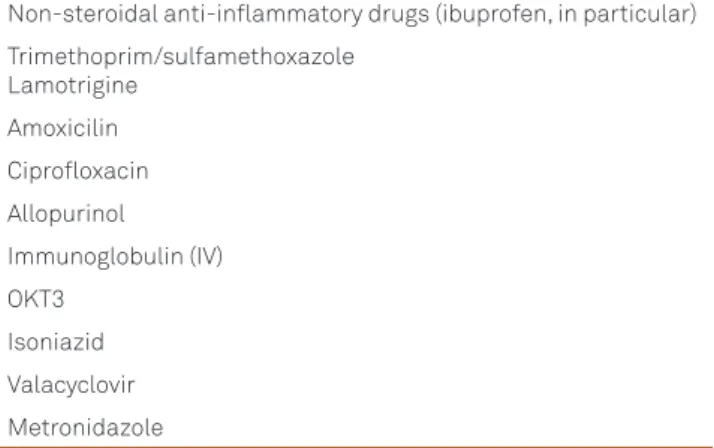
he medications most commonly charged with the ap -pearance of signs and symptoms of meningeal irritation are
listed in Table 2, although any medication has the potential to cause the frame. he diagnosis depends on clinical suspi
-cion. It may be stressed that this is a diagnosis of exclusion. In general, the signs and symptoms begin within 24 hours from
the medication, although it can take more days. Neurologists should be alert to the recent and consistent description of aseptic meningitis induced by lamotrigine.
he pathophysiological mechanism is not completely un -derstood, although it must involve an acute hypersensitivity reaction, since repeated exposure to the triggering agent
in-duce increasingly early appearance of meningitis. here is a particular association between NSAID (non-steroidal anti-inlammatory drugs) use and the onset of signs and symp -toms of meningitis in patients diagnosed with systemic lupus
erythematosus and other collagen diseases. he association
should not be fortuitous and possibly involves the occur-rence of the phenomenon of hypersensitivity mediated by
deposition of immune complexes (type III hypersensitivity
reaction).
Cerebrospinal luid study shows pleocytosis of polymor -phonuclear predominance, although there are reports of
eo-sinophilic or lymphocytic predominance. Glucose concen -trations are usually normal or slightly decreased; proteins are commonly elevated. Cultures (bacteria, fungi and viruses), by
deinition, are always negative.
Management is primarily symptomatic and the drug
needs to be discontinued. Symptoms usually disappear 24 to 48 hours after drug withdrawal.
Table 1. Clinical and Demographic Features of the Patients with Fungal Iatrogenic Meningitis after Epidural Contaminated Methylprednisolone.
Variable N %
Age (years)
Median 69
Range 23-91
Gender
Female 47 71
Signs and symptoms
Fever 23 35
Headache 48 73
Nausea/vomiting 42 63
Stiff neck 19 29
Cervical pain 12 18
Back pain 33 50
Table 2. Drugs potentially related to the appearance of aseptic meningitis.
Non-steroidal anti-inflammatory drugs (ibuprofen, in particular) Trimethoprim/sulfamethoxazole
Lamotrigine Amoxicilin Ciprofloxacin Allopurinol Immunoglobulin (IV) OKT3
Isoniazid Valacyclovir Metronidazole
References
1. Kainer MA, Reagan DR, Nguyen DC, et al. Fungal infections associated with contamined methylprednisolone in Tennessee. N Engl J Med 2012;367:2194-2203.
2. Multistate outbreak of fungal infection associated with injection of methylprednisolone acetate solution from a single compounding
pharmacy - United States, 2012. MMWR Morb Mortal Wkly Rep 2012;61:839-842.
3. Cascella C, Nausheen S, Cunha BA. A differential diagnosis of drug-induced aseptic meningitis. Infect Med 2008;25:331-334.